1 Marques A, et al. Br J Sports Med 2017;0:1–11. doi:10.1136/bjsports-2016-097361
ABSTRACT
Objective This report aimed to systematically review the evidence for a differential association between objective and self-reported physical activity and cardiorespiratory fitness on academic achievement.
Design Systematic review.
Data sources Studies were identified from searches in Embase, Education Resources Information Center, PubMed, PsycINFO, SPORTdiscus and Web of Science databases from January 2000 to December 2016.
Eligibility criteria for selecting studies Eligibility criteria included cross-sectional, longitudinal and interventional study designs. Outcomes included students’ school grade or a standardised test or measure of academic achievement. Explanatory variables were cardiorespiratory fitness and objective and self-reported physical activity. Inclusion criteria included school-aged children and adolescents aged– 18 years (or students from primary to secondary school when student’s participants age was not described) and articles published in English, Portuguese or Spanish.
Results A total of 51 articles met inclusion criteria: 41 cross-sectional, 2 intervention and 8 longitudinal studies. Results from 11 studies were inconsistent regarding the relationship between objectively measured physical activity and academic achievement. Ten of the 16 articles reported positive associations between self-reported physical activity and academic achievement. From the 22 studies that analysed the relationship between cardiorespiratory fitness and academic achievement, it was verified that they all generally support the beneficial effect of cardiorespiratory fitness on students’ academic achievement.
Conclusion Higher cardiorespiratory fitness may be important to enhance children and adolescents’ health and, additionally, academic achievement. Due to a lack of consensus across studies, methodological issues associated with the assessment of physical activity should be considered when investigating physical activity and academic achievement.
INTRODUCTION
Physical activity and cardiorespiratory fitness are associated with a variety of health benefits in children and adolescents.1–3 In addition to the benefits on physical and mental health, studies in neuroscience have shown that physical activity
and cardiorespiratory fitness are related to brain structure and function.4 The pathways by which they may change brain structure and function include: (1) alterations in thickness of grey matter in specific cortical regions5 and integrity of white matter tracts that support executive function6; (2) alterations in brain plasticity that change the structure of the neuron and strengthen its signalling capability7 8; and (3) improvements in attention,9 memory10 11 and executive function.12 Accordingly, it is expected that the benefits of cardiorespiratory fitness and physical activity on brain structure, function, plasticity and cogni-tion might translate to improvement in academic achievement.5
There is a growing body of literature that has examined the relationship between phys-ical activity and cardiorespiratory fitness with academic achievement in children and adoles-cents.13–15 Although most studies have shown that physical activity and cardiorespiratory fitness are associated with enhanced academic achievement,13 14 the literature has not yet reached consensus,15 as there are some studies showing no associations16 17 or negative associa-tions18 19 between physical activity or
cardiorespi-ratory fitness with academic achievement.
These inconsistent results may occur since physical activity can be assessed objectively or subjectively and, moreover, physical activity and cardiorespiratory fitness may not have the same relation to academic achievement. In fact, self-re-ported measures tend to overestimate physical activity when compared with accelerometry.20 21 Furthermore, mean time spent per day in moder-ate-to-vigorous physical activity (MVPA) can differ by over 100 min when comparing questionnaires and accelerometers (146 min/day using a ques-tionnaire vs 24 min/day using an accelerometer).21 Thus, separating investigations of objectively measured and self-reported physical activity and cardiorespiratory fitness would help to clarify the associations between physical activity and cardio-respiratory fitness with academic achievement. We aimed to systematically review the evidence from 2000 to 2016 of an association between objective and self-reported physical activity and cardiorespiratory fitness with academic achieve-ment in school-aged children and adolescents.
How does academic achievement relate to
cardiorespiratory fitness, self-reported physical
activity and objectively reported physical activity: a
systematic review in children and adolescents aged
6–18 years
Adilson Marques,
1,2Diana A Santos,
1Charles H Hillman,
3,4Luís B Sardinha
1To cite: Marques A, Santos DA, Hillman CH, et al. Br J Sports Med Published Online First: [please include Day Month Year]. doi:10.1136/ bjsports-2016-097361 1Centro Interdisciplinar de Estudo da Performance Humana, Faculdade de Motricidade Humana, Universidade de Lisboa, Lisboa, Portugal
2Centro de Investigação em Saúde Pública, Escola Nacional de Saúde Pública, Universidade Nova de Lisboa, Lisboa, Portugal 3Department of Psychology, Northeastern University, Boston, Massachusetts, USA
4Department of Health Sciences, Northeastern University, Boston, Massachusetts, USA
Correspondence to Professor Luís B Sardinha, Faculdade de Motricidade Humana, Universidade de Lisboa, Estrada da Costa, 1499-002 Cruz-Quebrada, Portugal; lsardinha@ fmh. ulisboa. pt
Accepted 12 September 2017
METHODS
This systematic review was performed in accordance with the Preferred Reporting Items for Systematic Reviews and
Meta-Analysis (PRISMA) guidelines22 and the association
of physical activity and academic achievement protocol for systematic reviews and meta-analysis.23 The protocol was registered on the International Prospective Register of System-atic Reviews database under the number CRD42016043204.
Inclusion criteria
Primary source articles published from 2000 to 2016 in peer-reviewed journals were eligible for inclusion if data were presented on the relationship among physical activity, cardiorespiratory fitness and academic achievement. Specific eligibility criteria included the following: (1) cross-sectional, longitudinal and interventional study designs (study design criterion); (2) outcomes included students’ school grade or a standardised test or measure of academic achievement (outcome measure criterion); (3) cardiorespiratory fitness, objective and self-reported physical activity and academic achievement (relationship criterion); (4) school-aged children and adolescents aged 6–18 years, or students from primary, elementary and secondary school when participants’ age was not reported (participants criterion); (5) articles published in English, Portuguese or Spanish (language criterion); (6) arti-cles were excluded if they did not meet inclusion criteria or did not include findings related to the inclusion criteria (ie, measured cardiorespiratory fitness and physical activity but failed to compare with academic achievement) (exclusion criteria); and (7) studied with a sample size below 30 (n<30) were also excluded,24 because the measure of physical activity
(subjective and objective) in small samples is subject to a greater variability.
Search strategy and study selection
Studies were comprehensively identified by searching in electronic databases of peer-reviewed articles published from January 2000 to December 2016. The last search was conducted on 17 January 2017. The search was applied to Embase, Education Resources Information Center, PubMed, PsycINFO, SPORTdiscus and Web of Science. Investigations using accelerometers started to rise in the beginning of the millennium.25 To avoid any secular trends in the outcomes and
explanatory variables (eg, subjective vs objective outcomes), the selection criteria was restricted to studies published since 2000, ensuring that all independent variables were analysed within the same time frame.
Search terms were defined through discussion among the research team and were used in each database to identify potential articles with abstracts for review. The search terms were as follows: ‘physical activity’ OR ‘physical education’ OR ‘sport’ OR ‘athletic participation’ OR ‘exercise’ OR ‘fitness’ OR ‘aerobic’ AND ‘academic achievement’ OR ‘academic performance’ OR ‘academic attainment’ OR ‘academic skills’ OR ‘academic ability’ OR ‘performance at school’ OR ‘cogni-tive performance’.
Retrieved titles and abstracts were independently assessed for eligibility for inclusion in the review by two authors (AM and DAS) and coded as ‘yes’, ‘no’ or ‘maybe’. Duplicate entries were manually removed. Relevant articles were then retrieved for complete review and analysis. The same two authors reviewed the full text of potential studies, and deci-sions to include or exclude studies in the review were made by
consensus. A Microsoft Excel spread sheet was developed to track eligibility status. Authors of articles lacking information were contacted for clarification.
Data extraction and harmonisation
A data extraction form was developed based on the PRISMA statement.22 Relevant data were extracted from each
manu-script by one author (AM), and coding was verified by the other authors (DAS and LBS). Disagreements were resolved by discussion among authors. Data extracted from each article included study information (design, country, sample size, groups compared and cardiorespiratory and/or physical activity groups/ interventions), participant characteristics (age, sex and school grade), cardiorespiratory fitness and physical activity assessment method, academic achievement assessment method and results.
Study quality and risk of bias
Study quality was assessed using checklist criteria from the Quality Assessment Tool for Quantitative Studies.26 The
check-list was adapted to evaluate both experimental and observational studies. The checklist comprises 19 items, assessing eight key methodological domains (sections): selection bias, study design, confounders, blinding, data collection methods, withdrawals and dropouts, intervention integrity and analyses. Each section was classified as strong, moderate and weak methodological quality. Then, a global rating is determined based on the scores of each component. Two researchers rated the articles in each domain and in overall quality. Discrepancies were resolved by consensus. Studies were not excluded based on methodological quality.
Synthesis of results
This systematic review analysed the relationship between objec-tively measured and self-reported physical activity, cardiore-spiratory fitness and academic achievement in children and adolescents. Although academic achievement was measured through school grades or standardised test scores, the articles were not grouped by the outcome variable. However, since inconsistent study results may be due to the fact that physical activity can be assessed objectively or subjectively and that phys-ical activity and cardiorespiratory fitness may not have the same effect on academic achievement, articles were grouped by the exposure variable (cardiorespiratory fitness, objectively assessed physical activity and subjectively assessed physical activity).
Considerable heterogeneity existed across studies for several parameters. These parameters included the following: partici-pant characteristics, academic achievement measures and cardio-respiratory and physical activity assessment methods. The details for each study, including design, measures, participant character-istics and sample size, study quality and results, are presented in a consistent manner.
RESULTS Literature search
Study characteristics
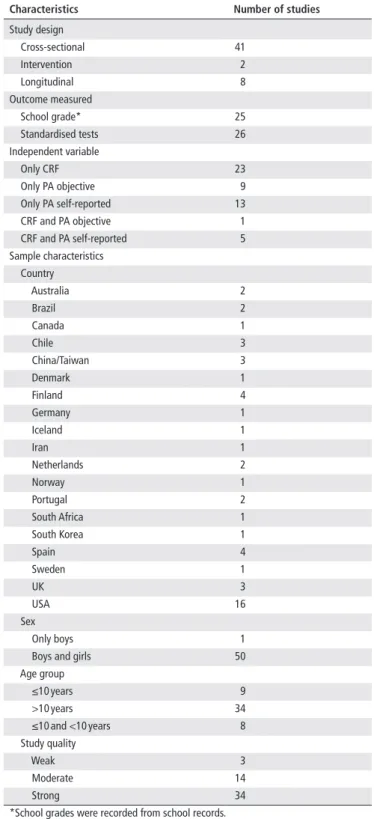
The study characteristics are summarised in table 1. Of the 51 included studies, 41 were cross-sectional, 2 intervention and 8 longitudinal. In half of the studies, the outcome variable (academic achievement) was the students’ marks at the school level, and standardised tests were used for the other half. Most studies analysed the relationship between academic achievement with cardiorespiratory fitness, followed by the relationship with self-reported physical activity and lastly objectively measured physical activity. Five studies used both cardiorespiratory fitness and objective physical activity as independent variables, and one study used cardiorespiratory fitness and self-reported physical activity. Most studies took place in Europe (n=20) or North America (n=17), and the remainder studies were from Africa (n=1), Asia (n=5), Oceania (n=2) and South America (n=6). Three studies were considered to be of weak methodological quality, 14 of moderate quality and the other 34 of strong quality.
Principal findings
Objectively measured physical activity and academic achievement
The description of the studies reporting the relationship between objectively measured physical activity and academic achievement is presented in table 2. The results from the 11 studies that were screened17 19 27–35 were inconsistent regarding the relationship between objectively measured physical activity and academic achievement. Four studies of strong quality provided partial support for a positive relationship.27 28 31 35 Vigorous physical activity (VPA) was associated with academic achievement in girls, after controlling for confounding factors, but no signifi-cant association was observed in boys.28 In a longitudinal study, the percentage of time spent in MVPA predicted greater perfor-mance in English assessments across sexes but not in math and science.27 Higher MVPA was related to higher academic achieve-ment in writing and numeracy but not in reading and spelling.31 In an intervention study, there was a significant effect of physical activity on numeracy among the children who initially performed the most poorly on the test, but no significant effect of the intervention on academic achievement measures was observed using intention-to-treat analyses.35 These studies that partially supported a positive relationship between objectively measured
physical activity and academic achievement were performed in different countries, with sample sizes ranging from 232 to 4755 children and adolescents. In one study of strong quality and with a large sample, physical activity was negatively associated with all academic achievement indicators after adjusting for poten-tial confounders, such as adiposity and fitness.19 However, the strength of the association was weak in all activity intensities. In the other six studies, no significant association was found between physical activity and academic achievement.17 29 30 32–34
Figure 1 ERIC, Education Resources Information Center.
Table 1 Characteristics of the studies examining potential relationship between CRF, PA and academic achievement
Characteristics Number of studies
Study design
Cross-sectional 41
Intervention 2
Longitudinal 8
Outcome measured
School grade* 25
Standardised tests 26
Independent variable
Only CRF 23
Only PA objective 9
Only PA self-reported 13 CRF and PA objective 1 CRF and PA self-reported 5 Sample characteristics
Country
Australia 2
Brazil 2
Canada 1
Chile 3
China/Taiwan 3
Denmark 1
Finland 4
Germany 1
Iceland 1
Iran 1
Netherlands 2
Norway 1
Portugal 2
South Africa 1 South Korea 1
Spain 4
Sweden 1
UK 3
USA 16
Sex
Only boys 1
Boys and girls 50 Age group
≤10 years 9
>10 years 34 ≤10 and <10 years 8 Study quality
Weak 3
Moderate 14
Strong 34
In the three studies performed with children under 10 years old,17 29 32 no significant association was found between physical
activity and academic achievement.
Self-report physical activity and academic achievement
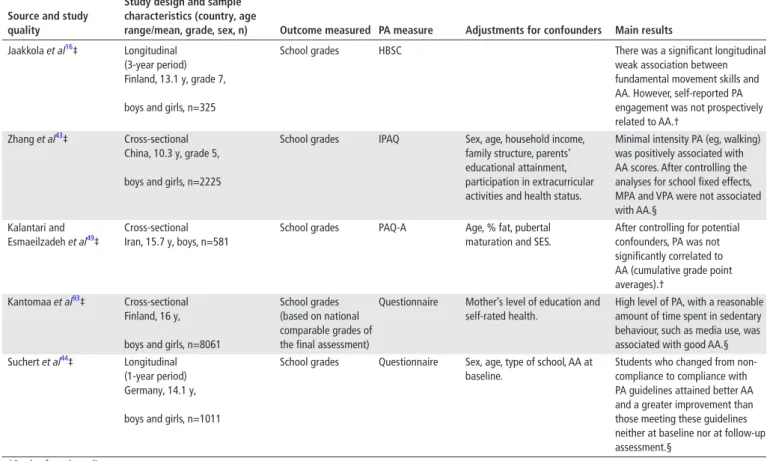
Studies reporting the relationship between self-reported phys-ical activity and academic achievement are presented in table 3. Twelve of the 18 studies that reported positive associations
between physical activity and academic achievement included data from several different countries, with sample sizes ranging from 277 to 861.33 36–46 Of these 12 studies, three were
longi-tudinal, and physical activity was prospectively associated with academic achievement.39 42 44 However, 5 of the 18 studies, two of which had weak methodological quality, did not observe any association.16 47–50 Nonetheless, in an interventional study, about 50 additional minutes devoted to physical activity per week,
Table 2 Description of the studies reporting the relationship between objectively measured PA and AA in children and adolescents
Source and study quality
Study design and sample characteristics (country,
age range/mean, grade, sex, n) Outcome measured PA measure Adjustments for confounders Main results
Kwak et al28
† Cross-sectional Sweden, 16 y, grade 9, boys and girls, n=232
School grades Accelerometer Age, pubertal phase, sum of skinfolds, mother’s education, family structure and parental monitoring.
VPA was associated with AA in girls, after controlling for confounding factors.‡ LPA and MPA were not associated with AA in boys. (±) LPA, MPA and VPA were not associated with AA in boys.§ LeBlanc et al30† Cross-sectional
USA, 10.5 y, grades 4–6, boys and girls, n=261
Standardised annual test Accelerometer Age, sex and SES. MPA was not associated with AA.§
Booth et al27
† Longitudinal
UK, 11 y, boys and girls, n=4755
Compulsory nationally administered tests
Accelerometer Age, birth weight, gestation, age of mother at delivery, mother’s oily fish intake, mother smoking habits in the first 3 months of pregnancy, BMI Z score, pubertal stage, ethnicity, maternal educational, occupational social class and total PA.
%MVPA at 11 y predicted performance in English assessments at 11, 13 and 16 y, in boys and girls.‡
%MVPA at 11 y predicted performance in maths and sciences assessments at 16 y, in girls.‡
%MVPA at 11 y was not associated with performance in sciences and maths at 11, 13, and 16 y, in boys.§
%MVPA at 11 y was not associated with performance in sciences and maths at 11 and 13 y, in girls.§
Lambourne et al29
† Cross-sectional USA, 7.6 y, grades 2–3, boys and girls, n=401
Weschsler Individual Achievement Test–Third Edition
Accelerometer Sex, grade, BMI, mother’s education level and household income.
Total PA was associated with math achievement (partially mediated by fitness).‡
Total PA was not associated with reading or spelling.§
Syväoja et al33
† Cross-sectional Finland, 12.2 y, grades 5–6, boys and girls, n=277
School grades Accelerometer Sex, children’s learning difficulties, highest level of parental education and amount of sleep.
MVPA was not associated with grade point average.§
Esteban-Cornejo et al19
† Cross-sectional Spain, 10.5 y, boys and girls, n=1778
School grades Accelerometer Sex, age, city, maternal education, birth weight, gestational age, BMI and z-score values computed from CRF and motor fitness tests.
MPA, VPA and MVPA were inversely associated with all AA indicators.¶
Hansen et al17† Cross-sectional USA, 7.8 y,
2–3 boys and girls, n=687
Standardised composite academic test
Accelerometer Sex, grade, race, ethnicity, mother’s education level, household income and BMI.
Total PA was not significantly correlated with AA, either linearly or non-linearly.§
Van Dijk et al34
† Cross-sectional
Netherlands, 13 y, grades 7–9, boys and girls, n=255
School grades Accelerometer Sex, nationality, grade, school level, SES, BMI, CRF, pubertal phase, depressive symptoms and self-esteem.
Considering the overall sample, weekly volume of total PA and MVPA was not associated with AA.§
In grade 7 students, weekly volume of total PA and MVPA were negatively associated with AA, and MVPA was also negatively associated with mathematics achievement.¶
In grade 9, weekly volume of total PA and MVPA were positively associated with maths performance.‡
Maher et al31† Cross-sectional Australia, 10.2 y, grade 5, boys and girls, n=285
National Assessment Program – Literacy and Numeracy
Accelerometer Sex, school clustering, MVPA, sedentary behaviour, BMI z-score, ethnicity, highest household education, household income, marital status, mothers employment hours and number of siblings.
Higher MVPA was related with higher AA in writing and numeracy.‡
MVPA was not related to language, reading and
spelling.§ Pindus et al32
† Cross-sectional
UK, 8.7 y, boys and girls, n=74
Kaufman Test of Educational Achievement
Accelerometer Sex, age, IQ, SES, birth weight, diagnosis of attention deficit hyperactivity disorder and CRF.
No significant associations were found between MVPA and AA.§
Resaland et al35
† Intervention (7-month cluster RCT) Norway, 10.2 y, boys and girls, n=596
Standardised Norwegian national tests
Accelerometer Sex, SES, PA and AA at baseline. No significant overall effect of the intervention (increasing 165 min/week of PA) on AA.§
There was a significant effect on numeracy among children who initially performed the poorest.‡
†Study of strong quality.
‡The symbol means that in general there is a positive correlation/association between objective physical activity and academic achievement. §The symbol means that in general there is no correlation/association between objective physical activity and academic achievement. ¶The symbol means that in general there is a negative correlation/association between objective physical activity and academic achievement.
Table 3 Description of the studies reporting the relationship between self-reported PA and AA in children and adolescents
Source and study quality
Study design and sample characteristics (country, age
range/mean, grade, sex, n) Outcome measured PA measure Adjustments for confounders Main results
Daley and Ryan 200048* Cross-sectional
UK, 13–16 y, grades 8–11, boys and girls, n=232
School grades PA Participation Questionnaire
Overall, no significant correlations were found between PA and AA. However, weak negative correlations were found between total PA and English scores for those aged 13, 14 and 16 years.†
Dwyer et al37‡ Cross-sectional Australia, 7–15 y, boys and girls, n=7962
School grades Questionnaire Age, school type, region, % body fat, time of sleep, ate before school, musical train and parental exercise.
More active students had better AA. The association between total PA (minutes of weekly PA) and AA were weak in girls.§
Yu et al50* Cross-sectional China, 10.4 y, grades 1–4, boys and girls, n=333
School grades PAQ-C There was no relationship between
PA level and AA.†
Ahamed et al47‡ Intervention (16-month cluster RCT) Canada, 10.2 y, grades 4–5, boys and girls, n=287
Canadian Achievement Test
PAQ-C Baseline evaluate AA. Additional 10–15 min of school time devoted to PA did not compromise AA.†
Stevens et al42¶ Longitudinal (5-year period) USA, grade 5, boys and girls, n=6482
Standardised test scores
Questionnaire SES. PA was significantly and positively related to both mathematics and reading achievement in boys and girls.§
Kristjánsson
et al46‡
Cross-sectional
Iceland, 14–15 y, grades 9–10, boys and girls, n=6345
School grades Questionnaire Sex, family structure, parental education and absenteeism
Although the correlation was weak, increased PA levels was positively correlated with AA.§
Edwards et al38‡ Cross-sectional USA, 11–13 y, boys and girls, n=694
Measures of academic progress
Questionnaire Sex, meals, fitness measures and BMI.
Higher measures of academic progress math scores were associated with VPA and sport teams participation.§ Morales et al41¶ Cross-sectional
Spain, 14.7 y, boys and girls, n=284
School grades IPAQ There was a linear relationship
between MVPA and AA. There is a trend to stronger correlation when modelling the
relationship with a quadratic equation.§
So51‡ Cross-sectional
South Korea, 15.1 y, grades 7–12, boys and girls, n=75 066
School grades Questionnaire Age, BMI, the parents’ education level and SES.
VPA was positively correlated with AA in boys, and MPA was positively correlated with AA in both boys and girls.§
However, undertaken ≥5 times/ week, VPA in boys and strengthening exercises in both boys and girls were negatively correlated with AA.** Syväoja et al33‡ Cross-sectional
Finland, 12.2 y, grades 5–6, boys and girls, n=277
School grades HBSC Sex, children’s learning difficulties, highest level of parental education and amount of sleep.
PA was directly associated with AA. MVPA had an inverse U-shaped curvilinear
association with grade point average.§
Burrows et al36‡ Cross-sectional Chile, 12.9 y, grades 5–9,
boys and girls, n=1271
System for the Assessment of Educational Quality
Questionnaire Sex, SES and student’s learning experience
Those reporting ≤2 hours/ week of PA had significantly lower performance in language, maths and science, than those reporting ≥4 hours.§ Haapala et al39‡ Longitudinal
(5-year period)
Finland, 7.7 y, grades 1–3, boys and girls, n=186
Nationally normed reading achievement test battery
PANIC-PAQ Sex, age, parental education and the age, sex, parental education and study group.
Total PA and physically active school transportation were related to better academic
skills.§ Maureira Cid et al40 Cross-sectional
Chile, 15.6 y, grades 9–12, boys and girls, n=309
School grades Questionnaire There was a significant relationship between the number of weekdays of PA and performance in mathematics, history and sciences.§
as a result of the intervention, did not increase or compromise students’ academic achievement.47 A study performed among
North Korean adolescents showed interesting results since VPA was positively correlated with academic achievement, but when
undertaken ≥5 times/week VPA was negatively correlated with
academic achievement.51
Cardiorespiratory fitness and academic achievement
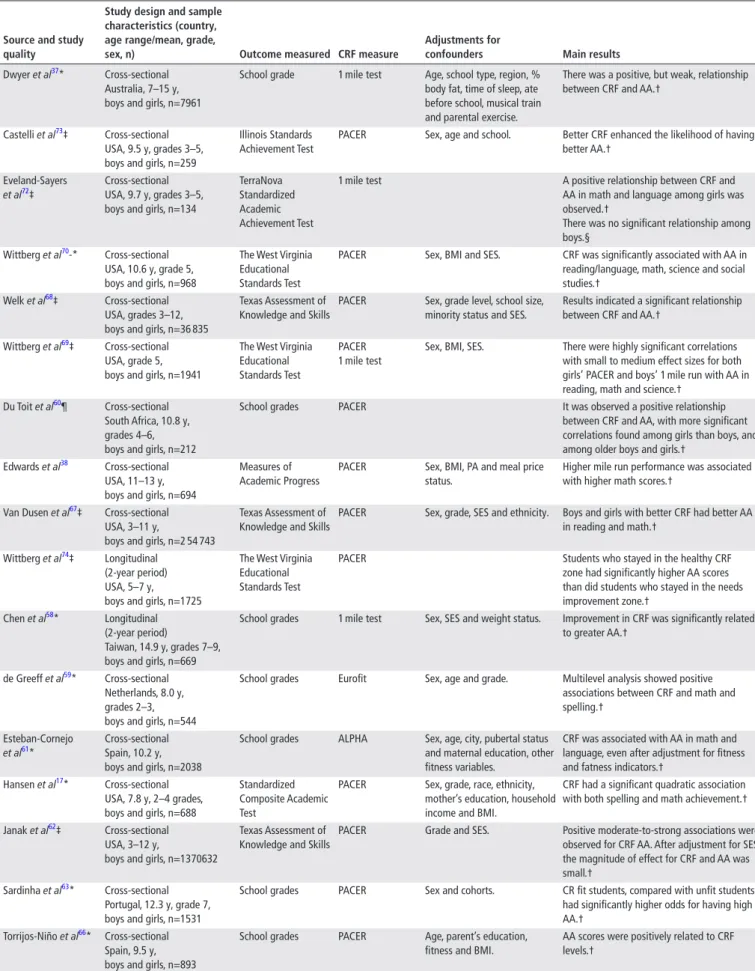
The description of the included studies reporting on the relation-ship between cardiorespiratory fitness and academic achieve-ment is presented in table 4. Cardiorespiratory fitness has most often been measured using the Progressive Aerobic Cardiovas-cular Endurance Run and 1 mile test. From the 28 studies that have analysed the relationship between cardiorespiratory fitness and academic achievement,17 37 38 44 49 52–73 it was verified that they generally supported the beneficial effect of cardiorespira-tory fitness on students’ academic achievement. However, in two of the studies, a significant association between cardiorespi-ratory fitness and academic achievement was not observed56 71 after adjusting the analysis for potential confounders. In the four longitudinal studies,44 58 64 74 staying in the healthy cardiorespi-ratory fitness zone or improving cardiorespicardiorespi-ratory fitness during the observational period was significantly related to better academic achievement, reinforcing prior research indicating that
cardiorespiratory fitness has a significant and positive relation-ship with academic achievement. No pattern could be identified that included students’ age. It is important to highlight that none of the studies of cardiorespiratory fitness observed a detrimental relationship with academic achievement.
DISCUSSION
Overall, the findings revealed that self-reported physical activity and cardiorespiratory fitness were consistently and positively associated with academic achievement. Objec-tively measured physical activity was inconsistently related to academic achievement. Although the results varied, phys-ical activity does not have a detrimental effect on academic achievement.
The positive and significant association between cardiorespira-tory fitness and academic achievement was shown in all reviewed studies,17 37 38 49 52–67 69–74 although in two studies the relation-ship was only observed among girls,52 72 and in two others the
significant effect disappeared when potential confounders were included in the analysis.56 71 The conclusion that cardiorespira-tory fitness is associated with academic achievement was rein-forced by the significant findings in the four longitudinal studies reviewed.44 58 64 74
Source and study quality
Study design and sample characteristics (country, age
range/mean, grade, sex, n) Outcome measured PA measure Adjustments for confounders Main results
Jaakkola et al16‡ Longitudinal (3-year period) Finland, 13.1 y, grade 7,
boys and girls, n=325
School grades HBSC There was a significant longitudinal
weak association between fundamental movement skills and AA. However, self-reported PA engagement was not prospectively related to AA.†
Zhang et al43‡ Cross-sectional China, 10.3 y, grade 5,
boys and girls, n=2225
School grades IPAQ Sex, age, household income, family structure, parents’ educational attainment, participation in extracurricular activities and health status.
Minimal intensity PA (eg, walking) was positively associated with AA scores. After controlling the analyses for school fixed effects, MPA and VPA were not associated with AA.§
Kalantari and Esmaeilzadeh et al49‡
Cross-sectional Iran, 15.7 y, boys, n=581
School grades PAQ-A Age, % fat, pubertal maturation and SES.
After controlling for potential confounders, PA was not significantly correlated to AA (cumulative grade point averages).†
Kantomaa et al93‡ Cross-sectional Finland, 16 y,
boys and girls, n=8061
School grades (based on national comparable grades of the final assessment)
Questionnaire Mother’s level of education and self-rated health.
High level of PA, with a reasonable amount of time spent in sedentary behaviour, such as media use, was associated with good AA.§ Suchert et al44‡ Longitudinal
(1-year period) Germany, 14.1 y,
boys and girls, n=1011
School grades Questionnaire Sex, age, type of school, AA at baseline.
Students who changed from non-compliance to non-compliance with PA guidelines attained better AA and a greater improvement than those meeting these guidelines neither at baseline nor at follow-up assessment.§
*Study of weak quality.
†The symbol means that in general there is no correlation/association between self-reported physical activity and academic achievement. ‡Study of strong quality.
§The symbol means that in general there is a positive correlation/association between self-reported physical activity and academic achievement. ¶Study of moderate quality.
**The symbol means that in general there is a negative correlation/association between self-reported physical activity and academic achievement.
AA, academic achievement; BMI, body mass index; HBSC, Health Behaviour in School-aged Children survey; IPAQ, International Physical Activity Questionnaire; MVPA, moderate-to-vigorous physical activity; PA, physical activity; PANIC-PAQ, Physical Activity and Nutrition in Children-Physical Activity Questionnaire; PAQ-A, Physical Activity Questionnaire-Adolescents; PAQ-C, Physical Activity Questionnaire-Children; RCT, randomised control trial; SES, socioeconomic status; VPA, vigorous physical activity; y, years.
Table 4 Description of the studies reporting the relationship between CRF and AA in children and adolescents
Source and study quality
Study design and sample characteristics (country, age range/mean, grade,
sex, n) Outcome measured CRF measure
Adjustments for
confounders Main results
Dwyer et al37* Cross-sectional Australia, 7–15 y, boys and girls, n=7961
School grade 1 mile test Age, school type, region, % body fat, time of sleep, ate before school, musical train and parental exercise.
There was a positive, but weak, relationship between CRF and AA.†
Castelli et al73‡ Cross-sectional USA, 9.5 y, grades 3–5, boys and girls, n=259
Illinois Standards Achievement Test
PACER Sex, age and school. Better CRF enhanced the likelihood of having better AA.†
Eveland-Sayers
et al72‡
Cross-sectional USA, 9.7 y, grades 3–5, boys and girls, n=134
TerraNova Standardized Academic Achievement Test
1 mile test A positive relationship between CRF and AA in math and language among girls was observed.†
There was no significant relationship among boys.§
Wittberg et al70-* Cross-sectional USA, 10.6 y, grade 5, boys and girls, n=968
The West Virginia Educational Standards Test
PACER Sex, BMI and SES. CRF was significantly associated with AA in reading/language, math, science and social studies.†
Welk et al68‡ Cross-sectional USA, grades 3–12, boys and girls, n=36 835
Texas Assessment of Knowledge and Skills
PACER Sex, grade level, school size, minority status and SES.
Results indicated a significant relationship between CRF and AA.†
Wittberg et al69‡ Cross-sectional USA, grade 5, boys and girls, n=1941
The West Virginia Educational Standards Test
PACER 1 mile test
Sex, BMI, SES. There were highly significant correlations with small to medium effect sizes for both girls’ PACER and boys’ 1 mile run with AA in reading, math and science.†
Du Toit et al60¶ Cross-sectional South Africa, 10.8 y, grades 4–6, boys and girls, n=212
School grades PACER It was observed a positive relationship
between CRF and AA, with more significant correlations found among girls than boys, and among older boys and girls.†
Edwards et al38 Cross-sectional USA, 11–13 y, boys and girls, n=694
Measures of Academic Progress
PACER Sex, BMI, PA and meal price status.
Higher mile run performance was associated with higher math scores.†
Van Dusen et al67‡ Cross-sectional USA, 3–11 y,
boys and girls, n=2 54 743
Texas Assessment of Knowledge and Skills
PACER Sex, grade, SES and ethnicity. Boys and girls with better CRF had better AA in reading and math.†
Wittberg et al74‡ Longitudinal (2-year period) USA, 5–7 y, boys and girls, n=1725
The West Virginia Educational Standards Test
PACER Students who stayed in the healthy CRF
zone had significantly higher AA scores than did students who stayed in the needs improvement zone.†
Chen et al58* Longitudinal (2-year period)
Taiwan, 14.9 y, grades 7–9, boys and girls, n=669
School grades 1 mile test Sex, SES and weight status. Improvement in CRF was significantly related to greater AA.†
de Greeff et al59* Cross-sectional Netherlands, 8.0 y, grades 2–3, boys and girls, n=544
School grades Eurofit Sex, age and grade. Multilevel analysis showed positive associations between CRF and math and spelling.†
Esteban-Cornejo
et al61*
Cross-sectional Spain, 10.2 y, boys and girls, n=2038
School grades ALPHA Sex, age, city, pubertal status and maternal education, other fitness variables.
CRF was associated with AA in math and language, even after adjustment for fitness and fatness indicators.†
Hansen et al17* Cross-sectional USA, 7.8 y, 2–4 grades, boys and girls, n=688
Standardized Composite Academic Test
PACER Sex, grade, race, ethnicity, mother’s education, household income and BMI.
CRF had a significant quadratic association with both spelling and math achievement.†
Janak et al62‡ Cross-sectional USA, 3–12 y,
boys and girls, n=1370632
Texas Assessment of Knowledge and Skills
PACER Grade and SES. Positive moderate-to-strong associations were observed for CRF AA. After adjustment for SES, the magnitude of effect for CRF and AA was small.†
Sardinha et al63* Cross-sectional Portugal, 12.3 y, grade 7, boys and girls, n=1531
School grades PACER Sex and cohorts. CR fit students, compared with unfit students had significantly higher odds for having high AA.†
Torrijos-Niño et al66* Cross-sectional Spain, 9.5 y, boys and girls, n=893
School grades PACER Age, parent’s education, fitness and BMI.
AA scores were positively related to CRF levels.†
Possible mechanisms for the association between cardiorespiratory fitness and academic achievement
There are several potential explanations for the association between cardiorespiratory fitness and academic achievement. First, students with better academic achievement may be better oriented for success, and therefore might attempt to achieve success in both academics and physical fitness.75 A second cate-gory of mechanisms may relate to cardiorespiratory fitness effects neural substrates. Cardiorespiratory fitness enhances brain structure and function underlying students’ concentration and memory which, in turn, could relate to academic achieve-ment. Cardiorespiratory fitness increases the density of neuronal synapses,76 the vasculature in the cerebral cortex and the recruit-ment of neural resources related to the effectiveness of adapting
to task demands and fatigue.4 Cardiorespiratory fitness also enhances the integrity of white matter tracts in the brain during childhood, which may be one pathway to improve the cogni-tion.5 77 Furthermore, at a biochemical level, cardiorespiratory
fitness may enhance the synthesis of brain-derived neurotrophic factor (BDNF), and an increase in BDNF is associated with increases in neurogenesis.7 78 79
What is the association between physical activity (objective and self-reported) and academic achievement?
We found a positive association between self-reported physical activity and academic achievement in most studies,33 36–46 51 which extends previous findings that assessed physical activity Source and study
quality
Study design and sample characteristics (country, age range/mean, grade,
sex, n) Outcome measured CRF measure
Adjustments for
confounders Main results
Srikanth et al65* Cross-sectional USA, 12.4 y, grades 7–8, boys and girls, n=1211
Texas Assessment of Knowledge and Skills
PACER SES, like reading, health perception and BMI.
Regression analyses revealed that CRF was a consistent predictor of the students’ AA in in math and reading.†
Aguilar et al71* Cross-sectional Chile, 12.1 y, grade 7, boys and girls, n=395
School grades PACER Age, BMI, SES, PA, parental education and screen time.
Good CRF levels was associated with high language and mean AA grades; however, after adjusting for other potential confounders, these associations disappear.†§ Bass et al57* Cross-sectional
USA, 13.1 y, grades 6–8, boys and girls, n=838
Illinois Standardized Achievement Test
PACER Age and SES Boys and girls in the CRF zone (HFZ) were more likely to pass in their math and reading tests.†
Andersen et al53¶ Cross-sectional Denmark, 13–15 y, boys and girls, n=1119
Standardised test (mandatory exams)
Cycle ergometer SES and ethnicity. Students with higher CRF perform better academically than students with lower CRF.†
Castro and Oliveira 54¶
Cross-sectional Brazil, 15–18 y, boys and girls, n=326
School grades 1 mile test Age and sex CRF was associated with AA. Being unfit doubles the likelihood of poor AA.†
Kalantari and Esmaeilzadeh49*
Cross-sectional Iran, 15.7 y, boys, n=580
School grades 1 mile test Age, adiposity, pubertal maturation and SES.
CRF is significantly correlated to better AA in the adolescent boys.†
Kao et al55‡ Cross-sectional USA, 10.1 y, boys and girls, n=79
California Standards Test
Graded exercise test
Age, sex, grade, SES, IQ CRF was associated with greater mathematics performance in the category of algebraic functions.†
Olivares and Garcí a-Rubio56¶
Cross-sectional Chile, grade 8, boys and girls, n=18 746
Standardised tests Chilean Standardized System for the Assessment of Educational Quality test
Age, sex, SES, region and type of school, fitness components
CRF was not associated with AA if fatness and other fitness components were included in the model.§
de Almeida Santana
et al52¶
Cross-sectional
Brazil, 10–13 y, grades 5–6, boys and girls, n=392
Standardised test PACER Absolute skinfold thickness, BMI-percentiles and SES.
CRF was associated with higher academic achievement among girls.†
No significant association was found among boys.§
Sardinha et al64* Longitudinal (3-year period) Portugal, 11.3 years, grades 6–7, boys and girls, n=1286
School grades PACER Sex, BMI z-score, AA at baseline and schools.
Consistently CRF fit and improvements in CRF were prospectively associated with better AA in languages.†
Suchert et al44‡ Longitudinal (1-year period) Germany, 14.1 y, boys and girls, n=1011
School grades PACER (shuttle run test)
Sex, age, type of school, AA at baseline.
High CRF predicted higher AA.†
*Study of strong quality.
†The symbol means that in general there is a positive correlation/association between cardiorespiratory fitness and academic achievement. ‡Study of moderate quality.
§The symbol means that in general there is no correlation/association between cardiorespiratory fitness and academic achievement. ¶Study of weak quality.
AA, academic achievement; ALPHA, Assessing Levels of Physical Activity; BMI, body mass index; CRF, cardiorespiratory fitness; HFZ, healthy fitness zone; PA, physical activity; PACER, Progressive Aerobic Cardiovascular Endurance Run, which is part of Fitnessgram; SES, socioeconomic status; y, years.
through self-reported questionnaires.13 80 However, 6 of 11 studies that objectively measured physical activity showed no relationship with academic achievement17 29 30 32–34 and one showed a negative relationship.19 This negative association was only observed when analyses were adjusted for potential confounders including a computed z-score from cardiorespira-tory and motor fitness tests.
The studies included in this review did not account for the time of day when physical activity was performed. This is an important consideration because some of the benefits that are related to physical activity on academic achievement may be acute,81 and therefore physical activity should be performed within the school environment.82 This lack of consistency when using self-reported versus objectively assessed physical activity associated with academic achievement has been previously discussed.33 82 83 Indeed, Syväoja et al33 observed that
self-re-ported, but not objectively measured physical activity, was associated with academic achievement. There are a numerous possibilities for this inconsistency; younger children tend to over-estimate their physical activity relative to objective measures.84 Interestingly, it was previously reported that those children overestimating physical activity were also those presenting with higher academic achievement.33
Accelerometers provide several advantages in assessing physical activity, but they are not free of limitations.85 Accelerometers are used during a short period of time that may not fully represent the typical physical activity patterns. Also, there are limitations when assessing cycling, swimming or other activities that are not reflected in typical activity counts (eg, skill-specific activities related with agility, balance, control and coordination).82 84 Indeed, some activ-ities that do not accumulate activity counts may improve motor control, and this may potentially contribute to improved academic performance via opportunities to interact with the environment and rehearse language and cognitive skills.86 Children with better motor control performance have better academic achievement.86 87 This is consistent with the results that demonstrate interwoven associations between motor control and cognitive development, showing that many brain areas are involved in both motor control and cognitive processes.88 89
Based on the inconsistent results observed for objective and self-reported physical activity, it is clear that the relationship between physical activity and academic achievement is not yet conclusive.13 80 It is necessary to reinforce that self-reported physical activity methods possess several limitations in terms of reliability and validity.90 Self-reported physical activity may be problematic in children and adolescents because they are less time conscious than adults and tend to engage in physical activity in sporadic periods with different intensities rather than consistent patterns.91 Besides compromised reliability, the validity of measures may be affected in children and adolescents who feel compelled to respond in a socially desirable manner. Children and adolescents may have difficulties in recalling physical activity and in understanding and responding to items within the questionnaire.92 In addition, in some instances, self-reported physical activity measures only assess the frequency, the intensity or the duration, which limits the conclusions that may be drawn regarding its relationship with academic achievement. As a result, to report that physical activity is associated with academic achievement based mainly on self-re-ported physical activity should be made with caution, and the assumption that participation in physical activity positively affects academic achievement or the way that children behave and learn in school has yet to be validated.15 The present study further extends this conclusion by reviewed studies using objective and subjective measures of physical activity.
Are there differences in how physical activity influences academic performance at different ages?
Since this review included the entire spectrum of school-aged chil-dren, ranging from 6 to 18 years, which is novel compared with previous reviews,13 14 80 results could point to differential
tions between children and adolescents. In regard to the associa-tion between objective physical activity and academic achievement, positive associations were observed with students older than 10 years,27 28 31 35 whereas this was not seen in younger students.17 29 32
Perhaps during the early years of schooling, parents’ education, socioeconomic status or time devoted to studying are some of the main factors that explain the students’ academic success. In general, based on this review, it is not possible to conclude any relationship with age, because none of the studies were designed to examine the effect of age and most accounted for age in their analysis.
Strengths and limitations
The main strength of this review arises from the systematisa-tion of studies on associasystematisa-tions with cardiorespiratory fitness and physical activity, with a further differentiation between objec-tive and self-reported physical activity. Previous reviews13 80 did not differentiate between objective and self-reported phys-ical activity. The present review included school-aged children and adolescents from 6 to 18 years, which represents the entire primary, middle and secondary education in most countries.
This review has limitations that restrict the ability to draw causal inferences. Although the studies were assessed according to their methodological quality,26 they were not ranked or
weighted, consequently, findings from studies with weaker quality, and smaller sample sizes were given equal weight rela-tive to findings from studies with stronger research designs and larger sample sizes. Academic achievement was measured based on school grades or standardised tests. School grades given by teacher are subject to bias because teachers' evaluation can also reflect other constructs, such as students’ behaviour. Thus, it might be difficult to compare results from school grades and standardised tests.
We could not apply our methods to any interventions studies; as most studies included were cross-sectional, we must limit our conclusions. Another limitation is the fact that some studies were adjusted for potential confounders, and others were not. Furthermore, to reinforce the evidence observed in the present study, future work should endeavour to perform meta-ana-lytic analyses. Such meta-analyses were not possible herein, as the studies reviewed possessed a wide range of metrics and outcomes, which precluded the possibility of creating a coherent analytical strategy.
CONCLUSION
Our systematic review revealed an association between cardio-respiratory fitness and academic achievement. There was incon-sistency in the results of studies that examined the association between physical activity and academic achievement; this was particularly the case when physical activity was measured by accelerometry.
What are the findings?
How might it impact on clinical practice in the future?
► There is a positive relationship between cardiorespiratory fitness and academic achievement.
► The results were inconsistent regarding the relationship between objective measured physical activity and academic achievement.
► Studies reporting the relationship between self-reported physical activity and academic achievement reported positive associations between physical activity and academic achievement.
Contributors AM, DAS and LBS conceived the study, and AM and DAS developed a systematic review protocol. AM and DAS conducted the literature search and selected the studies based on the title and the abstract and extracted and coded the data from all studies. Study outcomes were summarised by AM, DAS and LBS. They wrote the initial draft of the manuscript, and CHH made significant revisions and contributions. All authors read and approved the final manuscript.
Funding DAS is supported by a scholarship from the Portuguese Foundation for Science and Technology (grant: SFRH/BPD/92462/2013).
Competing interests None declared.
Provenance and peer review Not commissioned; externally peer reviewed. © Article author(s) (or their employer(s) unless otherwise stated in the text of the article) 2017. All rights reserved. No commercial use is permitted unless otherwise expressly granted.
REFERENCES
1 Janssen I, Leblanc AG. Systematic review of the health benefits of physical activity and fitness in school-aged children and youth. Int J Behav Nutr Phys Act 2010;7:40. 2 Andersen LB, Sardinha LB, Froberg K, et al. Fitness, fatness and clustering of
cardiovascular risk factors in children from Denmark, Estonia and Portugal: the European Youth Heart Study. Int J Pediatr Obes 2008;3:58–66.
3 Anderssen SA, Cooper AR, Riddoch C, et al. Low cardiorespiratory fitness is a strong predictor for clustering of cardiovascular disease risk factors in children independent of country, age and sex. Eur J Cardiovasc Prev Rehabil 2007;14:526–31. 4 Chaddock L, Erickson KI, Prakash RS, et al. A functional MRI investigation of the
association between childhood aerobic fitness and neurocognitive control. Biol Psychol 2012;89:260–8.
5 Chaddock-Heyman L, Erickson KI, Kienzler C, et al. The role of aerobic fitness in cortical thickness and mathematics achievement in preadolescent children. PLoS One
2015;10:e0134115.
6 Schaeffer DJ, Krafft CE, Schwarz NF, et al. An 8-month exercise intervention alters frontotemporal white matter integrity in overweight children. Psychophysiology
2014;51:728–33.
7 Cotman CW, Berchtold NC, Christie LA. Exercise builds brain health: key roles of growth factor cascades and inflammation. Trends Neurosci 2007;30:464–72. 8 Hillman CH, Erickson KI, Kramer AF. Be smart, exercise your heart: exercise effects on
brain and cognition. Nat Rev Neurosci 2008;9:58–65.
9 Chaddock L, Hillman CH, Pontifex MB, et al. Childhood aerobic fitness predicts cognitive performance one year later. J Sports Sci 2012;30:421–30.
10 Hillman CH, Castelli DM, Buck SM. Aerobic fitness and neurocognitive function in healthy preadolescent children. Med Sci Sports Exerc 2005;37:1967–74. 11 Monti JM, Hillman CH, Cohen NJ. Aerobic fitness enhances relational memory
in preadolescent children: the FITKids randomized control trial. Hippocampus
2012;22:1876–82.
12 Moore RD, Wu CT, Pontifex MB, et al. Aerobic fitness and intra-individual variability of neurocognition in preadolescent children. Brain Cogn 2013;82:43–57.
13 Esteban-Cornejo I, Tejero-Gonzalez CM, Sallis JF, et al. Physical activity and cognition in adolescents: A systematic review. J Sci Med Sport 2015;18:534–9.
14 Rasberry CN, Lee SM, Robin L, et al. The association between school-based physical activity, including physical education, and academic performance: a systematic review of the literature. Prev Med 2011;52 Suppl 1:S10–S20.
15 Donnelly JE, Hillman CH, Castelli D, et al. Physical activity, fitness, cognitive function, and academic achievement in children: a systematic review. Med Sci Sports Exerc
2016;48:1197–222.
16 Jaakkola T, Hillman C, Kalaja S, et al. The associations among fundamental movement skills, self-reported physical activity and academic performance during junior high school in Finland. J Sports Sci 2015;33:1719–29.
17 Hansen DM, Herrmann SD, Lambourne K, et al. Linear/nonlinear relations of activity and fitness with children’s academic achievement. Med Sci Sports Exerc
2014;46:2279–85.
18 Tremblay MS, Inman JW, Willms JD. The relationship between physical activity, self-esteem, and academic achievement in 12-year-old children. Pediatr Exerc Sci
2000;12:312–23.
19 Esteban-Cornejo I, Tejero-González CM, Martinez-Gomez D, et al. Objectively measured physical activity has a negative but weak association with academic performance in children and adolescents. Acta Paediatr 2014;103:e501–e506. 20 Adamo KB, Prince SA, Tricco AC, et al. A comparison of indirect versus direct measures
for assessing physical activity in the pediatric population: a systematic review. Int J Pediatr Obes 2009;4:2–27.
21 Basterfield L, Adamson AJ, Parkinson KN, et al. Surveillance of physical activity in the UK is flawed: validation of the Health Survey for England Physical Activity Questionnaire. Arch Dis Child 2008;93:1054–8.
22 Moher D, Shamseer L, Clarke M, et al. Preferred reporting items for systematic review and meta-analysis protocols (PRISMA-P) 2015 statement. Syst Rev 2015;4:1. 23 Álvarez-Bueno C, Pesce C, Cavero-Redondo I, et al. Association of physical
activity with cognition, metacognition and academic performance in children and adolescents: a protocol for systematic review and meta-analysis. BMJ Open
2016;6:e011065.
24 Hogg R, Tanis E, Zimmerman D. Probability and statistical inference. Upper Saddle River, NJ: Pearson, 2015.
25 Troiano RP. A timely meeting: objective measurement of physical activity. Med Sci Sports Exerc 2005;37:S487–S489.
26 Thomas BH, Ciliska D, Dobbins M, et al. A process for systematically reviewing the literature: providing the research evidence for public health nursing interventions.
Worldviews Evid Based Nurs 2004;1:176–84.
27 Booth JN, Leary SD, Joinson C, et al. Associations between objectively measured physical activity and academic attainment in adolescents from a UK cohort. Br J Sports Med 2014;48:265–70.
28 Kwak L, Kremers SP, Bergman P, et al. Associations between physical activity, fitness, and academic achievement. J Pediatr 2009;155:914–8.
29 Lambourne K, Hansen DM, Szabo AN, et al. Indirect and direct relations between aerobic fitness, physical activity, and academic achievement in elementary school students. Ment Health Phys Act 2013;6:165–71.
30 LeBlanc MM, Martin CK, Han H, et al. Adiposity and physical activity are not related to academic achievement in school-aged children. J Dev Behav Pediatr 2012;33:486–94. 31 Maher C, Lewis L, Katzmarzyk PT, et al. The associations between physical activity,
sedentary behaviour and academic performance. J Sci Med Sport 2016;19:1004–9. 32 Pindus DM, Drollette ES, Scudder MR, et al. Moderate-to-vigorous physical activity, indices of cognitive control, and academic achievement in preadolescents. J Pediatr
2016;173:136–42.
33 Syväoja HJ, Kantomaa MT, Ahonen T, et al. Physical activity, sedentary behavior, and academic performance in Finnish children. Med Sci Sports Exerc 2013;45:2098–104. 34 Van Dijk ML, De Groot RH, Savelberg HH, et al. The association between
objectively measured physical activity and academic achievement in dutch adolescents: findings from the GOALS study. J Sport Exerc Psychol
2014;36:460–73.
35 Resaland GK, Aadland E, Moe VF, et al. Effects of physical activity on schoolchildren’s academic performance: the Active Smarter Kids (ASK) cluster-randomized controlled trial. Prev Med 2016;91:322–8.
36 Burrows R, Correa-Burrows P, Orellana Y, et al. Scheduled physical activity is associated with better academic performance in Chilean school-age children. J Phys Act Health 2014;11:1600–6.
37 Dwyer T, Sallis JF, Blizzard L, et al. Relation of academic performance to physical activity and fitness in children. Pediatr Exerc Sci 2001;13:225–37.
38 Edwards JU, Mauch L, Winkelman MR. Relationship of nutrition and physical activity behaviors and fitness measures to academic performance for sixth graders in a midwest city school district. J Sch Health 2011;81:65–73.
39 Haapala EA, Poikkeus AM, Kukkonen-Harjula K, et al. Associations of physical activity and sedentary behavior with academic skills--a follow-up study among primary school children. PLoS One 2014;9:e107031.
40 Maureira Cid F, Mallea D I, Foos Espuña P, et al. Relation of the practice of physical activity and the academic performance in students of santiago of chile. Revista Ciencias de la Actividad Física UCM 2014;15:43–50.
41 Morales J, Pellicer-Chenoll M, García-Masso X, et al. Relation between physical activity and academic performance in 3rd-year secondary education students. Percept Mot Skills 2011;113:539–46.
42 Stevens TA, To Y, Stevenson SJ, et al. The importance of physical activity and physical education in the prediction of academic achievement. Journal of Sport Behavior
2008;31:368–88.
43 Zhang Y, Zhang D, Jiang Y, et al. Association between physical activity and teacher-reported academic performance among fifth-graders in Shanghai: a quantile regression. PLoS One 2015;10:e0115483.
44 Suchert V, Hanewinkel R, Isensee B. Longitudinal relationships of fitness, physical activity, and weight status with academic achievement in adolescents. J Sch Health
2016;86:734–41.
45 Kantomaa MT, Stamatakis E, Kankaanpää A, et al. Associations of physical activity and sedentary behavior with adolescent academic achievement. J Res Adolesc
46 Kristjánsson AL, Sigfúsdóttir ID, Allegrante JP. Health behavior and academic achievement among adolescents: the relative contribution of dietary habits, physical activity, body mass index, and self-esteem. Health Educ Behav 2010;37:51–64. 47 Ahamed Y, Macdonald H, Reed K, et al. School-based physical activity does not
compromise children’s academic performance. Med Sci Sports Exerc 2007;39:371–6. 48 Daley AJ, Ryan J. Academic performance and participation in physical activity by
secondary school adolescents. Percept Mot Skills 2000;91:531–4.
49 Kalantari HA, Esmaeilzadeh S. Association between academic achievement and physical status including physical activity, aerobic and muscular fitness tests in adolescent boys. Environ Health Prev Med 2016;21:27–33.
50 Ccw Y, Chan S, Cheng F, et al. Are physical activity and academic performance compatible? Academic achievement, conduct, physical activity and self-esteem of Hong Kong Chinese primary school children. Educational Studies 2006;32:331–41. 51 So WY. Association between physical activity and academic performance in Korean
adolescent students. BMC Public Health 2012;12:258.
52 de Almeida Santana CC, Farah BQ, de Azevedo LB, et al. Associations between cardiorespiratory fitness and overweight with academic performance in 12-year-old Brazilian children. Pediatr Exerc Sci 2017;29:220–7.
53 Andersen MP, Mortensen RN, Vardinghus-Nielsen H, et al. Association between physical fitness and academic achievement in a cohort of danish school pupils. J Sch Health 2016;86:686–95.
54 Castro F, Oliveira AC. Association between health-related physical fitness and academic performance in adolescents. Rev Bras Cineantropom Hum 2016;18:441–9. 55 Kao SC, Westfall DR, Parks AC, et al. Muscular and aerobic fitness, working memory,
and academic achievement in children. Med Sci Sports Exerc 2016.
56 Olivares PR, García-Rubio J. Associations between different components of fitness and fatness with academic performance in Chilean youths. PeerJ 2016;4:e2560. 57 Bass RW, Brown DD, Laurson KR, et al. Physical fitness and academic performance in
middle school students. Acta Paediatr 2013;102:832–7.
58 Chen LJ, Fox KR, Ku PW, et al. Fitness change and subsequent academic performance in adolescents. J Sch Health 2013;83:631–8.
59 de Greeff JW, Hartman E, Mullender-Wijnsma MJ, et al. Physical fitness and academic performance in primary school children with and without a social disadvantage.
Health Educ Res 2014;29:853–60.
60 Du Toit D, Pienaar AE, Truter L. Relationship between physical fitness and academic performance in South African children. South African Journal for Research in Sport, Physical Education & Recreation 2011;33:23–35.
61 Esteban-Cornejo I, Tejero-González CM, Martinez-Gomez D, et al. Independent and combined influence of the components of physical fitness on academic performance in youth. J Pediatr 2014;165:306–12.
62 Janak JC, Gabriel KP, Oluyomi AO, et al. The association between physical fitness and academic achievement in Texas state house legislative districts: an ecologic study. J Sch Health 2014;84:533–42.
63 Sardinha LB, Marques A, Martins S, et al. Fitness, fatness, and academic performance in seventh-grade elementary school students. BMC Pediatr 2014;14:176.
64 Sardinha LB, Marques A, Minderico C, et al. Longitudinal relationship between cardiorespiratory fitness and academic achievement. Med Sci Sports Exerc
2016;48:839–44.
65 Srikanth S, Petrie TA, Greenleaf C, et al. The relationship of physical fitness, self-beliefs, and social support to the academic performance of middle school boys and girls. J Early Adolesc 2015;35:353–77.
66 Torrijos-Niño C, Martínez-Vizcaíno V, Pardo-Guijarro MJ, et al. Physical fitness, obesity, and academic achievement in schoolchildren. J Pediatr 2014;165:104–9.
67 Van Dusen DP, Kelder SH, Kohl HW, et al. Associations of physical fitness and academic performance among schoolchildren. J Sch Health 2011;81:733–40. 68 Welk GJ, Jackson AW, Morrow JR, et al. The association of health-related fitness
with indicators of academic performance in Texas schools. Res Q Exerc Sport
2010;81:S16–S23.
69 Wittberg R, Cottrell LA, Davis CL, et al. Aerobic fitness thresholds associated with fifth grade academic achievement. Am J Health Educ 2010;41:284–91.
70 Wittberg RA, Northrup KL, Cottrel L. Children’s physical fitness and academic performance. Am J Health Educ 2009;40:30–6.
71 Aguilar MM, Vergara FA, Velásquez EJ, et al. Screen time impairs the relationship between physical fitness and academic attainment in children. J Pediatr
2015;91:339–45.
72 Eveland-Sayers BM, Farley RS, Fuller DK, et al. Physical fitness and academic achievement in elementary school children. J Phys Act Health 2009;6:99–104. 73 Castelli DM, Hillman CH, Buck SM, et al. Physical fitness and academic
achievement in third- and fifth-grade students. J Sport Exerc Psychol
2007;29:239–52.
74 Wittberg RA, Northrup KL, Cottrell LA. Children’s aerobic fitness and academic achievement: a longitudinal examination of students during their fifth and seventh grade years. Am J Public Health 2012;102:2303–7.
75 Thøgersen-Ntoumani C, Ntoumanis N. The role of self-determined motivation in the understanding of exercise-related behaviours, cognitions and physical self-evaluations.
J Sports Sci 2006;24:393–404.
76 Kramer AF, Colcombe S, Erickson K, et al. Effects of aerobic fitness training on human cortical function: a proposal. J Mol Neurosci 2002;19:227–31.
77 Chaddock-Heyman L, Erickson KI, Holtrop JL, et al. Aerobic fitness is associated with greater white matter integrity in children. Front Hum Neurosci 2014;8.
78 Erickson KI, Voss MW, Prakash RS, et al. Exercise training increases size of hippocampus and improves memory. Proc Natl Acad Sci U S A 2011;108:3017–22. 79 Vaynman S, Ying Z, Gomez-Pinilla F. Hippocampal BDNF mediates the efficacy of
exercise on synaptic plasticity and cognition. Eur J Neurosci 2004;20:2580–90. 80 Singh A, Uijtdewilligen L, Twisk JW, et al. Physical activity and performance at school:
a systematic review of the literature including a methodological quality assessment.
Arch Pediatr Adolesc Med 2012;166:49–55.
81 Hillman CH, Pontifex MB, Raine LB, et al. The effect of acute treadmill walking on cognitive control and academic achievement in preadolescent children. Neuroscience
2009;159:1044–54.
82 Shephard RJ. Physical activity of children and academic achievement. Med Sci Sports Exerc 2014;46:840.
83 Syväoja HJ, Kantomaa MT, Ahonen T, et al. Response. Med Sci Sports Exerc
2014;46:841.
84 Corder K, van Sluijs EM, McMinn AM, et al. Perception versus reality awareness of physical activity levels of British children. Am J Prev Med 2010;38:1–8.
85 Pedišić Ž, Bauman A. Accelerometer-based measures in physical activity surveillance: current practices and issues. Br J Sports Med 2015;49:219–23.
86 Iverson JM. Developing language in a developing body: the relationship between motor development and language development. J Child Lang 2010;37:229–61. 87 Westendorp M, Hartman E, Houwen S, et al. The relationship between gross motor
skills and academic achievement in children with learning disabilities. Res Dev Disabil
2011;32:2773–9.
88 Diamond A. Close interrelation of motor development and cognitive development and of the cerebellum and prefrontal cortex. Child Dev 2000;71:44–56.
89 Best JR. Effects of physical activity on children’s executive function: contributions of experimental research on Aerobic exercise. Dev Rev 2010;30:331–51.
90 Shephard RJ. Limits to the measurement of habitual physical activity by questionnaires. Br J Sports Med 2003;37:197–206.
91 Bailey RC, Olson J, Pepper SL, et al. The level and tempo of children’s physical activities: an observational study. Med Sci Sports Exerc 1995;27:1033–41. 92 Chinapaw MJ, Mokkink LB, van Poppel MN, et al. Physical activity questionnaires for
youth: a systematic review of measurement properties. Sports Med 2010;40:539–63. 93 Kantomaa MT, Stamatakis E, Kankaanpää A, et al. Physical activity and obesity