Video-Game Epilepsy:
A
European Study
D. G. A. Kasteleijn-Nolst TrenitC,
*A. Martins da Silva,
TS.
Ricci,
$C.
D. Binnie, §G. Rubboli,
§C. A. Tassinari, and J. P. Segers
Stichting Epilepsie Instellingen Nederland, Heemstede, The Netherlands; *Hospital de Santo Antonio, Porto, Portugal; f Universita di Roma La Sapienza, Rome, Italy; $King’s College Hospital, London, England: and $Universita di Bologna,
Bologna, Italy
Summary: With the introduction of Nintendo video-games on a large scale, reports of children having seizures while playing suggested a possible specific, provocative factor. Although 50% of the photosensitive patients are also sensitive to a 50-Hz television, nonphotosensitive patients with a history of video- game seizures were described as well. The question arises whether this is a mere coincidence, provoked by fatigue and stress, is related to the reaction to the television screen itself, or depends on the movement and color of the pictures of this specific game.
A European study was performed in four countries and five
sites. All patients were selected because of a history of televi- sion, video- or computer-game seizures, with a history of sun- light-, discotheque-, or black and white pattern-evoked sei- zures, or were already known to be sensitive to intermittent photic stimulation. A total of 387 patients were investigated; 220 (75%) were female and 214 (55%) of those were <18 years of age.
After a routine examination, intermittent photic, pattern, and television stimulation were performed in a standardized way. The patients were investigated with Super Mario World and a
standard relatively nonprovocative TV program, both on a 50-
and 100-Hz television. Regardless of the distance, Super Mario World proved to be more provocative than the standard pro- gram (Wilcoxon, p < 0.05). Eighty-five percent showed epi- leptiform discharges evoked by intermittent photic stimulation. Forty-five percent of patients were 50-Hz television sensitive and 26% were 100-Hz television sensitive. Pattern sensitivity was found in 28% of patients.
The patients, referred because of a television, video- or com- puter-game seizure, were significantly more sensitive to pattern and to the 50-Hz television (chi square, p < 0.001). More pa- tients are sensitive when playing Super Mario, compared with the standard program (Wilcoxon, p = 0.001) and more sensi- tive with playing versus viewing (p = 0.016).
Of the patients who were referred because of seizures in front of the television, or evoked by a video- or computer game, 14% proved not to be photosensitive. Although no difference in age or use of medication was found, twice as many men were found in this nonphotosensitive group. Key Words: Video- game seizures-Photosensitivity-Visual1 y induced seizures- Television game-induced seizures-Reflex epilepsy.
Video game-related seizures have been reported since 1981. Rushton (1) reported a case of so-called “Space Invader epilepsy”: a 17-year-old boy had a history of seizures during a 15-Hz flashing multicolored part of an amusement arcade game. Daneshmend and Campbell (2) reported a similar case in which flashing components of a “Dark Warrior” game evoked seizures. From 1992, with the commercial introduction of video games on a large scale, reports of children having their first epileptic seizure while playing suggested a possible specific, pro- vocative factor. Although it was known that -50% of patients sensitive to intermittent photic stimulation (IPS)
also are sensitive to a 50-Hz television, patients with a
Address correspondence and reprint requests to Dr. D. G . A. Kasteleijn-Nolst TrenitC at Stichting Epilepsie Instellingen Nederland, Post Box No. 21, 2100 AA Heemstede, The Netherlands. E-mail: [email protected]
history of video-game seizures were described with nor- mal responses to IPS (3).
Quirk et al. (4) performed a prospective epidemiologic study in the United Kingdom to determine the incidence of video-game seizures in 1993 and investigated a pos-
sible relation to photosensitivity. One hundred eighteen patients with a history of first seizures occumng while playing an electronic screen game were traced. The vast majority were in the age range of 17-19 years. Most showed either a photosensitive reaction to IPS during
EEG recording or a history of clear visually induced seizures. Tiredness was an additional factor in -20% of cases. The duration of playing was typically <30 min at a median distance of half a meter from a domestic tele- vision set. No consistent results were found with regard to the content of the video game itself. Many different screen games were used. The recent epidemic of seizures in Japan in December 1997, elicited by a 15-Hz alter-
nating red-and-blue section of the television animation “Pokemon” seemed to confirm previous reports (5,6) that flashes of very-long-wavelength monochromatic light are particularly provocative. Because of the great diver-
sity in history taking and EEG investigation, no definite conclusions could be drawn regarding the relation be- tween photosensitivity and video-game seizures. Further- more, it is still unclear why such a high number of chil- dren have a seizure while playing the popular video game “Super Mario.” Is this a mere coincidence, or pro- voked by fatigue and stress, or related to the reaction to the television screen itself, or does it depend on the movement, pattern, and color of the pictures of this spe- cific game?
To answer these questions, a European study was per- formed in four countries and five sites, sponsored by the International Commission on Electronic Screen Games and Epilepsy. In these five Centers, an anticipated 300 patients were to be included in a standardized prospec- tive study. All patients with either a clear history of television-induced seizures (video game, computer game, or otherwise) were included, as well as patients already known to be photosensitive, regardless of their clinical history. By comparing a 50- and a 100-Hz tele- vision, as well as different video games, we attempted to determine whether patients with a history of television, video-, or computer-game seizures are indeed photosen- sitive, and whether specific video games are more pro- vocative than are other programs. Finally, the cognitive activity of video-game playing was compared with pas- sive viewing of the same game (“Super Mario World,” “Nintendo”).
METHODS
The collaborative data collection continued from 1995 to 1998. All patients included were referred to the centers because of a history of seizures induced by television, video or computer games, sunlight, discotheque lighting, or black-and-white pattern, or had already been shown to be sensitive to IPS in the Center itself or elsewhere. Age, sex, medication, and seizure type were not selection cri- teria. During that period, 387 patients were investigated; in the Netherlands, 183; in Portugal, 90; in Rome, 52; in Bologna, 27; and in the U.K., 35. Of these patients, 220 (75%) were female; 149 (39%) were referred because of a history of television-, video-, or computer-game sei- zures. Thirty-seven had a history of sunlight-, disco-, or pattern-evoked seizures, whereas 45% of patients were already known to have been photosensitive during pre- vious EEG recordings.
A full seizure history was taken in all patients: infor- mation was obtained about seizure type, with special emphasis on provocative factors. Patients also were asked specifically about seizures related to television,
effects of viewing distance, type of program, influence of sunlight, artificial light (discotheque), or black-and- white patterns. Further information was gathered about their viewing habits and use of computer games. Current and past medications also were documented.
All patients underwent a standardized EEG examina- tion. After a routine examination (background activity, spontaneous epileptiform discharges, or epileptifonn ac- tivity evoked by hyperventilation), intermittent photic, pattern, and television stimulation was performed in a standardized way.
IPS was performed at all centers by using a Grass
PS33 photic stimulator at a distance of 30 cm from the nasion. Flashes were given on eye-closure, with eyes closed, and eyes open, with frequencies between 2 and
60 Hz. Photosensitivity ranges were determined. Pattern stimulation was performed with horizontally and verti- cally oriented black-and-white stripes with a spatial fre- quency of 2 cycles per degree.
The following programs were presented both on a 50-
and a 100-Hz television at distances of 2, 1, and 0.5 m from the television set:
a standard program containing no material expected to be provocative (high luminance or red flicker, linear patterns, etc.);
a selection of television commercials or cartoons considered potentially provocative;
“Super Mario World” (Nintendo) with active par- ticipation; and
0 “Super Mario World,” observed by the subject, who
was not playing.
The television programs differed between centers, and a second more provocative program was not used in the United Kingdom.
The programs were shown for 2 min each, at the vari- ous distances, on both a 50- and a 100-Hz television. The EEG recordings were analyzed, and all information about spontaneous and evoked epileptiform discharges were scored by using the same form. A distinction was made between generalized and focal epileptiform activ- ity, with or without spreading to other areas.
Both the historic and investigative data were collected and combined in a specifically designed database. Every year, workshops were held to make sure that the methods and input of data were equal among the various centers. Analysis of the data was performed by J. P. Segers and D.G.A. Kasteleijn-Nolst TrenitC (the Netherlands). A fi- nal workshop was held to discuss the combined study results.
RESULTS
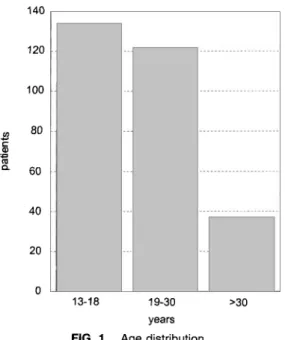
The age distribution of the 387 patients is shown in
Fig. 1. The majority were aged between 13 and 18 years.
140 120 100 80 3
5
P 60 40 20 0 13-18 19-30 >30 yearsFIG. 1. Age distribution.
Clear differences were found in age distribution between the various Centers: the United Kingdom had more pa- tients in younger groups, whereas Portugal had older patients. A children's hospital and an adult center par- ticipated in Italy. In the Netherlands, first referrals and children without medication having had their first seizure were investigated, as were known photosensitive pa- tients, generally receiving medication. The pooled data provided a good coverage of all age groups. For the total group, 220 were female and 167 were male patients. Only the patients from the United Kingdom had a dif- ferent sex distribution (i.e., 24 of the 35 were male and only 11 were female patients). The majority (66%) were using antiepileptic medications (AEDs). In Table 1, the reasons for referral are shown. Besides known photosen- sitivity, a history of seizures induced by television, video games, or sunlight were among the most frequently re- ported reasons. The detailed clinical history of the 387 patients revealed that most of them had a history of ton- ic-clonic, myoclonic, or absence seizures; some of them also showed partial or secondarily generalized seizures (see Fig. 2). Concerning the history of visually induced seizures, television-evoked seizures were 'found in 3 1 %
of all patients, sunlight-evoked seizures in 12%, video
TABLE 1. Category of referral in 387 patients
History of No. % TV 119 31 Video games 44 11 Computer games 25 6 Sunlight 48 12 Disco/artificial 28 7 Pattern 13 3
Known IPS positive 310 80
IPS, intermittent photic stimulation.
250 200
8
150 g 100 0.-
* 50 0tonic clonic myoclonic absence sz partlal, sec. other
gen. seizure type
FIG. 2. Clinical history and types of seizures in 329 patients.
game-induced seizures in 1 1 %, and discotheque seizures in 7%. Computer-evoked seizures were reported in 7%, whereas pattern-evoked seizures were rarely reported (3%).
Of all patients investigated, 328 (85%) showed epi- leptiform discharges evoked by IPS in the laboratory. The response to IPS appeared to be generalized in the vast majority of cases. In only 17 patients was focal epileptiform activity evoked by IPS. Forty-five percent of patients were sensitive to 50-Hz television, with all programs, including commercials, being taken into ac- count. The same ratio between generalized multifocal and focal epileptiform activity was seen as during IPS.
Pattern-sensitivity was seen in 104 (28%) of 369 patients that were investigated with pattern; about equal numbers of either generalized epileptiform activity or multifocal epileptiform activity were seen in these pattern-sensitive patients. The 100-Hz television was tested in 297 of the 387 patients, and 76 (26%) were 100-Hz sensitive. Again, all types of programs and commercials, including flashing patterns, were considered. Generalized epilepti- form discharges were seen in twice as many as were multifocal discharges. Only in the minority was focal epileptiform activity seen.
When the patients were divided according to reason for referral, two main categories could be compared: group 1 with a history of television, video-, or computer- game seizures (n = 149), and those known to have been photosensitive in a previous EEG recording (n = 173). In those groups, about equal numbers proved to be sen- sitive to intermittent stimulation and stimulation with the 100-Hz television. Significant differences were found with regard to pattern sensitivity and 50-Hz television sensitivity. The patients referred because of a television, video-, or computer-game seizure were significantly more sensitive to pattern and to the 50-Hz television
(x2,
p<
0.001). Although the duration of television stimula- tion was kept relatively short (3 min), a total period of 2 3 0 rnin recording was done during television stimula- tion. The likelihood of false positives, however, was rela- tively low, because only 59 of the total of 387 patients had spontaneous generalized epileptiform discharges in their EEGs; of these patients, 60% were sensitive to 50-Hz television. This means that possibly there is a slight overrepresentation of apparent 50- and 1 00-Hz television sensitivity because of spontaneous discharges.
All 387 patients were investigated with the video game, “Super Mario World,” and a standard, relatively nonprovocative television program. One hundred twenty-nine of the 387 proved to be sensitive to both. Furthermore, slightly more patients (56) were only sen- sitive at a distance of 0.5 m than at 1 m (39 patients), and 2 m (34 patients). Regardless of the distance, “Super Mario World” proved to be more provocative than the standard program (Wilcoxon signed-ranks test, p < 0.05). A total of 309 patients was investigated with both “Super Mario” viewing and playing; 83 appeared to be sensitive in both conditions. Slightly more patients were sensitive at 2 m or 1 m, compared with 0.5 m. Statistical analysis revealed that more patients are sensitive to “Su- per Mario” playing, compared with the standard pro- grams (Wilcoxon signed-ranks test, p = 0.000) and more sensitive with playing versus viewing (p = 0.016). Two hundred ninety-six patients were investigated with “Super Mario” and a standard program on the 100-Hz television; 35 of them were sensitive to both programs. More patients were sensitive at a distance of 1 or 2 m than at 1 m only. In 269 cases, “Super Mario World” was played on the 100-Hz television. No differences were found between the standard programs and whether view- ing or playing “Super Mario.” About one third of the patients sensitive for a 50- or 100-Hz television (“Super Mario” viewing, playing, and standard program) were sensitive for all three conditions. Furthermore, with the 50-Hz television, two thirds (21 of 34 patients) proved to be sensitive at the same distance, whereas only one third (three of nine patients) were sensitive for all programs on the 100-Hz television.
Fifty-seven percent of patients had never played a video game, and 10% often did so. Computer games were even less often used (67% never, 9% often). When a comparison is made with the television-sensitive pa- tients, the same distribution is found as in the total group. The sensitive patients do not play video games or com- puter games less often than those who are not.
Of the patients who are referred because of’a seizure in front of the television, or evoked by a video or computer game, 14% proved not to be photosensitive, but these nonphotosensitive patients do not differ with regard to use of AED or age. However, a significant difference could be found in sex: twice as many boys were found in the group that was not photosensitive, compared with those who were, whereas of the total group, two thirds were girls.
In the total group of 387 patients, only one proved to be pattern sensitive and not photosensitive. However, this patient has been photosensitive in the past, and with medication, this response was suppressed. Furthermore,
only 12 patients sensitive for 50- and 100-Hz television were insensitive to IPS.
In conclusion, of patients referred with television-, video-, or computer-game seizures, about 86% were sub- sequently found to be photosensitive in the laboratory; 58% to 50-Hz television and
25%
to 100-Hz television. Regardless of the program, patients were significantly more sensitive to 50-Hz than to 100-Hz television (p < 0.05). Nintendo viewing on a 50-Hz television appeared to be more provocative than the control program (p < 0.05). Nintendo playing on a 50-Hz television is more provocative than is viewing (p < 0.05). No differences between playing and viewing were found with 100-Hz television.DISCUSSION
A total of 387 patients with either a history of televi- sion, video-, or computer-game seizures (149), a history of visually induced seizures otherwise (37) or already known photosensitive patients (173) were investigated. About 90% of all these patients appeared to be photo- sensitive in the laboratory. This is in line with previous studies (7,8).
Only in the nonphotosensitive patients with a history of television, video-, or computer-game seizures was a male preponderance found. Because especially boys be- tween the ages of 10 and 20 years spend many hours playing video or computer games, it is possible that some of these patients had spontaneous seizures. Use of medi- cation was not a discriminative factor between those who were or were not photosensitive. It will be noted that the only patient who was pattern and not IPS sensitive had shown flicker-sensitivity before being medicated. Re- peated subsequent EEGs with a lower dose of valproic acid (VPA), however, revealed that he was photosensi- tive, albeit with a small photosensitive range. Photic stimulation is also the most provocative when a photic stimulator with a high intensity is used; in this case, all five centers used the same highly effective Grass photic stimulator (see Appendix to this volume). Furthermore, the method of photic stimulation was standardized; in all centers, all three eye conditions were used, and frequen- cies of 2-60 Hz were delivered. The homogeneity of the outcome may be attributed to standardized methods of investigation. In other studies, for example an epidemio- logic survey of EEG departments in the United Kingdom
(4), photic stimulation was performed in various ways, so that little reliability could be attached to the finding that patients were not photosensitive. About half of the patients were sensitive to 50-Hz, and -25% to 100-Hz television. Although the numbers were smaller in a pre- vious study by Kasteleijn et al., using the same methods, the same ratio between photosensitivity, pattern sensitiv- ity, and 50- or 100-Hz television sensitivity were found.
The finding that a 100-Hz television is in itself (i.e., regardless of the programs shown) less provocative in all patients than a 50-Hz television was previously demon- strated (9,lO). In daily clinical practice, some parents adopt the preventive measure of allowing their child to use only a 100-Hz television, instead of taking AEDs. For the minority who were sensitive to a 100-Hz televi- sion, no differences were found between “Super Mario” and a standard program. For the 50-Hz television, sig- nificant differences were found. This result explains why in December 1992, many reports of children having their first epileptic seizure while playing “Super Mario” at- tracted media attention. The same happened again in De- cember 1997 with the “Pokemon” red and blue flickering program. Playing the “Super Mario” game also is impli- cated in the French collaborative study (1 l), and since
1992, the packaging has carried a warning about sei- zures. Better advice would he that patients should be
22.5 m from the television when playing the game. Fur- thermore, if myoclonic jerks in the eyelids or arms occur, parents and children should be advised to test the child for photosensitivity and prohibit the child from playing until more information is available. These patients should be tested with a standardized method of IPS and television stimulation. Surprisingly, patients who ap- peared to be sensitive to a 50-Hz television had no dif- ferent habits of playing computer or video games than did those who were not. This is in line with information from some patients, in whom it is clear that although the patients are warned about playing games at a close dis- tance to the television set, they continued doing so.
Acknowledgment: This study was made possible by the grant Basic Research on Television Game-induced Seizures, from the International Commission on Electronic Screen Games and Seizures.
REFERENCES 1. 2. 3. 4 5 6 7. 8. 9. 10. 11.
Rushton DN. Space invader epilepsy. Lancet 1981;1:501. Daneshmend TK, Campbell MJ. Dark Wamor epilepsy. Br Med J 1982;2:1751-2.
Graf WD, Chatrian GE, Glass ST, Knauss TA. Video-game-related seizures: a report on 10 patients and a review of the literature.
Pediatrics 1994;93:551-6.
Quirk JA, Fish DR, Smith SJM, Sander JWAS, Shorvon SD, Allen PJ. Incidence of photosensitive epilepsy: a prospective national study. Electroencephalogr Clin Neurophysiol 1995;95:426G7. Takahashi T, Tsukahara Y , Kaneda S. Influence of pattern and red colour on the photoconvulsive response and the photic driving.
Tohoku J Exp Med 1981;133:129-37,
Binnie CD, Estevez 0, Kasteleijn-Nolst TrenitC DGA, Peters A.
Colour and photosensitive epilepsy. Electroencephalogr Clin Neu-
rophysiol 984;58:387-91.
Binnie CD, Jeavons PM. Photosensitive epilepsies. In: Roger J, Bureau C, Dravet FE, Dreifuss A, Perret A, Wolf P, eds. Childhood
and Adolescence. 2nd ed. London: Libbey, 1992:299-5.
Kasteleijn-Nolst TrenitC DGA. Photosensitive epilepsy as an age- related genetic disorder. In: Wolf P, ed. Epileptic seizures and
syndromes. London: Libbey, 1994:41-8.
Fylan F, Harding GFA. The effect of television frame rate on EEG abnormalities in photosensitive and pattern sensitive epilepsy. Epi-
lepsia 1997;38:1124-31.
Ricci S, Vigevano F, Manfredi M, Kasteleijn-Nolst Trenitk DGA. Epilepsy provoked by television and video games: safety of 100 Hz screens. Neurology 1998;50:79&3.
Badinand-Hubert N, Bureau M, Hirsch E, Masnou P, Nahum L, Parain D, Naquet R. Epilepsies and video games: results of a multicentric study. Electroencephalogr Clin Neurophysiol 1998;
107:422-7.