INDIAN JOURNAL OF APPLIED RESEARCH
X
685
Volume : 5 | Issue : 2 | Feb 2015 | ISSN - 2249-555XRESEARCH PAPER
Nurses’ Knowledge of The Themes Regional Food
and Food Security Before and After Trainning
Julliana dos Santos Aires
Ádria Marcela Vieira
Ferreira
Leidiane Minervina Moraes
de Sabino
Master of nursing.Federal University of Ceará, Fortaleza, Ceará, Brazil
Master’s nursing student. Federal University of Ceará, Fortaleza,
Ceará, Brazil
Master’s nursing student. Federal University of Ceará, Fortaleza,
Ceará, Brazil
Emilly Karoline Freire Oliveira
Mariana Cavalcante Martins
Nurse. Specialist of Neonatal Nursing. Federal University of Ceará, Fortaleza, Ceará, Brazil
PhD of Nursing. Federal University of Ceará, Fortaleza, Ceará, Brazil
Paulo César de Almeida
Lorena Barbosa Ximenes
Statistic. PhD of Public Health. State University of Ceará, Fortaleza, Ceará, Brazil
PhD of Nursing. Cnpq Researcher. Federal University of Ceará, Fortaleza, Ceará, Brazil
KEYWORDS
Nursing, Professional Training, LearningNursing
ABSTRACT The aim of this study was to measure the theoretical knowledge of nurses on regional food and on food
security, before and after training. A quasi-experimental study of before-and-after design, conducted with seven nurses working in the Family Health Strategy (FHS) located in a city in the rural area of the Ceará State, Brazil. In data collection, we used pre-test and post-test instruments before and after the training provided through the serial album. We verified that in nine of thirteen questions, nurses answered correctly both the pre-test and post-test ques-tions. On the other hand, in four questions remaining, not all nurses got the pre-test questions right and after training, there was an increase in the number of successes in post-test questions. Thus, we conclude that the training contrib-uted to the improvement of theoretical knowledge of nurses about regional food and food security.
INTRODUCTION
The Food and Nutrition Security (FNS) is defined as the right of all to regular and permanent access to quality food, in sufficient quantity, based on practices that pro-mote health that respect cultural diversity and that are so-cially, economically and environmentally sustainable (BRA-ZIL, 2006).
According to the last survey conducted in Brazil in 2013 it was found that 77.4% of households were in FNS situation. On the other hand, emphasizes that the Northeast region of the country had a higher percentage of food insecure - FI (38.1%) (IBGE,2013).
In this sense, it is known that FI can manifest itself in vari-ous ways, such as hunger, malnutrition and nutritional defi-ciencies (Oliveira et al., 2009). Because of this, it becomes more necessary to implement food-related measures in health services in order to minimize future complications.
Among the actions developed in Brazil to ensure the FNS of the population, we can highlight the dissemination of regional food. These have a low cost, easy access and high nutritional value, contributing to the quality of food and helping to reverse the situation of nutritional deficien-cies, especially in children (BRAZIL, 2002).
In this context, encouraging the consumption of regional food through food and nutrition education becomes an al-ternative to the performance of health professionals. Thus the integration between theory and practice is favored when using educational approaches and problem-solving processes, enabling dialogue between professionals and
population (BRAZIL, 2012), replacing the simple transfer of information for the construction of knowledge from the ex-perience of each individual.
From this perspective, primary care, by its interdisciplinary character, becomes a privileged place for actions to en-courage appropriate infant feeding. Thus, it is necessary that professionals have knowledge about the cultural prac-tices of food supply.
In view of the above, knowing that promoting eating hab-its in childhood is a major challenge for professionals, this study aimed to measure the theoretical knowledge of nurs-es about the thematic “regional food” and “food security and nutrition”, before and after a training process.
MATERIAL AND METHOD
Quasi-experimental study developed with seven nurses working in the Health Strategy teams of family rural area of a city in the metropolitan area of Fortaleza, Ceará, Brazil.
Data collection occurred from August to October 2012, during which the nurses participated in a training process using the serial album Regional Food promoting food se-curity. This serial album consists of seven illustrations and five script-cards, which address situations related to infant feeding, especially “food and nutrition security” and “re-gional foods” (Martins et al., 2012).
686
X
INDIAN JOURNAL OF APPLIED RESEARCH
Volume : 5 | Issue : 2 | Feb 2015 | ISSN - 2249-555X
RESEARCH PAPER
questionnaires consist of thirteen issues and address the themes on the album. However, the order of questions and the structure of the questionnaire was modified in an attempt to minimize recall bias. It is noteworthy that both have been validated and the issues identified as clear/un-derstandable and relevant; and Content Validity Index (CVI) of 0.95 in the pre-test and post-test 0.94.
The data were presented in tables. The descriptive analy-sis was conanaly-sisted by absolute and relative frequencies; and averages. It was held the statistical test that compared two proportions in an attempt to evaluate the difference in the number of correct pre-test questions in relation to post-test. For all inferential analyzes it were considered statisti-cally significant when p <0.05.
The project was approved by the Ethics Committee of the Federal University of Ceará under protocol No. 353/11.
RESULTS
With regard to the profile of participants, it was observed that all were female with a mean age of 32 years, about six years graduated and working time in the city of on av-erage of four years. As for the title, five graduate profes-sional had post-graduation (N = 5; 71.4%) in the areas of neonatology, pediatrics, public health and obstetrics. In addition, five (71.4%) reported having participated in train-ing before other subjects.
All knew the definition of the terminology regional food. However, only four (57.1%) of them had prior knowledge about the concept of food and nutrition security.
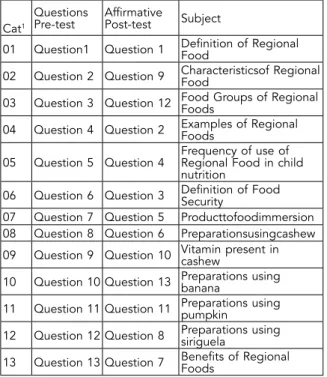
To facilitate data analysis, due to the difference in the structure of the assessment of the instruments, it was de-cided to organize the questions of the pre-test and post-test statements into categories by subject, as those de-scribed in Table 1.
Table 1. Question distribution of pre and post-test ac-cording to subject categories about regional food and food security. Ceará, 2012.
Cat1
Questions
Pre-test Affirmative Post-test Subject
01 Question1 Question 1 Definition of Regional Food
02 Question 2 Question 9 Characteristicsof Regional Food
03 Question 3 Question 12 Food Groups of Regional Foods
04 Question 4 Question 2 Examples of Regional Foods
05 Question 5 Question 4 Frequency of use of Regional Food in child nutrition
06 Question 6 Question 3 Definition of Food Security 07 Question 7 Question 5 Producttofoodimmersion 08 Question 8 Question 6 Preparationsusingcashew 09 Question 9 Question 10 Vitamin present in cashew
10 Question 10 Question 13 Preparations using banana
11 Question 11 Question 11 Preparations using pumpkin
12 Question 12 Question 8 Preparations using siriguela
13 Question 13 Question 7 Benefits of Regional Foods
1Cat: Category
Table 2 shows the distribution of instruments subject cat-egories against nurses who answered correctly.
Table 2. Distribution of the number of nurses’ correct answers in pre-test and post-test questionnaires accord-ing to the subject categories about regional and secu-rity food. Ceará, 2012.
Cat1Subject Nurses
p2 Pre-test Post-test
1 Definition of Regional Food 7 7
-2 Characteristicsof Regional Food 7 7
-3 Food Groups of Regional
Foods 5 7 0,774
4 Examples of Regional
Foods 7 7
-5
Frequency of use of Regional Food in child nutrition
7 7
-6 Definition of Food Se-curity 4 6 0,754
7 Producttofoodimmersion 7 7 -8 Preparationusingcashew 5 6 0,999
9 Vitamin present in cashew 7 7
-10 Preparations using banana 7 7
-11 Preparations using pump-kin 7 7
-12 Preparations using siriguela 4 7 0,549
13 Benefits of Regional Foods 7 7
-1Cat: Category
2Test paired proportions
According to Table 2 data, it can be seen that the thirteen displayed categories in nine of them (N = 7; 100%) all nurses answer correctly both pre-test post-test questions.
Although the p values found in category 3, 6, 8 and 12 were not statistically significant - indicating that the num-ber of correct answers in the pretest was equal/similar to post-test in each subject category – there was an increase of the number of correct answers by the nurses at post-test.
It is clear, then, at the post-test, that in the categories 3 and 12 all nurses marked the correct answers. And the cat-egories 6 and 08 there was an increase in the number of correct answers compared to pre-test.
DISCUSSION
Regarding the professional aspect, the profile of the nurses participants of this study is similar to other research (Almei-da et al., 2011) that evaluated the theoretical knowledge of nurses and noted the predominance of women (80.8%) of the average age of 36.2 years and 71.2% attended graduate.
INDIAN JOURNAL OF APPLIED RESEARCH
X
687
Volume : 5 | Issue : 2 | Feb 2015 | ISSN - 2249-555XRESEARCH PAPER
theoretical framework to guide the population adequately (Leite et al., 2012).
From the evaluation of nurses theoretical knowledge, it was observed that in nine categories the number of cor-rect answers in the pre-test was the same as the post-test.
Among these, the numbers 1, 2, 4, 5, 7 sand 13 refer to the definition of regional food, its features, exemplifying these foods, as well the frequency of use in infant feed-ing, hygiene care and the benefits of the same. It can be inferred that despite the nurses were not trained previously in relation to theme, the very existence of them in Basic Health Units of the countryside may have promoted an ap-propriation of such information, allowing them to answer the questions so correctly.
Furthermore, the categories 9, 10 and 11 refer to vitamin present in cashew, as well as the preparation of options using banana (enriched crumbs with banana peel) and pumpkin (pumpkin puree). Such knowledge can be justi-fied due to regional characteristic of these foods (Martins et al., 2012) and the broad dissemination of revenues by the Social Service of Ceará Industry and Ministry of Health, respectively.
On the other hand, in the other categories (3, 6, 8 and 12) not all nurses answered correct the pre-test questions. Cat-egory 3 refers to food groups of regional food. Therefore, it is assumed that the nurses may have had difficulty an-swering this question, because the terminology is not used by them in their daily lives.
In addition, only four nurses were aware about the con-cept of FNS (category 6). This difficulty was found in a study that assessed the understanding of health profes-sionals about the FNS (Ramos & Cuervo, 2012) and found that most did not know how define it; and tried to estab-lish some concept, dissociated the definition of FNS as the right to food for all individuals.
Also found in the pre-test only four nurses knew the juice siriguela leaf (category 12) and this fact is justifiable since
this type of preparation is not yet present in official pub-lications. However, it is believed to be important that pro-fessionals know this option in view that the study conduct-ed on determining the chemical composition of Spondias purpurea L. leaves (siriguela) detected that the lea had 2.40 grams of lipids and 0.10 grams of lipids in the fruit; as well as higher energy value (113 kilocalories) in the leaf relative to fruit (83 kilocalories) (Reis, Arruda & Oliveira, 2007).
In this sense, among the regional food (banana, pumpkin, cashews and siriguela) on the serial album it is noticed that the nurses knew these foods, as well as their availability in the region, however, they did not use to guide the intro-duction of them in child feeding.
These findings corroborate with the research conducted in the city of Rio de Janeiro-Brazil which showed that some health professionals have difficulty in orienting the intro-duction of new foods, as well as mothers also have limi-tations to follow the recommendations (Ferreira, Castro & Menezes, 2009 ), stressing the need to spread the benefits of the food for the child.
CONCLUSIONS
Nurses have a satisfactory theoretical knowledge about the “regional food” and the “food security and nutrition”. However, despite the good performance of the same it is necessary monitoring and practical deepening on the sub-ject in order to encourage them to enter the use of the guidelines of regional food by households.
This allows us to reflect how much becomes important to develop studies involving not only the performance of in-dividual training, but also studies This allows us to reflect how much becomes important to develop studies involving not only the performance of individual training, but also studies that seek professional health education in an effort that professionals rethink their behavior, strengthen team-work and transform their practices in order to improve the quality of nutrition of children and their families.