1. INTRODUCTION
On the back of windfall revenues from oil and gas exports, Russia has transformed itself from a defunct military superpower into a new energy superpower. Passing from the cold war geopolitics to actual geo-economics during Vladimir Putin leadership has been a constant factor in international politics in Central Asia. As states who possess the largest known natural gas reserves of any state on earth, along with the second largest coal reserves, and the eighth largest oil reserves, the world fourth largest electricity producer, Russia is the world’s leading net energy exporter and a major supplier to the most developed areas of the world. Due to that reason it defi nes activities not only in the international economic and political relations but has signifi cant impact on the energy markets, producers and consumers of vast natural resources, natural gas and crude oil.
Having natural energy resources Russia infl uences markets and economic growth in parts of the most developed world. This crucial position of Russian Federation (R.F.) in the respect of the one of the largest supplier of the
natural energy resources puts questions concerning its policy, especially in Central Asia. Policy which implicates not only energy markets but economic security of the different countries from distant part of the world. Will this position allow Russia to uphold signifi cant impact of development and wellbeing of Central Asia countries? How Russian Federation will use vast natural resources to rebuild its status and prestige not only in this part of the world but also in other regions? Will the outgoing effect of Russian Federation approach to Central Asia serve to “obtain” its “area of infl uence” in this part of the world as an effect of its policy? Are those questions only an imagination from the past?
The essence of Russian policy towards Central Asia and adjacent regions consists in conducting economic activities determining geo-political activities. They are subordinated to the Russian Federation’s tendencies to rebuild the importance and infl uence that the Soviet Union once had. The multi power policy with the Russian signifi cant role of shaping international relations remains one of the top priorities enhanced by Vladimir Putin [1]. Therefore, the methods of cooperation, competition
SECURITY IMPLICATIONS
OF RUSSIAN FEDERATION ENERGY POLICY
IN CENTRAL ASIA
Aneta NOWAKOWSKA-KRYSTMAN
Assistant Professor PhD, Vice-Rector for Students Affairs, National Defense University, Warsaw, Poland
The importance of Central Asia region in energy market creates certain approach of Russian Federation. It infl uences not only situation in the region but also short and long term prospects of economic development of adjacent regions, i.e. North, East and South Asia, the Middle East and Europe. Russian economic policy determines and defi nes certain forms of international cooperation, which, in turn, results in its importance for international political relations. The article points out the essence of Russian Federation policy towards Central Asia and adjacent regions which consists in conducting geo-economic activities determining geo-political activities.
and confrontation used by the Russian diplomacy towards the countries in this region and also to entities from outside such as the European Union serve that purpose. The considerations in this article focus on problems concerning the essence of Russian energy policy and forms of its pursuing towards Central Asia.
2. POLITICAL OUTLINE
Russia’s activities in the energy sector result from a planned government policy aiming at increasing its importance on the international arena The effect of these activities is shown in the document “The Russian Federation’s Energy Strategy up to 2030” which was commissioned for the Ministry of Power and Industry of the Russian Federation by the most important Russian research centers that deal with power industry [2]. This document stipulates the extension and upgrading of Russian economy due to the use of energy sources. The energy sector is treated as a driving force for Russian civilizational progress, as well as a tool of international policy. It makes a vital determinant of the Russian way of thinking relating to the future of the Russian Federation.
The following elements in Russian Federation politics are crucial: the reform of the energy sector, strengthening Russian export, ensuring the economic security of the state, upholding and reform of social structures and – generally - up keeping steady progress in political reforms of state and its armed forces. One of patterns of politics, which serves the idea “great Russia”, is gaining infl uence on international energy resources’ markets (the prices of gas and crude oil are an important external factor infl uencing the Russian Federation economy in the 2030 perspective). This creates a certain political imperative resulting from Russian mentality and attitude to social reality. This imperative is expressed in the Russian Federation’s tendency to:
• gaining by Russia a decisive or full control of energy resources’ supplies to neighboring Central Asia countries;
• taking over a substantial part of shares or full control of energy distributors in Central Asia neighboring countries;
• decisive or complete dependence of Central Asia neighboring countries on Russian economic policy and as well energy factor.
On this background, the main aim of the Russian Federation seems to be:
• diversify the energy resources’ transport trails from Central Asia to gain maximum level of oil and gas which will prevent seeking for its alternatives in extracting and as well production and transport; • decrease dependence of Central Asia
states on Russian transit routes. As a consequence, the essence of Russian policy towards Central Asia and adjacent regions consists in conducting geo-economic activities determining geo-political activities. These activities are subordinated to the Russian Federation’s tendencies to rebuild the importance and infl uence [3]. Methods of cooperation, competition and confrontation used by the Russian diplomacy towards the countries in this region serve that purpose. Experiences of economic integration in the Central Asia region until now point to the principally political motives of the agreement which Moscow has lobbied for.
Instead of the Red Army, the penetrating forces of Moscow’s power in Central Asia are now its exports of natural gas, crude oil, electricity, as well cultural products and consumer goods. Because the recent developments in the oil and gas sectors are seen in these political rather than economic terms, the easy conclusion is drawn that it will all end in tears, since it is readily assumed that only Russian or mixed Russian - local oil and gas companies can deliver, and to do this only they are to able to buy up reserves. Rather than keep berating Russia for its approach to the energy sector, it might be better to recognize that below the ugly politics lays a deeper rationale.
of 73–80 billion cubic meters per year in East Siberia and the Far East (however, there is not a forecast of natural gas export into Asia and Pacifi c region, which according to the document in force is to reach 80 billion cubic meters, Transneft is currently building a pipeline from Eastern Siberia to the Pacifi c. Its opening is planned in 2015-2017). Nonetheless, this document does not assume considering two topics: activating new gas fi elds in East Siberia and Russian Far East and Russian energy expansion into North and South-Eastern Asia [4]. Only the project to build a gas pipeline Altai to China was included as an infrastructure priority. In fact, this state may result from uncertainty concerning developing new areas of excavation and strengthening Russia’s position in the region of Asia and Pacifi c as it refers to the economic development of remote regions and directly the Russian Federation’s territorial integrity.
A crucial determinant of Russian energy policy worth mentioning is the Russian Federation’s current uncertainty concerning prospects of excavating and distributing energy resources from Central Asia to the most developed economic actors of the planet: European Union and China. In response to these countries’ investments and activities, the R.F. has undertaken a diplomatic offensive aiming at Central Asian states’ withdrawal from their own undertakings (i.e. without Russia’s participation). This kind of situation we may fi nd in fi nancial conditions offered by Russian energy businesses to Azerbaijani and Turkmenistani producers. Comparing to the beginning of the early 1990s, such as state oil companies KazMunaiGaz of Kazakhstan and SOCAR of Azerbaijan, which plan to expand their business operations within and beyond their own borders, are not accepted. Created by R.F conditions serves to induce them to withdraw from their energy policy that they have been carrying out in recent years. If it happens, the Russian Federation will fulfi ll its energy policy on the post Soviet areas and will remain the only liquid fuels producer and supplier [5]. If it fails, the whole of political enterprises based on
geo-economic may bring about fewer benefi ts than expected.
3. FORMS OF RUSSIAN ENERGY POLICY TOWARDS
CENTRAL ASIA
According to the assumption that conditions to overcome internal threats to Russia as a producer must be ensured, Russia’s transformation into European and Asian natural gas hub as well oil supplier. Russian Federation gas and oil companies are tasked to use optimally its own infrastructure in order to controlling transport and transit streams from Central Asia. Gasprom, Rosnieft, Lukoil insists on long-term contracts and rejects any attempt to open up its pipelines to third parties out from the region. That is why the European Union’s European Commission is getting nowhere in its negotiations with Russia. This kind of asymmetry in economic relations provides Russia with a certain amount of leverage in the short run. As the past has shown, however, attempts to exploit this asymmetry have not caused major policy change in the affected countries. A strong limitation for Russia to make use of the asymmetry lies in the fact that many smaller purchasers are at the same time producers and transit countries.
will remain for thirty years. Preceded it, approved in February 2013 version of Russian Federation Foreign Policy Concept. It announced a shift towards Asia. Ukrainian crisis and forming his consistency Western economic sanctions against Russia are just a catalyst decisions that have to be made much earlier. President of the Presidium Council, Foreign and Defense Policy - the infl uential think-tank committed to developing strategic concepts at the request of the Presidential Administration of Russia – Fyodor Lukyanov, expressed option that searching for new alternative political solutions for close cooperation with the Western world was considered much earlier, sprung up before the fi rst symptoms of the crisis in relations between Russia and the West. Two options were analyzed: fi rst one, take the efforts that Russia could become an independent pole of attraction and, the second one, engage in cooperation with other centers of a multipolar world. Since the possibility of forming an independent “second pole” remained and remain limited (despite the fact that Russia’s infl uence on the post-Soviet area are still signifi cant), was taken realization of the second variant: cooperation [7]. The choice of a partner for cooperation fell on China. The lack of trust and long-standing disputes (ideological , boundary), which divided the two countries went to plan further in the face of the need for joint counter the strength of the United states, which occurs in Asia.
Announcing more explicit American presence in Asia was the direct cause for which both Russia and China have begun to pay more attention to the activity on the forum of the Shanghai Cooperation Organization. If SCO accede to India, Pakistan and Iran, internal negotiation process within the organization considerably more complicated, and variants of the coalition would be much more than now. First of all - the position would have been noticeable marginalization of post-Soviet Central Asian states, particularly Kazakhstan, whose president demonstrates the ambition of creating the center of
supra-regional infl uence. This situation relays on question of competitors against Russian domination in energy sector and as well economy.
4. MEANING OF CENTRAL ASIA IN THE SECURITY CONTEXT
Security meaning of Central Asia relays on signifi cant issue of progress and development of countries out of area and placed in adhere regions. This is very strong combined with means of policy, especially in economics in international organizations [8]. One of the leading issues for Central Asia countries is access to the world markets. Vast natural resources being placed in this region gives opportunities to create different types of economic cooperation on ground of political agreements and infrastructure.
In the 21st century reliable sources
of energy has became one of the crucial global security issues of the. Particularly in context of modern economies depend. The present meaning of the countries from Central Asia can be described by their participation in oil and gas production. Their infl uence on energy markets stay groves since dissolution of Soviet Union. Particular in the crude oil and natural gas production Central Asia countries has demonstrated that are a serious player.
Figure 1. Central Asia pipeline connections
Source: Presentation of Ambassador Richard Jones, Deputy Executive Director, International Energy Agency, The Politics of Central Asian and Caspian
Table 1. Crude oil and natural gas production Source: The World Factbook 2011
Rank Country Raw material
Crude oil – production (million bbl/day), 2011 est. 1 Kazakstan 1.635 bbl/day 2 Kyrgystan 1,000 bbl/day 3 Azerbejdan 987,000 bbl/day 4 Turkmenistan 222,200 bbl/day 5 Tajikistan 215 bbl/day 6 Uzbekistan 104,400 bbl/day
Natural Gas Production (in m3) (T), 2009 est.
1 Uzbekistan 61,410,000,000 2 Turkmenistan 38,100,000,000 3 Kazakhstan 35,610,000,000 4 Azerbaijan 16,520,000,000 5 Tajikistan 38,000,000 6 Kyrgyzstan 15,400,000
Economic security of the World and its dependence on Central Asia allow to better understand the well-being dilemmas of survival and prosperity in today’s more complex world. The present situation in fact excludes countries from Central Asia from open access to the global market. This is due to the historical development of Central Asia’s economic ties during USSR times and after the dissolution of the Soviet Union.
At present three players focus on Central Asia, Russian Federation, China, and European Union. Each of them has different types of interests and approach towards the region.
In Russian Federation view, effect of policies of other countries in Central Asia harms Russia’s vital interests. Mainly trough changing its position in the gas sector and crude oil sector though setting rules of infrastructure operator (operator of oil and gas pipelines and depots); transparency, as well as equal access to information in accordance with international fi nancial standards and practices; set tariffs and enabling access to the oil and gas networks according to international standards.
Till now China has proposed a new concept of energy security for Central Asia countries. It is based on win -win cooperation, diversifi ed supply and coordinated protection of energy. China endorses regional dialogues and cooperation and has played a constructive role in regional mechanisms, including economic one with countries from the Central Asia region [9]. The energy exploration and use; research and development and promotion of new technologies and maintenance of a positive political climate for energy security creates long-term basis for international community activeness dedicated to countries from and out of the Central Asia region [10].
In case of European Union and Central Asia countries the economic relations relaying on energy ties are more complicated. The result of the Russian Federation’s multidimensional and complex energy policy in the Central Asia region is to achieve a privileged position of a supplier and supervisor of energy power resources to countries located on the European continent, most of all to the European Union. This enables Russian Federation’s permanent infl uence on the EU economic development and its fi nances. Due to this, the economic and fi nancial goals naturally match the political ones creating the possibility to gain permanent infl uence to subordinate European Union’s countries’ interests to the Russian ones.
Figure 2. Potential Access to Major World Markets
Here must be stressed the co-dependency of Russian activities and the ways of conducting them. Gaining infl uence is accompanied by promoting the bilateral cooperation with Russia. It is vital in case of political elites, fi rst of all of the Western European countries, and political ones. Consequently, in the context of Russian energy power businesses, Gazprom in particular, the breaking through year was 2006 when, in fact, the European Union’s principles in force on 1st July 2007 limiting monopolistic practices were discredited. The participation of Gazprom in the European gas sector, i.e. transport, distribution and trade deepens the European Commission’s diffi culties with enforcing the European Union’s law on this market. On this background, the principles of cooperation taking into account in their formula an equal access of one party to the energy market of the second party which were included in the document called the Energy Charter were also discredited [11]. It must be underlined here that this document contradicts the principles of the Russian energy power policy due to the fact that in the practical dimension it stipulates, among others, the abolition of Gazprom monopoly on natural gas deliveries from Russia and Central Asia. Similarly, the Russian Federation’s activities question the European Union’s energy security strategy [12].
For Russia, playing a leading role of liquid fl uids’ supplier to the European Union’s countries creates a certain political imperative which results from Russian mentality and approach to social reality. This imperative is expressed in the Russian Federation’s tendency to achieve a decisive or full control of energy power resources’ supplies to the European Union and consequently, taking over a substantial part of shares or full control of energy distributors in the European Union’s countries and, moreover, a decisive or complete dependence of the European Union on the Russian energy factor. This indirect may be confi rmed by Vladimir Putin issues a decree ‘in defense’ of Gazprom [13].
5. CONCLUSIONS
Changes taking place in regional and global politics have a substantial impact on the signifi cance of Central Asia. The evolution of Russian aspirations in the international arena and reorientation (pivot) for Asia and the Pacifi c has become more clearly visible during the confl ict Ukrainian. The pace of change may indicate the offi cial position regularly occurring transformation objectives and priorities of Russian diplomacy [14], especially regarding the international market energy market. In this respect effi cient economic ties regarding energy (mainly oil and gas) are consolidating. The Central Asia area plays a great role in the international oil and gas market. It should be underlined that the Eurasian market, raw materials coming from the Central Asia area, creates for the moment the major alternative to oil produced by OPEC countries. In this context Russian Federation energy policy keeping a strong position in this market remains a priority. A different political relationship between Russian Federation and Central Asia Countries, as well countries from the most developed regions of the world affect the importing and exporting nations and their placement on economics relation gravity map.
It seems that Russia believes that the new world order will be shaped by a progressive shift in the distribution of power in favor of non-Western states and that this will bring with it increasing competition over access to raw materials, especially crude oil and natural gas. Taking into consideration fact that Russian political elite proceeds on its understanding that the international security order should be
negotiated on the basis of the national interests of the leading world powers it can be estimated that countries with similar patterns of bilateral commerce and an affi nity for bilateral trade will be close one to another. This creates basis for international cooperation among countries placed in Central Asia but will affect cooperation with those from other regions.
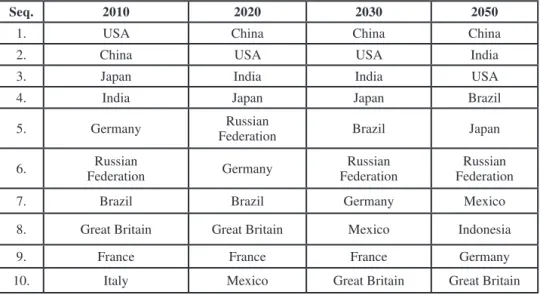
Table 2. Ten greatest economy’s of the World according to purchasing power parity
Source: HM Government, „Let’s choose growth. Why we need reform to unlock Europe’s potential”, 2011
Seq. 2010 2020 2030 2050
1. USA China China China
2. China USA USA India
3. Japan India India USA
4. India Japan Japan Brazil
5. Germany FederationRussian Brazil Japan
6. FederationRussian Germany FederationRussian FederationRussian
7. Brazil Brazil Germany Mexico
8. Great Britain Great Britain Mexico Indonesia
9. France France France Germany
10. Italy Mexico Great Britain Great Britain
There may however be noted that this situation may change with the infl uence of the United States, and its energy policy. Replacement of Russian gas supplies to the EU market for the supply of liquefi ed shale gas in the US will open new period in relations among Central Asia states. Furthermore, economic sanctions which Europe and the US applied to Russia in response to Russia’s behavior towards Ukraine have an additional, diffi cult to predict outcome: spoiled Russian gas interests with China [15]. Despite this, the Russian authorities are not giving up strategic documents referred to in FR ambitious development plans that require huge investments [16].
There is no doubt that in the coming years, the Central Asian states will be
forced to declare choose one of the three options dictated to them: integration projects promoted by Russia (Eurasian Economic Community, the Customs Union), the Chinese of the “New Silk Road” supported the benefi ts of (fi nanced mainly by China) SCO, and fi nally a proposal to strengthen cooperation with the United States, eager to maintain its presence in the region after leaving Afghanistan.
NOTES AND REFERENCES
[1] As a multi-polar world actors are also mentioned: a group of emerging economic powers conventionally defi ned as B (R) ICs, the Islamic world (trying to defy the spiritual values of Islam material values, the concept of radical Islamists symbolized by the broader West), and even the European Union. As the most similar to the model in describing the reality of the global balance of power is assumed, however, the paradigm “multi polarity”, which provides the existence of many (more or less attractive) centers of attraction. However, signifi cant changes in international politics, including the Ukrainian crisis, were factors which resulted in increased activity of most important players in the political arena. Local political poles of gravity (“regional powers”), the dynamism of action, which would prove their political, economic, cultural attractiveness and thus to bring together additional entities. At the same time, however, it was next door (despite) the phenomenon of multi polarity in global policy processes underway whose job it is - it seems - to rebuild a bipolar world, that is, the restoration of the second pole of infl uence.
Sources: Jim O’Neill, Building Better Global Economic BRICs, Goldman Sachs Global Economics Paper No: 66, available online at: http://www.content.gs.com/ japan/ideas/brics/building-better-pdf.pdf, accessed on: October 20, 2014; Gunilla Herolf, “Multipolar World at the End of the First Decade of the 21st Century: How about Europe?”, in Central European Journal of Public Policy, Center for Social and Economic Strategies (CESES), Faculty of Social Sciences, Charles University in Prague, Czech Republic, Volume 5, Number 1, June 2011, pp. 4-22.
[2] Energy Strategy of Russia for the period up to 2030 approved by Decree No. 1715-r of the Government of the Russian Federation, dated 13 November 2009, Ministry of Energy of the Russian Federation, Moscow 2010.
[3] On 5 July 2010 in Astana, the presidents of the states which make up the customs union, Russia’s Dmitri Medvedev, Kazakhstan’s Nursultan Nazabayev and Belarus’s Alyaksandr Lukashenka, signed a declaration on the entry into effect of the joint Customs Code. This formally signifi es the
creation of a Customs Union (CU) between these states, although in reality it will only be a substitute for one. Despite its limitations, the CU may prove to be advantageous for these countries’ economic co-operation. Over the last 20 years, economic relations between Russia and the countries of the former USSR have loosened. In the years 2004-2008, Kazakhstan and Belarus’ shares of exports to Russia in these countries’ total exports fell, by 11% (to 9%) and 18% (to 32%) respectively. Experiences of economic integration in the region until now (which include failures to respect agreements which have been concluded) point to the principally political motives of the agreement which Moscow has lobbied for, considering the invariability of Russian interests.
Source: Iwona Wisniewska, “The customs union: Russia’s political project”, EASTWEEK 2010-07-07, available online at http://www.osw.waw.pl/en/publikacje/ eastweek/2010-07-07/customs-union-russia-s-political-project, accessed on October 22, 2014.
deposits of around 1.7 billion tones), and the possibility for ExxonMobil to participate in production on these fi elds in the future.
Source: Ewa Paszyc, “Russia: Rosneft and ExxonMobil strike another deal”, EASTWEEK 2012-04-18, available online at http://www.osw.waw.pl/en/publikacje/ eastweek/2012-04-18/russia-rosneft-and-exxonmobil-strike-another-deal, accessed on March 18, 2014.
[5] On 15 December 2011, the Caspian Pipeline Consortium (CPC), which is the owner and the operator of the Tengiz– Novorossiysk oil pipeline, made the fi nal decision to increase the pipeline’s fl ow capacity from the present level of 28 million tones of oil annually to 67 million tones in 2015. The consortium’s decision means that the pattern of oil export from Kazakhstan will be preserved, and the key roles will still be played by Russia as the transit country and Europe as the outlet. Around 75% of the oil exported from Kazakhstan is transported through Russian territory, the Tengiz–Novorossiysk pipeline being the key transport route (carrying around 40% of Kazakh oil exports). Increasing the pipeline’s capacity means that within a decade, Astana will have guaranteed its oil export routes and may feel free to increase production. Moreover, Europe will remain the main destination for Kazakh oil exports (especially its southern part, the Black and Mediterranean Sea basins). The signifi cance of the Tengiz-Novorossiysk pipeline may decrease, and exports via the Caucasus may develop only by the end of the next decade, when production in the Kashagan fi eld starts and the planned large export of oil via the Caspian Sea is launched.
Source: Alexandra Jarosiewicz, “Russia as the main corridor for oil export from Kazakhstan”, EASTWEEK 2010-12-29, available online at http://www.osw.waw. pl/en/publikacje/eastweek/2010-12-29/ russia-main-corridor-oil-export-kazakhstan, accessed on October 26, 2012.
[6] On 22 October 2012, Rosneft announced the conclusion of an agreement with BP to buy back 50% of shares in TNK-BP (which TNK-BP owns) for US$17.1 billion, as well as 12.85% of Rosneft own shares . For part of that sum ($4.8 billion) – after the government and the relevant authorities
(including the anti-monopoly service) give their formal approval – BP will buy a 5.56% stake in Rosneft (from the state-owned Rosneftegaz company).If the deal is fi nalized, BP’s share in Rosneft’s capital will have risen from the current level of 1.25% to 19.75%. Rosneft has also agreed a pre-investment with the Russian AAR consortium (Alfa Group, Access Industries and Renova) to buy back the remaining 50% stake in TNK-BP owned by the consortium for US$28 billion. The details of both transactions are to be agreed by mid-2013. This transaction would allow Rosneft to take total control over TNK-BP, the third largest Russian oil company by extraction (which produced about 84 million tones in 2011). Rosneft plans to fi nance the transaction from its own funds, loans from Western banks, and funds rose from a bond issue. The alliance between Rosneft and BP should give Russia access to the latest technologies for developing and producing crude oil from the fi elds in Western Siberia, which are diffi cult to exploit, as well as from the Arctic shelf.
Source: Ewa Paszyc, “Russia: Rosneft announces it will take control of TNK-BP”, EASTWEEK, 2012-10-24, available online at http://www.osw.waw.pl/en/publikacje/ eastweek/2012-10-24/russia-rosneft-announces-it-will-take-control-tnkbp, accessed on October 25, 2012.
[7] Ф. Л , -З , “ ”, available online at http://www.rg.ru/2014/06/25/lukjanov.html, accessed on August 10, 2014.
Cooperation Organization (ECO), and the Special Programme for the Economies of Central Asia (SPECA).
[9] The Shanghai Cooperation Organization (SCO), the Asia-Pacifi c Economic Cooperation (APEC) forum, and the Asia Cooperation Dialogue (ACD).
[10] It should be underlined that the Chinese economy has escaped almost unscathed from soaring international oil prices owing to its relatively low oil dependency compared to many Western countries.
[11] This document expressed common approach of the EU countries to the energy security issue taking into consideration the second party’s interests (potential contracting party).
Source: Lenka Kovačovská, “European Union’s Energy (In)security – Dependence on Russia“, Defence&Strategy, 2/2007, 7–9.
[12] Its second priority stipulates the European countries’ energy power solidarity through mutual assistance in crisis and it identifi es actions to prevent such a situation. These provisions gradually become illusory.
Source: Green Paper on A European Strategy for Sustainable, Competitive and Secure Energy, 2006/03/08, COM (2006)105.
[13] 11 September 2012 saw the publication of a decree by President Vladimir Putin concerning “measures to protect the interests of Russia in respect to the conduct of foreign economic activity by Russian legal entities”. This document covers part-state-owned joint-stock companies which are listed as strategic enterprises, and the companies dependent on them. Te decree obliges such companies to obtain prior consent to act from the federal government of Russia in three situations: (1) the disclosure, at the request of the authorities of other countries, international organizations and international
structures, of information on their activities (other than those disclosed in Russian law, and those concerning information related to the issue of securities); (2) if changes are to be made in contracts entered into by strategically important companies (including changes to prices); and (3) the sale of foreign assets belonging to Russian strategic companies.
Source: Szymon Karda , “Vladimir Putin issues a decree ‘in defence’ of Gazprom”, EASTWEEK 2012-09-12, available online at http://www.osw.waw.pl/en/publikacje/ eastweek/2012-09-12/vladimir-putin-issues-a-decree-defence-gazprom, accessed on October 30, 2012.
[14]
Ф .
ITAR-TASS Agency, available online at http://itar-tass.com/spravochnaya-informaciya/1289883, accessed on July 07, 2014.
[15] Meticulously kept secret Russian-Chinese gas contract turned out to be, as can be judged, much less fi nancial success than anticipated Russians. The negotiated price - probably $ 350 per thousand m3 - turned out to be lower than the sales price to the European markets.
Source:
« » Jurnal
“Izviestia” z 22.05.2014 r., available online at http://izvestia.ru/news/571201, accessed on May 22, 2014.
[16]
Л 2030 , “Izviestia” 8.05.2014 r., available online at http://izvestia. ru/news/570482, accessed on June 17, 2014);