doi: http://dx.doi.org/10.3391/mbi.2012.3.2.05
© 2012 The Author(s). Journal compilation © 2012 REABIC
Open Access
Research Article
Allelopathic effects of the invasive
Prosopis juliflora
(Sw.) DC. on selected native
plant species in Middle Awash, Southern Afar Rift of Ethiopia
Samuel Getachew1*, Sebsebe Demissew2 and Tadesse Woldemariam3
1 Ethiopian Institute of Agricultural Research, P.O.Box: 70209, Addis Ababa, Ethiopia
2 Addis Ababa University, P.O.Box: 3434, Addis Ababa, Ethiopia
3 Environment and Coffee Forest Forum, P.O.Box: 28513, Addis Ababa, Ethiopia
E-mail: [email protected] (SG), [email protected] (SD), [email protected] (TW)
*Corresponding author
Received: 18 June 2012 / Accepted: 30 November 2012 / Published online: 24 December 2012
Handling editor: Elias Dana, University of Almeria, Spain
Abstract
The allelopathic effects of the invasive Prosopis juliflora (Sw.) DC. was studied on seed germination and seedling growth of Acacia nilotica
(L.) Willd. ex Del., Acacia tortilis (Forssk.) Hayne, Cenchrus ciliaris L. and Enteropogon rupestris (J.A. Schmidt) A. Chev. Vegetation sampling in different habitat types in the area was made to identify the target plant species. Comparison of canopy characteristics among
P.juliflora, A. nilotica and A. tortilis was also made to observe differences if any in canopy closure. P. juliflora was recorded in all habitat types in highest density and observed affecting the plant diversity there in. Its growth characteristics and dense thicket formation restrict light to the ground flora and hence diminishes plant diversity. Leaf, bark and root aqueous extract of P. juliflora at 0, 0.5, 0.8, 1, 2 and 6% were prepared and their effect studied on germination percentage and seedling growth of the study plant species. Germination of A. nilotica and
A.tortilis was not affected by all aqueous extracts of different organ parts of P. juliflora while leaf and root extracts at higher concentrations inhibited germination of C. ciliaris and E. rupestris. Shoot and root growth of the study species were inhibited by leaf and root at higher concentrations. Seed germination of all species except A. nilotica was inhibited by soil amended with decaying plant parts and under canopy soil. The effect is species specific and annuals (grasses and herbs) were affected more than perennials. Leaf seems to contain greater number/ amount of inhibitors than does root and bark. Bark seems to contain the least. Heavy accumulation of toxic substances at under canopy soil of P. juliflora may be one of the reasons for its invasiveness and low plant diversity.
Key words: Aqueous extract; canopy closure; germination percentage; plant diversity; seedling growth
Introduction
The spread of invasive alien species (IAS) is now recognized as one of the greatest threats to the ecological and economic well - being of the planet. IAS are causing enormous damage to biodiversity and on agricultural system we depend on. These alien species outcompete, infect or transmit diseases, compete, hybridize with the native ones or attack them (Wittenberg and Cock 2001). With increasing trade and globalization, movement of people and goods also increased. This facilitated the spread of IAS. Prosopis juliflora (Sw.) DC. is a noxious invasive weed that is native to America ranging from Peru to Mexico (GISP 2004). Currently, it occurs as invasive weed in 25 African countries
including Ethiopia (GISP 2004). In Ethiopia, Prosopis juliflora was introduced and cultivated for shade, timber, forage, food and medicine (Hunde and Thulin 1989). It escaped cultivation and spread to farmlands, irrigation areas and rangelands. Prosopis juliflora has now invaded most of the pastoral areas in Afar Regional State.
Afar people. The invasion by P. juliflora reduces grass availability and stocking density by livestock. It impacts the plant biodiversity by creating a physical barrier on seedlings of other plant species, preventing sunlight to reach to the under canopy vegetation, lowering the water table and by releasing various chemicals that may have negative effect on the native plant species.
The success of P. juliflora is largely attributed to the high number of seeds produced and their efficient dispersal mechanisms (Shiferaw et al. 2004). In addition, its fast growing ability, dormant seeds, attractive and rewarding pods, seeds maintaining viability in the droppings of livestock and wild animals, resistance to browsing, incredible ability of re-sprouting and fast coppice growth (Shiferaw et al. 2004), and high water use efficiency (Felker et al. 1983) contribute to its invasion. Now P. juliflora has become the national no. 1 invasive species in Ethiopia (EARO and HDRA 2005).
Allelopathy is the detrimental effect of chemi-cals or exudates produced by one living plant species on the germination, growth or develop-ment of another plant species or microorganisms sharing the same habitat (Akobundu 1987). The leaves of P. juliflora contain various chemicals including tannins, flavinoids, steroids, hydro-carbons, waxes and alkaloids (Pasiecznik et al. 2001). These are known to have effects on the germination and growth of other plant species. As a result of this, the plant diversity (both the number of individual plants of a species and the number of species around P. juliflora) will be affected by the allele-chemicals. Low light under P. juliflora canopy also make other plant species’ survival difficult.
Appropriate controlling mechanism should be implemented to eradicate and/or minimize the risk posed by this naughty invasive species on the native flora. There are four kinds of controlling mechanisms: mechanical, chemical, fire and biological (Pasiecznik et al. 2001). Mechanical controlling by cutting has been used widely in Ethiopia but the high sprouting and coppicing ability of P. juliflora made controlling by cutting difficult. Thus the aim of this study was to evaluate the allelopathic effects of P. juliflora on selected valuable dominant native plant species and to compare its canopy characteristics with common tree species in the study area.
Materials and methods
The study area
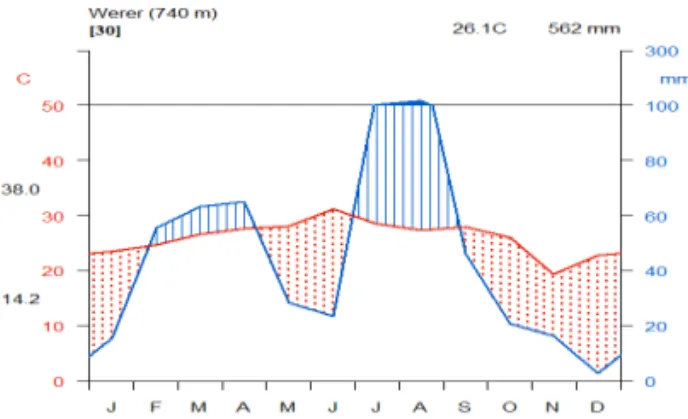
The study area is located at Melka-Werer in Amibara Wereda, Middle Awash, in Afar Natio-nal RegioNatio-nal State (ANRS). It is located at about 09°28'09.4''N - 09°17'18.8''N and 40°18'53.8''E - 40°10'08.1''E, about 285 km north-east of Addis Ababa at an altitude of 740 to 860 m. Thirty years of meteorological data obtained from Werer Agricultural Research Center shows bimodal type of rain fall in the Middle Awash (Figure 1). July and August are the wettest months with mean monthly rain fall greater than 100 mm. The second rainy season is from February to April With mean monthly rainfall around 70 mm. The area is characterized by high moisture deficit because of high evapo-transpi-ration. The mean annual evapo-transpiration is 2702 mm which much exceeds the mean annual rainfall of the area which is about 562 mm. The mean maximum temperature is 34.1oC and the mean minimum temperature is 19oC. The maximum and the minimum temperatures are 38oC and 14.2oC in June and November respectively.
Selection of species for the study
A preliminary survey was carried out to select the dominant tree and forage grass species in the study area that would be particularly affected by the allelopathic effects of P. juliflora. Two dominant tree species: A. nilotica and A. tortilis and two dominant highly valuable forage grass species: C. ciliaris and E. rupestris were selected among the many that occur in the area based on field observations and information obtained from Werer Agricultural Research Center.
Plant material
Leaves, bark and roots of P. juliflora were collected from an area infested by P. juliflora in Melka-Werer. These were air-dried, powdered and stored in polythene bags. Seeds of A. nilotica and A. tortilis (legumes), C. ciliaris and E. rupestris (grasses) were also collected for the allelopathy trial.
Vegetation data collection
Figure 1. Mean monthly rain fall and maximum and minimum temperature for the last thirty years. Source: Werer Agro-meteorological Station (WAS).
two in open Acacia woodland (in flat and open slopes), one in riverine and one in wetland vegetation to know the target plant species. Vegetation counting for trees, shrubs and herbs was made in the study area to know their density (individuals /ha). Plant specimens were collected and identified at the National Herbarium (ETH), Addis Ababa University.
Variation in canopy characteristics
Canopy diameter, canopy closure, branching nature and branch angle
50 individual trees of dominant plant species: A. nilotica, A. tortilis and P. juliflora were taken randomly and their canopy diameter, canopy closure, branching nature and branch angle were measured and compared by using a measuring tape, a densiometer, a measuring tape and an angle measuring device respectively. Height from the ground to the first branch and average angle of tree branching were taken for branching nature and branch angle measurement.
Allelopathic effects of P. juliflora Initial leachate bioassays
An aqueous extract was prepared by adding 0, 0.5, 0.8, 1, 2 and 6 g of leaves, bark and roots of P. juliflora (powder) in 100 ml of distilled water. Then the solution was shaken for 10 seconds and kept for 24 hours in the dark. It was filtered using a filter paper and designated as 0%, 0.5%, 0.8%, 1%, 2% and 6% and stored for seed treatment experiment (Hoque et al. 2003).
Germination and growth record
The germination test was carried out in sterile Petri dishes using a filter paper. Four ml of each concentration of leaf, bark and root was added to each Petri dish of respective treatments shown above and moisture was maintained with distilled water. The control was treated with 4 ml distil water only. Four replications with 25 seeds each of receptor plants (A. nilotica, A. tortilis, C. ciliaris and E. rupestris) was used for each treatment. Germination count was made at two days interval until no new seed germination was observed for two consecutive counts and radicle and plumule length was recorded at the end of the experiment. The seed was considered as germinated when the radicle emerged visibly. Amended soil with decaying plant parts and growth records
To simulate a natural condition 5, 8, 10, 20 and 60 gm of P. juliflora decaying plant parts (powder) was added into 1 kg soil collected from fields outside P. juliflora to get 0.5, 0.8, 1, 2 and 6% concentrations of P. juliflora respectively. 500 ml of distilled water was added and left for 16 hours. Then 160 g of the respective amended soil was taken for growth experiments (Singh et al. 2005). Twenty-five seeds of the native species (A. nilotica, A. tortilis, C. ciliaris and E. rupestris) with four replications were sown in each amended soil type in Petri dishes. Germination count was done at two days interval until no new seed germination was observed for two consecutive counts.
Soil bioassay
Statistical analysis
Data were subjected to analysis of variance using SPSS 18.0 software program. Excel 2007, one way ANOVA and Dunkan's multiple range test were used for the data analysis. All data were tested at p<0.05 level. Mean germination capacity was shown using bar graphs.
Results and discussion
Vegetation characteristics
Twenty seven species were recorded in the sampling plots (Appendix 5). Out of these, thirteen are trees and shrubs and the remaining fourteen are herbs. 9 species were observed in the riverine plot, whereas 8 in the wetland, 12 species in Acacia woodland respectively. Among these species P. juliflora was recorded in all plots and its density was the highest (Appendix 5). The number of species recorded in open Acacia woodlands was low. This is due to the relatively high density of P. juliflora which is associated with fewer number of other plant species (El-Keblawy and Al-Rawai 2007). P. juliflora has a negative impact on plant diversity (Singh et al. 2008). Along with P. juliflora, A. tortilis was common in open Acacia woodlands, A. nilotica in riverine, Typha domingensis Pers. and Sporobolus spicatus (Vahl) Kunth in swamp areas. Grasses were recorded only in swamps. No grass species and only a small number of herb species were recorded in P. juliflora invaded lands. P. juliflora was invading all the habitat types observed in the area and affecting the Acacia woodlands more than the others, and changing to P. juliflora dominated shrub lands. Information obtained from the elderly members of the community shows that the Acacia woodlands had been covered with forage grasses before invasion by the exotic P. juliflora. Now, these valuable forage grass species have not been observed in P. juliflora dominated lands. These forage grasses were very important feed for their livestock and goats for pastoralist community in the area. Due to lack of sufficient grass species to their animals (cattle, goats and camels), the community is experiencing serious food shortage. As a result the pastoralist people in the area are forced to evacuate their original land in search of forage grasses.
The Acacia woodland vegetation type in the area is being changed into P. juliflora dominated
shrub land (Figure 2). Field observations and information from the elderly indicated that open areas that were previously range and farm lands are more readily invaded by P. juliflora than areas that were already covered with vegetation. This may possibly be due to the fact that open areas are highly prone for invasion by alien species (Ruijven et al. 2003).
According to the 1986 and 2001 land use cover classification map (Ame 2002), the area coverage of P. juliflora was increasing from 5.45% in 1986 to 6.75% in 2001 with an average increase of 0.08% per year. New areas that were important forage lands for the pastoral people are now invaded by this noxious invasive weed. High coppicing ability, effective dispersal mechanism, deep tap root system, dormant seeds, attractive and rewarding pods help for its invasion. Livestock, camels and goats play a significant role in spreading of P. juliflora seeds via their faeces (Shiferaw et al. 2004) by carrying them into different areas. Rivers and water canals also play a significant role in the dissemination of seeds to different areas. Swamp areas, road sides and irrigation canals are highly invaded by P. juliflora. This shows P. juliflora establishes well in areas where water is available and also where surface runoff water present for its seed dispersal (Figure 3). This may be also the reason why P. juliflora invaded most of the area along river Awash in the rift valley.
Canopy characteristics
P. juliflora starts branching closer to the ground than the other two tree species. This makes under canopy seedling establishment difficult as a result of a physical barrier created by lower branches. Even though the branching angle of P. juliflora is not greater than A. nilotica and A. tortilis, its branches stretch out sideways and intercept each other. This results in interference with light and hence the death of under story vegetation.
Figure 2. Invasion of the Acacia wood land vegetation type in the area by Prosopis juliflora (Photo Samuel Getachew).
The depressive effect of P. juliflora canopy in the abundance of annuals is higher than it is for perennials (El-Keblawy and Al-Rawai 2007). The seedlings of most annuals and perennials had not been seen except seedlings of P juliflora. This may be attributed to the allelopathic nature of P. juliflora and its shade effects that hinder other species’ seedlings to germinate. El-Keblawy and Al-Rawai (2007) also reached to the same conclusion in that large and medium sized individuals of P. juliflora significantly reduced the number of species and density under canopy compared to outside canopy.
Allelopathic effects of P. juliflora Germination
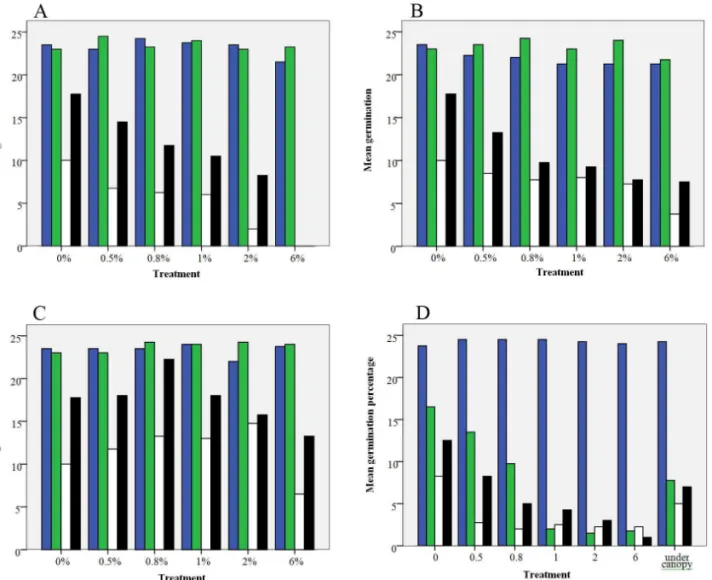
As compared to the control seed germination of A. nilotica and A. tortilis was not affected by all treatment types of leaf, bark and root extracts (Table 1), while C. ciliaris and E. rupestris seed germination was inhibited by aqueous extracts of all leaf treatments of P. juliflora. Bark facilitated germination especially in smaller concentrations
for the grass species. C. ciliaris seed germination was facilitated by bark at smaller concentrations. It significantly facilitated germination at 2%, while with the increased concentration above 2%, germination declined but not significantly (Table 1). E. rupestris seed germination was also facilitated by bark at smaller concentrations. Maximum germination percentage was recorded at 0.8% concentration level of bark, while seed germination went on decreasing above 0.8% and inhibited significantly at 6% concentration level (Table 1). Root extracts inhibited seed germi-nation of the grass species significantly at higher concentrations for the grass species. C. ciliaris and E. rupestris seed germination was inhibited significantly by 6% root and all concentration of leaf aqueous extracts respectively.
Figure 3. Prosopis juliflora invading swampy areas (A),
Prosopis juliflora spreading along river side of Awash (B) (Photo Samuel Getachew)
extracts of P. juliflora organ parts while grasses were highly affected (Figure 4). But higher concentration of these allelochemical compounds (in residue amended and under canopy soil) significantly inhibited the tree species (A. tortilis) (Appendix 4). This also supports previous results found from other allelopathic studies of P. juliflora and information from local people. Information from elderly indicated that the areas that are now invaded by the invasive P. juliflora had been covered with grasses. After invasion of the areas by P. juliflora, these valuable grass species, which are very important for the pastoralist as a forage species for their cattle, goats and camels, have disappeared.
There are also other evidences for allelopathic nature of P. juliflora. Seed germination of Cynodon dactylon (L.) Pers. was greatly reduced by aqueous extracts of leaf of P. juliflora (Al- Humaid and Warrag 1998). Autotoxicity of P. juliflora was also investigated and self-inhibition of seed germination observed except at least (6 g) pericarp aqueous extracts (Warrag 1994). Aqueous extracts from under canopy soil and from different parts of P. juliflora inhibited germination and early seedling growth of various cultivars of Zea mays L., Triticum aestivum L. and Albizia lebbeck (L.) Benth. (Noor et al. 1995). In pot studies examining the allelopathic effect of P. juliflora leaf litter, (Chellamuthu et al. 1997) indicated that germination of Vigna mungo (L.) Hepper, Sorghum bicolor (L.) Moench and P. juliflora was significantly reduced with the maximum reduction occurring at 2% incorporation of P. juliflora leaf litter. Therefore P. juliflora affects the vegetation found in the invaded lands, especially annuals.
The allelopathic effect of P. juliflora leaf litter is due to the presence of some phenolic compounds (Chellamuthu et al. 1997). Nakano et al. (2001) suggested that L-tryptophan may play an important role in the allelopathy of P. juliflora leaves. Plant growth inhibitory alkaloids were also isolated from the extract of P. juliflora leaves (Nakano et al. 2004).
Seedling growth
Table 1. Results from the germination experiment of A. nilotica, A. tortilis, C. ciliaris and E. rupestris subjected to different treatments (a, not significantly different; b, significantly different (P<0.05) from controls (Duncan’s multiple range test)).
Species Treatment type
Concentrations (%) LSD
(0.05)
0 0,5 0,8 1 2 6
A. nilotica leaf 23.5001.732 23.0001.633a
24.2500.500a
23.7500.957a
23.5001.000a
22.0002.646a
0.211
bark 23.5001.732 23.5001.291a
23.5001.291a
24.0001.414a
22.0000.816a
23.7500.957a
0.351
root 23.5001.732 22.0000.000a
23.5001.291a
21.2502.754a
21.2500.957a
21.9201.692a
0.376 A. tortilis leaf 23.0001.414 24.5000.577a
23.2502.062a
24.0001.414a
23.0000.816a
23.0000.816a
0.475
bark 23.0001.414 23.0000.816a
24.2500.500a
24.0000.816a
24.2500.957a
24.2500.957a
0.204
root 23.0001.414 23.5001.000a
24.2500.500a
23.0001.414a
24.0001.414a
24.0001.414a
0.686 C. cillaris leaf 10.0002.449 6.7500.957b
6.2501.893b
6.0001.826b
2.0002.160b
0b
0.000
bark 10.0002.449 11.7504.193a
13.2502.630a
13.0003.742a
14.7501.893b
6.5003.416a
0.023
root 10.0002.449 8.0002.708a
7.7503.500a
7.2501.708a
7.2500.500a
3.7503.096 0.063 E. rupesteris leaf 17.7501.708 14.5001.000b
11.7501.708b
10.5001.915b
8.2502.500b
0b
0.000
bark 17.7501.708 17.5001.915a
22.2503.202a
18.0004.830a
15.7503.096a
13.2503.096b
0.021
root 17.7501.708 13.2503.304b
9.7501.258b
9.2503.304b
7.7503.403b
7.5004.041b
0.001
facilitated by root aqueous extracts by all concentration levels but the facilitation decreased at higher concentrations (6%). A. tortilis's shoot growth was facilitated at 0.8 and 1% while inhibited by higher concentrations (2 and 6%) of root aqueous extracts. C. ciliaris shoot growth was facilitated by 0.8 and higher concentrations and E. rupestris's shoot growth was facilitated by all concentrations of bark aqueous extracts (Appendix 3).
A. nilotica root growth was retarded significantly by all concentration levels of leaf aqueous extracts (Appendix 4). A. tortilis's root growth was also retarded by leaf aqueous extracts even if it was not significant. Root growth of C. ciliaris was inhibited significantly by all concentration of leaf aqueous extracts (Appendix 4). Leaf aqueous extracts at high con-centration (6%) had deleterious effects on root growth of E. rupestris. Bark had a stimulatory effect on root growth of the tree species. Root growth of the grasses was facilitated by bark extracts at lower concentrations while inhibited at higher concentrations. Root aqueous extracts seem to have had stimulatory effects at lower concentration levels and an inhibitory effect at higher concentrations for both the tree and the grass species.
Leaf aqueous extracts of P. juliflora retarded root and shoot growth of Cynodon dactylon (Al- Humaid and Warrag 1998), P. juliflora (Warrag 1994) and Lepidium sativum L. (Nakano et al. 2004). In this study, it was observed that leaf extracts had an inhibitory effect on shoot-root length of the study species while bark and root
had stimulatory effects at small concentrations, but root extracts had inhibitory effects at higher concentrations. Leaves seem to have higher allelopathic compounds than roots and bark while bark seems to have the least. This may be due to leaves containing more allelo-compounds in number/amount. The effects are concentration dependent and species specific.
Residue amended and under canopy soil
Figure 4. The effect of different concentrations of aqueous extracts of P. juliflora obtained from leaf (A), root (B), bark (C), and residues (D) on seed germination of the studied plant species: A. nilotica, A. tortilis, C. ciliaris and E. rupesteris (blue, green, open and black columns, respectively).
inhibitory compounds when compared to the control soil (from outside fields). The amended and under canopy soil experiment revealed the field situation. Slow decomposition and heavy accumulation of leaf litter below P. juliflora resulted in accumulation of toxic substances in the soil layers, inhibiting the growth of other species. That is the reason why little vegetation is usually observed under P. juliflora canopy.
Conclusions and recommendations
The occurrence of P. juliflora in all habitat types in the area studied and its high population number indicate it is invading the study area. Low plant diversity and its high density show its high competitiveness and its threat to other plant
concentration of root extracts while shoot-root growth was facilitated by bark and root extracts at lower concentration. These indicate that P. juliflora contains allelo-chemicals in its organ parts in various amounts and types. Leaves seem to have greater inhibitory effects than roots and barks. Bark seems to contain the least inhibitory compounds. The effect is also species specific. Allelochemicals released from various parts of P. juliflora affect more on annuals (especially grasses) than perennials. From the under canopy soil experiment it was also observed that under canopy soil contains more allelochemicals that inhibit germination of other plant species especially grasses than outsides. Inhibition of seed germination of A. tortilis by both residue amended and under canopy soil of P. juliflora indicate that trees are also being affected by these allelopathic substances of P. juliflora at higher concentrations. Generally low plant diversity in P. juliflora invaded areas was observed as a result of the combined effect of its allelochemicals and shade effects together with its extensive and deep-rooted system.
Mechanical controlling by cutting for charcoal production and fire wood may be effective to lessen the impacts on the native plant species and to reduce its rate of invasion (Abebe 2012). But due to its high coppicing ability and many sprouting after cutting, cutting will not help to eradicate P. juliflora in the area unless it is done some distance below the ground. Dissemination of seeds to various areas by the movement of cattle, goats and camels feaces has been observed playing a major role in increasing the rate of expansion of the species. Controlling movement of the livestock may play an important role in preventing further invasion to new areas. Invasion can also be lessened by using crushed pods as a fodder for livestock. Irrigation cannels also play a significant role in transporting the seeds to different areas including farming lands. Therefore removing P. juliflora trees found close to irrigation cannels may decrease dissemination of seeds by water bodies and as a result decrease invasion rate.
Acknowledgements
The financial assistance of the UNEP/GEF Project on Removing Barriers to Invasive Plant Management in Africa (RBIPMA) project through the National Invasive Plant Management, Ethiopian Institute of Agricultural Research (EIAR) is gratefully acknowledged. Forestry Research Center, Addis Ababa University, Werer Agricultural Research Center, and those who facilitated the work are highly acknowledged.
References
Abebe Y (2012) Ecological and economical dimensions of the paradoxical invasive species - Prosopis juliflora and policy challenges in Ethiopia. Journal of Economics and Sustainable Development 3(8): 62–70
Akobundu IO (1987) Weed Science in the Tropics: Principles and Practices. John Wiley and Sons Ltd., London
Al-Humaid AI, Warrag MO (1998) Allelopathic effects of mesquite (Prosopis juliflora) foliage on seed germination and seedling growth of Bermudagrass (Cynodon dactylon).
Journal of Arid Environment 38: 237–243, http://dx.doi.org/ 10.1006/jare.1997.0312
Al-Wakeel SAM, Gabr MA, Hamid AA, Abu-El-Soud WM (2007) Allelopathic effects of A. nilotica leaf residues on
Pisum sativum L. Allelopathy Journal 19(2): 411–42 Ame A (2002) The Paradox of Share Cropping in the Middle
Awash Valley. Paper Submitted to the 1st International Conferences on Ethiopia Economy, Addis Ababa
Chellamuthu V, Balasusbramanian TN, Rajarajan A, Palaniappan SN (1997) Allelopathic influence of Prosopis juliflora
(Swartz) DC. on field crops. Allelopathy Journal 4: 291–302 EARO, HDRA (2005) Controlling the spread of Prosopis in
Ethiopia by its utilisation. Ethiopian Agricultural Research Organization (EARO) and Henry Doubleday Research Association (HDRA), Addis Ababa
El-Keblawy A, Al-Rawai A (2007) Impacts of the invasive exotic
Prosopis juliflora (Sw.) DC. on the native flora and soils of the UAE. Plant Ecology 190: 23–25, http://dx.doi.org/10. 1007/s11258-006-9188-2
Felker P, Cannell GH, Osborn JF, Clark P R, Nash P (1983) Effects of irrigation on biomass production of 32 Prosopis
(mesquite) accessions. Experimental Agriculture 19:187–198, http://dx.doi.org/10.1017/S0014479700022638
GISP (2004) Africa invaded: The growing danger of invasive alien species. Global Invasive Species Program, Cape Town Hillman JM (1997) Potentially Allelopathic Effects of Poison
Hemlock (Conium maculatum) on Native Plant Revegetation at Wilder Ranch State Park. http://ucce.ucdavis.edu/freeform (Accessed 15 November 2008)
Hoque R, ATM, Ahmed R, Uddin MB, Hossain MK (2003) Allelopathic Effect of Different Concentration of Water Extracts of Acacia auriculiformis Leaf on Some Initial Growth Parameters of Five Common Agricultural Crops.
Pakistan Journal of Agronomy 2 (2): 92–100
Hunde A, Thulin M (1989) Mimosoideae. In: Hedberg I, Edwards S (eds), Flora of Ethiopia: Pittosporaceae to Araliaceae, Vol. 3. Addis Ababa University, Addis Ababa and Uppsala University, Sweden, pp 71-98
Mehari Z (2008) Invasion of Prosopis juliflora (SW.) DC and Rural Livelihoods. The Case of Afar Pastoralists at Middle Awash Area of Ethiopia. MSc. Thesis, Norwegian University of Life Science, Oslo, 3 pp
Nakano H, Fujii Y, Suzuki T, Yamada K, Kosemura S, Yamamura S, Hasegawa K (2001) A growth-inhibitory substance exuded from freeze-dried mesquite (Prosopis juliflora (Sw.) DC.) leaves. Plant Growth Regulation 33: 165–168, http://dx.doi.org/10.1023/A:1017505702039
Nakano H, Nakajima E, Hiradate S, Fujii Y, Yamada K, Shigemori H, Hasegawa K (2004) Growth inhibitory alkaloids from mesquite (Prosopis juliflora (Swartz.) DC. leaves. Phytochemistry 65: 587–591, http://dx.doi.org/10. 1016/j.phytochem.2004.01.006
Noor M, Salam U, Khan MA (1995) Allelopathic effects of
JC, Cadorer K, Maldonado LJ (2001) The Prosopis juliflora-Prosopis pallida Complex: A Monograph. HADRA, Coventry, 172 pp
Ruijven JA, Gerlinde B, Deyn D, Berendse F (2003) Diversity reduces invisibility in experimental plot communities: the role of plant species. Ecology Letters 6: 910–918, http://dx. doi.org/10.1046/j.1461-0248.2003.00516.x
Shiferaw H, Teketay D, Nemomissa S, Assefa F (2004) Some biological characteristics that foster the invasion of Prosopis juliflora (Sw.) DC. at Middle Awash Rift Valley Area, north-eastern Ethiopia. Journal of Arid Environments 58: 134–153, http://dx.doi.org/10.1016/j.jaridenv.2003.08.011
Singh HP, Batish DR, Pandher JK, Kohli RK (2005) Phytotoxic effects of Parthenium hysterophorus residues on three Brassica species. Weed Biology and Management 5: 105– 109, http://dx.doi.org/10.1111/j.1445-6664.2005.00172.x
Impact of different tree species canopy on diversity and production of under storey vegetation in Indian desert.
Tropical Ecology 49(1): 13–23
Warrag MOA (1994) Autotoxicity of mesquite (Prosopis juliflora) pericarps on seed germination and seedling growth.
Journal of Arid Environment 27: 79–84, http://dx.doi.org/ 10.1006/jare.1994.1047
Wittenberg R, Cock MJW (2001) Invasive alien species. How to address one of the greatest threats to biodiversity: A toolkit of best prevention and management practices. CAB International, Wallingford, http://dx.doi.org/10.1079/9780851 995694.0000
Supplementary material
The following supplementary material is available for this article.
Appendix 1. Mean growth variables of trees and their effects on canopy closure.
Appendix 2. Shoot length (cm) for aqueous extracts of leaf, bark and root of P. juliflora of different concentrations.
Appendix 3. Root length (cm) for aqueous extracts of leaf, bark and root of P. juliflora of different concentrations.
Appendix 4. Results of germination percentage from residue amended and under canopy soil experiment.
Appendix 5. Trees, shrubs and herbs recorded in the study areas. This material is available as part of online article from: