www.bjorl.org
Brazilian
Journal
of
OTORHINOLARYNGOLOGY
CASE
REPORT
Speech
auditory
brainstem
response
(speech
ABR)
in
the
differential
diagnosis
of
scholastic
difficulties
夽
Potencial
auditivo
de
tronco
encefálico
com
estímulo
de
fala
(PEATE-fala)
no
diagnóstico
diferencial
de
dificuldades
escolares
Milaine
Dominici
Sanfins
a,∗,
Letícia
Reis
Borges
a,
Thalita
Ubiali
a,
Maria
Francisca
Colella-Santos
baUniversidadeEstadualdeCampinas(UNICAMP),FaculdadedeCiênciasMédicas,ProgramadeSaúdedaCrianc¸aedo
Adolescente,Campinas,SP,Brazil
bUniversidadeEstadualdeCampinas(UNICAMP),FaculdadedeCiênciasMédicas,CursodeFonoaudiologia,Campinas,
SP,Brazil
Received8April2015;accepted29May2015 Availableonline6November2015
Introduction
Learningspokenandwrittenlanguagedependsonthe assim-ilation of acoustic elements and the representation of phoneticcharacteristicsofalanguage.1Auditoryprocessing, phonological awareness, and auditory discrimination are factors that affect the learning of reading and writing, because they are directly related to receptive hearing.2 Researchershave associatedthe presenceof learning dis-abilitieswithhearingdeficitsinchildren.3
Afteranacousticstimulation,electrophysiological eval-uationofhearingcanestablishananatomicalandfunctional correlation in the central auditory nervous system that occursthroughtheactivationofseveralstructures through-outthe system. Thus,in cases of learningdisabilities, an
夽 Please cite this article as: Sanfins MD, Borges LR, Ubiali T,
Colella-SantosMF.Speech-evokedauditorybrainstemresponsein thedifferentialdiagnosisofscholasticdifficulties.BrazJ Otorhino-laryngol.2017;83:112---6.
∗Correspondingauthor.
E-mail:[email protected](M.D.Sanfins).
PeerReviewundertheresponsibilityofAssociac¸ãoBrasileirade OtorrinolaringologiaeCirurgiaCérvico-Facial.
analysisoftheintegrityandfunctionoftheauditory path-waysisrecommended.4
Speechauditorybrainstem response(SpeechABR) test-ingcanbeelicitedbyawidevarietyofsoundstimuli:click, puretone,maskedtone,andcomplexsounds(speech). Stud-ieshavedocumentedthenormalresponsesusingtheclick stimuliinchildrenwithlearningdisabilities;however,recent studies suggest thepresence of alterationsin responseto speechstimuli,duetotheexistenceofsubcorticaldeficits associatedwithlearningdisorders.5---7
Case
report
The subjectsselected forthis studywere individualswith scholasticdifficultieswithadiscrepancybetweenabilityand academicperformance.Thediagnosiswasbasedonalong anddetailedstudycarriedoutbyamultidisciplinaryteam, consistingof apsychologist,speechtherapist,educational psychologist,physicaltherapist,psychomotrician, neurolo-gist,andpsychiatristoftheResearchLaboratoryofLearning Disorders,Disabilities,andAttentionDeficitDisorderofthe FaculdadedeCiênciasMédicas(LaboratóriodePesquisaem Distúrbios, Dificuldades de Aprendizagem e Transtorno de Atenc¸ão da Faculdade de CiênciasMédicas --- DISAPRE) of http://dx.doi.org/10.1016/j.bjorl.2015.05.014
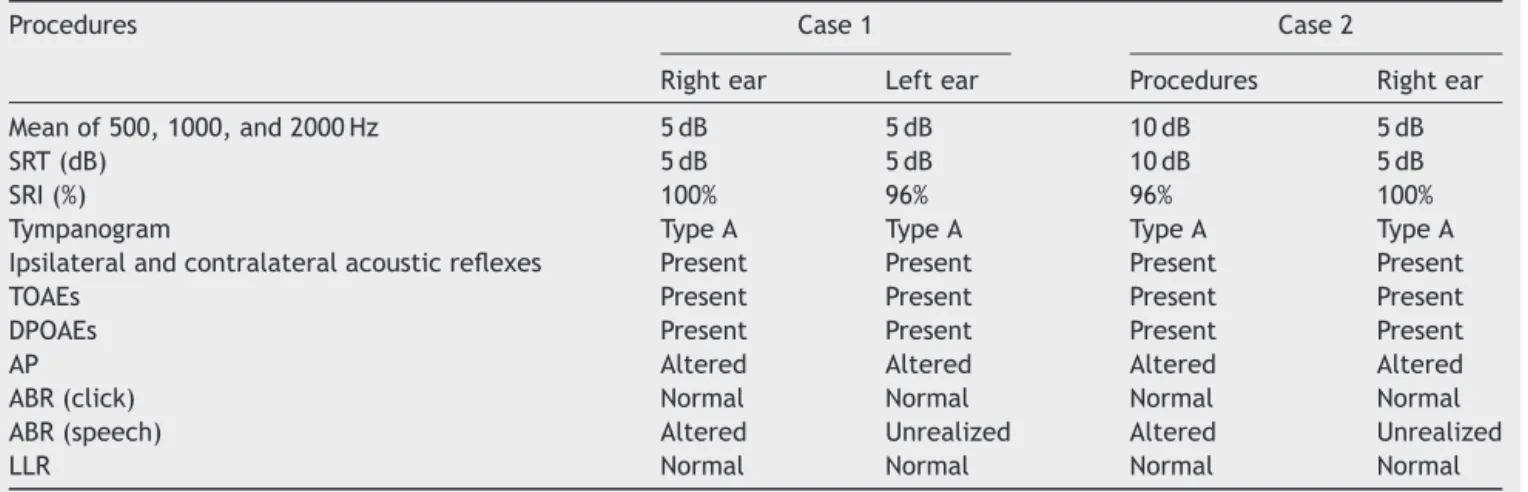
Table1 Assessmentvaluesofauditoryprocessing.
Procedures Case1 Case2
Rightear Leftear Rightear Leftear
DD 87.5% 92.5% 100% 95%
FPT(naming) 48.27% 58.62% 43.33% 26.66%
GIN% 71.66% 58.33% 73.33% 65%
GIN 4ms 8ms 5ms 6ms
SSI(relation---15dB) 70% 50% 60% 30%
Speechinnoise 88% 80% 84% 72%
DD,DichoticDigitstest;FPT,FrequencyPatternTest;GIN,gapinnoise;GIN%,gapinnoise(%);SSI,syntheticsentenceidentification testwithipsilateralcompetingmessage.
Table2 Valuesoftheperformedhearingassessments.
Procedures Case1 Case2
Rightear Leftear Procedures Rightear
Meanof500,1000,and2000Hz 5dB 5dB 10dB 5dB
SRT(dB) 5dB 5dB 10dB 5dB
SRI(%) 100% 96% 96% 100%
Tympanogram TypeA TypeA TypeA TypeA
Ipsilateralandcontralateralacousticreflexes Present Present Present Present
TOAEs Present Present Present Present
DPOAEs Present Present Present Present
AP Altered Altered Altered Altered
ABR(click) Normal Normal Normal Normal
ABR(speech) Altered Unrealized Altered Unrealized
LLR Normal Normal Normal Normal
SRT,speechrecognitionthreshold;SRI,speechrecognitionindex;TOAEs,transientotoacousticemissions;DPOAEs,distortionproduct otoacousticemissions;AP,auditoryprocessing;ABR,auditorybrainstemresponse;LLR,longlatencyresponses.
the Universidade Estadual de Campinas (UNICAMP), Cam-pinas, SãoPaulo, Brazil. The diagnosis wasfinalized after ruling outgenetic,organic, psychological, andpsychiatric disorders that couldcause those alterations. The present study reports two male cases (10 and 11 years old) who wereassessedforaMasterDegree’sdissertation.The par-ents/guardianswereinformedofthestudygoalsandsigned thefreeandinformedconsentformNo.431,184/2013.
A basic audiological evaluationwasperformed and the results were within the normal range, bilaterally. At the behavioralassessmentofauditoryprocessing(AP),an alter-ationwasidentifiedintheauditoryabilitiesoffigure-ground for verbal sounds, temporal ordering, and temporal res-olution (Table 1), whereas at the AP electrophysiological evaluation,theresponseswerewithinthenormalrangein the ABR (click) andlong latency responses (LLR; Table 2) wereobserved. The results oftransient otoacoustic emis-sions(TOAEs)anddistortion productotoacoustic emissions (DPOAEs)werenormalbilaterally.
ABR with speechstimuli wascarried outwith the syn-thesizedsyllable/da/,atarateof10.9stimulipersecond, providedbytheBioMARKTMsoftwareoftheBiologicdevice. Atotalof6000stimuliweregivenintwoburstsof3000,and theanalysiswasperformedonthesumofthetracing.The stimuliwereappliedthroughaninsertionphoneintheright earat80SPL(soundpressurelevel),becauseoftheknown superiorityofthelefthemisphereforspeechprocessing.8
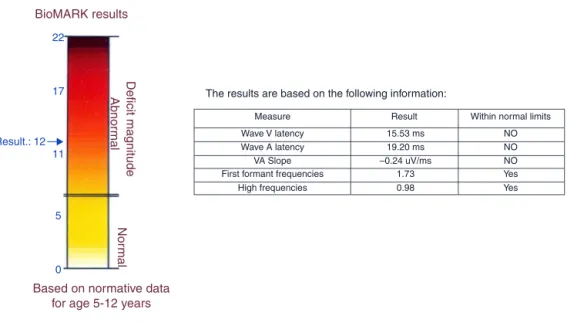
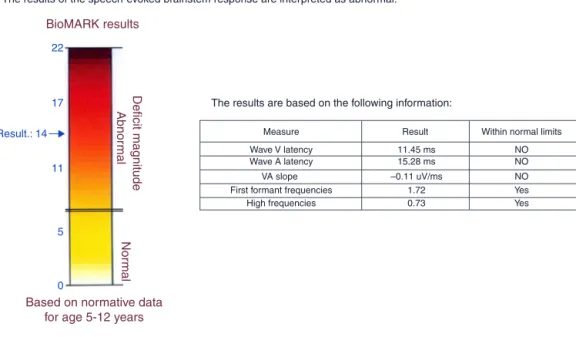
The stimulusconsisted ofthe consonant/d/(transient portion---onset)andashortvowel/a/(sustainedportion ---frequencyfollowingresponse).TheCwaveformrepresents thetransitionbetweenconsonantandvowel,whereastheO waverepresentstheendofthevowel(Fig.1).Afterthe col-lection,thelatencyandamplitudeofthetransientportion (VandAwaves) andtheVA slope (VAamplitude/VA dura-tion)wereanalyzed using thenormative BioMARKTM wave asthebasisforanalysis.Inbothcases,abnormalresponses wereobservedinthelatencyvaluesofthewavesV,A,and VAslope(Figs.2and3).
Discussion
Intheanalysisoftheresults,ABRwithclickstimuluswere normalinbothcases,inagreementwithstudiesinthe lit-erature that indicate that only the processes involved in encodingspeechsignalsinthebrainstemregionarealtered inchildrenwithlearningdisabilities.Theseresultsshowthat the ABR withclick and speech stimuli differ in how they stimulate the auditory structures along the central audi-torynervoussystem(CANS),asthedifferentacousticstimuli reflectdistinctneuralprocess.5,7
10
Transient portion (onset)
20 30
Sustained portion (FFR-frequency following response)
40
Final A
D
Transition
Consonant /d/ Short vowel /a/ Electrophysiological response to synthesized syllable /da/
Amplitude (µV)
Latency (ms)
E
F
C
O
Figure1 Representationofelectrophysiologicalresponsetosynthesizedsyllable /da/.Personalfileoftheinvestigatorofan assessmentperformedwithBioMARKTM software.
the VA slope. Studies support these findings anddescribe adifferencebetween theV andA wavelatency valuesin childrenwithlearning disabilitieswhencompared to chil-drenwithnormaldevelopment.This suggestsarethinking ofhowspeechsoundsareencodedandthefunctionalrole
ofthestructuresresponsibleforgeneratingthesewaves(the regionofthelaterallemniscusandinferiorcolliculus).5---7
Thefindingsofthisstudysuggesttheexistenceof func-tional impairment in speech processing in the brainstem region,identifiedbyprolongedlatenciesofVandAwaves
22
Score: 12 (abnormal BioMARK)
BioMARK results
Based on normative data for age 5-12 years
The results of the speech-evoked brainstem response are interpreted as abnormal.
The results are based on the following information:
Abnormal brainstem function has been associated with impaired auditory perception and literacy skills. Research has found that children with abnormal brainstem function can benefit from auditory training programs. Auditory training can alter the neural encoding of speech and serves as a promising remediation strategy.
Measure
Wave V latency Wave A latency VA Slope First formant frequencies
High frequencies
15.53 ms
1.73 0.98
NO NO NO Yes Yes 19.20 ms
–0.24 uV/ms
Result Within normal limits 17
Result.: 12
Deficit magnitude
Abnor
mal
Nor
mal
11
5
0
22
Score: 14 (abnormal BioMARK)
BioMARK results
Based on normative data for age 5-12 years
The results of the speech-evoked brainstem response are interpreted as abnormal.
The results are based on the following information:
Abnormal brainstem function has been associated with impaired auditory perception and literacy skills. Research has found that children with abnormal brainstem function can benefit from auditory training programs. Auditory training can alter the neural encoding of speech and serves as a promising remediation strategy.
Measure
Wave V latency Wave A latency
VA slope First formant frequencies
High frequencies
11.45 ms
1.72 0.73
NO NO NO Yes Yes 15.28 ms
–0.11 uV/ms
Result Within normal limits 17
Result.: 14
Deficit magnitude
Abnor
mal
Nor
mal
11
5
0
Figure3 Auditorybrainstemresponse(ABR)withspeechstimulusandabnormalresponses.Researcher’sdatafromamalepatient (11yearsold).
and VA slope, suggesting that the physiological mecha-nisms are altered,even without a proven neurobiological abnormalityinpatientsexhibitingscholasticdifficulties.As a result of this deficit in speech perception, there is an impairmentofthecommunicationandlanguageprocesses, withconsequentdegradationoflinguisticandparalinguistic informationthatcausesdifficultiesinacademicskills.This canresultinsevereconsequencesinqualityoflifeandsocial interactionsandculminateinlearningdisorders.Thus,there isanegativeimpactontheprocessingoffastacousticsignals inthespecializedcorticalstructures,whichdonotrespond tothesoundstimulusinasynchronousandorganizedfashion andthusrendertheinterpretationandunderstandingofthe meaningdifficultforchildrenwithscholasticdifficulties.
Several abnormalities in sound processing can be observedinpatientswithlearningdisabilities.Thus differ-entlevelsoftheauditorytrajectoryshouldbeinvestigated toestablishadifferentialdiagnosis.Onewaytoevaluatethe CANSis throughbehavioraltests; however,the evaluation istime-consumingandrequireseffectivepatient participa-tion.Forpatientswithlearningdifficulties,ABRwithspeech stimulusisindicated,sinceitisanobjective,practical,and effectivetestthatdoesnotdependonthepatient’sresponse and is independent of attention; additionally,it provides an analysis of numerical measures that can be used as a predictorofthedegreeofthedisorder.
AccordingtoChandrasekaranandKraus,9theanalysisof absolute latency values for ABR with speech stimuli can helpdifferentiateandestablishdifferentclinicalpictures, andallow for an objective measureof subcortical speech processing.Thisanalysiswouldbeveryimportantin cases oflearningdisabilitiesthatincludeseveralothersubgroups
of disorders, including scholastic difficulties. Researchers stressthatthisprocedurecanbeusedtoevaluateauditory functionandprovideadditionalinformationinthediagnosis oflearningdisabilitiesandauditoryprocessingdisorders.10
The present findings suggest that changes in the per-ceptionandprocessingofauditoryinformationobservedin childrenwithscholasticdifficultiesappeartobethesame asthose seen in children with learning disabilities.Thus, the authors stress the importance of evaluating children withscholasticdifficulties, considering that alterations in speechsoundprocessingappeartobeofcrucialimportance inthelearningprocess.Knowingthemagnitudeofhearing alterationsin thesepatients maysuggest moreaggressive actionsfortheprevention,detection,andtreatmentofthis disorder.
Conclusion
Analysis of these two cases showed the value of using ABR with speech stimuli in the evaluation of children with scholastic difficulties, considering the abnormalities detected in this study. This procedure is objective, fast, andeffective. It does notrequire the patient’s conscious participationandprovidesnumericaldatathatcan demon-stratetheCANSmaturationand,therefore,canfunctionas abiomarkerofscholasticdifficulties.
astoinvestigateandmonitortheconsequencesofimpaired speechperceptionincasesofscholasticdifficulties.
Funding
ThisstudywasfundedbyFAPESP.
Conflicts
of
interest
Theauthorsdeclarenoconflictsofinterest.
References
1.Regac¸oneSF,Guc¸ãoACB,GiachetiCM,RomeroACL,FrizzoACF. Potenciaisevocadosauditivosdelongalatênciaem escolares comtranstornosespecíficosdeaprendizagem.AudiolCommun Res.2014;19:13---8.
2.HallidayLF,BishopDVM.Ispoorfrequencymodulationdetection linkedtoliteracyproblems?Acomparisonofspecificreading disabilityandmildtomoderatesensorineuralhearingloss.Brain Lang.2006;9:200---13.
3.CacaceAT,McFarlandDJ.Centralauditoryprocessingdisorder inschool-agedchildren:acriticalreview.JSpeechLangHear Res.1998;41:355---73.
4.MusiekFE, ShinnJ, Hare C.Plasticity, auditorytrainingand auditoryprocessingdisorders.SeminHear.2002;23:263---75.
5.Abrams DA, Nicol T, Zecker SG, Kraus N. Rapid acoustics processingintheauditorybrainstemisnotrelatedtocortical asymmetryforthesyllablerateofspeech.ClinNeurophysiol. 2010;121:1343---50.
6.Skoe E, Kraus N. Auditory brainstem response to complex sounds:atutorial.EarHear.2010;31:302---24.
7.Johnson KL, Nicol T, Kraus N. The brainstem response to speech:abiologicalmarkerofauditoryprocessing.EarHear. 2005;26:424---34.
8.HornickelJ,SkoeE,NicolT,ZeckerS,KrausN.Subcortical dif-ferentiationofstopconsonantsrelatestoreadingand speech-in-noiseperception.ProcNatlAcadSci.2009;106:13022---7.
9.Chandrasekaran B, Kraus N. The scalp recorded brainstem responsetospeech:neuraloriginsandplasticity. Psychophys-iology.2010;47:236---46.