Article
ISSN 0102-695X doi: 10.1590/S0102-695X2011005000107
Received 10 Dec 2010 Accepted 15 Feb 2011 Available online 17 Jun 2011
of
Capsella bursa-pastoris
Clara Grosso,
1Juliana Vinholes,
1Luís R. Silva,
1Paula Guedes
de Pinho,
2Rui F. Gonçalves,
1Patrícia Valentão,
1Anna K.
Jäger,
3Paula B. Andrade
*,11REQUIMTE/Laboratório de Farmacognosia, Departamento de Química, Faculdade
de Farmácia, Universidade do Porto, Portugal,
2REQUIMTE/Laboratório de Toxicologia, Departamento de Ciências Biológicas,
Faculdade de Farmácia, Universidade do Porto, Portugal,
3Department of Medicinal Chemistry, Faculty of Pharmaceutical Sciences University
of Copenhagen, Denmark.
Abstract: Capsella bursa-pastoris (L.) Medik. (Brassicaceae) is a wild herb with high nutritional value that can be eaten raw or cooked. A metabolomic study was performed with different extracts of its aerial parts that were tested concerning their antiradical, acetylcholinesterase inhibitory and antibacterial activities. Phenolic compounds were identified and quantified by HPLC-DAD, organic acids and amino acids were determined by HPLC-UV, while free fatty acids and sterols were analysed by GC-ITMS. The vegetal material was rich in kaempferol-3-O-rutinoside (mean value 2247.09 mg/kg of dry plant), quinic acid (95628.00 mg/kg of dry plant), arginine (mean value of 1.18 mg/kg of dry plant), palmitic acid (284.48 mg/kg) and
β-sitosterol (28%). The extracts presented a concentration-dependent antiradical
activity (against DPPH•, O2•- and LOO•), being most effective against •NO (EC25
0.20 μg/mL). In addition, the extracts were also acetylcholinesterase inhibitors and
antibacterial active, revealing that, besides the plant’s good nutritional value, it presents important biological properties as well.
Keywords:
acetylcholinesterase inhibition antibacterial activity
antioxidant activity
Capsella bursa-pastoris
metabolic profile
Introduction
Capsella bursa-pastoris (L.) Medik.,
Brassicaceae, commonly known as shepherd's purse, is a wild plant, whose young leaves and roots have been used as an edible vegetable, eaten raw or cooked in some countries (Zennie & Ogzewalla, 1977; Kweon et al., 1996). The nutritional composition of this species, including minerals, vitamin A, ascorbic acid, proteins,
linoleic acid and ω3 polyunsaturated fatty acids, is
considered to be beneficial to human health (Zennie & Ogzewalla, 1977; Guil-Guerrero et al., 1999). Besides this, C. bursa-pastoris has some medicinal properties, being indicated as anti-bleeding, anticancer, antithrombin (Bekker et al., 2002; Goun et al., 2002), wound-healing (Park et al., 2000) and antioxidant agent (Ivanova et al., 2005), as well as for diabetes and fever treatment (Kweon et al., 1996). However, an approach to the chemical composition was not provided by the authors. On the other hand, Park et al. (2000) isolated peptides from the roots that showed activity against several strains of bacteria and fungi, while an isolated flavonoid-O-glucoside revealed to be a superoxide anion radical scavenger (Kweon et al., 1996).
From the chemical point of view, several classes of secondary metabolites have already been found in this species, such as phenolic compounds, mainly flavonoids (Song et al., 2007), alkaloids, namely calystegines (Brock et al., 2006), glucosinolates (Cole, 1976) and saponins (Marquina et al., 1955).
Considering the scarce literature on the metabolic composition and the broad spectrum of activities observed for this species, the aim of this study was to characterize the aerial parts of C. bursa-pastoris, focusing on flavonoids, organic acids, fatty acids, sterols, and amino acids. Subsequently, several in vitro (antioxidant, anti-cholinesterase and antibacterial) assays were carried out.
Materials and Methods
Plant material
described in Floras (Coutinho, 1939; Flora Ibérica, 2003). The acquired sample was also compared with an individual occurring in nature. The plant material
was powdered (mean particle size lower than 910 μm).
Voucher specimen was deposited at Laboratório de Farmacognosia, Faculdade de Farmácia, Universidade do Porto (CBP-AP-032010).
Standards and reagents
Reference compounds were purchased from various suppliers: flavonoid standards were from Extrasynthèse (Genay, France). 1,1-Diphenyl-2-picrylhydrazyl (DPPH•), β-nicotinamide adenine dinucleotide (NADH), phenazine methosulphate (PMS), nitroblue tetrazolium chloride (NBT), 5,5’-dithio-bis(2-nitrobenzoic acid) (DTNB), sulphanilamide, acetylcholinesterase (AChE) (CAS Registry No. 9000-81-1; EC 232-559-3, type VI-s) from electric
eel (Electrophorus electricus), acetylthiocholine
iodide (ATCI), Tris-HCl, hexane, 2-propanol, L-amino acid kit, organic acids and sterols standards were purchased from Sigma (St. Louis, MO, USA). N-(1-Naphthyl) ethylenediamine dihydrochloride, ferrous sulphate heptahydrate, ethanol, methanol, ethyl ether, dichloromethane and chloride, sulphuric and formic acids were obtained from Merck (Darmstadt, Germany). Sodium nitroprussiate dehydrate (SNP) and ascorbic acid were purchased from Sigma-Aldrich (Steinheim, Germany). Linoleic acid was from BDH chemicals, Ltd. (Poole, England). Trichloromethane, sodium sulphate anhydrous and isooctane were purchased from Panreac Química SA (Barcelona, Spain). Potassium hydroxide was from Pronalab (Lisboa, Portugal) and boron trifluoride (BF3) 10% methanolic solution, dabsyl chloride and fatty acid methyl esters (FAME kit were purchased from Supelco (Bellafonte, PA, USA)). Methyl jasmonate (internal standard) was from SAFC (St. Louis, USA). Mueller Hinton broth (MHB) and Mueller Hinton agar (MHA) were purchased from Liofilchem (Roseto degli Abruzzi, Italy).
Phenolic compounds
Extraction
The extraction of aerial parts of C.
bursa-pastoris was performed with methanol (MeOH), and
methanol:water (1:1) mixture (MeOH/H2O) (1 g/100 mL), applying the following steps: sonication (1 h), stirring maceration at room temperature (200 rpm, 16 h), plus sonication (1 h), filtration and evaporation under reduced pressure.
Hydrolysis
For the identification of C-heterosides 2 N HCl
was added to methanolic extract (250 μL) and heated at
100 ºC (1 h). The hydrolysed extract was applied in a Chromabond C18 column (500 mg sorbent mass/6 mL reservoir volume), conditioned with methanol (5 mL) and acid water (5 mL, pH 2 with HCl), and eluted with methanol (5 mL). The eluate was dried, redissolved in
methanol (250 μL), and analysed (20 μL) by HPLC.
HPLC/DAD analysis and quantification
The extracts were analysed on an analytical HPLC unit (Gilson), using a previously described procedure (Oliveira et al., 2009). Detection was achieved with a Gilson diode array detector, spectral data were collected in 200-400 nm range, and chromatograms were recorded at 350 nm. The data were processed on an Unipoint System software (Gilson Medical Electronics, Villiers le Bel, France). Phenolic compounds quantification was achieved by external standards method. Quercetin-6-C-glucoside (not commercially available) was quantified as
quercetin-3-O-glucoside, being all other compounds quantified by their correspondent standard.
Organic acids
Extraction
Organic acids were extracted from 1 g of raw material with H2SO4 (50 mL, 0.01 N), under stirring (200 rpm, 30 min), followed by filtration and evaporation. The resulting extract was redissolved in H2SO4 (1 mL,
0.01 N) and subjected to analysis (20 μL).
HPLC/UV-vis analysis
Organic acids were analysed on an analytical HPLC unit (Gilson), using an ion exclusion Nucleogel Ion 300 OA column (300 × 7.7 mm) (Germany), with a column heating device (30 ºC) (Oliveira et al., 2009). Elution (70 min) was carried out isocratically, using H2SO4 0.01 N (0.2 mL/min). Detection was performed with a Gilson UV-Vis detector at 214 nm. The organic acids quantification was achieved relatively to external standards.
Amino acids
Derivatization
(400 μL, 0.1 M). The derivatization procedure was
described previously by Oliveira et al. (2008).
HPLC/UV-vis analysis
Dabsyl derivatives of free amino acids were analysed on a Gilson HPLC unit, using a C18 Spherisorb
ODS2 column (25.0 cm × 0.46 cm; 5 μm particle size)
from Waters (Ireland), applying the same conditions of Oliveira et al. (2008).
Fatty acids
Extraction
The extraction and derivatization procedures were performed according to Ribeiro et al. (2009).
GC-ITMS analysis
FAME quantification was performed by external standards calibration curves obtained by GC-ITMS using the conditions described by Ribeiro et al. (2009). One microliter of the extract was analysed in Full Scan mode. Identification of compounds was achieved by comparison of their mass spectra and retention times with those from pure standards (FAME kit purchased from Supelco (Bellafonte, PA, USA), analysed under the same conditions, and with NIST 05 MS Library Database.
Sterols
Extraction
The sterols extraction of aerial parts of C.
bursa-pastoris was performed with dichloromethane
(DCM), in a ratio of 1 g/100 mL, using the following steps: sonication (1 h), stirring maceration at room temperature (16 h), plus sonication (1 h). After filtration the extracts were evaporated under reduced pressure, redissolved in DCM and analysed by GC-ITMS.
GC-ITMS analysis
The sterols were estimated by their relative abundance from their total chromatographic area. The injector port was heated to 250 ºC, and injections were performed in split mode (1/40), the oven temperature was set at 40 ºC (for 1 min), then increasing 2 ºC/min to 220 ºC and held for 30 min. All mass spectrometer parameters were kept as mentioned in Ribeiro et al. (2009) with the exception of m/z mass range (50 to 1000). The compounds identification was achieved by comparing their retention indices and mass spectra
with those of authentic reference compounds, and with NIST 05 MS Library Database.
Antioxidant activity
DPPH• assay
The free radical-scavenging activity was determined in a Multiskan Ascent plate reader (Thermo Electron Corporation), by monitoring the decrease of absorbance of DPPH•, according to Oliveira et al. (2009).
Superoxide anion (O2•-) assay
O2•- was generated by the NADH/PMS system, as referred in Oliveira et al. (2009).
Nitric oxide (•NO) assay
The antiradical activity was determined in a Multiskan Ascent plate reader (Thermo Electron Corporation), using a previously described procedure (Oliveira et al., 2009).
Lipid peroxidation (LOO•) inhibition
Lipid peroxyl radical (LOO•) was generated according to the method described by Choi et al. (2002). The detection of conjugated dienes was measured with
slight modiications to the method reported by Shimasaki
(2000). The absorbance at 233 nm was measured
in a spectrophotometer (Helios α, Unicam) at room
temperature.
Acetylcholinesterase (AChE) inhibitory activity
The inhibition of AChE activity was determined spectrophotometrically in a Multiskan Ascent plate reader (Thermo Electron Corporation), based on Ellman’s method, as previously reported (Oliveira et al., 2009). Physostigmine was used as a positive control (data not shown).
Antibacterial activity
Microorganisms
Nine bacteria species were used: Staphylococcus
aureus (ATCC 20231), Staphylococcus epidermidis (ATCC
20044), Micrococcus luteus (ATCC 20030), Enterococcus
faecalis (ATCC 20477), Bacillus cereus (ATCC 31),
Proteus mirabilis (ATCC 4479), Escherichia coli (ATCC
30083), Pseudomonas aeruginosa (ATCC 50071) and
Salmonella typhimurium (ATCC 43971). All cultures were
of Pharmacy, Porto University, Portugal. The stock culture was maintained on MHA at 4 ºC.
Preparation of inoculums
Bacterial inoculums were prepared by growing cells in MHB for 24 h at 37 ºC. Cell suspensions were diluted with sterile MHB to provide initial cell counts of about 106 CFU/mL.
Minimum inhibitory concentration (MIC)
The minimum inhibitory concentration of C. bursa-pastoris extracts was assessed by the twofold serial dilution method as described by Taveira et al. (2010). The MIC was determined as the lowest concentration of the raw material inhibiting the visible growth of the test culture on the microplate.
Results and Discussion
Metabolic profile
Phenolic compounds
The MeOH and MeOH/H2O extracts of C.
bursa-pastoris analysed by HPLC-DAD allowed the
identiication of ive lavonoids, namely, quercetin-6-C
-glucoside, quercetin-3-O-glucoside, kaempferol-3-O -rutinoside, quercetin, and kaempferol (Table 1, Figure 1a). Kaempferol-3-O-rutinoside was the main phenolic in both MeOH and MeOH/H2O extracts, representing 65 and
51 % of total determined compounds, respectively (Table
1). The presence of the C-heteroside described by Song et al. (2007), quercetin-6-C-glucoside, was conirmed in
both extracts by HPLC/DAD analysis of the hydrolysed extracts (Figure 1b). The hydrolysis is just able to cleave the O-glycosyl bond, being C-bond resistant. Only one compound remained after samples’ treatment and quercetin and kaempferol contents increased. Therefore, it was assumed that the C-heteroside was a lavonol derivative,
most probably quercetin-6-C-glucoside reported before.
Table 1. Flavonoids composition of C. bursa-pastoris
(L.) Medik. (mg/kg of dry plant)a.
Flavonoid MeOH MeOH/H2O
1 Quercetin-6-C-glucoside 793.90±8.80 564.32±8.09
2 Quercetin-3-O-glucoside 426.26±1.01 1241.25±37.61
3 Kaempferol-3-O-rutinoside 2314.61±11.59 2179.57±67.68
4 Quercetin 16.36±0.59 110.86±15.69
5 Kaempferol 16.01±0.12 130.41±12.27
Total 3567.15±1.31 4226.41±109.96
Figure 1. HPLC-DAD chromatogram of phenolic compounds from C. bursa-pastoris (L.) Medik. MeOH extract (a) and hydrolysed extract (b). Detection at 350 nm. 1.
quercetin-6-C-glucoside; 2. quercetin-3-O-glucoside; 3. kaempferol-3-O -rutinoside; 4. quercetin; 5. kaempferol.
Organic acids
Six compounds were identiied in C.
bursa-pastoris (Figure 2) acidic extract, in concentrations ranging from 8.02 to 95628.00 mg/kg (Table 2). Among
the identiied compounds only oxalic acid was previously
described in this species (Guil-Guerrero et al., 1999).
Quinic, malic and citric acid were responsible for 97% of the total organic acids content, being the irst one the most representative (48%).
Table 2. Organic acid composition of C. bursa-pastoris
(L.) Medik. (mg/kg of dry plant)a.
Organic acid Content
1 Oxalic 2416.98±405.50
2 Citric 27408.80±4161.68
3 Malic 68288.82±11217.03
4 Quinic 95628.00±15827.51
5 Shikimic 8.02±1.15
6 Fumaric 3540.02±546.01
Total 197290.63±32158.88
aResults are expressed as mean ± standard deviation of three assays .
Figure 2. HPLC-UV chromatogram of organic acids from C. bursa-pastoris (L.) Medik. (detection at 214 nm). 1. oxalic acid; 2. citric acid; 3. malic acid; 4. quinic acid; 5. shikimic acid; 6. fumaric acid.
Amino acids
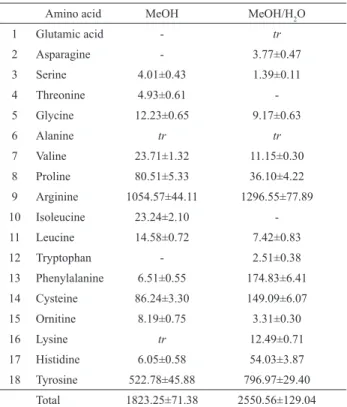
A total of eighteen amino acids (AA) were found in MeOH (Figure 3) and MeOH/H2O C. bursa-pastoris extracts, but their AA proile was distinct. Threonine and
isoleucine were found only in MeOH, while glutamic acid,
asparagine and tryptophan were just identiied in MeOH/
H2O extract. Arginine and tyrosine were the main amino
acids in both extracts, where the irst one represents more than 50% and the second 30% of the total amino acid content (Table 3). As far as we know, this is the irst report
on amino acids in this species.
Figure 3. HPLC-UV chromatogram of amino acids from C. bursa-pastoris (L.) Medik. MeOH/H2O extract. Detection at 436 nm. 1. glutamic acid; 2. asparagine; 3. serine; 5. glycine; 6. alanine; 7. valine; 8. proline; 9. arginine; 11. leucine; 12. tryptophan; 13. phenylalanine; 14. cysteine; 15. ornitine; 16. lysine; 17. histidine; 18. tyrosine.
Table 3. Amino acids composition of C. bursa-pastoris
(L.) Medik. (μg/kg of dry plant)a.
Amino acid MeOH MeOH/H2O
1 Glutamic acid - tr
2 Asparagine - 3.77±0.47
3 Serine 4.01±0.43 1.39±0.11
4 Threonine 4.93±0.61
-5 Glycine 12.23±0.65 9.17±0.63
6 Alanine tr tr
7 Valine 23.71±1.32 11.15±0.30
8 Proline 80.51±5.33 36.10±4.22
9 Arginine 1054.57±44.11 1296.55±77.89
10 Isoleucine 23.24±2.10
-11 Leucine 14.58±0.72 7.42±0.83
12 Tryptophan - 2.51±0.38
13 Phenylalanine 6.51±0.55 174.83±6.41
14 Cysteine 86.24±3.30 149.09±6.07
15 Ornitine 8.19±0.75 3.31±0.30
16 Lysine tr 12.49±0.71
17 Histidine 6.05±0.58 54.03±3.87
18 Tyrosine 522.78±45.88 796.97±29.40
Total 1823.25±71.38 2550.56±129.04
Fatty acids
Thirteen fatty acids (FA) were quantiied in C.
bursa-pastoris extract. From these, heptadecanoic acid
is reported for the irst time. As can be seen in Table 4
and Figure 4, the FA compounds found exhibit C12:0 to C20:0 structures, with saturated (8), monounsaturated, (4) and polyunsaturated (1) bonds. Among these, palmitic acid (hexadecanoic acid, C16:0) was the main compound,
representing 52% of the FA composition, followed by
stearic acid and oleic acid, both representing approximately
10% of the total FA found. These results were in accordance
with the study performed on the aerial parts of C. bursa-pastoris (Bekker et al., 2002), where palmitic acid and
oleic acid represented 50 and 12%, respectively.
Sterols
Several sterols were identiied in C.
bursa-pastoris dichloromethane extract (Figure 5), and their
relative contents are shown in Table 5. β-Sitosterol, the
only sterol described so far, was the main compound;
thus, its abundance was considered as 100% and the
other compounds reported against it. The contribution of the other compounds followed the order campesterol
(38%) > stigmasta-4-en-3-one (14%) > cholesterol (7%) > stigmasterol (6%) > cholest-5-en-3-one (5%) >
ergosta-aResults are expressed as mean ± standard deviation of three assays.
4,6,8(14),22-tetraen-3-one (3%) > lupeol (2%) > stigmasta-3,5-dien-7-one (2%).
Table 4. Free fatty acids composition (as methyl esters) of C. bursa-pastoris (L.) Medik. (mg/Kg of dry plant)a.
Free fatty acid Content
1 C12:0 Dodecanoic acid (Lauric acid)b 5.66±1.17
2 C14:0 Tetradecanoic acid (Myristic acid)b 29.63±5.79
3 C15:0 Pentadecanoic acidb 18.05±3.06
4 C16:1 (Z)-9-hexadecenoic acid (Palmitoleic acid)c
23.29±0.49
5 C16:1 (Z)-7-hexadecenoic acidc 22.97±4.27
6 C16:0 Hexadecanoic acid (Palmitic acid)b 284.48±41.06
7 C17:0 9,10-(Z)-Methylene-hexadecanoic acidd
17.59±2.18
8 C17:0 Heptadecanoic acidb 7.11±1.60
9 C18:2 (Z)-9.12-octadecadienoic acid (Linoleic acid)b
20.09±4.35
10 C18:1 (Z)-9-octadecenoic acid (Oleic acid)b 53.03±9.99
11 C18:1 (Z)-6-octadecenoic acide 9.00±0.08
12 C18:0 Octadecanoic acid (Stearic acid)b 53.20±0.68
13 C20:0 Eicosanoic acid (Arachidic acid)b 2.52±0.33
Total 546.62±52.04
aResults are expressed as mean ± standard deviation of three assays. bCompound quantiied with correspondent standard. cExpressed in
equivalents of hexadecanoic acid (C16:0), tentatively identiied by NIST
05 database. dExpressed in equivalents of heptadecanoic acid (C17:0),
tentatively identiied by NIST 05 database. eExpressed in equivalents
of cis-9-octadecenoic acid (C18:1), tentatively identiied by NIST 05 database.
Figure 4. GC-ITMS chromatogram of C. bursa-pastoris (L.) Medik. methyl esters of free fatty acids. 1. dodecanoic acid; 2. tetradecanoic acid; 3. pentadecanoic acid; 4- (Z)-9-Hexadecenoic acid; 5. (Z)-7-hexadecenoic acid; 6. hexadecanoic acid; 7. 9,10-(Z)-methylene-hexadecanoic acid; 8. heptadecanoic acid; 9. (Z)-9,12-octadecadienoic acid; 10. (Z)-9-octadecenoic acid; 11. (Z)-6-octadecenoic acid; 12. octadecanoic acid; 13. octadecanoic acid and IS. methyl jasmonate.
Biological activities
Antioxidant activity
Plant extracts with antiradical activity are of great importance when an uncontrolled production of reactive species occurs in the organism, and the endogenous antioxidants are not capable to overcome their deleterious effect. The search of new bioactive compounds from natural sources has been motivated by the concern about the safety of synthetic antioxidants (Williams et al., 1999). A concentration-dependent pattern was observed in all antioxidant assays (Figure 6a-d, Table 6), which is in accordance with results obtained for other plants belonging to the Brassicaceae family (Orhan et al., 2009). MeOH/ H2O extract was more effective against DPPH•, O2•- and
•NO, while MeOH was more active for LOO•. Extracts that
eficiently act against O2
•- and •NO radicals are considered
very important, once they can prevent the formation of other deleterious radicals, like peroxynitrite (Pacher et al., 2007).
Table 5. Relative abundance of phytosterol compounds identiied
in dichloromethane extracts of C. bursa-pastoris (L.) Medik. by GC-ITMS analysisa.
Compound Relative
abundance (%)
1 Cholesterolb 6.77±1.46
2 Campesterolb 38.12±0.35
3 Stigmasterolb 5.97±0.06
4 β-Sitosterolb 100.00±0.00
5 Cholest-5-en-3-onec 4.51±0.23
6 Ergosta-4,6,8(14),22-tetraen-3-onec 3.01±0.02
7 Lupeolb 2.33±0.08
8 Stigmasta-3,5-dien-7-onec 2.32±0.34 9 Stigmasta-4-en-3-onec 13.97±0.23 10 unknown (m/z 648, 662, 316, 57, 191) 17.41±0.60 11 unknown (m/z 531, 516, 219, 147, 57) 4.08±0.03
Table 6. Antioxidant and acetylcholinesterase inhibitory potential of C. bursa-pastoris (L.) Medik. extractsa.
Assays MeOH MeOH/H2O
DPPH• 1041.49 420.96
O2•- 538.03 167.60
•NO 0.23b 0.20b
LOO• 600.46 906.02
AChE 909.44 3579.41
aCompounds relative abundance expressed as mean±standard deviation
against the highest phytosterol chromatographic area. bCompounds
identiied by comparison with authentic standard. cCompounds tentatively
identiied by the NIST 05 library.
aEC50 values (μg/mL) are expressed as mean of three assays. bValue
The main difference observed between the extracts composition is in the content of quercetin and its derivatives, present in higher amounts in the MeOH/
H2O extract. The radical scavenging activity of lavonoids
is partially related with the catechol group in the B-ring; therefore, quercetin activity is more pronounced than that of kaempferol (Ji & Zhang, 2006). However we should also consider the presence of other bioactive compounds, once MeOH extract was more effective as LOO• scavenger. For instance, the presence of compounds, such as i) quinic acid, which is described as antioxidant (Pero et al., 2009), ii) stearic acid, which is involved in the inhibition of lipid peroxidation and in the promotion of antioxidant enzymes activity, like Cu/Zn superoxide dismutase (SOD) and catalase (Wang et al., 2007), and iii) oleic acid, as well as other monounsaturated fatty acids, which are involved in the reduction of the susceptibility of LDL to oxidation (Tsimikas et al., 1999), should be taken into account. The
presence of a ω6 fatty acid (linoleic acid), even in low
concentrations, seems to be very important because this compound is involved in diminishing coronary disease risk
(WHO, 2003). ω3 Fatty acids, also biologicaly important,
were not detected in C. bursa-pastoris analysed extract. Moreover, the presence of phytosterols can inhibit the dietary and biliary cholesterol uptake (Klingberg et al., 2008).
Acetylcholinesterase inhibition
All over the world, 24 million people suffer from dementia, with Alzheimer’s disease (AD) being the most common cause in the elderly (WHO, 2006). It is assumed that the dysfunction of cholinergic neurotransmission in the brain contributes to the relevant cognitive decline in
AD. The loss of cholinergic cells is accompanied by the loss of the neurotransmitter acetylcholine, thus, one of the most accepted strategies in AD treatment is the use of cholinesterase inhibitors (de Paula et al., 2009; Vinutha et al., 2007). Under the assay conditions, MeOH and MeOH/ H2O extracts exhibited high acetylcholinesterase inhibitory capacity (Table 6, Figure 7). Our results are in agreement with the AChE inhibition observed for other Brassicaceae (Local Food-Nutraceuticals Consortium, 2005; Orhan et al., 2009). These species showed an AChE inhibition of
10-19% at a concentration of 0.1 mg/mL, which correspond
to the same range of inhibition observed for the C. bursa-pastoris MeOH extract.
Figure 6. Scavenging activity of C. bursa-pastoris (L.) Medik. MeOH and MeOH/H2O extracts against (A) DPPH•, (B) superoxide radical (O2•-), (C) nitric oxide radical (•NO) and (D) lipid peroxyl radical (LOO•). Values show mean±SEM of three experiments performed in triplicate.
Figure 5. GC-ITMS (full scan acquisition) chromatogram of sterol derivatives of C. bursa-pastoris (L.) Medik. DCM extract.
1. cholesterol; 2. campesterol; 3. stigmasterol; 4. β-sitosterol; 5.
Figure 7. Acetylcholinesterase inhibition of C. bursa-pastoris
(L.) Medik. MeOH and MeOH/H2O extracts. Results show mean±SEM of three experiments performed in triplicate.
As observed for LOO• inhibition, MeOH extract was more active than MeOH/H2O over AChE. As above, we have to consider the overall interaction between the
different classes of compounds identiied in this species
(phenolic compounds, organic acids, amino acids, fatty acids, and sterols).
In a general way, the results obtained in the
performed assays revealed that these extracts are eficient
free radical scavengers and moderate inhibitors of AChE as well.
Antibacterial activity
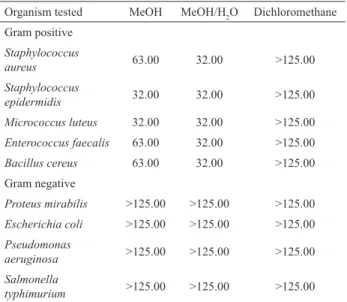
The uncontrolled use of antibiotics can cause microorganisms resistance. Therefore, actions must be taken to develop new antimicrobial agents from natural sources (Chandrasekaran et al., 2008). In order to evaluate the antibacterial potential of C. bursa-pastoris, MeOH, MeOH/H2O and dichloromethane extracts were screened
for activity against ive positive and four
Gram-negative bacteria. The MIC was calculated to evaluate the extracts’ effects. As can be observed in Table 7, the MICs obtained for MeOH and MeOH/H2O extracts were lower than those of DCM. In addition, Gram-positive bacteria were more susceptible than Gram-negative ones.
In a general way, the MeOH/H2O extract was more effective, with MICs bellow 32.00 mg/mL for all Gram-positive bacteria, while for methanol this was observed only for S. epidermidis and M. luteus (Table 7). Since immunocompromised patients are more vulnerable to these two microorganisms (Prescott et al., 1996) extracts that are active against them can be of great importance. The MICs observed for MeOH/H2O extract against S. aureus, E. faecalis and B. cereus were lower than those observed for MeOH extracts. The effective action against these pathogenic microorganisms is also important, as they are involved, for instance, in the origin of urinary tract infections and endocarditis (E. faecalis) (Prescott et al., 1996).
Previous studies already indicated that Gram-positive bacteria appear to be more sensitive to the action of many natural extracts (Dorman & Deans, 2000), which is in agreement with our results.
The different degree of activity observed for C. bursa pastoris extracts can be ascribed to the presence of several classes of compounds. In particular, the higher antibacterial effect of MeOH/H2O and MeOH can be related, at least partially, to the presence of phenolic compounds. Thus, the more pronounced antibacterial effect observed for MeOH/H2O extracts can be explained by the higher content of quercetin that is already known by its ability to increase the membrane permeability (Cushnie & Lamb, 2005).
Table 7. Minimal inhibitory concentration (MIC) of C. bursa-pastoris (L.) Medik. extracts tested against Gram-positive and Gram-negative bacteriaa.
Organism tested MeOH MeOH/H2O Dichloromethane Gram positive
Staphylococcus
aureus 63.00 32.00 >125.00
Staphylococcus
epidermidis 32.00 32.00 >125.00
Micrococcus luteus 32.00 32.00 >125.00
Enterococcus faecalis 63.00 32.00 >125.00
Bacillus cereus 63.00 32.00 >125.00
Gram negative
Proteus mirabilis >125.00 >125.00 >125.00
Escherichia coli >125.00 >125.00 >125.00
Pseudomonas
aeruginosa >125.00 >125.00 >125.00
Salmonella
typhimurium >125.00 >125.00 >125.00
Conclusion
The identiication and quantiication of primary
(organic acids, amino acids and fatty acids) and secondary (phenolic compounds, and sterols derivatives) metabolites in C. bursa-pastoris, as well as the screening of a variety of biological activities, was achieved. Twenty seven
compounds are reported for the irst time in this species.
Besides the good nutritional value already described, this species revealed to be an interesting source of bioactive compounds. We can highlight the extracts’ antioxidant and antibacterial activities, suggesting that they may be interesting not only for human health but also as food additive. Moreover the AChE inhibitory activity, an important factor in Alzheimer’s disease, may extend the use of C. bursa-pastoris for pharmaceutical applications. aMIC is expressed as weight of raw material per volume of solvent (mg/
Acknowledgment
Clara Grosso thanks the Fundação para a Ciência e a Tecnologia for the Post-Doc fellowship (SFRH/ BPD/63922/2009)
References
Bekker NP, UI’chenko NT, Glushenkova AI 2002. Lipids of the aerial part of Capsella bursa-pastoris. Chem Nat Compd 38: 610-611.
Brock A, Herzfeld T, Paschke R, Koch M, Dräger B 2006. Brassicaceae contain nortropane alkaloids.
Phytochemistry 67: 2050-2057.
Chandrasekaran M, Kannathasan K, Venkatesalu V 2008. Antimicrobial activity of fatty acid methyl esters of some members of Chenopodiaceae. Z Naturforsch C 63: 331-336.
Choi CW, Kim SC, Hwang SS, Choi BK, Ahn HJ, Lee MY, Park SH, Kim SK 2002. Antioxidant activity and free radical scavenging capacity between Korean medicinal plants
and lavonoids by assay-guided comparison. Plant Sci 163:1161-1168.
Cole RA 1976. Isothiocyanates, nitriles and thiocyanates as products of autolysis of glucosinolates in Cruciferae.
Phytochemistry 15: 759-762.
Coutinho AXP 1939. Flora de Portugal: plantas vasculares.
Lisboa: Bertrand.
Cushnie TPT, Lamb AJ 2005. Antimicrobial activity of lavonoids. Int J Antimicrob Agents 26: 343-356.
De Paula AAN, Martins JBL, dos Santos ML, Nascente LC, Romeiro LAS, Áreas TFMA, Vieira KST, Gambôa NF, Castro NG, Gargano R 2009. New potential AChE inhibitor candidates. Eur J Med Chem 44: 3754-3759. Dorman HJD, Deans SG 2000. Antimicrobial agents from
plants: antibacterial activity of plant volatile oils. J Appl Microbiol 88: 308-316.
Flora Iberica 2003. Plantas Vasculares de la Peninsula Iberica e Islas Baleares. vol. 4. Cruciferae. Madrid: Real Jardín Botánico, CSIC.
Goun EA, Petrichenko VM, Solodnikov SU, Suhinina TV, Kline MA, Cunningham G, Nguyen C, Miles H 2002. Anticancer and antithrombin activity of Russian plants.
J Ethnopharmacol 81: 337-342.
Guil-Guerrero JL, Giménez-Martínez JJ, Torija-Isasa ME 1999. Nutritional composition of wild edible crucifer species. J Food Biochem 23: 283-294.
Ivanova D, Gerova D, Chervenkov T, Yankova T 2005. Polyphenols and antioxidant capacity of Bulgarian medicinal plants. J Ethnopharmacol 96: 145-150.
Ji H-F, Zhang H-Y 2006. Theoretical evaluation of lavonoids
as multipotent agents to combat Alzheimer’s disease.
Journal of Molecular Structure-THEOCHEM 767: 3-9. LFN (Local Food-Nutraceuticals Consortium) 2005.
Understanding local Mediterranean diets: a multidisciplinary pharmacological and ethnobotanical approach. Pharmacol Res 52: 353-366.
Klingberg S, Ellegård L, Johansson I, Hallmans G, Weinehall L, Andersson H, Winkvist A 2008. Inverse relation between dietary intake of naturally occurring plant sterols and
serum cholesterol in northern Sweden. Am J Clin Nutr 87: 993-1001.
Kweon MH, Kwak JH, Ra KS, Sung HC, Yang HC 1996. Structural
characterization of a lavonoid compound scavenging
superoxide anion radical isolated from Capsella bursa-pastoris. J Biochem Mol Biol 29: 423-428.
Marquina, JMG, Villa MG, Garriga AB 1955. Fracción saponínica de la “Capsella bursa pastoris”. An R Acad Farm 21: 49-60.
Oliveira AP, Pereira D, Andrade PB, Valentão P, Sousa C, Pereira JA, Bento A, Rodrigues MA, Seabra RM, Silva BM 2008. Free amino acids of tronchuda cabbage (Brassica oleracea L. var. costata DC): Inluence of leaf position
(internal or external) and collection time. J Agric Food Chem 56: 5216-5221.
Oliveira AP, Valentão P, Pereira JA, Silva BM, Tavares F, Andrade PB 2009. Ficus carica L.: metabolic and biological screening. Food Chem Toxicol 47: 2841-2846.
Orhan I, Kartal M, Abu-Asaker M, Şenol FS, Yilmaz G, Şener
B 2009. Free radical scavenging properties and phenolic characterization of some edible plants. Food Chem 114: 276-281.
Pacher P, Beckman JS, Liaudet L 2007. Nitric oxide and peroxynitrite in health and disease. Physiol Rev 87: 315-424.
Park CJ, Park CB, Hong S-S, Lee H-S, Lee SY, Kim SC 2000. Characterization and cDNA cloning of two glycine- and histidine-rich antimicrobial peptides from the roots of shepherd’s purse, Capsella bursa-pastoris. Plant Mol Biol 44: 187-197.
Pero RW, Lund H, Leanderson T 2009. Antioxidant metabolism induced by quinic acid. Increased urinary excrection of tryptophan and nicotinamide. Phytother Res 23: 335-346.
Prescott LM, Harley JP, Klein PH 1996. Microbiology. Dubuque: Wm. C. Brown Publishers.
Ribeiro B, Guedes de Pinho P, Andrade PB, Baptista P, Valentão P 2009. Fatty acid composition of wild edible mushrooms species: A comparative study. Microchem J 93: 29-35. Shimasaki H 2000. Diene conjugation. In: Taniguchi N,
Gutteridge JMC (org.) Experimental protocols for reactive oxygen and nitrogen species. New York: Press Inc., by Oxford University, p. 142-143.
Song N, Xu W, Guan H, Liu X, Wang Y, Nie X 2007. Several
lavonoids from Capsella bursa-pastoris (L.) Medik.
Asian Journal of Traditional Medicines 2: 218-222. Taveira M, Silva LR, Vale-Silva LA, Pinto E, Valentão P, Ferreres
F, Guedes de Pinho P, Andrade PB 2010. Lycopersicon esculentum seeds: an industrial by product as an antimicrobial agent. J Agr Food Chem 58: 9529-9536. Tsimikas S, Philis-Tsimikas A, Alexopoulos S, Sigari F, Lee C,
Reaven PD 1999. LDL isolated from greek subjects on a typical diet or from American subjects on an oleate-supplemented diet induces less monocyte chemotaxis and adhesion when exposed to oxidative stress. Arterioscl Throm Vas Biol 19: 122-130.
Wang Z-J, Liang C-L, Li G-M, Yu C-Y, Yin M 2007. Stearic acid protects primary cultured cortical neurons against oxidative stress. Acta Pharmacologica Sin 28: 315-326. WHO 2006. Neurological disorders: public health challenges.
Geneva: World Health Organization
WHO 2003. Technical Report Series 916. Diet, nutrition and the prevention of chronic diseases, report of a joint WHO/FAO expert consultation. Geneva: World Health Organization, p. 82.
Williams GM, Iatropoulos MJ, Whysner J 1999. Safety assessment of butylated hydroxyanisole and butylated hydroxytoluene as antioxidant food additives. Food Chem Toxicol 37: 1027-1038.
Zennie TM, Ogzewalla D 1977. Ascorbic acid and vitamin C content of edible wild plants of Ohio and Kentucky. Econ Bot 31: 76-79.
*Correspondence
Paula B. Andrade
REQUIMTE/Laboratório de Farmacognosia, Departamento de Química, Faculdade de Farmácia, Universidade do Porto R. Aníbal Cunha, 164, 4050-047 Porto, Portugal [email protected]