ABSTRACT: Objective: To describe the prevalence of alcohol consumption among Brazilian students and identify the sociodemographic factors associated alcohol consumption in the last 30 days. Methods: Cross-sectional study with a cluster sample of 109,104 9th grade students in Brazilian public and private schools in 2012. The prevalence and 95% conidence intervals of the indicators of alcohol consumption were analyzed. Results: Of the students analyzed, 50.3% (95%CI 49.0 – 51.6) experimented one dose of alcoholic beverages or more. The consumption of alcohol in the last 30 days was 26.1% (95%CI 24.5 – 27.7), and there was no diference in prevalence between students from public and private schools. Drunkenness episodes were reported by 21.8% (95%CI 21.1 – 22.5) of the students. The perception of students about the negative reaction of their family if they came home drunk occurred in 89,7% (95%CI 89,6 – 89,9) of cases, and 10% (95%CI 8.9 – 11.1) of them reported having problems with their families or friends because they had been drinking. Among adolescents aged less than 14 years old, the irst alcoholic drink intake was predominantly at 12 to 13 years old. The most common way to get a drink was at parties, with friends, buying in them in supermarkets, stores or bars and at home. The consumption of alcohol in the last 30 days was less frequent among boys, increasing with age. Conclusion: The study demonstrates the extension of alcohol as a problem, making it important to advance in measures such as the improvement of protective legislation for children and adolescents and stricter enforcement in alcohol sales.
Keywords: Adolescence. School health. Alcoholic beverages. Surveys. Drunkenness. Family.
Alcohol consumption among Brazilian
Adolescents according to the National Adolescent
School-based Health Survey (PeNSE 2012)
Consumo de álcool entre adolescentes brasileiros segundo a Pesquisa
Nacional de Saúde Escolar (PeNSE 2012)
Deborah Carvalho MaltaI,II, Isis Eloah MachadoII, Denise Lopes PortoI, Marta Maria Alves da SilvaI, Paula Carvalho de FreitasI, André Wallace Ney da CostaIII, Maryane Oliveira-CamposI
IDepartment of Non-Communicable Diseases Surveillance and Health Promotion, Health Surveillance Secretariat, Ministry of
Health – Brasília (DF), Brazil.
IINursing school of Universidade Federal de Minas Gerais – Belo Horizonte (MG), Brazil.
IIIBrazilian Institute of Geography and Statistics – Rio de Janeiro (RJ), Brazil.
Corresponding author: Deborah Carvalho Malta. Departamento de Vigilância de Doenças e Agravos Não Transmissíveis. Secretaria de Vigilância em Saúde. Ministério da Saúde. – SAF Sul, Trecho 2, Lote 5/6, Torre I, Edifício Premium, Sala 14, Térreo, CEP: 70070-600. Brasília, DF, Brasil. E-mail: [email protected]
INTRODUCTION
The act of trying alcoholic beverages usually occurs in adolescence, and this period is characterized by intense psychosocial and biological changes1. Even though it is forbidden to sell alcoholic beverages to people aged less than 18 years old, alcohol consumption by teenagers is still a common practice2. Studies have shown that the use of alcohol in adolescence is associated with sociocultural and environmental factors, use of psychoactive substances by family members and friends, besides conlicts with parents and negative feelings, such as sadness and loneliness3.
The damage resulting from the consumption of alcohol among adolescents is diferent from that observed in adult individuals, due to the psychosocial speciicities in this cycle of life, or to speciic neurological matters that exist due to brain maturation4. Besides, the use of alcohol among adolescents is usually more episodic, being consumed abusively or heavily, which leads to potential risks, including of overdose or alcoholic intoxication, and this may afect the development and cause consequences to adulthood4,5.
Alcohol causes many efects on the central nervous system of adolescents. Brain immaturity in that phase brings great vulnerability, associated with genetic predisposition4. The use of alcohol and other drugs can afect its maturation. As a consequence, adolescents who are
RESUMO:Objetivo: Descrever a prevalência do consumo de álcool entre escolares brasileiros e veriicar os fatores sociodemográicos associados ao consumo nos últimos 30 dias.Metodologia: Estudo transversal com amostra de conglomerados de 109.104 estudantes do 9º ano do ensino fundamental de escolas públicas e privadas do Brasil em 2012. Foram analisadas as prevalências e intervalos de coniança de 95% de indicadores do consumo de álcool.Resultados: Experimentaram uma dose ou mais de bebidas 50,3% (IC95% 49,0 – 51,6) dos escolares. O consumo de bebida alcoólica nos últimos 30 dias foi de 26,1% (IC95% 24,5 – 27,7), e alunos de escola privada e pública não diferiram nas prevalências. Episódios de embriaguez foram relatados por 21,8% (IC95% 21,1 – 22,5) dos alunos. A percepção dos escolares sobre a reação negativa de sua família caso eles chegassem em casa bêbados ocorreu em 89,7% (95%CI 89,6 – 89,9) dos casos; 10% (IC95% 8,9 – 11,1) dos estudantes relataram ter tido problemas com suas famílias ou amigos devido a bebida. Entre adolescentes com idade igual ou superior a 14 anos, a primeira dose de bebida alcoólica ocorreu de forma mais frequente entre 12 a 13 anos. As formas mais comuns de obter bebidas foram em festas, junto aos amigos, comprando no mercado, bar ou supermercado e em casa. O consumo de bebida alcoólica nos últimos 30 dias foi menos frequente entre meninos, aumentando com a idade. Conclusão: O estudo demonstra a extensão do problema do álcool, tornando-se importante avançar em ações como o aperfeiçoamento das medidas legislativas protetoras e maior rigor na iscalização das vendas de bebidas para adolescentes.
addicted to alcohol and drugs may present with reduced hippocampal volume and skills, such as memory and learning4. Neurophysiological studies have shown that the frontal lobe is essential for functions such as responses for inhibition, emotional regulation, planning and organization, and its development and maturation continue during adolescence and in young adults. The lateral lobe is associated with language and hearing, and these functions are widely mature in adolescence. With regard to occipital, parietal and temporal lobes, they present small changes in these phases of life and are less afected4.
For collective health, it is very important to verify the frequency of early alcohol consumption, once it is not only associated with damages to health, but it can also be related to the use of other substances, risky sexual behavior and involvement with episodes of violence and accidents. Besides, the abusive use can lead to dependency, and it is one of the main risk factors for chronic diseases in the future. It is calculated that the use of alcohol can cause 2.5 million deaths every year, and a considerable proportion of them corresponds to young people; therefore, it is the third among the main risk factors for premature death and impairment in the population6,7 and the sixth among young people aged between 10 and 24 years old8.
Both editions of the National Adolescent School-based Health Survey (PeNSE), in 2009 and in 2012, monitored the health of adolescents. Among the researched indicators, the use of alcohol was included due to its strategic importance in the health of adolescents. This study aims at describing the prevalence of alcohol consumption among Brazilian 9th grade students in 2012 and to verify the sociodemographic factors associated with consumption in the past 30 days.
METHODS
PeNSE 2012 is a cross-sectional study conducted by the Ministry of Health, together with the Brazilian Institute of Geography and Statistics (IBGE), with 9th grade students of public and private schools. The sample of PeNSE 2012 was representative of Brazil, the ive regions (South, Southeast, North, Northeast, Center-West) and the 26 Brazilian state capitals and the Federal District; 3,004 schools and 4,288 classrooms were analyzed9. The sample (n = 109,104) was composed of male (47.8%) and female students (52.2%); 86% of the students were aged between 13 and 15 years old, 82.8% studied in public schools and 16.2% attended private schools9.
The study was approved in the Ethics Research Council of the Ministry of Health, report n. 192/2012, referring to registration n. 16805 of CONEP/MS on 27/03/2012.
SAMPLING PLAN
the primary sampling units, were selected and, afterwards, the eligible classrooms of these schools were selected, which were the secondary sampling units9.
The ive regions were represented by the capitals and by the cities that are not capitals. The cities that are not capitals were grouped according to homogeneity and neighboring criteria. In this case, cluster sampling was conducted and selected in three stages: primary sampling units were groups of cities; secondary sampling units were schools; and classrooms in these schools were the tertiary sampling units9. The sample of each geographic stratum was allocated proportionally to the number of schools, according to their administrative dependency (private or public)9.
All of the students in the selected classrooms who were present on the day of data collection formed the sample of students and were invited to participate in the study. The 9th grade was chosen because the students in this grade, mostly aged between 13 and 15 years old, have already acquired the necessary skills to answer the self-applicable questionnaire, since they are prone to being exposed to several risk factors and because it enables the relative comparability with systems from other countries10.
The self-applicable structured questionnaire was inserted in the smartphone and has about 140 questions. The questionnaire includes subjects such as diet, physical activity, alcohol, tobacco and drug use, among others. Further methodological information can be obtained in the technical report of PeNSE 20129.
The collected information was inserted in a data base and was analyzed with the statistical package SPSS (PASW Statisticss 18)11.
VARIABLES
The studied variables refer to the following situations related to alcohol consumption: • Trying alcohol (“At any point in life, have you tried alcohol?”), with the orientation
to exclude “taste some wine for religious purposes”,
• Trying one dose of alcohol (“Have you ever had a dose of alcohol? One dose refers to a can of beer, or one glass of wine, or one dose of cachaça or scotch etc.”); • Alcohol consumption in the past 30 days or current/regular consumption (“In the
past 30 days, how many days did you have at least one glass or one dose of alcohol?”), with the codiication “No” and “Yes” (1 or more days);
• Drunkenness in life (“In your life, how many times have you consumed so much alcohol to become completely drunk?”);
• Problems with family or friends due to alcohol consumption (“In your life, how often did you have problems with family or friends, missed classes or fought because of drinking?”);
The number of glasses/doses of alcohol consumed in the past 30 days was veriied by the question “In the past 30 days, on days when you had any drink, how many glasses or doses did you have a day?”. The age of trying alcohol was obtained by the question “How old were you when you drank your irst alcoholic beverage? One dose refers to a can of beer, or a glass of wine, or one dose of cachaça or scotch etc.” For this single indicator, only students aged 14 years old or more were selected (n = 86,661), so all of the students would have the opportunity of passing by the age of higher frequency of alcohol experimentation. This option existed because, if all of the students in the sample had been considered, it would have been possible to observe higher frequencies of initiation at younger ages due to the cut of efect.
STATISTICAL ANALYSIS
At irst, for the variables tasting beverages, trying one dose of alcohol, alcohol consumption in the past 30 days, drunkenness, family’s reaction and having problems with family, prevalence and its respective 95% conidence intervals (95%CI) were estimated for Brazil, by sex, administrative dependency of the school and regions.
For the variable trying alcohol, prevalence and 95%CI were estimated according to age of irst alcohol drink and sex. Prevalence and respective 95%CI were also estimated for the number of glasses/doses consumed in the past 30 days and place where the drink was obtained according to sex.
For the univariate and multivariate model, the dependent variable use of alcohol in the past 30 days (current use) was analyzed. The odds ratio (OR) of the model, their respective 95%CI and p values were estimated. In the univariate model, the alcohol consumption in the past 30 days was analyzed by the logistic regression, with one sociodemographic variable at a time. In the multivariate model, all of the sociodemographic variables participated in the model at the same time.
RESULTS
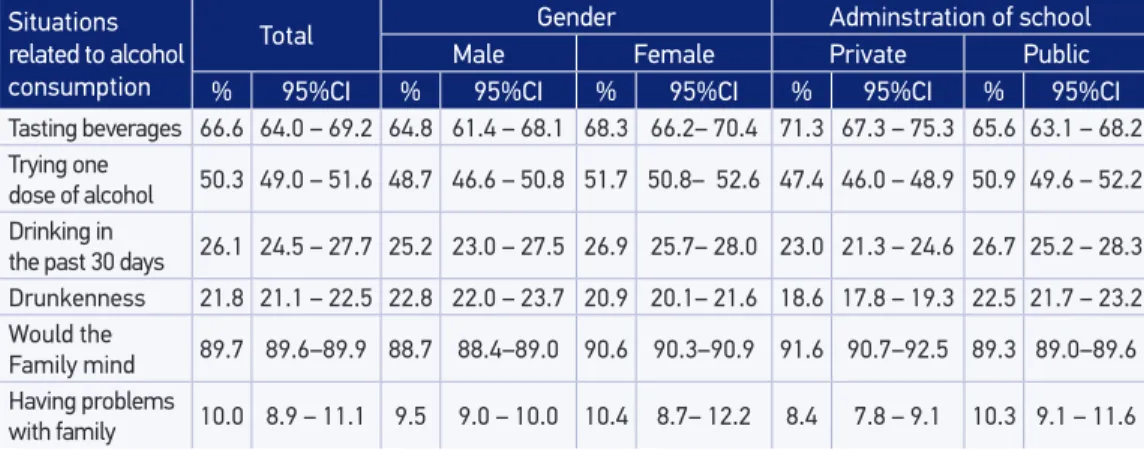
Indicators related to alcohol consumption show that 66.6% of the students (95%CI 64.0 – 69.2) tried alcohol, regardless of amount; the ones who tried/drank one dose of alcohol are 50.3% (95%CI 49.0 – 51.6), and prevalence was higher among girls (51.7%; 95%CI 50.8 – 52.6) than among boys (48.7%; 95%CI 46.6 – 50.8), and among students attending public schools (50.9%; 95%CI 49.6 – 52.2) (Table 1).
Alcohol consumption in the past 30 days was of 26.1% (95%CI 24.5 – 27.7) in Brazil, being 25.2% (95%CI 23 – 27.5) for males and 26.9% (95%CI 25.7 – 28.0) for females. The episodes of drunkenness in life were reported by 21.8% (95%CI 21.1 – 22.5) of students being more frequent among boys (22.8%; 95%CI 22.0 – 23.7) than girls (20.9%; 95%CI 20.1 – 21.6), and more common in public (22.5%; 95%CI 21.7 – 23.2) than private schools (18.6%; 95%CI 17.8 – 19.3) (Table 1). Among regions, there is a 17.3% variation (95%CI 16.5 – 18.0) in the Northeast region to 27.4% (95%CI (25.4 – 29.5) in the South region (Tables 1 and 2). With regard to the perception of students about their families’ perception in case they got home drunk, 89.7% (95%CI 89.6 – 89.9) of the students stated their parents would care very much, mostly for girls (90.6%; 95%CI 90.3 – 90.9) than for boys (88.7%; 95%CI 88.4 – 89.0) (Table 1).
Table 1. Prevalence and respective 95% conidence intervals of situations related to alcohol con -sumption, according to gender and administrative dependence of the school. National Adolescent School-based Health Survey (PeNSE). Brazil, 2012.
Situations related to alcohol consumption
Total Gender Adminstration of school
Male Female Private Public
% 95%CI % 95%CI % 95%CI % 95%CI % 95%CI
Tasting beverages 66.6 64.0 – 69.2 64.8 61.4 – 68.1 68.3 66.2– 70.4 71.3 67.3 – 75.3 65.6 63.1 – 68.2 Trying one
dose of alcohol 50.3 49.0 – 51.6 48.7 46.6 – 50.8 51.7 50.8– 52.6 47.4 46.0 – 48.9 50.9 49.6 – 52.2
Drinking in
the past 30 days 26.1 24.5 – 27.7 25.2 23.0 – 27.5 26.9 25.7– 28.0 23.0 21.3 – 24.6 26.7 25.2 – 28.3 Drunkenness 21.8 21.1 – 22.5 22.8 22.0 – 23.7 20.9 20.1– 21.6 18.6 17.8 – 19.3 22.5 21.7 – 23.2 Would the
Family mind 89.7 89.6–89.9 88.7 88.4–89.0 90.6 90.3–90.9 91.6 90.7–92.5 89.3 89.0–89.6 Having problems
with family 10.0 8.9 – 11.1 9.5 9.0 – 10.0 10.4 8.7– 12.2 8.4 7.8 – 9.1 10.3 9.1 – 11.6
Table 2. Prevalence and respective 95% conidence intervals of experimenting alcoholic bevera -ges in life, alcohol consumption in the past 30 days and having problems with the use of alcohol. National Adolescent School-based Health Survey (PeNSE). Brazil and regions, 2012.
Regions
North Northeast Southeast South Center-West
% 95%CI % 95%CI % 95%CI % 95%CI % 95%CI
Tasting beverages 58.5 56.7 – 60.4 59.6 59.3 – 59.8 68.1 62.2 – 74.0 76.9 75.4 – 78.3 69.8 68.5 – 71.2 Trying one
dose of alcohol 47.4 44.4 – 50.4 47.3 46.0 – 48.6 49.6 46.9 – 52.3 56.8 54.3 – 59.3 54.5 53.3 – 55.7 Drinking in the
past 30 days 21.2 19.1 – 23.4 22.9 21.0 – 24.8 26.1 22.9 – 29.3 33.3 29.0 – 37.5 28.1 25.1 – 31.1 Drunkenness 18.9 16.5 – 21.2 17.3 16.5 – 18.0 22.3 21.1 – 23.6 27.4 25.4 – 29.5 25.9 25.0 – 26.8 Would the
Family mind 90.3 89.8 – 90.7 91.8 91.7 – 91.9 89.0 88.7 – 89.3 89.0 88.8 – 89.2 87.9 86.9 – 88.8 Having problems
Among the regions, the lowest frequency occurred in the Center-West (87.9%; 95%CI 86.9 – 88.8), and the highest frequency occurred in the Northeast region (91.8%; 95%CI 91.7 – 91.9) (Table 2). With regard to alcohol consumption, 10.0% (95%CI 8.9 – 11.1) of students reported having had problems with their families or friends, missing school or getting involved in ights because of drinking, without diferences between boys and girls. Problems with alcohol consumption among students ranged from 11.5% (95%CI 11.1 – 11.8) in the Center-West region to 8.4% (95%CI 7.0 – 9.9) in the Northeast region (Table 2).
Among adolescents aged 14 years old or more, the irst dose of alcoholic beverage occurred mostly at the age of 12 or 13 years old, being higher among girls (42.0%; 95%CI 39.1 – 44.4) than among boys (36.6%; 95%CI 35.0 – 38.3), followed by the occurrence at the age of 14 or 15 years old, being 34.5% (95%CI 32.2 – 36.8) and 34.2% (95%CI 30.1 – 38.3) among boys and girls, respectively. The age of 9 years old or less was the age of initiation in 9.7% (95%CI 8.8 – 10.7) of the boys and 8.1% (95%CI 6.7 – 9.3) of the girls (Figure 1).
More than half of the students (55.5%) drank one dose or less, and 16.0% drank ive doses and more on the 30 days prior to the study; abusive consumption, that is, ive doses and more, is prevalent among boys (18%; 95%CI 14.6 – 21.9) and among girls (14.3%; 95%CI 11.7 – 17.3). Girls tend to drink less than one dose (31.4%. 95%CI 29.3 – 33.6), while the same variable had a 26.6% prevalence (95%CI; 24.7 – 28.6) among boys (Figure 2).
Among students who consumed alcohol in the past 30 days, the most common way of obtaining beverages was in parties, especially among girls (44.4%, and 33.9% among boys); with friends (23% for girls and 20.4% for boys); or buying in the market, store, bar or supermarket (21.9% for boys and 10.5% for girls); in the fourth position, 11.2% of the boys and 8.8% of the girls consumed alcohol in their own houses (Figure 3).
Figure 1. Prevalence and respective 95% conidence intervals of age of experimenting alcohol among Brazilian 9th grade students aged 14 years old or more, according to gender. Brazil, 2012.
50
45
40
35
30
25
20
15
10
5
0
Male Female
≤ 9 years old 10 or 11 ≥ 16 years old
years old
12 or 13 years old
Alcohol consumption among students increases with age, and it ranges according to race/ color, being 26.2% among white people, 27.7% among black people, 25.3% among mulattos, 26.9% among yellow and 27.7% among indigenous people. From private and public students, this indicator was 23.0% and 26.7%, respectively. The crude and adjusted OR was calculated by all of the sociodemographic variables of the model, therefore, the study points to lower chances of alcohol consumption among boys (OR = 0.84); increasing consumption with age, being OR = 1.34 at the age of 14, OR = 2.13 at the age of 15, and OR = 2.63 at the age of 16. Students attending private and public schools showed no diferences when adjusted by the other variables (Table 3).
DISCUSSION
Results conirmed the magnitude of alcohol use among adolescents, which constitutes one of the main risk factors for the occurrence of accidents and violence, in Brazil and in the world1,6.
The age of drinking for the irst time occurred more frequently among 12 to 13 years old. A similar initiation age (12.5 years old) was described in a study conducted in 2004,
Figure 2. Prevalence and respective 95% conidence intervals of alcoholic beverage consumption according to the number of glasses/doses consumed within the last 30 days and gender. National Adolescent School-based Health Survey (PeNSE). Brazil, 2012.
0 5 10 15 20 25 30 35 40
< 1 1 2 3 4 ≥ 5
%
Figure 3. Prevalence of alcohol consumption within the last 30 days according to place where alcoholic beverages were obtained among Brazilian 9th grade students who reported alcohol consumption in the past 30 days, by gender. National Adolescent School-based Health Survey (PeNSE). Brazil, 2012.
60,0
50,0
40,0
30,0
20,0
10,0
0,0 %
Another way Street salesman
Money for someone to buy it
At home Market, store, bar or supermarket
With friends At a party Female
Male
7,1 6,1
4,4 3,4
8,8
3,1
11,2 21,9
20,4
33,9
23,0
44,4
10,5
1,7
Table 3. Prevalence, crude and adjusted odds ratio (OR) and respective 95% conidence intervals of alcohol consumption within the last 30 days, according to sociodemographic characteristics. National Adolescent School-based Health Survey (PeNSE). Brazil, 2012.
Variables
Use of alcohol in the past 30 days Prevalence %
(95%CI) Crude OR (95%CI) p-value
Adjusted OR
(95%CI) p-value
Gender 0.043 0.002
Male 25.2 (23.0 – 27.6) 0.92 (0.85 – 1.00) 0.84 (0.76 – 0.94)
Female 26.9 (25.7 – 28.0) 1.00 1.00
Age (years)
< 13 11.4 (7.3 – 17.3) 0.55 (0.39 – 0.78) < 0.001 0.55 (0.39 – 0.78) < 0.001
13 19.0 (16.7 – 21.5) 1.00 1.00
14 23.8 (20.9 – 27.0) 1.33 (1.28 – 1.38) 1.34 (1.30 – 1.39) 15 32.8 (29.6 – 36.2) 2.08 (1.98 – 2.20) 2.13 (2.00 – 2.27) 16 and more 37.4 (35.6 – 39.3) 2.56 (2.30 – 2.84) 2.63 (2.29 – 3.02) Color or race
White 26.2 (24.6 – 28.0) 1.00 < 0.001 1.00 < 0.001 Black 27.7 (24.9 – 30.7) 1.08 (0.99 – 1.17) 0.96 (0.88 – 1.05)
Mulatto 25.3 (23.9 – 26.6) 0.95 (0.91 – 0.99) 0.87 (0.82 – 0.92) Yellow 26.9 (22.8 – 31.4) 1.03 (0.89 – 1.19) 0.96 (0.84 – 1.11) Indigenous 27.7 (25.7 – 29.8) 1.08 (0.96 – 1.21) 0.99 (0.86 – 1.12) School
Public 26.7 (25.2 – 28.3) 1.22 (1.12 – 1.34) < 0.001 1.08 (0.93 – 1.26) 0.310
Private 23.0 (21.4 – 24.7) 1.00 1.00
with students from elementary and high school of the public schools in the 27 Brazilian state capitals12.
Trying alcohol is an important control indicator, since it enables to verify if the adolescent has early contact with the drink. In 2012, two indicators were investigated: the irst one asks if the person has tasted drinks, which was also used in 2009, and the second one, which asks if the person has tried one dose of drink.
Frequencies were diferent, which showed that alcoholic beverages is more unspeciic and can contain attitudes, such as tasting in little sips1. Therefore, in accordance with international literature, trying alcoholic beverages should be considered by the more speciic question, formulated here as drinking one dose1. The variable trying one dose of alcohol reached half the students, and girls did it more frequently. In the United States the national study Youth Risk Behavior Surveillance (YRBS) revealed that trying one dose of alcohol at least once at any point in life has presented decreasing tendency throughout the years. In 1997, it corresponded to 81.6%, and it fell to 70.8% among adolescents in 201213. Prevalence in the United States is higher than in Brazil, even though it is not possible to compare them entirely, since the American study included students at older ages (14 to17 years old). In Spain, the frequencies of trying alcohol among 13 to 14 year-old students were of 35.5% among boys and 27.3% among girls, with increasing tendency among older students (from 15 to 16 years old), for 67.6% among boys and 71.9% among girls14.
Alcohol consumption in the past 30 days was of 26%, and its increasing use was observed with age. Besides, the facility with which the interviewed teenagers had access to alcohol at parties, bars, stores and in their own houses calls the attention. The great exposure of adolescences to alcohol is partly explained by the fact that alcohol is socially accepted and stimulated in Brazil and most countries in the world6. Among older adolescents (14 to 17 years old) in the United States, the current use of alcohol was observed in 44.7% of the interviewees13. In the case of Brazil, beer commercials are free, since this beverage is not included as an alcoholic beverage under the current legislation, with the explanation of having “low alcohol content”. Therefore, children and adolescents are continuously exposed to marketing, and this fact can contribute with the very high prevalence in this age group15,16. Brazil has made important progress in the policy to regulate tobacco, which contributed with the reduced prevalence17, especially among teenagers. In order to obtain the same results with the reduction of alcohol use in vulnerable and young populations, it is important to move forward in the regulation debate, especially concerning the prohibition of the beer commercial, once this type of advertisement stimulates alcohol consumption among children and teenagers16.
conducted in Pelotas18, the authors found similar results: 24.2% for women and 21.7% for men, which can be understood as something associated with adolescence and faster maturity among girls. However, with the years, boys tend to overcome this type of consumption and, in general, young male teenagers tend to drink more19. However, these behaviors should be monitored, since they can constitute new tendencies of gender identity20.
With regard to the habit of getting drunk and the more frequent intake of alcoholic doses in a single occasion were mostly reported by boys in PeNSE, and numbers were higher than those in other studies. HBSC showed that 11% of the students (9% of girls and 13% of boys) had drunk excessively, or gotten drunk, at least twice. A study in several countries conducted by the WHO also showed that episodes of drunkenness before the age of 13 were more frequent among boys10. The excessive alcohol consumption increases the risk of involvement in episodes of accidents and violence10, unprotected sex21, among others. In PeNSe, about 10% of the students referred problems with family, school and friends, and that was also described in other studies15.
A positive factor was the high proportion of adolescents about 90% who reported that parents would be upset in case they got home drunk. Studies indicate the importance of family for the protection of adolescents, and the fact that parents are worried about their children’s attitudes discourages risk behaviors21-23. Other studies21,24,25 show that children whose parents pay more attention to their activities present less involvement with alcohol, drugs and tobacco.
The analysis shows that the variation of prevalence concerning use in the past 30 days between categories of color/race is little expressive. The adjusted statistical test showed that students who identiied themselves as mulattos present with a little less expressive use. Besides, no diferences were observed between the public and the private school after the adjustment by other sociodemographic factors.
FINAL CONSIDERATIONS
1. World Health Organization. Social determinants of health and well-being among young people. Health Behaviour in School-aged Children (HBSC) study: international report from the 2009/2010 survey. Copenhagen: WHO; 2012 (Health Policy for Children and Adolescents, No. 6).
2. Gomes BM, Alves JG, Nascimento LC. Consumo de álcool entre estudantes de escolas públicas da Região Metropolitana do Recife, Pernambuco, Brasil. Cad Saúde Pública 2010; 26(4): 706-12.
3. Barbosa FV, Campos W, Lopes AS. Prevalence of alcohol and tobacco use among Brazilian adolescents: a systematic review. Rev Saúde Pública 2012; 46(5): 901-17. 4. Pechansky F, Szobot CM, Scivoletto S. Uso de
álcool entre adolescentes: conceitos, características epidemiológicas e fatores etiopatogênicos. Rev Bras Psiquiatr 2004; 26 (1): 14-7.
5. Malta DC, Mascarenhas MDM, Porto DL, Duarte EA, Sardinha LM, Barreto SM, et al. Prevalência do consumo de álcool e drogas entre adolescentes: análise dos dados da Pesquisa Nacional de Saúde Escolar. Rev Bras Epidemiol 2011; 14(1): 136-46.
6. World Health Organization. International guide for monitoring alcohol consumption and related harm. Genebra: WHO; 2002.
7. World Health Organization. Global health risks: mortality and burden of disease attributable to selected major risks. Genebra: WHO; 2009.
8. Gore FM, Bloem PJ, Patton GC, Ferguson J, Joseph V, Cofey C, et al. Global burden of disease in young people aged 10-24 years: a systematic analysis. Lancet 2011; 377(9783): 2093-102.
9. Brasil. Instituto Brasileiro de Geograia e Estatística. Pesquisa Nacional de Saude do Escolar (PeNSE) - 2012. Rio de Janeiro: IBGE; 2013.
10. World Health Organization. Inequalites in young people´s health: Health Behavior in School-aged Children. International Report from 2005-2006. Genebra: WHO; 2008. (Health Policy for Children and Adolescents, No. 5) 11. SPSS Inc. PASW Statistics for Windows [computer
program]. Version 18.0. Chicago: SPSS Inc, 2009. 12. Galduróz JC, Noto AR, Fonseca AM, Carlini EA. V
Levantamento nacional sobre o consumo de drogas psicotrópicas entre estudantes do ensino fundamental e médio da rede pública de ensino nas 27 capitais brasileiras, 2004. São Paulo: Centro Brasileiro de Informações Sobre Drogas Psicotrópicas, Escola Paulista de Medicina; 2005.
13. United States of America. Centers for Disease Control and Prevention (CDC). Youth Risk Behavior Surveillance. Morb Mort Week Rep 2012; 61(4): 168.
14. España. Ministério de Sanidad y Consumo. Los adolescentes españoles y su salud. Resumen del estudio Health Behavior in School Aged Children (HBSC – 2002). Madrid; 2005.
15. Vieira PC, Aerts DR, Freddo SL, Bittencourt A, Monteiro L. Uso de álcool, tabaco e outras drogas por adolescentes escolares em município do Sul do Brasil. Cad Saúde Pública 2008; 24(11): 2487-98. 16. Vendrame A, Pinsky I, Faria R, Silva R. Apreciação
de propagandas de cerveja por adolescentes: relações com a exposição prévia às mesmas e o consumo de álcool. Cad Saúde Pública 2009; 25(2): 359-65. 17. Malta DC, Iser BP, Sá NN, Yokota RT, Moura L,
Claro RM, et al . Tendências temporais no consumo de tabaco nas capitais brasileiras, segundo dados do VIGITEL, 2006 a 2011. Cad Saúde Pública 2013; 29(4): 812-22.
18. Strauch ES, Pinheiro RT, Silva RA, Horta BL. Uso do álcool por adolescentes: estudo de base populacional. Rev Saúde Pública 2009; 43(4): 647-55.
19. Schulte MT, Ramo D, Brown SA. Gender Diferences in Factors Influencing Alcohol Use and Drinking Progression Among Adolescents. Clin Psychol Rev 2009; 29(6): 535-47.
20. Machado IE, Lana FC, Felisbino-Mendes MS, Malta DC. Factors associated with alcohol intake and alcohol abuse among women in Belo Horizonte, Minas Gerais State, Brazil. Cad Saúde Pública 2013; 29(7): 1449-59. 21. Oliveira-Campos M, Giatti L, Malta D, Barreto SM. Contextual factors associated with sexual behavior among Brazilian adolescents. Ann Epidemiol 2013; 23(10): 629-35.
22. Malta DC, Porto DL, Melo FC, Monteiro RA, Sardinha LM, Lessa BH. Família e proteção ao uso de tabaco, álcool e drogas em adolescentes, Pesquisa Nacional de Saúde dos Escolares. Rev Bras Epidemiol 2011; 14(1): 166-77.
23. DiClemente RJ, Wingood GM, Crosby R, Sionean C, Cobb BK, Harrington K, et al. Parental monitoring: association with adolescents’ risk behavior. Pediatrics 2001; 107(6): 1363-8.
24. Paiva FS, Rozani TM. Estilos parentais e consumo de drogas entre adolescentes: revisão sistemática. Psicol Estud 2009; 14(1): 117-83.
25. Barreto SM, GiattiL, Casado L, MouraL, CrespoC, MaltaDC. Exposição ao tabagismo entre escolares no Brasil. Ciênc Saúde Coletiva 2010; 15( 2): 3027-34.
Received on: 11/23/2013
Final version presented on: 01/13/2014 Accepted on: 01/18/2014