Health Conditions and Memory Performance:
a study with older adult women
Condições de saúde e desempenho da memória: um estudo com idosas
Condiciones de la salud y del desempeño de la memoria: un estudio con mujeres mayores
Alice Milani Nespollo
I,II, Samira Reschetti Marcon
I,II, Nathalie Vilma Pollo de Lima
II,
Tatiane Lebre Dias
III, Mariano Martínez Espinosa
IVI Universidade Federal de Mato Grosso, Faculty of Nursing, Postgraduate Program in Nursing. Cuiabá, Mato Grosso, Brazil. II Universidade Federal de Mato Grosso, Faculty of Nursing, Center for Mental Health Studies. Cuiabá, Mato Grosso, Brazil. III Universidade Federal de Mato Grosso, Institute of Education, Postgraduate Program in Psychology. Cuiabá, Mato Grosso, Brazil.
IV Universidade Federal de Mato Grosso, Department of Statistics,
Postgraduate Program in Public Health. Cuiabá, Mato Grosso, Brazil.
How to cite this article:
Nespollo AM, Marcon SR, Lima NVP, Dias TL, Martínez Espinosa M. Health Conditions and Memory Performance: a study with older adult women. Rev Bras Enferm [Internet]. 2017;70(3):640-6. DOI: http://dx.doi.org/10.1590/0034-7167-2016-0529
Submission: 11-04-2016 Approval: 02-20-2017
ABSTRACT
Objective: to verify the correlation between health condition and memory performance of older adult women in the community.
Method: Analytical cross-sectional study developed with 28 older adult women living in Cuiabá-MT. They answered the Mini– Mental State Examination (MMSE), and a shortened Geriatric Depression Scale (GDS-15) to screen for dementia and depression symptoms. Memory skills were assessed through Rey Auditory Verbal Learning Test (RAVLT). Results: The mean age was 66.36 years and 75% of the participants had educational level higher than 7 years. The MMSE mean score was 28.45. The correlations found were: educational level and immediate memory (r = 0.49; p = 0.008); delayed recall and immediate memory (r = 0.71; p < 0.001); memory recognition and immediate memory (r = 0.43; p = 0.021) and recognition memory with delayed recall (r = 0.47; p = 0.012). Conclusion: High scores in the MMSE and a satisfactory health perception among the participants were evident. There was no correlation between memory performance and health perception.
Descriptors: Aged; Cognition; Memory; Neuropsychological Tests; Health Condition.
RESUMO
Objetivo: Verifi car a correlação entre condições de saúde e desempenho da memória de idosas da comunidade. Método: Estudo transversal analítico, realizado com 28 idosas residentes em Cuiabá-MT. Essas foram submetidas a rastreio para demências e sintomas depressivos por meio do Miniexame do Estado Mental (MEEM) e Escala de Depressão Geriátrica Abreviada (GDS-15). A avaliação das habilidades de memória ocorreu por meio do Teste de Aprendizagem Auditivo-Verbal de Rey (RAVLT).
Resultados: A idade média foi de 66,36 anos e 75% possuíam escolaridade maior que sete anos. A média do MEEM foi 28,45. As correlações encontradas foram: escolaridade e memória imediata (r = 0,49; p = 0,008); evocação tardia e memória de reconhecimento com memória imediata (r = 0,71; p < 0,001 e r = 0,43; p = 0,021) e memória de reconhecimento com evocação tardia (r = 0,47; p = 0,012). Conclusão: Evidenciou-se escore elevado no MEEM e percepção de saúde satisfatória entre os participantes. Não houve correlação entre desempenho da memória e percepção de saúde.
Descritores: Idosos; Cognição; Memória; Testes Neuropsicológicos; Nível de Saúde.
RESUMEN
INTRODUCTION
The decrease in fertility and infant mortality rate and the in-crease in the life expectancy of the world population have led to a change in the age pyramid in recent years and to a signifi-cant increase in older adults’ population(1-2). In 2010, the
num-ber of people over 65 years old was 524 million, representing 8% of the world’s population. It is estimated that by the year 2050 this number will triple, reaching about 1.5 billion older adults and representing 16% of the world population(3).
In Brazil, in 2010, the number of people aged 60 years old or over was 20,588,890, representing just over 10% of the country’s population(4). It is estimated that by 2025 the
num-ber of older adults will be 32 million, and in 2050 they will represent 22.71% of the Brazilian population(2).
The increase in older adults` population, along with the con-sequent aging process, can cause small incapacities or major limi-tations to individuals in functional, psychic and cognitive aspects, directly interfering in the health conditions of the elderly(2).
Health conditions are defined as the different health cir-cumstances, with varying duration, that need answers from society, the healthcare system, professionals and users(5).
Several variables are related to and may affect health condi-tions of older adults, such as use of medicacondi-tions(6), health
self-perception, practice of physical activities(7), physical illnesses
and, especially, cognitive impairment(6-7).
Some cognitive functions are more affected by advancing age, such as attention, executive function and memory(8). The
latter is considered the most susceptible to the aging process(9).
Memory is characterized by the ability to retain past informa-tion, store it and use it in the present. It is analyzed hierarchi-cally, according to the time of retention of the stored informa-tion (short and long term) and the type of informainforma-tion(9).
The decline of cognitive functions in the elderly is an expected event and does not significantly compromise daily living activi-ties. However, this decline may be more severe, characterizing dementia, which affects the execution of simple daily tasks and directly interferes in the elderly’s health conditions(10).
A study conducted in the United States with 3,030 individuals between 34 and 85 years old - aimed at assessing the relationship between subjective memory complaints and the variables physi-cal activity, cognitive activity, social activity and perceived health status - showed that, among the older adults, those individuals who presented subjective memory complaints had lower educa-tional level and poor health perception(11).
It is important to emphasize that elderly people with some level of cognitive impairment have a perception of their health
status different from cognitively healthy elderly(12), meaning
they overestimate their possible alterations. This way, cogni-tive evaluation through neuropsychological instruments, such as tests, scales and questionnaires, has been an efficient tool to assess overall cognitive ability and specific cognitive func-tions(8), providing an accurate diagnosis of cognitive
condi-tions. Neuropsychological examination assists in the diagnosis of cognitive decline (which usually precedes dementia) and in the differentiation and classification of dementia(13).
Considering the above, assessing memory performance in its aging process is fundamental for the health professional to be able to identify early cognitive changes of older adults and interfere with actions to improve health conditions and, consequently, quality of life of this population.
OBJECTIVE
To verify the correlation between health conditions and memory performance in older adult women in the community.
METHOD
Ethical aspects
This study is part of a quasi-experimental research approved by the Research Ethics Comittee of the Universidade Federal de Mato Grosso - Campus Araguaia, according to Resolution 466/2012, that concerns research involving human beings. Anonymity of the participants was guaranteed, as well as the possibility to withdraw from the study at any time. Participants were informed about the condition of voluntary participation and signed an Informed Consent Form.
Study design, location and period
This is an analytical cross-sectional study, conducted at the main campus of UFMT (Universidade Federal do Mato Gros-so), in Cuiabá, capital of the state of Mato Grosso. The study was conducted from February to April 2016.
Population or sample; inclusion and exclusion criteria
The sample consisted of women living in Cuiabá-MT and sur-rounding cities, invited to participate in an extension project devel-oped by UFMT professors, called “Healthy Longevity Program”.
The project is linked to the Older Adults University (UNATI – Universidade da Terceira Idade). It is open to the commu-nity and includes individuals over 60 years of both genders. It has about 300 older adults, of which approximately 95% are women, which determined the choice for the female gender
Alice Milani Nespollo E-mail: [email protected]
CORRESPONDING AUTHOR
años y 75% poseían escolaridad mayor que siete años. La media del MEEM fue del 28,45. Las interrelaciones encontradas fueron las siguientes: escolaridad y memoria inmediata (r = 0,49; p = 0,008); evocación tardía y memoria de reconocimiento con memoria inmediata (r = 0,71; p < 0,001 y r = 0,43; p = 0,021) y memoria de reconocimiento con evocación tardía (r = 0,47; p = 0,012). Conclusión: Se hizo evidente el marcador elevado del MEEM y la percepción de salud satisfactoria entre los participantes. No hubo interrelación entre el desempeño de la memoria y la percepción de la salud.
in the present study. The activities developed are water-based exercises, resistance training, among others, besides comput-er, language and singing classes.
Information was disseminated through social media in order to recruit individuals for the study. The selection had the follow-ing inclusion criteria: women; aged 60 years or over; participat-ing for the first time in the “Healthy Longevity Program”; com-pleted at least the first four years of formal education; present a score in the Mini–Mental State Examination (MMSE)(14) above
the cutoff score for the educational level; present a score <5 on the shortened Geriatric Depression Scale (GDS-15)(15).
MMSE is an instrument used to screen for dementia by as-sessing orientation to time and to space, attention and calcu-lation, registration recall and language. The cutoff score is re-lated to educational level(16). GDS-15 is also a screening scale,
used for depression symptoms. It contains 15 questions for older adults, and scores over 5 suggest the presence of depres-sive symptoms(15). Both tests were used to select participants in
order to avoid a possible alterations in the neuropsychological test score, due to the presence of mild cognitive impairment, dementia and/or depression, considering that these patholo-gies might act as effect modifiers.
The following exclusion criteria were established: having a neurological history; using psychotropic medications; pres-ence of auditory and/or visual limitations without corrective devices; difficulty in walking without the use of walking aids; and motor deficiency and/or musculoskeletal disorders that make practicing physical activities impossible.
Study Protocol
According to the inclusion and exclusion criteria, a total of 41 volunteers were screened trough application of the MMSE, the GDS-15 and a questionnaire addressing sociodemographic characteristics and health conditions. The questionnaire was divided in three parts: sociodemographic characteristics (age and educational level); health conditions (health perception and health problems); living habits (practice of physical activities). Time of application of the screening instruments was approxi-mately 30 minutes. In this stage, two candidates were excluded due to their use of antidepressants and anxiolytics, one for hav-ing symptoms of depression and five because they were illiter-ate. Therefore, the sample was composed by 33 participants.
After the selection, neuropsychological evaluations were ap-plied individually in an appropriate room in the Apap-plied Psychol-ogy Service of the UFMT, with an evaluator trained and supervised by a UFMT teaching psychologist and member of the research. In this stage, five participants withdrew themselves from the research due to incompatibility of schedules or personal reasons. Finally, the final sample consisted of 28 older adult women.
The instrument used to evaluate memory was the Rey Au-ditory-Verbal Learning Test (RAVLT), adapted and validated for Brazilian older adults population(17). It consists of a list of
15 words (list A), read aloud and followed by an immediate recall test (A1). This procedure is repeated five times (A2, A3, A4 and A5). After that, another list of words (list B) is read and followed by another recall test (B1). After application of list B, the participant is asked to remember as many words
as possible from list A (A6). This process is repeated after a 20-minute interval (A7). Finally, a list of 50 words containing list A, list B and 20 other words, semantically or phonetically similar to those of both lists, is presented to the participant, who is asked to recognize those belonging to the first list; in this step the recognition memory is evaluated(17).
This test is recognized in the literature for its sensitivity in detecting memory deficits and, therefore, it is widely used. In this study the variables of delayed recall (A7) and recogni-tion memory (REC) were used for the evaluarecogni-tion of long-term memory. Short-term memory was evaluated by the variable immediate memory (A1)(17). These memory cognitive abilities
are susceptible to the aging process(8).
Result Analysis and statistics
Data were analyzed in the software Statistical Package For The Social Sciences (SPSS) 17.0. To verify the distribution of the data, the Shapiro-Wilk test was applied. Non-normality was found for the immediate memory variable, and, therefore, non-parametric tests were used for the bivariate analysis.
The results of the continuous variables were presented as mean ± standard deviation, according to distribution. Cat-egorical variables were expressed as proportions. The Spear-man Correlation Coefficient was used to analyze the correla-tion between numerical and nominal variables. The level of significance was set at 5%.
RESULTS
The mean age of the 28 women evaluated was 66.36 years and 75% of them had seven years or more of formal educa-tion. MMSE mean score was 28.45. A total of 60.7% of the women considered their health as good and 25% as great; 78.6% of them reported having at least one health problem. Regarding physical activity, 53.6% of them reported not prac-ticing any kind of exercise (Table 1).
Table 1 – Health conditions characteristics of the sample, Cuiabá, Mato Grosso, Brazil, 2016 (N = 28)
Mean ± SD** n (%)
Age 66.36 ± 6.12
MMSE* 28.45 ± 1.60
Educational level
1–3 1 (3.6)
4–7 6 (21.4)
> 7 21 (75.0)
Perception of health
Regular 4 (14.3)
Good 17 (60.7)
Great 7 (25.0)
Health problems
None 6 (21.4)
One or more 22 (78.6)
The descriptive results of the neuropsychological tests are shown in Table 2. The mean of number of words recalled in immediate memory test was 6.04; in the delayed recall test the mean was 8.57; and for memory recognition of the word list the mean was 12.82.
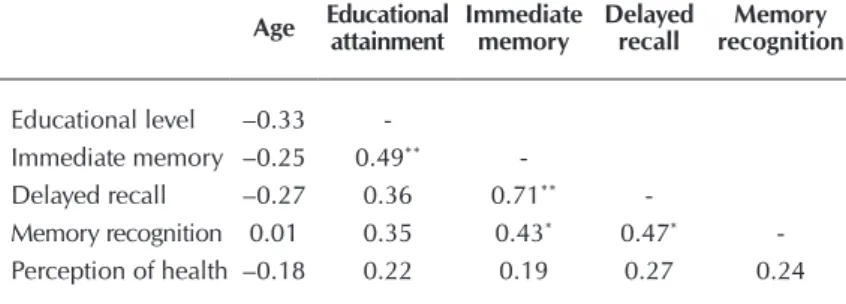
Table 3 presents the correlations between neuropsychological tests and the variables of health conditions, verifying correlation between educational level and immediate memory (R = 0.49, p = 0.008); delayed recall and immediate memory (R = 0.71, p <0.001); recognition memory and immediate memory (R = 0.43, p = 0.021); and recognition memory and delayed recall (R = 0.47, p = 0.012).
of formal education(18). Another study, with 20 older adults
in the Geriatric Ambulatory Services of the Hospital das Clínicas of the Faculdade de Medicina de São Paulo showed a mean MMSE score of 28.35 correlated to a mean of 7.75 years of formal education(19), similar to the results found in the
present study.
The variable “educational level” was also compared to MMSE scores in international studies. A study conducted in Japan with 47 participants with mean educational level of 13 years(20) and another one, conducted in Spain with 20
participants with mean education level of 13.43 years(21),
found mean MMSE scores of 28.20 and 28.86 respectively, showing results similar to the present research, even though educational level was way higher.
Considering the above, the five-year difference of educa-tional level compared to the internaeduca-tional studies does not seem to have a significant influence in the MMSE scores. The lack of impact in the test result of this difference in for-mal education might have happened due to the low mean age of the population of the present study. Studies indicate that age is also directly related to MMSE scores, since aging is one of the major risk factor for dementia(1,22); therefore,
higher ages make the individual more likely to have a lower performance in the MMSE. In this case, the sample of these international studies had mean ages higher than the sample of this study. Therefore, the findings reinforce the evidences found in the literature regard-ing influence of educational levels and age in MMSE performance(14,23).
Although the results of the MMSE are pre-sented in this paper - and this instrument was used only for the purpose of screening for cognitive impairment, and not as the main instrument of evaluation of the object studied - the discussion of the findings is important since studies conducted in Brazil use the test extensively, but still present con-tradictory results due to the non-existence of a standardized version(24). Also, Brazilian
studies addressing cognitive evaluation gen-erally use the MMSE as the only assessment instrument, unlike international studies, that conduct cognitive examination using specif-ic instruments for each function. However, this study was concerned with the specificity of the evaluation of mem-ory performance, using a unique instrument to assess this function, unlike the majority of studies conducted with the same population in Brazil.
Regarding health perception of the elderly, most of the participants classified their health as “good”. This finding is in agreement with the literature, since evidence found in a study suggests that a negative health self-perception is closely related to cognitive decline(25). The high percentage
of “good” and “great” health self-assessments (80%) in this study is explained by the fact that the sample did not pres-ent evidence of cognitive deficit, had functional capacity preserved and were active and socially engaged.
Table 2 – Descriptive statistics of performance in the neuro-psychological tests, Cuiabá, Mato Grosso, Brazil, 2016 (N = 28)
Tests Mean ± SD* Minimum Median Maximum
Immediate memory 6.04 ± 1.83 2 6 9
Delayed recall 8.57 ± 2.96 3 8 13
Memory recognition 12.82 ± 2.39 6 13 15
Note: SD*: Standard Deviation.
Table 3 – Correlation of the variables age, educational level, health perception and neuropsychological tests, Cuiabá, Mato Grosso, Brazil (N = 28)
Age Educational attainment Immediate memory Delayed recall recognition Memory
Educational level –0.33
-Immediate memory –0.25 0.49**
-Delayed recall –0.27 0.36 0.71**
-Memory recognition 0.01 0.35 0.43* 0.47*
-Perception of health –0.18 0.22 0.19 0.27 0.24
Note: * Correlation is significant at the 0.05 level (2-tailed); ** Correlation is significant at the 0.01 level (2-tailed)
DISCUSSION
The participants of the present study had high scores in the MMSE and educational level mostly over seven years, corroborating evidence from the literature that MMSE per-formance is strongly influenced by the years of formal edu-cation (14,16,18). Educational level is also considered an aspect
of neuronal protection(18).
A household survey conducted in three cities of differ-ent Brazilian regions, aimed at analyzing factors associated to a negative health perceptions of Brazilian older adults population, found a significant association between a nega-tive health self-perception and use of two or more medica-tions, hypertension and functional disability(26). Therefore,
health self-perception can be considered a reflection of the overall health situation of the elderly and directly related to autonomy and independence(26). Furthermore, it is an important
indicator of mortality, since those that perceive their health as bad have higher chances of dying than those that report health as good(27).
When asked about health problems, most of the partici-pants reported having one health problem or more. Interest-ingly, even though the participants had some type of dis-ease, positive health perception was prevalent. The same result was found in a study that aimed to evaluate the health self-perception of 274 older adults in the city of Passo Fun-do-RS(28). This finding can be explained by the fact that these
individuals do not have disabilities or limitations, and most of the times they live without any type of symptoms(29). This
corroborates the idea that, for the older adults, a bad health condition is associated with functional decline and need for help in the execution of activities, associating bad health condition with dependence and not necessarily with the presence and/or number of diseases(26).
In the evaluation of immediate memory, the mean score found in this study is similar to the results of the validity study of the RAVLT test for Brazilian women between 65 and 69 years old(17). The mean scores of delayed recall and
memory recognition were respectively lower and higher than the scores obtained in the reference study. Another study conducted in the State of Parana with 57 individuals of both genders aged 65 or more found a mean of imme-diate memory of 5.1, a delayed recall mean of 7.1 and a memory recognition mean of 12.2, all lower to the results found in the present study(30).
A positive correlation between educational level and im-mediate memory performance in the RAVLT test (p < 0.01) was found in this study. This means that when the level of formal education increases the number of words recalled after the first reading of the word list also increases. This finding is similar to the result obtained in a study with 158 Brazilian older adults from Juiz de Fora-MG. This study aimed at verifying the correlation between cognitive tests obtained by the CERAD (Consortium to Establish a Registry for Alzheimer’s Disease) and sociodemographic variables. A correlation (p < 0,001) between educational level and immediate memory was also found (23). The study by
Mag-alhães and Hamdam(30) also indicated the same correlation.
Although not fully understood yet, the educational level seems to be a protective factor for the decline not only of memory performance, but also of cognitive function in gen-eral. This assertion can be explained by the cognitive reserve model, meaning that a more complex and effective neuronal network, attained through a higher education time, might com-pensate for neuronal and synaptic losses related to aging(22).
Regarding the analysis of the correlation between delayed recall and recognition memory and between immediate mem-ory and recognition memmem-ory, the high results obtained were corroborated in a study with Brazilian older adults (p ≤ 0.05 e p ≤ 0.001)(23). This means that as the number of words
re-called in the first reading of the word list increases, number of words recalled after the 20-minute delay and distinguished among the 50 words in the recognition list also increase. In-terestingly, even with the use of different instruments for the evaluation of the same variables, the results found are similar. Health perception presented a positive correlation with educational level and immediate memory in the study con-ducted in Juiz de Fora-MG(23). However, in the present study,
no correlation was found between the variable “health per-ception” and the results of the neuropsychological test.
This study showed no correlation between the perfor-mance on the neuropsychological test and health percep-tion, unlike a study conducted in Belo Horizonte-MG with 98 older adults that found that individuals with no cogni-tive impairment found in the MMSE tended to present a bad health perception (p = 0,006)(25). A possibility for the
cor-relations of these studies might be the fact that, among the older adults in the study from Belo Horizonte-MG, some presented cardiovascular problems, reaffirming the influ-ence of the presinflu-ence of chronic diseases in the perception of health conditions.
A relevant point is that, while the literature has been dis-cussing the correlations between subjective complaints of memory and health conditions(11), this study measured the
performance of memory through a neuropsychological test. This gives greater reliability to the findings, since evaluation of this function considering subjectivity becomes abstract and vulnerable to the psychic and cognitive status of the individual interviewed(26), as mentioned previously.
Study limitations
This study presents some limitations regarding the com-parison and discussion of the findings, since few national studies make a systematic evaluation of memory perfor-mance in the older adults’ population and correlate it with health conditions. Another limitation is the fact that the ab-sence of correlation between the health perception variable and the results of the neuropsychological test can be due to the reduced number of participants in the study, a fact that demonstrates the need for new studies on this subject.
Contributions to the area of nursing, health or public policy
Based on the knowledge of the variables correlated with memory performance and its possible changes, the health professional, in particular the nurse, can identify problems and direct the planning of care to older adults, as well as the monitoring, considering that cognitive loss occurs gradually in this population.
CONCLUSION
This study evidence that the participating population pre-sented a high score in the MMSE and a satisfactory health per-ception, despite reporting one or more health problems. Re-garding the neuropsychological test that evaluated the memory
performance, there was no correlation of the variables of this test with the health perception.
FUNDING
Project funded by the Coordenação de Aperfeiçoamento de Pessoal de Nível Superior. Edital 071/2013 – Programa Na-cional de Cooperação Acadêmica 2013.
ACKNOWLEDGMENT
To the Coordenação de Aperfeiçoamento de Pessoal de Nível Superior, master’s degree scholarship.
REFERÊNCIAS
1. Chaimowicz F. Saúde do Idoso[Internet]. Belo Horizonte: NESCOM UFMG; 2013 [cited 2016 Jun 09]. 167p. Available from:
https://www.nescon.medicina.ufmg.br/biblioteca/imagem/3836.pdf
2. Moraes EN. Atenção à saúde do idoso: aspectos conceituais[Internet]. Brasília: Organização Pan-Americana da Saúde; 2012 [cited
2016 Jun 12]. Available from: http://pesquisa.bvsalud.org/portal/resource/pt/lil-713328
3. World Health Organization. NIA/NIH/US Department of Health and Human Services. Global aging and health[Internet]. WHO;
2011 [cited 2016 Jun 10]. 32p. Available from: http://www.who.int/ageing/publications/global_health.pdf
4. Brasil. Instituto Brasileiro de Geografia e Estatística-IBGE. Censo demográfico: resultado final: total de pessoas de 0 a 14 anos, 15
a 29 anos, 55 anos ou mais e 60 anos ou mais [Internet]. 2010 [cited 2016 Aug 14]. Available from: http://www.ibge.gov.br/apps/ snig/v1/?loc=0&cat=-1,-2,-3,77,128&ind=4707
5. Mendes EV. Redes de atenção à saúde[Internet]. Brasília: Organização Pan-Americana de Saúde; 2011 [cited 2016 Jul 02].
Available from: http://www.saude.sp.gov.br/resources/ses/perfil/gestor/documentos-de-planejamento-em-saude/elaboracao-do-plano-estadual-de-saude-2010-2015/textos-de-apoios/redes_de_atencao_mendes_2.pdf
6. Vagetti GC, Barboza Fo VC, Moreira NB, Oliveira V, Mazzardo O, Campos W. Condições de saúde e variáveis sociodemográficas
associadas à qualidade de vida em idosas de um programa de atividade física de Curitiba, Paraná, Sul do Brasil. Cad Saúde Pública [Internet]. 2013 [cited 2016 Jul 19];29(5):955-69. Available from: http://www.scielo.br/pdf/csp/v29n5/13.pdf
7. Benedetti TRB, Mazo GZ, Borges LJ. Condições de saúde e nível de atividade física em idosos participantes e não participantes
de grupos de convivência de Florianópolis. Ciênc Saúde Colet [Internet]. 2012 [cited 2016 Jul 19];17(8):2087-93. Available from: http://www.scielo.br/pdf/csc/v17n8/19.pdf
8. Bharer L. Cognitive plasticity in older adults: effects of cognitive training and physical exercise. Ann N Y Acad Sci [Internet]. 2015
[cited 2016 May 29];1337:1-6. Available from: http://onlinelibrary.wiley.com/doi/10.1111/nyas.12682/pdf
9. Abrisqueta-Gomez J. Memória e envelhecimento cognitivo saudável. In: Malloy-Diniz LF, Fuentes D, Consenza RM, (orgs).
Neuropsicologia do Envelhecimento: uma abordagem multidimensional. Porto Alegre: Artmed; 2013. p. 171-96.
10. Morrison JH, Baxter MG. The aging cortical synapses: hallmarks and implication for cognitive decline. Nat Rev Neurosci [Internet]. 2012 [cited 2016 Jul 19];13(4):240-50. Available from: http://www.nature.com/nrn/journal/v13/n4/pdf/nrn3200.pdf
11. Lee PL. The relationship between memory complaints, activity and perceived health status. Scand J Psychol [Internet]. 2014 [cited 2016 Jul 17];55(2):136-41. Available from: http://onlinelibrary.wiley.com/doi/10.1111/sjop.12107/epdf
12. Freitas SR, Fernandes MH, Coqueiro RS, Reis Júnior WM, Rocha SV, Brito TA. Functional capacity and associated factors in the elderly: a population study. Acta Paul Enferm [Internet]. 2012 [cited 2016 Jun 21];25(6): 933-9. Available from: http://www.scielo. br/pdf/ape/v25n6/en_v25n6a17.pdf
13. Diniz LF, Abreu N, Bertola L, Fuentes D, Antunes AM, Paula JJ, et al. O exame neuropsicológico do idoso. In: Malloy-Diniz LF, Fuentes D, Consenza RM, organizadores. Neuropsicologia do Envelhecimento: uma abordagem multidimensional Porto Alegre: Artmed; 2013. p. 243-264.
14. Bertolucci PHF, Brucki SMD, CampacciSR, JulianoY. O mini-exame do estado mental em uma população geral: impacto da
escolaridade. Arq Neuro-Psiquiatr [Internet]. 1994 [cited 2016 Aug 29];52(1):1-7. Available from: http://www.scielo.br/pdf/anp/ v52n1/01.pdf
16. Almeida OP. Mini Exame do Estado Mental e o diagnóstico de demência no Brasil. Arq Neuropsiquiatr [Internet]. 1998 [cited 2016 Aug 22];56(3-B):605-12. Available from: http://www.scielo.br/pdf/anp/v56n3B/1774.pdf
17. Malloy-Diniz LF, Lasmar VAP, Gazinelli LSR, Fuentes D, Salgado JV. The Rey Auditory-Verbal Learning Test: applicability for the Brazilian elderly population. Rev Bras Psiquiatr [Internet]. 2007 [cited 2016 Sep 03];29(4):324-9. Available from: http://www. scielo.br/pdf/rbp/v29n4/a06v29n4.pdf
18. Coelho FGM, Vital TM, Novais IP, Costa GA, Stella F, Santos-Galduroz RF. Desempenho cognitivo em diferentes níveis de escolaridade de adultos e idosos ativos. Rev Bras Geriatr Gerontol [Internet]. 2012 [cited 2016 Sep 07];15(1):7-15. Available from: http://www.scielo.br/pdf/rbgg/v15n1/02.pdf
19. Oliveira RS, Trezza BM, Busse AL, Jacob-Filho W. Efeito de aprendizagem de testes cognitivos computadorizados em idosos. Einstein [Internet]. 2014 [cited 2016 Sep 18];12(2):149-53. Available from: http://www.scielo.br/pdf/eins/v12n2/pt_1679-4508-eins-12-2-0149.pdf
20. Ichihara-Takeda S, Taqueda K, Ikeda N, Matsuyama K, Funahashi S. Neuropsychological assessment of a new computerized cognitive task that was developed to train several cognitive functions simultaneously. Front Psychol [Internet]. 2016 [cited 2016 Aug 13];7:497. Available from: https://www.ncbi.nlm.nih.gov/pmc/articles/PMC4828453/pdf/fpsyg-07-00497.pdf
21. Correia R, Nieto A, Ferreira D, Sabucedo M, Barroso J. Fund of information is more strongly associated with neuropsychological function than education in older spanish adults. Arch Clin Neuropsycho [Internet]. 2015 [cited 2016 Sep 10];30(4):310-21. Available from: http://acn.oxfordjournals.org/content/30/4/310.full.pdf+html
22. Alzheimer Disease International. World Alzheimer Report 2014: dementia and risk reduction: an analysis of prospective and modifiable factors [Internet]. London: Alzheimer Disease International; 2014 [cited 2016 Jul 05]. Available from: https://www.alz. co.uk/research/WorldAlzheimerReport2014.pdf
23. Ribeiro PCC, Oliveira BHD, Cupertino APFB, Neri AL, Yassuda MS. Desempenho de idosos na Bateria Cognitiva Cerad: relações com variáveis sociodemográficas e saúde percebida. Psicol-Reflex Crit [Internet]. 2010 [cited 2016 May 14];23(1):102-9. Available from: http://www.scielo.br/pdf/prc/v23n1/a13v23n1.pdf
24. Melo DM, Barbosa AJG. O uso do Mini-Exame do Estado Mental em pesquisas com idosos no Brasil: uma revisão sistemática. Ciênc Saúde Colet [Internet]. 2015 [cited 2016 Aug 24];20(12):3865-76. Available from: http://www.scielo.br/pdf/csc/v20n12/1413-8123-csc-20-12-3865. pdf
25. Freitas DHM, Campos FCA, Linhares LQ, Santos CR, Ferreira CB, Diniz BS, et al. Autopercepção da saúde e desempenho cognitivo em idosos residentes na comunidade. Rev Psiq Clin [Internet]. 2010 [cited 2016 Aug 19];37(1):49-52. Available from: http://www.scielo.br/pdf/rpc/v37n1/a07v37n1.pdf
26. Silva RJS, Smith-Menezes A, Tribess S, Rómo-Perez V, Virtuoso Júnior JS. Prevalência e fatores associados à percepção negativa da saúde em pessoas idosas no Brasil. Rev Bras Epidemiol [Internet]. 2012 [cited 2016 Aug 15];15(1):49-62. Available from: http:// www.scielo.br/pdf/rbepid/v15n1/05.pdf
27. DeSalvo KB, Muntner P. Discordance between physician and patient self-rated health and all-Cause mortality. Ochsner J [Internet]. 2011 [cited 2016 Aug 22];11:232-40. Available from: https://www.ncbi.nlm.nih.gov/pmc/articles/PMC3179188/pdf/i1524-5012-11-3-232.pdf
28. Borges AM, Santos G, Kummer JA, Fior L, Molim VD, Wibelinger LM. Autopercepção de saúde em idosos residentes em um município do interior do Rio Grande do Sul. Rev Bras Geriatr Gerontol [Internet]. 2014 [cited 2016 Sep 03];17(1):79-86. Available from: http://www.scielo.br/pdf/rbgg/v17n1/1809-9823-rbgg-17-01-00079.pdf
29. Agostinho MR, Oliveira MC, Pinto MEB, Balardin GU, Harzheim E. Autopercepção da saúde entre usuários da Atenção Primária em Porto Alegre, RS. Rev Bras Med Fam Com [Internet]. 2010 [cited 2016 Aug 22];5(17):9-15. Available from: https://rbmfc.org. br/rbmfc/article/view/175/128