Masticatory performance and bite force
in children with primary dentition
Performance mastigatória e força de mordida
em crianças na dentição decídua
Abstract: The aim of this study was to evaluate the relationship between masticatory performance and maximum bite force in the primary dentition. The sample comprised 15 children of both genders, aged 3 to 5.5 years, with good systemic and oral health, pres-ence of all primary teeth without large caries, no structural anomalies, without severe malocclusion, and no history of orthodontic treatment. They chewed one standardized silicone tablet for 20 strokes and the median areas of the chewed particles were measured by an optical digital system. Enhanced performance was measured by a decrease in the chewed particle areas and an increase in the amount of chewed particles. The bite force was determined using a transmitter pressurized tube connected to an analog/digital elec-tronic circuit. Weight, height and body mass index (kg/m2) were determined. The data were analyzed by descriptive statistics and Pearson or Spearman’s correlations, after as-sessment of the normality of the distribution by Shapiro-Wilks’ W-test. There was no cor-relation between bite force and particle area and amount (p > 0.05), neither were the body variables correlated with the masticatory variables (p > 0.05). It was concluded that the bite force was not a primary determinant of masticatory performance, and both variables were not dependent on body variables in the studied sample.
Descriptors: Mastication; Bite force; Dentition, deciduous.
Resumo: O objetivo deste estudo foi avaliar a correlação entre performance mastigatória e força de mordida máxima na dentição decídua. A amostra consistiu de 15 crianças de 3 a 5,5 anos de idade, de ambos os gêneros, apresentando boa saúde bucal e sistêmica, com a presença de todos os dentes decíduos, sem cáries extensas, sem anomalias estruturais, sem maloclusão severa e ausência de tratamento ortodôntico. Um tablete de silicone foi mastigado durante 20 ciclos e as áreas medianas das partículas foram mensuradas por um sistema óptico digital. A performance mastigatória foi considerada melhor quanto menor o tamanho das partículas mastigadas e quanto maior o número das mesmas. Para a força de mordida utilizou-se um tubo transmissor pressurizado, conectado a circuito eletrônico analógico/digital. O peso, a altura e o índice de massa corporal (kg/m2) foram determi-nados. Os dados foram analisados pela estatística descritiva e correlacionados pelo coe-iciente de Pearson ou Spearman, após a avaliação da normalidade da distribuição pelo teste de Shapiro-Wilks. Não houve correlação signiicativa entre a força de mordida e as áreas e o número das partículas (p > 0,05), assim como as variáveis corporais não se cor-relacionaram com as variáveis mastigatórias (p > 0,05). Concluiu-se que a força de mordi-da não foi o principal determinante mordi-da performance mastigatória na amostra avaliamordi-da, e ambas não foram dependentes das variáveis corporais.
Descritores: Mastigação; Força de mordida; Dentição decídua. Maria Beatriz Duarte Gavião(a)
Vaneska Graciele Raymundo(b)
Alessandra Matias Rentes(b)
(a) PhD, Professor, Department of Pediatric
Dentistry, School of Dentistry of Piracicaba, State University of Campinas.
(b) Dental clinicians, São Paulo, SP, Brazil.
Corresponding author:
Maria Beatriz Duarte Gavião
Faculdade de Odontologia de Piracicaba/ UNICAMP, Departamento de Odontologia Infantil - Área de Odontopediatria, Av. Limeira, 901, Piracicaba - SP - Brazil CEP: 13414-903
E-mail: [email protected]
Introduction
Mastication is a developmental function and its maturation occurs from learning experiences. If it is adequate, it gives stimulus and proper function for the normal development of the maxilla and man-dible.20 As mastication results in reducing the size
of food particles in preparation for swallowing and digestion, its performance can be measured by de-termining the individual capacity to comminute a test food.
Artiicial foods may be preferred to natural foods for measuring masticatory performance be-cause the physical properties, shape and size of the particles are more reproducible.2,11 Fractional
siev-ing has been widely used to determine the degree of breakdown of the chewed food.2,11,21 Nevertheless,
the accuracy and speciicity of an optical system, in which the projected dimensions of the commi-nuted food particles can be measured, is accompa-nied by an increase in speed over the conventional method.17
Several factors inluence masticatory perfor-mance, including severity of the malocclusion,3
oc-clusal contact area and body size,11,21 number of
functional tooth units and bite force.5,9 The areas of
contact between occluding teeth determine the area available for shearing food during chewing cycles.11
Deteriorated dentition and malocclusions can de-crease performance.5,26
The bite force is one of the components of the chewing function. It increases with age from child-hood,1 stays fairly constant from 20 to 40 years of
age and then declines.6 Hatch et al.9 (2001), in a
large sample of 283 men and 348 women aged from 37 to 80 years, found the mean bilateral bite force in the molar region to be 583.49 ± 281.11 N. In ages from 7 to 20 years, the mean values of unilat-eral bite force were 309.50 ± 193.75 N for boys and 219 ± 144.21 N for girls.24
In children aged 3-5 years old, Kamegai et al.12 (2005) observed that the mean bite force was
186.2 N in boys and 203.4 N in girls, whereas Mae-da et al.14 (1989) found values of 212.16 N in this
age range. For Rentes et al.23 (2002), the mean value
was 213.17 N in children from 3 to 5.5 years old with normal occlusion.
Facial structure, general muscular force and gen-der differences are only a few factors that may inlu-ence bite force values.13 Other factors, such as state
of dentition, instrumentation design and transducer position related to dental arch,15,25 malocclusions,
signs and symptoms of temporomandibular disor-ders; size, composition and mechanical advantage of jaw-closing muscles, may inluence the values found for bite force.1,15,25 Thus, the subjects’ sensory
feed-back may limit willingness to exert the maximum effort.6
The primary occlusion directly inluences the de-velopment of the permanent dentition16, and
condi-tions that are known to interfere with growth and development should be considered.18 Therefore, the
purpose of this study was to evaluate masticatory function in children with primary dentition, check-ing the relationship between masticatory perfor-mance and maximal bite force.
Material and Methods
The study comprised children of both genders aged 3 to 5.5 years. The procedures, possible dis-comforts or risks, as well as the possible beneits, were fully explained to the children and their par-ents/guardians, and their informed consent was ob-tained. The Ethical Committee of our Dental School approved the research. The inclusion criteria were the presence of all the primary teeth, without varia-tions that could compromise their dimensions, such as large caries and structural anomalies, normal-ity of the oral tissues and no history of orthodon-tic treatment. The exclusion criteria were systemic disturbances in general, ingestion of medicines that could interfere directly or indirectly with muscular activity, uncooperative behavior, tooth anomalies of structure, number or form, large caries and/or restorations, bruxism, indicated clinically by the presence of bruxofacets, and severe malocclusion. About thirty children were selected, but only 15 cooperated and performed the two tests properly, despite the training before the experiments. The sample size was determined taking into account the correlation coeficients found in the literature5,14,15,19
Body weight and height were determined by an anthropometric balance and body mass index (BMI = weight/heigth2) was calculated.
Masticatory performance and bite force measurements
The masticatory performance and bite force measurement procedures had been previously de-scribed,7,23 and they were applied by two trained
dental students, with the supervision of a pediatric dentist. Briely, the median particle areas (mm2) and
the number of chewed particles were used as repre-sentative values of masticatory performance. A de-crease in the measurements and an inde-crease in the number of the particles were considered as represen-tative of enhanced performance. The test material was a round tablet (5 mm in thickness and 10 mm in diameter, 1.6 ± 0.005 g) of condensed silicone (Op-tosil, Bayer, Leverkusen, Germany). Optosil is an ap-propriate material for the optical method, validated by Mowlana et al.17 (1994). Each child chewed one
tablet for a total of 20 bilateral strokes, which were considered adequate as they did not lead to chew-ing stress, as assessed durchew-ing the trainchew-ing before the actual test. After that, they spat the particles into a plastic cup, rinsed their mouth with water and spat the remaining mouth contents until all particles were removed. It was veriied that no par-ticle remained. After the parpar-ticles dried, they were weighed in order to assess the lost material. The test was repeated when there was any loss of mate-rial greater than 6%. The particles in each cup were transferred to a tray with a dark background and disconnectedly distributed, allowing correct digital analysis of all pieces. Each tray was photographed using a standardized particle-camera distance. Dig-ital images of the particles were obtained on a table scanner (HP ScanJet 4c/T scanner, Hewlett-Pack-ard, Palo Alto, CA, USA) and analyzed by Image Lab software (Softium Informática Ltda.-ME, For-taleza, CE, Brazil).
The bite force measurement methodology was based on that of Braun et al.1 (1996), modiied by
Rentes et al.23 (2002) for applicability in pre-school
children. The system consisted of a pressurized rubber tube, with a diameter of 7 mm, which is
adequate for the primary dentition, connected to a sensor element (MPX 5700 Motorola SPS, Aus-tin, Texas, USA), with a converse analog/digital electronic circuit. The system was connected to the computer and software for reading the pressure was developed. During its use, the tube was elasti-cally deformed, conforming to the occlusal anatomy of the individual maxillary and mandibular teeth, thereby providing a more uniform force distribu-tion1. This deformation is important because it gives
the subjects a degree of psychological security un-like the typical metal biting elements.
The subject bit the tube, placed between the pos-terior maxillary and mandibular teeth, with maxi-mum force, 3 times successively for 5 seconds, with a 10-second interval. The highest value was consid-ered, i.e., the maximal force generated, obtained in Psi and converted to Newton, taking into account the area of the tube, since force (F) is equal to pres-sure (p) times area (a) (equation 1).
F = p × a (1)
The average bite force values of all the three measurements were in line with the maximum val-ues. The method error was applied to check the re-producibility on repeated measurements, at two sep-arate occasions of 10 randomly selected children not included in the study, using Dahlberg’s formula:
3 NŇmŇN
O 4FŇŇ
where:
m: measurement; n: selected participants; Se: errors of measurements.
They underwent the measurements at intervals of at least 21 days, using the same method as with the experimental subjects. There were no differences be-tween the sets of two measurements. The error for the bite force was 5.04 N. For masticatory performance, represented by the particles sizes, it was 0.6 mm2.
to its tasteless characteristic or did not allow placing of the tube on their posterior teeth, biting improp-erly. Therefore, they were excluded.
Statistical analysis
The normality of the data distributions was as-sessed by Shapiro-Wilks’ W-test. The chewing and body variables were normally distributed, except for height. Data were analyzed by descriptive statistics and Pearson and Spearman’s coeficients. The sig-niicant level considered was p < 0.05. The Sigma Stat 3.0 statistical package (SPSS Inc., Chicago, IL, USA) was used.
Results
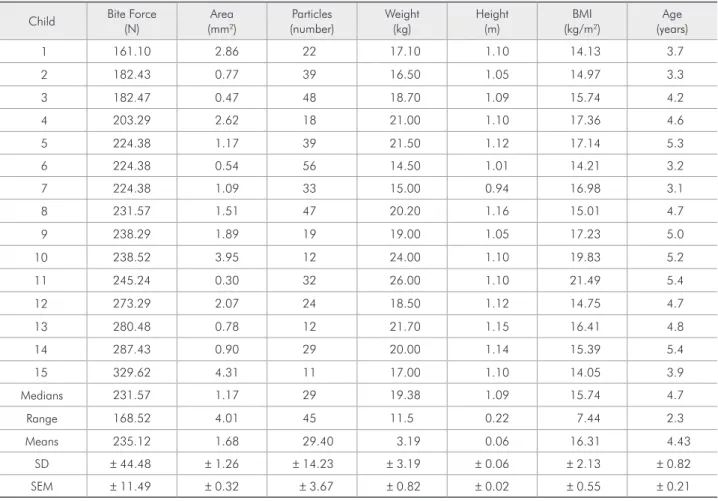
The individual data are listed in Table 1. The correlation coeficients and respective p-values are
presented in Table 2. There were no correlations be-tween particle areas, number, bite force, and body variables (p > 0.05).
Table 1 - Individual data and descriptive statistics of particle area, bite force, body variables and age.
Child Bite Force
(N)
Area (mm2)
Particles (number)
Weight (kg)
Height (m)
BMI (kg/m2)
Age (years)
1 161.10 2.86 22 17.10 1.10 14.13 3.7
2 182.43 0.77 39 16.50 1.05 14.97 3.3
3 182.47 0.47 48 18.70 1.09 15.74 4.2
4 203.29 2.62 18 21.00 1.10 17.36 4.6
5 224.38 1.17 39 21.50 1.12 17.14 5.3
6 224.38 0.54 56 14.50 1.01 14.21 3.2
7 224.38 1.09 33 15.00 0.94 16.98 3.1
8 231.57 1.51 47 20.20 1.16 15.01 4.7
9 238.29 1.89 19 19.00 1.05 17.23 5.0
10 238.52 3.95 12 24.00 1.10 19.83 5.2
11 245.24 0.30 32 26.00 1.10 21.49 5.4
12 273.29 2.07 24 18.50 1.12 14.75 4.7
13 280.48 0.78 12 21.70 1.15 16.41 4.8
14 287.43 0.90 29 20.00 1.14 15.39 5.4
15 329.62 4.31 11 17.00 1.10 14.05 3.9
Medians 231.57 1.17 29 19.38 1.09 15.74 4.7
Range 168.52 4.01 45 11.5 0.22 7.44 2.3
Means 235.12 1.68 29.40 3.19 0.06 16.31 4.43
SD ± 44.48 ± 1.26 ± 14.23 ± 3.19 ± 0.06 ± 2.13 ± 0.82
SEM ± 11.49 ± 0.32 ± 3.67 ± 0.82 ± 0.02 ± 0.55 ± 0.21
SD: Standard deviation. SEM: standard error of the mean. BMI: Body mass index.
Table 2 - Correlation coefficients of masticatory perfor-mance and body variables.
Bite
force Area Particles Weight Height BMI
Bite force - 0.370 0.102 0.543 0.072 0.979
Area 0.250 - 0.005 0.935 0.486 0.794
Particles –0.439 –0.683 - 0.243 0.391 0.416
Weight 0.171 0.023 –0.321 - 0.017
-Height 0.477 0.195 –0.239 0.603 -
-BMI –0.007 –0.074 –0.227 - -
Discussion
The methods used in this study for measuring masticatory performance and bite force in pre-school children were previously developed and used,7,23
having proved to be adequate for ield work. Com-parisons with other studies are tricky, since values of masticatory performance may be confounded by the use of different methodologies. Nevertheless, the results of bite force were similar to those of other studies in pre-school children,14,15 despite the
differ-ent devices used.
Applicability of these methods depends on chil-dren collaboration. Young chilchil-dren have more dif-iculty following instructions and may be less likely to perform the tasks properly. Thus, they received detailed experimental instructions and motivation, chewed the silicone tablets and tested the biting equipment several times before the actual recordings were made in order to build conidence in the test procedures. Although some children were excluded from the study because they did not collaborate, we perceived that young children are able to perform the tests well.
Masticatory performance and bite force were independent of each other, since there was no cor-relation between particle areas and bite force values (Tables 1 and 2). In children, low variability should occur in bite force,11 but chewing maturation is a
learned behavior,20 thus allowing an improvement
in performance. Moreover, chewing in small chil-dren depends on the daily performance and on the neuronal and psycho-social maturation as well as on the developmental status. Therefore, the muscle eficiency and force generated during mastication could not be considered the primary determinants of masticatory performance in the studied sample, agreeing with others.19,26
The lack of correlation between masticatory variables in this study could also be attributed to the dietary habits of today. The increasing softness of food is an environmental factor that might exert a strong inluence on occlusal force.15 The occlusal
force of children who mainly ate a soft diet was sig-niicantly lower than that of those who ate a more ibrous diet.14 Hence, it is important to evaluate the
child’s diet in relation not only to the nutritional and
cariogenicity aspects, but also in relation to its con-sistency, which may determine if he/she will acquire a good chewing pattern and strength of the masti-catory muscles, thus inluencing the development of the masticatory system.
On the other hand, the number of posterior func-tional teeth has been considered one of the best pre-dictors of masticatory performance9,26 because the
contacts between occluding teeth determine the area available for shearing and grinding food during the chewing cycle.5,9,11 This could explain the present
indings, as children had no missing teeth. Another factor that inluences masticatory performance is the amount of lateral excursion during mastication. Occlusal wear may eliminate interferences, permit-ting a greater range of lateral movements.8,10 There is
a high prevalence of occlusal tooth wear in the pri-mary dentition as a physiological condition, which determines greater contact areas, improving the masticatory function.8-10,21
Median particle areas and bite force were not correlated with body variables. The expected inlu-ences of body size upon masticatory variables must occur later due to the increase in muscle mass.3,24
These indings are in agreement with those of other studies that observed no signiicant correlations be-tween bite force and body variables in children,13,23
as well as between masticatory performance and body variables in primary dentition.7 The bite force
evidently may depend on more complex factors than body size, such as the cross-sectional area of the masticatory muscles and jaw biomechanics.22
An-other factor is dental occlusion, although there are contradictory results in the literature. No statisti-cal difference were observed in maximal bite force with different kinds of occlusion in the primary dentition,12,23 whereas the occlusal conditions in this
phase had an inluence on masticatory performance.7
In older children and adolescents, bite force was not correlated with the Angle classiication,21,24,25,27 but
correlated with maxillary protrusion, anterior cross-bite, crowding and open cross-bite,12 suggesting that the
during eruption and establishment of the permanent dentition. Studies taking into account occlusion in the primary dentition in a larger sample are neces-sary to assess its inluence on the relationship be-tween masticatory performance and bite force.
Chewing places a functional demand on the sto-matognathic system throughout life. A panoramic view of the changes that occur during growth may give insight into naturally occurring relationships between form and function.8 The three years prior to
initiation of the mixed dentition are crucial, in that normal changes of growth and functional adaptabil-ity occur. In young children, peripheral sensorimo-tor pathways that underlie the jaw stretch relex are maturing as the child continues to acquire oral mo-tor skills.4 Since the primary occlusion undergoes
continuous change and it is adapting to growth and developmental functional patterns, its functional determinants can and must be established to explain and assure appropriate growth and development of the stomatognathic system and to allow a better un-derstanding of the functional aspects of the mastica-tory system development.
Conclusions
Masticatory performance was independent of muscular force, and body variables had no inluence upon masticatory variables in the studied sample.
Acknowledgments
This project was supported by FAPESP and FAEP/UNICAMP (Brazil).
References
1. Braun S, Hnat WP, Marcotte MR. A study of maximum bite force during growth and development. Angle Orthod. 1996;66(4):261-4.
2. Edlund J, Lamm CJ. Masticatory efficiency. J Oral Rehabil. 1980;7(2):123-30.
3. English JD, Buschang PH, Throckmorton GS. Does Mal-occlusion Affect Masticatory Performance? Angle Orthod. 2002;72(1):21-7.
4. Finan DS, Smith A. Jaw stretch reflexes in children. Exp Brain Res. 2005;164(1):58-66.
5. Fontijn-Tekamp FA, Slagter AP, van der Bilt A, Van’T Hof MA, Witter DJ, Kalk W et al. Biting and chewing in over-dentures, full over-dentures, and natural dentitions. J Dent Res. 2000;79(7):1519-24.
6. Garner LD, Kotwal NS. Correlation study of incisive bit-ing forces with age, sex and anterior occlusion. J Dent Res. 1973;52(4):698-702.
7. Gavião MB, Raymundo VG, Sobrinho LC. Masticatory ef-ficiency in children with primary dentition. Pediatr Dent. 2001;23(6):499-505.
8. Gibbs CH, Wickwire NA, Jacobson AP, Lundeen HC, Ma-han PE, Lupkiewicz SM. Comparison of typical chewing patterns in normal children and adults. J Am Dent Assoc. 1982;105(1):33-42.
9. Hatch JP, Shinkai RS, Sakai S, Rugh JD, Paunovich ED. De-terminants of masticatory performance in dentate adults. Arch Oral Biol. 2001;46(7):641-8.
10. Hugoson A, Ekfeldt A, Koch G, Hallonsten AL. Incisal and occlusal tooth wear in children and adolescents in a Swedish population. Acta Odontol Scand. 1996;54(4):263-70.
11. Julien KC, Buschang PH, Throckmorton GS, Dechow PC. Normal masticatory performance in young adults and chil-dren. Arch Oral Biol. 1996;41(1):69-75.
12. Kamegai T, Tatsuki T, Nagano H, Mitsuhashi H, Kumeta J, Tatsuki Y et al. A determination of bite force in northern Japanese children. Eur J Orthod. 2005;27(1):53-7.
13. Kiliaridis S, Kjellberg H, Wenneberg B, Engstrom C. The rela-tionship between bite force endurance and facial morphology during growth. A cross-sectional study. Acta Odontol Scand. 1993;51(5):323-31.
14. Maeda T, Imai U, Saito T, Higuchi N, Akasaka M. [Study on the feeding function and feeding behavior of children. 1. Biting pressure and masticatory efficiency for 3, 4 and 5 years old children] [Article in Japanese]. Shoni Shikagaku Zasshi. 1989;27(4):1002-9.
15. Maki K, Nishioka T, Morimoto A, Naito M, Kimura M. A study on the measurement of occlusal force and masticatory efficiency in school age Japanese children. Int J Paediatric Dent. 2001;11(4):281-5.
16. Mauck C, Trankmann J. Influence of orthodontic treatment in the primary dentition upon development of the dentition and craniofacial growth. J Orofac Orthop. 1998;59(4):229-36. 17. Mowlana F, Heath MR, van der Bilt A, van der Glas HW.
As-sessment of chewing efficiency: a comparison of particle size distribution determined using optical scanning and sieving of almonds. J Oral Rehabil. 1994;21(5):545-51.
19. Okiyama S, Ikebe K, Nokubi T. Association between mastica-tory performance and maximal occlusal force in young men. J Oral Rehabil. 2003;30(3):278-82.
20. Ono Y, Lin YF, Iijima H, Miwa Z, Shibata M. [Masticatory training with chewing gum on young children] [Article in Japanese]. Kokubyo Gakkai Zasshi. 1992;59(2):512-7. 21. Owens S, Buschang PH, Throckmorton GS, Palmer L, English
J. Masticatory performance and areas of occlusal contact and near contact in subjects with normal occlusion and malocclu-sion. Am J Orthod Dentofacial Orthop. 2002;121(6):602-9. 22. Oyen OJ. Masticatory function and facial growth and devel-opment. In: Enlow DH. Facial Growth. 3rd ed. Philadelphia: Saunders; 1990. p. 281-300.
23. Rentes AM, Gavião MB, Amaral JR. Bite force determi-nation in children with primary dentition. J Oral Rehabil. 2002;29(12):1174-80.
24. Shiau YY, Wang JS. The effects of dental condition on hand strength and maximum bite force. Cranio. 1993;11(1):48-54.
25. Sonnesen L, Bakke M. Molar bite force in relation to occlu-sion, craniofacial dimensions, and head posture in pre-ortho-dontic children. Eur J Orthod. 2005;27(1):58-63.
26. Tate GS, Throckmorton GS, Ellis E 3rd, Sinn DP. Mastica-tory performance, muscle activity, and occlusal force in preorthognathic surgery patients. J Oral Maxillofac Surg. 1994;52(5):476-81.