492
A
rt
igo
Received 08/16/07. Accepted 11/20/07 Brazilian Journal of Pharmacognosy
17(4): 492-496, Out./Dez. 2007
Assessment of anti-hyperlipidemic effect of
Citrullus colocynthis
Marzyieh Zamani
1, Alireza O. Rahimi
1, Reza Mahdavi
1, Mohammed Nikbakhsh
1, Morteza V.
Jabbari
1, Hassan Rezazadeh
2, Abbas Delazar
2, Lutfun Nahar
3, Satyajit D. Sarker
3*
1School of Health and Nutrition, Tabriz University of Medical Sciences, Tabriz, Iran,
2Faculty of Pharmacy and Drug Applied Research Center, Tabriz University of Medical Sciences, Tabriz, Iran, 3School of Biomedical Sciences, University of Ulster at Coleraine, Cromore Road, Coleraine BT52
1SA, Co. Londonderry, Northern Ireland, UK
RESUMO: “Avaliação do efeito antihiperlipidêmico de Citrullus colocynthis”. Hiperlipidemia é um fator de risco bem conhecido para diversas doenças inclusive aterosclerose, doenças cardíacas e derrame cerebral. Na procura de potenciais agentes antihiperlipidêmicos a partir de plantas para prevenir essas doenças, a polpa e as sementes de Citrullus colocynthis foram testadas para verifi car seus efeitos no perfi l lipídico de coelhos Nova Zelândia hiperlipidêmicos. Nos grupos experimentais que receberam a polpa de C. colocynthis ou 100 mg/kg das sementes, os perfi s lipídicos foram signifi cantemente reduzidos quando comparados ao grupo de controle (P<0,05).
Unitermos:Citrullus colocynthis, Cucurbitaceae, hiperlipidemia, coelhos.
ABSTRACT: Hyperlipidemia is a well-known risk factor for several illnesses including atherosclerosis, heart and vascular diseases and stroke. In the search for potential anti-hyperlipidemic agents from plants to prevent these conditions, the pulp and the seeds of Citrullus colocynthis were assessed for their effects on the lipid profi le of hyperlipidemic New Zealand rabbits. In the experimental groups that received the pulp of C. colocynthis or 100 mg/kg of seeds, the lipid profi les were signifi cantly reduced when compared to the control group (P<0.05).
Keywords:Citrullus colocynthis, Cucurbitaceae, hyperlipidemia, rabbits.
INTRODUCTION
From the seventeen major causes of human death, cardiovascular diseases rank seventh. Coronary heart disease (CHD) is the cause of mortality in 50% of people around the world (Faergeman, 2000; Sullivan, 2002). Hyperlipidemia is considered to be the most infl uencial risk factor for CHD (Torres et al., 2000; Nilson et al., 2001; Patel, 2001). Therefore, maintaining low blood lipid profi le and blood cholesterol is essential for cardiovascular health. A 20% reduction of blood cholesterol level can decrease about 31% of CHD incidence, and 33% of its mortality rate (Scott, 1997).
Citrullus colocynthis (L.) Schrad. (Cucurbitaceae), commonly known as ‘bitter apple’, ‘colosynth’, ‘vine-of-Sodom’, ‘hendavaneye aboojahl’, ‘tumba’ or ‘wild gourd’, is a tropical plant that grows abundantly in southern Iran, and also in other parts of the world (GRIN Database, 2007). It is described in the fi rst edition of Brazilian Offi cial Pharmacopoeia (Brandão et al., 2006). The usable part of C. colocynthis is its fruit about the size of an apple, yellow in color and bitter tasting. Ripe fruits contain white spongy pulp located in the leathern cover with many white or brown ovoid
seeds. The fruits are used as a purgative in constipation, anthelmintic, carminative, anti-rheumatic, anti-diabetic and antipyretic (Adam et al., 2001; Madari and Jacobs, 2004; Dr. Duke’s Phytochemical and Ethnobotanical Databases, 2007).
The fruits of C. colocynthis contain saponins (Montaral and Jersey, 2000; Yoshikawa et al., 2007; ISI Database, 2007). Most saponins form an insoluble complex with 3ȕ-hydroxysteroids, and consequently large micelles with choleic acids and cholesterol. C. colocynthis is known to increase peristaltic movements of the gut, and cause diarrhea (Milgate and Roberts, 1995). We now report the effects of this plant on blood lipid profi le in hyperlipidemic rabbits.
MATERIAL AND METHODS
Plant material
the School of Pharmacy, Tabriz University of Medical Sciences, Iran. A voucher specimen (TUM-ADA 87) for this collection has been deposited in the herbarium of the Faculty of Pharmacy, Tabriz University of Medical Science, and also in the herbarium of the Plant and Soil Science Department, University of Aberdeen, Scotland (ABD).
Preparation of plant extracts
The ground pulp (500 g) and the seeds (500 g) of
C. colocynthis were extracted separately by maceration with water:methanol (30:70) for 24 hours and repeated three times. The pooled hydro-methanolic extracts were concentrated by rotary evaporator at 45 oC.
Animals
Thirty four 1-1.5 month old New Zealand male rabbits, which were suitable models for the examination of anti-cholestrolemic or anti-hyperlipidemic agents (Behr-Roussel et al., 2002; Aguilera et al., 2003; Ishizaka et al., 2003; Hyashi et al., 2004), were purchased from Iran Pasteur Institute (Tehran-Iran), and were housed in the animal farm of Tabriz Medical University for 18 consecutive weeks: 2 weeks and 16 weeks, respectively, for the adaptation and the experimental periods, as described in the literature (Kwon et al., 2000, 2003; Mackness et al., 2000; Zaho and Zhang, 2003) under standard environmental conditions of temperature, humidity and light. Rabbits were kept in aluminium cages and received the standard diet and water ad libitum
(‘free-feeding’)(Table1).
Protocol
After 2 weeks, the rabbits were placed in a specifi c holder and were humanely bled from their marginal ear vein by using xylol to facilitate the process of bleeding. The samples were centrifuged (1500 spin for 15 min) and 5 mL of serum was analyzed for lipid profi le (cholesterol, LDL-C, HDL-C and triglyceride) and fasting blood sugar.
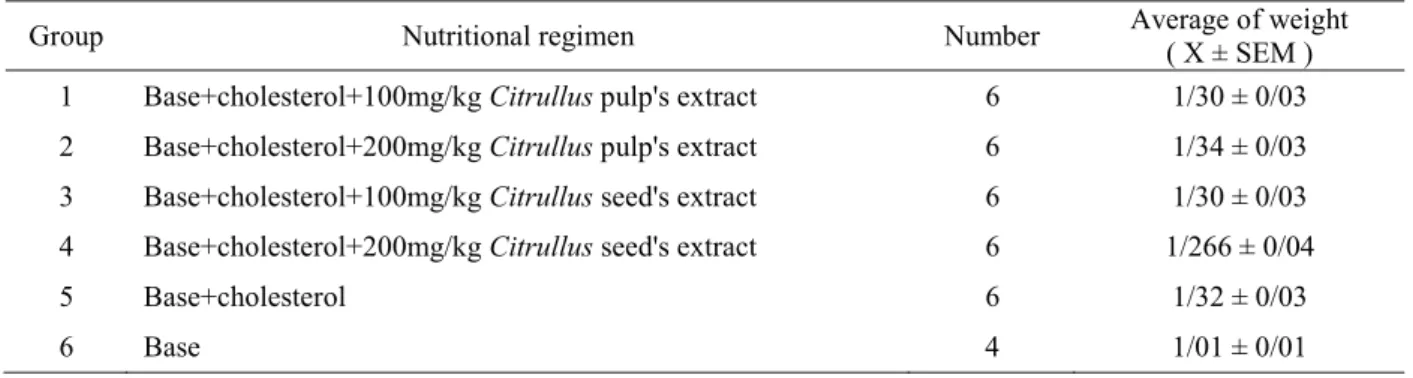
After the adaptation period, the rabbits were assigned to 6 groups. Group 1 received a diet containing the standard regimen, plus cholesterol (0.5%) and 100 mg/kg of Citrullus pulp extract; group 2 received a diet containing the standard regimen plus cholesterol (0.5%) and 200 mg/kg Citrullus pulps extract, group 3 received a diet containing the standard regimen plus cholesterol (0.5%) and 100 mg/kg of Citrullus seed extract, group 4 received a diet containing the standard regimen plus cholesterol (0.5%) and 200 mg/kg of Citrullus seed extract, group 5 received a diet containing the standard regimen plus cholesterol (0.5%) and group 6 received a diet containing the standard regimen only (Table 2). The cholesterol containing diet was prepared through
mixing a solution of cholesterol (dissolved in diethyl ether) with the standard diet.
Rabbits were bled once a week, at random, to confi rm hypercholesterolemia or hyperlipidemia. After 12 weeks, rabbits of the intervention groups became hypercholestrolemic or hyperlipidemia. Fasting blood samples were then taken to measure the lipid profi le (cholesterol, HDL-C, LDL-C and triglyceride) and the amount of blood sugar. After 18 weeks of the treatment, rabbits were sacrifi ced and blood samples were collected for serum chemistry analysis and haematological studies. Total amount of cholesterol, LDL-C, HDL-C, serum triglyceride (TG) and blood glucose were measured by a manual kit (Pars azmoon, Iran) following the enzymatic and colorimetric methods (Enzymatic-colorimetric/ CHOD-PAP) available in the literature (Rifai et al., 1991; Artiss and Zak, 1997; Cole et al., 1997; Sacks, 1999). In order to compare the averages, the ANOVA test, Dunkan test, Paired t-test and Student t-test were utilized.
RESULTS AND DISCUSSION
As seeds and pulps generally have different chemical profiles, both extracts were tested for their potential anti-hyperlipidemic effect. The hypercholesterolemic regimen signifi cantly increased the amount of blood cholesterol, LDL-C, HDL-C, triglyceride and blood sugar (p<0.05). The hypercholestrolemic control rabbits (group 5) remained hypercholesterolemic throughout the experimental period while serum cholesterol and triglyceride in the fi rst three groups receiving both seeds and pulps extracts ofC. colocynthis were reduced (p<0.05).
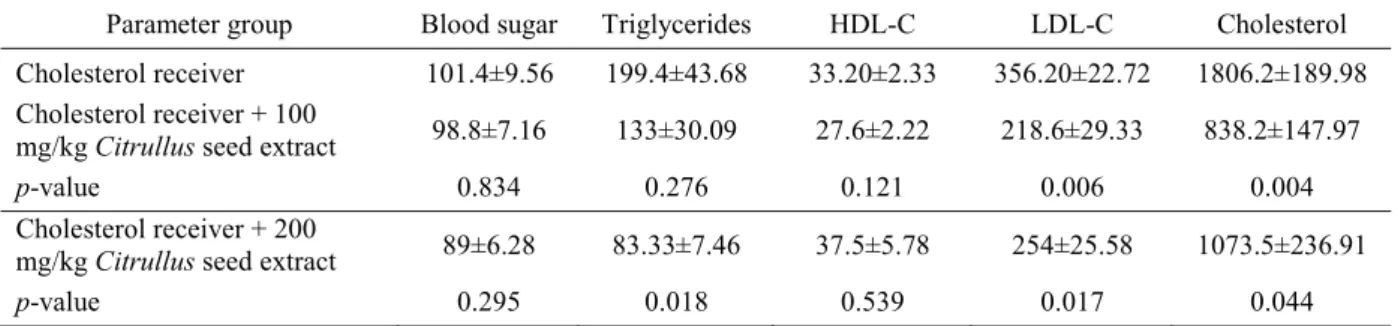
The reduction of LDL-C in the groups receiving the pulp extracts and 100 mg/kg seed extract were significant (p<0.05). HDL-C reduction was also signifi cant in the fi rst four groups receiving the extract of C. colocynthis except at the doses of 200 mg/kg (p<0.05). On the other hand, the comparison between the four groups receiving the extract of C. colocynthis
demonstrated that the average amount of cholesterol, LDL-C, HDL-C, TG and blood sugar were reduced compared to those of the control group. The dose response for the different groups to oral administration ofC. colocynthis is shown in Tables 3-4.
494 Rev. Bras. Farmacogn.
Materials Energy proportion (%)
Protein 8
Lysine 6
Metyonine + cystein 7
Calcium 9
Phosphorus 4
Sodium chloride 4
Fiber 12
Fat 12
Carbohydrate 65
Energy 2700 kcal
Group Nutritional regimen Number Average of weight
( X ± SEM )
1 Base+cholesterol+100mg/kg Citrullus pulp's extract 6 1/30 ± 0/03
2 Base+cholesterol+200mg/kg Citrullus pulp's extract 6 1/34 ± 0/03
3 Base+cholesterol+100mg/kg Citrullus seed's extract 6 1/30 ± 0/03
4 Base+cholesterol+200mg/kg Citrullus seed's extract 6 1/266 ± 0/04
5 Base+cholesterol 6 1/32 ± 0/03
6 Base 4 1/01 ± 0/01
Table 1. The standard regimen of rabbits.
Table 2. The nutritional regimen of rabbits in each group.
Table 3. Comparison of the averages of serum biochemical values, weight and food consumption indexes between the groups receiving cholesterol + 100 mg/kg Citrullus pulps, and cholesterol + 200 mg/kg Citrullus pulps at the end of the study.
*Units are in mg/dL
Parameter group Blood sugar Triglycerides HDL-C LDL-C Cholesterol
Cholesterol receiver 101.4±9.56 199.4±43.68 33.20±2.33 356.2±22.72 1806±189.98
Cholesterol receiver + 100
mg/kg Citrullus pulps extract 97±8.03 90.5±27.63 30.33±3.12 183±25.99 7656.5±154.12
p-value 0.735 0.057 0.497 0.001 0.000
Cholesterol receiver + 200
mg/kg Citrullus pulps extract 98±1.81 66.4±14.43 25.8±2.76 162.4±29.13 418.4±119.59
p-value 0.746 0.02 0.075 0.001 0.000
result is different from the fi ndings by Adam et al. (2001) where an oral administration of C. colocynthis (0.25 g/ kg) in sheep for 12 days had no signifi cant changes on the level of blood cholesterol.
The effect of saponins, natural or synthetic, in lowering the levels of cholesterols has been demonstrated in a number of studies (Morehouse et
Table 4. Comparison of the averages of serum biochemical values, weight and food consumption indexes between the groups receiving cholesterol + 100 mg/kg Citrullus seeds, and cholesterol + 200 mg/kg Citrullus seeds at the end of the study.
Thefi ndings of our present study provide further evidence in support of the previously published reports on the anti-hyperlipidemic properties of saponins or saponin-containing plant extracts in animal models.
REFERENCES
Adam SEI, Al-Yahya MA, Al-Farhan AH 2001. Response of najdisheep to oral administration of Citrullus colocynthis fruits, Nerium oleander leaves or their mixture.Small Ruminant Res 40: 239-244.
Aguilera CM, Mesa M, Ramirez-Tortosa J, Qulies L 2003. Virgin olive and fi sh oils enhance the hepatic antioxidant defence system in atherosclerotic rabbits.
Clin Nutr 22: 379-384.
Artiss JD, Zak B 1997. Measurment of cholesterol concentration. In: Warnick GR and Dominicazak MH, Handbook of lipoprotein testing, Washington, AA CC Press, 99-114.
Behr-Roussel D, Bernabe J, Compagnie S, Rupin A 2002. Distinct mechanisms implicated in atherosclerosis-induced erectile dys function in rabbits.
Atherosclerosis 162: 355-362.
Brandão MGL, Cosenza GP, Moreira RA, Monte-Mor RLM 2006. Medicinal plants and other botanical products from the Brazilian Offi cial Pharmacopoeia. Rev Bras Farmacogn 16: 408-420.
Cole TG, Klotzsch SG, Namara J 1997. Measuerment of triglyceride concentration. In: Rafai N, Warnick GR, Dominiczak MH, Hand book of lipoprotein testing, Washington, AA CC Press, 115-126.
Dr. Duke’s Phytochemical and Ethnobotanical Databases (2007), Ethnobotanical uses of Citrullus
(Cucurbitaceae). Available on-line at: http://www. ars-grin.gov/cgi-bin/duke/ethnobot.pl
Faergeman O 2000. The revised joint guidelines atherosclerosis supplements 1: 37.
GRIN Database 2007. USDA, ARS, National Genetic Resources Program, Germplasm Resources Information Network (GRIN) online database, National Germsplasm Resources Laboratory, Beltsville, Maryland. Available on-line at: http:// www.ars-grin.gov/cgi-bin/npgs/html/taxon.pl?10674 Hayashi T, Sumi D, Juliet PAR, Matsui-Hirai H, Asai-Tanaka
Y, Kano H, Fukatsu A, Tsunekawa T, Miyazaki A, Iguchi A, Ignarro LJ 2004. Gene transfer of
endothelial NO synthase, but not eNOS, plus inducible NOS regressed atherosclerosis in rabbits.
Cardiovasc Res 61: 339-351.
Ishizaka T, Matsui T, Kurta A 2003. Romatroban, a TP receptor antagonist, improves cardiovascular response to acetylcholine in hypercholesterolemic rabbits in vivo.Eur J Pharmacol 468: 27-35.
ISI Database 2007. ISI Web of Knowledge Service for UK Education, supported by MIMAS at The University of Manchester and hosted by Thomson Scientifi c. Available on-line at: http://portal.isiknowledge.com/ portal.cgi?DestApp=WOS&Func=Frame.
Jiping L, Huang M, Teoh H, Man A 1999. Panax quinquefolium
saponins protects low density lipoproteins from oxidation.Life Sci 64: 53-62.
Kwon MJ, Song YS, Choi MS, Song YO 2000. Red pepper attenuates cholesteryl ester transfer protein activity and atherosclerosis in cholesterol-fed rabbits. Clin Chim Acta 332: 37-44.
Kwon MJ, Song YS, Choi MS, Park SJ, Jeong KS, Song YO 2003. Cholesteryl ester transfer protein activity and atherogenic parameters in rabbits supplemented with cholesterol and garlic powder, Life Sci 72: 2953-2964.
Mackness M, Bouiller A, Hennuyer N, Machness B, Hal M 2000. Paraxonase activity in reduced by a pro-atherosclerotic diet in rabbits, Biochem Bioph Res 269: 232-236.
Madari H, Jacobs RS 2004. An analysis of cytotoxic botanical formulations used in the traditional medicine of ancient Persia as abortifacients. J Nat Prod 67: 1204-1210.
Milgate J, Roberts DCK 1995. The nutritional and biological signifi cance of saponins. Nutr Res 15: 1223-1249. Montaral E, Jersey N 2000. PDR for Herbal, 2nd ed. London,
Medical Economic Company, 83-84.
Morehouse L, Ban Gerter FW, Ninno M, Inskeep B, Carthy P, Pethini J 1999. Comparison of synthetic saponin cholesterol absorption inhibitors in rabbits: evidence for a non-stoichiometric, intestinal mechanism of action.J Lipid Res 40: 464-437.
Nilson WT, Albertketsen G, Landmark K 2001. Effect of a high dose conectrate of n-3 fatty acids or core oil introduced early after an acute myocardial infarction on serum TG and HDL. Am J Clin Nutr 74: 50-56. Patel B 2001. A means to an end. An overview of a
hyperlipidemia outcomes managements program.
Parameter group Blood sugar Triglycerides HDL-C LDL-C Cholesterol
Cholesterol receiver 101.4±9.56 199.4±43.68 33.20±2.33 356.20±22.72 1806.2±189.98
Cholesterol receiver + 100
mg/kg Citrullus seed extract 98.8±7.16 133±30.09 27.6±2.22 218.6±29.33 838.2±147.97
p-value 0.834 0.276 0.121 0.006 0.004
Cholesterol receiver + 200
mg/kg Citrullus seed extract 89±6.28 83.33±7.46 37.5±5.78 254±25.58 1073.5±236.91
496 Rev. Bras. Farmacogn.
Am J Med 110: 125-155.
Rifai N, Bachorik PS, Albers J 1991. Lipids, lipoprotein and apolipoprotein. In: Tietz text book of clinical chemistry, Burtis CA, Ashwood ER, 3th ed. Philadelphia, W.B.Saunder: 809-861.
Sacks DB 1999. Carbohydrate. In: Buotis CA, Ashwood ER. Tietz text book of clinical chemistry, 3th ed.
Philadelphia, W.B.Saunder, 750-808.
Scott M 1997. Management of high serum cholesterol and related disorders in patients at risk for coronary heart disease.Am J Med 110: 125-155.
Sullivan D 2002. Screening for cardiovascular disease with cholesterol.Clin Chim Acta 315: 49-60.
Torres I, Mira L, Ornelas C, Melim A 2000. Study of the effects on dietary fi sh intake on serum lipids and lipoproteins in two populations with different dietary habits.Brit J Nutr 83: 371-379.
Yoshikawa M, Morikawa T, Kobayashi H, Nakamura A, Matsuhira K, Nakamura S, Matsuda H 2007. Bioactive saponins and glycosides. XXVII. Structures of new cucurbitane-type triterpene glycosides and antiallergic constituents from Citrullus colocynthis.
Chem Pharm Bull 55: 428-434.