Original article (short paper)
Proprioceptive evaluation in healthy women
undergoing Infrared Low Level Laser Therapy
Grazieli da Silva Hewelayne Suelyn Gomes
Morgana Neves Jhenifer Karvat Gustavo Kiyosen Nakayama Gladson Ricardo Flor Bertolini
Universidade Estadual do Oeste do Paraná, Cascavel, PR, Brasil
Abstract — Aim: To evaluate if the application of infrared low-level laser therapy (LLLT) alters proprioception in young women. Methods: 26 female volunteers were evaluated statically and dynamically by means of electronic baropodometry in the variables: distance from the foot center, maximum and medium pressure, and surface. Proprioception was also functionally assessed by the Star Excursion Balance Test (SEBT). The intervention occurred in two distinct periods, separated by one week apart, as this was a crossover study, so volunteers were submitted to placebo or LLLT (830 nm,
8 J/cm2), on the muscles: gastrocnemius, soleus, tibialis previous and long and short ibular. Results: the analysis of baropodometry for both dynamic and static found no signiicant differences for the intervention group and the control
group. Similar results were observed for SEBT. Conclusion: The application of the LLLT, in the proposed parameters,
did not inluence the proprioception in young women.
Keywords: laser therapy; postural balance; nervous system; kinesthesis.
Introduction
In many sports, balance improvement is one of the most important goals and it is associated with increased athletic performance and sports injuries reduction. In this context, proprioception plays an
essential role, and is deined as the ability to integrate various
sensory signals from the mechanoreceptors to determining the body position and movements in space1. It happens through the stretching of the muscle spindles, joint capsule and ligaments receivers, and Golgi tendon organs. The inputs of these various receptors are processed in the brain and integrated with visual and vestibular information to generate a position sense and movement in space2,4. The proprioceptive information triggered by joint and muscle receptors plays an integral role in neuromuscular control,
which undergoes constant revisions and modiications, based
on the integration and analysis of sensory input, efferent motor control, resulting in movements5,6.
Among the proprioception evaluations, one can mention electronic baropodometry, which is an instrumental method, being a record posturographic technique used to evaluate the plantar pressure in both the static position and movement, which records the pressure points exerted by the body7-10. On the other hand, the Star Excursion Balance Test (SEBT) is a functional balanc-ing test used to assess proprioception considered modern, easy
to handle, not instrumental, with a satisfactory cost-beneit, that
evaluates the ability of the individual to maintain body balance, while making attempts to reach the longest distance possible with
the contralateral limb in speciic directions11,12.
The low level laser therapy (LLLT) has been used for repair and analgesic purposes13. The basic biological mechanism promoted by this electrophysical feature appears to be the absorption of red and infrared light by chromophores contained in the protein
components of the respiratory chain located in the mitochondria, which, in turn, by absorbing the energy, trigger a cascade of biochemical events, resulting in increased enzymatic activity, production of adenosine triphosphate (ATP), protein synthesis, cell proliferation, collagen deposition and organization14, increase in the DNA activity and RNA and protein synthesis. When ap-plied to stem cells it has been observed increased proliferation and cell differentiation13.
In recent years, LLLT has been used aiming not only repair and analgesia, but to delay the levels of muscle fatigue15, reduce lactate levels, creatine kinase and C-reactive protein after exercise, and to increase muscle resistance16, increase muscle performance by delaying muscle fatigue17 and increasing muscle torque18. Although biostimulants effects, there is a lack of research linking LLLT effects with proprioception, balance and movement control in healthy young women, since the research to date sticks in evaluating elderly19 or with neurological disorders20 and pain21; so the aim of this study was to evaluate whether the application of infrared laser (830 nm)
inluence on proprioception in young women, given the potential
both in sports and in athletes rehabilitation process.
Materials and Methods
research. Exclusion factors were: pain and/or recent injury in the lower limb, active or suspected carcinoma, pregnant women, the presence of hemorrhagic areas and sensory or motor abnormalities
in the lower limb, vision deicit and dizziness.
Before starting the data collection procedure all volunteers signed the informed consent approved by the Research Ethics Committee of Unioeste, under protocol number: 1.134.647.
Proceedings
The volunteers were, by lot in opaque envelope, randomly as-signed into two groups of 13 subjects each (intervention group and placebo group) submitted to two interventions, performing the same activities, but in different weeks. They were evalu-ated by Electronic Baropodometry in two ways: statically and
dynamically, and at irst, the volunteer remained with open
eyes in bipodal support on the equipment, hands on her hips
and staring at a speciic point. Then, evaluation was performed
dynamically, when the patient was advised to walk, and should initially step with the support of one foot on the equipment and return it to the contralateral foot. The information was sent to the computer for analysis in the program Footwork®.
For the static baropodometry analysis, the lower limb subjected to intervention was the dominant and the contralateral limb was used as control of this assessment. In the week that the volunteers were not subject to the active laser, they were also considered as placebo for the dominant and non-dominant limb. The variables analyzed were distance from the center of the foot (cm) referring to balance, maximum pressure and medium pressure (kPa) indicating the maximum value from the average behavior of the registered pressures in all sensors throughout the support phase22. The dynamic evaluation was performed with the same previous standard, but the variables analyzed were maximum pressure and medium pressure (kPa), and the surface (cm²) which assesses sensory information from the plantar surface, important factors for maintaining postural balance during normal conditions23.
Thereafter, SEBT was performed in the dominant leg. This test consists of a series of mini unilateral squats performed while trying to get as far as possible in a particular direction with the dominant leg. A large star was made on the ground, with eight different direc-tions with a 45° angle away from each other24. The volunteer was instructed to position themselves in the center of the star on one foot, with the hands on the waist and reach it as far as possible, with the non-dominant limb, in each of the eight directions, making a light
touch on the tape that was staked out the scope of the volunteer with a permanent marker, and the test following directions: anterior, posterior, medial and lateral. All carried out with only one attempt in each direction in order to decrease the learning effects during testing. The distance measurement was carried out from the center of the star to the farthest point reached in each direction.
After the evaluations, the intervention group was stimulated with LLLT (Ibramed®) with 830 nm wavelength, output power
30 mw, luency 8 J/cm² per point, total energy of 7.68 J, on the
dominant leg. The application sites were four points in each muscle, for 16 seconds in each point, which were sanitized with alcohol gel. Muscles for application were: gastrocnemius, soleus, tibialis
anterior, long and short ibular (in this study, considered as a unit). The placebo group underwent similar procedure in the irst week,
but without effective implementation of radiation. In the follow-ing week there was an exchange of groups. The volunteers were not informed if the equipment was either not producing effective radiation. Prior to the start of the stimulation device was measured by a radiation power meter.
Following procedures irradiation / placebo, there was a ive
minute interval for the 2nd evaluation, both in the baropodometry as SEBT. Then again there was a 25 minute interval, for resting, and the 3rd evaluation of the day. The following week, all these steps were repeated, changing only the irradiation group / placebo.
Statistical Analysis
Based on baropodometry data to the sample size used, with a standard deviation of 2.2, the difference being detected 1.5 and 5%
signiicance level, the test power was 80%. Data were analyzed
as its normality, by the Shapiro-Wilk test. It was used ANOVA repeated measures for comparisons within and between groups in assessments of baropodometry. For evaluations with SEBT was
used the nonparametric Friedman test. In all cases, the signiicance
level was set at p <0.05.
Results
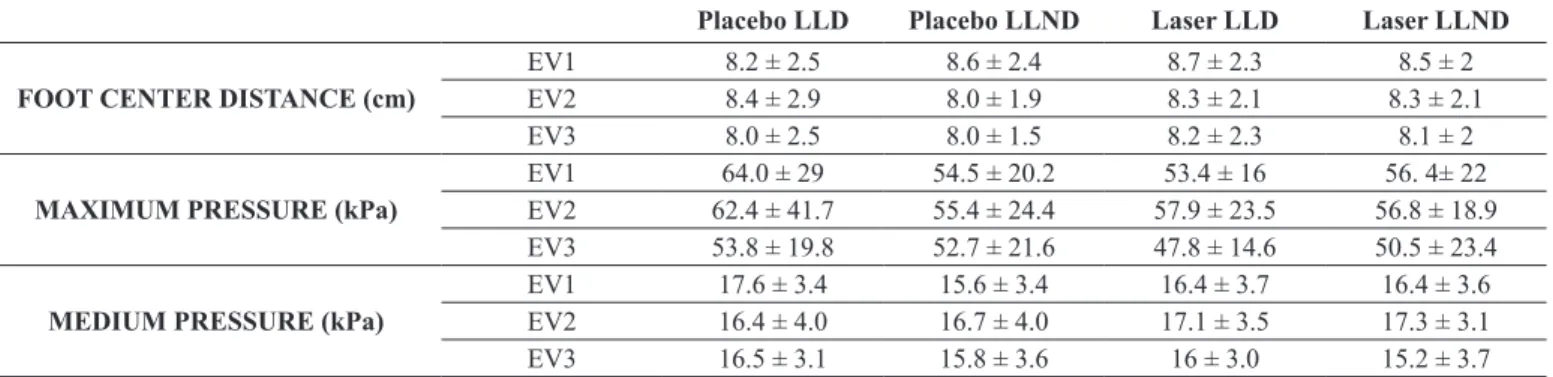
The variables of the distance from the center to the foot, maxi-mum and medium pressure exerted by the volunteers in standing
position on the platform, did not show signiicant differences
(F(4,1;95,4)=0,39, p=0,825); (F(11;253)=1,22, p=0,275); (F(4,4; 100,8)=1,5; p=0,192), respectively (Table 1).
Table 1 – Baropodometry – Static Analysis. Assessments occurred in the lower limb dominant (LLD) and non-dominant (LLND).
Placebo LLD Placebo LLND Laser LLD Laser LLND
FOOT CENTER DISTANCE (cm)
EV1 8.2 ± 2.5 8.6 ± 2.4 8.7 ± 2.3 8.5 ± 2
EV2 8.4 ± 2.9 8.0 ± 1.9 8.3 ± 2.1 8.3 ± 2.1
EV3 8.0 ± 2.5 8.0 ± 1.5 8.2 ± 2.3 8.1 ± 2
MAXIMUM PRESSURE (kPa)
EV1 64.0 ± 29 54.5 ± 20.2 53.4 ± 16 56. 4± 22
EV2 62.4 ± 41.7 55.4 ± 24.4 57.9 ± 23.5 56.8 ± 18.9
EV3 53.8 ± 19.8 52.7 ± 21.6 47.8 ± 14.6 50.5 ± 23.4
MEDIUM PRESSURE (kPa)
EV1 17.6 ± 3.4 15.6 ± 3.4 16.4 ± 3.7 16.4 ± 3.6
EV2 16.4 ± 4.0 16.7 ± 4.0 17.1 ± 3.5 17.3 ± 3.1
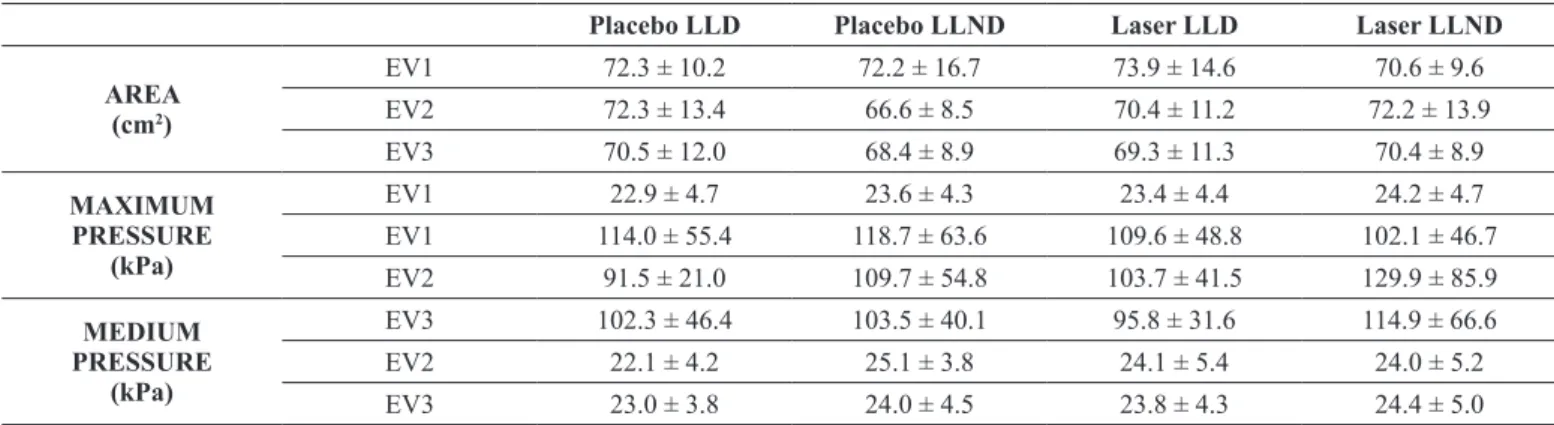
The variables area, maximum pressure and mean pressure were analyzed as carried out by the volunteers, when touched the platform with one foot at the time of going and return, also
showed no signiicant differences (F(4.5;103.5)=1.7;p=0.157);
(F(6.3; 146)=1.9; p=0.078); (F(5.1;118.3)=1.9;p=0.091), re-spectively (table 2).
Table 2 – Baropodometry – Dinamic Analysis. Assessments occurred in the lower limb dominant (LLD) and non-dominant (LLND).
Placebo LLD Placebo LLND Laser LLD Laser LLND
AREA (cm2)
EV1 72.3 ± 10.2 72.2 ± 16.7 73.9 ± 14.6 70.6 ± 9.6
EV2 72.3 ± 13.4 66.6 ± 8.5 70.4 ± 11.2 72.2 ± 13.9
EV3 70.5 ± 12.0 68.4 ± 8.9 69.3 ± 11.3 70.4 ± 8.9
MAXIMUM PRESSURE
(kPa)
EV1 22.9 ± 4.7 23.6 ± 4.3 23.4 ± 4.4 24.2 ± 4.7
EV1 114.0 ± 55.4 118.7 ± 63.6 109.6 ± 48.8 102.1 ± 46.7
EV2 91.5 ± 21.0 109.7 ± 54.8 103.7 ± 41.5 129.9 ± 85.9
MEDIUM PRESSURE
(kPa)
EV3 102.3 ± 46.4 103.5 ± 40.1 95.8 ± 31.6 114.9 ± 66.6
EV2 22.1 ± 4.2 25.1 ± 3.8 24.1 ± 5.4 24.0 ± 5.2
EV3 23.0 ± 3.8 24.0 ± 4.5 23.8 ± 4.3 24.4 ± 5.0
In the analysis performed by the SEBT, the results did not
show signiicant differences in the eight directions, according
to the Friedman test (Fr= 18.5; p=0.0024) (Table 3).
Table 3 - Results observed in the Star Excursion Balance Test (SEBT), the distance is displayed in cm.
LLLT PLACEBO
EV1 EV2 EV3 EV1 EV2 EV3
First quartile
(25%)
87.0 88.7 94.0 88.8 94.4 97.2
Median 96.1 98.9 99.8 98.8 99.9 103.1
Third quartile
(75%)
104.8 108.2 112.5 106.4 109.7 107.8
Discussion
The LLLT is an important and effective tool, which interacts with biological tissue, produces various physiological and therapeutic effects, including improving muscle performance in both animal15,25 and human studies17.
Because of all these effects and by increasing cellular me-tabolism, when the LLLT penetrate the tissue, could interfere on the movement control and postural stability, improving balance and position sense, which is given by the mechanical stimulation of the muscles and joints. Therefore, the leg muscles were chosen for the application of LLLT, they are responsible for a number of movements, that together assist to maintain the body balance26,30.
One of the most important parameters to the LLLT is the wavelength, which can determine the depth of penetration and absorption, thus their effects. Since longer wavelengths are absorbed into the deeper layers of biological tissue31, and in the
present study the aim was to reach the muscle tissue by stimulating the proprioceptive components2,3,6, it was chosen infrared 830 nm wavelength. Similar to the wavelength used by Almeida et al.32, comparing the 830 nm to 660 nm, but found that both wavelengths promoted increased peak power and delayed fatigue of the biceps
muscle. As noted above, recent studies have addressed the eficacy
of LLLT in muscle performance, however, other studies did not show superior effects to the control with laser therapy, mainly due to enormous parameters variation of therapy33,34.
In the present study, it was sought to use a commercial equipment with routinely used parameters in order to analyze if the LLLT application provide any change in proprioception, improving balance, and other variables, data from baropodometry referring to pressure from the feet were analyzed, distance from the center and even to the plantar surface, since the skin sensory stimulation plant contributes to the march and postural control, providing information on the compensatory reactions35.
Proprioceptive data on the direction of movement, speed and joint position, analyzed by SEBT did not show any differences between the placebo compared to LLLT, and both the functional analysis as performed in baropodometry showed that the LLLT had no effect on proprioception. However, divergent from what was observed here, Gallamini20, in case studies (unspeciied dizzi -ness and moderate Parkinson), points out that the very low power laser (0.01 mW average power) used in acupuncture points, can be an effective resource in the improvement of body balance..
On the other hand, Bergamaschi, Ferrari, Gallamini, Scoppa 19, used the LLLT on acupuncture and auriculoacupuncture points, with power of 30 mW and energy 0.3 J, in a group of institutionalized elderly; report that pain affects postural control, and that the sample investigated there was reduction of pain
conditions, and thus improves the balance veriied by force
It is noteworthy that, assessing only healthy individuals, simi-lar studies were not found in literature to perform comparisons, despite the literary wealth and clinical studies on the LLLT ap-plication. Therefore, despite the LLLT is a widely used resource, it is in constant process of evaluating its various parameters and
it needs more controlled studies to conirm their mechanisms of action in the various ields. The use of a single LLLT session
has been used to assess their effects on endurance16, muscle performance, oxidative stress and fatigue17, however note that the use of only a therapeutic session is considered a limitation of this study, and that further studies could assess whether the
sum therapies could signiicantly inluence proprioception in
healthy subjects.
Conclusion
The application of infrared laser (830nm), in the proposed
pa-rameters, did not inluence the proprioception in young women.
References
1. Han J, Anson J, Waddington G, Adams R, Liu Y. The role of ankle proprioception for balance control in relation to sports performance and injury. Biomed Res Int. 2015;2015.
2. Wodowski AJ, Swigler CW, Liu H, Nord KM, Toy PC, Mihalko WM. Proprioception and knee arthroplasty. A literature review. Orthop Clin North Am. 2016;47(2):301–9.
3. Vassallo M, Mallela SK, Williams A, Kwan J, Allen S, Sharma JC. Fall risk factors in elderly patients with cognitive impairment on rehabilitation wards. Geriatr Gerontol Int. 2009;9(1):41–6. 4. Isotalo E, Kapoula Z, Feret PH, Gauchon K, Zamirescu F, Gagey
PM. Monocular versus binocular vision in postural control. Auris Nasus Larynx. 2004;31(1):11–7.
5. Riemann BL, Lephart SM. The sensorimotor system, part I: The physiologic basis of functional joint stability. J Athl Train. 2002;37(1):71–9.
6. Hung Y-J. Neuromuscular control and rehabilitation of the un-stable ankle. World J Orthop. 2015;6(5):434–8.
7. Bankoff ADP, Ciol P, Zamai CA, Schmidt A, Barros DD. Estudo do equilíbrio corporal postural através do sistema de baropodo-metria eletrônica. Rev Conex. 2004;2(2):87–104.
8. Alieri FM. Distribuição da pressão plantar em idosos após
intervenção proprioceptiva. Rev Bras Cineantropometria e
Desempenho Hum. 2008;10(2):137–42.
9. Alieri FM, Teodori RM, Guirro RRJ. Pedobarometric study in elderly after physical therapy intervention. Fisioter em Mov. 2006;19(2):67–74.
10. Santos AA, Bertato F. T, Montebelo MIL, Guirro ECO. Efeito do treinamento proprioceptivo em mulheres diabéticas. Rev Bras Fisioter. 2008;12(3):183–7.
11. Meneghini T, Rempel C, Barnes DD, Duarte F, Périco E. Avaliação
da ativação proprioceptiva em atletas amadoras de voleibol.
Conscientiae Saúde. 2009;8(1):47–55.
12. Hertel J, Braham RA, Hale SA, Olmsted-Kramer LC. Simplifying the Star Excursion Balance Test: Analyses of subjects with and
without chronic ankle instability. J Orthop Sport Phys Ther. 2006;36(3):131–7.
13. Ginani F, Soares DM, Barreto MP e V, Barboza CAG. Effect of low-level laser therapy on mesenchymal stem cell proliferation: a systematic review. Lasers Med Sci. 2015;30(8):2189–94. 14. Karu TI, Pyatibrat L V, Kalendo GS. Photobiological modulation
of cell attachment via cytochrome c oxidase. Photochem Photobiol Sci. 2004;3(2):211–6.
15. Leal Jr ECP, Lopes-Martins RÁB, De Almeida P, Ramos L, Iversen V V., Bjordal JM. Effect of low-level laser therapy (GaAs 904 nm) in skeletal muscle fatigue and biochemical markers of muscle damage in rats. Eur J Appl Physiol. 2010;108(6):1083–8. 16. Leal Jr ECP, Lopes-Martins RÁB, Frigo L, Marchi T de, Rossi
RP, Godoi V de, et al. Effects of low-level laser therapy (LLLT) in the development of exercise- induced skeletal muscle fatigue and changes in biochemical markers related to postexercise recovery. J Orthop Sport Phys Ther. 2010;40(8):524–32.
17. De Marchi T, Leal ECP, Bortoli C, Tomazoni SS, Lopes-Martins RÁB, Salvador M. Low-level laser therapy (LLLT) in human progressive-intensity running: Effects on exercise performance, skeletal muscle status, and oxidative stress. Lasers Med Sci. 2012;27(1):231–6.
18. Leal Jr ECP, Nassar FR, Tomazoni S da S, Bjordal JM, Lopes-Martins RÁB. A laserterapia de baixa potência melhora o des-empenho muscular mensurado por dinamometria isocinética em humanos. Fisioter Pesqui. 2010;17(4):317–21.
19. Bergamaschi M, Ferrari G, Gallamini M, Scoppa F. Laser acu-puncture and auriculotherapy in postural instability-A preliminary report. J Acupunct Meridian Stud. 2011;4(1):69–74.
20. Gallamini M. Treating balance disorders by ultra-low-level laser stimulation of Acupoints. J Acupunct Meridian Stud. 2013;6(2):119–23.
21. Chang CC, Ku CH, Hsu WC, Hu YA, Shyu JF, Chang ST. Five-day, low-level laser therapy for sports-related lower extremity periostitis in adult men: A randomized, controlled trial. Lasers Med Sci. 2014;29(4):1485–94.
22. Filippin NT, Barbosa VLP, Sacco ICN, Costa PHL. Efeitos da
obesidade na distribuição de pressão plantar. Rev Bras Fisioter.
2007;11(6):495–501.
23. Perrin PP, Gauchard GC, Perrot C, Jeandel C. Effects of physical and sporting activities on balance control in elderly people. Br J Sport Med. 1999;33(2):121–6.
24. Earl JE, Hertel J. Lower-extremity muscle activation during the star excursion balance tests. J Sport Rehabil. 2001;10(2):93–104. 25. Lopes-Martins RAB, Marcos RL, Leonardo PS, Prianti AC,
Muscará MN, Aimbire F, et al. Effect of low-level laser (Ga-Al-As 655 nm) on skeletal muscle fatigue induced by electrical stimula-tion in rats. J Appl Physiol. 2006;101(1):283–8.
26. Donath L, Kurz E, Roth R, Zahner L, Faude O. Different ankle muscle coordination patterns and co-activation during quiet stance between young adults and seniors do not change after a bout of high intensity training. BMC Geriatr. 2015;15:19.
27. Fong SSM, Ng SSM, Guo X, Wang Y, Chung RCK, Stat G, et al.
Deicits in lower limb muscle relex contraction latency and peak
Available from: http://www.pubmedcentral.nih.gov/articlerender. fcgi?artid=4616810&tool=pmcentrez&rendertype=abstract 28. Fujiwara K, Kiyota N, Maekawa M, Prokopenko S V., Vasilyevna
AM. Postural control during transient loor translation while stand
-ing with the leg and trunk ixed. Neurosci Lett. 2015;594:93–8.
29. de Oliveira DCS, de Rezende PAM dos SL, da Silva MR, Lizardo FB, Sousa G da C, dos Santos LA, et al. Electromyographic analysis of lower limb muscles in proprioceptive exercises performed with eyes open and closed. Rev Bras Med Esporte. 2012;18(4):261–6.
30. Yang WC, Cheng CH, Wang HK, Lin KH, Hsu WL. Multi-muscle coordination during a challenging stance. Eur J Appl Physiol. 2015;115(9):1959–66.
31. Kim T-H, Kim N-J, Youn J-I. Evaluation of wavelength-dependent hair growth effects on low-level laser therapy: an experimental animal study. Lasers Med Sci. 2015;30(6):1703–9.
32. De Almeida P, Lopes-Martins RÁB, De Marchi T, Tomazoni SS, Albertini R, Corrêa JCF, et al. Red (660 nm) and infrared (830 nm) low-level laser therapy in skeletal muscle fatigue in humans: What is better? Lasers Med Sci. 2012;27(2):453–8.
33. Maciel TD, Silva J, Jorge FS, Nicolau RA. The inluence of the 830 nm laser on the jump performance of female volleyball ath-letes. Rev Bras Eng Bioméd. 2013;29(2):199–205.
34. Kakihata CMM, Malanotte JA, Higa JY, Errero TK, Balbo SL,
Bertolini GRF. Inluence of low-level laser therapy on vertical
jump in sedentary individuals. Einstein. 2015;13(1):41–6. 35. Perry SD, McIlroy WE, Maki BE. The role of plantar cutaneous
mechanoreceptors in the control of compensatory stepping reac-tions evoked by unpredictable, multi-directional perturbation. Brain Res. 2000;877(2):401–6.
Corresponding author
Gladson Ricardo Flor Bertolini. Address: Universitária St., 2069, Jd. Universitário, Cascavel, Paraná, Brazil
Email: [email protected]
Manuscript received on August 25, 2016 Manuscript accepted on November 08, 2016