Quality of life in individuals
with cervical dystonia before
botulinum toxin injection in a
Brazilian tertiary care hospital
Mariana Ribeiro Queiroz1, Hsin Fen Chien2, Egberto Reis Barbosa2
ABSTRACT
Objective: The purpose of this study was to evaluate quality of life (QoL) in a Brazilian population of individuals with cervical dystonia (CD) without effect of botulinum toxin (BTx) or with only residual effect of BTx, and identify possible physical and social aspects that affect their QoL. Method: Sixty five out of sixty seven consecutive patients with CD were assessed with two instruments: Short-form Health Survey with 36 questions (SF-36) and Toronto Western Spasmodic Torticollis Rating Scale (TWSTRS). Results: Severity of CD (TWSTRS) correlated moderately with two SF-36 subscale: role-physical (r= –0.42) and body pain (r= –0.43). Women also scored worse in two subscale of SF-36: vitality (p<0.05) and mental-health (p<0.005). Conclusion: Severity of CD and gender (female) were the main factors related to a worse QoL perception. These findings may help health professionals to predict which characteristics could lead to worse QoL, and therefore, better target their interventions to lessen the burden caused by CD.
Key words: cervical dystonia, quality of life, botulinum neurotoxin type-A, Toronto Western Spasmodic Torticollis Rating Scale, Short-form Health Survey.
Qualidade de vida em indivíduos com distonia cervical antes da aplicação de toxina botulínica em um hospital terciário brasileiro
RESUMO
Objetivo: O objetivo deste estudo foi avaliar a qualidade de vida (QV) em uma população brasileira de indivíduos com distonia cervical (DC), que estavam sem o efeito da toxina botulínica ou com efeito residual da mesma, e identificar os possíveis aspectos físicos e sociais que afetam sua QV. Método: Sessenta e cinco de sessenta e sete pacientes consecutivos com DC foram avaliados com dois instrumentos: Short-form Health Survey com 36 questões (SF-36) e Toronto Western Spasmodic Torticollis Rating Scale (TWSTRS).
Resultados: A gravidade da DC (TWSTRS) correlacionou-se moderadamente com duas sub-escalas da SF-36: aspectos físicos (r= –0,42) e dor (r= –0,43). Mulheres apresentaram piores pontuações em duas sub-escalas da SF-36: vitalidade (p<0,05) e saúde mental (p<0,005). Conclusão: Gravidade da DC e gênero (feminino) foram os principais fatores relacionados à pior percepção de QV. Estes achados podem auxiliar profissionais da saúde a identificarem quais características poderiam levar a uma pior QV, e assim direcionar melhor suas intervenções, atenuando os danos causados pela DC.
Palavras-Chave: distonia cervical, qualidade de vida, toxina botulínica do tipo-A, Toronto Western Spasmodic Torticollis Rating Scale, Short-form Health Survey.
Correspondence
Mariana Araújo Ribeiro Queiroz Rua Andirá 195 / 81 86020-520 Londrina PR - Brasil E-mail: [email protected]
Conflicts of interest
The authors report no conflicts of interest
Received 18 April 2011
Received in final form 10 June 2011 Accepted 17 June 2011
1Physical therapist, Movement Disorders Clinic of the Division of Neurology, Hospital das Clínicas of the University of São
Cervical dystonia (CD) is the most common form of focal dystonia and its prevalence is estimated to be 11.5 cases per 100,000 individuals1,2. CD is characterized
by involuntary contractions of cervical region muscles, leading to awkward posture of the head and neck. Most of the cases have idiopathic origin3.
The most debilitating symptoms in this condition are: pain, head abnormal posture, and tremor4. he pain,
present in two third of patients, is the most disabling one5. Mental stress resulting from the disease may also
contribute for the high level of dysfunction and inter-feres in important aspects of daily living such as profes-sional and social activities6. Its efect on patient’s health is
comparable to progressive and generalized neurological degenerative diseases which are more severe than CD1.
Botulinum toxin (BTx) is the most efective treatment option for focal dystonias, which includes CD. It leads to symptoms relief, specially pain, and signiicant pos-tural improvement7. Many studies show improvement
of quality of life (QoL) after BTx injections1,8,9. Other
authors10,11, on the other hand, disagree with this point
of view since their patients did not have signiicant im-provement of QoL after BTx injections. Some reasons may partially explain these conlicting opinions: the ef-fect of the treatment changes over time reaching a pla-teau after the injection and decreasing soon after it; not all injections achieve the same results; it is a long-term treatment and the procedure has to be repeated fre-quently. hese facts discourage the patients and leads to negative impact in their QoL.
Although many studies1,8,10,12 have demonstrated that
CD impacts negatively in the patient’s QoL there are no agreements about which individual or social aspects are the most troublesome. Furthermore, there are few data about patients QoL without the efect of BTx treatment or with only residual efects, since in most studies the authors assess the QoL exclusively during the period of action of BTx without an adequate control10, or do not
even mention when they interviewed their patients1,12.
he purpose of the present study was to evaluate QoL in a Brazilian population of individuals with CD without the efect of BTx or with only residual efect of BTx, and identify possible clinical and social aspects that afect their QoL that can be targeted by speciic interventions.
METHOD
Sixty ive out of sixty seven consecutive CD patients treated at the Movement Disorder Clinic of the Division of Neurology of the Hospital das Clínicas of the Uni-versity of São Paulo School of Medicine were initially evaluated by one physiotherapist during the period of November 2007 to September 2009. he patients were assessed by Short-form Health Survey with 36 questions
(SF-36) and the Toronto Western Spasmodic Torticollis Rating Scale (TWSTRS), at the day they would receive BTx injection, before the procedure. he study was ap-proved by the hospital ethics committee. All patients had signed the informed consent form prior to their inclu-sion to the study.
he SF-36 health survey questionnaire yields an eight scale proile and they are hypothesized to form two dis-tinct higher-ordered clusters: physical and mental health. he physical health domain comprehends the following items: physical functioning, role-physical, body pain, and general health. he mental health domain measures the following areas: vitality, social functioning, role-emo-tional, and mental health. he scores range from zero, the lowest possible score, to one hundred, with 100 rep-resenting the highest level of functioning possible13. he
Brazilian SF-36 version was translated and validated by Ciconelli et al.14.
he TWSTRS, developed by Consky et al.15, is
com-prised of three diferent components which are: severity, disability, and pain. his instrument is reliable and com-bines the scores obtained by the examiner doctor (se-verity subcale score), and the rating given by the patients (disability and pain subscales). The total score varies from 0 (best state) to 85 (worst state). Each subscale, severity, disability, and pain, may obtain the maximum scores of 35, 30, and 20 respectively. he more severe the disease the higher is the inal score. his scale was translated and adapted to Brazilian Portuguese by Sekef-Sallem et al.16 and is in process of validation to Brazilian
Portuguese by the same authors.
he following data were also recorded: gender, age, educational attainment, years of disease, time of treat-ment with BTx, time lag between years of disease and be-ginning of BTx treatment.
Before receiving BTx injection, all patients were eval-uated by at least two neurologists, with experience on Movement Disorders, who administered BTx type-A in the cervical dystonic muscles. We did not have quanti-tative measurements, such as electromyograph, to as-sure that the patients had residual efect or no efect of BTx from last procedure. According to our previous study published elsewhere17, the mean duration of
clin-ical improvement obtained from BTx in our patients is 13 weeks. It is a practice in our service to reinject them in approximately 20 week interval, when it is assumed that the patient had no more efect of BTx.
cognitive impairment. Two patients, from the total 67 evaluated, were excluded from this study because they did not score the cut-of point of the Mini-Mental State Examination, which varied according to educational at-tainment. For more details on the use of the method for the Brazilian population, see Brucki et al.18.
Statistical analysis
he numerical variables were tested for normal dis-tribution. Mean and standard deviation were used to de-scribe continuous variables with a normal distribution, whereas median and interquartiles (25-75%) were used for ordinal data and for continuous variables without a normal distribution. Categorical variables were pre-sented in absolute (n) or relative (%) frequencies. Pearson and Spearman tests were used to calculate the variables correlation. he correlation coeicient was interpreted based on the following criteria: 0 ≤r ≤0.39=weak correla-tion; 0.40 ≤r ≤0.69=moderate correlacorrela-tion; r≥0.70=strong correlation. To assess the mean diferences Student t and Mann-Whitney tests were used for independent samples. he level of signiicance was set at p≤0.05.
RESULTS
The mean age of the evaluated patients was 49.90 (Standard deviation - SD±14.60) and twenty eight pa-tients (43%) were male. he educational attainment was based on years of formal education for which the median was 11 years (8-13, irst and third quartiles). here were no statistical diferences between gender in all other vari-ables evaluated: age (47.86 SD±13.9 for man and 51.54 SD±15.09 for woman, p=0.31), educational attainment (median 11 [8-13, irst and third quartiles] for man and 11 [8-14, irst and third quartiles] for woman, p=0.73), dura-tion of disease (median 11.5 [5.25-18, irst and third quar-tiles] for man and 9 [7-16, first and third quarquar-tiles] for woman, p=0.92), time of treatment (median 5.25 [2.25-14.25, irst and third quartiles] for man and 5 [3-11.25, irst and third quartiles] for woman, p=0.78). he median du-ration of disease, in years was 11 (7-16.50, irst and third quartiles), the median time of treatment with BTx was 5 years (3-12, irst and third quartiles), and the median in-terval between the onset of the disease and the respec-tive treatment was 3 years (1-8, irst and third quartiles). In relation to the severity of CD, assessed by TWSTRS scale the mean score obtained in subscale I (severity) was 16.80 (SD±4.60), scale II (disability) 11.20 (SD±5.10), and subscale III (pain) 9.40 (SD±4.40). he sum of all do-mains mean was 37.40 (SD±10.40).
he data obtained by the SF-36 assessment were cal-culated by median and quartiles (25%-75%). The fol-lowing scores were achieved: physical functioning 65 (35-82.50), role-physical 25 (0-75), body pain 51
(31-63.50), general health 62 (46-71), vitality 50 (37.50-70), social functioning 50 (37.50-75), role-emotional 67 (16.50-100), and mental health 68 (44-76).
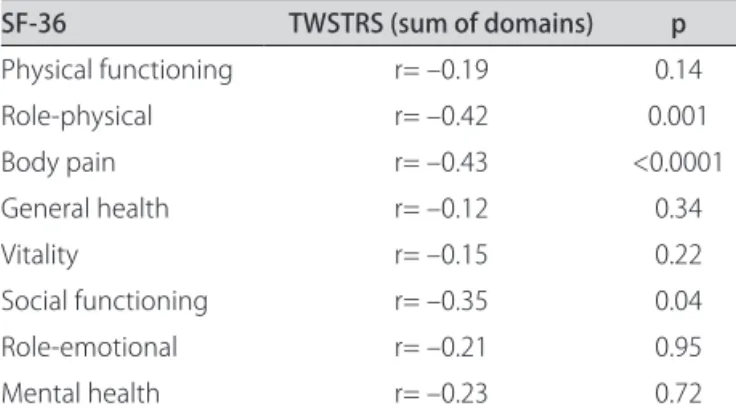
We observed that the severity of CD (TWSTRS) correlated moderately with the following two SF-36 subscales: Role-physical (r= –0.42) and Body pain (r= –0.43). he negative correlation suggests the more severe the CD, the worst is the QoL (Table 1).
Age had poor correlation with SF-36 and TWSTRS, the rank was very low (r= –0.30), this means that the variable age does not inluence both scales. Relating ed-ucational attainment to QoL, we observed a weak corre-lation between years of school and SF-36 (r<0.30) but the same was not observed for TWSTRS (r=0.52).
here was weak correlation between onset of CD and SF-36; in relation to duration of treatment there were also weak correlations to all items of SF-36 scale. he diference between the onset of the disease and time to treatment of CD correlated weakly to all SF-36 subscales. he onset and duration of disease did not correlate to TWSTRS (r<0.30).
We also compared the TWSTRS and SF-36 scales with gender. No statistical diference was observed be-Table 1. Correlations between TWSTRS and QoL (SF-36)
SF-36 TWSTRS (sum of domains) p
Physical functioning r= –0.19 0.14 Role-physical r= –0.42 0.001 Body pain r= –0.43 <0.0001 General health r= –0.12 0.34
Vitality r= –0.15 0.22
Social functioning r= –0.35 0.04 Role-emotional r= –0.21 0.95
Mental health r= –0.23 0.72
Correlations: Spearman correlation test. Signiicance level p≤0.05. TWSTRS: Toronto Western Spasmodic Torticollis Rating Scale; QoL: Quality of Life.
Table 2. Inluence of gender in QoL (SF-36).
SF-36 (25-75%)Man Md Woman Md (25-75%) p
Physical functioning
64.80 (45-88.70) 53.30 (35-55) 0.06
Role- physical 50 (0-93.70) 25 (0-50) 0.28 Body pain 54 (31-70.20) 42 (30-61.50) 0.31 General health 64.50 (39-72) 57 (47-67) 0.38 Vitality 67.50 (56.20-75) 48.20 (35-60) 0.005 Social functioning 57.10 (37.50-75) 54.50 (31.20-75) 0.72 Role emotional 66.60 (33-100) 57.80 (0-100) 0.34 Mental health 70 (52-83) 60 (32-77) 0.05
tween gender and TWSTRS but women scored worse in two SF-36 subscales which were: vitality and mental health (p=0.05 and 0.005 respectively) (Table 2).
DISCUSSION
Our study evaluated QoL of CD patients with re-sidual or no efect of BTx, depicting a scenario mostly not described in the literature. he assessment of QoL is recognized as relevant in the evaluation and man-agement of patients with dystonia19, for the reason that
the identiication of possible physical and social aspects which may afect QoL helps to optimize the treatment10.
To assess QoL, general perceptual measures are im-portant tools in the treatment of CD patients because sometimes purely functional quantitative scales are not able to detect signiicant changes achieved by treatments such as BTx, neurological rehabilitation, psychotherapy, and so on20. he efect of the multidisciplinary approach
on CD may be estimated by means of scales that com-bine the measurement of motor functions and the im-pact that the disease has in the patient’s daily life activity, emotional and social functioning21. As a result, SF-36
health survey scale is a good tool for this evaluation and it is used in many studies for assessing QoL in CD9,11,12.
Although there is a more speciic questionnaire to evaluate quality of life of patients with cervical dystonia and blepharospasm, which is the CDQ-24, it was not used in our series because its Brazilian Portuguese ver-sion has not yet been validated.
here are three possible limitations in our study. he irst one relates to the fact that, even though there was probably no residual efect of the previous BTx injection by the time the patients were evaluated, it may be hard for patients who are on continuous BTx treatment to dis-criminate their QoL during the weeks when the efect of the drug is waning from the longer period during which they are under its full efect. Another study comparing un-treated patients with CD with those, like our patients, who are not under the active phase of the treatment, would help clarify if there is indeed a difference in their QoL.
he second limitation relates to the absence of in-formation on other treatments that the patients might be following aside from the BTx, like physiotherapy, during the whole treatment period or just to cover the few weeks of the waning efect of the BTx6. Such data
was not systematically collected in our study, because in empirical observations in our practice we realized that the vast majority of CD patients did not follow any other treatment. he third limitation is intrinsic to studies of a descriptive design such as ours, we only studied the QoL of patients with diferences in the severity of CD disease, but we did not plan a study to compare the QoL of these patients with normal individuals or with patients with
other diseases. One of the main reasons for choosing not do to so was the well known diiculty of inding adequate hospital controls to be used in case-control studies22.
In agreement with the results of our study, Sgoigseid et al.9, found that higher scores of TWSTRS (more severe
cases of CD) were associated to lower scores in social functioning of SF-36 scale. hese authors also reported similar indings and other relevant factor for lower QoL, such as depression, which was not evaluated in our series.
Hilker et al.23, and Müller et al.10, did not observe
cor-relations between severity of CD and low QoL, but they utilized Tsui scale. his data suggest that mixed scale which take into account both the health care professional and the patient perception (TWSTRS) is more sensible to assess patient status than measurement based on a single point of view rating (Tsui scale).
Camield et al.1 observed a correlation between age
and QoL (role-physical), the older the patient the lower the QoL. his inding is expected to occur in the general population but, according to the authors, it was more ev-ident in individuals with CD. Slawek et al.8 also described
decrease of SF-36 score (role-physical, role-emotional) inversely proportional to patient’s age. he data from the present study did not support their indings, this could be due to the fact that its age range was more extreme than ours1. Ben-Sholmo et al.12 also did not ind any
cor-relation between gender, age, educational attainment or social functioning and worsening of QoL.
Meanwhile duration of the disease (in years), dura-tion of the treatment, also in years, and the diference be-tween these two variables, correlated weakly to physical and emotional domains of SF-36 in our series.
Slawek et al.8 also reported a decrease in SF-36 score
(role-physical and role-emotional) with the increase of age of onset of CD. here was no correlation between SF-36 (and duration of the disease).
Our study also demonstrated that women scored lower QoL than men, mainly in emotional domains. Camield et al.1 observed that QoL scores were lower for women and
for those with low educational level. Even though these indings are also observed in the general population, the author noted that a chronic disorder such as CD maxi-mized the trend observed in the general population. Slawek et al.8 also described worse QoL (social functioning) in
women, single individuals, and lower income patients. In conclusion, or data suggest that the QoL perception in a Brazilian sample of patients with CD was worse for female patients and for those with more severe diseases.
REFERENCES
1. Camfield L, Ben-Shlomo Y, Warner TT. Impact of cervical dystonia in quality of life. Mov Disord 2002;17:838-841.
2. Jankovic J. Treatment of dystonia. Lancet Neurol 2006;5:864-872. 3. Lowestein DH, Aminoff MJ. The clinical course of spasmodic torticollis.
Neurology 1998;38:530-532.
4. Tarsy D, Simon DK. Dystonia. N Engl J Med 2006;355:818-829. 5. Jankovic J, Leder S, Warner D, Schwartz K. Cervical dystonia: clinical
find-ings and associated movement disorders. Neurology 1991;41:1088-1091. 6. Ramdharry G. Case report: physiotherapy cuts the dose of botulinum
toxin. Physiother Res Int 2006;11:117-122.
7. Papathanasiou I, MacDonald L, Whurr R, Jahanshahi M. Perceived stigma in spasmodic torticollis. Mov Disord 2001;16:280-285.
8. Slawek J, Friedman A, Potulska A, et al. Factors affecting the health-related quality of life of patients with cervical dystonia and the impact of botu-linum toxin type A injections. Functl Neurol 2007;22:95-100.
9. Sgoigsed IM, Malt UF, Roislien J, Kerty I. Determinants and status of quality of life after long-term botulinum toxin therapy for cervical dystonia. Eur J Neurol 2007;14:1129-1137.
10. Müller J, Kemmler G, Wissel J, et al. The impact of blepharospasm and cer-vical dystonia on health-related quality of life and depression. J Neurol 2002;429:842-846.
11. Gudex CM, Hawthorne MR, Duffey P. Effect of dystonia and botulinum toxin treatment on health-related quality of life. Mov Disord 1998;13:941-946. 12. Ben-Sholmo Y, Camfield L, Warner T. What are the determinants of quality of life in people with cervical dystonia? J Neurol Neurosurg Psychiatry 2002;72:608-614.
13. Severo M, Santos AC, Lopes C, Barros H. Reliability and validity in mea-suring physical and mental health construct of the Portuguese version of MOS SF-36. Acta Med Port 2006;19:281-287.
14. Ciconelli RM, Ferraz MB, Santos W, Meinão I, Marina RQ. Tradução para a língua portuguesa e validação do questionário genérico de avaliação de qualidade de vida SF- 36 (Brasil SF-36). Rev Bras Reumatol 1999;39: 143-150.
15. Consky ES, Basinki A, Belle L, Ranawaya R, Lang AE. The Toronto Western Spasmodic Torticollis Rating Scale (TWSTRS): assessment of validity and inter-rater reliability. Neurology 1990;40 (Suppl 1):S445.
16. Sekeff-Sallem FA, Caramelli P, Barbosa ER. Cross-cultural adaptation of To-ronto Western Spasmodic Torticollis Rating Scale (TWSTRS) to Brazilian Portuguese. Arq Neuropsiquiatr 2011;69:316-319.
17. Maia FM, Kanashiro AK, Chien HF, Goncalves LR, Barbosa ER. Clinical changes in cervical dystonia pattern in long-term botulinum toxin treated patients. Parkinsonism Relat Disord 2010;16:8-11.
18. Brucki SM, Nitrini R, Caramelli P, Bertolucci PH, Okamoto IH. Sugestões para o uso do mini-exame do estado mental no Brasil. Arq Neuropsiquiatr 2003;61:777-781.
19. Page D, Butler A, Jahanshani M. Quality of life in focal, segmental and gen-eralized dystonia. Mov Disord 2007;22:341-347.
20. Ebrahim S. Clinical and public health perspectives and applications of health related quality of life measurement. Soc Sci Med 1995;41: 1383- 1394.
21. Guyatt G, Feeny D, Patrick D. Issues in quality-of-life measurement in clin-ical trials. Control Clin Trials 1991;12 (Suppl 4):S81-S90.
22. Rothman KJ, Greenland S. Case-Control Studies. In Rothman KJ, Green-land S (Eds). Modern Epidemiology, 2nd ed. Philadelphia, Pa: Lippincott,
1998;93-114.