344 • Arq Gastroenterol • 2017. v. 54 nº 4 Out/Nov
344 • Arq Gastroenterol • 2017. v. 54 nº 4 Out/Nov
INTRODUCTION
Among the complications of cirrhosis are metabolic changes associated with malnutrition. Patients have significant loss of muscle mass, resulting in increased impaired functional capacity, thus compromising functionality and quality of life, predicting lower survival(9,20,23). Fatigue is a common complaint of patients with liver cirrhosis(15) defined as tiredness, weakness and mental exhaustion, physical or both(5). It can be considered a disabling symptom and its etiology is poorly understood and multifactorial(5,15).
In chronic liver disease, the pathophysiology of fatigue involves changes in central neurotransmission resulting from signaling between brain and liver, whose mechanisms involved are not yet fully understood(24). The prevalence of fatigue depends on its measurement and deinition, controversial factors for the great divergence between different authors(29). Most studies on fatigue and liver disease are performed on patients with primary biliary cirrhosis, hepatitis caused by C virus and cholestatic disease. Study Swain et al.(25) showed a prevalence of fatigue from 65% to 85% in patients with cholestasis. In individuals with primary biliary cir-rhosis it is considered the worst symptom in approximately 50% of
Psychometric property of fatigue severity scale
and correlation with depression and quality of life
in cirrhotics
Danusa
ROSSI
1, Lucas Homercher
GALANT
1and Claudio Augusto
MARRONI
1,2Received 18/8/2017 Accepted 28/8/2017
ABSTRACT – Background – Fatigue is a common complaint in cirrhotic patients and may be considered a debilitating symptom with negative impact on quality of life. Research on its etiology and treatment has been hampered by the lack of relevant and reproducible measures of fatigue. Objective – To evaluate the psychometric properties of the Fatigue Severity Scale (FSS) in cirrhotic patients and to correlate with depressive symptomatology and quality of life. Methods – Cross-sectional study with a convenience sample of 106 cirrhotic patients, aged between 18 and 70 years, both genders, liter-ate, pre and post liver transplantation in outpatient follow-up. Internal consistency, reproducibility, discriminant validity, criterion validity, construct validity, responsiveness criterion, depressive symptomatology and quality of life were evaluated through questionnaires between January and October 2015. Results – The mean age was 54.75±9.9 years, 65.1% male and 32.1% of the sample had cirrhosis due to hepatitis C virus. The mean FSS score was 4.74±1.64. Cronbach’s alpha was 0.93, and the Intraclass Correlation Coeficient was 0.905 (95% CI: 0.813-0.952). For discriminant validity, FSS differentiated scores from different groups (P=0.009) and presented a correlation with the Modiied Fatigue Impact Scale (r=0.606, P=0.002). FSS correlated signiicantly and positively with depressive symptomatology and correlated negatively with the SF-36 domains for construct validity. For responsiveness, no signiicant changes were observed in the fatigue scores in the pre and post-liver transplantation periods (P=0.327). Conclusion – FSS showed good psychometric performance in the evaluation of fatigue in patients with cirrhosis. Fatigue presented a strong correlation with depressive symptomatology and quality of life.
HEADINGS – Psychometrics. Scales. Fatigue. Depression. Quality of life. Liver transplantation.
Declared conflict of interest of all authors: none Disclosure of funding: no funding received
Support: Higher Level Coordination Staff (Coordenação de Aperfeiçoamento de Pessoal de Nível Superior – CAPES no.1411718).
1 Programa de Pós-Graduação em Hepatologia, Universidade Federal de Ciências da Saúde, Porto Alegre, RS, Brasil; 2 Serviço de Transplante de Fígado, Irmandade da Santa Casa de Misericórdia de Porto Alegre, RS, Brasil.
Correspondence: Danusa Rossi. Rua Carlos Giesen, 60, ap. 12 – CEP 95084-220 – Caxias do Sul RS, Brasil. E-mail: [email protected]
the patients, being incapacitating in 25%. It seems to be variable in patients with different forms of liver disease.
The assessment of fatigue and its effects in patients with liver disease has traditionally been performed using general questionnaires and Short Form Health Survey (SF-36)(28), or speciic as Scale Fatigue Impact Modiied (MFIS)(8) and Severity Score Fatigue (FSS)(14) that allow objective quantiication or score(1) of this symptom.
The validation process of a questionnaire should follow clearly deined steps, so that its usefulness is proven and safe for applica-tion in clinical research, through the study of the psychometric properties of the instrument. The psychometric properties refer to the set of techniques that allow the quantiication of psychological phenomena and aim to measure the constructs, that is, the variable that the instrument is willing to measure. Different psychometric requirements must be addressed in the validation process, such as reliability and validity(6).
METHODS
Patients and study design
A cross-sectional study was performed in cirrhotic of different etiologies, which underwent medical follow-up between January and October 2015 at the Transplantation Outpatient Clinic of the
Santa Clara Hospital of the Santa Casa de Misericórdia Hospital in Porto Alegre, Brazil. Patients between the ages of 18 and 70 years of both genders, diagnosed for cirrhosis, candidates for liver transplantation and/or already transplanted, who accepted to participate were included in the study. Illiterate patients with cognitive or visual impairment who underwent double transplan-tation (renal and hepatic) and patients with orthopedic disorders were excluded from the analysis. Patients taking antidepressants were not excluded. The data were collected after approval of the study conducted by the Ethics Committee of the Santa Casa de Misericórdia of Porto Alegre, protocol number 937192.
The sample size calculation was based on the studies of Valder-ramas et al.(26) and Mendes et al.(17,18), amounting to a minimum of 87 patients and a minimum sample size calculation for each psycho-metric property studied: internal consistency and construct validity n=87; Reproducibility n=23; Validity of criterion n=23; Discriminant validity n=21; Responsiveness criterion n=15. Each psychometric property studied was a subgroup extracted from the total sample.
Questionnaires and scales used
The same evaluator interviewed all the patients, using four instruments according to the psychometric property to be studied: FSS, MFIS, SF-36 and Beck Depression Inventory (BDI).
The Fatigue Severity Scale was developed by Krupp et al.(14) in 1989 to assess fatigue in patients with multiple sclerosis. The in-strument is composed of nine items that addresses daily situations, correlating with the social aspects of the individual, quantifying, through a score, the intensity of fatigue. Each item is scored on a Likert scale of seven points, one being “strongly disagree” and seven “strongly agree”. The sum of all items can range from 9 to 63. The total score is obtained by the sum of all items added, divided by the number of assertions of the instrument, i.e., nine. A inal score equal to or greater than four indicates severe fatigue. The higher the score, the greater the severity of the symptom(17). It was tested in(26) different populations(7,11,13), demonstrating good psychometric properties, but has not yet been tested in Brazilian cirrhotic patients. It has been translated and adapted to Brazilian Portuguese by Mendes et al.(17, 18).
Scale Fatigue Impact Modiied (MFIS), was developed by Fisk et al.(8) and validated in Brazil in 2007(19), it consists of 21 questions divided into three domains: physical (9 items), cognitive (10 items) and psychosocial (2 items). The format of the responses allows scores from 0 to 4 for each item, in the Likert type format, where the larger scores relect greater impact of the fatigue. The physical domain allows scores from 0 to 36, the cognitive, from 0 to 40 and the psychosocial from 0 to 8. The total score of MFIS is given by the sum of the three domains and ranges from 0 to 84 points. Values below 38 correspond to the absence of fatigue, and above this value, the higher the score, the greater the degree of fatigue of the individual(19).
Short Form Health Survey SF - 36 1992(28) was developed and validated in Brazil in 1999 by Ciconelli et al.(4). It is a multidi-mensional instrument formed by 36 items, encompassed in eight domains: functional capacity, physical and emotional aspects, pain,
general health, vitality, social aspects, mental health and a compara-tive evaluation between current health conditions and from a year ago. It is scored from zero to 100, where higher scores indicate a better quality of life. This instrument assesses both negative aspects (disease) as the positive aspects (welfare)(16).
The Inventory Beck Depression Inventory (BDI), was originally developed by Beck et al in 1961(2) and validated in Brazil in 2012 by Gomes Oliveira et al.(10), and consists of a self-report questionnaire with 21 multiple choice items related to depressive symptoms. Each response has a value of zero to three and the categories used are: 0-13 minimal depression, 14-19 mild depression, 20-28 moderate depression, and 29-63 severe depression.
Process of evaluation of psychometric properties • Reliability
Reliability was assessed through internal consistency, reproduci-bility and discriminant validity. To evaluate the internal consistency, Cronbach’s alpha was used, with a total sample of 106 patients. Reproducibility was assessed by applying the FSS by the same interviewer on two occasions, to the same subject, with an average time interval of one month. The sample used for this evaluation totaled 36 individuals. For this analysis, the intraclass correlation coeficient (ICC) was used and in the comparison between the two moments evaluated, the Wilcoxon Test was performed.
• Validity
The validity was veriied by criterion and construct validity. For the study of criterion validity, FSS was used in a total sample of 23 patients, who later, but at the same meeting, also answered the questionnaire Modiied Fatigue Impact Scale (MFIS). Scores were compared using Pearson’s correlation. The Construct Validity was veriied through the hypothesis analysis, in this study, represented by the correlation with other tests. It was evaluated through the correlation of the scores of the 106 patients with FSS and scores in the depressive symptomatology (BDI) and quality of life (SF-36) questionnaires. This evaluation was performed through the Spearman correlation.
• Discriminating validity
The discriminant validity was veriied by comparing the FSS scores in a sample of 23 cirrhotic patients (case group) with the scores of 23 healthy subjects (control group). The control group consisted of family members or caregivers who took patients to the outpatient clinic for follow-up, non-cirrhotic patients with no symptoms or fatigue complications, and were similar to the case group in sex, age and schooling. For this evaluation the t-test of
paired samples was used.
• Criterion of responsibility
The responsiveness criterion shows the ability of the question-naire to measure changes in scores after an intervention. In this study, the intervention was hepatic transplantation. For this crite-rion, 16 patients who performed the procedure responded to FSS in the pre- and post-transplant periods. The latter was determined as the irst outpatient visit after surgery, averaging within one month of the irst postoperative day. The paired sample t-test was used in
the analysis of this criterion.
• Statistical analysis
346 • Arq Gastroenterol • 2017. v. 54 nº 4 Out/Nov
normally distributed, and median and interquartile range, when not normally distributed. Normality was veriied by the Shapiro-Wilk test. The categorical data were presented in frequency and percentage.
Reliability was tested for internal consistency and reproducibil-ity. In order to evaluate the internal consistency of the instrument, Cronbach’s alpha coeficient was used, with a generally accepted lower limit of 0.7. In order to analyze the reproducibility, the intra-class correlation coeficient (ICC) was used and in the compari-son between the two moments evaluated, the Wilcoxon Test was performed. The discriminant validity was evaluated through the
t-test for paired samples. Criterion validity was determined using
Pearson’s correlation. The construct validity, assessed through the correlation of FSS with BDI and SF-36, was measured by Spear-man’s correlation. For responsiveness criterion, the t-test of paired
samples was used.
The results were analyzed using the Package for Social Sci-ences (SPSS) version 18. The sample was calculated based on the study et Valderramas(26). The level of signiicance adopted in all tests was 5%.
RESULTS
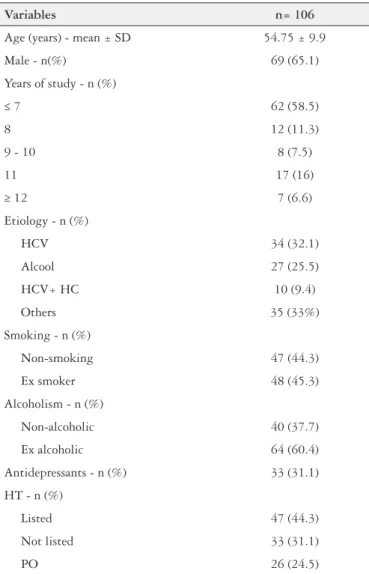
The study included a total of 114 participants, where 3 were excluded for encephalopathy, 3 for ascites requiring immediate paracentesis, 1 for illiteracy, 1 for deformities resulting from frac-tures. The majority of the patients were male 69 (65.1%), mean age 54.75 (SD ±9.9 years), 34 (32.1%) patients with cirrhosis caused by hepatitis C virus and 62 (58.5%) had incomplete elementary education, as shown in Table 1.
The calculated Cronbach’s Alpha Coeficient was 0.93, showing strong internal consistency of the instrument.
The observed intraclass correlation coeficient (ICC) was 0.905 (95% CI: 0.813-0.952), indicating a high agreement between the two moments evaluated. In the evaluation by question, the lowest ICC was observed in question 5, of 0.46 (95% CI: 0.000-0.728). No signiicant changes were observed in the scores between the two moments evaluated, except in question 6 where there was an increase in the median score as shown in Table 2.
TABLE 1. Characterization of the sample
Variables n= 106
Age (years) - mean ± SD 54.75 ± 9.9
Male - n(%) 69 (65.1)
Years of study - n (%)
≤ 7 62 (58.5)
8 12 (11.3)
9 - 10 8 (7.5)
11 17 (16)
≥ 12 7 (6.6)
Etiology - n (%)
HCV 34 (32.1)
Alcool 27 (25.5)
HCV+ HC 10 (9.4)
Others 35 (33%)
Smoking - n (%)
Non-smoking 47 (44.3)
Ex smoker 48 (45.3)
Alcoholism - n (%)
Non-alcoholic 40 (37.7)
Ex alcoholic 64 (60.4)
Antidepressants - n (%) 33 (31.1)
HT - n (%)
Listed 47 (44.3)
Not listed 33 (31.1)
PO 26 (24.5)
SD: standard deviation; HCV: hepatitis C virus; HC: hepatocellular carcinoma; HT: hepatic transplantation; PO: postoperative liver transplantation.
TABLE 2. Reproducibility* (n=36)
Questions Test (D1) Retest (D2)
P ICC P
Medium (25% - 75%) Medium (25% - 75%) Wilcoxon ICC test
1 6 (4 - 6) 6 (4 - 7) 0.95 0.56 0.008
2 5.50 (5 - 6) 6 (4.25 - 7) 0.40 0.71 <0.001
3 5.50 (4.25 - 7) 5.50 (3.25 - 7) 0.73 0.86 <0.001
4 6 (4 - 7) 6 (4 - 6) 0.24 0.82 <0.001
5 5 (2 - 7) 5 (3 - 6) 0.93 0.46 0.038
6 5 (4 - 7) 6 (5 - 7) 0.03 0.81 <0.001
7 5 (3 - 7) 5 (3 - 6) 0.79 0.78 <0.001
8 6.50 (2.25 - 7) 5.50 (3.25 - 6.75) 0.72 0.61 0.004
9 5 (2.25 - 6.75) 4 (2.25 - 6) 0.98 0.65 0.001
Total 5 (3.91 - 6.33) 5.33 (4.33 - 5.88) 0.22 0.90 <0.001
A correlation was observed between the FSS scores and the MFIS total score (r=0.60; P=0.002). The strongest correlation
was observed with the cognition domain (r=61; P=0.002) and the
weakest with the psychosocial domain (r=36; P=0.087) (Table 3).
FSS correlated signiicantly and positively with depressive symptomatology and negatively correlated with the eight domains of SF-36, for construct validity. The strongest correlation was observed with the vitality domain (r=-0.57; p<0.001) and the weaker correlation with the physical functioning domain (r=-0.44;
P<0.001) (Table 3).
remained constant at the two moments evaluated (test and re-test). These results were similar to those for Valderramas et al.(26). This study also found a strong correlation of fatigue with depressive symptomatology and quality of life, demonstrating that the more severe the fatigue, the more severe the depressive symptomatology and the greater impairment of quality of life.
In the study of criterion validity, the FSS presented a correlation with total score of the MFIS, that is, the results obtained through the MFIS predict the same performance presented by the FSS, serving as criterion to determine the validity of this.
FSS was sensitive to the detection of different fatigue scores between cirrhotic (case) and non-cirrhotic (control) patients, a fact conirmed by discriminant validity analysis (P=0.009). A similar
result was found in the study Kalaitzakis et al.(2012)(12).
Regarding the criteria of responsiveness, data analysis found no statistical difference in fatigue scores in the pre- and post-liver transplantation, inding consistent with the literature, in studies of the symptom after this intervention(3,12,27).
In cirrhotic patients, we did not ind studies that evaluated fatigue through the FSS, nor was it a speciic validated instru-ment for the evaluation of fatigue in this population. The fatigue evaluation has been performed more emphatically in patients with speciic diseases such as cholestasis, primary biliary cirrhosis and hepatitis C(21,24,25).
In this way, patients’ periodic follow-ups can be made and those with worse fatigue scores can be identiied and receive specialized support.
Currently, there are a growing number of questionnaires assess-ing various aspects of health in different contexts, includassess-ing fatigue assessment. As a result, methods that allow health professionals to evaluate fatigue in a reliable and reproducible way are being improved, making possible the use of assessment instruments in the care.
Fatigue assessment aims to provide higher quality health care, according to the needs of the population, aiming for their physical, mental and social well-being. Taking into account that the cirrhotic population is generally subject to several situations considered to be at risk for numerous outcomes compared to the general population, changes in the multiprofessional follow-up of these patients are necessary.
The Fatigue Severity Scale can serve as a useful tool in the evaluation of fatigue in future clinical research involving patients with cirrhosis of diverse etiologies, achieving advances in the treat-ment of this symptom.
CONCLUSION
In conclusion, FSS demonstrated good behavior in the psy-chometric properties evaluated: internal consistency, reproduc-ibility, criterion and construct validity, discriminant validity and responsiveness criterion. Consequently, it seems appropriate and applicable for cirrhotic patients of different etiologies. The fatigue symptom presented a strong correlation with depressive symptoma-tology and quality of life in these patients.
Authors’ contributions
Rossi D: data acquisition; preparation of the article and inal approval of the version to be published. Galant LH: conception and design, preparation of the article and inal approval of the version to be published. Marroni CA: conception and supervision, inal approval.
TABLE 3. Validity of construct criteria and validity
Variables FSS
rs P
MFIS (n=23)
MFIS F 0.50 0.01
MFIS C 0.61 0.002
MFIS P 0.36 0.087
MFIS total 0.60 0.002
BDI (n=106) 0.56 <0.001
SF- 36 (n=106)
Functional capacity -0.53 < 0.001 Physical aspects -0.44 < 0.001
Pain -0.45 < 0.001
Health -0.47 < 0.001
Vitality -0.57 < 0.001 Functional aspects -0.52 < 0.001 Emotional aspects -0.56 < 0.001 Mental health -0.56 < 0.001 MIFS: modiied scale of fatigue impact; MFIS F: physical domain; MFIS C: cognitive domain; MFIS P: psychosocial domain; FSS: Fatigue Severity Scale; BDI: inventory of Beck’s depression; SF-36: Short form survey health.
For discriminant validity, the t test proved that FSS differ-entiates between scores of individuals with and without fatigue (P=0.009).
For responsiveness criteria, no signiicant changes were ob-served in the fatigue scores in the pre and post liver transplantation periods (P=0.327).
DISCUSSION
Scales and questionnaires are used both in assessments and diagnoses as well as in research, making their use an important methodological aspect. To obtain reliable, and therefore relevant, results, valid and reliable measurement of data is essential.
The Fatigue Severity Scale demonstrated good psychometric performance, suggesting being a useful tool in the evaluation of fatigue in cirrhotic patients. In general, the instrument proved to be valid and reliable for evaluation of this symptom. FSS, despite the low educational level of the patients evaluated, was easy to understand and the mean response time was 8 minutes, suggesting feasibility for use in this population.
The reliability of the FSS, estimated by the Cronbach’s alpha value (0.933) was high, demonstrating strong internal consistency among the scale items.
348 • Arq Gastroenterol • 2017. v. 54 nº 4 Out/Nov
REFERENCES
1. Alvarenga Filho H, Carvalho SRS, Dias RM, et al. Principais testes utilizados na avaliação de fadiga na esclerose múltipla. Revisão sistemática. Rev. Bras. Neurol. 2010;46:37-43.
2. Beck AT, Ward CH, Mendelson M, et al. An inventory for measuring depression. Arch Gen Psychiatry. 1961;4:561-7.
3. Carbone M, Bufton S, Monaco A, et al. The effect of liver transplantation on pa-tients with primary biliary cirrhosis: A prospective study. J Hepatol. 2013;59:490-4.
4. Ciconelli RM, Ferraz MB, Santos W, et al. Translation into Portuguese and
validation of the SF-36 generic quality of life questionnaire (Brazil SF-36). Rev Bras Reumatol. 1999;39:143-50.
5. Ditter AJ, Wessely SC, Brown RG. The assessment of fatigue: A practical guide for clinicians and researchers. J Psychom Res. 2004;56:157-70.
6. Erthal, CT. Manual of psychometry. 8 ed. Rio de Janeiro. Jorge Zaha Ltd.,
2009, 149p.
7. Ferentinos P, Kontaxakis V, Havaki Kontaxaki B et al. Psychometric evaluation of the Fatigue Severity Scale in patients with major depression. Which Life Res. 2011;20:457-65.
8. Foroncewicz B, Mucha K, Szparaga B, et al. Rehabilitation and 6-minute walk
test after liver transplantation. Transplant Proc. 2010;43:3021-4.
9. Gomes MH, Oliveira Gorenstein C, Lotufo F Neto, et al. Validation of the Bra-zilian Portuguese version of the Beck Depression Inventory-II in a community sample. Rev Bras Psiquiatr. 2012;34:389-94.
10. Impellizzeri FM Agosti F, et al. Psychometric properties of the Fatigue Severity Scale in obese patients. Health What Life Oct. 2013;11:32.
11. JD Fisk, Ritvo PG, Ross G, et al. Measuring the functional impact of fatigue: initial validation of the fatigue impact scale. Clin Infect Dis. 1994;18:79-83. 12. Kalaitzakis E, Josefsson A, Castedal M, et al. Factors related to fatigue in
patients with cirrhosis before and after liver transplantation. Clin Gastroenterol Hepatol. 2012;10:174-81.
13. Kleinman L, Zodet MW, Hakim Z, et al. Psychometric evaluation of the fatigue severity scale for use in chronic hepatitis C. Qual Life Res. 2000;9:499-598. 14. Krupp LB, Larocca NG, Muir-Nash J, et al. The fatigue severity scale.
Applica-tion to Patients with multiple sclerosis and systemic lupus erythematosus. Arch Neurol. 1989;46:1121-3.
Rossi D, Galant LH, Marroni CA. Propriedade psicométrica da escala de severidade de fadiga e correlação com depressão e qualidade de vida em cir-róticos. Arq Gastroenterol. 2017;54(4):344-8.
RESUMO – Contexto – A fadiga é uma queixa comum em pacientes cirróticos e pode ser considerada um sintoma debilitante com impacto negativo na qualidade de vida. A investigação sobre a sua etiologia e tratamento tem sido diicultada pela falta de medidas relevantes e reprodutíveis da fadiga.
Objetivo – Avaliar as propriedades psicométricas da Escala de Gravidade da Fadiga (FSS) em pacientes cirróticos e correlacionar com sintomatologia depressiva e qualidade de vida. Métodos – Estudo transversal com amostra de conveniência de 106 pacientes cirróticos, com idade entre 18 e 70 anos, ambos os sexos, alfabetizados, pré e pós-transplante hepático em acompanhamento ambulatorial. Foram avaliados: consistência interna, reprodu-tibilidade, validade discriminante, validade de critério, validade de construto, critério de responsividade, sintomatologia depressiva e qualidade de vida através de questionários, entre janeiro e outubro de 2015. Resultados – A média de idade foi 54,75±9,9 anos, 65,1% do sexo masculino e 32,1% da amostra apresentava cirrose pelo vírus da hepatite C. O escore médio no FSS foi de 4,74±1,64. O alfa de Cronbach foi de 0,93, e o coeiciente de correlação intraclasse foi de 0,905 (IC 95%: 0,813-0,952). Para validade discriminante, o FSS diferenciou escores de grupos distintos (P=0,009) e apresentou correlação com a Escala de Impacto de Fadiga Modiicada (r=0,606, P=0,002). O FSS se correlacionou signiicativamente e positivamente com sintomatologia depressiva e, negativamente com os domínios SF-36 para a validade de construto. Para responsividade, não foram observadas alterações signiicativas nos escores de fadiga nos períodos de transplante pré e pós-fígado (P=0,327). Conclusão – O FSS mostrou bom desempenho psicométrico na avaliação da fadiga em pacientes com cirrose. A fadiga apresentou forte correlação com sintomatologia depressiva e qualidade de vida.
DESCRITORES – Psicometria. Escalas. Fadiga. Depressão. Qualidade de vida. Transplante de fígado.
15. Kumar D, Tandon RK. Fatigue in cholestatic liver disease - a symptom perplexing. Postgrad Med J. 2002;78:404-7.
16. McHorney CA, Ware JE, Raczek AE. The MOS 36-item Short Form Health Survey (SF-36): II. Psychometric and clinical tests of validity in physical and mental health constructs. Care Med. 1993;31:247-63.
17. Mendes MF, Pavan K, Marangoni BE, et al. Adaptação transcultural da escala de gravidade de fadiga para a língua portuguesa. Med Reabil. 2008;27:69-71. 18. Mendes MF, Tilbery CP, Balsimelli S, et al. Fatigue in the relapsing remitting form
of Multiple Sclerosis Múltipla. Arq Neuropsiquiatr. 2000;58:471-5.
19. Pavan K, Schmidt K, Marangoni B, et al. Adaptation transcultural and validates the modiied fatigue impact scale. Arq Neuropsiquiatr. 2007;65:669-73. 20. Pereira JLF, Figueredo TCM, Galant LH. Functional capacity and respiratory
muscle strength of candidates for liver transplantation. Rev Bras Med Esporte. 2011;17:315-18.
21. Poynard T, Cacoub P, Ratziu V, et al. Fatigue in patients with chronic hepatitis C. J Viral Hepat. 2002;9:295-303.
22. Prince MI, James OF, Holland NP, et al. Validation of the fatigue impact score in primary biliary cirrhosis: towards a standard for clinical and trial use. J Hepatol. 2000;32:368-73.
23. Robinson LR, Switala J, Tarter RE, et al. Functional Outcome After Liver Transplantation. Arch Phys Med Rehabil. 2000;71:426-7.
24. Swain MG. Fatigue in chronic disease. Clin Sci. 2000;99:1-8.
25. Swain, MG. Fatigue in liver disease: Pathophysiology and Clinical Management. Can J Gastroenterol. 2006;20:181-18.
26. Valderramas S, Feres AC, Melo A. Reliability and validity study of the Brazilian Portuguese version of the fatigue severity scale in Parkinson’s disease patients. Arq Neuropsiquiatr. 2012;70:497-500.
27. van den Berg-Emons R, van Ginneken B, Wijffels M, et al. Fatigue is a major problem after liver transplantation. Liver Transpl. 2006;12:928-33.
28. Ware JE, Sherbourne CD. The MOS - 36 item Short Form Health Survey (SF - 36) Conceptual framework and item selection. Med Care. 1992;30:473-83. 29. Wessely S. Fatigue, depression and chronic hepatitis C infection. Psychol Med.