AR
TIGO ORIGINAL/ ORIGINAL AR
TICLE
DOES LOW DOSE
13
C-UREA BREATH TEST
MAINTAIN A SATISFACTORY ACCURACY
IN DIAGNOSING
Helicobacter pylori
INFECTION?
Luiz Gonzaga Vaz
COELHO
1, Arilto Eleutério da
SILVA Jr
1,
Maria Clara de Freitas
COELHO
2, Francisco Guilherme Cancela e
PENNA
1,
Rafael Otto Antunes
FERREIRA
1and Elisa Viana
SANTA-CECILIA
2ABSTRACT – Context - The standard doses of 13C-urea in 13C-urea breath test is 75 mg. Objective - To assess the diagnostic accuracy
of 13C-urea breath test containing 25 mg of 13C-urea comparing with the standard doses of 75 mg in the diagnosis of Helicobacter
pylori infection. Methods – Two hundred seventy adult patients (96 males, 174 females, median age 41 years) performed the standard
13C-urea breath test (75 mg 13C-urea) and repeated the 13C-urea breath test using only 25 mg of 13C-urea within a 2 week interval.
The test was performed using an infrared isotope analyzer. Patients were considered positive if delta over baseline was >4.0‰ at the gold standard test. Results– One hundred sixty-one (59.6%) patients were H. pylori negative and 109 (40.4%) were positive by the gold standard test. Using receiver operating characteristic analysis we established a cut-off value of 3.4% as the best value of 25 mg 13C-urea breath test to discriminate positive and negative patients, considering the H. pylori prevalence (95% CI: 23.9-37.3)
at our setting. Therefore, we obtained to 25 mg 13C-urea breath test a diagnostic accuracy of 92.9% (95% CI: 88.1–97.9), sensitivity
83.5% (95% CI: 75.4–89.3), speciicity 99.4% (95% CI: 96.6–99.9), positive predictive value 98.3% (95% CI: 92.4-99.4), and negative predictive value 93.0% (95% CI: 88.6-96.1). Conclusions- Low-dose 13C-urea breath test (25 mg 13C-urea) does not reach accuracy
suficient to be recommended in clinical setting where a 30% prevalence of H. pylori infection is observed. Further studies should be done to determine the diagnostic accuracy of low doses of 13C-urea in the urea breath test.
HEADINGS - Helicobacter infections. Breath tests.
INTRODUCTION
The diagnosis of the gastric infection by H. pylori
is regularly performed by endoscopic examination with the collection of gastric mucosa fragments for histological examination, microbiological tests or even colorimetric methods like the urease test. The diagnosis can also be performed through non-endoscopic techniques like 13C-urea or 14C-urea breath tests. Such tests are based on the organism’s property to produce high quantities of the urea enzyme. The principle of the test is based on the ability of H. pylori (if present in the gastric setting) to break down orally absorbed 13C or 14C labeled urea. 13CO
2 or 14CO
2 diffuses into the blood and is excreted via the lung and can therefore be easily measured in the expired air using a mass or an infrared spectrometer(15, 16).
The 13C-urea breath test (UBT) is considered the gold standard in the identiication of H. pylori as it is a non-invasive, non-radioactive method (13C is a natural
1 Instituto Alfa de Gastroenterologia, Universidade Federal de Minas Gerais, Belo Horizonte, MG, Brasil; 2 Faculdade de Medicina de Barbacena, Barbacena, MG, Brazil.
Correspondence: Prof.Luiz Gonzaga Vaz Coelho – Rua dos Otoni, 705/601 – 30150-270 – Belo Horizonte, MG, Brasil. E-mail:[email protected]
isotope), which is reproducible and secure (able to be performed many times on a single patient, including pregnant women and children), and has a sensitivity and speciicity greater than 90% in adults(2, 6, 9, 11). There is no uniform standardization and the great majority of the protocols use a 75 mg dose of urea and two breath samples, one collected before and another collected 10–30 min after urea ingestion. Although the cut-off point must be adapted to different factors, in most studies it is located within the range between 2% and 5%(6).
Despite its high level of accuracy, UBT is still fairly unavailable on a global scale, mainly due to its high cost. One recent study suggests the UBT performed with doses that were 2 to 3 times less than that routinely recommended, and therefore of a more accessible cost, was still capable of maintaining high levels of sensitivity and speciicity(5).
25 mg dose of labelled urea (25-UBT) with that performed using a standard 75 mg dose (75-UBT), considered the gold standard, in the detection of H. pylori infection.
METHODS
The study was conducted at the Breath Tests Laboratory in the Gastroenterology Unit from University Hospital of the Federal University of Minas Gerais, Belo Horizonte, MG, Brazil. This laboratory performs UBT to adult population of Belo Horizonte city (around 2.5 million inhabitants) to initial diagnosis of H. pylori infection and/ or post-treatment control.
Patients
Initially, aimed at determining the H. pylori prevalence at our setting we analyzed 179 adult patients who were, consecutively, referred to our lababoratory for UBT from February to April 2007. This sample included patients with and without previous treatment to H. pylori infection.
Next, from May 2007 to April 2008 we studied 270 patients who were referred to our unit. Patients were excluded from the study if they were taking proton pump inhibitors or H2 receptor antagonists within the last week, or antibiotics and/or bismuth compounds within the 4 weeks preceding the initial visit. All participants included in both cohorts underwent a clinical exam and answered a standardized questionnaire to log clinical and demographic data as well as information about previous treatments for the eradication of H. pylori.
13C-urea breath test
All participants took a 75-UBT and then, within a 2 week interval, took a 25-UBT. No kind of treatment was allowed during this interval. The following methodology was used for the breath tests: after an overnight fast, a sample of exhaled CO2 air was taken, corresponding to time 0 (control), through the inlation of a breath bag. Then, patients ingested 75 mg (or 25 mg) of 13C-urea in 200 mL of pure orange juice, without the addition of water or sugar. Another breath sample was taken 30 min after the administration of the substrate. Samples were analyzed using an infrared analyzer (IRIS, Wagner Analysen-Technik, Bremen, Germany) and the results reported as delta over baseline per thousand (DOB‰), which indicates the change in the 13CO
2/ 12CO
2 ratio brought about by the metabolic activity induced by the administration of the labelled urea. A positive 75-UBT was previously validated by our group and were those with DOB values above 4‰(2).
Statistics
The sample size (number of positive and negative patients needed) was calculated based on the indings from Gatta et al.(5) regarding the estimate of sensitivity, speciicity, and amplitudes of the respective conidence intervals. In this light, a sample of 270 patients was set up, including 161 H. pylori-negative and 109 H. pylori-positive patients. Chi-square, t Student,
and Mann-Whitney tests were used, as appropriate, in the comparison of the two groups (H. pylori-positive and H.
pylori-negative). Proportions and 95% conidence intervals
(CI) were calculated using the method recommended by Newcombe et al.(12). Sensitivity, speciicity, positive predictive value (PV + ve), negative predictive value (PV - ve), and their 95% CI were calculated as compared to the deined gold standard, using methods recommended by Altman(1). The receiver operating characteristic (ROC) analysis was performed using non-parametric methods to deine the accuracy of 25-UBT as well as in choosing the best cut-off point, bearing in mind the H. pylori prevalence in our setting. Statistical analysis and graphs were constructed using Minitab 13, Excel, and the conidence interval analysis (CIA).
Ethics
The present study has been approved by the Ethics Committees of University Federal de Minas Gerais and Faculdade de Medicina de Barbacena, MG, Brazil and written informed consent was obtained from all patients.
RESULTS
The present study involved 492 patients, with 179 recruited to determine the prevalence of H. pylori infection in our setting. Likewise, 313 patients were recruited to perform both 25- and 75-UBT: 43 patients were excluded as they either did not show up for the second breath test (35 patients) or presented the need for the use of proton pump inhibitor or antibiotics in the interval between exams (8 patients). Thus, 270 patients were included in the cohort aimed at comparing the 75-UBT to the 25-UBT.
H. pylori prevalence in our setting
This cohort included 179 patients: 122 women (68.2%), 57 men (31.8%), at a median age of 48.3 years, SD 15.25. One hundred and ive patients presented 75-UBT negative (99 patients had previously undergone anti-H. pylori treatment, while 26 patients had never undergone anti-H. pylori treatment), whereas 54 patients presented 75-UBT positive (27 patients had never undergone anti-H. pylori treatment, while 27 patients had undergone previous anti-H. pylori treatment). The prevalence of H. pylori infection found was 30.2% (95% CI: 23.9-37.3).
Comparison between 25-UBT and 75-UBT
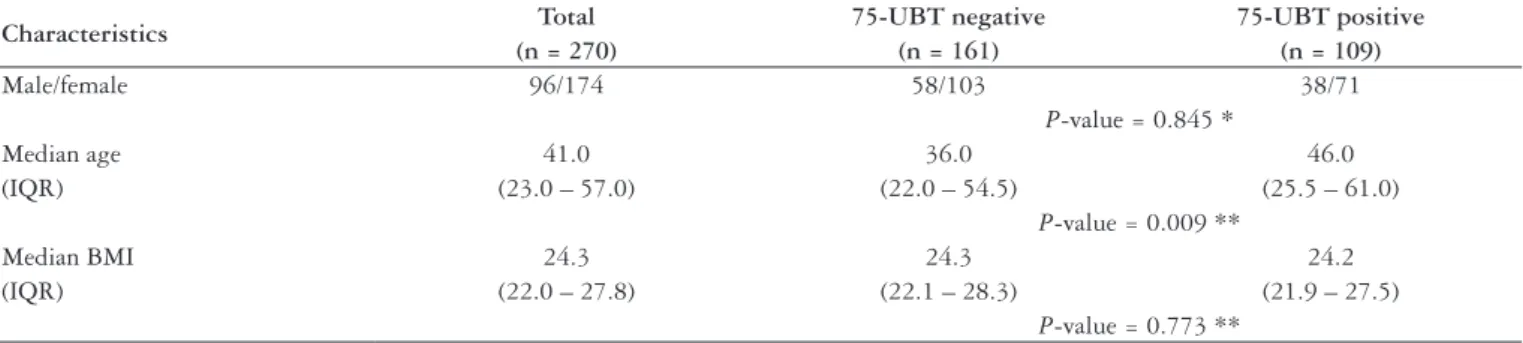
Characteristics Total 75-UBT negative 75-UBT positive
(n = 270) (n = 161) (n = 109)
Male/female 96/174 58/103 38/71
P-value = 0.845 *
Median age 41.0 36.0 46.0
(IQR) (23.0 – 57.0) (22.0 – 54.5) (25.5 – 61.0)
P-value = 0.009 **
Median BMI 24.3 24.3 24.2
(IQR) (22.0 – 27.8) (22.1 – 28.3) (21.9 – 27.5)
P-value = 0.773 **
TABLE 1. Demographic characteristics of the 270 patients included in the study
UBT = 13C-urea breath test; IQR = interquartill range; BMI = body mass index ;
* = chi-squared test; ** = Mann-Whitney test
25-UBT values
Total 75-UBT negative 75-UBT positive 95% CI for the
difference in populations means
(n = 270) (n = 161) (n = 109)
Mean Median
Standard deviation IQR
3.1 0.6 5.8 -0.9 - 5.9
-0.4 -0.5 1.5 -1.3 - 0.4
8.3 7.6 5.9 4.1 - 12.1
(-9.8 to -7.5) __ __ __
P-value = 0.000 #
TABLE 2. Values of descriptive statistics from 25-UBT for 75-UBT positive and negative patients
IQR = Interquartill range; # = t Student test; UBT = 13C-urea breath test
FIGURE 1. ROC curve 0%
0% 20% 40% 60% 80% 100%
10% 20% 30% 40% 50% 60% 70% 80% 90% 100% 1 - SPECIFICITY
SENSIVITY(%)
No signiicant differences between gender and body mass index (BMI) among the H. pylori negative and H. pylori positive patients could be observed in the cohort. The H. pylori negative patients presented median ages which were signiicantly lower than the H. pylori positive patients (P = 0.009).
Table 2 shows the values of descriptive statistics from 25-UBT for 75-25-UBT positive and negative patients. A statistically signiicant difference was observed among the means obtained in the 25-UBT in H. pylori negative and H. pylori positive patients (P = 0.000).
ROC curve
The ROC curve (Figure 1) provided a 92.99% (95% CI: 88.07-97-92) diagnostic accuracy.
Choice of best cut-off point of 25-UBT for the 270 patients studied
The sensitivity and speciicity of the test were calculated for each possible cut-off point. The best cut-off point for this study, 3.4‰, was chosen considering the prevalence
of H. pylori infection in our setting as 30.2% (95% CI:
23.9–37.3) and the upper positive predictive value (PV+) (or lower false-positive results). Although the sample size of the population studied was not so big, all prevalence values in the 95% CI prevalence (23.9% to 37.3%) conirmed 3.4‰ as the best cut-off of the study.
Table 3 shows the values of sensitivity and speciicity for some cut-off points, PV+ ve, PV- ve, and the corresponding false-results (positive and negatives) for the prevalence of 30.2%.
The results demonstrate that the best cut-off point was 3.4, with lower probabilities of false-positive values, bearing in mind the previous prevalence set for H. pylori
infection.
Considering the sample of 270 patients and the cut-off point equal to 3.4‰, the present study determined the following values: diagnostic accuracy of 25 mg UBT: 92.9% (95% CI: 88.1–97.9); sensitivity 83.5% (95% CI: 75.4–89.3); speciicity 99.4% (95% CI: 96.6–99.9); PV+ ve 98.3% (95% CI: 92.4-99.4), and PV- ve 93.0% (95% CI: 88.6-96.1).
DISCUSSION
Nevertheless, its use is still not largely employed worldwide because 13C-urea used to carry out the tests is still costly and makes the widespread use of this test dificult. In this light, different studies have been carried out aimed at reducing the need for serial tests and reducing the dosage of the substrate used in the exams. Although expert groups and regulatory agencies still advocate two UBT after treatment for the conirmation of eradication(8, 19), one study recently demonstrated that a single UBT performed 4 weeks after treatment is as effective as two serial breath tests in conirming H. pylori eradication. Nevertheless, the second breath test doubles the cost with no additional clinical beneit(17).
Although the dose 13C-urea described in the pioneer study carried out by Graham et al.(7), in 1987, was of 5 mg/kg (approximately 300 mg), later studies showed that lower doses, between 100 mg and 125 mg, were capable of achieving a sensitivity and speciicity of up to 100%(9, 11). More recently, the dose of 75 mg has been recommended and adopted in clinical studies and commercial kits(6, 8, 13).
In an attempt to reduce the dose of the substrate used even further, some studies, which employed 50 mg of 13C-urea released as a liquid solution or in capsules for gastric disintegration, have shown sensitivity and speciicity indices greater than 95%(4, 10). In 2006, Gatta et al.(5), using UBT with doses of 10 mg, 15 mg and 25 mg of 13C-urea, suggested that doses of up to 15 mg were accurate in diagnosing H. pylori
infection in patients that had not undergone treatment or after the eradication of the bacteria. One limitation of this study was not determining the prevalence of the H. pylori
infection in the studied population when determining the sensitivity, speciicity, and predictive value in the studied tests.
The present study irst demonstrated, in a prospective manner, that, in our Unit, 70% of the patients that perform UBT take it to control the eradication of the H. pylori infection, while 30% have never undergone previous treatment for H.
pylori. The prevalence of H. pylori infection was therefore
30.2% (95% CI: 23.9-37.3). Having deined the prevalence and its CI, it was determined that the best cut-off point for 25-UBT, with lower possibilities of false-positive values, is that which presents a DOB of equal to 3.4‰. With this cut-off point, the test achieved a sensitivity of 83.49% (95% CI: 75.4-89.3), a speciicity of 99.38% (95% CI: 96.6-99.9), and a diagnostic accuracy of 92.99% (IC 95%: 88.07-97.92). Such results, although reasonable, hinder the recommendation of the 25-UBT in daily practice due to the relatively high probability of obtaining false-negative results for the CI of the considered prevalence.
Some limitations of our study must be addressed: could the female predominance or the signiicantly (P = 0.009) lower ages in H. pylori negative patients have some inluence in our results? Although one study suggests that untreated infected females may have higher UBT values compared to untreated infected males(14), these indings are not considered suficient to change the cut-off value among sexes(6). Concerning the lower age observed in our H. pylori negative group compared to H. pylori positive group we attributed this inding to an overall decline on H. pylori
prevalence observed in the last 2 decades in children and young population in Brazil(3) and, also, to the increasing tendency to perform UBT to screen dyspeptic young people. The similar BMI values in H. pylori-positive and H. pylori -negative subjects of our study give consistency to our sample selection and reduce the possibility that young people, as observed in children under 6 years of age(20), could produce smaller amounts of endogenous 12CO
2, changing the ratio 13CO
2/ 12CO
2 with increase in DOB values and consequent false-positive results. And inally, some concern might be raised by the reference test used in the study, consisting of only one UBT performed with orange juice instead of citric acid. Just one UBT is now considered suficient for initial diagnosis and for the determination of the outcome of H.
pylori eradication therapy for most guidelines and studies(17).
Although the addition of a test meal, especially citric acid solution incorporated to 13C-urea may improve diagnostic performance of UBT(6), our test conirmed previous studies showing a very good discrimination between infected and non-infected patients when performed in fasting patients, with no test meal and using DOB values lower than 5‰(6, 7, 18). In conclusion, the results of this study demonstrate that UBT that use low doses (25 mg) of 13C-urea were not accurate enough to be recommended in clinical setting where a 30% prevalence of H. pylori infection is observed. Further studies should be done to determine the diagnostic accuracy of low doses of 13C-urea in the urea breath test.
ACKNOWLEDGEMENTS
Financial support for the study was furnished by FAPEMIG-Brazil. The authors would like to thank Osmar R. Trindade, Maurílio M. Fernandes and Maria de Lourdes M. Fernandes for technical and statistical assistance. The authors also thank Dr. Izabela M. Bomim, Rafael O.A. Ferreira, Marina R. Moreira, Raphael G. Andrade, Sheila M. Oliveira e Luiza Q. Ottoni for performing the breath tests.
Cut-off Sensitivity Speciicity PV+ ve False-positive PV- ve False-negative
2.5 87.16% 95.65% 89.66% 10.34% 94.51% 5.49%
2.7 86.24% 96.89% 92.32% 7.68% 94.21% 5.79%
3.1 85.32% 98.76% 96.74% 3.26% 93.96% 6.04%
3.4 83.49% 99.38% 98.31% 1.69% 93.29% 6.71%
3.8 78.90% 99.38% 98.21% 1.79% 91.59% 8.41%
Coelho LGV, Silva Jr AE, Coelho MCF, Penna FGC, Ferreira ROA, Santa-Cecília EV. Precisão do teste respiratório com pequenas doses de ureia marcada com carbono-13 no diagnóstico da infecção por Helicobacter pylori. Arq Gastroenterol. 2011;48(2):104-8 .
RESUMO – Contexto- A dose convencional de 13C-ureia para a realização do teste respiratório com 13C-ureia é 75 mg. Objetivo - Determinar a precisão
diagnóstica do teste respiratório contendo 25 mg de 13C-ureia comparada com a dose convencional de 75 mg para o diagnóstico de infecção por
H. pylori. Métodos – Duzentos e setenta pacientes adultos (96 homens, 174 mulheres, idade mediana de 41 anos) realizaram o teste respiratório convencional (75 mg 13C-ureia) e repetiram o teste respiratório usando apenas 25 mg de 13C-ureia dentro de 2 semanas de intervalo. O teste respiratório
foi realizado empregando-se analisador de isótopos por infravermelho. Os pacientes foram considerados positivos quando apresentavam valor delta acima da linha de base >4.0 no teste respiratório convencional (padrão-ouro). Resultados – Cento e sessenta e um pacientes (59,6%) eram H. pylori
negativos e 109 (40,4%) eram positivos aos testes respiratórios convencionais. Para deinição do melhor ponto de corte discriminatório entre positivos e negativos pelo teste respiratório com 25 mg, foi utilizado a curva ROC, obtendo-se o valor de 3,4%, considerando–se a prevalência de 30,2% (IC 95%: 23.9-37.3) da infecção por H. pylori no laboratório, onde se realizou este estudo. Desta forma, para o teste respiratório com 25 mg foi obtida uma precisão diagnóstica de 92,9% (IC 95%: 88,1–97,9), sensibilidade de 83,5% (IC 95%: 75,4–89,3) e especiicidade de 99,4% (IC 95%: 96,6-99,9).
Conclusões – Teste respiratório com dose baixa (25 mg) de 13C-ureia não proporciona precisão suiciente para ser recomendado em ambientes clínicos,
onde a prevalência de H. pylori está situada em torno de 30%.
DESCRITORES - Infecções porhelicobacter. Testes respiratórios.
REFERENCES
1. Altman DG. Diagnostic tests. In: Altman DG, Machin D, Trevor NB, Gardner MJ, editors. Statistics with conidences. 2nd. ed. Bristol: BMJ Books; 2003. p. 105-19.
2. Coelho LG, Reber M, Passos MC, Aguiar RO, Casaes PE, Bueno ML, Yasaki FR, Castro FJ, Vieira WL, Franco JM, Castro LP. Application of isotope-selective non-dispersive infrared spectrometry for the evaluation of 13C-urea breath test:
comparison with three concordant methods. Braz J Med Biol Res. 1999;32:1493-7. 3. Coelho MC, Bonim IM, Moreira MR, Santa-Cecilia EV, Oliveira SM, Trindade
OR, Coelho LG. Helicobacter pylori among medical students in Brazil [abstract]. Helicobacter. 2007;12:454.
4. Gatta L, Vakil N, Ricci C, Osborna JF, Tampieri A, Perna F, Miglioli M, Vaira D. A rapid, low-dose, 13C-urea tablet for the detection of Helicobacter pylori
infection before and after treatment. Aliment Pharmacol Ther. 2003;17:793-8. 5. Gatta L, Ricci C, Tampieri A, Osborn J, Perna F, Bernabucci V, Vaira D. Accuracy
of breath test using low doses of 13C-urea to diagnose Helicobacter pylori infection:
randomized controlled trial. Gut. 2006;55:457-62.
6. Gisbert JP, Pajares JM. 13C-urea breath test in the diagnosis of Helicobacter pylori
infection - a critical review. Aliment Pharmacol Ther. 2004;20:1001-17. 7. Graham DY, Klein PD, Evans DJ Jr, Evans DG, Alpert LC, Opekun AR, Boutton
TW. Campylobacter pylori detected nonivasively by the 13C-urea breath test.
Lancet. 1987;1:1174-7.
8. Health Canada. Guidance When Developing Therapeutic Regimens for the Eradication of Helicobacter pylori in GI diseases. Available at: http://www.hc-sc. gc.ca/dhp-mps/prodpharma/applic-demande/guide-ld/helicobacter/hpylor-eng. php (accessed on 19 December 2009).
9. Klein PD, Malaty HM, Martin RF, Graham KS, Genta RM, Graham DY. Noninvasive detection of Helicobacter pylori infection in clinical practice: the
13C urea breath test. Am J Gastroenterol. 1996;91:690-4.
10. Liao CC, Lee CL, Chiang TC, Lee SC, Huang SH, Tu TC, Chen TK, Wu CH. The 13C-urea breath test to detect Helicobacter pylori infection: a validated simple
methodology with 50 mg 13C-urea. Aliment Pharmacol Ther. 2002;16:787-92.
11. Logan RPH, Dill S, Bauer FE. et al. The European 13C-urea breath test for
detection of Helicobacter pylori. Eur J Gastroenterol Hepatol. 1991;3:915-21. 12. Newcombe RG, Altman DG. Proportions and their differences. In: Altman DG,
Machin D, Bryant TN, Gardner M, editors. Statistics with conidence. 2nd ed. Bristol: BMJ Books; 2003. p.45-56.
13. Savarino V, Vigneri S, Celle G. The 13C urea breath test in the diagnosis of
Helicobacter pylori infection. Gut. 1999;45:18-22.
14. Shmuely H, Yahav J, Samra Z, Chodick G, Ofek I. Elevated 13C-urea breath test
values females infected with Helicobacter pylori. Dig Dis Sci. 2007;52:402–4. 15. Suerbaum S, Michetti P. Helicobacter pylori infection. N Engl J Med.
2002;347:1175-86.
16. Talley NJ, Li Z. Helicobacter pylori: testing and treatment. Expert Rev Gastroenterol Hepatol. 2007;1:71-9.
17. Vakil N, Zullo A, Ricci C, Hassan C, Vaira D. Duplicate breath testing to conirm eradication of Helicobacter pylori: incremental beneit and cost in 419 patients. Aliment Pharmacol Ther. 2008;28:1304-8.
18. Wong WM, Wong BC, Li TM, Wong KW, Cheung KL, Fung FM, Xia HH, Lam SK. Twenty-minute 50 mg 13C-urea breath test without test meal for the
diagnosis of Helicobacter pylori infection in Chinese. Aliment Pharmacol Ther. 2001;15:1499-504.
19. Working Party of the European Helicobacter pylori Study Group. Technical annex: tests used to assess Helicobacter pylori infection. Gut. 1997;41: S10–8. 20. Yang HR, Ko JS, Seo JK. Does the diagnostic accuracy of the 13C-urea breath
test vary with age even after the application of urea hydrolysis rate? Helicobacter. 2008;13:239–44.