INTRODUCTION
The most used tool for measuring the insertion of a journal is an
analysis of how often articles published in that journal were cited in
other articles of the same or other journal, indexed in a particular
da tabase, in a given time. Although imperfect, this method is used
as an indicator of the global inclusion of a journal. Few years ago,
the “Arquivos Brasileiros de Oftalmologia (ABO)” and the “Revista
Bra-sileira de Oftalmologia (RBO)” have become part of the Institute for
Scientific Information (ISI) Web of Knowledge
®, considered the most
important database of scientific citations. The result of measurement
of the citations made by ISI is published in the Journal Citation
Re-ports
®(JCR) which contains several indicators, the best known being
ABSTRACT
Purpose: To compare clinical trials published in Brazilian journals of ophthalmology and in foreign journals of ophthalmology with respect to the number of citations and the quality of reporting [by applying the Consolidated Standards for Reporting Trials (CONSORT ) statement writing standards].
Methods: The sample of this systematic review comprised the two Brazilian jour nals of ophthalmology indexed at Science Citation Index Expanded and six
of the foreign journals of ophthalmology with highest Impact Factor®
according ISI. All clinical trials (CTs) published from January 2009 to December 2010 at the Brazilians journals and a 1:1 randomized sample of the foreign journals were included. The primary outcome was the number of citations through the end of 2011. Subgroup analysis included language. The secondary outcome included likelihood of citation (cited at least once versus no citation), and presence or absence of CONSORT statement indicators.
Results: The citation counts were statistically significantly higher (P<0.001) in the Foreign Group (10.50) compared with the Brazilian Group (0.45). The likelihood ci tation was statistically significantly higher (P<0.001) in the Foreign Group (20/20 - 100%) compared with the Brazilian Group (8/20 - 40%). The subgroup analysis of the language influence in Brazilian articles showed that the citation counts were statistically significantly higher in the papers published in English (P<0.04). Of 37 possible CONSORT items, the mean for the Foreign Group was 20.55 and for the Brazilian Group was 13.65 (P<0.003).
Conclusion: The number of citations and the quality of reporting of clinical trials in Brazilian journals of ophthalmology still are low when compared with the foreign
journals of ophthalmology with highest Impact Factor®
.
Keywords: Clinical trial; Ophthalmology; Citation databases; Journal Impact factor; Quality control
RESUMO
Objetivo: Comparar ensaios clínicos publicados em periódicos brasileiros de oftalmo-logia e em periódicos estrangeiros de oftalmooftalmo-logia em relação ao número de citações e à qualidade da informação [através da aplicação do Consolidated Standards for Reporting Trials (CONSORT ) statement].
Métodos: A amostra desta revisão sistemática abrangeu os dois periódicos brasileiras de oftalmologia indexaoas no Science Citation Index Expanded (Grupo Brasileiro) e seis dos periódicos estrangeiros de oftalmologia com maior fator de impacto de acordo com o ISI (Grupo Estrangeiro). Todos os ensaios clínicos, publicados entre janeiro de 2009 a dezembro de 2010, nos dois periódicos brasileiros e numa amostra aleatória 1:1 dos periódicos estrangeiros foram incluídos. O desfecho primário foi o número de citações até o final de 2011. A análise de subgrupos incluiu o idioma. O desfecho secundário incluiu a probabilidade de citação (citado ao menos uma vez versus não citado), e a presença ou ausência de indicadores da declaração CONSORT.
Resultados: O número de citações foi significativamente maior (P<0,001) no Grupo Estrangeiro (10,50) em comparação com o Grupo Brasileiro (0,45). A probabilidade de citação foi estatisticamente superior (P<0,001) no Grupo Estrangeiro (20/20-100%) comparado com o Grupo Brasileiro (8/20-41%). A análise de subgrupo sobre a influência da língua em artigos Brasileiros mostrou que o número de citações foi significativamente maior nos artigos publicados em Inglês (P<0,04). Dos 37 itens do CONSORT possíveis, a média para o Grupo Estrangeiro foi de 20,55 e para o Grupo Brasileiro foi 13,65 (P<0,003).
Conclusão: O número de citações e a qualidade da redação dos ensaios clínicos em periódicos Brasileiros de oftalmologia ainda são baixos quando comparados com os periódicos estrangeiros de oftalmologia com mais alto fator de impacto.
Descritores: Ensaio clínico; Oftalmologia; Bases de dados de citações; Fator de impacto de revistas; Controle de qualidade
the Impact Factor
®. The Impact Factor
®of a journal in a given year
is calculated based on the number of times articles published in the
journal in the two previous years were cited in that year by all journals
in that database
(1).
A clinical trial is a type of research study that tests how well new
medical approaches work in people. These studies test new methods
of screening, prevention, diagnosis, or treatment of a disease.
Clini-cal trials, when appropriately designed, conducted, and reported,
represent the gold standard in evaluating healthcare interventions
(2).
The Consolidated Standards of Reporting Trials Group (CONSORT)
statement provides a 25-item checklist for a minimum set of
recom-mendations for reporting the trial design, analysis, and results. It was
Clinical trials in Brazilian journals of ophthalmology: where we are
Ensaios clínicos em periódicos brasileiros de otalmologia: onde estamos
R
odRigoP
essoaC
avalCantil
iRa1,2, F
Ranzs
ChubeRtl
eal1, F
auzea
bdulmassihg
onçalves1, F
eRnandoh
enRiqueR
amosa
moRim1,
J
oãoP
auloF
eRnandesF
elix1, C
aRlose
duaRdol
eitea
Rieta1Submitted for publication: October 5, 2012 Accepted for publication: November 14, 2012
Study carried out at Faculdade de Ciências Médicas da Universidade Estadual de Campinas - UNICAMP.
1 Physician, Department of Ophthalmology, Universidade Estadual de Campinas - UNICAMP - Cam-pinas (SP), Brazil.
2 Physician, Department of Ophthalmology, Universidade Federal de Pernambuco - UFPE - Recife (PE), Brazil.
Funding: No specific financial support was available for this study.
Disclose of potential conflict of interest: R.P.C.Lira, None; F.S.Leal, None; F.A.Gonçalves, None; F.H.R.Amorim, None; J.P.F.Felix, None; C.E.L.Arieta, None.
Correspondence address: Rodrigo Pessoa Cavalcanti Lira. Rua Irmã Maria David, 200 - Apto. 1302 - Recife (PE) - 52061-070 - Brazil - E-mail: [email protected]
developed to assist authors in writing reports of clinical trials, editors
and peer reviewers in reviewing manuscripts for publication, and
readers in critically appraising published articles. It gives guidance
for reporting all clinical trials, but focuses on the most common
de-sign type-individually randomized, two group, parallel trials, which
accounts for over half of trials in the literature
(3).
The main purpose of this study is to compare clinical trials
publi-shed in Brazilians ophthalmology journals and in foreign
ophthalmo-logy journals with respect to the number of citations and the quality
of reporting (by applying the CONSORT statement writing standards).
METHODS
This study was a systematic review. Originals clinical trials phase
III or phase IV were identified by retrospective review of articles pu
-blished from January 2009 to December 2010 (2009/2010). Phase III
trials compare the results of people taking a new treatment with the
results of people taking the standard treatment. Phase IV trials are
done using thousands of people after a treatment has been
appro-ved and marketed, to check for side effects that were not seen in the
phase III trial.
One group (Brazilian Group) included the two Brazilian journals
of ophthalmology indexed at Science Citation Index Expanded
(“Ar-quivos Brasileiros de Oftalmologia” e “Revista Brasileira de
Oftalmolo-gia”), and the other group (Foreign Group) included six of the foreign
journals of ophthalmology with highest Impact Factor
®according
ISI (Ophthalmology; American Journal of Ophthalmology; Archives
of Ophthalmology; Investigative Ophthalmology and Vision Science;
Journal of Cataract and Refractive Surgery; and British Journal of
Oph thalmology)
(4).
The Brazilian group included all 20 clinical trials published in
2009/2010
(5-24). The Foreign group included a randomized (random
order with a computer generated random number) sample of 20
clinical trials among the 449 published in 2009/2010 [The Medline
search strategies for clinical trial sought (publication type) was:
“clinical trial”; or “clinical trial, phase III”; or “clinical trial, phase IV”; or
“controlled clinical trial”]
(25-44). All articles were carefully scrutinized to
confirm the study design.
The primary outcome was the number of citations through the
end of 2011
(4). Most articles are rarely cited, if at all, during the same
year in which they were published, but the citation count of the 2
sub sequent years is representative (it forms the basis of estimating
journal impact factors). Subgroup analysis included language.
The secondary outcome included likelihood of citation (cited at
least once versus no citation), and presence or absence of CONSORT
statement indicators
(3). Although the CONSORT checklist has 25 items,
our final grading scale had a maximum of 37 possible points, because
there are general items divided in subparts. It was assigned 1 point
per subpart.
Descriptive statistics were calculated. Continuous data were ex
-pres sed as mean values, standard deviation (SD) and ranges.
Inde-pendent sample t-test of equality of means was used to compare the
2 groups. Analyses were conducted using PSPP statistical software.
P
values are 2-tailed. Statistical significance was considered at the
0.05 level.
RESULTS
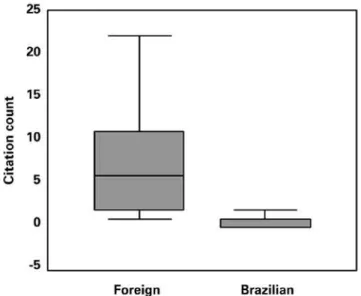
The citation counts were statistically significantly higher (P<0.001)
in the Foreign Group (mean=10.50, SD=11.22, with a range from 1 to
42) compared with the Brazilian Group (mean=0.45, SD=0.60, with a
range from 0 to 2) (Figure 1). The likelihood citation was statistically
significantly higher (P<0.001) in the Foreign Group (20/20 - 100%)
compared with the Brazilian Group (8/20 - 40%).
The subgroup analysis of the language influence in Brazilian
arti-cles showed that the citation counts were statistically significantly
hi-gher (P<0.04) in the papers published in English (mean=1.00, SD=0.82,
with a range from 0 to 2) compared with the papers published in
Portuguese (mean=0.31, SD=0.48, with a range from 0 to 1) (Figure 2).
Of 37 possible CONSORT items, the mean for the Foreign Group
was 20.55 (54%), SD=5.07, with a range from 11 to 29 (30%-78%),
and for the Brazilian Group was 13.65 (35%), SD=3.44, with a range
from 8 to 21 (22%-57%). The difference was statistically significant
(P<0.003) (Figure 3).
DISCUSSION
The results of this study demonstrated that the number of
citations and quality of reporting of Brazilian journals of
ophthal-mology still are low when compared with the foreign journals of
ophthalmology with higher Impact Factor. The situation is worse
to the articles published in Portuguese. By analyzing the citation of
articles according to the language in which they were published, it
Figure 1. Citation counts of Foreign Group compared with the Brazilian Group.
is possible notice that the number of citations of papers written in
English is higher
(1).
Citation analysis of ophthalmology articles has rarely been
repor-ted. The impact of a published article can be estimated by evaluating
how frequently the study is cited in subsequent peer-reviewed
publications
(45). The number of times an article is cited over a given
time period might indicates the level of importance attributed to its
findings by research medical community
(46). Researchers around the
world rank their choices of journals for publication according to
Im-pact Factor
®. The Coordination of Improvement of Higher Education
Personnel (CAPES), which is the government agency in the Ministry
of Education responsible for coordinating the post-graduation
pro-grams in Brazil, stratified the quality of the journals based exclusively
from the ISI Impact Factor
®(1).
One of the actions to reach a higher number of citations on CTs
may be to embrace principles of the CONSORT
(47). The
evidence-ba-sed approach that has been uevidence-ba-sed for CONSORT also served as a model
for development of other reporting guidelines, such as for reporting
systematic reviews and meta-analysis of studies evaluating
interven-tions (PRISMA)
(48), and Strengthening the Reporting of Observational
Studies in Epidemiology (STROBE)
(49). However, as a potential drawback,
a reporting guideline might encourage some authors to report
ficti-tiously the information suggested by the guidance rather than what
was actually done. Readers, peer reviewers, and editors should
vigi-lantly guard against that potential drawback and refer, for example,
to trial protocols, to information on trial registers, and to regulatory
agency websites. Moreover, in some cases, the CONSORT can led to
improvements in reporting but not in methodological conduct
(50).
Some caveats of this study should be discussed. First, we
com-pared the national journals versus a sample of the most important
foreign journals. However, the encouragement of our Brazilian
scientific community toward the highest standards of study conduct
and reporting is a realistic and important goal. Second, we can not
generalize the results because we analyzed only CTs. But this study
design, jointly with meta-analysis, is considered the gold standard for
clinical research
(51). Third, a citation does not guarantee the respect
of the citing investigators. Occasionally a study may be cited only to
be criticized or dismissed. Nevertheless, citation still means that the
study is active in the scientific debate. Moreover, we should
acknow-ledge that number of citation does not necessarily translate into
cli-nical or scientific impact
(40). Fourth, a presumable circumstance that
may had contributed to the low citation of papers from the Brazilian
journals was its relative low IF [in 2011, the IF of ABO was 0.326, and
the IF of RBO was 0.129] in comparison to the group of the foreign
journals (in 2011, the average of IF was 3.692), because there is a
ten-dency of authors to publish their best articles in journals with higher
IF, perpetuating this situation
(4). Finally, for the same reason above,
Brazilians authors used to publish its best articles in foreign journals.
Amazingly, in a paper applying the CONSORT and STROBE statements
to evaluate the reporting quality of neovascular age-related macular
degeneration studies the highest reporting scores were achieved by
Brazilians articles published in foreign journals
(48).
The boards of the Brazilians journals of ophthalmology are doing
efforts to change this current unfavorable picture because they know
the editorial scenario is competitive
(1,52-55). Although the ABO and RBO
have not yet officially adopted the CONSORT, neither the English
lan guage, they encourage its use as well as other protocols such as
STROBE and PRISMA. This attitude may contribute to the
improve-ment of Brazilian journals global insertion.
REFERENCES
1. Chamon W, Melo Jr LA. Impact factor and insertion of the ABO in the world scientific literature. Arq Bras Oftalmol [Internet]. 2011[cited 2012 May 21];74(4):243-4. http:// www.scielo.br/pdf/abo/v74n4/v74n4a01.pdf
2. Jüni P, Altman DG, Egger M. Systematic reviews in health care: assessing the quality of controlled clinical trials. BMJ [Internet]. 2001[cited 2011 Jan 21];323(7303):42-6.Availa-ble from: http://www.bmj.com/content/323/7303/42?view=long&pmid=11440947 3. Moher D, Hopewell S, Schulz KF, Montori V, Gotzsche PC, Devereaux PJ, Elbourne D,
Egger M, Altman DG; Consolidated Standards of Reporting Trials Group. CONSORT 2010 explanation and elaboration: updated guidelines for reporting parallel group randomised trials. J Clin Epidemiol [Internet]. 2010 [cited 2012 Jan 21];63(8):e1-37. Er-ratum in: J Clin Epidemiol. 2012;65(3):351. Available from: http://www.sciencedirect. com/science/article/pii/S0895435610001034
4. Web of Knowledge [Internet]. Philadelphia: Thomson Reuters. [cited 2012 Jun 30]. Available from: http://apps.webofknowledge.com
5. Fonseca Jr NL, Luci LM, Badessa MP, Rehder JR. [Comparison of two modified lido-caine solutions for local anesthesia in blepharoplasty]. Arq Bras Oftalmol [Internet]. 2009[citado 2012 Jun 21];72(2):211-4. Portuguese. Dispon: http://www.scielo.br/pdf/ abo/v72n2/15.pdf
6. Barreiro TP, Forseto AS, Pinto LF, Francesconi CM, Nosé W. [Wavefront-guided Lasik for low to moderate myopia: CustomCornea versus Zyoptix]. Arq Bras Oftalmol [Internet] 2009[cited 2010 Out 21];72(4):519-25. Portuguese. Disponível em: http://www.scielo. br/pdf/abo/v72n4/a16v72n4.pdf
7. Frantz KA, Moura Filho ER, Abud MB, Avila MP, Magacho L. [Comparison of the analgesic effect between 0- MG etoricoxib and dipyrone after exeresis of primary pterygium with conjunctival autograft]. Arq Bras Oftalmol [Internet]. 2009[citado 2010 Jun 21];72(5):661-4. Portuguese. Disponível em: http://www.scielo.br/pdf/abo/ v72n5/12.pdf
8. Gonçalves RD, Cruz AA. [Oral sedation with midazolam in blepharoplasty]. Arq Bras Oftalmol [Internet]. 2009[citado 2010 Jul 21];72(5):665-8. Portuguese. Disponível em: http://www.scielo.br/pdf/abo/v72n5/13.pdf
9. Hida WT, Motta AF, Kara-José Junior N, Alves E, Tadeu M, Cordeiro LN, et al. Compa-rison between OPD-Scan results and visual outcomes of monofocal and multifocal intraocular lenses. Arq Bras Oftalmol [Internet]. 2009[citado 2010 Mar 21];72(4):526-32. Disponível em: http://www.scielo.br/pdf/abo/v72n4/a17v72n4.pdf
10. Kara-José Jr N, Santhiago MR, Parede TR, Espindola RF, Mazurek MG, Germano R, et al. [Influence of cataract surgical correction on working perception]. Arq Bras Oftalmol [Internet]. 2010 [citado 2011 Fev 21];73(6):491-3. Disponível em: http://www.scielo. br/pdf/abo/v73n6/v73n6a03.pdf
11. Raskin E, Paula JS, Cruz AA, Coelho RP. Effect of bevel position on the corneal endo-thelium after phacoemulsification. Arq Bras Oftalmol [Internet]. 2010[citado 2012 Dez 21];73(6):508-10. Disponível em: http://www.scielo.br/pdf/abo/v73n6/v73n6a08.pdf 12. Rezende MP, Dias AF, Oshima A, Andrade EP, Serracarbassa PD. [Study of visual
acuity and intraocular pressure in the treatment of macular diabetic edema with intravitreous triamcinolone]. Arq Bras Oftalmol [Internet]. 2010[citado 2012 Set 21]; 73(2):129-34. Disponível em: http://www.scielo.br/pdf/abo/v73n2/v73n2a06.pdf 13. Urbano AP, Nosé W. [Correction of ocular aberrations in custom and standard LASIK
retreatments]. Arq Bras Oftalmol [Internet]. 2009[citado 2010 Jul 27];72(5):687-93. Portuguese. Disponível em: http://www.scielo.br/pdf/abo/v72n5/18.pdf
14. Nakano CT, Hida WT, Kara-Jose Junior N, Motta AF, Reis A, Pamplona M, et al. Com-parison of central corneal edema and visual recovery between liquefaction and conventional phacoemulsification in soft cataracts. Rev Bras Oftalmol [Internet]. 2009[citado 2011 Jun 21];68(1):7-12. Disponível em: http://www.scielo.br/pdf/rbof/ v68n1/02.pdf
15. Barreto RD, Biancardi AL, Nascimento EM, Pereira BD, de Moraes HV. Uso de ciclos-porina 0,05% tópica no tratamento de olho seco de pacientes portadores do vírus HIV. Rev Bras Oftalmol [Internet]. 2009[citado 2010 Mar 19];68(2):83-9. Disponível em: http://www.scielo.br/pdf/rbof/v68n2/a04v68n2.pdf
16. Martins FC, Miyaji ME, Lima VL, Rehder JR. Biometria ultrassônica no cálculo do poder dióptrico de lentes intraoculares: estudo comparativo dos métodos de contato e de imersão. Rev Bras Oftalmol [Internet]. 2009 [cited 2010 Aug 21];68(4):212-5. Disponí-vel em: http://www.scielo.br/pdf/rbof/v68n4/a05v68n4.pdf
17. Damasceno ED, Damasceno NA, Costa Filho AD. Ensino de oftalmologia na gradua-ção médica. Estudo comparativo de aprendizado na oftalmoscopia direta com oftalmoscópico convencional e de campo amplo (Panoptic), Rev Bras Oftalmol [Internet]. 2009 [cited 2010 Jan 21];68(4):231-6. Disponível em: http://www.scielo.br/ pdf/rbof/v68n4/a08v68n4.pdf
18. Nakano CT, Hida WT, Kara-Jose Junior N, Motta AF, Fante D, Masson VF, et al. Compa-rison between OPD-scan results and contrast sensitivity of three intraocular lenses: spheric AcrySof SN60AT, aspheric AcrySof SN60WF and multifocal AcrySof Restor lens. Rev Bras Oftalmol [Internet]. 2009[citado 2010 Nov 21];68(4):216-22.Disponível em: http://www.scielo.br/pdf/rbof/v68n4/a06v68n4.pdf
19. Mendes MH, Betinjane AJ, Cavalcante AF, Castanheira VR, Cheng CT, Carani JC. Estudo comparativo entre imagens ultra-sonográficas obtidas com sondas de 10MHz e 20 MHz na avaliação de anormalidades do segmento posterior do globo ocular. Rev Bras Oftalmol [Internet]. 2009[citado 2010 Jan 21];68(5):291-5.Disponível em: http://www. scielo.br/pdf/rbof/v68n5/a07v68n5.pdf
20. Portes AJ, Gomes LP, Amaral BL, Massa L. Percepção da administração tó pica ocular de drogas: vaporização x gotas. Rev Bras Oftalmol [Internet]. 2009 [citado 2011 Jan 21];68(6):327-31.Disponível em: http://www.scielo.br/pdf/rbof/v68n6/ rbofv68n06a02.pdf
21. Corpa JH, Martinelli EJ, Tarcha FA, Vitiello Neto V, Ribeiro LG, Rede JR. Estudo comparativo entre desepitelização mecânica e química na ceratectomia fotorrefra-tiva - sintomatologia e re-epitelização pós operatória. Rev Bras Oftalmol [Internet]. 2010[citado 2012 Jun 21];69(1):23-6.Disponível em: http://www.scielo.br/pdf/rbof/ v69n1/05.pdf
22. Almodin EM, Almodin JM, Almodin FM. Avaliação corneana após “crosslink” utilizando dois tipos diferentes equipamentos. Rev BrasOftalmol [Internet]. 2010 [citdo 2011 Fev 21];69(3):159-64.Disponível em: http://www.scielo.br/pdf/rbof/v69n3/a04v69n3.pdf 23. Pinto VC, Martini da Costa T, Grottone GT, Schor P, Pisa IT. Avaliação de um programa
para computador de mão no auxílio ao ensino de oftalmologia para estudantes de medicina. Rev Bras Oftalmol [Internet]. 2010[citado 2011 Jan 23];69(6):352-60. Disponível em: http://www.scielo.br/pdf/rbof/v69n6/a02v69n6.pdf
24. Germano JE, Hida WT, Brasil AA, Germano RA, Yamane IS, Reis A, et al. Lente intra-ocular multifocal refrativa: a performance visual e qualidade de vida em implantes bilaterais versus unilaterais. Rev Bras Oftalmol [Internet]. 2010[citado 2011 Ago 25]; 69(6):372-7. Disponível em: http://www.scielo.br/pdf/rbof/v69n6/a05v69n6.pdf 25. Bressler NM, Chang TS, Suñer IJ, Fine JT, Dolan CM, Ward J, Ianchulev T; MARINA and
ANCHOR Research Groups. Vision-related function after ranibizumab treatment by better- or worse-seeing eye: clinical trial results from MARINA and ANCHOR. Ophthal-mology. 2010;117(4):747-56.e4.
26. Vogel R, Crockett RS, Oden N, Laliberte TW, Molina L; Sodium Hyaluronate Ophthal-mic Solution Study Group. Demonstration of efficacy in the treatment of dry eye disease with 0.18% sodium hyaluronate ophthalmic solution (vismed, rejena). Am J Ophthalmol. 2010;149(4):594-601. Comment in: Am J Ophthalmol. 2010;150(5):757; author reply 757.
27. Pavesio C, Zierhut M, Bairi K, Comstock TL, Usner DW; Fluocinolone Acetonide Study Group. Evaluation of an intravitreal fluocinolone acetonide implant versus standard systemic therapy in noninfectious posterior uveitis. Ophthalmology. 2010;117(3): 567-75, 575.e1.
28. Domalpally A, Blodi BA, Scott IU, Ip MS, Oden NL, Lauer AK, VanVeldhuisen PC; SCORE Study Investigator Group. The Standard Care vs Corticosteroid for Retinal Vein Occlu-sion (SCORE) study system for evaluation of optical coherence tomograms: SCORE study report 4. Arch Ophthalmol [Internet]. 2009 [cited 2012 Nov 21];127(11):1461-7. Available from: http://www.ncbi.nlm.nih.gov/pmc/articles/PMC2788490/ 29. Scott IU, Oden NL, VanVeldhuisen PC, Ip MS, Blodi BA, Antoszyk AN; SCORE Study
In-vestigator Group. SCORE Study Report 7: incidence of intravitreal silicone oil droplets associated with staked-on vs luer cone syringe design. Am J Ophthalmol [Internet]. 2009 [cited 2012 Jan 24];148(5):725-32.e7. Available from: http://www.ncbi.nlm.nih. gov/pmc/articles/PMC2780008/
30. Boyer DS, Heier JS, Brown DM, Francom SF, Ianchulev T, Rubio RG. A Phase IIIb stu-dy to evaluate the safety of ranibizumab in subjects with neovascular age-related macular degeneration. Ophthalmology. 2009;116(9):1731-9. Comment in: Ophthal-mology. 2010;117(9):1860; author reply 1860-1. Available from: http://ac.els-cdn.com/ S0161642009005430/1-s2.0-S0161642009005430-main.pdf?_tid=c08a3786-8d8a-11e2-b888-00000aab0f26&acdnat=1363363965_5a760f5706a3fa6af5ba0a61121bdb68 31. Korenfeld MS, Silverstein SM, Cooke DL, Vogel R, Crockett RS; Difluprednate
Ophthalmic Emulsion 0.05% (Durezol) Study Group. Difluprednate ophthalmic emulsion 0.05% for postoperative inflammation and pain. J Cataract Refract Surg. 2009;35(1):26-34. Available from: http://online.liebertpub.com/doi/pdf/10.1089/ jop.2010.0059
32. Ip MS, Oden NL, Scott IU, VanVeldhuisen PC, Blodi BA, Figueroa M, Antoszyk A, Elman M; SCORE Study Investigators Group. SCORE Study report 3: study design and baseli-ne characteristics. Ophthalmology [Interbaseli-net]. 2009[cited 2011 Jun 21];116(9):1770-7.e1. Available from: http://www.ncbi.nlm.nih.gov/pmc/articles/PMC2785028/ 33. Suñer IJ, Kokame GT, Yu E, Ward J, Dolan C, Bressler NM. Responsiveness of NEI VFQ-25
to changes in visual acuity in neovascular AMD: validation studies from two phase 3 clinical trials. Invest Ophthalmol Vis Sci [Internet]. 2009 [cited 2010 Jun 21];50(8): 3629-35. Available from: http://www.iovs.org/content/50/8/3629.long
34. Kohnen T, Knorz MC, Cochener B, Gerl RH, Arné JL, Colin J, et al. AcrySof phakic angle- supported intraocular lens for the correction of moderate- to-high myopia: one-year results of a multicenter European study. Ophthalmology. 2009;116(7):1314-21. Available from: http://ac.els-cdn.com/S0161642009001031/1-s2.0-S0161642009001031-main. pdf?_tid=308438c0-8d8b-11e2-b5d0-00000aacb362&acdnat=1363364152_64051f1 a592253031533dd5c497333d1
35. Friberg TR, Tolentino M; LEVEL Study Group, Weber P, Patel S. Campbell S, Goldbaum M. Pegaptanib sodium as maintenance therapy in neovascular age-related macular dege-neration: the LEVEL study. Br J Ophthalmol [Internet]. 2010 [cited 2012 Apr 12];94:1611-7. Available from: http://www.ncbi.nlm.nih.gov/pmc/articles/PMC2991041/
36. Ehrlich JS, Manche EE. Regression of effect over long-term follow-up of conduc-tive keratoplasty to correct mild to moderate hyperopia. J Cataract Refract Surg. 2009;35(9):1591-6. Available from: http://www.sciencedirect.com/science/article/pii/ S0886335009005616
37. Scott IU, VanVeldhuisen PC, Oden NL, Ip MS, Blodi BA, Jumper JM, Figueroa M; SCORE Study Investigator Group.SCORE Study report 1: baseline associations between central retinal thickness and visual acuity in patients with retinal vein occlusion. Ophthalmology [Internet]. 2009[cited 2010 Aug 4];116(3):504-12. Available from: http://www.ncbi.nlm.nih.gov/pmc/articles/PMC2851408/
38. Bressler NM, Chang TS, Fine JT, Dolan CM, Ward J; Anti-VEGF Antibody for the Treat-ment of Predominantly Classic Choroidal Neovascularization in Age-Related Macular Degeneration (ANCHOR) Research Group. Improved vision-related function after ranibizumab vs photodynamic therapy: a randomized clinical trial. Arch Ophthalmol [Internet]. 2009[cited 2011 May 24];127(1):13-21. Available from: http://archopht. jamanetwork.com/article.aspx?articleid=420982
39. Keane PA, Patel PJ, Ouyang Y, Chen FK, Ikeji F, Walsh AC, et al. Effects of retinal morphology on contrast sensitivity and reading ability in neovascular age-related macular degeneration. Invest Ophthalmol Vis Sci [Internet]. 2010[cited 2012 Oct 21]; 51(11):5431-7. Available from: http://www.ncbi.nlm.nih.gov/pmc/articles/ PMC3061494/
40. Repka MX, Kraker RT, Beck RW, Atkinson CS, Bacal DA, Bremer DL, Davis PL, Gearin-ger MD, Glaser SR, Hoover DL, Laby DM, Morrison DG, RoGearin-gers DL, Sala NA, Suh DW, Wheeler MB; Pediatric Eye Disease Investigator Group. Pilot study of levodopa dose as treatment for residual amblyopia in children aged 8 years to younger than 18 years. Arch Ophthalmol [Internet]. 2010 [cited 2011 Nov 24];128(9):1215-7. Available from: http://www.ncbi.nlm.nih.gov/pmc/articles/PMC3137458/
41. Abraham P, Yue H, Wilson L. Randomized, double-masked, sham-controlled trial of ranibizumab for neovascular age-related macular degeneration: PIER study year 2. Am J Ophthalmol. 2010;150(3):315-24.e1. Available from: http://www.sciencedirect. com/science/article/pii/S0002939410002679
42. Macejko TT, Bergmann MT, Williams JI, Gow JA, Gomes PJ, McNamara TR, Abelson M; Bepotastine Besilate Ophthalmic Solutions Clinical Study Group. Multicenter clinical evaluation of bepotastine besilate ophthalmic solutions 1.0% and 1.5% to treat al-lergic conjunctivitis. Am J Ophthalmol. 2010;150(1):122-7.e5.. Available from: http:// www.sciencedirect.com/science/article/pii/S0002939410002679
43. Campochiaro PA, Heier JS, Feiner L, Gray S, Saroj N, Rundle AC, Murashashi WY, Rubio RG; BRAVO Investigators. Ranibizumab for macular edema following branch retinal vein occlusion: six-month primary end point results of a phase III study. Oph thalmology. 2010;117(6):1102-12.e1. Available from: http://ac.els-cdn.com/S0161642010001855/ 1-s2.0-S0161642010001855-main.pdf?_tid=151d2348-8d8c-11e2-a037-00000aab0f02 &acdnat=1363364536_7734850870a3d0d93b75d3b4e272eec3
44. Berson EL, Rosner B, Sandberg MA, Weigel-DiFranco C, Brockhurst RJ, Hayes KC, et al. Clinical trial of lutein in patients with retinitis pigmentosa receiving vitamin A. Arch Ophthalmol [Internet]. 2010[cited 2012 Mar 3];128(4):403-11. Available from: http:// www.ncbi.nlm.nih.gov/pmc/articles/PMC2987594/
45. Callaham M, Wears RL, Weber E. Journal prestige, publication bias, and other cha-racteristics associated with citation of published studies in peer-reviewed journals. J Am Med Assoc [Internet] 2002 [cited 2012 Apr 9];287:2847-50.Available from: http:// jama.jamanetwork.com/article.aspx?articleid=194972
46. Patsopoulos NA, Analatos AA, Ioannidis JPA. Relative citation impact of various study designs in the health sciences. JAMA [Internet]. 2005 [cited 2009 Set 23];293(19):2362-6. Available from: http://jama.jamanetwork.com/article.aspx?articleid=200905 47. Fung AE, Palanki R, Bakri SJ, Depperschmidt E, Gibson A. Applying the CONSORT
and STROBE statements to evaluate the reporting quality of neovascular age-related macular degeneration studies. Ophthalmology. 2009;116(2):286-96. Available from: http://www.sciencedirect.com/science/article/pii/S0161642008009020
49. Von Elm E, Altman DG, Egger M, Pocock SJ, Gøtzsche PC, Vandenbroucke JP; STROBE Initiative. Strengthening the reporting of observational studies in epidemiology (STROBE) statement: guidelines for reporting observational studies. BMJ [Internet]. 2007;335(7824):806-8. Comment in: BMJ. 2007;335(7626):900; BMJ. 2008;144(9):1200-4; BMJ. 2007;335(7624):783-4. Available from: http://www.bmj.com/content/335/7624/ 806?view=long&pmid=17947786
50. Ivers NM, Taljaard M, Dixon S, Bennett C, McRae A, Taleban J, et al. Impact of CON-SORT extension for cluster randomised trials on quality of reporting and study methodology: review of random sample of 300 trials, 2000-8. BMJ [Internet]. 2011 [cited 2009 Mar 5];343:d5886. Available from: http://www.bmj.com/content/343/ bmj.d5886?view=long&pmid=21948873
51. Atkins D, Best D, Briss PA, Eccles M, Falck-Ytter Y, Flottorp S, Guyatt GH, Harbour RT, Haugh MC, Henry D, Hill S, Jaeschke R, Leng G, Liberati A, Magrini N, Mason J, Middle ton P, Mrukowicz J, O’Connell D, Oxman AD, Phillips B, Schünemann HJ, Edejer T, Varonen H, Vist GE, Williams JW Jr, Zaza S; GRADE Working Group.Grading quality of
evidence and strength of recommendations. BMJ [Internet]. 2004 [cited 2009 Nov 10]; 328(7454):1490. Available from: http://www.bmj.com/content/328/7454/1490?view =long&pmid=15205295
52. Rocha EM. A great season for internationalization of Brazilian medical research. Arq Bras Oftalmol [Internet]. 2011 [citado 2012 Jan 16];74(6):392.Disponível em: http:// www.scielo.br/pdf/abo/v74n6/a01v74n6.pdf
53. Lira RP, Arieta CE. Good reporting practices and the CONSORT. Arq Bras Oftalmol [Internet]. 2012 [cited 2013 Jan 15];75(2):85-6. Disponível em: http://www.scielo.br/ pdf/abo/v75n2/a01v75n2.pdf
54. Portes AJF. O RBO na era da informação digital. Rev Bras Oftalmol [Internet]. 2011 [citado 2012 May 18];70(1):5-6.Available from: http://www.scielo.br/pdf/rbof/ v70n1/01.pdf