The bad public decisions’ ripple –
setting the education off balance.
Marketing simulation – education design decisions
Ioana Teodora DINU National School of Political Studies and Public Administration, Bucharest [email protected]
Abstract. The research goes in-depth of a highly debated public decision on education due to its topicality and suddenly enforced changes. The analysis argues that the perceptions of the groups which are mostly impacted by the changes contradict the effects targeted by the Law. These perceptions are tested in a split focus group (in three target subgroups – teaching staff, students and secretarial staff) and both the initial observations and the ones filtered through the field literature prove a strong burden on the higher education system, which will only multiply like ripples in the context of the current economic situation.
Keywords: higher education; public decision; perceptions.
JEL Codes: H11, I21. REL Codes: 13C, 13J.
Introduction
We have known for ever that the economic activity has a cyclic nature, it is definitely not linear and if we have the nerve to look back we can even substantiate our argument with the seven good years versus seven bad years of the Old Testament.
But it seems that the time of the two cycles has set and we have entered an era of permanent turbulence, pause free and chaos stressed (Kotler, Caslione, 2009, p. 19). When the 2008 crisis occurred we partly put our faith in the “natural” balance restoration. The economic theory of recessions provides us with the belief that we cannot escape the recession – expansion alternation, whether we shall have Kitchin, Juglar or Kondratieff cycles. No matter the timeline we keep setting our mind to a course correction by default.
The public decisions need to have a better system in which they are made, especially during downturns. If the public decisions taken during crisis or depression are “rotten” then they will definitely not restore balance, as they will rather trigger a chain reaction that will lead to constant bad judgment with regard to the services needed to be provided by the public administration for its customers.
This paper will follow the ripples created by the interventions (changes, suspensions, introductions, repeals, dismissals, replacements, approvals, extensions or reinstatements) of the decision triangle (managerial on the level of the executive power, political on the level of the legislative power and legal on the level of the judicial power) on the Law on Education over its existence in the late crisis period. The results of a focus group established for the purpose of validating or invalidating the hypothesis presented below shall be presented.
So, the work hypothesis refers to the fact that the interventions made by the new Law on Education set the undergrad and postgrad studies off balance after a rapid enforcement of poorly substantiated public decisions. Moreover, the marketing instruments that allow us to map the educational service in accordance with the consumers’ needs are ignored and this proves fatal for the educational system as a whole. Is it righteous to leave aside these instruments thus throwing the undergrad and postgrad studies into a burden ripple?
decision takes different forms: managerial on the level of the executive power, political on the level of the legislative power and legal on the level of the judicial power. These approaches are not separate, but they are embodied by the tri-dimensional view (managerial, administrative and political) of the public decision, as it follows: the government, as a representative of the executive power, applies the political decision coming from the legislative level and observes the other adopted decisions. These can refer to changes, suspensions, introductions, repeals, dismissals, replacements, approvals, extensions or reinstatements (Matei, Dinu, 2011, pp. 158-159). Thus, the previous analysis on which we are substantiating this new one aimed at establishing how this process was carried out in Romania. Normally, was the public decision typology righteously balanced in between the three powers? The case study followed the evolution of this typology for the Law on the Civil Servants’ Statute, Law on the Local Public Administration and the Law on Education and used the gathered data to test two hypotheses formulated in accordance with two of Zionts’ (1997) ten myths that haunt the decision-making process, be it managerial, political or legal.
The first myth refers to the decision itself. What it says is that though sometimes there is a well-defined decision and a timeframe for the decision, often there is not. The decision just happens.
After manipulating the gathered data, the first myth was invalidated by our analysis, which showed that the decision was not made in a well-defined timeframe, as it was continuously changing through the state’s powers will.
The second one, the decision maker’s myth places the decision-maker in the position of a wise isolated man who takes the decision on his own. In fact, also this one was invalidated. The scenario of a group, rather than an individual, taking the decision was confirmed by the active role that all the three state powers have.
1. Our focus group, a tether to reality
1.1. Who were the subjects
The focus group had twelve subjects who covered three subgroups of interest for the analysis: teaching staff, students, and secretarial staff. Each subgroup was selected based on their relevance for the topic under analysis and had four representatives coming from different levels pertaining to their specific organization or hierarchy.
The first subgroup was represented by the teaching staff, and had all teaching degrees represented: teaching assistant, lecturer, associate professor and full professor (according to Law on Education no.1/2011(1)).
The second subgroup consisted in four students, one from each form of education: bachelor studies full-time, bachelor studies (distance learning), master studies and doctoral studies (in accordance with the same above mentioned law).
The third subgroup was formed by the secretarial staff: one secretary from the full-time undergrad programs, one from the distance-learning programs, and head secretary on the faculty level and another on the university level.
The difference in age, education and social status was meant to be kept as a main feature of the focus group primarily because the product (Law) in itself is targeting those different groups and secondly because it is also a condition for validation (Babbie, 2010, p. 424).
1.2. Formulating the queries
This scientific initiative was born after a very specific decision analysis that made the author wonder whether there is a need to also assess the impact that the public decisions under analysis have upon their target group and not only focus on the impact of all the state’s bodies involved in the decision making process (with its tri-dimensional view) (Matei, Dinu, 2011, pp. 158-159).
Moreover, in the context of the economic and financial crisis, the focus upon the target group and less on the decision-making parties can prove to be helpful, giving our previous results that showed no significant problems with the decision-makers’ activity balance. There, we cannot help but wonder: what is the target groups’ perception? Maybe therein lies the problem.
with the International Monetary Fund, with special reference to the downsizing decisions unitary implemented (Dinu, 2011).
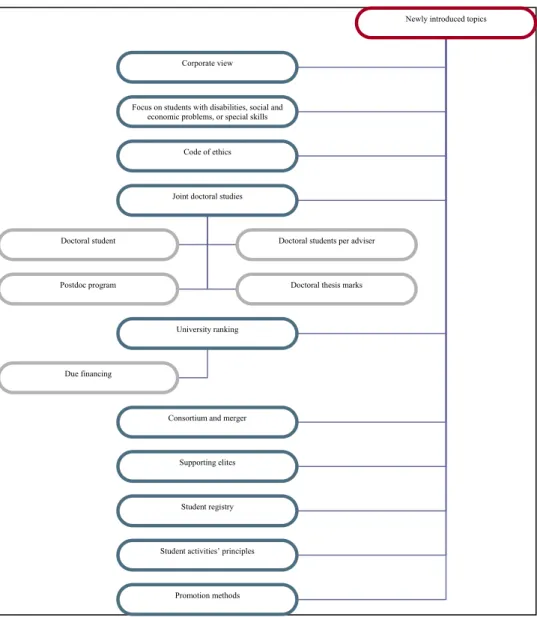
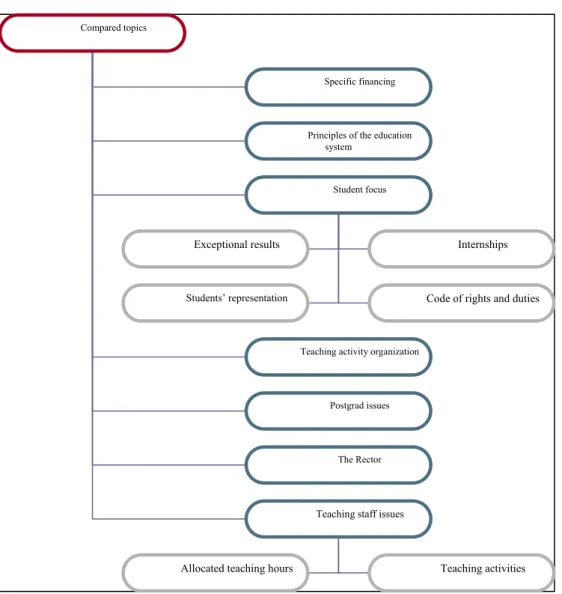
The queries covered aspects specific to each of the focus subgroups but also more general topics that were revealed by the comparative analysis, i.e. the mission that the law is following, the principles that is setting etc. The topics emphasized by the research are presented in the figures below.
Source: own elaboration based on the findings of the comparative analysis.
Figure 1. The newly introduced topics for the queries Newly introduced topics
Corporate view
Focus on students with disabilities, social and economic problems, or special skills
Code of ethics
Joint doctoral studies
Doctoral student Doctoral students per adviser
Doctoral thesis marks Postdoc program
University ranking
Due financing
Consortium and merger
Supporting elites
Student registry
Student activities’ principles
Source: own elaboration based on the findings of the comparative analysis.
Figure 2. The queries’ topics subjected to comparison
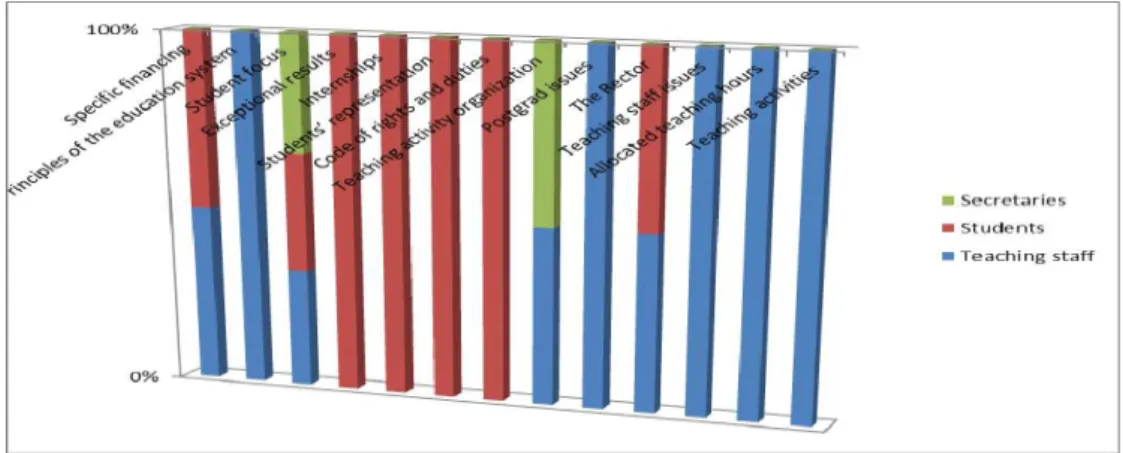
The queries that the moderator had at the beginning of the focus group covered a different number of topics (as shown above) that aimed at each of the focus subgroups (figures 3 and 4). Keeping in mind the free discussions the topics per subgroup could rebalance the three focus subgroups, as we shall see after reviewing the observations.
The ongoing economic and financial crisis urges us to adapt our educational strategies to the market movements. The problem is that changing an entire system does not come cheap, which contradicts the budgetary cuts that
Compared topics
Specific financing
Principles of the education system
Student focus
Teaching activity organization
Postgrad issues
The Rector
Exceptional results Internships
Code of rights and duties
Students’ representation
Teaching staff issues
Romania has been forced to make. Nevertheless, the bulk expenditure cuts must be avoided and we should rather focus on righteously sized and focused cuts (Kotler, Caslione, 2009, p. 78). What we aim to test here is whether the selected target groups perceive the changes enforced by the new law on education as a rescuing strategy for the education system also facing the crisis. Perception is a powerful instrument and should not be ignored by decision-makers.
Source: own elaboration based on the findings of the comparative analysis.
Figure 3. The queries’ newly topics on each focus subgroup
Source: own elaboration based on the findings of the comparative analysis.
2. Writing down the observations
2.1. Empirical observations
The results collected from the first focus subgroup (teaching staff) was structured in terms of ten items impacting this subgroup with regard to the newly introduced topics and also nine items from the category consisting in the compared topics, as follows:
1) Observations on the ten items representing the newly introduced topics:
a. Corporate view
The respondents agree that the corporate view is only declared but in fact the market-driven education that is suggested can easily be avoided, even obeying the law. Therefore, it can be argued that it does not show a unitary corporate vision but a collection of different ones.
b. Code of ethics
It is important to be established but seems a bit conflicting with the corporate view.
c. Joint doctoral studies
The doctoral studies also allow professors to enlarge their research horizons.
d. Doctoral students per adviser
It can be argued that the doctoral adviser puts more focus on each doctoral student but for an even better assessment of quantity versus quality focus a minimum and a maximum limit should have been set.
e. Postdoc program
There are many possibilities for this type of programs, both national and international, but very few financial support mechanisms.
f. University ranking
It is relevant only for those who know what it stands for, and it can be an incentive for the next evaluation.
g. Due financing
There is a lack of well-established financing criteria which only put more doubt into the rankings.
h. Consortium and merger
It can prove to be an advantage as long as the universities opt for consortium, not for mergers, which can trigger an identity loss.
There are too many institutes that do the same thing. Nevertheless, they are quite invisible for the academics; more emphasis should be put on promoting the existent ones.
j. Promotion methods
It is worth having fast promotion methods as long as you back them with strong instruments that the academics can use in order to fulfill the set criteria.
2) Observations on the nine items representing the compared topics: a. Specific financing
It is important to have a threshold, but the current situation also calls for more emphasis on the education sector that is the leading force pulling us out of the crisis.
b. Principles of the education system
Having certain guidelines is important for the academic environment, but it also important to present them as such and, at the same time, take into account the academic culture.
c. Student focus
The university is created for the students; therefore they should be at its core, a valid partner for dialogue. It may also stimulate the students to keep a high training level.
d. Teaching activity organization
It has no real impact on our university as we did not have evening classes. We can refer here to the mandatory full-time doctoral studies (the elimination of the part-time ones) corroborated with the tuition increase that will decrease the competition at the entry exam.
e. Postgrad issues
Places us ahead of the competition if we only look at the condition according to which we must have undergrad studies to be allowed to organize postgrad studies. With regard to the suggested partnerships with the possible employers so to better answer market needs, the question is “Who assesses market demands?”. Is it the jobs’ freeze measure taken three years ago for the public administration?
f. The Rector
g. Teaching staff issues
With more restrictive condition for obtaining an academic degree the teaching level will be kept high. Nevertheless, the issue of the promotion instruments comes back in the debate.
h. Allocated teaching hours
In the present context of the forced minimum payroll threshold the increase in the number of allocated teaching hours is clearly contrary to teaching quality.
i. Teaching activities
In the same line, limiting the extra hours paid does contravene the enhance quality claim of the Law in the context of the current financial restrictions.
The perception of the second focus subgroup (students) was the most debated both for the newly introduced topics and for the compared topics that were presented by the moderator. For the first category (the newly introduced topics) ten items were subjected to query, and for the second category (the compared topics) there were seven items, as follows:
1) Observations on the ten items representing the newly introduced topics:
a. Corporate view
The reported results on this item referred to both ends, namely that according to which the law must have a “soul” pointed out through mission, vision and so on (like it actually does), and the other end saying that this corporate view is only of surface as it has no successful implementation methods.
b. Focus on students with disabilities, social and economic problems, or special skills
None of the respondents felt the results of such provisions, especially in the current crisis situation. Therefore, they considered these provisions that aimed supporting students with disabilities and also students coming from low income families (through state guaranteed bank loans) as strictly declarative.
c. Code of ethics
Also in this case, there were respondents who delivered no opinions on this issue being unaware of such provisions, and there were also students who pleaded for the importance of such a code giving the massive reestablishment of social layers during these crisis’ years, and thus of the students’ behavior.
d. Joint doctoral studies
studies but pointed out the fact that, in the context of the few financing possibilities, there is also a lack of implementing guidelines.
e. Doctoral student
On one hand, the idea of specifically nominating the doctoral student creates a link between the teaching staff and the regular students but, on the other hand, it confuses the students with regard to their representation in the university’s management structures. The doctoral student’s status could be biased towards its role there, considering that is both a student and also engages in teaching activities.
f. Postdoc program
Even though the abrogated law did not specifically provided for postdoc programs, there were different other legal documents establishing this possibility. The problem lies more within the methods of financing than with its existence.
g. Doctoral thesis marks
The respondents here unanimously disagreed with the relevance of grading the result of a doctoral research work as all researches are relevant. They argued that, in the current situation of the budgetary cuts, the research should be greatly stimulated, especially in the field of administrative studies (relevant to our faculty).
h. University ranking
In terms of perceiving the differences between the three ranking categories established by the law, the students are unable to distinguish between them as they are too vaguely defined. The perception is that there are only empty words without a clear explanation of each ranking’s meaning.
i. Consortium and merger
The respondents again split in two teams, one arguing that they do not perceive a consortium or merger affecting them in anyhow (maybe for the better in terms of more financial resources), and the other that such a provision is forced into the new law, as a Law on consortiums(3) was already into force and established quite clear terms.
j. Student activities’ principles
Their knowledge of specific principles was very limited, but the respondents acknowledge the importance of defining such principles in the current changing environment but also underlined the difficulty of following them or, even worse, abusing them.
2) Observations on the seven items representing the compared topics: a. Specific financing
downturn and falling GDP, even a fixed percentage does not cover the educational and research needs. Also, with regard to the percentage dedicated to research activities it is not enough to fix a more profound problem, which refers to the lack of an investment and revaluating culture.
b. Student focus
The mutual feeling is that this new emphasis empowers the student. In times of crisis, when the budget is low, one needs to have strong negotiation powers to obtain what he demands.
c. Exceptional results
The performance criterion for graduating two years in one, which was established by the abrogated law, should also be kept in the new one. The current economic and financial terms do not mean a lower performance bar. On the other hand, the current provision related to no more than five percentages of the students that could graduate two years in one is also too prohibitive. Should more than five percent of one generation be exceptional they should be allowed to cumulate the study years.
d. Internships
The university should be the one establishing contact with the public institutions to receive students for internships. It will also have more control on the students’ work and develop a trusty relationship with the future employers, a big necessity during this period of public sector downsizing.
e. Students’ representation
The students’ bargaining power is somewhat diminished as the law distinguishes between students and doctoral students, thus creating a dispute with regard to council or senate representation, even though they are both students in the eyes of the new law.
f. Code of rights and duties
Yes, there was a need for an enhanced visibility of students’ rights and duties. As a matter of fact, at the beginning of April this Code was passed through the Minister’s ordinance(4). There is a problem though with the fact that the Minister only consulted the students’ federations and many of the students’ associations from different universities (ours included) are not part of any federation.
g. The Rector
The students did not have any idea about the way in which a university is administered, therefore could not express an opinion about the new vision on the rector.
those fitting the category of the newly introduced topics (three items) from that of the compared topics (two items), as presented below:
1) Observations on the three items representing the newly introduced topics:
a. Corporate view
The technic and administrative staff is not listed as part of the academic community by the new law (thus not part of the Senate nor the Council), therefore unable to get more involved in the managerial activities.
b. Focus on students with disabilities, social and economic problems, or special skills
Special attention should be given to the evaluation criteria; it is not enough to establish as a principle financial support for the less fortunate if you do not enforce fit evaluation mechanisms and bodies.
c. Student Registry
This registry allows us not only to have control over the number of students, but also over the issued diplomas. We can easily compare our secretarial outcomes with those of other universities.
2) Observations on the two items representing the compared topics: a. Student focus
Placing them on a higher level also increases our role as a liaison between the academic staff and the students.
b. Teaching activity organization
The new organization reduces our workload.
2.2. Filtered observations
When testing our hypothesis we turn to the initial observations provided by the focus group and further filter them in terms of connection to the budgetary cuts (Dinu, 2011) and to the field literature evidence with regard to the market-driven changes of the educational system (Diedrich, 2012, Kearney, Arnold, 1994, Kerka, 1996, Alam et al., 2010, Rosenberg, Sindelar, 1998, Olssen, Peters, 2005, Conway et al., 1994).
There are five derived hypotheses that we considered important in the testing process:
The market driven feature of the education system cannot work by itself under the current economic downturn.
Teaching performance can fade if not supported by strong teaching hours’ allocation and righteous payroll.
The merit based system should be the primary guideline in the entry exams. A corporate view is not established without firstly testing the market feeling. A number of observations stand out in the light of the “strainer”. The first one refers to a narrow view upon the education system supported by the observations of the first subgroup with regard to the market driven feature which is suggested through the master studies’ partnerships with the employers that can be part of the public sector (like in our case). Moreover, turning public education into a competitive market to drive reform misses the mark because none of the five conditions needed for pure competition exist in public education (Diedrich, 2012, pp. 15-23). For example, the Education Reform Act 1988 in UK similarly pushed the higher education institutions to operate within a much greater competitive context and need therefore to incorporate a greater market orientation into their strategic planning process in order to acquire a competitive advantage over their rivals (Conway et al., 1994).
A second filtered observation also comes from the first subgroup and refers to the allocated teaching hours that are currently forced to the minimum payroll threshold and, at the same time, increased in number. Both the provisions outbalance the teaching quality. For the school to be market driven the reward structure must be more and more oriented toward performance, under the theory of public choice (Kearney, Arnold, 1994).
Pertaining to both the first and the second subgroup the importance of the Code of ethics is not sufficiently stressed in practical terms. Ethical issues also arise when self-sufficiency or market demand drives program (Kerka, 1996).
There is a great emphasis on the social and economic problems that must be taken into account with regard to supporting students in accessing the higher education system, but no emphasis on the merit criterion. Meritocracy should be the only parameter in the recruitment and selection process of institutions of Education (Alam et al., 2010, p. 3411).
3. Conclusion and further research
To sum up, the work hypothesis referring to the fact that the interventions made by the new Law on Education set the undergrad and postgrad studies off balance after a rapid enforcement of poorly substantiated public decisions is validated through all five of its derived hypotheses. The focus group results showed us that the changes felt by the stakeholders do throw both the undergrad and postgrad studies into a burden ripple pertaining to the teaching staff group (mainly in terms of teaching activities organization), to the students group (in terms of a focus only on a declarative level), and to the secretarial staff (in terms of reduced involvement).
The limitations of the research pertain to the testing period available at the time of the focus group as the new Law on Education only entered into force last January, and was effectively applied with the beginning of the new academic year (October, 2011). Further research is required for at least two consecutive academic years.
Notes
(1)
Published in the Official Journal of Romania, part I, no. 18 on January 10, 2011.
(2)
Published in the Official Journal of Romania, part I, no. 606 on December 10, 1999.
(3)
Law no. 287/2004 published in the Official Gazette of Romania, part I, no. 614 on July 7, 2004.
(4)
MO no. 3,666/2012 published in the Official Gazette of Romania, part I, no. 225, on April 4, 2012.
References
Alam et al. (2010). “Do developing countries need Education laws to manage its system or are
ethics and a market-driven approach sufficient?”, African Journal of Business
Management, Vol. 4(15), pp. 3406-3416
Babbie, E. (2010). Practica cercetarii sociale, Collegium, Editura Polirom, București
Conway, T., Mackay, S., Yorke, D. (1994). “Strategic Planning in Higher Education: Who Are
the Customers”, International Journal of Educational Management, Vol. 8, Issue 6,
pp. 29-36, doi: 10.1108/09513549410069202
Diedrich, M. (2012). False choices: the economic argument against market-driven education
reform, Minnesota 2020, Saint Paul
Romanian Public Administration”, NISPAcee PRESS, Public Administration of the Future, Varna Free University, Bulgaria
Kearney, C.P., Arnold, M.L. (1994). “Market Driven Schools and Educational Choices”,
Theory into Practice, Vol. 33, No. 2, The Ohio State University
Kerka, S. (1996). Continuing Education: Market Driven or Learner Centered? Myths and
Realities, ERIC Publications, Office on Educational Research and Improvement, Washington, DC
Kotler, P., Caslione, J.A. (2009). Chaotics: management și marketing în era turbulenței, Editura Publica, București
Matei, L., Dinu, T. (2011). “The Multi-fold Object of Public Decisions. Case study: Law on the Civil Servants’ Statute, Law on the Local PA, Law on Education”, ASsee Online Series, no. 4, National and European Values of Public Administration in the Balkans, pp. 158-165
Olssen, M., Peters, M.A. (2005). “Neoliberalism, higher education and the knowledge economy: from the free market to knowledge capitalism”, Journal of Education Policy, 20:3, pp. 313-345
Rosenberg, M.S., Sindelar, P.T (1998). “Teacher Education and Special Education”, The
Journal of the Teacher Education Division of the Council for Exceptional Children,
Vol. 21, No. 3, pp. 227-235, doi: 10.1177/088840649802100307
Zionts, S. (1997). “Decision Making: Some Experiences, Myths and Observations, Multiple
Criteria Decision Making”, Proceedings of the Twelfth International Conference,
Haegen (Germany), Gunter Fandel, Tomas Gal (Eds.). In collaboration with Thomas Hanne Lecture Notes in Economics and Mathematical Systems 448, Springer, 1997