ISSN 0104-6632 Printed in Brazil
Vol. 19, No. 04, pp. 383 - 389, October - December 2002
of Chemical
Engineering
SHELF LIFE OF FRESH-CUT SPINACH AS
AFFECTED BY CHEMICAL TREATMENT
AND TYPE OF PACKAGING FILM
A.M.Piagentini* and D.R.Güemes
Instituto de Tecnología de Alimentos, Facultad de Ingeniería Química, Universidad Nacional del Litoral, C.C. 266 - 3000 Santa Fe - Argentina
E-mail: [email protected]
(Received March 5, 2002 ; Accepted, June 13, 2002)
Abstract - Fresh-cut vegetables are an important and rapidly developing class of convenience foods. Their storage life may be greatly reduced due to their high rates of respiration and transpiration and the possibility of enzymatic and microbiological deterioration. Consequently, the objective of this work was to determine the shelf life and the failure attribute that conditioned the shelf life of fresh-cut spinach treated with chemical solutions and packaged in bags with different permeabilities. The shelf life of fresh-cut vegetables was defined as the time of refrigerated storage at which any one of the sensory attributes scored below 7 or when
the microbiological counts exceeded 5.107 CFU/g. Fresh-cut spinach was treated with citric acid and ascorbic
acid solutions and packaged in mono-oriented polypropylene (OPP) bags or low-density polyethylene (LDPE) bags. Sensory attributes and total microbial counts were evaluated throughout refrigerated storage. Response surface methodology (RSM) was used to study the simultaneous effect of chemical treatment and refrigerated storage time on sensory and microbiological quality of fresh-cut spinach. A quadratic polynomial regression model was assumed for predicting off-odor, general appearance, wilting, browning, color, and mesophilic aerobic population. Type of packaging film only influenced development of off-odor (p≤0.001) and had no effect on visual sensory attributes or microbiological counts (p>0.05). Development of off-odor was the attribute that limited shelf life of fresh-cut spinach packaged in OPP bags. On the other hand, shelf life of samples packaged in LDPE bags was dependent on a decrease in general appearance or an increase in microbiological counts, depending on the chemical treatment used.
Keywords:shelf life, fresh-cut vegetables, packaging, spinach.
INTRODUCTION
Fresh-cut vegetables are an important and rapidly developing class of convenience foods. The suitability of these products is based on their attributes of convenience and fresh-like quality. A problem faced by these products is that their storage life may be greatly reduced as compared with the unprocessed raw material from which they are made. This problem may be due to their high rates of respiration and transpiration and the possibility of enzymatic and microbiological deterioration
(Huxsoll and Bolin, 1989). Therefore, spoilage of fresh-cut vegetables may result from degradation of sensory characteristics (color, texture, flavor, or aroma) as well as from microbiological degradation.
Rooney, 1994). However, improperly modified atmospheric conditions may adversely affect product quality. Therefore, selection of suitable packaging materials is critical to obtaining the environment desired for extending the shelf life of fresh-cut vegetables.
Chemical treatments are also used on lightly processed fresh produce mainly for controlling decay, reducing browning and retaining firmness (Brecht, 1995). Low-pH organic acid solutions are used as antimicrobials to control bacteria or as antioxidants to prevent browning; to reduce discoloration of pigments; and to protect against loss of flavor, changes in texture, and loss of nutritional quality (Wiley, 1994). Chemical treatments with citric acid and/or ascorbic acid solutions prevent browning in fresh prepared potatoes (Langdon, 1987) and lettuce (Castañer et al., 1996). Unfortunately, products that are artificially acidified to pH levels of 3.5-4 lose their fresh-like quality (Huxsoll and Bolin, 1989).
Consequently, the objective of this work was to determine the shelf life and the failure attribute that conditioned the shelf life of fresh-cut spinach treated with chemical solutions and packaged in bags with different permeabilities.
MATERIAL AND METHODS
Experimental Design
Response surface methodology (RSM) was used to study the simultaneous effect of chemical treatment and refrigerated storage time on fresh-cut spinach. The experiments were based on a three-level, three-factor factorial design, with two replicates at the central point (Montgomery, 1991). It was assumed that a mathematical functionexists for each response variable Yk (off-odor, general
appearance, wilting, browning, color, and mesophilic aerobic population) in terms of three independent variables: citric acid concentration (cC), ascorbic acid
concentration (cA) and refrigerated storage time (t).
A quadratic polynomial regression model, Eq. (1), was assumed for predicting individual Yk response variables (Watada et al., 1987;
Montgomery, 1991):
Yk=bko+bk1.X1+bk2.X2+bk3.X3+bk11.X12+bk22.X22+
(1) +bk33.X32+bk12.X1.X2+bk13.X1.X3+bk23.X2.X3
where bko, bki, bkii, and bkij are regression
coefficients and Xi the coded independent variables,
linearly related to cC, cA, and t (Table 1).
The factorial design described was used for samples packaged in mono-oriented polypropylene bags (OPP) and in low density polyethylene bags (LDPE) (29 runs for each type of packaging film).
Spinach Preparation
Spinach (Spinacia oleracea L., var. Hybrid 424) was obtained from a local farm near Santa Fe (Argentina). Outer, damaged and yellowed leaves, roots, and stems were removed. The remaining leaves were cut into 30mm x 40mm pieces and washed for 2 min in cold water (4-6°C) containing 120 mg/L available chlorine. Then they were rinsed with running tap water and dipped in citric acid and ascorbic acid solutions for 2 min as described in the experimental design. The spinach was centrifuged in a basket-type centrifuge at 540 rpm for 3 min. Fresh cut spinach samples (70 g) were placed in mono-oriented polypropylene bags 30 µm thick, or in low density polyethylene bags 40 µm thick, according to the experimental design. Gas transmission rates of OPP for O2, CO2, and water vapor were 2,000
cm3/m2.24h.atm, 6,000-7,000 cm3/m2.24h.atm (both at 23 °C and 1 atm), and 3-5 g/ m2.24 h. (at 37 °C and 90 % RH.), respectively. Gas transmission rates of LDPE for O2, CO2, and water vapor were
3,500-4,000 cm3/m2.24h.atm, 12,000-15,000 cm3/m2.24h.atm (both at 23 °C and 1 atm), and 10 g/ m2.24 h. (at 37 °C and 90 % RH.), respectively. Finally, the sealed bags were stored at 4.0 °C and 90% RH.
Table 1: Independent variables and their levels
Coded-variable levelsa Independent variable Symbol
-1 0 1
Concentration of citric acid (%, w/v) X1 0.00 0.50 1.00
Concentration of ascorbic acid (%, w/v) X2 0.00 0.50 1.00
Time (day) X3 0 7 14
a
Microbiological Analysis
Shredded spinach (10 g) was mixed with 90 mL 0.1 % peptone water and homogenized with a stomacher for 2 min. Further decimal dilutions, as required, were prepared with the same diluent and plated, in duplicate, on PCA and incubated during 48 hr at 30 °C. Viable counts were reported as log CFU/g (FAM).
Sensory Analysis
A trained quantitative descriptive panel was required to evaluate sensory quality attributes of spinach samples. The judges indicated their perception of the intensity of each quality attribute on a 100mm unstructured line, with anchored terms located 10 mm from either end. They scored the perceived intensity of each descriptor by placing a vertical line across the unstructured scale line. Quantitation was accomplished by measuring the distance from the left end (0.00) to the vertical line, reporting measurements in cm. The anchored terms were indicated from left to right as severe to none for off-odors, very poor to excellent for general appearance, very severe to none for wilting and browning, and yellow to dark green for color. Larger numbers on these scales represented higher quality for all attributes (Pirovani et al., 1997). The panelists evaluated development of off-odor, general appearance, wilting, browning, and color of fresh-cut spinach on each testing day.
Statistical Analysis
All data were submitted to analysis of variance to determine the effect of cC (X1), cA (X2), t (X3), and
type of packaging film (X4). STATGRAPHICS Plus
was used to fit the experimental data to the second-order polynomial equations, to obtain the coefficients of the equations, for regression analyses, and for analyses of variance. Response surfaces and contour plots were developed using the fitted quadratic polynomial equations obtained.
RESULTS AND DISCUSSION
The multifactor ANOVA indicated that storage time affected (p ≤ 0.001) all sensory attributes studied and total microbial counts. Type of packaging film (X4) only influenced (p ≤ 0.001)
development of off-odor of fresh-cut spinach. The multifactor ANOVA also indicated that type of packaging film and the corresponding interaction
terms of this factor (X1.X4, X2.X4, X3.X4) had no
effect (p > 0.05) on the visual sensory attributes and mesophilic aerobic population. Thus, the effect of cC,
cA, and t on visual sensory attributes and
microbiological counts for both types of packaging film was modeled as a whole (Montgomery, 1991).
Di Pentima et al. (1996) studied sensory quality of ready-to-use broccoli, whole spinach leaves and asparagus packaged in different plastic films, stored at 4 °C. They also found no differences in general appearance, color, browning, and wilting in samples packaged in different types of films. However, development of off-odor was significantly different depending on the film used, with higher values for the film with lower permeability.
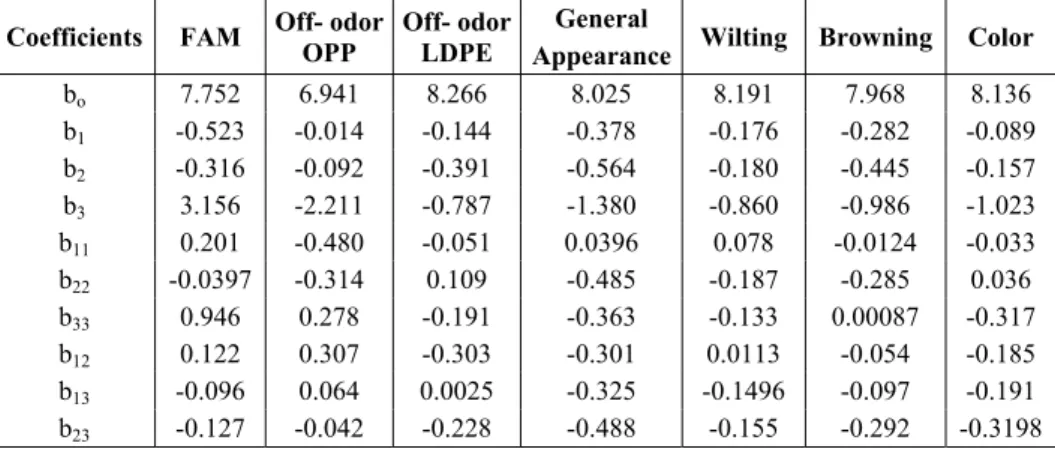
The ANOVA analyses of regression models indicated the models were highly significant (p ≤ 0.001), exhibiting no significant lack of fit (p > 0.05). The coefficients of determination (R2), explaining the variability of experimental data, were satisfactory. Based on all these tests, the prediction models were accepted. The regression coefficients of the fitted models are presented in Table 2.
Shelf life of the product must exceed the minimum distribution time required from the processor to the consumer to allow a reasonable period for home storage and use. This shelf life is defined as the time period that a product can be expected to maintain a predetermined level of quality under specified storage conditions (Shewfelt, 1986). Considering that fresh-cut vegetables must maintain their fresh-like quality and the limit of mesophilic aerobic population proposed by the French legislation at the end of the consumption stage, the shelf life was defined as the time of refrigerated storage at which any one of the sensory attributes scored below 7 or when the microbiological counts exceeded 5.107 CFU/g (Anónimo, 1989; Pirovani et al., 1997).
The shelf life of a whole product at any given temperature is determined by the mechanism in any component which proceeds fastest and thus causes the shortest life. A major question for fresh-cut vegetables is whether sensory spoilage, as a result of chemical or biochemical reactions, or growth of spoilage organisms determine the shelf life. To answer this question, in this work, the shelf life of fresh–cut spinach was determined by superimposing the contour plots of each sensory attribute over the contour plot of mesophilic aerobic count for the selected criteria. Contour plots represented lines of equal sensory score or FAM as a function of time and ascorbic acid concentration for cC = 0.50%.
satisfies the following conditions simultaneously: sensory attribute scores ≥ 7 and FAM ≤ 7.70.
It was found that wilting, browning, and color scores were always higher than 7 when FAM = 7.70. Therefore, these visual attributes did not determine the shelf life of fresh-cut spinach packaged in OPP or LDPE bags (Figure 1).
The off-odor score of fresh-cut spinach packaged in OPP bags decreased faster than the off-odor score of samples packaged in LDPE bags and decreased to 7 before the mesophilic aerobic population reached the limit value of 7.70. (Figure 2). Therefore, development of off-odor was the attribute that limited shelf life of fresh-cut spinach packaged in OPP bags up to 6 days (Figure 2a).
It was found that the general appearance score could decrease to 7 before FAM = 7.70 for samples packaged in LDPE. For a chemical treatment of cA≥
0.94 % and cC = 0.50% (Figure 3a) or cC = 1.00%, cA ≥ 0.71% (Figure 3b), general appearance is the attribute that conditioned shelf life of fresh-cut spinach packaged in LDPE bags up to 8 days.
Pirovani et al. (1997) also found that the failure attribute that conditioned the shelf life of minimally processed cabbage could be different depending on the packaging film used.
When deciding whether to buy a particular commodity, consumers evaluate fresh-cut vegetable quality by visual sensory attributes. Therefore, according to score ratings obtained for visual sensory attributes, some fresh-cut spinach samples could be considered suitable for commercial sale after 14 days of storage. Thus, with no obvious signs of spoilage, mesophilic aerobic microorganisms might be present at high concentrations, without anything to warn consumers of the danger.
Table 2: Regression coefficients of the second-order polynomial equations
Coefficients FAM Off- odor OPP
Off- odor LDPE
General
Appearance Wilting Browning Color bo 7.752 6.941 8.266 8.025 8.191 7.968 8.136
b1 -0.523 -0.014 -0.144 -0.378 -0.176 -0.282 -0.089
b2 -0.316 -0.092 -0.391 -0.564 -0.180 -0.445 -0.157
b3 3.156 -2.211 -0.787 -1.380 -0.860 -0.986 -1.023
b11 0.201 -0.480 -0.051 0.0396 0.078 -0.0124 -0.033
b22 -0.0397 -0.314 0.109 -0.485 -0.187 -0.285 0.036
b33 0.946 0.278 -0.191 -0.363 -0.133 0.00087 -0.317
b12 0.122 0.307 -0.303 -0.301 0.0113 -0.054 -0.185
b13 -0.096 0.064 0.0025 -0.325 -0.1496 -0.097 -0.191
b23 -0.127 -0.042 -0.228 -0.488 -0.155 -0.292 -0.3198
0 0.25 0.50 0.75 1
Ascorbic acid (%)
0
7
14
Time (day)
cC = 0.50%
7.5
8
8.5
Wilting
0 0.25 0.50 0.75 1
Ascorbic acid (%) 0
7 14 Time (day)
cC = 0.50%
7.5
8
8.5
Browning
FAM = 7.70
0 0.25 0.50 0.75 1
Ascorbic acid (%) 0
7 14 Time (day)
cC = 0.50%
7.5
8
8.5 FAM = 7.70
Color
Figure 1: Contour plots of wilting, browning, and color superimposed over the contour plot of mesophilic aerobic counts (FAM) at 7.70
0 0.25 0.50 0.75 1
Ascorbic acid (%) 0
7 14 Time (day)
(a) Off-odor OPP
cC = 0.50%
6
7
8 FAM = 7.70
Ascorbic acid (%)
0 7 14
Time (day)
(b) Off-odor LDPE cC = 0.50%
0 0.25 0.50 0.75 1
8.5 8
7.5
FAM = 7.70
Ascorbic acid (%)
Time (day) cC = 0.50%
(a) General appearance
FAM =7.70
0 7 14
0 0.25 0.50 0.75 1
7
8
(b) General appearance
Ascorbic acid (%)
Time (day) cC = 1.00 %
0 7 14
0 0.25 0.50 0.75 1
8 7
FAM = 7.70
CONCLUSIONS
Type of packaging film only influenced development of off-odor (p≤0.001) and had no effect on visual sensory attributes or microbiological counts (p>0.05). Development of off-odor was the attribute that limited shelf life of fresh-cut spinach packaged in OPP bags. On the other hand, the shelf life of samples packaged in LDPE bags was dependent on a decrease in general appearance or an increase in microbiological counts, depending on the chemical treatment used.
For fresh-cut spinach stored at 4 ºC and 90% HR a level of quality between excellent and good can be maintained for eight days using LDPE bags or for six days using OPP bags.
ACKNOWLEDGMENTS
We thank Universidad Nacional del Litoral (Santa Fe - Argentina) for financial support under Project CAI+D. We gratefully acknowledge the technical assistance of M. S. Salsi and M.A. Moguilevsky (microbiological analysis). We also extend our gratitude to the staff of the Instituto de Tecnología de Alimentos, who participated in the sensory evaluation.
REFERENCES
Anónimo. (1989). Dispositions concernant le produit fini. En Guide de Bonnes Practiques Hygiéniques concernant les produits végétaux dits de la IVe Gamme. Extrait du bulletin officiel de la République Francaisse. Ctifl, París, Francia. Brecht, J.K. (1995). Physiology of lightly processed
fruits and vegetables. Hortscience, 30(1):18-22.
Castañer M., Gil M. I., Artes F., and Tomas-Barberan F. A. (1996). Inhibition of browning of harvested head lettuce. J. Food Sci. 61(2):314-316. Di Pentima, J.H., Güemes, D.R., Pirovani, M.E., and
Piagentini, A.M. (1996). Estudio del comportamiento de vegetales listos para usar, envasados con diferentes láminas plásticas. La Alimentación Latinoamericana, 213, 46-50. Huxsoll, C.C. and Bolin, H.R. (1989). Processing
and distribution alternatives for minimally processed fruits and vegetables. Food Technol., 43 (2), 124-128.
Langdon, T.T. (1987). Preventing of browning in fresh prepared potatoes without the use of sulfiting agents. Food Technol., 41(5), 64-67. Montgomery, D.C. (1991). Diseño y análisis de
experimentos. 3rd Ed México: Grupo Editorial Iberoamérica.
Pirovani, M.E., Güemes, D.R., Piagentini, A.M., and Di Pentima, J.H. (1997). Storage quality of minimally processed cabbage packaged in plastic films. J. Food Quality, 20(5), 381-389.
Schlimme, D.V. and Rooney, M.L. (1994). Packaging of minimally processed fruits and vegetables. In: Wiley, RC, ed. Minimally Processed Refrigerated Fruits and Vegetables. New York: Chapman & Hall, Inc., pp.135-182. Shewfelt, R.L. (1986). Postharvest treatment for
extending the shelf life of fruits and vegetables. Food Technol., 46 (5), 70-80/89.
Watada, A.E., Kim, S.D., Kim, K.S., and Harris, T.C. (1987). Quality of green beans, bell peppers and spinach stored in polyethylene bags. J. Food Sci., 52(6), 1637-1641.