Péricles Alves NogueiraI Regina Maura Cabral de Melo AbrahãoI
Vera Maria Neder GalesiII
I Departamento de Epidemiologia. Faculdade de Saúde Pública. Universidade de São Paulo. São Paulo, SP, Brasil
II Divisão de Tuberculose. Centro de Vigilância Epidemiológica “Prof. Alexandre Vranjac”. Secretaria de Estado da Saúde. São Paulo, SP, Brasil
Correspondence: Péricles Alves Nogueira Departamento de Epidemiologia Faculdade de Saúde Pública Universidade de São Paulo
Av. Dr. Arnaldo, 715 – Cerqueira César 01246-904 São Paulo, SP, Brasil E-mail: [email protected] Received: 4/18/2011 Approved: 8/30/2011
Article available from: www.scielo.br/rsp
Tuberculosis and latent
tuberculosis in prison inmates
Tuberculose e tuberculose latente na
população prisional
ABSTRACT
OBJECTIVE: To estimate the prevalences of tuberculosis and latent tuberculosis in inmates.
METHODS: Observational study was carried out with inmates of a prison and a jail in the State of São Paulo, Southeastern Brazil, between March and December of 2008. Questionnaires were used to collect sociodemographic and epidemiological data. Tuberculin skin testing was administered (PPD-RT23-2TU/0.1 mL), and the following laboratory tests were also performed: sputum smear examination, sputum culture, identifi cation of strains isolated and drug susceptibility testing. The variables were compared using Pearson’s chi-square (χ2) association test, Fisher’s exact test and the proportion test.
RESULTS: Of the 2,435 inmates interviewed, 2,237 (91.9%) agreed to submit to tuberculin skin testing and of these, 73.0% had positive reactions. The prevalence of tuberculosis was 830.6 per 100,000 inmates. The coeffi cients of prevalence were 1,029.5/100,000 for inmates of the prison and 525.7/100,000 for inmates of the jail. The sociodemographic characteristics of the inmates in the two groups studied were similar; most of the inmates were young and single with little schooling. The epidemiological characteristics differed between the prison units, with the number of cases of previous tuberculosis and of previous contact with the disease greater in the prison and coughing, expectoration and smoking more common in the jail. Among the 20 Mycobacterium tuberculosis
strains identifi ed, 95.0% were sensitive to anti-tuberculosis drugs, and 5.0% were resistant to streptomycin.
CONCLUSIONS: The prevalences of tuberculosis and latent tuberculosis were higher in the incarcerated population than in the general population, and they were also higher in the prison than in the jail.
DESCRIPTORS: Latent Tuberculosis. Epidemiology. Prisoners.
Tuberculosis (TB) is a serious health problem for confi ned groups, especially with imprisoned popula-tions.4,14,15 Studies have shown higher prevalences
and incidences of TB in prison populations than in the general populations of various parts of the world since 1944.14,15,a,b
Among the factors that contribute to the high, endemic level of TB in prison populations are the characteristics of these populations. Prisoners typically are young, have little schooling, come from underprivileged communities and have higher than average inci-dences of HIV infection and recidivists (previous imprisonment).8,a,b
RESUMO
OBJETIVO: Estimar a prevalência da tuberculose e tuberculose latente em detentos.
MÉTODOS: Estudo observacional foi realizado com detentos de uma penitenciária e de um centro de detenção provisória do Estado de São Paulo, SP, entre março e dezembro de 2008. Questionários foram utilizados para a coleta de dados sociodemográfi cos e epidemiológicos. O teste tuberculínico foi aplicado (PPD-RT23-2UT/0,1ml) e os seguintes exames laboratoriais foram realizados: baciloscopia de escarro, cultura de escarro, identifi cação das cepas isoladas e teste de sensibilidade às drogas antituberculose. As variáveis foram comparadas utilizando-se o teste de associação qui-quadrado de Person (χ2),
teste exato de Fisher e teste das proporções.
RESULTADOS: Dos 2.435 detentos entrevistados, 2.237 (91,9%) concordaram em submeter-se ao teste tuberculínico e destes, 73,0% foram reatores. O coefi ciente de prevalência da tuberculose foi de 830,6 por 100.000 detentos. Os coefi cientes de prevalência foram de 1.029,5/100.000 detentos na penitenciária e de 525,7/100.000 detentos no centro de detenção provisória. As características sociodemográfi cas dos detentos nos dois grupos estudados foram semelhantes; a maioria dos detentos era jovem e solteiro com baixa escolaridade. As características epidemiológicas diferiram entre as unidades prisionais com o número de casos de tuberculose no passado e de contato prévio com doente maior na penitenciária e tosse, expectoração e hábito de fumar mais comum no centro de detenção. Entre as 20 cepas de Mycobacterium tuberculosis
identifi cadas, 95,0% foram sensíveis às drogas antituberculose e 5,0% foram resistentes à estreptomicina.
CONCLUSÕES: As prevalências da tuberculose e da tuberculose latente foram maiores na população carcerária do que na população geral; e também maiores na penitenciária do que no centro de detenção provisória.
DESCRITORES: Tuberculose Latente. Epidemiologia. Prisioneiros. Mycobacterium tuberculosis. Testes de sensibilidade microbiana. Teste tuberculínico.
INTRODUCTION
Prisoners experience a higher risk of infection and death from TB because of the following factors: over-crowding, poorly ventilated cells with little sunlight, poor hygienic conditions, inadequate nutrition, and frequent exposure to Mycobacterium tuberculosis in a confi ned space.8,a,b
Prison staff and visitors also have a high risk of contracting TB. Further more, when prisoners are released, the disease becomes a potential problem for the community into which they are reintegrated.b
In 2008, the prison population of the State of São Paulo, Southeastern Brazil, was about 153,000 persons, distributed across 143 prisons. The prevalence of TB
was approximately 800 cases per 100,000 inmates, which is higher than the 39.1 cases per 100,000 inhabit-ants in the general population.13,c,d
Previous studies on TB in the prisons of São Paulo have been conducted by Niero,e Ferreira et al,7 Rozman,f
Oliveira & Cardoso11 and Abrahão et al.1
Obstacles that have hindered the implementation of control strategies in prisons include the following: prisoners hide their symptoms because of the violent nature of prison life and the need of physical strength for survival, prisoners risk stigmatization and segregation if they report their symptoms, the human and fi nancial resources in prisons are limited, and the health services available in prisons are inadequate.a
The varying degrees of danger posed by prisoners and the priority given by prison authorities to security at the expense of health have hindered health professionals’ access to prisoners. The police fear that inmates will use health professionals as hostages to undertake a mass escape. Changes to the prison routine also require enhanced security. Therefore, infectious cases are rarely diagnosed, and if they are, the lack of control or the interruption of treatment increase the likelihood that drug-resistant strains will develop.a,b
Initial infection with M. tuberculosis leads to the devel-opment of primary tuberculosis, which in most people is clinically “silent” and resolves without intervention. However, the infection may enter a latent or dormant state, called latent tuberculosis infection (LTBI), which can last for years or even decades.6
Approximately 5% of infected persons cannot prevent the multiplication of the bacilli and fall ill with in two years after the primary infection. Another 5%, although they successfully block the infection at this stage, become sick later as a result of the reactivation of the original bacilli or as a result of exposure to a new source of infection.a
Because of the high prevalence of LTBI in Brazilian prisons (65%),a prisoners are at high risk for TB.g This
disease in closed institutions, because of the potential for transmission and the characteristics of the prison population, should be a high priority for the government. This study aimed to estimate the prevalence of tuber-culosis and latent tubertuber-culosis in inmates of one prison and one jail.
METHODS
Observational study was realized in 2,435 inmates in one prison and one jail in the city of Guarulhos, Southeastern Brazil, from March to December 2008. The prison housed inmates whose cases had already been judged and who were serving their sentences in closed or semi-open confi nement. Built to accom-modate 804 prisoners in seclusion and 216 in semi-seclusion, the prison housed 1,194 and 298 prisoners, respectively.
The jail was used for prisoners who were awaiting judgment and those who had already been sentenced but who were awaiting a vacancy in prison. Planned to hold 768 prisoners, the jail housed 1,136.
A research team consisting of doctors, nurses, pharma-ceutical chemists, technicians and assistant nurses was recruited and trained. The questionnaire was previously validated in a pilot phase and contained requests for the following information: name of the prisoner; parents’ names; age; marital status; ethnic group; birth place and nationality; schooling; previous prison sentences, if any; length of stay in the prison unit; history of tuberculosis; previous contact with tuberculosis cases; presence of coughing or expectoration; smoking habit; and history of any other lung disease.
Of the 1,492 inmates incarcerated in the prison, 99.0% were interviewed, and of the 1,136 inmates in the jail, 84.3% were interviewed. In total, 93.2% of the inmates in the two prison units were interviewed.
After the interview, nurses administered the tuber-culin skin test (TST) using 0.1 mL of Purifi ed Protein Derivative [PPD RT23 – 2 tuberculin units (TU)]. The tests were read after 72 hours by the same nurses who administered them.
The TST is used for the diagnosis of latent TB infec-tion (LTBI).a
The inmates were classifi ed as “non-reactive” and “reactive”. Prisoners presenting a palpable induration area of < 5 mm were classed as “non-reactive”, and those presenting an induration area of ≥ 5 mm were classed as “reactive”.
A sample of sputum was collected from each partici-pating inmate after the application of the TST regardless of clinical signs or symptoms.
c Ministério da Justiça. Secretaria Nacional de Justiça. Departamento Penitenciário Nacional. Sistema de Informações Penitenciárias: informações consolidadas. Brasília; 2007 [cited 2008 Sep 22]. Available from: http://www.mj.gov.br/depen/sistema_infopen.htm. d Secretaria de Administração Penitenciária do Estado de São Paulo. Unidades prisionais São Paulo; 2010 [cited 2010 Oct 18]. Available from: http://www.sap.sp.gov.br/common/unidades.html.
e Niero R. Tuberculose pulmonar em uma prisão: estudo de alguns aspectos epidemiológicos como subsídio para o seu controle [doctorate thesis]. São Paulo: Faculdade de Saúde Pública da USP; 1982.
f Rozman MA. AIDS e tuberculose na Casa de Detenção de São Paulo [master’s dissertation]. São Paulo: Faculdade de Saúde Pública da USP; 1993.
The sputum smear examination and sputum culture was performed on the same day as the collection of the sputum sample at either the School of Public Health Mycobacteria Laboratory or the Public Health Laboratory of Guarulhos.
The sputum smear examination was performed according to the Ziehl-Neelsen method,h and sputum
culture was performed according to the Ogawa-Kudoh method.5 Positive cultures were sent to the
Mycobacteria Laboratory of the Instituto Adolfo Lutz of São Paulo for identifi cation and drug susceptibility testing (DST).
The Epidemiological Surveillance authorities of the region were advised of those inmates diagnosed with active TB or nontuberculous Mycobacteria (NTM) infections. They provided medications for the prison clinics, which treated inmates using the directly observed treatment, short-course strategy.
Data were entered in an EpiInfo 6 database, version 6.04;17 the analyzed data are shown in the tables.
The variables were compared using Pearson’s chi-square (χ2) association test, Fisher’s exact test and
the proportion test, and differences were considered signifi cant for p < 0.05.
The study was approved by the respective Ethics Committees of the Faculdade de Saúde Pública of the Universidade de São Paulo, the State Health Department and the State Department of the Penitentiary Administration. Each prisoner who agreed to participate in the study signed a Declaration of Informed Consent.
RESULTS
Pearson’s chi-squared association test found no statisti-cally signifi cant differences in the variables analyzed (Table 1), suggesting that the populations of the two units were similar.
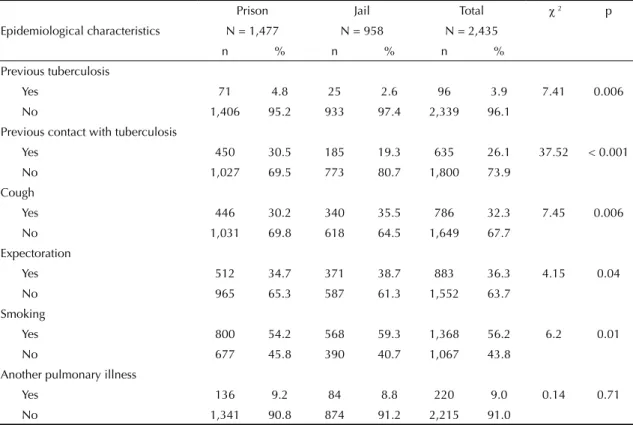
An analysis of the epidemiological characteristics (Table 2) showed statistically signifi cant differences in the following variables: history of TB, previous contact with TB, presence of coughing or expectoration and smoking habit.
Of the 786 (32.3%) prisoners who reported coughing, 55.0% had experienced this symptom for more than two weeks.a Of the 220 (9.0%) prisoners with a history
of a different respiratory tract disease, 79.5% reported bronchitis.
TSTs were performed on 2,237 (91.9%) inmates, 59.7% of whom were prison inmates and 40.3% of whom
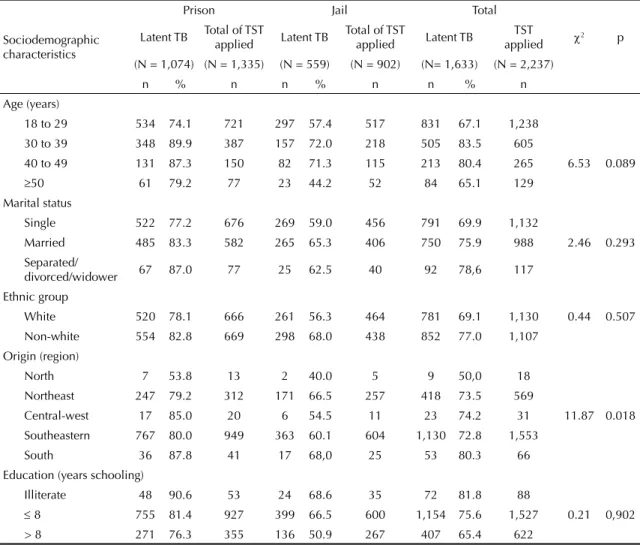
were jail inmates. Of those who received the test, 1,633 (73.0%) were reactors to PPD, indicating LTBI. The principal reasons for the non-application of the TST among the other prisoners were refusal to consent to the test and non-appearance for the reading of the test. Table 3 presents the sociodemographic characteristics of the 1,633 inmates with LTBI and the respective preva-lence. The prevalence of LTBI was higher in prisoners with one or more of the following characteristics: aged 30-39 years; separated, divorced or widower; non-white; illiterate; from southern Brazil. There were statistically signifi cant differences between inmates from the prison and the jail for region of origin (Table 3).
There were also statistically signifi cant differences between the two facilities in previous contact with TB and smoking habit, but not in any of the other variables. Among the 2,435 prisoners, sputum smears were obtained from 99.4% of the prisoners, and cultures were obtained from 98.9% of the prisoners (Table 4). Twenty-seven cultures were not carried out for the following reasons: 15 prisoners refused to collect sputum, and 12 culture medium tubes were contaminated.
There were no statistically significant differences between the two prisons units in either the sputum smear examination (Fisher’s test) or the culture exami-nation (Pearson’s test).
The coeffi cient of prevalence of TB by the sputum smear was 289.3/100,000 inmates and by the culture was 1,079.7/100,000 inmates.
Of the 26 strains isolated in culture, 20 (76.9%) were identifi ed as M. tuberculosis, and 6 (23.1%) were identifi ed as NTM. Of those identifi ed as NTM, one was M. chelonae, one was M. peregrinum, one was M. frederiksbergense, one was M. terrae, one was a slow-growing non-chromogenic Mycobacterium and one was a slow-growing scotochromogenic Mycobacterium.
The coeffi cient of prevalence of TB, according to the identifi cation of the strains of mycobacteria isolated, was of 830.6/100,000 inmates.
The sociodemographic characteristics of the 20 inmates with active TB are presented in Table 5. The proportion test found no statistically signifi cant differences for the variables analyzed.
There were statistically signifi cant differences for a history of TB and previous contact with TB, but no signifi cant differences for the other variables.
Of the 20 strains of M. tuberculosis identifi ed, 19 (95.0%) were sensitive to anti-tuberculosis drugs and
1 (5.0%) was resistant to streptomycin. In the prison, there were 14 prisoners with sensitive strains of M. tuberculosis, and one prisoner with a resistant strain.
DISCUSSION
The sociodemographic characteristics of the inmates of the two prison units were similar, and the populations were largely constituted of young, single individuals with little schooling, as is the profi le of the majority of the world’s prisoners.8,a,b
There were a large number of cases of previous TB and of previous contact with sick inmates in the prison, whose prisoners are serving longer sentences and living with a greater risk of infection and illness from TB. However, the existence of coughing, expectoration and a smoking habit was less frequent in the prison popu-lation, probably because the symptoms were ignored, since coughing is considered “normal”.
The greater number of reactors to TST in the prison, in all the categories of variables, refl ects the structural characteristics of this prison unit, where the close contact is more prolonged than in the jail.
According to the Brazilian Ministry of Health,a there
is an association between use of tobacco and TB infec-tion, TB disease, TB recurrence and mortality from the disease.
The high rate of LTBI in this population (73.0%) was greater than that estimated for the population of the Americas in general (25.0%, excluding the United States and Canada).16 Rates were also greater than
those found in the various studies undertaken in other countries, such as those of Adib et al2 (1999) in 21
prisons in Lebanon (45.0%) and those of Martin et al9,10
in penitentiaries in Spain in 1993 and 2000 (56.2% and 58.0%, respectively).
The percentage of cases of TB was greater in the prison, which was to be expected since the prison houses inmates with longer incarcerations.
The sensitivity of the sputum smear was 35% (seven sputum smears were positive of the 20 TB cases found by culture). This result was probably due to the collec-tion of sputum from all the inmates, not just from those who presented respiratory symptoms, and due to the collection of only one sample of sputum from each
Table 1. Sociodemographic characteristics of the inmates. State of São Paulo, Southeastern Brazil, 2008.
Sociodemographic characteristics
Prison Jail Total 2 p
N = 1,477 N = 958 N = 2,435
n % n % n %
Age (years)
18 to 29 801 54.2 540 56.4 1,341 55.1
30 to 39 427 28.9 237 24.7 664 27.3 5.95 0.11
40 to 49 162 11.0 123 12.8 285 11.7
50 87 5.9 58 6.1 145 5.9
Marital status
Single 748 50.6 473 49.4 1,221 50.1
Married 645 43.7 438 45.7 1,083 44.5 1.40 0.50
Separated/divorced/ widower 84 5.7 47 4.9 131 5.4
Ethnic group
White 752 50.9 501 52.3 1,253 51.5 0.44 0.51
Non-white 725 49.1 457 47.7 1,182 48.5
Origin (region)
North 14 1.0 5 0.5 19 0.8
Northeast 347 23.5 271 28.3 618 25.4
Central-west 21 1.4 12 1.3 33 1.4 8.26 0.08
Southeastern 1,049 71.0 644 67.2 1,693 69.5
South 46 3.1 26 2.7 72 2.9
Education (years schooling)
Illiterate 58 3.9 35 3.6 93 3.8
8 1,026 69.5 632 66.0 1,658 68.1 4.09 0.13
prisoner. According to the Brazilian Ministry of Health,h
there is an increase in the number of cases detected (10% to 14%) from the second sample and an additional increase (5% to 8%) from the third.
The culture results increased the positive TB diag-noses 3.7-fold. Regarding the identifi cation of the Mycobacteria strains isolated, the culture increased the positive diagnostic fi ndings 2.9-fold. These results agree with those of Abrahão et al.1
The coeffi cient of prevalence of TB in this study was 830.6/100,000 inmates, a value 21.4 times higher than that of the Brazilian population (38.8/100,000)i and 21.2
times higher than that of the São Paulo State population (39.1/100,000).i
The prevalence of tuberculosis found in this study changes when it is calculated separately for each prison unit, being 1,029.5/100,000 for inmates of the prison and 525.7/100,000 for inmates of the jail. This result indicates that the characteristics of each prison unit infl uence the prevalence of TB.
These results agree with those of Niero,e who found an
average annual incidence of 1,073/100,000 inmates. Rozmanf observed an incidence of 2,650/100,000 in the
same prison. Oliveira & Cardoso11 observed incidences
in Campinas, Southeastern Brazil, of 1,397/100,000 in 1994 and 559/100,000 in 1999.
The prevalences in this study are lower than those found by Sánchez et al12 in 2002, 2003 and 2005 in three prison
units in Rio de Janeiro, Southeastern Brazil, the coeffi -cients of which were 4,562/100,000 inmates in prison A, 6,271/100,000 in prison B and 8,600/100,000 in prison C. Of the 20 inmates with active TB in this study, the highest incidence of the disease occurred in the following groups: prisoners aged 40-49 years in the prison (1,851.9/100,000 inmates) and those aged 30-39 years in the jail (843.9/100,000); separated, divorced or widower prisoners; prisoners with white skin color in the prison and those with non-white skin in the jail; illiterate inmates in the prison and those with less than eight years of schooling in the jail; and inmates from Southern Brazil in the prison and those from Northeastern Brazil in the jail.
According the Center of Epidemiological Surveillance of São Paulo, there is a trend of increasing TB rates among those 20 to 29 years of age (246.2/100,000 inhabitants). This group was responsible for 26.6% of the new cases of TB in the State of São Paulo in 2008.
Table 2. Epidemiological characteristics of the inmates. State of São Paulo, Southeastern Brazil, 2008.
Epidemiological characteristics
Prison Jail Total 2 p
N = 1,477 N = 958 N = 2,435
n % n % n %
Previous tuberculosis
Yes 71 4.8 25 2.6 96 3.9 7.41 0.006
No 1,406 95.2 933 97.4 2,339 96.1
Previous contact with tuberculosis
Yes 450 30.5 185 19.3 635 26.1 37.52 < 0.001
No 1,027 69.5 773 80.7 1,800 73.9
Cough
Yes 446 30.2 340 35.5 786 32.3 7.45 0.006
No 1,031 69.8 618 64.5 1,649 67.7
Expectoration
Yes 512 34.7 371 38.7 883 36.3 4.15 0.04
No 965 65.3 587 61.3 1,552 63.7
Smoking
Yes 800 54.2 568 59.3 1,368 56.2 6.2 0.01
No 677 45.8 390 40.7 1,067 43.8
Another pulmonary illness
Yes 136 9.2 84 8.8 220 9.0 0.14 0.71
No 1,341 90.8 874 91.2 2,215 91.0
The frequency of drug resistant TB and multi-drug resistant TB (MDR-TB) is high in prisons and is related to inconsistent treatment and late detection of cases.a
In this study, the 5% rate of bacterial resistance was lower than that reported by Abrahão et al1 (14.3%) and
that reported by Sánchez et al12 (11.1%).
Table 4. Bacteriological examinations of the inmates. State of São Paulo, Southeastern Brazil, 2008.
Bacteriological examinations
Prison Jail Total 2 p
n =1,477 n =958 N = 2,435
n % n % n %
Sputum smear
Negative 1,460 98.9 953 99.5 2,413 99.1
Positive 6 0.4 1 0.1 7 0.3 0,26*
Not carried through 11 0.7 4 0.4 15 0.6
Culture
Negative 1,438 97.3 944 98.6 2,382 97.8
Positive 19 1.3 7 0.7 26 1.1 1.74* * 0,19* *
Not carried through 20 1.4 7 0.7 27 1.1
*Fisher’s exact test
* *Pearson’s chi-square association test
Table 3. Sociodemographic characteristics of the inmates with latent tuberculosis infection and incidence of latent tuberculosis infection. State of São Paulo, Southeastern Brazil, 2008.
Sociodemographic characteristics
Prison Jail Total
2 p
Latent TB Total of TST
applied Latent TB
Total of TST
applied Latent TB
TST applied
(N = 1,074) (N = 1,335) (N = 559) (N = 902) (N= 1,633) (N = 2,237)
n % n n % n n % n
Age (years)
18 to 29 534 74.1 721 297 57.4 517 831 67.1 1,238
30 to 39 348 89.9 387 157 72.0 218 505 83.5 605
40 to 49 131 87.3 150 82 71.3 115 213 80.4 265 6.53 0.089
50 61 79.2 77 23 44.2 52 84 65.1 129
Marital status
Single 522 77.2 676 269 59.0 456 791 69.9 1,132
Married 485 83.3 582 265 65.3 406 750 75.9 988 2.46 0.293
Separated/
divorced/widower 67 87.0 77 25 62.5 40 92 78,6 117
Ethnic group
White 520 78.1 666 261 56.3 464 781 69.1 1,130 0.44 0.507
Non-white 554 82.8 669 298 68.0 438 852 77.0 1,107
Origin (region)
North 7 53.8 13 2 40.0 5 9 50,0 18
Northeast 247 79.2 312 171 66.5 257 418 73.5 569
Central-west 17 85.0 20 6 54.5 11 23 74.2 31 11.87 0.018
Southeastern 767 80.0 949 363 60.1 604 1,130 72.8 1,553
South 36 87.8 41 17 68,0 25 53 80.3 66
Education (years schooling)
Illiterate 48 90.6 53 24 68.6 35 72 81.8 88
8 755 81.4 927 399 66.5 600 1,154 75.6 1,527 0.21 0,902
> 8 271 76.3 355 136 50.9 267 407 65.4 622
Table 5. Sociodemographic characteristics of the inmates with active tuberculosis and incidence of active tuberculosis. State of São Paulo, Southeastern Brazil, 2008.
Sociodemographics characteristics
Active TB prison (n = 15)
n
Total of inmates prison
(n = 1,477) n
Incidence of active TB/100.000 inmates prison
Active TB jail (n = 5)
n
Total of inmates jail
(n = 958) n
Incidence of active TB/100.000 inmates jail
Proportion test
p
Age (years)
18 to 29 8 801 998.8 2 540 370.4 0,1896
30 to 39 3 427 702.6 2 237 843.9 0,8401
40 to 49 3 162 1,851.9 1 123 813.0 0,4603
50 1 87 1,149.4 - 58
-Marital status
Single 6 748 802.1 2 473 422.9 0,4235
Married 4 645 620.2 - 438
-Separated/divorced/
widower 5 84 5,952.4 3 47 6,383.0 0,9214
Ethnic group
White 10 752 1,329.8 2 501 399.2 0,0975
Non-white 5 725 689.7 3 457 656.5 0,9459
Origin (region)
North - 14 - - 5
-Northeast 5 347 1,440.9 2 271 738.0 0,4126
Central-west - 21 - - 12
-Southeastern 9 1,049 858.0 3 644 465.8 0,3505
South 1 46 2,173.9 - 26
-Education (years schooling)
Illiterate 3 58 5,172.4 - 35
- 8 9 1,026 877.2 4 632 632.9 0,5839
> 8 3 393 763.4 1 291 343.6 0,4766
TB: tuberculosis
In a study undertaken by Aerts et al3 in European
prisons, the rates of bacterial resistance varied from 0.6% in Spain to 50.0% in Estonia, with intermediate values of 2.4% in Portugal, 11.0% in Latvia and 27.9% in Azerbaijan.
Because of increases in the incidence of drug resistant TB and MDR-TB in prisons, performing cultures with identifi cation and a drug susceptibility test is recom-mended, regardless of the result of the sputum smear.a
Some of the limitations of this study include the possible error introduced by the refusal of a few prisoners to be tested. Because of operational diffi culties, a second sample of sputum was not collected, and 12 culture tubes were contaminated. This study was also limited by the refusal of some prison inmates to take the tuberculin skin test and by the absence of some at the time of the reading because they were testifying at the Forum, they had been transferred to other prisons, or they had been released. TB surveillance in institutions such as prisons, hostels, asylums and other places of long-term residence should
be organized so that there may be an active search for cases on the occasion of admittance, an active periodic search for cases, diagnostic investigation, examination of contacts whenever an infectious case is found and treatment under supervision. Better communication should be established between the responsible institu-tions, in accordance with the established norms.a
The magnitude of the problem of TB in prisons in Brazil is not fully known, but in light of the results found in the few studies on TB in prisons, it is crucial to reduce overcrowding and to improve ventilation and lighting in prison units.
ACKNOWLEDGEMENTS
The Mycobacteria Laboratory of the Instituto Adolfo Lutz of São Paulo provided sample identifi cation and drug susceptibility testing; the Department of the
Penitentiary Administration of São Paulo State gave logistical support; Dr. Rossana Verónica Mendoza López (Ph.D.) of the Faculdade de Saúde Pública, Universidade de São Paulo, assisted with the statis-tical analyses.
1. Abrahão RMCM, Nogueira PA, Malucelli MIC. Tuberculosis in county jail prisoners in the western sector of the city of São Paulo, Brazil. Int J Tuberc Lung Dis. 2006;10(2):203-8.
2. Adib SM, Al-Takash H, Al-Hajj C. Tuberculosis in Lebanese jails: prevalence and risk factors. Eur J Epidemiol. 1999;15(3):253-60. DOI:10.1023/A: 1007520429497.
3. Aerts A, Hauer B, Wanlin M, Veen J. Tuberculosis and tuberculosis control in European prisons. Int J Tuberc Lung Dis. 2006;10(11):1215-23.
4. Braun MM, Truman BI, Maguire B, DiFerdinando Jr GT, Wormser G, Broaddus R, et al. Increasing incidence of tuberculosis in a prison inmate population. JAMA. 1989;261(3):393-7. DOI:10.1001/jama.261.3.393.
5. Carmo MAS, Silva RRF, Hamatsu LS. Avaliação da positividade em culturas para micobactérias, realizadas pelo Método de Ogawa-Kudoh, frente às baciloscopias negativas. IAL Santo André - SP. Laes Haes. 2002;23(137):126-32.
6. Davies PDO, Barnes PF, Gordon SB. Clinical Tuberculosis. 4.ed. London: Hodder Arnold; 2008. p.555.
7. Ferreira MMC, Ferrazoli L, Palaci M, Salles PS, Medeiros LA, Novoa P, et al. Tuberculosis and HIV infection among females’ inmates in São Paulo, Brazil: a prospective cohort study. J Acquir Immune Defi c Syndr Hum Retrovirol. 1996;13(2):177-83. DOI:10.1097/00042560-199610010-00009.
8. Maher D, Grzemska M, Coninx R, Reyes H. Guidelines for the control of tuberculosis in prisons. Geneva; 1998.
9. Martin V, Gonzalez P, Caylá JA, Mirabent J, Cañellas J, Pina JM, et al. Case fi nding of pulmonary tuberculosis
on admission to a penitentiary centre. Tuber Lung Dis. 1994;75(1):49-53. DOI:10.1016/0962-8479(94)90102-3.
10. Martín V, Brugos M, Valcarcel I. Prevalencia de tratamiento de la infección tuberculosa en la prisión provincial. Rev Esp Salud Publica. 2000;74(4):361-6. DOI:10.1590/S1135-57272000000400006.
11. Oliveira HB, Cardoso JC. Tuberculose no sistema prisional de Campinas, São Paulo, Brasil. Rev Panam Salud Publica. 2004;15(3):194-9. DOI:10.1590/S1020-49892004000300008.
12. Sánchez AR, Massari V, Gerhardt G, Barreto AW, Cesconi V, Pires J, et al. A tuberculose nas prisões do Rio de Janeiro, Brasil: uma urgência de saúde pública. Cad Saude Publica. 2007;23(3):545-52. DOI:10.1590/ S0102-311X2007000300013.
13. Secretaria de Estado da Saúde. Tuberculose no Estado de São Paulo: indicadores de morbimortalidade e indicadores de desempenho. Bol Epidemiol Paulista. 2006;3(Supl 4):S1-3.
14. Snider Jr DE, Hutton MD. Tuberculosis in correctional institutions. JAMA. 1989;261(3):436-7. DOI:10.1001/ jama.261.3.436.
15. Stead WW. Undetected tuberculosis in prison: source of infection for community at large. JAMA. 1978;240(23):2544-7. DOI:10.1001/ jama.240.23.2544.
16. Sudre P, ten Dam G, Kochi A. Tuberculosis: a global overview of the situation today. Bull World Health Organ. 1992;70(2):149-59.
17. Zar JH. Biostatistical Analysis. 3. ed. New Jersey: Prentice-Hall; 1996. p.563.
REFERENCES
This study was funded by Fundação de Amparo à Pesquisa do Estado de São Paulo (Process nº 07/54495-0).
This work was presented at the International Conference of the American Thoracic Society in New Orleans, Louisiana, USA, on 05/15/2010.