IMPLEMENTATION OF A RADIATION PROTECTION PROGRAM: OPINION
OF THE HEALTH TEAM WORKING IN A RADIOLOGY SERVICE
1Andrea Huhn2, Mara Ambrosina de Oliveira Vargas3, Juliana Almeida Coelho de Melo4, Francine Lima Gelbcke5,
Micheli Leal Ferreira6, Luís Lança7
1 Paper extracted from the thesis – Radiation Protection Program in a hospital radiology department, presented to the Nursing
Graduate Program (PEN) of the Universidade Federal de Santa Catarina (UFSC), in 2014.
2 Doctoral student PEN/UFSC. Professor, Radiology Technology Undergraduate Program, Instituto Federal de Santa Catarina
(IFSC). Florianópolis, Santa Catarina, Brazil. E-mail: [email protected]
3 Ph.D. in Nursing Philosophy. Professor, Nursing Department and PEN/UFSC. Florianópolis, Santa Catarina, Brazil. E-mail:
4 Doctoral student, PEN/UFSC. Professor, Radiology Technology Undergraduate Program, IFSC. Florianópolis, Santa Catarina,
Brazil. E-mail: [email protected]
5 Ph.D. in Nursing. Professor, Nursing Department and PEN/UFSC. Florianópolis, Santa Catarina, Brazil. E-mail: [email protected] 6 Master’s student, PEN/UFSC. Florianópolis, Santa Catarina, Brazil. E-mail: [email protected]
7 Ph.D. in Health Technologies. Professor, Escola Superior de Tecnologia da Saúde de Lisboa. Lisboa, Portugal. E-mail: luis.lanca@
estesl.ipl.pt
ABSTRACT
Objective: to identify the participation of a multi-professional healthcare team in a Radiation Protection Program, and to describe the implementation of this program by the staff working in the service.
Method: qualitative, exploratory and descriptive research, performed through a semi-structured interview with professionals of the
radiology service of a public hospital in the South of Brazil. A sample of 25 participants was considered suficient after data saturation.
The content analysis was used, with Atlas-Ti 7.0 software for treatment and data analysis. Two main categories emerged: Participation of the multi-professional healthcare team in the Radiation Protection Program and Implementation of the program by the multi-professional healthcare team.
Results: the program is not known by a large part of the team, indicating that the professionals would have dificulties in identifying
intercurrences involving ionizing radiation, as well as in inding fast solutions in emergency situations.
Conclusion: in the service researched, the Radiation Protection Program is only known by those who participated in its creation, and most of the members of the multi-professional team did not participate in it, which allows to deduce that its implementation by part of the team is, for this reason, impaired.
DESCRIPTORS: Ionizing radiation. Radiation protection. Hospital radiology service. Patient care team. Occupational health.
IMPLEMENTAÇÃO DO PROGRAMA DE PROTEÇÃO RADIOLÓGICA:
OLHAR DA EQUIPE DE SAÚDE ATUANTE EM UM SERVIÇO DE
RADIOLOGIA
RESUMO
Objetivo: identiicar a participação da equipe multiproissional de saúde no Programa de Proteção Radiológica e descrever a implementação
deste programa pela equipe atuante no serviço.
Método: pesquisa qualitativa, exploratória e descritiva, realizada por meio de entrevista semiestruturada com proissionais do serviço
de radiologia hospitalar de um hospital público do Sul do Brasil. A amostra de 25 participantes foi considerada suiciente após saturação
dos dados. Utilizou-se a análise de conteúdo, com auxílio do softwareAtlas-Ti 7.0 para tratamento e análise dos dados. Emergiram duas
categorias principais: Participação da equipe multiproissional de saúde no Programa de Proteção Radiológica Implementação do Programa pela equipe multiproissional.
Resultados: o programa é desconhecido por grande parte da equipe, indicando que os trabalhadores teriam diiculdades em identiicar
intercorrências envolvendo radiações ionizantes, bem como encontrar rápidas soluções em situações emergenciais.
Conclusão: no serviço pesquisado, o Programa de Proteção Radiológica só é conhecido por quem participou de sua elaboração, ou seja,
grande parte dos integrantes da equipe multiproissional não participou da elaboração do Programa de Proteção Radiológica, o que permite deduzir que a implementação dele por parte da equipe está, justamente por este motivo, comprometida.
DESCRITORES: Radiação ionizante. Proteção radiológica. Serviço hospitalar de radiologia. Equipe de assistência ao paciente. Saúde do trabalhador.
IMPLEMENTACIÓN DEL PROGRAMA DE PROTECCIÓN RADIOLÓGICA:
UNA MIRADA DEL EQUIPO DE SALUD ACTUANTE EN UN SERVICIO DE
RADIOLOGÍA
RESUMEN
Objetivo: identiicar la participación del equipo multiprofesional de salud en el Programa de Protección Radiológica y describir la implementación de este programa por el equipo actuante en el servicio.
Método: investigación cualitativa, exploratoria y descriptiva, realizada a través de entrevista semiestructurada con profesionales de servicios
de radiología hospitalaria, de un hospital público del Sur de Brasil. La muestra de 25 participantes fue considerada suiciente después
de la saturación de datos. Se utilizó análisis de contenido, con auxilio del software Atlas-Ti 7.0 para el tratamiento y análisis de los datos. Emergieron dos categorías principales: Participación del Equipo Multiprofesional de salud en el Programa de Protección Radiológica e Implementación del Programa por el Equipo Multiprofesional.
Resultados: el programa es desconocido por la mayor parte del equipo, indicando que los trabajadores tendrían diicultades para identiicar inconvenientes que involucren radiaciones ionizantes, así como encontrar rápidas soluciones en situaciones emergenciales.
Conclusión: en el servicio investigado, el Programa de Protección Radiológico solamente es conocido por quien participó de su elaboración, es decir, gran parte de los integrantes del equipo multiprofesional no participó de la elaboración del Programa de Protección Radiológica, lo que permite deducir que la implementación de él por parte del equipo, está comprometida.
DESCRIPTORES: Radiación ionizante. Protección radiológica. Servicio hospitalario de radiología. Equipo de asistencia al paciente. Salud del trabajador.
INTRODUCTION
Ionizing radiations (IR), X-rays included, were discovered in 1895, and their immediate use brought
numerous beneits to the science and medicine, but
also caused a number of irreversible biological ef-fects in patients, researchers, physicians, and other exposed individuals. This radiation is called ioniz-ing because it has the atom ionization feature, affects molecules and cells, and causes serious damage. Thus, it is possible to state that its discovery brought
not only beneits but also intrinsic and unknown
dangers at the moment of its incorporation to the social practices.¹
In a short time, less than ive years after the
discovery of X-rays, radiobiological health damage was observed in all those who surrounded the new technology, the equipment operators, called occupa-tionally and para-occupaoccupa-tionally exposed workers, a multi-professional healthcare team working in the radiodiagnosis services, and individuals from the
public. In the irst two years of use of X-rays, it was
a common practice to expose workers to radiation to assess the intensity of X-rays. This measure was only taken after the exposed region had showed skin irritation.²
Professionals in contact with IR, such as radiology technicians (radiology technicians and technologists), are referred to as occupationally ex-posed workers, and professionals who participate in some form of performance of diagnostic imaging examinations, assisting the professionals of radio-logical techniques, such as nurses, nursing aides and technicians, and physicians will be referred to herein as para-occupationally exposed workers, just
as Regulatory Norm 32 (NR 32) refers to the worker whose work activities are not directly connected to radiation, but who can occasionally receive doses exceeding the limits recommended by the Nuclear Standard (NN) of the National Commission of Nuclear Energy (CNEN), NN 3.01.³
Concomitantly with the technological devel-opment, misfortunes have occurred due to undue exposure to radiation. Biological damage, misuse, and lack of knowledge of the properties of radiation have led to the creation of regulations aimed at the protection of humans and the environment.4 Thus,
with the conirmation that high doses of IR dam
-age human tissue, twenty years after the discovery of the X-rays, the American Röentgen Ray Society
published the irst recommendations of radiation
protection (RP) for workers.2-5
In Brazil, the need to establish more stringent standards in radiodiagnosis services was triggered by an accident in Goiânia, in September 1987, with an abandoned device in a junkyard that had previ-ously been used in radiotherapy treatments. This equipment, which was destroyed by two men, had the radioactive element Cesium-137, and caused the largest radioactive accident in Brazil. The element in question infected hundreds of people. Soon after contamination, four people died. This accident was widely disseminated, nationally and internationally, initiating various adjustments and implementation of new practices in diagnostic imaging services involving IR.6
Ordinance no. 3214, of June 8, 1978. Two decades later, Ordinance SVS/MS no. 453 of June 1, 1998 was published, which establishes basic guidelines of RP in medical and dental radiodiagnosis, provides for the use of diagnostic X-rays throughout the national territory, and makes other provisions; among these, in item 3.9, it requires a Descriptive Memorial (DM) that contains a Radiation Protection Program (RPP), the content of which consists of describing the ap-propriate ways of controlling physical risk to IR, both for occupational purposes and to minimize the dose in patients. It is mandatory that the radiol-ogy service present a DM containing the RPP to the Health Surveillance Department.7
Radiation Protection Programs should be in-corporated into the Environmental Risk Prevention Plan (ERPP) and include the physical risk “ionizing radiation”, which must be recognized by an Internal Commission for Accident Prevention, and serve as a basis for the prevention of accidents in the working routine that involves IR or radioactive materials.8
In addition to Ordinance 453/98, it is worth highlighting the importance of NR 32, approved by Ordinance 483/2005, which establishes a Radiation Protection Plan with basic guidelines for the imple-mentation of measures to protect the health and safety of health workers and of those who carry out health promotion and assistance activities in general.3
In summary, Ordinance 453/98 requires an RPP, while NR 32 requires a Radiation Protection Plan, which has the purpose to adapt different sec-tors to RP. RPP, described in Ordinance 453/98, is intended for medical and dental radiodiagnostic services. The Plan referred to in NR 32 applies to Nuclear Medicine and Radiation Therapy services, that is, the NR aims to develop an RPP for services in which there are radioactive sources, and Ordinance 453/98 refers to services that use X-rays to generate diagnostic images.7
In this study, the RPP nomenclature is used because it was developed in a hospital radiology ser-vice, and it is assumed that the legislation regarding radiodiagnostic services is described in Ordinance 453/98. The option to use Ordinance 453/98 is also explained by the fact that it is applied and super-vised in any healthcare service, regardless of being public or private.
Radiodiagnostic services using IR and
in-volving high-tech procedures require a qualiied
multi-professional healthcare team to properly use the radiation-emitting equipment; thus, the lack of preparedness by professionals can cause occupational hazards to workers of these services.
However, risks can be minimized or even avoided when safety measures are undertaken to carry out RP. In addition, permanent training reinforces and aggregates knowledge about RP.9-10
Considering the existence of IR in the environ-ments that have radiation-emitting equipment, it is assumed that the multi-professional healthcare team should have knowledge and basis on the provisions of the current legislation on radiation protection, in an attempt to participate in the implementation of the RPP of their department, to protect everyone who is in that environment.
Accordingly, this study aims to identify the participation of the multi-professional healthcare team in the Radiation Protection Program, and to describe the implementation of this program by the team working in the radiology service of a public hospital in the South of Brazil.
METHOD
This is a qualitative, exploratory and descrip-tive study carried out in a public hospital in the South of Brazil, which operates at three levels of care, and is a state reference in complex pathologies. It has 253 beds, eight operating rooms, a mammographer,
a dental X-ray device, two devices for luoroscopy,
seven X-ray machines, two hemodynamics devices, and a CT scanner. The researched department, known in the hospital as “radiology service”, began the implementation of the RPP in the year of 2009, and has IR-emitting equipment, as follows: two con-ventional X-ray machines, a mammographer, a CT
scanner, and a luoroscopy machine.
The research participants are occupationally and para-occupationally IR-exposed professionals, included in the work schedule of the service. Those who were retired, or on health or maternity leave during the period of data collection were excluded. Thus, a total of 46 professionals working in the service participated: four radiologists, four medical residents, three radiology technologists, nine radiol-ogy technicians, one nurse, one nursing technician, one nursing aide, and two administrative assistants. Among the 25 participants, 11 were female and 14 were male. These have 15 years of work on average in the radiology service researched. For the sample size, the criterion of data saturation was adopted.11
Before data collection, there was a irst contact
individual interviews were scheduled, which took place between July and September 2014. The semi-structured interviews were carried out in the RP room and recorded as consented by the interview-ees. The content of the interviews approached the professionals’ understanding regarding ionizing radiation, RPP, the current legislation dealing with the subject, and the interest in professional training on the subject.
To keep the conidentiality of the research par -ticipants, these were cited as the chemical elements of the periodic table. With the help of Atlas-Ti 7.0 software (Qualitative Research and Solutions), the
data were organized and codiied, categorized and
subsequently submitted to content analysis.12 According to resolution no. 466/2012, the re-search was evaluated and approved by the Rere-search Ethics Committee, under report no. 717660 of July
14, 2014, and Certiicate of Presentation for Ethical
Assessment CAAE: 25382813.8.0000.0121. Anonym-ity of the study participants was preserved.
RESULTS
The involvement of the multi-professional healthcare team working in radiodiagnostic services is essential for the elaboration of the RPP, which will present the nominal list of all the staff working in the
service, as well as speciic responsibilities and attri
-butions, including procedures for cases of accidental exposure of the service users, members of the multi-professional healthcare team, and/or individuals
of the public, with registration and notiication of
the accident.7 These requirements are intended to promote health protection of the multi-professional team and of the service users against possible ra-diobiological damage. The service researched has an Internal Commission for the Prevention of Ac-cidents and is supervised by municipal, state and national sanitary surveillance organs. Since 2003, the institution has a Hospital Sanitary Surveillance
Center, which has a permanent technical-scientiic
nature, and should assist the National Health
Sur-veillance Agency in obtaining qualiied information
about adverse events and technical complaints of health products, including diagnostic equipment.
Two categories emerged from this study: Par-ticipation of the multi-professional healthcare team in the RPP, and implementation of the RPP by the multi-professional team. They provided important
relections towards the understanding of RP, RPP,
and continuing education by the hospital staff.
Category 1 - Participation of the
multi-professional healthcare team in the Radiation
Protection Program
The participation of the multi-professional healthcare team in the RPP is represented in Figure 1.
Did not participate (22)
PARTICIPATION OF THE TEAM IN THE RPP ELABORATION
Would not participate (1) Participad (3) Would participate (24)
Figure 1 - Participation of the multi-professional healthcare team in the elaboration of the Radiation Protection Program
The reasons for non-participation are indi-cated in the following statements.
I did not really participate. There was a period that
[Thorium] was here in the service controlling X-ray ilms
waste. Thus, we had to specify the reason for the waste. Today it is digitalized, and we do not follow this system (Radium).
I’ve been here for almost a year now and I do not know the RPP, I had no explanation about it when I
came in here. Now we have a pregnant colleague and she was told not to enter the room because the doors are not armored, so I have doubts about this shield (Gallium).
does not strictly comply with Ordinance 453/98, which emphasizes, in item 3.9, the existence of a periodic training and updating program, about RP in the RPP, for all the staff working in the service.7 Interviewees who participated in the preparation of the RPP also showed incipient and fragmented knowledge on the subject.
I participated in the elaboration, because we needed to conform to Ordinance 453 and to know what it was about (Gadolinium).
I participated a little. My job was to ind equip
-ment speciications, a list of those that used a dosimeter
[...]. I had a question at that time, because my dosimeter came with a change, and I did not even work inside the
rooms with X-ray equipment. I imagine this happened
because the door of a room, which was in front of mine, had a problem and did not close completely (Uranium).
We need a professional here, a radiologist, a radiol-ogy technologist, a medical physicist, who has the knowl-edge about radiological protection and makes everyone put what is in the RPP into practice (Cobalt).
The professionals that participated in the preparation of the RPP proved the lack of
knowl-edge of the legislation that requires this document to license the services that use IR-emitting equipment. Furthermore, they show that they had little contact with Ordinance 453. They were obliged to study and prepare the RPP of the institution only when the Sanitary Surveillance demanded it, and to prepare the document they requested the assistance from a radiology technologist who had disciplines during his academic training that addressed RP and RPP.
Some professionals answered that they would participate in the elaboration of the RPP if they had been invited, except one, who used the lack of time as an argument not to participate.
I do not work only here, I do not have much time to spare, I have a family and small children, I do not know if I would participate. Moreover, I know almost nothing about this RPP (Gallium).
The unavailability of time, that is, the work overload to which the professional is submitted is one of the reasons that may have contributed to this report. In addition, the results show that there was little participation in the process of RPP imple-mentation by the multi-professional team, a fact that generated category 2.
Category 2 - Implementation of the Radiation Protection Program by the multi-professional team
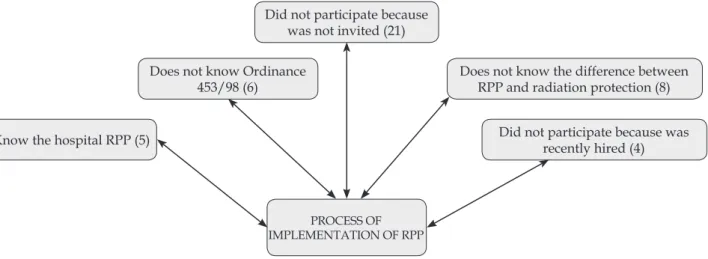
The reasons why the professionals did not participate in the implementation of the RPP are presented in Figure 2.
Did not participate because was not invited (21)
PROCESS OF IMPLEMENTATION OF RPP
Does not know Ordinance 453/98 (6)
Does not know the difference between RPP and radiation protection (8)
Know the hospital RPP (5) Did not participate because was
recently hired (4)
Figure 2 - Reasons why they did not participate in the implementation of the Radiation Protection Program
In the following speech, we veriied the group that identiied itself as uninvited:
[...] I did not participate because I was not invited (Radium).
service. Their speeches emphasize the importance of training at the beginning of the work, since they are allocated in an environment that has IR-generating equipment.
I do not know the RPP speciically, I have already
read about protection, but because of a test for enter-ing an institution [...]. We have a general notion [...]. The peers who have been here longer have instructed the newer ones [...]. Nobody in charge for this talked
to us, said something speciic about RP, what I think should have taken place on the irst day, before enter -ing that door [...]. Have you seen how many are using a dosimeter? I’m not wearing it, I’m careless. If you do not use it, it will not even have radiation registered. So, is everything ok in the radiology department? No, I think they have to check the use of the dosimeter. Those in charge did not say that we had to use the dosimeter. I wore where I thought I might be exposed. In the CT room, where we stay in the control station, I do not usually use it and I’m aware that I have to (Cesium).
I know there is a radiation protection sector back there, but I did not receive guidance on protection and RPP [...]. Only what I read, what the colleagues pass,
but nothing oficial (Beryllium).
There was a lecture of how the theoretical and prac-tical activities that we carry on would be, but nothing
speciically about RP. I studied more by myself, precisely
because I know that I will be exposed to radiation, because I am a little interested in the area (Iodine).
The professionals demonstrate some dis-crepancy regarding the RP sector, understanding that it is external to the radiology service, and they
assign this to the lack of oficial information. Some
professionals have demonstrated that they do not understand the difference between RP and RPP.
RPP had to have RP as well [...]. We need an awareness course with technical personnel, because there was a course in the hospital, but not for training, it was to improve the salary, the hospital was never concerned
with a course of specialization, training or clariication,
I have never seen it, it is necessary. It would be nice to have an annual course, with experienced physicists, doc-tors, radiologists, technologists and technicians [...]. This is also protection, it is not directly protecting, but it is raising awareness (Polonium).
We have the protectors and something descriptive in terms of descriptive memorial, of the devices and radi-ology, and the SOP, the Standard Operating Procedure, which has been done recently. But in terms of RPP, nothing (Thallium).
Others do not recognize themselves as partici-pants in the process, perhaps for lack of
encourage-ment and knowledge, as the following stateencourage-ment demonstrates.
As far as I know, I’ve never been asked to partici-pate. A long time ago there was a team that really cared about this, it was an employee of the Federal Technical School, she called for meetings, showed projects and our rights, but this was a long time ago. We also gave our opinions. It is important because she guided us and kept us aware of situations (Polonium).
Among the professionals who express knowl-edge about the RPP, there are exactly the ones who elaborated the document.
We started, we founded the DM that did not exist here in the X-ray department, surveying the
equipment, age, all the technical speciication of the
machines, of all rooms, radioprotection, isolation, dis-tance, room size, if it had barium, lead; we put personal
protective equipment (PPE) on the loors, we renewed
the individual protection material, and monitored dosimeters of X-rays, hemodynamics, angiography, surgical center, all personnel were involved. This was 8, 10 years ago, I think (Cobalt).
I volunteered to help in the setup of an RP depart-ment, and a DM and RPP. As I was already aware be-cause of my training, I was able to help [...] (Polonium). Some participants believe that the fact that they were hired recently was a reason for not par-ticipating in the implementation of the RPP.
I’ve been here for a short time, I imagine that the dosimeter control is part of a larger program, a control program, and that, to me, means that someone must be in control. [...] during this period I did not know what dose of radiation I was exposed to, this feedback I haven’t had yet. I think the control program must have that an-swer as well. I gave my name to receive the dosimeter, nothing more. [...] There should be a committee taking care of it [...], speciically which professional should take care of, with knowledge of the part regarding work medicine and safety (Iodine).
Therefore, in every RPP implementation process, few professionals participated, and this is
perhaps the reason for the dificulty in their exis -tence and effectiveness in the hospital work routine.
DISCUSSION
The multi-professional team that works with equipment becomes responsible for the RP of these environments and for the elaboration of an effective RPP that meets the needs of all.
In order to relect on the RP, it is important to
is to perform a precise, quality and safe examina-tion.13 Because in these settings the presence of IR is constant, the need to know the possible damages is essential to guarantee the RP of professionals, patients and companions.
It is noticed, by the subjects’ speeches, that there is still an inadequate knowledge about what an RPP is. What exists in the service is a document based on legislation, elaborated by necessity and imposition of the inspection body, leading to im-portant weaknesses in the service, as well as a lack of socialized information.
In addition, some professionals do not under-stand the difference between RP and RPP, i.e., they do not understand that RP is the act of protecting oneself, others and the environment against IRs, and should occur whenever there is exposure to radia-tion, whereas the RPP is the document that is part of the DM, recommended by the Ministry of Health to ensure the operation of radiology services. The RPP should contain important information about the service, including a list of the staff, with their respective functions, data of those in charge for the service (Supervisor of radiation protection – SRP, and Technician in charge - TC), behavioral informa-tion for possible occurrences of accidental exposure of users, members of the multi-professional health-care team, or individuals from the public, and the description of PPE with their respective quantities per room.14 Thus, the RPP includes not only informa-tion about RP, but also other important items that refer to the radiology service.
Besides the dificulty in differentiating RP
and RPP, the professionals raised the issue of the use of the dosimeter, showing concern about knowing the radiation dose received monthly, and at the same time the lack of willingness to use the radiation dosimeter. This demonstrates that they really do not understand and maybe do not try to question the function of the meter, sometimes assigning the responsibility to another subject, without placing themselves in the role of responsible for themselves and their acts.15-16 The multi-professional team working in radiodiagnosis should take responsibility, and take the necessary precautions to minimize harmful risks. Therefore, the importance of the use of PPE and a dosimeter is emphasized for periodic evaluations.17
Therefore, permanent education is an
impor-tant tool for the qualiication/training of profes -sionals, which is materialized in the opportunity of aggregated knowledge exchange, after the initial
formation. From the identiication of the reality ex
-perienced by the professionals in their workplace,
and noting the deiciencies of knowledge and ac
-tions for the ideal performance of their func-tions, the
resolution of possible laws is pursued, in a collec -tive way, thus allowing new knowledge to emerge. Through permanent education, the possibility of new dynamics and new spaces in this scenario can
be expanded through a irmer path.18
To reinforce the importance of updating in the radiology sector, the Ministry of Health, based on Ordinance 453/1998, established that it is the duty of service providers to operationalize health
education programs, at least annually. It also deines
some themes that should be socialized, such as pro-cedures for operating equipment, use of individual dosimeters, use of PPE for professionals, as well as for patients and companions, among others related to the safety of the department.7
It is necessary for institutions that have work-ers in contact with IR to facilitate their access to courses, as well as to provide educational
materi-als that are updated by competent and qualiied
professionals in this area of knowledge. This peda-gogical resource may result in good radiological safety practices.19
It is assumed that the lack of knowledge about the legislation that discusses the RPP and the unavailability of time to gather all the team have collaborated to show that the few that developed the RPP were the same that implemented it.
Insuf-icient knowledge about the legislation and of RP
in the training of these professionals may have
been one of the factors that made it dificult for the
entire multi-professional team to be involved in the implementation of the document. The very fact that one does not recognize oneself as a participant in the RPP implementation process can be attributed to the lack of professional knowledge.
The importance of companies to intercept the needs presented by professionals, and to develop
methods to propose and deine the paths to be de
-veloped to build healthy environments to aggregate knowledge is demonstrated. From this awareness, the success and quality of care are improved, and occupational biological effects are avoided.20
It should be emphasized here that the idea is not to propose that all healthcare professionals
have speciic training in radioprotection but that
examina-tion, among others: when requesting examinations, performing examinations, and participating in the performance, or even while traveling in environ-ments that have IR-generating equipment.
Dificulties found in the work of professionals,
such as the lack of time stimulated by the high work-loads imposed on these professionals, have proved to be determinant for non-participation during the implementation of the RPP. The concept of work-loads refers to the dynamic process that involves the elements of the work process that interact with each other and with the professional’s body itself.21
This interaction can trigger biological and psychic alterations, such as physical wear and tear, especially due to long working hours, double shifts, and occupational stress situations. In the meantime, it is necessary to emphasize the indifference of the professionals submitted to the high workloads regarding the RPP, highlighting that exactly the physically/psychically worn professional will be more subject to radiological exposure when failing to take the necessary precautions.
Analyzing the statements, it is noticed that the interviewees would be available to build the RPP of their service, which attests the interest of the team in RP. In the hospital sector, the multi-professional teams working with IR, in terms of radiodiagnosis, organize their work in order to meet the demand for procedures, that is, the team organizes itself as requirements for examinations arise. It should be considered that for both low and high complexity imaging studies, RP should be of equal relevance.22
In the case of radiodiagnosis workers, it can be said that there is a technique to be followed for the acquisition of radiodiagnostic images, and this can be performed by only one professional category,
but multidisciplinary integration can bring beneits
to more accurate diagnoses, that is, exchange of ex-perience and knowledge among professionals from different areas, which adds value to the diagnoses and consequently to patients.
Radiodiagnosis should not be treated as a puzzle game, in which all parts can be manipulated by trial and error. Diagnostic imaging tests serve to attest clinical suspicions, except for screening programs, where tests are performed for the early detection of pathologies.23
The level of quality of diagnostic imaging services, and their consecutive role for the country’s health system, are mainly related to the level of
tech-nical, scientiic and ethical training of professionals
and the community.1 If the team is aware of the basic
principles of RP and the provisions of Ordinance 453/98, which refer to the radiology workforce, periodic training, and all safety standards, it will be prepared to participate effectively in the preparation of the RPP at the workplace. In addition, the SRP, responsible for the elaboration and updating of the RPP, when inviting or summoning the workers to participate in the RPP, will make sure that the team can add value to the document, as well as improve the notion that each worker is also responsible for him/herself and the other.
The RPP is the document that contains rules of how to behave in case of an emergency in each
radiology service, besides containing speciications
for each type of IR-emitting equipment used in the radiodiagnosis department. Moreover, it is neces-sary to reformulate the RPP to ensure its legitimacy, since when it comes to exposure to IR, bearing in mind that each radiation received by the human beings may pose a risk to their health, the use of radiation can only occur under proven betterment to the whole society or part of it24. However, the lack of resources and knowledge of all the
multi-professional teams in differentiating what is specii -cally an RPP, what its function is within a radiology service, and what RP is, are preponderant factors to make the RPP a reality in the service.
CONCLUSION
The results of this study show that the RPP is not known by most of the multi-professional team that works in the hospital. It can be inferred that the
workers would have dificulties in identifying inter
-currences involving IR, as well as ind quick solu -tions in emergency situa-tions. However, the RPP is known by those who participated in its elaboration, although by a derisory number of members of the multi-professional team. Therefore, from this reality, it is deduced that the implementation of the RPP by the team is, precisely for this reason, compromised.
In addition, some professionals do not differ-entiate RP and RPP, stating that they ignore Ordi-nance 453/98 that deals with this subject. Thus, only those who participated in the implementation of the RPP have the understanding of what RP effectively is, and that the RPP is a document that contains, among other items, RP standards.
profes-sionals from different areas can add value to diagnoses and, consequently, to the service and patient care.
Finally, the importance of services carried out by committees specialized in occupational medicine, safety engineering, and internal accident prevention commissions, among other health and safety committees present in the institutions, is highlighted, to promote the participation of workers in the programs and plans for health protection; it is suggested that inspection agencies act effectively so that the RPP can achieve the objective of preserv-ing the health integrity of professionals workpreserv-ing in radiodiagnostic services, as well as of those who use these services.
REFERENCES
1. Navarro MVT. O radiodiagnóstico na saúde pública. In: Risco, radiodiagnóstico e vigilância sanitária. Salvador (BA): EDUFBA; 2009. p.166.
2. Xavier AM, Gaidano E, Morro JT, Heilbron PF.
Princípios básicos de segurança e proteção radiológica.
3ª ed. Rio Grande do Sul (RS): UFRG; 2010.
3. Ministério do Trabalho e Emprego (BR). Portaria nº 485, de 11 de Novembro de 2005. Norma
Regulamentadora NR 32 Segurança e saúde no
trabalho em estabelecimentos de saúde.Diário Oicial
da União, 16 Nov 2005.
4. Huhn A, Vargas MAO, Melo JAC, Lima FG, Lança
L, Ferreira ML. Proteção radiológica: da legislação à prática de um serviço. Rev Enferm Foco. 2016;
7(2):[in press].
5. Martin CJ, Sutton DG. Practical radiation protection in health care. London (UK): Oxford University Press; 2002.
6. Chemello E. Césio 137: a tragédia radioativa do Brasil. Química Virt [Internet]. 2010 Ago [cited 2014 Sep 28]. Available from: http://www.quimica.net/emiliano/ artigos/2010agosto-cesio137.pdf
7. Brasil. Secretaria de Vigilância Sanitária do Ministério da Saúde. Portaria nº 453 de 1º de junho de 1998.
Diretrizes de proteção radiológica em radiodiagnóstico médico e odontológico. Diário Oicial da União, 1998.
8. Proteção Radiológica (PRO-RAD). Consultores em
radioproteção S/S Ltda [Internet]. 2013 [cited 2013
Apr 05]. Available from: http://www.prorad.com. br/index.php?data=memorial_descritivo.php 9. Melo JAC, Gelbcke FL, Huhn A, Vargas MAO. The
work process in radiological nursing: invisibility of ionizing radiation. Texto Contexto Enferm [Internet]. 2015 [cited 2016 Abr 10]; 24(3):801-8. Available from: http://www.scielo.br/pdf/tce/v24n3/0104-0707-tce-24-03-00801.pdf
10. Trevisan M, Rosa C, Lima CCB, Souza JA. A
importância da biossegurança aplicada aos
proissionais da radiologia. Gestão & Saúde [Internet].
2013 [cited 2014 Oct 10]; 4(3):786-800. Available from: gestaoesaude.unb.br/index.php/gestaoesaude/ article/download/542/pdf
11. Fontanella BJB, Luchesi BM, Saidel MGB, Ricas J, Turato ER, Melo DG. Amostragem em pesquisas qualitativas: proposta de procedimentos para constatar
saturação teórica. Cad Saúde Pública [Internet]. 2011
[cited 2016 Abr 08]; 27(2). Available from: http:// dx.doi.org/10.1590/S0102-311X2011000200020 12. Bardin L. Análise de conteúdo. 4ª ed. Lisboa (PT):
Edições 70; 2014.
13. Kim H, Park M, Park S, Jeong H, Kim J, Kim Y. Estimation of absorbed organ doses and effective dose based on body mass index in digital radiography.
Radiat Prot Dosimetry.2013; 153(1):92-9.
14. Palácio EP, Ribeiro AA, Gavassi BM, Di Stasi GG, Galbiatti JA, Junior AD, et al. Exposure of the surgical team to ionizing radiation during orthopedic surgical procedures. Rev Bras Ortop [Internet]. 2014 [cited 2016 Apr 08]; 49(3):227-32. Available from: http://www.
scielo.br/scielo.php?script=sci_arttext&pid=S0102-36162014000300227&lng=en&nrm=iso
15. Ramos FRS, Brehmer LCF, Vargas MAO, Schneider DG, Drago LC. Ethics constructed through the process of nurse training: conceptions, spaces and strategies. Rev Latino-am Enfermagem [Internet]. 2013 [cited 2016 Apr 10]; 21 (Spe):113-21. Available from: http:// www.scielo.br/pdf/rlae/v21nspe/15.pdf
16. Huhn A, Vargas MAO. Plano de proteção radiológica e responsabilidade ética. Braz J Rad Sci [Internet]. 2016 [cited 2016 Apr 10]; 4(1):1-7. Available from: http:// www.bjrs.org.br/revista/index.php/REVISTA/ article/view/184
17. Flor RC, Gelbcke FL. Proteção radiológica e a atitude
de trabalhadores de enfermagem em serviço de
hemodinâmica. Texto Contexto Enferm [Internet]. 2013 [cited 2016 Apr 10]; 22(2):416-22. Available from: http://www.scielo.br/pdf/tce/v22n2/v22n2a18.pdf 18. Oliveira JSA, Cavalcante EFO, Macêdo MLAF,
Oliveira JSA, Martini JG, Backes VMS. Practice of permanent education by nursing care in health services. J Nurs UFPE [Internet]. 2013 [cited 2015 Mar 26]; 7(2):598-607. Available from: http://www.revista. ufpe.br/revistaenfermagem/index.php/revista/ article/view/3073/pdf_2091
19. Brand CI, Fontana RT, Santos AV. A saúde do
trabalhador em radiologia: algumas considerações.
Texto Contexto Enferm [Internet]. 2011 [cited 2014 Aug 10]; 20(1):68-75. Available from: http://www. scielo.br/pdf/tce/v20n1/08.pdf
20. Pires DEP, Bertoncini JH, Trindade LL, Matos E,
Azambuja E, Borges AMF. Inovação tecnológica e cargas de trabalho dos proissionais de saúde: uma relação ambígua. Rev Gaúcha Enferm [Internet].
Correspondence: Andrea Huhn Rua Delminda da Silveira, 740/503
88025-500 – Agronômica, Florianópolis, SC, Brasil E-mail: [email protected]
Received: October 20, 2015 Aproved: August 24, 2016 21. Flor RC, Gelbcke FL. Análise das cargas de trabalho
decorrentes da práxis da enfermagem em serviço
de hemodinâmica. Rev Enfermagem UFPE OnLine [Internet]. 2013; 7(Esp):7034-41. [cited 2016 Apr 10]. Available from: http://www.revista.ufpe.br/ revistaenfermagem/index.php/revista/article/ download/3338/8114
22. International Atomic Energy Agency (IAEA). Optimization of the radiological protection of patients
undergoing radiography, luoroscopy and computed
tomography. IAEA-TECDOC-1423. Vienna: IAEA; 2004. 23. Organização Panamericana de Saúde (OPAS).
Organización, desarrollo, garantía de calidad y radioprotección en los servicios de radiología: imaginología y radioterapia. Washington DC; 1997. 24. Arias CF. La regulación de la protección radiológica