João Mauricio Brambati Sant’AnaI
Vera Lúcia Edais PepeII Tatiana Aragão FigueiredoI Claudia Garcia Serpa Osorio-de-CastroIII
Miriam VenturaI
I Programa de Pós-Graduação em Saúde
Pública. Escola Nacional de Saúde Pública. Fundação Oswaldo Cruz. Rio de Janeiro, RJ, Brasil
II Departamento de Administração e
Planejamento em Saúde. Escola Nacional de Saúde Pública. Fundação Oswaldo Cruz. Rio de Janeiro, RJ, Brasil
III Núcleo de Assistência Farmacêutica. Escola
Nacional de Saúde Pública. Fundação Oswaldo Cruz. Rio de Janeiro, RJ, Brasil Correspondência | Correspondence: João Maurício Brambati Sant’Ana Rua Dr. Aristides Navarro de Carvalho 300 Centro
29200-120 Guarapari, ES, Brasil E-mail: [email protected] Received: 3/8/2010
Approved: 1/19/2011
Article available from: www.scielo.br/rsp
Rational therapeutics:
health-related elements in lawsuits
demanding medicines
ABSTRACT
OBJECTIVE: To characterize the main medical, scientifi c and health-related procedural elements upon which decisions are made in individual lawsuits demanding medicines that are considered essential to the Court of Justice.
METHODS: Retrospective descriptive study based on 27 cases ruled on by the Court of Appeals in Rio de Janeiro, Southeastern Brazil, in 2006. The original proceedings were solicited from the Central Archive of the Court of Justice of the State of Rio de Janeiro and were photographed and analyzed in full.
RESULTS: Prescriptions and medical certifi cates were present in 100% of the lawsuits. All prescriptions lacked conformity to legislation. No expert medical reports were added, and only 7.4% of the lawsuits presented complementary examinations. In spite of the scarcity of medical information present in the records, all of the demands were granted.
CONCLUSIONS: The admission of judicial demands devoid of clinical and diagnostic substantiation results in managerial and health-related constraints on the health system. Besides creating havoc in standard pharmaceutical services, badly justifi ed medicine demands may compromise rational drug use.
DESCRIPTORS: Pharmaceutical Services, legislation & jurisprudence. Drug Prescriptions. Judicial Decisions. Legislation, Health.
INTRODUCTION
The assertion of the right to healthcare in the Brazilian legal system, combined with persisting unequal access to health goods and services, including medi-cines,11 has encouraged a resort to judicial protection and an increase in lawsuits to assure this right. The ph enomenon has been called the judicialization of health.
In the early 1990s, lawsuits targeted medications for HIV/AIDS and current lawsuits address several additional treatments. S tudies indicate defi ciencies in access to medicines by users of the Sistema Único de Saúde (SUS – National Health System).11,a They also reveal that it is diffi cult for the judicial system and the judicial procedure itself to ensure compliance with the principles of universality and equity of the Brazilian Health System and it’s National Drug Policy guidelines. This is especially the case in the selection of essential medications and the promotion of the rational use of medicines (RUM).1,3,6,7,13,14
It is the State’s constitutional duty to provide comprehensive pharmaceutical care to its citizens, and it is the citizens’ right to compel the judicial branch to
a Organização Pan-Americana da Saúde. Ministério da Saúde. Avaliação da assistência
force the public administration to meet this obligation. It is also a constitutional duty of the State to protect the health of its citizens, which can only be realized if the State provides access to medicines via mechanisms that ensure the rational use of those drugs.
Prescription medicines play a critical role in lawsuits. Medical professionals are responsible for a signifi cant portion of healthcare costs through their diagnostic and/or therapeutic decisions. Rational prescription, related to rational use of and adherence to medica-tions, thus influencing treatment outcome, is one component of these decisions. However, prescription is also infl uenced by the physical conditions of care and certain characteristics of the health professional, such as knowledge, expertise, professional training, and current understanding of the effi cacy and safety of both old and new drugs. Moreover, according to Teixeira,12 the United States pharmaceutical industry infl uences the continued education of health professionals and also promotes off-label prescriptions. This results in a return on investment of up to three times the amount spent on continued education.
Rational prescription, a fundamental component of the promotion of RUM,15 is one of the greatest chal-lenges facing public management of pharmaceutical care. This is especially true for new and more expen-sive medicines. Therefore, most lawsuits are granted with a medical prescription as the only procedural evidence.3,4,14
Given the importance of health judicialization and its challenges to the new political-institutional relation-ships between the health and judicial sectors, the present study aims to characterize the main medical, scientifi c and health-related procedural elements supporting the rulings on those lawsuits considered essential.
METHODS
A descriptive retrospective study was conducted. The unit of analysis was the legal process brought by a citizen, regarding a supply of medicine, against a state entity in Rio de Janeiro, Southeastern Brazil. Lawsuits
fi led through 31 December 2007 were included if they met the following conditions: they were fi rst heard in the District Court, they had a fi nal ruling in the Court of Appeals in 2006, and their summary judgment contained the keywords “medicine” and “essential.”
b Brasil. Lei nº 5.991, de 17 de dezembro de 1973. Dispõe sobre o controle sanitário do comércio de drogas, medicamentos, insumos
farmacêuticos e correlatos, e dá outras providências. Diario Ofi cial Uniao. 19 dez 1973: 13049.
c Brasil. Lei nº 9.787, de 10 de fevereiro de 1999. Altera a Lei n.º. 6.360, de 26 de setembro de 1976, que dispõe sobre a vigilância sanitária,
estabelece o medicamento genérico, dispõe sobre a utilização de nomes genéricos em produtos farmacêuticos e dá outras providências.
Diario Ofi cial Uniao. 11 fev 1999:1.
d Ministério da Saúde. Portaria n°344, de 12 de maio de 1998. Aprova o Regulamento Técnico sobre substâncias e medicamentos sujeitos a
controle especial. Diario Ofi cial Uniao. 19 maio.1998.
e Conselho Federal de Farmácia. Resolução 357, de 20 de abril de 2001. Aprova o Regulamento Técnico das Boas Práticas de Farmácia. In:
Conselho Federal de Farmácia: a organização jurídica da profi ssão farmacêutica. 3. ed. Brasília; 2001. p.342.
These criteria enabled an analysis of the conduct of proceedings in two distinct legal courts: that is, from the author’s fi rst application until the fi nal legal ruling in the Court of Appeals by the Court of Justice of the State of Rio de Janeiro (CJ/RJ). In addition, access was available to all of the original documents that were part of the legal process.
Of the 3,456 lawsuits concerning the keyword “medi-cine” decided in the Court of Appeals in 2006 and available on the CJ/RJ site, 162 had originated at the district court level and used the terms “medicine” and “essential” in their summaries. The 27 lawsuits with a
fi nal verdict declared and fi led were requested from the CJ/RJ Central Archive and photographed.
The procedural, medical, scientifi c and health-related elements of the lawsuits were analyzed by the following primary variables: author’s legal representation; defen-dant; time elapsed between procedural steps; legal requirements; result of rulings; existence of appeals; presence of medical prescription; appropriateness of medical prescription relative to good prescription practices; presence of medical document; comple-mentary examinations and medical report; diagnosis; demanded medicines; medicine register in Agência Nacional de Vigilância Sanitária (ANVISA – National Health Surveillance Agency); and presence of on the Brazilian List of Essential Medicines (RENAME) and other offi cial lists.
The appropriateness of the medical prescription rela-tive to general and legal principles of good prescription practice was based on 14 minimum criteria of federal norms - Federal Laws n. 5991/73b and n. 9787/99;c Decree n. SVS/MS 344/98d and CFF Ruling n. 357/2001.e” The appropriateness and good prescription practice principles were considered to be in agreement only when the criteria were met for all the prescribed medicines in a case.
The medicines were classified by the Anatomical Therapeutic Chemical Classifi cation (ATC),2 whereas the diagnosis was classified by the International Classifi cation of Diseases, tenth edition (ICD-10).8 The presence of the medicine on offi cial lists was verifi ed by searches in RENAME 2002 (valid at that time) and in the Lists of the Pharmaceutical Assistance Programs (PAP) from the Ministry of Health, until 2006,
The project was approved by the Committee on Ethics in Research from the Escola Nacional de Saúde Pública Sérgio Arouca at Fiocruz on 24 March 2008 (protocol 32/08).
RESULTS
Of the 27 authors, 19 were represented by the Public Defender of the State of Rio de Janeiro. The State of Rio de Janeiro appeared most frequently as the defendant (seven lawsuits). In 11 lawsuits, though there was more than one defendant, the emphasis was placed on the State and the Municipality of Rio de Janeiro (six lawsuits).
All injunctions were granted and confi rmed by the decisions handed down in the District Court, and the decisions were further confi rmed in the Court of Appeals. In three lawsuits, the judge made some type of demand before the preliminary decision. Of the 27 pleadings, 16 were accepted in the exact terms of the pleading. In 11 cases, a supply of similar medicines was granted. Finally, in fi ve cases, the supply was linked to the demonstration of a prescription given by a SUS doctor. The defendant appealed the preliminary decision in only one lawsuit and appealed the decision in 16 lawsuits. There was no appeal of the judgment rendered by the Court of Appeals to the Superior Court of Justice and/or the Federal Supreme Court.
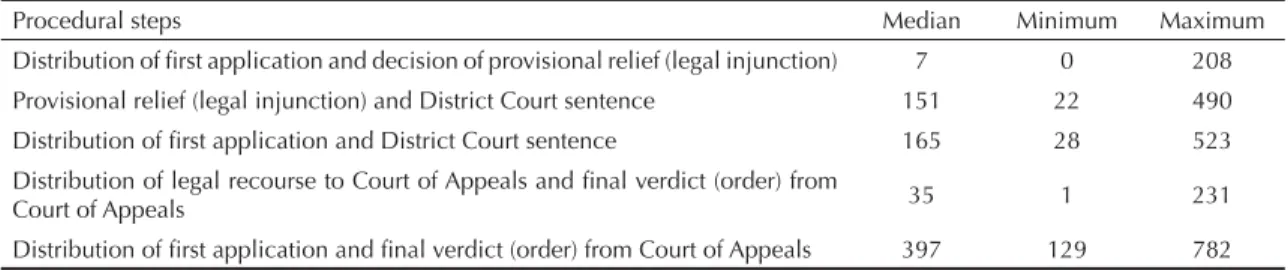
The median time interval between procedural steps of interest is shown in Table 1.
In every process, there was an attached prescription, and in three instances, there were two prescriptions, thus resulting in a total of 30 prescriptions for analysis. Half of the prescriptions were generated by the SUS (six from university hospitals and nine from other SUS units), whereas 13 came from private doctors and two from mutual health associations.
None of the prescriptions was found to be compliant with the general and legal principles of good prescrip-tion practice, and a median of fi ve non-compliant criteria were found for each prescription (Table 2).
In seven cases of prescriptions that contained specially controlled substances, there was no notifi cation of a prescription attached to the process. In the four cases
where all of the special prescriptions were attached, none of them was compliant with the requirements of the Ordinanced that standardizes the prescription of controlled medicines in Brazil.
There was a medical document confi rming the disease in all of the lawsuits. In fi ve of the lawsuits, a “medical certifi cate” and a prescription appeared for the same document. There was no medical report in any of the 27 lawsuits, and in only two of the lawsuits there were complementary examinations attached. Table 3 shows the relationship between present and absent medical documents in the lawsuits.
Five of the eight explicit justifi cations for the prescrip-tion referred to an unsatisfactory response to treatment with a previously selected medicine, whereas only four demands even referenced previous treatment. In one particular case, there was justifi cation for only one prescription, yet this medicine was not being demanded in the lawsuit.
Twenty-seven main diagnoses and 24 secondary ones were mentioned. Taking all diagnoses into consideration, circulatory system diseases were the most frequent, at 33.3%, with hypertensive diseases following at 15.7%. Diseases of the musculoskeletal system and connective tissues were diagnosed in 13.7% of the cases, whereas mental and behavioral disorders were mentioned in 11.8% of the diagnoses.
Although the median number of medicines demanded per lawsuit was four, the number ranged from one to 12. There was a demand for other inputs in two of the lawsuits, and included blood glucose meters, physi-ological saline and syringes. On the whole, there were 116 medicines demanded, one of which was illegible and could not be identifi ed. From the 115 that were analyzed, 104 contained a single active compound, and 11 were combinations in a fi xed dose. It was possible to classify 93 different active compounds.
Approximately one-third (29.6%) of the medicines were prescribed by their generic name. The percentage of medicines prescribed by their generic name was slightly larger among doctors from the SUS (32.3%) than it was among those not belonging to the SUS (26.4%).
Table 1. Minimum, median and maximum time (in days) elapsed between procedural steps. State of Rio de Janeiro, Southeastern Brazil, 2006.
Procedural steps Median Minimum Maximum
Distribution of fi rst application and decision of provisional relief (legal injunction) 7 0 208
Provisional relief (legal injunction) and District Court sentence 151 22 490
Distribution of fi rst application and District Court sentence 165 28 523
Distribution of legal recourse to Court of Appeals and fi nal verdict (order) from
Court of Appeals 35 1 231
Distribution of fi rst application and fi nal verdict (order) from Court of Appeals 397 129 782
The most-demanded drugs, according to the 5th level of the ATC, were furosemide (5.4%), digoxin (4.5%), clonazepam (4.5%), acetylsalicylic acid (3.6%), enala-pril (3.6%) and bromazepam (3.6%) (Table 4).
In only one case (0.9%), in which foscarnet was demanded, a valid register was not found in ANVISA for its active compound.
Twenty-one (77.8%) lawsuits demanded all the prescribed medicines. In more than half (57.4%) of the lawsuits, the demanded medicines belonged to an offi cial list of free supply. Specifi cally, 45.2% belonged to RENAME 2002, and 32.2% belonged to other lists with an emphasis (13.9%) on the list of the Unusual Medication Program. However, in 22 (81.5%) lawsuits, there was a demand for at least one medicine that was not included on the offi cial list.
In the fi ve lawsuits where all of the demanded medi-cines belonged to an offi cial list, there was at least one drug that was an exceptional circumstance drug dispensing . From the total of seven demanded medi-cines in those lawsuits, six belonged to the list excep-tional circumstance drug dispensing , and they were provided in the SUS for the treatment of the author’s respective pathology, as classifi ed by the ICD-10. In one
of those cases, although the indication was not provided for the current Ordinance that approves the Exceptional Circumstance Drug Dispensing Component of Medications (Ordinance MS/GM n. 2.577/2006),f it was provided for the previous Ordinance (Ordinance MS/GM n. 1.318/2002)g that was still in force on the date when the lawsuit originated (Table 5).
Of the 49 medicines that do not belong to offi cial lists, 46 could be classifi ed up to the 5th level of the ATC. The most frequent ones were bromazepam (8.7%), propatylnitrate (6.5%), and capecitabine, carvedilol, and clonidine, each of which shows a frequency of 4.3%. None of the drugs was included in RENAME 2006. However, carvedilol (6.25-mg pills), beclometa-sone dipropionate (aerosol, 200 mcg/dose) and enalapril (10-mg pills) were included in RENAME 2008.
DISCUSSION
The low number of cases analyzed constitutes both the main limitation and the strongest point of the study. More specifi cally, the small sample size prevented generalization from the results, while enabling the analysis of the legal processes in their entirety for the
fi rst time.
Table 2. Compliance of medical prescriptions with general and legal principles of good prescription practices. State of Rio de Janeiro, Southeastern Brazil 2006.
Prescription item Noncompliant Compliant Total
a
n % n % n
01 Legibilityb 16 59.3 11 40.7 30
02 Patient’s name 1 3.3 29 96.7 30
03 Patient’s home address 30 100.0 0 0.0 30
04 Professional’s offi ce or home address 16 53.3 14 46.7 30
05 Registration number at respective Professional Committee 3 10.0 27 90.0 30
06 Professional’s signature 1 3.3 29 96.7 30
07 Professional’s identifi cation stamp 3 10.0 27 90.0 30
08 Prescription by generic name, within scope of SUS 14 93.3 1 6.7 15c
09 Directive n. 344/98 (controlled medicines) 11 100.0 0 0.0 11d
10 Date 3 10.0 27 90.0 30
11 Posology 5 16.7 25 83.3 30
12 Presentation 25 83.3 5 16.7 30
13 Route 14 46.7 16 53.3 30
14 Treatment length 19 63.3 11 36.7 30
Source: Court of Justice, Rio de Janeiro, Brazil
a Total prescriptions.
b Readable by two pharmacists, according to Yamanaka16
c Only 15 prescriptions came from SUS.
d Only 11 prescriptions contained substances that were subject to special control.
f Ministério da Saúde. Portaria n.º 2.577 de, 27 de outubro de 2006. Aprova o componente de medicamentos de dispensação excepcional. Diario Ofi cial Uniao. 10 nov 2006:1.
g Ministério da Saúde. Portaria n.º 1.318 de 23 de julho de 2002. Defi ne, para o grupo 36, medicamentos, da tabela descritiva do sistema de
Despite the small number of initial legal requirements, all of the preliminary injunctions were granted, and the defendants were not usually willing to appeal. The median time between the preliminary decision and the judgment of the merits of the lawsuit (151 days) indi-cates that the use of medicine supplied by court order is generally prolonged by months, without reevaluation of the appropriateness of the medication for the health needs of the plaintiff, as Messeder et al7 (2005) previ-ously mentioned. The absence of any reference to this kind of procedure being conducted in the court fi les supports this hypothesis.
The almost absolute acceptance of demands has also been reported by Marques & Dallari6 (2007), Borges1 (2007) and Romeroh (2008), indicating a certain homogenization, or even an automation, of the judg-ment of certain lawsuits. This frequent acceptance may also indicate that the State does not exercise its role as protector of healthcare. Its consistent technical defenses demonstrate the inappropriateness of determined prescriptions, the existence of available therapeutic alternatives in the SUS, and the possible damages that a particular prescribed medicine may cause the user.
The dominance of prescriptions originating from the SUS, observed here, was also observed in other studies,3,7,14,h suggesting a failure in public policies regarding medicine. This shortcoming may be charac-terized by non-guaranteed access, a delay in incorpo-rating new drugs into offi cial lists or the non-adherence of professionals in the public network to such lists.7,14
It is concerning that none of the analyzed prescriptions complied with all of the selected guidelines for good prescription practices. These have all been granted by the judicial branch without requiring any compliance with the current health laws.
Errors in prescriptions may lead to a series of prob-lems associated with the use of drug, such as medicine replacement and/or the substitution of pharmaceutical forms during dispensing, using wrong route adminis-tration , errors in dosing, use of medicine beyond the time required or failure to comply with the prescribed treatment.5,10 Considering that the focus of lawsuits demanding medicines, from a legal point of view, is the health of the litigating patient, it is important that the court demand adherence to minimum requirements, legal and otherwise, to ensure a safe and appropriate prescription.
Table 3. Medical documents attached to the selected lawsuits. State of Rio de Janeiro, Southeastern Brazil, 2006.
Document Yes No
n % n %
Prescrição 27 100.0 0 0.0
Documento médico atestando
doença 27 100.0 0 0.0
Does it refer to previous
treatments? 4 14.8 23 85.2
Does it refer to disease
evolution time? 3 11.1 24 88.9
Does it refer to complementary
exams? 2 7.4 25 92.6
Does it have a diagnosis with
ICD-10? 8 29.6 19 70.4
Does it explicitly justify the
prescription?a 8 29.6 19 70.4
Complementary exams 2 7.4 25 92.6
Medical report 0 0.0 27 100.0
Source: Court of Justice, Rio de Janeiro, Brazil
a Written justification of the prescription of that active
ingredient at the expense of available therapeutic alternatives.
Table 4. Medicines more frequently requested in the selected lawsuits, classified by the fifth level of the Anatomical, Therapeutic and Chemical Classifi cation and by their presence in the Essential Medications List 2002. State of Rio de Janeiro, Southeastern Brazil, 2006.
ATCa Common name Medications Essential
List 2002 n % C03CA01 Furosemide Yes 6 5.4 C01AA05 Digoxin Yes 5 4.5 N03AE01 Clonazepam Yes 5 4.5
B01AC06 Acetylsalicylicacid b Yes 4 3.6
C09AA02 Enalapril Yes 4 3.6 N05BA08 Bromazepam No 4 3.6 C01DA07 Propatylnitrate No 3 2.7 A02BA02 Ranitidine Yes 2 1.8 B01AA03 Warfarin sodium Yes 2 1.8 C01BD01 Amiodarone Yes 2 1.8 C02AC01 Clonidine, chloride No 2 1.8 C03AA03 Hydrochlorothiazide Yes 2 1.8 C03DA01 Spironolactone Yes 2 1.8 C07AG02 Carvedilol No 2 1.8 C09AA01 Captopril Yes 2 1.8 C10AA01 Simvastatin Yes 2 1.8 L01BC06 Capecitabine No 2 1.8 N03AF01 Carbamazepine Yes 2 1.8
Others - - 59 52.7
Total - - 112 100.0
Source: Court of Justice, Rio de Janeiro, Brazil.
a Anatomical Therapeutic Chemical Classifi cation. b 100 mg dose.
h Romero LC. Judicialização das políticas de assistência farmacêutica: o caso do distrito federal. Brasília: Consultoria Legislativa do Senado
Another noteworthy fact is the low percentage of generic drugs prescribed, particularly by the SUS, as the Federal Law n. 9.787/1999c establishes the enforcement of prescribing generic drugs .
The careful and responsible consideration of cases involving medicines, for the sake of the good health of the litigating patient, cannot disregard clinical and diagnostic substantiation. Although almost all of the analyzed lawsuits included a medical certifi cate, but this document is generally limited to determining a disease or diseases without supplying further informa-tion. Because of this, most of the legal procedures do not include any explicit justifi cation for prescriptions or any information about previous treatment, disease evolution, complementary examinations or diagnoses according to ICD-10.
What was discussed in many of lawsuits is the advan-tage of, or even the need for, a particular drug that is not incorporated by the SUS, despite therapeutic alterna-tives already incorporated for the treatment of the same disease.7,14 In those cases, it does not seem reasonable to discard an explicit justifi cation for the prescription of a medicine different from the one belonging to an offi cial list. Moreover, as long as there is no need for the courts to refer to a technical organization or to a medical expert to grant the preliminary injunction, as the delay may result in even greater damage to the plaintiff’s health,1 it is certainly perplexing that those procedures are completely absent throughout the entire legal process.
A frequent complaint among health managers is that the demand fordrugs not registered in the ANVISA has not received much attention from Brazilian studies of the judicialization of health. The few studies that have explored the issue of unregistered medicines have found that anywhere from 1% to 10% of the legal cases involve unregistered medicines.3,6 The register of drugs in ANVISA plays an important role when evaluating the
risks and benefi ts of the drug and taking into account the disease for which it is being prescribed. Federal Law n. 6.360/1976i expressly forbids the industrialization, sale or delivery for consumption of any medicine not registered with the Ministry of Health.
The current study did not allow a deep analysis of the diagnoses of the authors of the lawsuits. Chronic diseases, such as those of the nervous and cardiovas-cular systems, were among the most frequent, as in the study by Messeder et al7 (2005), which was also conducted in Rio de Janeiro.
The high frequency of lawsuits in the State of Rio de Janeiro for medicines from the SUS lists was also reported by Messeder et al7 (2005) and Borges1 (2007). However, the present study observed that, in 80% of the lawsuits, at least one drug was not on the offi cial lists. This suggests one more reason for the high percentage of medicines from the SUS lists that are legally demanded, as reported by several studies of judicialization.1,3,7,14,h Because lawsuits generally demand all of the prescribed drugs, it is reasonable to suppose that medicines that are not on the lists are the main motivation for demanding lawsuits.
The data also suggest an important role of exceptional circumstance drug dispensing in the generation of lawsuits. This fact may indicate both persistent failure in the management of this component of pharmaceutical care and successful attempts to circumvent offi cially established criteria for appropriate dispensing in the SUS. The simple specifi cation of diagnosis, devoid of confi rming medical examinations, although admittedly insuffi cient to provide safe and responsible dispensing of specially prescribed drugs in the SUS, has been suffi cient to obtain a supply of medicine via a lawsuit.
This makes the legal path faster, less bureaucratic and, therefore, very attractive despite the fi nancial and managerial implications for the SUS and the consequent health implications for the individual. The acceptance
Tabela 5. Special medicines demanded in lawsuits where all medicines requested belonged to some National Health System list, their respective diagnosis and compliance with Ordinance 2.577/2006. State of Rio de Janeiro, Southeastern Brazil,2006.
ATC Medicine and Dose Pathological Condition (ICD-10) Predicted Indication
G02CB03 Cabergoline 0.5mg E22.1 - Hyperprolactinemia Yes
J05AB04 Ribavirin 250mg B18.2 – Chronic viral hepatitis C Yes
L04AA13 Lefl unomide 20mg M06.4 - Infl ammatory polyarthropathy Noa
N04BA02 Levodopa 250mg + Carbidopa 25mg G20 – Parkinson’s disease Yes
N04BD01 Selegiline 5mg G20 – Parkinson’s disease Yes
N05AH03 Olanzapine 5mg F20.0 – Paranoid schizophrenia Yes
Source: Legal Court, Rio de Janeiro, Brazil
a Although it is not provided in the previously mentioned Directive, this indication was provided in the previous edition
(Directive MS/GM n. 1.318/2002)19 in force at the beginning of the lawsuit.
i Brasil. Lei nº. 6.360, de 23 de setembro de 1976. Dispõe a vigilância sanitária a que fi cam sujeitos os medicamentos, as drogas, os insumos
of these lawsuits, despite the lack of clinical and diagnostic substantiation in court fi les of the analyzed processes, reinforces such hypotheses.
Rational access to medicines is the basic purpose of and premise behind pharmaceutical care. To this end, all of the lawsuits are connected to medicines, whether from the judicial or the executive branch, should unequivo-cally contribute to this purpose.
Health policies, including pharmaceutical ones and those related to the selection of essential medicines and their products, such as lists and therapeutic formularies and protocols, are examples of successful initiatives of healthcare management aimed at the promotion of RUM in Brazil. Unfortunately, those policies do not always serve the needs of the patient. This may be due to negligence in a policy’s formulation, as is the case with the lack of specifi cation of clear criteria for dealing with peculiarities (i.e., procedures and/or materials that are not predicted by the policies), or due to negligence
in the healthcare system (i.e., delay in updating drug lists and protocols).
Legal intervention may contribute to the promotion of RUM, providing that a lawsuit is clinically and pharmacologically substantiated. The acceptance of lawsuits devoid of such substantiation, or based only on a medical prescription, places managerial and health-related constraints on the healthcare system. Additionally, it prevents the formulation and imple-mentation of pharmaceutical care policies, encourages the unreasonable use of medicines and often damages the already suffering health of the plaintiff, whom the State has the constitutional duty to protect.
ACKNOWLEDGMENTS
1. Borges DCL, Ugá MAD. Confl itos e impasses da judicialização na obtenção de medicamentos: as decisões de 1a instância nas ações individuais contra o Estado do Rio de Janeiro, Brasil, em 2005. Cad Saude Publica. 2010;26(1):59-69. DOI:10.1590/S0102-3 2. Capellà D. Descritive tools and analysis. In: Dukes
MNG, organizer. Drug Utilization Studies: Methods and Uses. Copenhagen: World Health Organization Regional Publications; 1993. p. 55-78. (European Series, 45).
3. Chieffi NA, Barata RB. Judicialização da política pública de assistência farmacêutica e eqüidade. Cad Saude Publica. 2009;25(8):1839-49. DOI: 10.1590/ S0102-311X2009000800020
4. Figueiredo TA, Pepe VLE, Osorio-de-Castro CGS. Um enfoque sanitário sobre a demanda judicial de medicamentos. Physis (Rio J). 2010;20(1):101-18. DOI:10.1590/S0103-73312010000100007 5. Guzatto P, Bueno D. Análise de prescrições
medicamentosas dispensadas na farmácia de uma Unidade Básica de Saúde de Porto Alegre – RS. Rev HCPA. 2007;27(3):20-6.
6. Marques SB, Dallari SG. Garantia do direito social à assistência farmacêutica no Estado de São Paulo. Rev Saude Publica. 2007;41(1):101-7. DOI: 10.1590/ S0034-89102007000100014
7. Messeder AM, Osorio-de-Castro CGS, Luiza VL. Mandados judiciais como ferramenta para garantia do acesso a medicamentos no setor público: a experiência do Estado do Rio de Janeiro, Brasil. Cad Saude Publica. 2005;21(2):525-34. DOI: 10.1590/ S0102-311X2005000200019
8. Organização Mundial da Saúde. CID-10 Classifi cação Estatística Internacional de Doenças e Problemas Relacionados à Saúde. 10 ed. São Paulo: Edusp; 1997.
9. Pontes Jr DM, Pepe VLE, Osorio-de-Castro CGS, Massena EP, Portela MC, Miranda MC, et al. A defi nição de medicamentos prioritários para o monitoramento da qualidade laboratorial no Brasil: articulação entre a vigilância sanitária e a Política Nacional de Medicamentos. Cad Saude Publica. 2008; 24(9):2081-90. DOI:10.1590/S0102-311X2008000900014.
10. Schachter M. The epidemiology of medication errors: how many, how serious? Br J Clin
Pharmacol. 2009;67(6):621-3. DOI:10.1111/j.1365-2125.2009.03418.x
11. Szwarcwald CL, Viacava F, Vasconcellos MTL, Leal MC, Azevedo LO, Queiroz RSB, et al. Pesquisa Mundial de Saúde 2003: o Brasil em números. Radis. 2004;(23):14-33.
12. Teixeira M. A bilionária indústria da educação médica continuada nos EUA: mais uma forma de interferência das empresas na relação médico-paciente. Rev Latinoam Psicopatol Fundam. 2009;12(4):731-42. 13. Vieira FS. Ações judiciais e direito à saúde: refl exão
sobre a observância aos princípios do SUS. Rev Saude Publica. 2008;42(2):365-9. DOI:10.1590/S0034-89102008005000010
14. Vieira FS, Zucchi P. Distorções causadas pelas ações judiciais à política de medicamentos no Brasil. Rev Saude Publica. 2007;41(2):214-22. DOI: 10.1590/ S0034-89102007000200007
15. World Health Organization. The Rational Use of Drugs - Report of the Conference of Experts, Nairobi 25-29 November 1985. Geneva; 1987.
16. Yamanaka TI, Pereira DG, Pedreira MLG, Peterlini MAS. Redesenho de atividades da enfermagem para redução de erros de medicação em pediatria. Rev Bras Enferm. 2007;60(2):190-6. 11X2010000100007
REFERENCES
The study was fi nanced by the Carlos Chagas Filho Foundation for the Support of Research (Process N.: E-26/170.652/20). This article is based on a Master’s dissertation by JMB Sant’Ana, presented at the Sergio Arouca National School of Public Health, Fiocruz, in 2009.