Legal and health variations
in drug litigation injunctions
granted in Minas Gerais
Variáveis jurídicas e de saúde
no deferimento de liminares por
medicamentos em Minas Gerais
I Programa de Pós-Graduação em Saúde
Pública. Faculdade de Medicina. Universidade Federal de Minas Gerais. Belo Horizonte, MG, Brasil
II Programa de Pós-Graduação em
Bioinformática. Universidade Federal de Minas Gerais. Belo Horizonte, MG, Brasil
III Departamento de Farmácia Social.
Faculdade de Farmácia. Universidade Federal de Minas Gerais. Belo Horizonte, MG, Brasil
IV Departamento de Medicina Preventiva
e Social. Faculdade de Medicina. Universidade Federal de Minas Gerais. Belo Horizonte, MG, Brasil
Correspondence: Tiago Lopes Coelho
Rua Jornalista Juracy Manoel, 16 apto. 101 Silveira
31140-370 Belo Horizonte, MG, Brasil E-mail: [email protected] Received: 12/5/2013
Approved: 4/8/2014
Article available from: www.scielo.br/rsp
ABSTRACT
OBJECTIVE: To investigate the factors related to the granting of preliminary court orders [injunctions] in drug litigations.
METHODS: A retrospective descriptive study of drug lawsuits in the State of Minas Gerais, Southeastern Brazil, was conducted from October 1999 to 2009. The database consists of 6,112 lawsuits, out of which 6,044 had motions for injunctions and 5,167 included the requisition of drugs. Those with more than one beneiciary were excluded, which totaled 5,072 examined suits. The variables for complete, partial, and suppressed motions were treated as dependent and assessed in relation to those that were independent – lawsuits (year, type, legal representation, defendant, court in which it was iled, adjudication time), drugs (level ive of the anatomical therapeutic chemical classiication), and diseases (chapter of the International Classiication of Diseases). Statistical analyses were performed using the Chi-square test. RESULTS: Out of the 5,072 lawsuits with injunctions, 4,184 (82.5%) had the injunctions granted. Granting varied from 95.8% of the total lawsuits in 2004 to 76.9% in 2008. Where there was legal representation, granting exceeded 80.0% and in lawsuits without representation, it did not exceed 66.9%. In public civil actions (89.1%), granting was higher relative to ordinary lawsuits (82.8%) and injunctions (80.1%). Federal courts granted only 68.6% of the injunctions, while the state courts granted 84.8%. Diseases of the digestive system and neoplasms received up to 87.0% in granting, while diseases of the nervous system, mental and behavioral disorders, and diseases of the skin and subcutaneous tissue received granting below 78.6% and showed a high proportion of suspended injunctions (10.9%). Injunctions involving paroxetine, somatropin, and ferrous sulfate drugs were all granted, while less than 54.0% of those involving escitalopram, sodium diclofenac, and nortriptyline were granted.
CONCLUSIONS: There are signiicant differences in the granting of injunctions, depending on the procedural and clinical variances. Important trends in the pattern of judicial action were observed, particularly, in the reduced granting [of injunctions] over the period.
DESCRIPTORS: Pharmaceutical Preparations, supply & distribution. Pharmaceutical Services, legislation & jurisprudence. Judicial Decisions. Patient Advocacy.
Tiago Lopes CoelhoI
Felipe FerréII,III
Orozimbo Henriques Campos NetoI
Francisco de Assis AcurcioIII
Mariângela Leal CherchigliaIV
Deining the judiciary’s role is one of the greatest chal-lenges of democratic societies. It is a dificult and contro-versial task to identify the limits of judicial activity, espe -cially in its control over political activity.2,5,7 This task has become increasingly more intricate due to the proac -tiveness of the judiciary in guaranteeing the eficacy of social rights. This new position has expanded the hori-zons of judicial action, reconigured relations between the different branches of government, and destabilized the structures that once served to steer the checks and balances system in the judiciary.12,a
Judicial proactivity in Brazil has gained prominence in the healthcare industry. Over 240,000 lawsuits
RESUMO
OBJETIVO: Investigar fatores relacionados ao deferimento de liminares por medicamentos.
MÉTODOS: Estudo descritivo retrospectivo dos processos judiciais por medicamentos em Minas Gerais, de outubro de 1999 a 2009. A base de dados, constituída por 6.112 ações judiciais, teve 6.044 com pedido de liminar e 5.167 com requisição de medicamentos. Foram excluídas as ações que continham mais de um beneiciário, totalizando 5.072 ações analisadas. As variáveis deferimento total, parcial e suspensão foram tratadas como dependentes e avaliadas em relação às independentes: processo (ano, tipo de ação, representação judicial, réu, justiça de ajuizamento, tempo de decisão judicial), medicamentos (nível 5 da Anatomical Therapeutic Chemical) e doença (por capítulo da Classiicação Internacional de Doenças. As análises estatísticas foram realizadas pelo teste Qui-quadrado.
RESULTADOS: Dentre as 5.072 ações com liminares, 4.184 (82,5%) foram deferidas. O deferimento variou de 95,8% em 2004 a 76,9% em 2008. Quando houve representação judicial, o deferimento superou 80,0%; nas ações sem representação, não ultrapassou 66,9%. Nas ações civis públicas (89,1%) o deferimento foi superior ao veriicado em ações ordinárias (82,8%) e nos mandados de segurança (80,1%). A Justiça Federal deferiu apenas 68,6% das liminares, contra 84,8% da Justiça Estadual. Doenças do aparelho digestivo e neoplasias apresentaram deferimento acima de 87,0%, enquanto doenças do sistema nervoso, transtornos mentais e comportamentais e doenças da pele e do tecido celular subcutâneo tiveram deferimento inferior a 78,6% e apresentaram elevada proporção de liminares suspensas (10,9%). Os fármacos paroxetina, somatropina e sulfato ferroso tiveram 100% de deferimento. Escitalopram, diclofenaco de sódio e nortriptilina obtiveram deferimento inferior a 54,0%.
CONCLUSÕES: Há diferença signiicativa no deferimento das liminares a partir de variáveis processuais e clínicas. Tendências importantes no padrão de atuação judicial foram observadas, particularmente a redução do deferimento ao longo do período.
DESCRITORES: Preparações Farmacêuticas, provisão & distribuição. Assistência Farmacêutica, legislação & jurisprudência. Decisões Judiciais. Defesa do Paciente.
INTRODUCTION
for health beneits were in progress in 2011, which contributes to the exponential growth of expenditure and indicates that the judiciary is determined to play a prominent role in the process of guaranteeing the right to health.
Petitioning for medicines via the judiciary represents the principal means by which the constitutional right to health is exercised. Consequently, this method presents itself as one of the factors that can inluence the interpretation of the National Policy on Drugs. The change in the performance of pharmaceutical assis -tance for the implementation of this policy was recently directed to the expanding of the concept of essential
drugs, culminating in the inclusion of several drugs in the essential drugs list in force (RENAME – 2013) in order to universalize the availability of drugs according to growing demands.b,c,d
Because of this major role, several issues arise, which control the effects of judicial intervention. While the judiciary is appointed as the last resort for those who do not receive the necessary health care guaranteed by the State, judicial action often has negative effects on the development of the health system (e.g., irrational spending) and may eventually harm patients seeking legal protection (e.g., cases of lawsuits that determine the delivery of multiple drugs whose combined use results in drug interac -tions, causing adverse reactions and endangering patients’ health).3,4,9,13
Injunction motions are among the key aspects of this phenomenon. Under Article 273 of the Code of Civil Procedure, this procedural tool seeks to anticipate the motion made in court, where delaying the verdict can jeopardize the right being claimed. Thus, the granting of injunction does not require a deinitive proof of the existence of a right, but requires the plaintiff to prove that the delay in deciding endangers the right being claimed (periculum in mora).
In case of legalization of health, this application is very common, and most of the suits receive favorable deci -sion. The high rate of granting has been problematized in several studies and concludes by questioning the limits to use such an instrument in suits, which seeks access to medicines.6,8 It is important to acknowledge
that injunctions may be essential to ensure a patient’s right to an emergency situation. However, some features of this procedural tool – urgency, plausibility of the claims, and provisional decision – can be decisive in the disorganization of the health system and increasing the use of drugs without suficiently documented scien-tiic evidence.3
Despite emphasizing the injunction motions in inves -tigations dealing with the legalization of health, espe -cially with regard to the developments in drug policy management and to promote rational use of granting, one cannot ind studies with a speciic approach on the use of this procedural tool [injunction] in drug suits.e This absence precludes an understanding of the funda -mentals that guide the magistrate in the decision-making process of the injunctions and prevents him/
her from reaching further clarity about the balanced use of such an instrument.
This study aims to investigate the factors related to granted injunctions in the health care industry.
METHODS
A retrospective descriptive study based on the data obtained from administrative iles related to lawsuits for drugs in the state of Minas Gerais, Southeastern Brazil, was conducted from 1999 to 2009 October.
Data were collected from the personnel of the State Secretariat of Health of Minas Gerais, between February and November 2009, by researchers of the Grupo de Pesquisa em Economia da Saúde (GPES – Health Economics Research Group) of Universidade Federal de Minas Gerais (UFMG). A pretested ques -tionnaire, on completed or ongoing court proceed -ings, was presented to the administrative personnel. The information obtained was stored in a database by using Microsoft Ofice Access 2007®, including 6,112 lawsuits in total. Among these, 6,044 had motions for injunction iled and 5,167 were petitions for drugs. Cases with more than one beneiciary were excluded because of the dificulty to establish unam-biguous association in those with more than one patient, and consequently, several drugs. During screening, 5,072 cases (83.0% in total) were selected with refer -ence to 6,237 diseases and 9,932 drugs.
Associations for the descriptive analysis were estab -lished using database management system (DBMS) MySQL 5.1.41, and the rest of the primary analyses were performed using Microsoft Ofice Excel 2007®.
The dichotomous variables related to total, partial, and suppressed injunctions were treated as dependent. Due to the unknown distribution of each variable, Pearson’s Chi-squared test was performed with Yates continuity correction (p < 0.05), reporting only the statistically significant variables. Independent variables were described in terms of the distribution of relative and absolute frequency. Independent variables were the beneiciary (gender, legal representative), case (year, type of lawsuit, legal representation, defendant, type of court iled with, time of adjudication, the district of prosecution, judiciary department), drugs by chemical substance pursuant to level ive of the Anatomical Therapeutic Chemical (ATC), disease (according
b Ministério da Saúde. Secretaria de Políticas de Saúde. Departamento de Atenção Básica. Política nacional de medicamentos. Brasília (DF); 2001. c Decreto nº 7.508, de 28 de junho de 2011. Regulamenta a Lei nº 8.080, de 19 de setembro de 1990, para dispor sobre a organização do
Sistema Único de Saúde - SUS, o planejamento da saúde, a assistência à saúde e a articulação interfederativa, e dá outras providências.
Diario Oficial Uniao. 29 Jun 2011:1.
d Ministério da Saúde. Portaria nº 533, de 28 de março de 2012. Estabelece o elenco de medicamentos e insumos da Relação Nacional de
Medicamentos Essenciais (RENAME) no âmbito do Sistema Único de Saúde (SUS). Diario Oficial Uniao. 29 Mar 2012.
e Torres IDC. Judicialização do acesso a medicamentos no Brasil: uma revisão sistemática [MA dissertation]. Salvador: Universidade Federal
to chapter of the International Classification of Diseases – ICD-10), and medical document (prescrip-tion and/or medical report). Statistical analyses were performed using R project version 2.14.1 and OpenEpi version 3.01 software.
Ethical aspects and conidentiality of the study were guaranteed. This study was a part of the “Impacto das ações judiciais na política nacional de assistência farmacêutica: gestão da clínica e medicalização da justiça” (Impact of lawsuits on the national pharmaceu-tical care policy: clinical management and the medi -calization of justice),f and the “Avaliação de cober
-tura, acesso e qualidade da assistência farmacêutica, garantidos pelas decisões judiciais em Minas Gerais” (Evaluation of the coverage, access, and quality of pharmaceutical care, guaranteed by the decisions of the courts in the State of Minas Gerais). The project was approved by the Ethics Committee of Universidade Federal de Minas Gerais (Opinion of the ETIC 292/08, dated September 24, 2008).
RESULTS
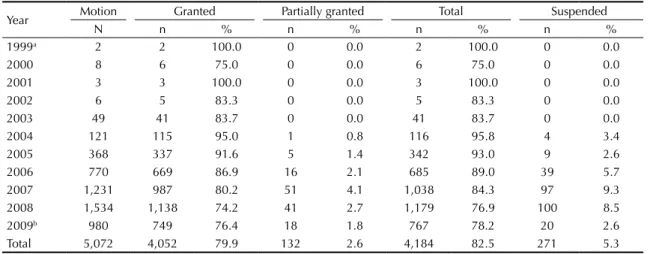
Table 1 shows the distribution of the proportion of injunction motions granted in the speciied course of time, according to the procedural variables, judicial representation, type of claim, defendant, and court in which the claim was iled. Out of the 5,072 injunction motions selected, 4,052 (79.9%) were fully granted and 132 (2.6%) were partially granted, totaling 4,184 (82.5%). By excluding the initial years (1999-2002) because of less occurrence, the granting of injunctions varied from 95.8% in 2004 to 76.9% in 2008, considering that the defendant could seek to reverse the decision by iling an appeal with the court thereafter. Table 1 shows that by 2003, the appeals did not result in suspension and in 2007 – the year with the highest number of suspended injunctions – approxi-mately 10.0% of the granted motions in the irst instance were reversed by the Court. Although, the data analyzed show the number of suspended injunctions, but do not indicate the number of appeals iled thereafter.
Table 2 shows the proportion of granted injunctions in cases with and without representation by legal counsel. All cases without legal representation were found in ordinary lawsuits, representing 14.4% present in this type of lawsuit. The ability to appeal the judiciary inde -pendent of having an attorney is an exception in the Brazilian legal system, established in Article 9 of Law 9,099/95 as well as in Article 10 of Law 10,259/2001. In cases where legal representation was involved, the proportion of acceptance was above 80.0%, more than
the lawsuits iled without legal representation, which did not exceed 66.9% of the approvals. Despite lower acceptance rates, injunctions petitioned without the aid of a legal counsel, where they were granted, were in most cases conirmed after appeal. The cases in which there was legal representation, petitions made by public defenders achieved greater success (86.9% granted) and the acceptance rate of the injunctions requested by the center for legal assistance (84.6%) exceeded the motions moved by private attorneys (82.7%). The granting of injunctions iled in public civil actions (89.1%) was superior to those recorded for ordinary lawsuits (82.8%) and writs of mandamus (80.1%). However, the suspension of the injunctions in public civil action was 3.1% higher than that in ordinary actions, and 6.4% higher when compared with the writs of mandamus. The Federal Courts granted only 68.6% of the injunctions, whereas the State Courts granted 84.8%.
Table 3 shows the time required for a decision on a motion for injunction in the irst instance. Out of 5,072 injunction motions, 48.2% were decided within a week and 70.0% within 30 days. The time between the date of the motion and decision interfered in the results of the injunction with proportionately greater accep -tance for motions granted in very short period of time.
Although there were 6,237 diagnoses in total, covering 450 different diseases, most cases (85.9%) reported only one diagnosis, varying from one to twelve. As seen in Table 4, digestive system diseases and neoplasms showed a high rate of occurrence (over 87.0%) and diseases of the nervous system, mental and behavioral disorders, and diseases of the skin and subcutaneous tissue received granting below 78.6% and also showed a high proportion of suspended injunctions (10.9%). However, there was a similar proportion of suspended injunctions in the diseases related to blood and blood-forming organs as well as in some immune disorders (n = 48) that obtained 98.0% of acceptance. The diseases in Chapter XX of the ICD-10, referring to the external causes of morbidity and mortality (V01 to Y98), were not claimed. There was no signiicant difference between the approval process of cases involving just one disease and those with multiple illnesses.
The comparison of acceptance proportion from the area of iling (capital or inland) indicated greater accep-tance in the counties of the capital. A difference in acceptance rates was also observed in different judicial sectors.g The analysis from the judicial sectors showed 20.8% variation among sectors, with Uberlândia recording the lowest percentage of acceptance (72.6%
f Ministério da Ciência e Tecnologia; Conselho Nacional de Desenvolvimento Científico e Tecnológico; Ministério da Saúde. Edital MCT/
CNPq/MS-SCTIE-DECIT/CT-Saúde 33/2007. Brasília (DF); 2007.
g O setor judiciário é uma divisão administrativa que consiste no agrupamento de comarcas de uma mesma região. Tribunal de Justiça de
of 489 injunctions) and Divinópolis with the highest percentage of acceptance (93.4% of 274 injunctions).
Only one drug had been suits filed against in 68.9% of motions, while in 96.1% of cases, up to eight were iled suit against. A single case had up to 27 drugs iled suit against. Ultimately, 9,932 medicines repre-senting 699 different drugs were recorded. The medi -cines with the highest numbers of lawsuits iled against were adalimumab (362, 83.7% of acceptance), etanercept (289, 77.2% of acceptance), and suporte nutricional (nutritional support – 237, 77.2% of acceptance). The drugs paroxetine (31), somatropin (26), and ferrous sulfate (19) received 100% acceptance. Escitalopram (28),
sodium diclofenac (23), and nortriptyline (18) received less than 54.0% of the suits accepted. The anatomical group P (antiparasitic products, insecticides, and repel -lents) had the lowest rate of acceptance (71.4%), but in none of the cases were the injunctions for this group of drugs suspended. The anatomical group H (systemic hormonal preparations, excluding sexual hormones and insulin) was not surpassed and had 85.7% of injunc -tion mo-tions granted preliminary. The presence of other items, along with drug petitions did not signiicantly alter the proportion of acceptances; however, they were 11.7% higher when the prescription was attached to the motion (n = 4,719), 5.6% higher with medical report attached (n = 4,051), and 2.7% higher in motions with a
Table 1. Annual distribution of granted injunctions. Minas Gerais, Southeastern Brazil, 1999-2009.
Year Motion Granted Partially granted Total Suspended
N n % n % n % n %
1999a 2 2 100.0 0 0.0 2 100.0 0 0.0
2000 8 6 75.0 0 0.0 6 75.0 0 0.0
2001 3 3 100.0 0 0.0 3 100.0 0 0.0
2002 6 5 83.3 0 0.0 5 83.3 0 0.0
2003 49 41 83.7 0 0.0 41 83.7 0 0.0
2004 121 115 95.0 1 0.8 116 95.8 4 3.4
2005 368 337 91.6 5 1.4 342 93.0 9 2.6
2006 770 669 86.9 16 2.1 685 89.0 39 5.7
2007 1,231 987 80.2 51 4.1 1,038 84.3 97 9.3
2008 1,534 1,138 74.2 41 2.7 1,179 76.9 100 8.5
2009b 980 749 76.4 18 1.8 767 78.2 20 2.6
Total 5,072 4,052 79.9 132 2.6 4,184 82.5 271 5.3
a October to December.
b January to October.
Table 2. Distribution of granting according to procedural variables. Minas Gerais, Southeastern Brazil, 1999-2009.
Procedural variable Motion Granted Partially granted Total Suspended
N n % n % n % n %
Legal representative of the beneficiary
Legal attorney 2,807 2,273 81.0 48 1.7 2,321 82.7 162 7.0
Public defender 1,175 971 82.6 50 4.3 1,021 86.9 73 7.1
Center for legal Assistance 188 151 80.3 8 4.3 159 84.6 9 5.7
Without representation 511 324 63.4 18 3.5 342 66.9 4 1.1
Not informed 391 333 85.1 8 2.1 341 87.2 23 6.7
Claim filed
Public civil action 284 242 85.2 11 3.9 253 89.1 26 10.3
Ordinary action 3,312 2,640 79.7 103 3.1 2,743 82.8 198 7.2
Writ of mandamus 1,443 1,139 78.9 18 1.2 1,157 80.1 45 3.9
Other 33 31 93.9 0 0.0 31 93.9 0 0.0
Defendant
State only 3,528 2,890 81.9 72 2.0 2,962 83.9 209 7.1
More than one defendant 1,544 1,162 75.3 60 3.9 1,222 79.2 62 5.1
Filing court
Federal 707 460 65.1 25 3.5 485 68.6 8 1.1
State 4,365 3,592 82.3 107 2.5 3,699 84.8 263 6.0
single drug. Among the drugs litigated against, 54.5% are standardized in the RENAME 2013 list of drugs, with the granting of injunctions in 81.1% of the cases. This inding did not differ signiicantly relative to drugs not listed in the RENAME.
DISCUSSION
Among all cases with injunctions, 4,184 out of 5,072 cases were granted. Granting varied from 95.8% in 2004 to 76.9% in 2008. The result of the injunctions varied according to the type of claim iled, with higher acceptance of public civil actions, and lower acceptance of cases with writ of Mandamus. Where there was legal representation, acceptance exceeded up to 80.0% and in cases without represen-tation, it did not exceed more than 66.9%. The court also led to different results for injunction motions. Digestive system diseases and neoplasms showed up to 87.0% granting, while diseases of the nervous system, mental and behavioral disorders, and diseases of the skin and subcutaneous tissue, received granting less than 78.6% times and showed a high proportion of suspended injunctions (10.9%). As for the drugs, some were granted in all opportunities and others in only half of the cases.
The proportion of motions granted, which are veriied in this study (82.5%), was below the results achieved by other studies because the literature does not report approval percentage of less than 90.0%, and in some cases, it reports 100% approval.1,8,9,11 Data referring to the results of injunction motions indicate that the development of the phenomenon and the subsequent maturing of discussions resulted in a stricter judi -ciary – in Minas Gerais, between 2004 and 2008, the proportion of motions granted dropped from 95.8% to 76.9%, and the proportion of injunctions suspended after appeals iled increased. This maturing process
was accompanied by a consensus on the need to create focused interagency structures in order to provide tech -nical assistance to the magistrates, which, in turn, could constitute the basis for greater judicial rigor, pursuant to Recommendation 31 of the National Council of Justice (CNJ).h However, one still needs to perform speciic tests to check whether the proportional decrease in the deferrals was the result of greater rigor, and if it was, would there be a relationship between greater rigor and imposition of more secure and cost-effective beneits. In the case of Minas Gerais, the CNJ’s recommenda-tion encouraged the crearecommenda-tion, in December 2010, of the State Executive Committee for Health,i which,
in turn, developed partnership between the Court of Minas Gerais and the Center for Health Technology Assessment of UFMG’s Hospital das Clínicas. Since 2010, this partnership has provided the magistrates the technical documentation to assist them in their decisions when assessing clinical issues presented in lawsuits involving health care. In 2014, the partnership also began to assist in actions involving supplementary health care.j Since the database of this study contained
lawsuits from 1999 to 2009, the introduction of expert opinion in the evaluation of the actions did not contem -plate a sensitive variable.
The time required to grant the injunctions is an impor -tant indicator to portray the extent to which health care claims are treated as emergencies by the judiciary. This study reinforces the results achieved by other studies by showing that, in most cases, the approval occurred within 30 days, and a considerable proportion of the motions were granted within a week.8,9,k However, we still need to investigate whether the perception of urgent health care assessed by the judiciary is supported by scientiic standards, especially after the creation of institutional technical support structures. As for the relationship between the time and proportion of motions attended to, those that were decided in lesser
Table 3. Distribution of the granting of injunctions according to the time for decision. Minas Gerais, Southeastern Brazil, 1999-2009.
Time Motion Granted Partially granted Total
n % n % n % n %
Up to 1 day 266 5.2 250 93.9 2 0.8 252 94.7
Up to 1 week 2,180 43.0 1,950 89.4 3 0.1 1,953 89.5
Up to 30 days 1,054 20.8 894 84.9 3 0.2 897 85.1
Over 30 days 978 19.3 772 78.9 4 0.4 776 79.3
Date unknown 594 11.7 186 31.2 120 20.3 306 51.5
Total 5,072 100.0 4,052 100.0 132 100.0 4,184 100.0
h Recomendação nº 31 de 30 de março de 2010. Recomenda aos Tribunais a adoção de medidas visando a melhor subsidiar os magistrados e demais
operadores do direito, para assegurar maior eficiência na solução das demandas judiciais envolvendo a assistência à saúde. DJ. 7 Abr 2010:4-6.
i Tribunal de Justiça de Minas Gerais. Magistrado do TJMG integra Fórum Nacional do Judiciário para a Saúde. Minas Gerais; 2013 [cited
2014 Mar 30]. Available from: http://tj-mg.justica.inf.br/noticia/2013/10/magistrado-tjmg-integra-forum-nacional-judiciario-saude
j Tribunal de Justiça de Minas Gerais. Convênio vai orientar magistrados nas ações envolvendo saúde. Minas Gerais; 2014 [cited 2014 Mar 30].
Available from: http://www.tjmg.jus.br/portal/imprensa/noticias/convenio-vai-orientar-magistrados-nas-acoes-envolvendo-saude-1.htm#.Uzi0mqhdU0g
k Camargo IA. Análise das demandas judiciais para o tratamento da artrite reumatoíde no Estado de São Paulo [MA dissertation]. Sorocaba:
periods showed the highest proportion of approvals. This inding indicates the need to verify the existence of the association between the time of acceptance and the effective provision of technical assistance.
The prevalence of chronic diseases observed is similar to the indings of other studies.8.13 There was no unifor -mity of approval when cases were analyzed on the basis of the diagnosed diseases. The trend indicates that the court’s decision is sensitive to the potential risk to the patient. The need for quicker treatment in order to achieve the best treatment or the possibility of a cure may have inluenced the formation of an emergency; the diseases related to blood and blood-forming organs
were superior in their approvals to cases involving chronic diseases or long-term treatments, such as skin diseases and mental disorders. It is conjectured that the inancial impact of treatment may have touched the judges as well, since diseases, which initially do not involve emergencies, but then require very expensive treatment at later stages, showed approvals similar to those with imminent risk.
The comparison of approval proportions based on the type of action indicated a higher proportion of the granting of injunctions in public civil actions, contrary to expectations. Valle & Camargo10 argue that the statements given at the public hearing held in
Table 4. Distribution of the results of injunctions related to disease classified by WHO/ICD-10. Minas Gerais, Southeastern Brazil, 1999-2009.
Disease according to chapter of ICD-10 Motion Granted
Partially
granted Total Suspended
N n % n % n % n %
D50-D89 III Diseases of the blood and blood-forming organs, and certain immune disorders
48 44 91.7 3 6.3 47 98.0 5 10.4
XVI P00-P96 Certain conditions originating in the perinatal period
14 13 92.9 0 0.0 13 92.9 0 0.0
XI K00-K93 Diseases of the digestive system 323 284 87.9 5 1.5 289 89.4 8 2.5
XVII Q00-Q99 Congenital malformations,
deformations and chromosomal abnormalities 60 50 83.3 3 5.0 53 88.3 2 3.3
II C00-D48 Neoplasms [Tumors] 495 428 86.5 3 0.6 431 87.1 30 6.1
XIX S00-T98 Injury, poisoning, and certain
other consequences of external causes 53 39 73.6 7 13.2 46 86.8 9 17.0
X J00-J99 Diseases of the respiratory system 234 190 81.2 12 5.1 202 86.3 15 6.4
XIV N00-N99 Diseases of the genitourinary
system 151 117 77.5 12 7.9 129 85.4 7 4.6
XV O00-O99 Pregnancy, childbirth, and
puerperium 13 11 84.6 0 0.0 11 84.6 0 0.0
IX I00-I99 Diseases of the circulatory system 626 481 76.8 38 6.1 519 82.9 23 3.7
III A00-B99 Certain infectious and parasitic diseases
174 142 81.6 2 1.1 144 82.7 11 6.3
IV E00-E90 Endocrine, nutritional, and metabolic diseases
680 543 79.9 19 2.8 562 82.7 35 5.1
XIII M00-M99 Diseases of the musculoskeletal system and connective tissue
887 714 80.5 18 2.0 732 82.5 62 7.0
VII H00-H59 Diseases of the eye and
adnexa 139 111 79.9 1 0.7 112 80.6 6 4.3
VI G00-G99 Diseases of the nervous system 407 293 72.0 27 6.6 320 78.6 10 2.5
V F00-F99 Mental and behavioral disorders 481 363 75.5 9 1.9 372 77.4 20 4.2
XVIII R00-R99 Symptoms, signs, and abnormal clinical and laboratory findings not classified elsewhere
48 36 75.0 1 2.1 37 77.1 4 8.3
XXI Z00-Z99 Factors influencing health
condition and contact with health services 30 23 76.7 0 0.0 23 76.7 0 0.0
VIII H60-H96 Diseases of the ear and
mastoid process 4 3 75.0 0 0.0 3 75.0 0 0.0
XII L00-L99 Diseases of the skin and subcutaneous tissue
156 113 72.4 2 1.3 115 73.7 17 10.9
CID not specified or invalid 931 931 76.7 42 3.2 973 79.9 68 5.6
2009 in the Supreme Court indicate a pattern by the judiciary toward the greater acceptance of individual claims, given that the inancial impact of the judicial action would not be as evident as that in class actions. Even with 10.0% of the revoked injunctions, the public civil actions remained ahead of other types of actions in terms of acceptance proportion. However, in some cases, public civil actions are managed to ensure indi -vidual rights, and it would therefore not be appropriate to assume them to always be collective. As for this aspect, in spite of Law 7,347/1985 (regulates the public civil action), establishing that it should handle cases involving collective or diffuse interests, the courts, including the High Court of Justice (precedent: REsp 931,513/RS, REsp 819,010/SP and AgRg no REsp 1328270/MG), consolidated the possibility of using the action in drug claims for a single citizen, particularly in cases of “protection by the court of hyper-vulnerable interests” (REsp 931,513/RS).
The discrepancy in approval observed from the compar -ison between the lawsuits iled in Federal and State Courts indicate the need for studies that seek to iden-tify, for each justice (State and Federal), the differences in training judges, especially with regard to health law or which propose to evaluate the distinctions related to the quality of the institutional structures created to provide technical support to the judges.
The veriication of the proportion of approvals based on the types of representation and the most successful motions made in proceedings with professional repre -sentation ratify the fact that the motions iled by lawyers favor approval. This situation questions the mechanisms established to facilitate access to justice, regardless of the representation by the legal professional given that, in principle, the use of such paths could not interfere with the patient’s chance of success, especially in cases involving health emergencies. In this sense, one should investigate the speciic aspects of the legal representa-tive’s performance that can interfere with the granting as well as clarify the reason or the reduced rate of successful cases with judicial representation with the courts of appeal.
Pepe et al8evaluated the decisions of court injunctions in the State of Rio de Janeiro, Southeastern Brazil. The authors suggested an almost absolute trend of accep -tance in the actions that petitioned for drugs. In this study, we found a maximum approval of 85.7%, with less than 70.0% acceptance near or distant from an absolute granting for the same. Considering some diseases individually, approval is almost absolute; as is the case of diseases related to the blood and blood-forming organs as well as some immune disorders in which the proportion of granting reached 98.0%. These results suggest speciic differences in the treatment of injunctions. The variation of acceptance in different
Table 5. Requested medication according to ATC/WHO Classification. Minas Gerais, Southeastern Brazil, 1999-2009.
Anatomical level Motion Granted Partially granted Total
Suspended by appeal to the
Court
N n % n % n % n %
H – Systemic hormonal preparations,
excluding sex hormones and insulin 328 269 82.0 12 3.7 281 85.7 17 5.2
J – General anti-infectives for systemic use 375 309 82.4 9 2.4 318 84.8 26 6.9
L – Antineoplastic and
immunomodulating agents 1,800 1,494 83.0 23 1.3 1,517 84.3 131 7.3
B – Blood and blood-forming organs 579 444 76.7 42 7.3 486 84.0 26 4.5
R – Respiratory system 482 380 78.8 25 5.2 405 84.0 26 5.4
A – Digestive System and Metabolism 1,518 1,167 76.9 81 5.3 1,248 82.2 66 4.3
D – Dermatological Drugs 125 91 72.8 11 8.8 102 81.6 7 5.6
G – Urogenital system and sex hormones 279 214 76.7 10 3.6 224 80.3 12 4.3
V – Various 339 252 74.3 16 4.7 268 79.0 8 2.4
C – Cardiovascular system 1,467 1,003 68.4 154 10.5 115 78.9 72 4.9
N – Nervous System 1,935 1,383 71.5 115 5.9 1,498 77.4 80 4.1
S – Sense organs 215 156 72.6 4 1.9 160 74.5 6 2.8
M – Musculoskeletal System 333 213 64.0 30 9.0 243 73.0 27 8.1
P – Antiparasitic products, insecticides,
and repellents 21 15 71.4 0 0.0 15 71.4 0 0.0
Not specified or invalid 136 89 65.4 4 2.9 93 68.3 4 2.9
Total 9,932 7,479 75.3 538 5.4 8,017 80.7 508 5.1
1. Delduque MC, Marques SB. A judicialização da política de assistência farmacêutica no distrito federal: diálogos entre a política e o direito. Rev Eletrol Tempus Actas Saude Coletiva. 2011;5(4):97-106.
2. Garapon A. O juiz e a democracia: o guardião das promessas. Rio de Janeiro: Revan; 2001.
3. Macedo EI, Lopes LC, Barberato-Filho S. Análise técnica para a tomada de decisão do fornecimento de medicamentos pela via judicial. Rev Saude Publica. 2011;45(4):706-13. DOI:10.1590/S0034-89102011005000044 4. Marques SB, Dallari SG. Garantia do direito
social à assistência farmacêutica no Estado de São Paulo. Rev Saude Publica. 2007;41(1):101-7. DOI:10.1590/S0034-89102007000100014
5. Maus I. Judiciário como super-ego da sociedade: o papel da atividade jurisprudencial na ‘sociedade órfã’.
Novos Estud CEBRAP. 2000;58:185.
6. Menicucci TMG, Machado JA. Judicialization of health policy in the definition of access to public goods: individual rights versus collective rights. Braz Polit Sci Rev. 2010;4(1):33-68.
7. Moro SF. Jurisdição constitucional como democracia. São Paulo: Editora Revista dos Tribunais; 2004.
8. Pepe VLE, Ventura M, Sant’ana JMB, Figueiredo TA, Souza VR, Simas L, et al. Caracterização de demandas judiciais de fornecimento de medicamentos “essenciais” no Estado do Rio de Janeiro, Brasil. Cad Saude Publica. 2010;26(3):461-71. DOI:10.1590/S0102-311X2010000300004
9. Sant’ana JMB, Pepe VLE, Figueiredo TA, Osorio-de-Castro CGS, Ventura M. Racionalidade terapêutica: elementos médico-sanitários nas demandas judiciais de
medicamentos. Rev Saude Publica. 2011;45(4):714-21.
DOI:10.1590/S0034-89102011005000042 10. Valle GHM, Camargo JMP. A audiência pública
sobre a judicialização da saúde e seus reflexos na jurisprudência do supremo tribunal federal. Rev Direito Sanit. 2011;11(3):13-31.
11. Ventura M, Simas L, Pepe VLE, Schramm FR.
Judicialização da saúde, acesso à justiça e a efetividade do direito à saúde. Physis. 2010;20(1):77-100. DOI:10.1590/S0103-73312010000100006
12. Vianna WL. A judicialização da política e das relações sociais no Brasil. Rio de Janeiro: Revan; 1999. 13. Vieira FS, Zucchi P. Distorções causadas pelas
ações judiciais à política de medicamentos no Brasil. Rev Saude Publica. 2007;41(2):214-22. DOI:10.1590/S0034-89102007000200007
REFERENCES
This study was supported by the Conselho Nacional de Desenvolvimento Científico e Tecnológico (CNPq – Process
551495/2007-3) and by the Fundação de Apoio à Pesquisa de Minas Gerais (FAPEMIG – Notice MS/CNPq/FAPEMIG/SES
09/2009, Process EFP-00001059). The authors declare no conflict of interest.
anatomical groups of the ATC indicates that some treat-ments may inluence the court’s decision.
We observed the exploratory character of the statistical method chosen to establish the differences between the groups. Although the number of evaluated cases was lower in the early years and demanded correction of continuity, the approach to the whole period adds repre -sentativeness to the study of the phenomenon. Given the results, in-depth statistical analyses should be prepared to make speciic comparisons and enable further knowledge on the elements that inluence the outcome of judicial