DOI: 10.1590/0004-282X20160149
ARTICLE
High prevalence of neuropathic pain in the
hand of patients with traumatic brachial
plexus injury: a cross-sectional study
Alta prevalência de dor neuropática em sujeitos com lesão traumática do plexo braquial:
um estudo de corte transversal
Marcus V. B. Santana1,2, Mauro T. Bina3, Matheus G. Paz3, Scheila N. Santos3, Manoel J. Teixeira4,
Irina Raicher4, José V. Martins5, Daniel C. Araujo Andrade4, Abrahão F. Baptista1
Traumatic brachial plexus injury (TBPI) is a highly
dis-abling condition, commonly seen in young men. his injury
leads to diiculties in performing upper limb movements, sen
-sory changes, emotional disturbances and pain1,2,3. he preva
-lence of pain in TBPI varies between 24% and 95% and can occur immediately after the injury or several days or months
after the traumatic event3. Over 50% of individuals with TBPI
experience pain4,5,6,7,8,9,10, which is generally described as shoot
-ing, smash-ing, burning or electric shocks11,12.
he origin of the pain is not clearly established, and this may be a confounding factor for treatment. Furthermore, it is important to distinguish nociceptive from neuropathic
pain. he nervous system lesion may explain the manifes
-tation of neuropathic pain, but injuries to musculoskeletal
1Universidade Federal da Bahia, Faculdade de Medicina, Programa de Graduação em Medicina e Saúde, Salvador BA, Brasil;
2Faculdade de Medicina Baiana e Saúde Pública, Salvador BA, Brasil;
3Universidade Federal da Bahia, Faculdade de Medicina, Salvador BA, Brasil;
4Universidade de São Paulo, Faculdade de Medicina, Departamento de Neurologia, São Paulo SP, Brasil;
5Universidade Federal do Rio de Janeiro, Instituto Deolindo Couto de Neurologia, Rio de Janeiro RJ, Brasil.
Correspondence: Marcus V. B. Santana; Universidade Federal da Bahia, Instituto de Ciências da Saúde; Av. Reitor Miguel Calmon, s/n / sala 306; 40110-902 Salvador BA, Brasil; E-mail: [email protected]
Conflict of interest: There is no conlict of interest to declare.
Received 14 April 2016; Received in inal form 20 July 2016; Accepted 16 August 2016.
ABSTRACT
Objective:To describe the pain proile of patients with traumatic brachial plexus injury. Methods: We enrolled 65 patients with traumatic brachial plexus injury. The Douleur Neuropathique 4 questionnaire was used to classify pain and the SF-36 was used to evaluate quality of life. Results: The patients with traumatic brachial plexus injury were predominantly young male victims of motorcycle accidents. Pain was present in 75.4% of the individuals and 79% presented with neuropathic pain, mostly located in the hands (30.41%). The use of auxiliary devices (p = 0.05) and marital status (p = 0.03) were both independent predictors of pain. Pain also impacted negatively on the quality of life (p = 0.001). Conclusions: Pain is frequent in patients with traumatic brachial plexus injury. Despite the peripheral nervous system injury, nociceptive pain is not unusual. Pain evaluation, including validated instruments, is essential to guide optimal clinical management of patients with the condition.
Keywords: brachial plexus; nociceptive pain; pain; peripheral nerve injuries.
RESUMO
Objetivo: Descrever o peril de dor de sujeitos com lesão traumática do plexo braquial. Métodos: Nós incluímos 65 indivíduos com lesão traumática do plexo braquial. O Douleur Neuropathique 4 foi usado para classiicar a dor e o SF-36 foi usado para avaliar a qualidade de vida. Resultados: Sujeitos com lesão traumática do plexo braquial eram em sua maioria homens jovens, vítimas de acidentes motociclísticos. A dor esteve presete em 75.4% dos indivíduos e 79% deles apresentaram dor neuropática, mais frequentemente localizada nas mãos (30.41%). O uso de dispositivos auxiliares (p = 0.05) e o estado civil foram, ambos, preditores independentes de dor. A dor ainda impactou negativamente da qualidade de vida (p = 0.001). Conclusões: A dor é frequente em sujeitos com lesão traumática do plexo braquial. Apesar de envolver uma lesão do sistema nervoso a dor nociceptiva não é infrequente. A avaliação da dor, incluindo instrumentos validados, é essencial para direcionar as condutas clínicas de sujeitos com esta condição.
structures, such as bones and soft tissues, could explain the
onset of nociceptive pain5,13. Although some studies classify
the pain present in TBPI according to well-established crite
-ria5,9, many merely assume that pain is neuropathic given the
presence of the brachial plexus injury6,7. Furthermore, most
studies on pain in TBPI were not designed to describe the painful proile in this condition7,8.
Giving the lack of detailed information about the pain proile in individuals with traumatic brachial plexus injury, this study had two objectives: a) to classify the type of pain as neuropathic or nociceptive; and b) to describe associations among pain characteristics, demographic data, quality of life, and symptoms of anxiety/depression.
METHODS
his cross-sectional study was conducted between June 2011 and September 2013 in three Brazilian referral centers. We included patients with TBPI, diagnosed by a neurologist.
Exclusion criteria were: (1) Patients with psychiatric disor
-ders or cognitive impairment that would prevent accurate answers to the questions of the study; (2) Individuals who were submitted to surgeries on the central nervous system; (3) Individuals with a history of non-traumatic diseases of the peripheral nervous system; (4) Individuals with a history of cervical spine disease, thoracic outlet syndrome and prior neuropathy in the afected arm; (5) Participants presenting with peripheral nerve injuries in both upper limbs.
Outcomes
Pain location was evaluated using a body map, and its intensity with a 0-100 Visual Analog Scale classiied as low (below 25), moderate (between 25 and 75) and high intensity (up to 75). Sociodemographic data and information related
to pain duration were also collected. he irst seven ques
-tions of the Brazilian version of the Douleur Neuropathique
4 questionnaire14 were used to classify pain as neuropathic
or nociceptive. Scores over three were considered as neuro
-pathic pain15. Anxiety and depression were evaluated with
the Hospital Anxiety and Depression Scale, and quality of
life by the 36-item Short Form Health Survey (SF-36) ques
-tionnaire. he Brazilian Criteria for Market Research was used to determine social class. he sample size calculation
was based on a previous study5 showing that the prevalence
of neuropathic pain in patients with TBPI was 67%, with an absolute estimation accuracy of 15% and alpha value of 5%. he required number was 40 patients, which was expanded to 65 in view of the diferences between the conditions in the three diferent pain centers.
To avoid possible biases, the following precautions were
taken: the sample size calculation was based on a previ
-ous study5; the evaluations were conducted by a trained
team and all of them were standardized; all assessment
instruments were validated and had good levels of reliability in their implementation; participants who needed assistance with communication were excluded; the study followed the
recommendations of the STROBE Guideline16.
Statistical analysis
he descriptive analysis was carried out for the
socio-demographic variables, prevalence, type, location and tem
-poral characteristics of pain. To assess the impact of those variables on pain we used multivariate logistic regression. Univariate logistic regression models were adjusted for
all the explanatory variables. he variables with a signii
-cance level of p < 0.20 were entered into a single model, and
an automatic stepwise selection procedure was then per
-formed, with only those variables with p < 0.05 remaining in the model. he Hosmer-Lemeshow test was used to verify that the regression model was appropriate. To compare the quality of life of patients with and without pain, the t-test for independent samples was used, with 5% signiicance level. he Fisher’s exact test was used to assess the association between pain and anxiety and between pain and depression. he G-test was used to evaluate the association between pain and the frequency of physiotherapy, assistive device usage, level of injury and surgery.
Participants and ethical considerations
his study was approved by the Institutional Review
Board from Climério de Oliveira Maternity Hospital, num
-ber 022/11 (blinded). All patients gave written informed con
-sent to participate. his study included a total of 65 individu
-als with TBPI. Participants were mostly young males, single,
belonging to the middle class, had completed secondary or
higher education and were unemployed (Table 1).
RESULTS
he majority of patients were right handed (n = 36, 44.6%),
the time from injury was 78 ± 88 week and the time between
injury and surgery was 29 ± 40 weeks. he most common
cause of trauma was motorcycle accidents (n = 47, 73.4%), fol
-lowed by automobile accidents (n = 7, 10.9%). he remaining causes included being run over, falling from a height, occu
-pational accidents, electric shock, vertical impact injury and others. Individuals referred had movement limitations as the main cause of discomfort (n = 35, 53.8%), followed by pain (n = 20, 30.8%). Other problems, such as diiculty in inding a
job or not working, tingling or numbness, aesthetics, and pare
-sis were less common. he main associated injuries, measured by the number of events that occurred, were fracture of long
bones (n = 23, 36.9%), head injury (n = 8, 12.1%), loss of con
-sciousness (n = 6, 9%), and luxation of a lower limb extrem
-ity (n = 6, 7.5%). he other less frequent events included verte
he logistic regression analysis was used to evaluate inde
-pendent predictors of pain. he variables selected from uni
-variate analysis (Table 2) to compose the multi-variate model were marital status, auxiliary device usage and physiotherapy or occupational therapy. In multivariate analysis, auxiliary device usage and marital status were independent predictors of pain. Subjects who were married or divorced had a greater chance of having pain than those who were single (OR = 4.75 (1,09–17,17); p < 0.05). Patients who used a sling or sling asso
-ciated with another auxiliary device tended to have pain more regularly than those who did not use these devices (OR = 4.32 (1,00–18,69); p = 0.051). he model was adequate according to
the results of the Hosmer-Lemeshow test (X2 = 1.520, p = 0.823).
Depressive states were found in seven patients (10.8%) and anxiety in 20 (30.8%). Similar results were found when only individuals with pain were evaluated and 17 (34.7%) patients had states of anxiety and seven presented with depression (14.3%). here was no association between pain and anxiety (p = 0.349) or depression (p = 0.182). here was an association between pain scores assessed by the Visual
Analog Scale and quality of life regarding functional capac
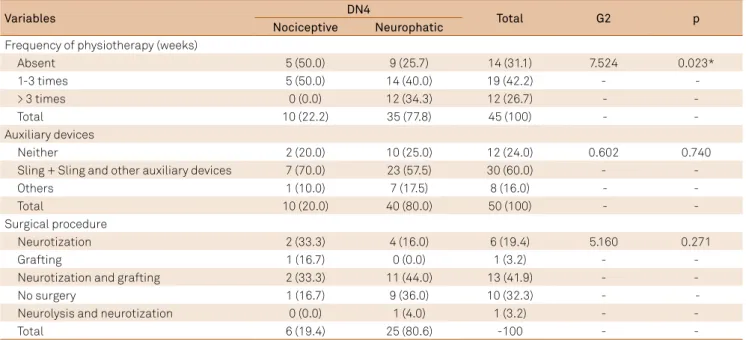
-ity items (t = 2.138, p < 0.050) and pain (t = 5.594, p < 0.001). Participants who did not feel pain regularly presented with higher scores for quality of life than those who presented with chronic pain (Figure 2). No associations were found between the frequency of physiotherapy, auxiliary device use, surgical procedure and pain intensity. Regarding the auxiliary device use, the diference was borderline (G = 9,272; p = 0.055), with individuals who used a sling or sling associated with another auxiliary device presenting more moderate pain than others. Evaluation of the relationship between these variables and the type of pain showed that individuals with neuropathic pain attended physical therapy more often (Tables 3 and 4). fracture of facial bones, vascular injury, luxation of an upper
limb extremity/ligament injury, cardiovascular arrest, fracture of lower limb extremity bones, and pulmonary injury.
he prevalence of pain was 75.4% (n = 49), and neuro
-pathic pain appeared in 79.2% (n = 38) of patients. Of these, 32 participants presented with associated injuries, the most common being a fracture of long bones (23 times, 36.9%). Movement limitations and pain were the most reported
complaints (Table 1). Data were missed in a small propor
-tion due to religion (1.5%), marital status (1.5%), educa-tional degree (1.5%), occupation (3%) and trauma etiology (1.5%),
Of the 65 test patients, 48 patients reported 217 loca
-tions of pain, and the most cited sites were the hands (n = 66, 30.41%), followed by the forearm (n = 52, 23.96%). he chest and shoulder region (n = 42, 19.35%) and arms (n = 38, 17.51%) showed similar frequencies. he neck and head were the least cited (n = 19, 8.76%) (Figure 1). Data was
missing in one participant.
Table 1. Socio-demographic data of patients with traumatic brachial plexus injury (n = 65).
Variables n (% Mean/SD)
Gender
Male 58 (89,2)
Age 30 ± 11
Marital status
Single 37 (57.8)
Married/ Divorced 27(42.2)
Educational degree
≤ 6 years of study 2 (3.1)
≤ 7 years of study 9 (14.1)
≤ 11 years of study 14 (21.9)
≤ 14 years of study 36 (56.2)
≤ 19 years of study 3 (4.7)
Occupation
No occupation/ Retired/ Unemployed 10 (16.1)
Away from work 44 (71)
Employed 8 (12.9)
Social class
Middle class 45 (69.2)
Lower class 20 (30.8)
Pain
No 16 (24.6)
Yes 49 (75.4)
Type of pain
Neuropathic pain 38 (79.2)
Nociceptive pain 10 (20.8)
Pain intensity (VAS) 46 (33)
Duration of pain (weeks) 58 (92)
Number of pain sites
One site 13 (26.5)
Two sites 12 (24.5)
Three sites 14 (28.6)
Four sites 8 (16.3)
Five sites 1 (2)
SD: standard deviation; VAS: visual analogue scale. Figure 1. Frequency of pain according to location in the body.
19,35% 8,76%
17,51%
23,96%
FC: functional capacity; LPA: limitation by physical aspects; HGS: health general status; SA: social aspects; LEA: limitation by emotional aspects; MH: mental mealth.
Figure 2. Association between quality of life and pain. The results showed signiicant association between functional capacity and pain. Subjects with pain presented with worse functional capacity results (p = 0.038*).
*
FC LPA Pain HGS Vitality S A LEA MH
120.0
100.0
80.0
60.0
40.0
20.0
-20.0 0
Pain No Yes Table 2. Univariate analysis between pain and socio-demographic data and pain and physiotherapy.
Variables OR* Not adjusted (IC95%) p OR* Adjusted (IC95%) p
Age 1.02 (0.96–1.08) 0.507
Marital status
Single 1.00 - 1.00
-Married/divorced 4.33 (1.09–17.17) 0.037 4.75 (1.12–20.22) 0.035
Educational degree
High school or college 1.00 - -
-Complete basic education 1.44 (0.34–6.17) 0.623 -
-Incomplete basic education 1.77 (0.33–9.52) 0.507 -
-Occupation
Employed 1.00 - -
-No occupation/retired/unemployed 2.40 (0.29–19.78) 0.419 -
-Away from work 1.80 (0.37–8.79) 0.468 -
-Race
Non white 1.00 - -
-White 1.00 (0.24–4.26) 1.000 -
-Auxiliary devices
Neither 1.00 - 1.00
-Sling or sling associated with other auxiliary devices* 4.61 (1.13–18.92) 0.034 4.32 (1.00–18.69) 0.051
Others 1.15 (0.27–4.87) 0.854 0.89 (0.19–4.22) 0.893
Level of injury
Complete injury 1.00 - -
-Incomplete injury 1.56 (0.25–9.65) 0.631 -
-Social class
Middle class 1.00 - -
-Lower class 1.46 (0.41–5.23) 0.566 -
-Physiotherapy or occupational therapy*
Yes 1.00 - -
-No 5.42 (0.65–45.18) 0.119 -
DISCUSSION
his study aimed to estimate the prevalence of pain in patients with TBPI, establish location patterns, intensity, temporal behavior and pain scores. Furthermore, we aimed
to verify the impact of pain on the quality of life. he preva
-lence of pain was 75.4%, and the most common type of pain
was neuropathic, located in the hand region. he main con
-tribution of this study was to assess patients from three dif
-ferent reference centers, using validated instruments and exploring a range of pain characteristics in these individu
-als, which has not been described systematically in the litera
-ture. here was no association between pain and anxiety or
depression, although anxiety is present in approximately one
Table 3. Association between pain intensity and clinical and surgical variables.
Variables VAS* major pain Total G2 p
Low intensity Moderate intensity High intensity
Frequency of physiotherapy 5 (33.3) 8 (53.3) 2 (13.3) 15 (25.4) 6.527 -
Absent 5 (33.3) 8 (53.3) 2 (13.3) 15 (25.4) 6.527 0.163
1-3 times/week 11 (39.3) 6 (21.4) 11 (39.3) 28 (47.5) - -
> 3 times 8 (50.0) 5 (31.3) 3 (18.8) 16 (27.1) - -
Total 24 (40.7) 19 (32.2) 16 (27.1) 59 (100) --
Auxiliary devices
Neither 10 (55.6) 2 (11.1) 6 (33.3) 18 (28.1) 9.272 0.055
Sling or sling associated with
other auxiliary devices** 8 (24.2) 16 (48.5) 9 (27.3) 33 (51.6) -
-Others 6 (46.2) 4 (30.8) 3 (23.1) 13 (20.3) - -
Total 24 (37.5) 22 (34.4) 18 (28.1) 64 (100) -
-Level of injury
Complete injury 7 (33.3) 7 (33.3) 7 (33.3) 21 (63.6) 2.102 0.350
Incomplete injury 2 (16.7) 7 (58.3) 3 (25.0) 12 (36.4) - -
Total 9 (27.3) 14 (42.4) 10 (30.3) 33 (100) - -
Surgical procedure
Neurotization 7 (58.3) 3 (25.0) 2 (16.7) 12 (31.6) 10.470 0.234
Grafting 0 (0.0) 1 (100) 0 (0.0) 1 (2.6) -
-Neurotization and grafting 2 (15.4) 5 (38.5) 6 (46.2) 13 (34.2) -
-No surgery 5 (45.5) 4 (36.4) 2 (18.2) 11 (28.9) -
-Neurolysis and neurotization 0 (0.0) 1 (100) 0 (0.0) 1 (2.6) - -
Total 14 (36.8) 14 (36.8) 10 (26.3) 38 (100) -
-VAS*: visual analogue scale; G2: G-test.
Table 4. Association between type of pain and clinical and surgical variables.
Variables DN4 Total G2 p
Nociceptive Neurophatic
Frequency of physiotherapy (weeks)
Absent 5 (50.0) 9 (25.7) 14 (31.1) 7.524 0.023*
1-3 times 5 (50.0) 14 (40.0) 19 (42.2) -
-> 3 times 0 (0.0) 12 (34.3) 12 (26.7) - -
Total 10 (22.2) 35 (77.8) 45 (100) - -
Auxiliary devices
Neither 2 (20.0) 10 (25.0) 12 (24.0) 0.602 0.740
Sling + Sling and other auxiliary devices 7 (70.0) 23 (57.5) 30 (60.0) - -
Others 1 (10.0) 7 (17.5) 8 (16.0) - -
Total 10 (20.0) 40 (80.0) 50 (100) - -
Surgical procedure
Neurotization 2 (33.3) 4 (16.0) 6 (19.4) 5.160 0.271
Grafting 1 (16.7) 0 (0.0) 1 (3.2) - -
Neurotization and grafting 2 (33.3) 11 (44.0) 13 (41.9) - -
No surgery 1 (16.7) 9 (36.0) 10 (32.3) -
-Neurolysis and neurotization 0 (0.0) 1 (4.0) 1 (3.2) - -
Total 6 (19.4) 25 (80.6) -100 - -
third of the patients. Quality of life was associated with pain in items related to pain and functional capacity domains. he characteristics of sex, age, type of accident and extent of injury were similar to other studies evaluating individuals with TBPI6,7,8,10,17.
he majority of our patients had completed high school, but they were unemployed. Almost half of them had some associated injury, fractures of long bones being the most
common6. he socioeconomic proile may explain the
choice of more afordable vehicles like the motorcycle. his form of urban transport is mostly used by young men, who are then the main victims of this type of injury. he head is
pushed in the opposite direction to the shoulder, stretching the brachial plexus18.
In fact, the southeast and northeast regions have the high
-est number of motorcycles in Brazil (66%), and the number of accidents related to this type of vehicle is increasing every year, according to the National Department of Transport Infrastructure18. In a motorcycle accident, the subject falls,
hitting the ground. he Brazilian Government has developed actions to promote traic safety education, and prevention strategies have gained more attention. he number of deaths related to traic accidents has reduced and consequently the number of people with injury sequelae has increased after the implementation of laws that established penalties for drunk
driving, according to data from Brazilian Government18.
he prevalence of pain in these TBPI injuries is usually elevated5,6,8,9,10. Only one study found conlicting results7. As in
our results, the pain usually begins suddenly and is located in the hand1,11,19. In clinical practice, it has been observed that in
some cases the diagnosis of brachial plexus injury is delayed,
possibly because the subject has multiple injuries5,20. In this
case, movement limitations associated with the character
-istics of sudden localized pain in the hand could be indic
-ative of brachial plexus injury19,21. he maladaptive plastic
-ity in sensory and motor cortices, with invasion of adjacent
regions in the hand representation area may explain this
inding. Similar results were reported in patients with phan
-tom limb pain20, a condition where there is also denervation
of the afected limb.
Many patients described the pain as burning or associ
-ated with electric shocks10,11,12, consistent with the most com
-mon type of pain5,8,9. Because it is an injury of the nervous
system, it is expected that the majority of patients will pres
-ent with neuropathic pain. However, nociceptive pain cannot be ruled out. In some previous studies, pain classiication has
been made through clear diagnostic criteria5,9, but in others
the criteria have not been speciied6,7. Adopting ratings with
-out the use of established criteria may under- or overesti
-mate the diagnosis of pain, increase the chance of misguided interventions, and consequently risk therapy failure.
In this study, the independent predictors of pain were the use of a sling with or without auxiliary devices, and marital status. It has been observed that patients with
TBPI continue using the auxiliary device for long periods22
– in some cases for more than a year. his behavior may be explained by erroneous beliefs about pain, such as that immobilization may improve pain symptoms. hese results suggest that limb restriction can be a detrimental factor. It is possible that this factor is associated with complaints of pain in the hand. If there is maladaptive plasticity as a result of immobility, prevention of the use of this device and promoting early active mobilization within the individual may be possibilities for treatment.
Regarding marital status, married individuals or those who had previously been married were more likely to have pain symptoms. Similar indings have been demonstrated
elsewhere23. While it is sometimes diicult to establish why
this happens, it is possible that diiculties in living together could contribute to pain symptoms. his would be enhanced by the presence of a higher frequency of anxiety in patients
with pain, which is a common inding24.
here was loss of quality of life in the items of SF-36 scale associated with pain and functional capacity in the pain
group. In general, the quality of life in patients with periph
-eral nerve injury is worse than in normal patients and this
also applies to functional capacity25. One previous study
found diferent results when measuring quality of life in bra
-chial plexus injury26. However, the instrument used for evalu
-ation was diferent from that used in this study and in previ
-ous studies and their sample was small.
An evaluation of musculoskeletal sources of pain through
a more detailed history and physical examination with pres
-sure threshold mea-surements, range of motion tests, muscle
strength and electromyographic signals could contribute to
further information about the pain. Future research monitor
-ing individuals dur-ing the follow-up phase is important for a
better understanding of the evolution of pain and to under
-stand the inluence of pain on functional recovery of these patients. Because of the possibility that the pain is conse
-quent to maladaptive plasticity in the brain, neuroimaging
studies or electrophysiological tools are desirable.
This study presented some limitations: lack of infor
-mation about types of drugs used for pain treatment;
and mixed pain was not evaluated because the Douleur
Neuropathique 4 was not created for this purpose. The Leeds Assessment of Neuropathic Symptoms and Signs could have been used but it was validated to Brazilian Portuguese only after the research project was submitted to the Institutional Review Board.
In conclusion, TBPI is more common in young male
victims of motorcycle accidents who often sufer pain. Although TBPI involves a nerve injury, nociceptive pain may also occur and clear steps of pain classiication, using
validated instruments, are essential to avoid errors in diag
-nosis and treatment.
Deolindo Couto Neurology Institute – Federal University of Rio de Janeiro; Ambulatory Peripheral Nerve Lesions from the Psychiatric Institute, Clinical Hospital – Faculty of Medicine
of São Paulo University; Lyn T Yeng; Ricardo Galhardoni; José M Siqueira; José FG Corrêa; Juliana Maia; Gustavo Pacheco;
Claudia D Vargas5; José Marcos PF Lima; Israel Souza
References
1. Geertzen JH, Groothoff JW, Nicolai JP, Rietman JS. Brachial plexus neuropathy: a long-term outcome study. J Hand Surg Br. 2000; 25(5):461-4. doi:10.1054/jhsb.2000.0459
2. Novak BCB, Anastakis DJ, Beaton DE, Mackinnon SE, Katz J. Biomedical and psychosocial factors associated with disability after peripheral nerve injury. J Bone Joint Surg Am. 2011; 93(10):929-37. doi:10.2106/JBJS.J.00110
3. Privat JM, Allieu Y, Bonnel F, De Godebout J. [Pain following traumatic lesions of the brachial plexus (radicular avulsions and truncular lesions)]. Neurochirurgie. 1985;31(5):435-41. French.
4. Bruxelle J, Travers V, Thiebaut JB. Occurrence and treatment of pain after brachial plexus injury. Clin Orthop Relat Res. 1988;(237):87-95. doi:10.1097/00003086-198812000-00013
5. Ciaramitaro M, Mondelli M, Longullo F, Grimaldi F, Battiston B, Sard A et al. Traumatic peripheral nerve injuries: epidemiological findings, neuropathic pain and quality of life in 158 patients. J Peripher Nerv Syst. 2010;15(2):120-7. doi:10.1111/j.1529-8027.2010.00260.x
6. Flores LP. [Epidemiological study of the traumatic brachial plexus injuries in adults]. Arq Neuropsiquiatr. 2006;64(1):88-94. Portuguese. doi:10.1590/S0004-282X2006000100018
7. Jain DK, Bhardwaj P, Venkataramani H, Sabapathy SR. An epidemiological study of traumatic brachial plexus injury patients treated at an Indian centre. Indian J Plast Surg. 2012;45(3):498-503. doi:10.4103/0970-0358.105960
8. Kretschmer T, Ihle S, Antoniadis G, Seidel JA, Heinen C, Börm W et al. Patient satisfaction and disability after brachial plexus surgery. Neurosurgery. 2009;65(4 Suppl):A189-96. doi:10.1227/01.NEU.0000335646.31980.33
9. Vannier J-L, Belkheyar Z, Oberlin C, Montravers P. [Management of neuropathic pain after brachial plexus injury in adult patients: a report of 60 cases]. Ann Fr Anesth Reanim. 2008;27(11):890-5. French. doi:10.1016/j.annfar.2008.08.013
10. Waikakul S, Waikakul W, Pausawasdi S. Brachial plexus injury and pain incidence and the effects of surgical reconstruction. J Med Assoc Thai. 2000;83(7):708-18.
11. Berman JS, Birch R, Anand P. Pain following human brachial plexus injury with spinal cord root avulsion and the effect of surgery. Pain. 1998;75(2-3):199-207. doi:10.1016/S0304-3959(97)00220-0
12. Brill S, Aryeh IG. Neuromodulation in the management of pain from brachial plexus injury. Pain Physician. 2008;11(1):81-5.
13. Dolan RT, Butler JS, Murphy SM, Hynes D, Cronin KJ. Health-related quality of life and functional outcomes following nerve transfers for traumatic upper brachial plexus injuries. J Hand Surg Eur Vol. 2012;37(7):642-51. doi:10.1177/1753193411432706
14. Santos JG, Brito JO, Andrade DC, Kaziyama VM, Ferreira KA, Souza I et al.. Translation to Portuguese and validation of the Douleur Neuropathique 4 questionnaire. J Pain. 2010;11(5):484-90. doi:10.1016/j.jpain.2009.09.014
15. Bouhassira D, Attal N, Alchaar H, Boureau F, Brochet B, Bruxelle J et al. Comparison of pain syndromes associated with nervous or somatic lesions and development of a new neuropathic pain diagnostic questionnaire (DN4). Pain. 2005;114(1-2):29-36. doi:10.1016/j.pain.2004.12.010
16. Elm E, Altman DG, Egger M, Pocock SJ, Gøtzsche PC, Vandenbroucke JP. The Strengthening the Reporting of Observational Studies in Epidemiology (STROBE) statement: guidelines for reporting observational studies. Epidemiology. 2007;18(6):800-4. doi:10.1097/EDE.0b013e3181577654
17. Narakas AO. The effects on pain of reconstructive neurosurgery in 160 patients with traction and/or crush injury to the brachial plexus. In: Siegfried J, Zimmermann M, eds. Phantom and stump pain. Berlim: Springer; 1981. p. 126-47
18. Portal Brasil. Saúde. Brasil reduz em 5,7% número de mortes no trânsito. Brasília, DF; 2015 [cited 2016 Jul 12]. Available from: http:// www.brasil.gov.br/saude/2015/11/brasil-reduz-em-5-7-numero-de-mortes-no-transito
19. Moran SL, Steinmann SP, Shin AY. Adult brachial plexus injuries: mechanism, patterns of injury, and physical diagnosis. Hand Clin. 2005;21(1):13-24. doi:10.1016/j.hcl.2004.09.004
20. Htut M, Misra M, Anand P, Birch R, Carlstedt T. Pain phenomena and sensory recovery following brachial plexus avulsion injury and surgical repair. J Hand Surg Eur Vol. 2006;31B(6):596-605. doi:10.1016/j.jhsb.2006.04.027
21. Flor H, Nikolajsen L, Staehelin Jensen T. Phantom limb pain: a case of maladaptive CNS plasticity? Nat Rev Neurosci. 2006;7(11):873-81. doi:10.1038/nrn1991
22. Parry CB. Pain in avulsion lesions of the brachial plexus. Pain. 1980;9(1):41-53. doi:10.1016/0304-3959(80)90027-5
23. Novak CB. Rehabilitation following motor nerve transfers. Hand Clin. 2008;24(4):417-23. doi:10.1016/j.hcl.2008.06.001
24. Sá KN, Baptista AF, Matos MA, Lessa I. Chronic pain and gender in Salvador population, Brazil. Pain. 2008;139(3):498-506. doi:10.1016/j.pain.2008.06.008
25. Rocha G, Schor N. [Motorcycle accidents in the municipality of Rio Branco in the State of Acre: characterization and trends]. Ciênc Saúde Coletiva. 2013;18(3):721-32. Portuguese. doi:10.1590/S1413-81232013000300018