RESUMO
Objetivou-se verificar a associação entre a capacidade de autocuidado e os fatores sociodemográficos de pessoas com lesão medular (LM). Estudo transversal, reali-zado em 2012, em todas as 58 Unidades Básicas de Saúde de Natal/RN, Brasil. Participaram 73 sujeitos que responde-ram um formulário sociodemográfico e a Escala de Avaliação para o Autocuida-do. Foram efetuados no SPSS os testes Alfa de Conbrach, Qui-quadrado, Fisher e Coeficiente de contingência. O Alfa de Cronbach foi 0,788. Verificou-se que o sexo (p=0,028), a religião (p<0,001), a escolaridade (p=0,046), a idade atual (p=0,027), o tempo de LM (p=0,020) e o tipo de LM (p=0,012) são variáveis asso-ciadas à capacidade de autocuidado dos sujeitos. Conclui-se que os fatores socio-demográficos podem interferir na capa-cidade de autocuidado das pessoas com LM, devendo os enfermeiros considerar esse aspecto durante a execução do pro-cesso de enfermagem.
DESCRITORES
Traumaismos da medula espinhal Autocuidado
Enfermagem em reabilitação Fatores socioeconômicos
Ability for self-care and its association
with sociodemographic factors of people
with spinal cord injury
*ABSTRACT
This study aimed to verify the association between self-care ability and sociode-mographic factors of people with spinal cord injury (SCI). It was a cross-sectional study, conducted in 2012, in all 58 Basic Health Units of Natal/RN, Brazil. Seventy-three subjects completed a sociodemo-graphic form andSelf-Care Agency Scale. Statistical analyses were performed us-ing SPSS,includus-ing Cronbach’s Alpha, Chi-square, Fisher’s and contingency co-efficient tests. The Cronbach’s alpha was 0.788. The result verified that sex (p = 0.028), religion (p <0.001), education (p = 0.046), current age (p = 0.027), SCI time (p = 0.020) and the SCI type (p = 0.012) were variables associated with self-care ability of the subjects. It was concluded that sociodemographic factors may inter-fere with the self-care ability of persons with SCI, and nurses should consider this aspect during the execution of the nurs-ing process.
DESCRIPTORS Spinal cord injuries Self care
Rehabilitaion nursing Socioeconomic factors
RESUMEN
El objeivo fue veriicar la asociación entre la capacidad de autocuidado y los factores socio-demográicos en personas con lesión medular (LM). Estudio transversal llevado a cabo en el 2012, en todas las 58 unidades básicas de atención primaria de Natal/RN, Brasil. Pariciparon 73 sujetos que respon -dieron un cuesionario socio-demográico y la Escala de Evaluación de Autocuidado. Las pruebas de Alfa de Cronbach, Chi-quadrado, Fisher y Coeiciente de coningencia fueron aplicadas en el SPSS. El Alfa de Cronbach fue de 0,788. Se veriicó que el sexo (p=0,028), la religión (p<0,001), la escolaridad (p=0,046), la edad actual (p=0,027), el iem -po de la lesión medular (p=0,020) y el i-po de lesión medular (p=0,012), son variables asociadas a la capacidad de autocuidado de los sujetos. Se concluye que los factores socio-demográicos pueden interferir en la capacidad de autocuidado de las personas con lesión medular, por lo que las enferme -ras deben considerar este aspecto durante la ejecución del proceso de enfermería.
DESCRIPTORES
Traumaismos de la médula espinal Autocuidado
Enfermería en rehabilitación Factores socioeconómicos Alexsandro Silva Coura1, Bertha Cruz Enders2, Inacia Sátiro Xavier de França3, Caroline Evelin Nascimento Kluczynik Vieira4, Dândara Nayara Azevedo Dantas5, Dayane Jessyca Cunha de Menezes6
CAPACIDADE DE AUTOCUIDADO E SUA ASSOCIAÇÃO COM OS FATORES SOCIODEMOGRÁFICOS DE PESSOAS COM LESÃO MEDULAR
CAPACIDAD DE AUTOCUIDADO Y SU ASOCIACIÓN CON LOS FACTORES SOCIO-DEMOGRÁFICOS EN PERSONAS CON LESIÓN MEDULAR
* Extracted from the thesis, “Desenvolvimento e validação de instrumento para consulta de enfermagem na visita domiciliar as pessoas com lesão medular: um enfoque no autocuidado”, Universidade Federal do Rio Grande do Norte, 2012. 1Nurse. Doctoral student in nursing, Universidade Federal do Rio Grande do Norte. Natal, RN, Brazil. [email protected] 2Nurse. Doctorate. Full Professor, Department of Nursing and the Graduate Program in Nursing,Universidade Federal do Rio Grande do Norte. Natal, RN, Brazil. [email protected] 3Nurse. Doctorate. Full Professor, Department of Nursing and the Graduate Program in Nursing, Universidade Estadual da Paraíba. Campina Grande, PB, Brazil. [email protected] 4Nurse. Master’s student in nursing,Universidade Federal do Rio Grande do Norte. Natal, RN, Brazil. [email protected] 5Undergraduate nursing student,Universidade Federal do Rio Grande do Norte. Natal, RN, Brazil. [email protected] 6Undergraduate nursing student,Universidade Federal do Rio Grande do
O
r
i
g
i
n
a
l
a
r
ti
c
le
INTRODUCTION
The number of people with spinal cord injury (SCI) has
signiicantly increased in recent years, relecing the grea -ter frequency of ex-ternal trauma due to urban violence(1).
The principal causes of these injuries are motor vehicle
accidents, work, leisure, and episodes with a irearm(1-2).
However, the SCI may also be the result of non-traumaic eiologies, such as infecious, vascular, and degeneraive
diseases and malignancies(3).
Data on SCI are not yetwell established, but the
worl-dwide incidence is esimated at between nine and 50 ca -ses/million inhabitants, and it is more prevalent in large
ciies(4). In the United States, about 60 million
peoplean-nually, mostly young, are vicims of traumaic injuries. On the European coninent, trauma is the leading cause of
death in individuals up to 40 years of age(5). In Brazil,
ap-proximately 7,000 ocurrences of people with SCI per year
were veriied(6).
Since the spinal cord is the organ responsible for the
communicaion between the brain and
other body areas, SCI interferes in ner-ve pathways and can cause serious
heal-th complicaions. People wiheal-th heal-this type of damage may have a deicit in respiratory,
thermal, musculoskeletal, circulatory,
uri-nary and bowel sphincter funcions as well as in sexual acivity(3).
In addiion to the health problems men
-ioned above, the SCI is a serious public he
-alth problem, since it afects, most oten,
young people who come to depend on a
cos-tly and complex process of rehabilitaion(7).
Other aggravaing factors of such problems are the diiculty of health faciliies access for persons with disabiliies due to architec
-tural and aitudinal barriers and unfavorable socioecono
-mic factors, such as low income and educaion(8).
The sequelae of SCI undermine people’s ability to
per-form aciviies in their daily lives, such as: walking, trans -ferring, dressing, and climbing stairs. The individual with
this injury usually presents with self-care deicits, and is
considered dependent on nursing care or lay caregivers
for basic aciviies of daily living(9). Therefore, studies that
address the self-care ability of people with SCI are rele-vant, and this is the object of the study in this manuscript.
Self-care is considered the set of acions developed by
the individual to meet daily needs. The nursing care for
the subject with SCI should assist in the prevenion and treatment of complicaions associated with it, and, es
-pecially, promote rehabilitaion and help him, along with
his family, in the development of self-care to be done at home(3). Thus, it is understoodd asfundamental that the
care provided by nurses is grounded in the Systemaiza
-ion of Nursing Care(3), favoring the ideniicaion of nur
-sing diagnoses and planning of intervenion/evaluaion guided by theoreical constructs.
The research was guided by the assumpion that, in addiion to health diiculies generated by medullary da -mage, demographic and social factors may also adversely
afect the ability to develop self-care acions(9). The eiolo
-gy, type and period of SCI can impair funcional ability(10).
From this perspecive, the objecive was to verify the as
-sociaion between self-care ability and sociodemographic
factors of people with spinal cord injury.
The study was jusiied because of some gaps in publi
-caions of oicial data and workwith respect to SCI in Bra
-zil, since this condiion is not subject to compulsory noii
-caion(4); by the potenial of research to ofer subsidies for
the (re)formulaion of public policies designed to ensure the ciizenship of people with disabiliies; as well as plan
-ning nursing care in post-rehabilitaion to ensure greater
self-care and quality of life for people with SCI, with the
importance of knowledge about the relaionship between
sociodemographic factors and self-care capacity.
METHOD
This was a cross-secional and analyical study, with a quanitaive approach, per -formed in the period from January to Sep-tember of 2012, in all 58 Basic Health Units (BHU) in Natal/RN, Brazil.
No sampling technique was used; due to
logisical and temporal viability it was possi -ble to perform a census of people with SCI registered in theBHU. Thus, 73 subjects (58 paraplegics and 15 quadriplegics) who met
the eligibility criteriaparicipated: 18 years
of age or older, SCI diagnosed by aspecialist,
preserved cogniive funcion, and assigned
to one of the BHU in the city of Natal.
The strategy for approaching the subjects and data
col-lecion was the home visit, with the accompaniment of the
community health worker from the Family Health Strategy
responsible for each micro-area. At irst, the research was explained and paricipants were invited to sign the Terms of Free and Informed Consent. Thereater, people who agreed to paricipate responded to two instruments: Form I and the
Self-Care Agency Scale (ASA).
Form I was designed for the invesigaion of demogra -phic and socioeconomic variables. This instrument
inclu-ded closed quesions that were completedby the resear
-cher based on paricipant responses.
The ASA was developed based on studies with a
foun-daion in Orem’s Theory of Self Care, in which the capacity of self-care ability of the human being to perform praci
-ces of self-careis understood, in the relaionship between
the individual and the environment. The ASA is composed of 24 items, in a scale ranging from four points where the ... the spinal
cord injury is a serious public health problem, since it affects, most often, young people who come
to depend on a costly and complex
number 1 (never) corresponds to the lowest value in the self-care ability, 2 (almost never), 3 (almost always) and 4 (always) equals the maximum ability of the subject. The overall result ranges from 24 to 96 points. A score between 24-48 means low self-care capacity, 49-72 represents regu-lar self-care capacity, and 73-96 is good self-care capacity.
The validity of the ASA was studied by Evers and
Isen-berg, and was posiively related to health status in dife -rent cultures(11). This instrument was orally applied by the
researcher, and all the items of the scale were read for
each paricipant, with repeiion in cases in which it was requested. Ater reading, the scale was marked according
to the responses of the subjects.
Data were processed and analyzed by the Staisical
Package for the Social Sciences (SPSS) basis for Windows
15.0 and presented in tables. Deducive staisics were
used to describe the variables, by means of absolute and
relaive frequencies, means, standard deviaion and range of numerical distribuion.
In order to verify the internal consistency of the ASA scale in the studied sample, the Cronbach’s Alpha
test was used, considering the Item-Total Correlaion,
Cronbach’sAlpha withdeleted item, and total Cronbach’s Alpha. Total Cronbach’s Alpha values > 0.70 were
conside-red saisfactory(12).
To verify the level of signiicance between the associa
-ion of self-care capacity and sociodemographic factors, a
dichotomy of the total scores of the ASA was conducted (Dependent = low or average capacity of self-care; Inde-pendent = good capacity for self-care), the prevalence
ra-io was calculatedand compared to the proporra-ions of pre -valence using the Chi-square or Fisher when blanks were
below ive(12). To evaluate the magnitude of associaion between variables, the Coningency Coeicient and the following parameters were used: c≥0.750 = strong asso
-ciaion; 0.500 to 0.749 = moderate asso-ciaion; ≤ 0.499 = weak associaion. Conidence intervals of 95% were consi
-dered during associaionsinvesigated(12).
The project was approved by the Ethics in Research
Com-mitee of the Universidade Federal do Rio Grande do Norte, under protocol No. 223/11 and CAAE
No.0243.0.051.000-11. The ethical principles of privacy, conideniality, auto
-nomy and the right of paricipants to decline paricipaion at any ime and without onus were observed.
RESULTS
Sociodemographic Proile
As shown in Table 1, the majority of paricipants we
-re male (84.9%), single (61.7%), held -religious beliefs (83.6%), had primary school educaion (54.6%), survived with per capita monthly income up to 1 ime the mini
-mum wage (64.4%), and sufered the injury up to 34 ye
-ars of age (81.2%), mostly by traumaic injury (73.9%) and with progression to paraplegia (79.4%). The mean age at
injury was 25.48 years (± 12.11) and the mean age at the
ime of data collecion was 38.37 years (± 13.09). The me
-an ime ofSCI was 12.89 years (± 9.34).
Reliability test of the ASA scale
By means othe Cronbach’s test, the ASA scale pre
-sentedsaisfactory internal consistency for the sample
studied, with a total alpha of 0.788. According to Table 2, each item of the scale also showed good reliability.
Table 1 – Sociodemographic proile of the adults with spinal cord injury
– Natal, RN, Brazil, 2012
Variables n %
Sex Male 62 84.9
Female 11 15.1
Currentage 18 - 33 yearss 30 41.2
34 - 49 years 26 35.6
50 - 65 years 15 20.5
66 - 81 years 2 2.7
Age at the time of SCI 1 - 17 years 16 21.9
18 - 34 years 44 60.3
35 - 51 years 11 15.1
52 - 68 years 2 2.7
Religion No faith 12 16.4
Catholic 35 47.9
Evangelical 24 33
Spirtism 2 2.7
Education No schooling 1 1.4
Grade school 23 31.3
Junior high school 16 21.9
High school 24 33
College 7 9.6
Postgraduate 2 2.8
Marital Status Single 45 61.7
Married 17 23.3
Stable 5 6.8
Divorced 4 5.5
Widower 2 2.7
Per capita income 1x minimum wage* 47 64.4
2x minimum wage 18 24.7
3x minimum wage 2 2.7
≥ 4x minimum wage 4 5.5
Etiology Firearm 35 47.9
Automobile accident 19 26
Infectious disease 8 11
Fall 4 5.5
Diving into shallow water 3 4.1
Bladed Weapon 4 5.5
Time of SCI 1-10 years 35 47.9
11-20 years 26 35.6
21-30 years 9 12.4
31-40 years 3 4.1
Type of SCI Paraplegia 58 79.4
Quadraplegia 15 20.6
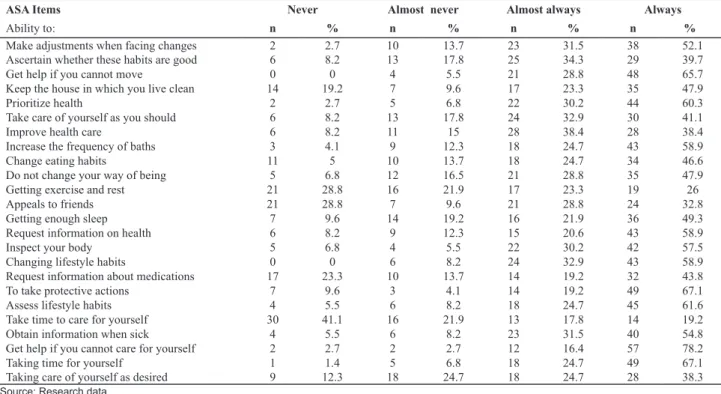
Table 3 - Distribuion of people with spinal cord injury according to their self-care ability indicated by the ASA - Natal, RN, Brazil, 2012
ASA Items Never Almost never Almost always Always
Ability to: n % n % n % n %
Make adjustments when facing changes 2 2.7 10 13.7 23 31.5 38 52.1
Ascertain whether these habits are good 6 8.2 13 17.8 25 34.3 29 39.7
Get help if you cannot move 0 0 4 5.5 21 28.8 48 65.7
Keep the house in which you live clean 14 19.2 7 9.6 17 23.3 35 47.9
Prioritize health 2 2.7 5 6.8 22 30.2 44 60.3
Take care of yourself as you should 6 8.2 13 17.8 24 32.9 30 41.1
Improve health care 6 8.2 11 15 28 38.4 28 38.4
Increase the frequency of baths 3 4.1 9 12.3 18 24.7 43 58.9
Change eating habits 11 5 10 13.7 18 24.7 34 46.6
Do not change your way of being 5 6.8 12 16.5 21 28.8 35 47.9
Getting exercise and rest 21 28.8 16 21.9 17 23.3 19 26
Appeals to friends 21 28.8 7 9.6 21 28.8 24 32.8
Getting enough sleep 7 9.6 14 19.2 16 21.9 36 49.3
Request information on health 6 8.2 9 12.3 15 20.6 43 58.9
Inspect your body 5 6.8 4 5.5 22 30.2 42 57.5
Changing lifestyle habits 0 0 6 8.2 24 32.9 43 58.9
Request information about medications 17 23.3 10 13.7 14 19.2 32 43.8
To take protective actions 7 9.6 3 4.1 14 19.2 49 67.1
Assess lifestyle habits 4 5.5 6 8.2 18 24.7 45 61.6
Take time to care for yourself 30 41.1 16 21.9 13 17.8 14 19.2
Obtain information when sick 4 5.5 6 8.2 23 31.5 40 54.8
Get help if you cannot care for yourself 2 2.7 2 2.7 12 16.4 57 78.2
Taking time for yourself 1 1.4 5 6.8 18 24.7 49 67.1
Taking care of yourself as desired 9 12.3 18 24.7 18 24.7 28 38.3
Self-care ability
The staisical analysis of the data from the ASA sho -wed that the mean of the total scale was 75.9 points,
standard deviaion of ± 9.45, with a range in responses
between 44-92 points, and a real amplitude range of 24
to 96 points. It was veriied that 69.9% of the paricipants presented good care ability, 28.8% hadregular self-care ability, and 1.4% had lower self-self-care ability. Among
paricipants who presented regular or low self-care ability, 93.3% (n = 14) were quadraplegic.
According to the data presented in Table 3, the
self-care aciviies that presented greater impairment were: takingime to care foryourself (63%), geingexercise and rest (50.7%), appeals to friends (38.4%), taking care of yourself as desired (37%), and request informaion about medicines (37%).
Table 2 - Self-Care Agency Scale (ASA) tested with Cronbach’s alpha - Natal, RN, Brazil, 2012
ASA Items Total correlation of
corrected items
Cronbach’s alpha with item deleted
Cronbach’s alpha total
Ability to:
Make adjustments when facing changes 0.486 0.774 0.788
Ascertain whether these habits are good 0.481 0.772
Get help if you cannot move 0.158 0.788
Keep the house in which you live clean 0.521 0.768
Prioritize health 0.564 0.771
Take care of yourself as you should 0.534 0.769
Improve health care 0.206 0.787
Increase the frequency of baths 0.449 0.775
Change eating habits 0.305 0.782
Do not change your way of being 0.154 0.790
Getting exercise and rest 0.222 0.788
Appeals to friends 0.177 0.792
Getting enough sleep 0.111 0.793
Request information on health 0.508 0.771
Inspect your body 0.363 0.779
Changing lifestyle habits 0.519 0.775
Request information aboutmedications 0.426 0.775
To take protective actions 0.435 0.775
Assess lifestyle habits 0.552 0.770
Take time to care for yourself 0.041 0.804
Obtain information when sick 0.400 0.777
Get help if you cannot care for yourself 0.134 0.789
Taking time for yourself 0.021 0.793
Taking care of yourself as desired 0.360 0.779
Relaionship between self-care ability and sociodemographic factors
In Table 4, sex (p = 0.028), religion (p <0.001), edu-cation (p = 0.046), current age (p = 0.027), time of SCI
Table 4 - Associations between the self-care ability and sociodemographic factors of people with spinal cord injury - Natal, RN, Brazil, 2012
Self-care ability
Sociodemographic factors Depend. Independ. deleted X2 Pd c
n % n %
Sex
Male 14 22.6 48 77.4 0.41 (0.20-0.84) 4.800 0.028 0.457
Female 6 54.5 5 45.5
Religion
No faith 7 58.4 5 41.6 2.74 (1.39-5.40) 6.910 <0.001 0.219
With faith 13 21.3 48 78.7
Education
<10 years 15 36.6 26 63.4 2.34 (0.95-5.76) 3.970 0.046 0.143
≥10 years 5 15.6 27 84.4
Marital Status
Without partner 16 31.4 35 68.6 1.72 (0.65-4.57) 1.344 0.193 0.246
With partner 4 18.2 18 81.8
Income
Up to 2 MW† 17 26.2 48 73.8 0.78 (0.23-2.61) 0.144 0.513 0.704
More than 2 MW 2 33.4 4 66.6
Current age
< 48 years 19 33.4 38 66.6 5.33 (0.77-36.8) 4.600 0.027 0.244
> 48 years 1 6.3 15 93.7
Age at SCI
< 34 years 16 26.7 44 73.3 0.86 (0.34-2.16) 0.900 0.503 0.764
> 34 years 4 30.7 9 69.3
Etiology
Traumatic 18 27.7 47 72.3 1.10 (0.31-3.91) 0.026 0.872 0.019
Nontraumatic 2 25 6 75
Time ofSCI
< 10 years 14 40 21 60 2.53 (1.05-5.86) 5.370 0.020 0.205
> 10 years 6 15.8 32 84.2
Type of SCI
Quadraplegia 8 53.3 7 46.7 2.57 (1.29-5.14) 6.385 0.012 0.284
Paraplegia 12 20.7 46 79.3
Source: Research data. Dependent = low or medium self-care ability; Independent = good self-care ability, †MW = minimum wage * Withless than ive blanks, we considered the Fisher test.
(p = 0.020) and the type of SCI (p = 0.012) were so-ciodemographic factors that were associated with the self-care ability of the subjects, with associations of
low magnitude (c ≤ 0.499).
DISCUSSION
In this study, the predominance of male individuals,
who-se mean age at the ime of injury was approximately 25 ye -ars, supported the research conducted in the city of Campina
Grande, Paraíba, in which the proporion was 10.75 men for every woman, in which 48.9% sufered their SCI when
they were in the age range of 13 to 30 years(2). Other
rese-arch also identified mostly young men: Malawi, Africa (75.7%)(5); Brasília, Brazil (69.2%)(13); and São Paulo,
Bra-zil (86.7%)(14).
The occurrence of SCI in people in the producive age range consitutes a public health problem, becau
-se it afects health, limits the ability for work and daily
aciviies, in addiion to causing economic and social im
-plicaions for both the individual and for society, due to the long rehabilitaion period(7).
A study from São Paulo/SP with 60 people who
su-fered traumaic SCI indicated that there was frequent diiculty in returning to the labor market and earning
an income for these subjects, since most of them had a
low level of educaion (63.3%) were social security re
-cipients (63.3%) and had some occupaion (36.7%), in
-cluding informal aciviies, such as traveling salesman(15).
60 subjects, identified similar results: men (86.7%), sin
-gle (61.7%), a mean age of 32.9 (± 9.47) years, and pri
-mary education (63.3%)(14).
These results are worrying, because the consequences
of a SCI extend beyond the motorissues. This is, oten, an independent individual who becomes parially or comple -tely dependent on others to meet his basic needs. The lack
of companion, the low level of educaion and family inco
-me are complicators that will e-merge or saturatediiculies in emoional, social, economic and interpersonal areas(16).
Regarding self-care, most of the paricipants presen -ted good self-care ability. However, a considerable
por-ion of the paricipants were classiied as regular or low
capacity. This result is consistent with the literature con-sulted, which indicates that these individuals may present
changes in moility and sensiivity, resuling in dependen
-ce on others for everyday or inimateaciviies, or that is,
impairing the capacity for self-care(17). Importantly, the
fact that each item of the ASA scale showed good internal reliability reinforced the relevance and consistency of the results presented(12).
In this context, it is essenial that nurses develop their
praxis of care for people with SCI, considering the new paradigm within the understanding of persons with
disa-biliies. Arising in the midst of the creaion of the Interna
-ional Classiicaion of Funcioning, Disability and Health (ICF), such a paradigm replaces the negaive perspecive of disability with a posiive understanding. That is, people with disabiliies should be considered in their enirety and with potenials that can be developed to facilitate the pro -cess of social (re)inclusion(18).
Based onself-care aciviies, inwhich there wasgreater impairment, it is believed thathere are relevantnursing prescripionsaimed atself-defense, self-care, saisfacion of basic needs and recreaional aciviies, because the success of their implementaion will contribute to a re
-ducion in the limitaions that these people face(19).
However, biological changes are not the only deter-minants of the (in)abilityof self-care for people with SCI, because, as demonstrated by the results, there is a strong
inluence of psychological aspects. Therefore, the struc -ture of nursing care for these individuals should consider
the human aspects, such as subjecivity, emoions, the un -conscious, and the will to live, so that their individual
nee-ds are met, including the maintenance and simulaion of social interacion(16).
In addiion to the biological and psychological as -pects, the environment also interferes with the abi-lity of these persons to care for themselves, and consequently,is relevant to the planning of the nursing process. According to the conceptual constructs of the
ICF, the environment afects the funcional status of individuals, and can ofer barriers or facilitate the pro
-cess of social paricipaion. Therefore, in addiion to the
problems of natural biology, one must consider the
in-teracion of the person with SCI and the environmental
context in which he is inserted(18).
Regarding the associaion between self-care ability
and sociodemographic factors of people with SCI, we
ob-served staisical signiicance for gender, religion, educa
-ion, current age, duraion and type of SCI. Onlyone study
with similar methodology was found, which used the
Bar-thel Index to analyze the associaion between sociodemo
-graphic factors and funcional capacity in people with SCI, however no associaion was veriied(9). Thus, the paucity
of similar studies prevents a more detailed comparison of
the results, indicaing the need for replicaion of the me
-thodology used in other locaions.
In general, the frequency of dependence in self-care capacity was higher in females, a similar result to that
shown by a study about the basic aciviies of daily living,
conducted with individuals with SCI living in the Agreste
region of Paraíba(9). This inding probably occurred becau
-se a woman, ater traumaic events, is more likely to pre
-sent emoional vulnerability, depression, and compromise in self-image, which hinders her efecive paricipaion in
self-care and the quest for independence(16).
Another highlight was the fact that the majority had some religious belief,this is because, as a rule, the SCI event happens without people being prepared to face it,
necessitaing spiritual support. The loss sufered results in a violaion of the person as a whole and the sufering goes
beyond the physical, reaching the psychological and spi-rituality. Therefore, hope powered by faith and sustained
by a religious belief helps in overcoming subjecive states
such as hopelessness or impotence, which contributes to
adaptaion and a range of self-care ability. Ater overco -ming them, as they adapt and achieve the ability to care for themselves, religion becomes more concrete in the view of these subjects(1).
Other variables associated with funcional status were educaion, age and the actual ime of SCI. In the majori
-ty of the paricipants afected by SCIin youth, the longer the ime of injury, the beter the individual had adapted to the condiion which ensured greater independence for self-care, due to coping strategies constructed with ime
and maturity(13).
Regarding educaion, it is believed that fewer years of study can generate diiculty in obtaining work and, therefore, inancial deicits arise. With low income, pre -venion and health promoion will be more diicult, as well as access to goods and servicesforhealth, especially at the secondary level of health care(9). Adequate access
to sources of informaion and care will be jeopardized,
a disturbing fact, because such assistance is crucial for
adaptaion and acquisiion of independence for acivi
-ionto facilitatethe process ofaccessibility, rehabilitaion
and social(re)inclusion(20).
With relaionship to the associaion between self-care
ability and the type of SCI, it is necessary to consider that
paraplegics and quadriplegics present diferent degrees in terms of motor coordinaion of the upper limbs, making
them more or less able to care for themselves. A study conducted in Rio de Janeiro with 70 people with SCI
iden-iied the lesion level was negaively correlated (p = 0.01) with spasicity, indicaing that the higher the level, the greater the spasicity(10).
As to the implicaion of this study for nursing pracice, the result indicaing that the rehabilitaion of individuals
with SCI goes beyond merely motor issues is emphasized.
The sociodemographic characterisics are also important in the planning of care; in order to achieve funcional in -dependence, nurses should consider this aspect during
the execuion of the nursing process. However, care pro
-viders sill need a speciic instrument to measure the fun
-ional capacity of people with SCI, to improve nursing care for this populaion(9).
Another important factor that must be considered is
the inclusive perspecive and understanding of the social
model of disability. Therefore, it is believed that it is ne-cessary to confront people with SCI as subjects able to
develop aciviies in the family, the community, the labor market and in all social sectors. Therefore, in addiion to
physical accessibility, the plural society should be
encou-raged to change prejudiced aitudes and become acive
in the process of inclusion of these people in the context
of communiies.
From this perspecive, a network of social support is needed for beter care for people with SCI, and the lack of social support is a factor that inluences the quality of life
and burden on the family caregivers(21).
When considering that the quality of life of caregivers can interfere with the care provided and, consequen-tly, the self-care ability of individuals with SCI, a concern should exist for knowing the level of burden that the
ca-re for a person with litle ability to saisfybasic needs can
generate in the caregiver. A study conducted in Malaga, Spain, found that the burden and stress of caregivers of
people with some dependencywere associated with
dys-funcional thoughts(22). Therefore, nursing care aiming at
comprehensiveness should consider the dyad of theper-son with SCI-caregiver, providing technical and psycholo-gical support for the lay caregivers.
Finally, a limitation of the study was the impossibi-lity to determine the directionaimpossibi-lity of the associations (risk of reverse causality), because the variables were considered concurrently, with the transversalverifica-tion of conditransversalverifica-tioning factors and outcomes therefore occurrig. Another limiting factor was the fact that so-me units did not possess community health workers, or possessed some small micro-areas without monitoring by these professionals.
CONCLUSION
Individuals with SCI living in the city of Natal/RN, in the
majority, were: men, with a mean age of 38 years, with religious beliefs, primary educaion, single, earning up to two imes the minimum wage, and sufered aSCI due to trauma, progressing to paraplegia. Most were classiied
with good self-care capacity, however, mainly due to the
paricipaion of individuals with quadraplegia, impair
-ment in the realizaion of some aciviies were ideniied, among which the following were highlighted: taking ime to care for yourself, geing exercise and rest, appeal to friends, taking careof yourselfas desired, and requesing informaion on medicaions.
It was found that sociodemographic factors may inter-fere with self-care ability for people with SCI, especially
those related to gender, age, religion, educaion, ime and
type of SCI, that nurses from the BHU, where subjects of
this study were ideniied, should consider this aspect and include it in the planning and implementaion of the nur -sing process focused on long-term care, including
evalua-ion through systemaic home visits.
It is hoped that the knowledge generated by the
stu-dy allows, in addiion to staisical data for planning heal
-th acions at -the local level, -the implementaion of more qualiied nursing acions for the recovery of self-care ca
-pacity in this populaion.
REFERENCES
1. Amaral MTMP. A new sense for living: a comprehensive stu
-dy about the adaptaion process following spinal cord inju
-ries. Rev Esc Enferm USP [Internet]. 2009 [cited 2012 Sept
16];43(3):573-80. Available from: htp://www.scielo.br/pdf/
reeusp/v43n3/en_a11v43n3.pdf
2. França ISX, Coura AS, França EG, Basílio NNV, Souto RQ. Qua
-lity of life of adults with spinal cord injury: a study using the
WHOQOL-bref. Rev Esc Enferm USP [Internet]. 2011 [cited
2012 Sept 16];45(6):1364-71. Available from: htp://www.
3. Vasconcelos AS, França ISX, Coura AS, Sousa FS, Souto RQ,
Cartaxo HGO. Nursing intervenions on the needs of people with spinal cord injury: an integraive review. Online Braz
J Nurs [Internet]. 2010 [cited 2012 Sept 16];9(2). Available
from: htp://www.objnursing.uf.br/index.php/nursing/ari
-cle/view/j.1676-4285.2010.3000/674
4. Brito LMO, Chein MBC, Marinho SC, Duarte TB. Avaliação
epi-demiológica dos pacientes víimas de traumaismo raquime
-dular. Rev Col Bras Cir. 2011;38(5):304-9.
5. Samuel JC, Akinkuoto A, Vilaveces A, Charles AG, Lee CN,
Ho-fman IF, et al. Epidemiology of Injuries at a teriary care cen
-ter in Malawi. World J Surg. 2009; 33(9):1836-41.
6. Uida C, Truzzi JC, Bruschini H, Simonei R, Cedenho AP, Srou
-gi M, et al. Male inferility in spinal cord trauma. Int Braz J Urol. 2008;31(4):375-83.
7. Assis GM, Faro ACM. Clean intermitent self catheterizaion in
spinal cord injury. Rev Esc Enferm USP [Internet]. 2011 [cited
2012 Sept 16];45(1):289-93. Available from: htp://www.scie
-lo.br/pdf/reeusp/v45n1/en_41.pdf
8. França ISX, Coura AS, França EG, Cavalcante GMC, Sousa FS.
Applicaion of principlist bioethics to public policies for disa
-bled people: systemaic review. Online Braz J Nurs [Internet]. 2010 [cited 2012 Sept 16]; 9(1). Available from: htp://www. objnursing.uf.br/index.php/nursing/aricle/view/2893
9. Coura AS, França ISX, Enders BC, Barbosa ML, Souza JRS.
Funcional disability of adult individuals with spinal cord in
-jury and its associaion with socio-demographic characteris
-ics. Rev Laino Am Enferm. 2012;20(1):84-92.
10. Franzoi AC, Bapista AL, Carvalho AM, Gonçalves W, Rosa
ACB, Pinto A, et al. Peril funcional de locomoção em um
grupo de pacientes com lesão medular atendidos em um
centro de reabilitação. Coluna/Columna. 2009;8(4):401-7.
11. Velandia-Arias A, Rivera-Álvarez LN. Agencia de Autocuida-do y Adherencia al Tratamiento en Personas con Factores de
Riesgo Cardiovascular. Rev Salud Pública. 2009;11(4):538-48.
12. Field A. Descobrindo a estaísica usando o SPSS. 2a ed. Por
-to Alegre: Artmed; 2009.
13. Vera RS, Araújo TCCF. Enfretamento e lesão medular: um
estudo de corte transversal com pacientes em reabilitação.
Comun Ciênc Saúde. 2011;22(3):2011-20.
14. Blanes L, Lourenço L, Carmagnani MIS, Ferreira LM. Clinical
and socio-demographic characterisics of persons with trau
-maic paraplegia living in São Paulo, Brazil. Arq Neuropsi
-quiatr. 2009;67(2b):388-90.
15. Blanes L, Carmagnani MIS, Ferreira LM. Quality of life and self-esteen of persons with paraplegia living in São Paulo,
Brazil. Qual Life Res. 2009;18(1):15-21.
16. Conceição MIG, Auad JC, Vasconcelos L, Macêdo A, Bressa-nelli R. Avaliação da depressão em pacientes com lesão
me-dular. Rev Bras Comport Cogn. 2010;12(1):43-59.
17. Machado WCA, Scramin AP. Funcional (in)dependence in the
dependent relaionship of quadriplegic men with their (un)
replaceable parents/caregivers. Rev Esc Enferm USP
[Inter-net]. 2010 [cited 2012 Apr 30]; 44(1):53-60. Available from:
18. Farias N, Buchalla CM. A Classiicação Internacional de Fun
-cionalidade, Incapacidade e Saúde da Organização Mundial
da Saúde: conceitos, usos e perspecivas. Rev Bras Epide
-miol. 2005;8(2):187-93.
19. Miranda FL, Henriques SM, Abrahão CM, Gonçalves ND,
Tan-nure MC. Diagnósicos e intervenções de enfermagem iden
-iicados em pacientes com lesão medular: revisão sistemá
-ica de literatura. Rev Enferm UFPE [Internet]. 2010 [citado
2013 fev. 10]; 4(3):1101-9. Disponível em: htp://www.re
-vista.ufpe.br/revistaenfermagem/index.php/revista/aricle/ viewAricle/960
20. Baista SM, França RM. Família de pessoas com deiciên
-cia: desaios e superação. Rev Divulg Técnico Cient ICPG. 2009;3(10):117-21.
21. Amendola F, Oliveira MAC, Alvarenga MRM. Inluence of
social support on the quality of life of family caregivers while caring for people with dependence. Rev Esc Enferm
USP [Internet]. 2011 [cited 2013 Feb 10];45(4):884-9. Ava
-liable from: htp://www.scielo.br/pdf/reeusp/v45n4/en_
v45n4a13.pdf
22. Vázquez-Sánchez MÁ, Aguilar-Trujillo MP,
Estébanez-Carvajal FM, Casals-Vázquez C, Casals-Sánchez JL,
Heras-Pérez MC. The inluence of dysfuncional thoughts on the
burden of the dependent person caregiver. Enferm Clin.
2012;22(1):11-7.
Acknowledgements