RESUmO
O objeivo do estudo foi comparar resulta
-dos perinatais de mulheres com idade igual ou superior a 35 anos com os de mulheres entre 20 e 34 anos. O estudo é retrospec
-ivo e foi realizado a parir da consulta às ichas obstétricas de 1.255 puérperas que iveram partos no único hospital de Sarandi-PR, no período de janeiro de 2007 a dezembro de 2008. As variáveis analisa
-das foram: estado civil, escolaridade, idade gestacional, ipo de parto, peso ao nascer, índice de Apgar no 1º e 5º minutos e óbi -tos fetais. Na regressão logísica, a idade materna avançada esteve associada signi
-icaivamente à cesariana (OR 1,23, IC 95% 0,19-0,44) e a um índice de Apgar menor que 7 no 5º minuto de vida (OR 5,78, IC 95% 0,74-2,76). Esses resultados eviden
-ciam os riscos de complicações em gestan
-tes com idade igual ou superior a 35 anos e a necessidade de que o aconselhamento às mulheres que pretendam postergar a ges -tação seja realizado.
dEScRitORES Idade materna Gestantes
Complicações na gravidez Enfermagem obstétrica
Outcomes in late-age pregnancies
O
r
i
g
i
n
a
l
a
r
ti
c
le
AbStRAct
The objecive of the present study was to compare perinatal outcomes in women aged 35 or older with women aged 20 to 34 years. This retrospecive study was per
-formed by reviewing the obstetric records of 1255 mothers who gave birth at the only hospital in Sarandi-PR, from January 2007 to December 2008. The analyzed variables were: marital status, educaion, gestaion
-al age at birth, type of delivery, newborn birth weight, Apgar score at one and ive minutes and sillbirths. Logisic regression showed that advanced maternal age was signiicantly associated with adverse out
-comes such as cesareans (OR 1.23, 95% CI 0.19-0.44) and 5-minute Apgar scores below 7 (OR 5.78 95% CI 0.74-0.76). These results are important to show the risk of complicaions in pregnant women aged 35 years or older, and the need to provide guidance to women who wish to postpone pregnancy.
dEScRiPtORS Maternal age Pregnant women Pregnancy complicaions Obstetrical nursing
RESUmEn
Estudio que objeivó comparar resultados perinatales de mujeres de edad igual o mayor a 35 años con los de mujeres entre 20 y 34 años. De carácter retrospecivo, realizado mediante consulta de ichas obs
-tétricas de 1.255 puérperas que dieron a luz en hospital de Sarandi-PR, entre enero 2007 y diciembre 2008. Las variables ana
-lizadas fueron: estado civil, escolaridad, edad gestacional, ipo de parto, peso al nacer, índice de Apgar en 1º y 5º minutos y muertes fetales. En la regresión logísica, la edad materna avanzada se asoció signi
-icaivamente a la cesárea (OR 1,23, IC 95% 0,19-0,44) y a un índice de Apgar menor a 7 en 5º minuto de vida (OR 5,78, IC 95% 0,74-2,76). Tales resultados evidencian los riesgos y complicaciones en gestantes con edad igual o superior a 35 años y la nece
-sidad de aconsejar a aquellas mujeres que pretendan postergar la gestación.
dEScRiPtORES Edad materna Mujeres embarazadas Complicaciones del embarazo Enfermería obstétrica
Angela Andréia França Gravena1, Arethuza Sass2, Sonia Silva marcon3, Sandra marisa Pelloso4 Resultados peRinatais em gestações taRdias
Resultados peRinatales en gestaciones taRdías
intROdUctiOn
A pregnancy in a woman older than 35 years old is termed a late pregnancy and women older than 45 years old are considered to be at a very advanced maternal age(1). Pregnancies among women older than 35 years old have increased considerably, a fact seen in various Brazil -ian(2-3) and internaional studies(1-4). Reasons vary, includ
-ing the desire of women to invest in their educaion and professional career, postpone marriage, remarriage, the large and diversiied availability of contracepive meth -ods, and inferility problems.
The percentage of primiparous women aged from 35 to 39 years old and from 40 to 44 years old increased 36% and 70%, respecively(5), between 1991 and 2001 in the United States. Staisical data show that birth rates in women aged from 40 to 44 years old coninued to grow in 2005 and in 2006, reaching a rate of 9.4/1,000(6).
The Brazilian Survey of Children’s and Women’s Demog -raphy and Health (PNDS), conducted with 15,000 women from all Brazilian regions, showed that the
average number of live births is 1.5 among women 15 to 49 years old and 2.6 among women 45 to 49 years old(7). According to this study, the average age of Brazilian mothers decreased from 25.6 years old in 1991 to 24.8 years old in 2000. Only women aged from 15 to 19 years old experienced a posiive varia -ion of 25.4% in ferility rate in the same pe -riod, while all the remaining experienced a negaive variaion, especially women 35 to 39 years old, 40 to 44 and 45 to 49 years old, that is, 28.0%, 47.8% and 63.3%, respecively(8).
Despite this decline, the number of wom -en who become pregnant at a more advanced age is signiicant and of concern since vari -ous studies show an important associaion
between maternal age of 35 years or older and adverse perinatal outcomes(2,9); that is, a greater risk of maternal, fetal and newborn complicaions exists. Women 35 to 39 years old, for instance, are at a risk two to three imes greater of maternal death than are women around 20 years of age and this risk is even greater for women 40 years old or older(10).
In comparison with younger women, 35 year old wom -en experi-ence more spontaneous and induced aborions, a greater risk of perinatal death, low newborn vitality, low birth weight, preterm delivery, and newborns small for their gestaional age(11). It is worth noing that more frequent alteraions of newborn’s weight in these women involve cases of both macrosomia and low weight for ges -taional age(12).
Advanced age pregnancies have tradiionally been con -sidered high-risk pregnancies mainly due to the growing incidence of hypertensive syndrome, greater weight gain, obesity, ibroids, diabetes, aborions and C-secions(13).
Many studies(1-3,11) have invesigated the adverse out -comes of pregnancies at extreme reproducive ages, though it is extremely important to invesigate the ad -verse results of late pregnancies to minimize harm, since women have postponed maternity due to many factors, such as postponed marriages, remarriage, investment in educaion and professional careers, greater use of contra -cepive methods and inferility problems.
The assumpion that women of advanced age are more likely to experience complicaions during pregnancy and adverse perinatal outcomes in comparison with women at an ideal reproducive age encouraged the development of this study intended to compare the perinatal outcomes of women 35 years old or older with those of women 20 to 34 years old.
mEtHOd
This cross-secional study conducted retrospecive data collecion based on obstetrical iles of women who delivered their children in the Metropolitan Hospital of Sarandi, PR, Brazil from January 1st 2007 to December 31st 2008.
Sarandi is one of the 13 ciies that inte -grate the Metropolitan Region of East Mar -ingá with a total area of 104.04 km2 and an esimated populaion of 88,747 inhabitants in 2006. This city concentrates the highest populaion density of the metropolitan ar -ea with 692 inhabitants per km2. Its urban rate is 97.3% and in 2000 its Human Devel -opment Index (HDI) was 0.768(14).
In terms of health care, the city has an emergency department and a private gen -eral hospital linked to the Uniied Health System (SUS) with 140 beds, 15 of which are in the Inten -sive Care Unit (ICU). The primary health care network has seven private health units and two teams from the Family Health Strategy that cover 8.87% of the city’s populaion. The University Hospital of Maringá is a referral center for high-risk pregnancies, while all remaining pregnant wom -en are cared for in the studied insituion.
A total of 1,883 women delivered their children in this insituion during the study’s data collecion period, though 628 (33.3%) were excluded from the study: 626 were younger than 20 years old and two were pregnant with twins. The sample efecively studied was composed of 1,255 women distributed into two groups according to age: group I with 1,117 women aged from 20 to 34 years old and group II with 138 women aged 35 years old or older.
The study’s variables include informaion available in the women’s obstetrical iles categorized by: maternal age (20 to 34 years old and 35 years old or older), marital
...the number of women who become
pregnant at a more advanced age is
signiicant and of
concern since various studies show an important association between maternal age
of 35 years or older and adverse perinatal
status (single, married, widowed or divorced), educaion (up to seven years of schooling and eight or more years of schooling), type of delivery (normal or C-secion), gesta -ional age (preterm=less than 37 weeks; at term=between 37 and 42 weeks and post term=more than 42 weeks)(15), birth weight (low weight=less than 2,500g; normal=2,500g to 3,999g; and macrosomia=equal to 4,000g or above)(16), Apgar index in the 1st and 5th minutes (less than seven and equal or above seven) (4) and fetal deaths (yes or no). It is worth noing that the ile does not provide informaion concerning the women’s parity.
Data were collected from January to February 2009 and directly recorded in an Excel spread sheet.
Associaion among risk or protecion factors with ma -ternal age was analyzed through the Chi-square or Fish -er’s exact test, which were considered signiicant when p<0.05. To evaluate the joint efect of risk factors on age, muliple regression analysis was used. The variables with p=0.20 in the univariate analysis were included in the mul -ivariate model. Odds Raio (OR) and its respecive coni -dence interval at 95% were computed in the inal model. Epi Info 3.1 and Staisica 7.1 were used.
This study complied with Resoluion 196/96, Naional Council of Health and was approved by the Commitee for Research Ethics Concerning Human Subjects at the State University of Maringá (Process n.º 207/2009). Free and in -formed consent forms were not required since data were collected from secondary sources.
RESULtS
Of the 1,255 women composing the study’s sample, 89.0% were 20 to 34 years old. The age of women ranged from 20 to 46 years old, and the average ages in groups I and II were 24.8 (SD=3.6) years old and 37.6 (SD=3.2) years old respecively.
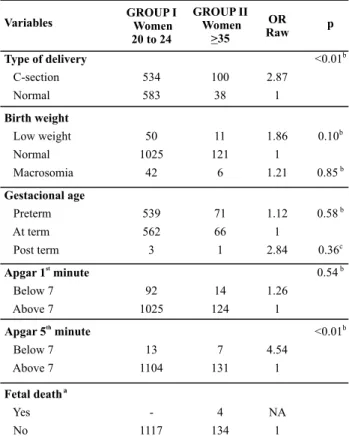
Some of the maternal characterisics and gestaional results from both groups are described in Table 1. In re -laion to maternal characterisics, the number of women with eight or more years of educaion was higher among younger women. In relaion to marital status, the propor -ion of single women was higher among those aged 20 to 34 years old, while widowed or divorced women predomi -nated among those 35 years old.
In regard to perinatal outcomes, C-secions were three imes more frequent among women from group II. The fact that all the remaining negaive outcomes were more frequently observed among women from group II draws one’s atenion. There was a greater proporion of low
weight newborns (18.1%) and macrosomia (12.5%), pre -term (11.6%) and post -term infants (25.0%), with Apgar index below seven in the 1st (13.2%) and 5th (35.0%) min
-utes of life, in addiion to fetal deaths, which occurred on -ly within this group. The average newborn weight among older women was 3,192g (SD=591) and 3,204g (SD=439) (p=0.81) among younger women.
Table 1 – Characterization and perinatal outcomes in women 20
to 34 years old and women 35 years old or older – Sarandi, PR, Brazil - 2009
aaunknown (marital status=3; gestational age=13), loss less than 10%
GROUP I Women 20 to 34
GROUP II Women>35 Variables
N % N %
Education(n=1255)
Up to 7 years 372 84.4 69 15.6 8 or more 745 91.5 69 8.5
Marital status(n=1252)a
Single 741 92.7 58 7.3 Married 367 84.2 69 15.8 Widowed 1 20.0 4 80.0 Divorced 5 41.7 7 58.3
Type of delivery(n=1255)
Normal 583 93.9 38 6.1 C-section 534 84.2 100 15.8
Birth weight(n=1255)
Low weight 50 81.9 11 18.1 Normal 1025 89.4 121 10.6 Macrosomia 42 87.5 6 12.5
Gestacional age (n=1242)a
Preterm 539 88.4 71 11.6 At term 562 89.5 66 10.5 Post term 3 75.0 1 25.0
Apgar 1 minutest
(n=1255)
Below 7 92 86.7 14 13.2 Above 7 1025 89.2 124 10.8
Apgar 5 minuteth
(n=1255)
Below 7 13 65.0 7 35.0 Above 7 1104 89.4 131 10.6
Fetal death(n=1255)
Yes - - 4 100.0 No 1117 89.3 134 10.7
The results obtained in the logisic regression show that older women are 1.23 imes more likely to experi -ence a C-secion and their children have 5.78 imes more at risk of presening an Apgar index below seven in the 5th minute (Table 3).
diScUSSiOn
Pregnancy among women 35 years old or older has been increasingly observed in obstetrical pracice due to social, educaional, economic and cultural factors that en -able the absence, reducion, or even control of the num -ber of children. In this context, higher educaional levels Table 2 – Univariate analysis of adverse perinatal outcomes in
women 20 to 34 years old and women 35 years old or older – Sa-randi, PR, Brazil - 2009
oR = odds Ratio; na = not applicable
a oR does not apply given the lack of fetal death among women 20 to 34 years old
b chi-square test c Fischer’s exact test
Table 3 – Independent variables associated with maternal age 35
years old or older with respective OR adjustment, conidence in
-terval at 95% and p-value – Sarandi, PR, Brazil - 2009
OR = Odds Ratio; CI = Conidence Interval
GROUP I Women 20 to 24
GROUP II Women
35 >
OR
Raw p
Variables
Type of delivery <0.01b
C-section 534 100 2.87
Normal 583 38 1
Birth weight
Low weight 50 11 1.86 0.10b
Normal 1025 121 1
Macrosomia 42 6 1.21 0.85b
Gestacional age
Preterm 539 71 1.12 0.58b
At term 562 66 1
Post term 3 1 2.84 0.36c
Apgar 1 minutest
0.54b
Below 7 92 14 1.26
Above 7 1025 124 1
Apgar 5 minuteth
<0.01b
Below 7 13 7 4.54
Above 7 1104 131 1
Fetal deatha
Yes - 4 NA
No 1117 134 1
Variables OR adjusted CI (95%) P
1.23 0.19-0.44 <0.01
1.71 0.82-1.26 0.14
C-section
Low birth weight
Apgar index in the 5 minute below 7
th
5.78 0.74-2.76 <0.01
are a simulus to postpone the irst pregnancy. There is a tendency, among women with higher educaional lev -els, for the irst occurrence of sexual intercourse to be with appropriate protecion, marriage to be postponed, greater use of contracepive methods and valorizaion of smaller families(16).
Addiionally, women using modern contracepive methods in a more systemaic manner tend to postpone the birth of the irst child(16). Informaion from the 2006 PNDS report revealed that 81.6% of women 15 to 44 years old with a partner used some type of contracepive method(7).
Recent advancements in reproducive technologies of -fered to couples have increased the number of successful pregnancies in women who otherwise experience diicul -ty becoming pregnant. One study showed that pregnan -cies resuling from assisted reproducion predominated among women older than 33 years of age, with 54.2% of pregnancies(17). However, oping for late pregnancy may cause problems both for the mother and child.
This study’s results revealed that women older than 35 years of age more frequently experience adverse perina -tal outcomes when compared to women 20 to 34 years old, mainly low birth weight and macrosomia, preterm and post term, and an Apgar index below seven in the irst and ith minutes of life in addiion to fetal death.
Women 20 to 44 years old had more years of schooling than women older than 35 years of age. A muli-center study conducted with 36,056 women in the United States found contradictory data concerning educaion; a higher educaional level (about 15 years) was observed among older women (≥ 35 years old) (13). The low educaional level among older women found in this study may be related to the unfavorable socioeconomic condiions of the studied women.
The incidence of 15.8% C-secions in older women and 84.2% in women in the ideal reproducive age exceeds the 15% recommended by the World Health Organizaion(17). The incidence of C-secions in older women has been re -ported in other studies(4,13,18-19). The chance of C-secion among women older than 35 years of age was 1.23 great -er than among women 20 to 34 years old. A retrospecive study conducted in Taiwan with 39,763 women provided evidence that the chance of C-secion was 1.6 and 2.6 imes greater in women 35 years old and 39 to 40 years old or older, respecively(15).
subsequent pregnancies, including placenta praevia and placental abrupion(18-19).
In relaion to the Apgar index, women older than 35 years of age have a 5.78 greater chance of having children with Apgar score below seven in the ith minute of life. This index is a good indicator for perinatal outcomes in the long term(4). The analysis of vitality through Apgar in the ith minute is the most relevant measure to evaluate birth prognosis.
It is important to note that children of older women in this study had twice the risk of presening an Apgar score below seven in the ith minute compared to what is ob -served in the literature. An internaional study reported an increased risk of 2.05 for Apgar below seven in the ith minute among women 40 years old or older(4). A Brazilian study conducted in the University Hospital of Maranhão reported a risk 2.90 imes greater for children of women older than 35 years of age in regard to presening an Ap -gar score below seven in the ith minute of life(20).
Comparison among gestaional ages showed that both preterm and post term births were observed among older women. In relaion to prematurity, data obtained in this study corroborate the results of a study conducted in Maranhão, which did not ind a signiicant associaion between prematurity and advancedage pregnancy(20). In
-ternaional studies show that prematurity has been more frequently observed among women older than 35 years of age(11,19). A study conducted in Lebanon reported that the diference in the rate of preterm deliveries remained sig -niicantly higher among older women, even when women who had a medical or obstetrical indicaion to induce la -bor were excluded, indicaing the inherent risk of preterm delivery among older women(21).
Some studies have not found signiicant diferences between younger and older women in regard to post term births(4,12). A study conducted in Rio Grande do Norte, Bra -zil reported that 1.4% of women 35 years old and 1.5% of women 20 to 34 years old experienced post term deliv -eries(12). A study comparing women 40 years old or older with women 20 to 30 years old found higher diferences, though not staisically signiicant,:1.5% and 4.5% experi -enced post term delivered respecively(4).
The greatest incidence of low birth weight in older women was also ideniied in other studies(3,19). A retro
-specive study analyzed the records of 9,506 children born in the Liverpool Women’s Hospital and showed that 8.85% of women 35 years old or older had low birth weight in -fants, while this percentage was 6.35% among women 20 to 30 years old(11). Concern with low birth weight is re -lated to the fact it is one of the factors implicated in an increased rate of perinatal mortality(2).
Risk factors associated with low birth weight are more common among older women such as arthriis, chronic hypertension, depression, cancer and acute myocardial
infarcion, which are factors that do not depend on fetal growth restricion(18). All these factors need to be properly monitored during the gestaional period. It is known that the incidence of chronic hypertension increases with age and it is possible for vascular impairment inherent to age rendering some women more suscepible to pregnancy-induced hypertension, even those who do not develop clinically recognized hypertension. Addiionally, pre -eclampsia is more frequently reported at the extremes of reproducive age especially among older women(4,20).
The greater incidence of newborns weighing more than 4,000g among women 35 years old or older corrob -orate data from a study conducted in Taiwan(15) in which 3.9% and 3.7% of women 35 to 39 years old and 40 years old or older had macrosomic newborns. Similar data were also evidenced in a Brazilian study comparing the weight of newborns (≥4,000g) of women 35 years old and women 20 to 34 years old(12).
In relaion to the occurrence of fetal death, this study veriied that it occurred only among women 35 years old, which agrees with results from other studies(2,13,22). A study conducted in the United States observed that women old -er than 40 years of age presented a signiicant associaion with perinatal mortality, having a risk 2.2 imes greater in comparison to women younger than 35 years old(13).
The increased occurrence of fetal death among older women may be explained by the greater frequency of adverse complicaions, including worse Apgar indexes and low birth weight. There is sill uncertainty regarding biological mechanism increasing the risk of fetal death with advanced maternal age, though the direct efect of maternal aging may exist. It is probably related to a de -iciency of placental perfusion caused by poor uterine vascularizaion. The increased risk may also be atributed to an associaion of maternal age and certain risk factors for fetal death such as chronic diseases and obstetrical complicaions(1,20).
It is essenial to broaden informaion concerning un -favorable perinatal outcomes so that older women will seek early prenatal care and be monitored by a mulidisci -plinary health team, minimizing the risk for both mother and child.
cOncLUSiOn
Some of this study’s limitaions should be noted. One is related to the fact this is a retrospecive study conduct -ed in a hospital, whose data were collect-ed from obstetri -cal iles of pregnant women from low-risk services. There -fore, results cannot be generalized to pregnant women from high-risk services; the later certainly would present a greater probability of adverse perinatal outcomes.
Hence, considering that parity is a factor directly related to maternal condiions, these aspects deserve greater atenion in future studies to enable greater clarity of results.
This study’s results showed high levels of C-secions and an Apgar index below seven at the ith minute in women older than 35 years of age when compared to the indexes observed among women 20 to 34 years old, in addiion to four neonatal deaths among women older than 35 years of age. These facts lead us to relect on the importance of minimizing adverse perinatal out -comes and on the need for appropriate policies to care for these women, not only due to perinatal risks but also due to their peculiar social, economic and psychological aspects.
Therefore, professionals responsible for caring for these women need to be atenive to the characterisics
of pregnancy at this stage of life and be apt to idenify signs and symptoms of complicaions early and, at the same ime, have a support service to ensure care delivery and exams when required. This way, pregnancies can be monitored with greater safety, thus reducing the possibil -ity of complicaions and unfavorable perinatal outcomes. It is worth noing that this study’s results can be used in the rouine of health services aiming to inform and warn women who intend to postpone pregnancy, which has the risk of complicaions arising in pregnancies in this period of life.
Finally, the results are also evidence of the importance of further research addressing perinatal outcomes among women of advanced age, which would enable beter com -parison and understanding of the results found in urban centers where studies with a substanially greater number of women are conducted.
REFEREncES
1. Huang L, Sauve R, Birket N, Fergusson D, Walraven CV. Ma
-ternal age and risk of sillbirth: a systemaic review. Can Med Assoc J. 2008;178(2):165-78.
2. Andrade PA, Linhares JJ, Marinelli S, Antonini M, Lippi AG, Baracat FF. Resultados Perinatais em Grávidas com mais de 35 Anos: estudo Controlado. Rev Bras Ginecol Obstet. 2004;26(9):697-702.
3. Senesi LG, Tristão EG, Andrade RP, Krajden ML, Oliveira Junior
FC, Nascimento DJ. Morbidade e mortalidade neonatais rela
-cionadas à idade materna igual ou superior a 35 anos, segun
-do a paridade. Rev Bras Ginecol Obstet. 2004;26(6):477-82.
4. Jahromi BN, Husseini Z. Pregnancy outcome at maternal age
40 and older.Taiwan J Obstet Gynecol. 2008;47(3):318-21.
5. Hefner LJ. Advanced maternal age: how old is too old? N Engl J Med. 2004;351(19):1927-9.
6. Hamilton BE, Minino AM, Marin JA, Kochanek KD, Strobino
DM, Guyer B. Annual summary of vital staisics: 2005. Pediat
-rics. 2007;119(2):345-60.
7. Brasil. Ministério da Saúde; Centro Brasileiro de Análise e Planejamento. Pesquisa Nacional de Demograia e Saúde da Criança e da Mulher - PNDS 2006. Dimensões do processo reproduivo e da saúde da criança [Internet]. Brasília; 2009 [citado 2010 fev. 15]. Disponível em: htp://bvsms.saude.gov. br/bvs/publicacoes/pnds_crianca_mulher.pdf
8. Oliveira JC. Peril socioeconômico da maternidade nos extre
-mos do período reproduivo. Rio de Janeiro: IBGE; 2005.
9. Ziadeh SM. Maternal and perinatal outcome in nullipa
-rous women aged 35 and older. Gynecol Obstet Invest. 2002;54(1):6-10.
10. Berg CJ, Chang J, Callaghan WM, Whitehead SJ. Pregnancy- related mortality in the United States, 1991-1997. Obstet Gynecol. 2003;101(5):289-96.
11. Delpisheh A, Brabin L, Aia E, Brabin BJ. Pregnancy late in life: a hospital-based study of birth outcomes. J Womens Health. 2008;17(6):965-70.
12. Azevedo GD, Freitas RAO, Freitas AKMSO, Araújo ACPF,
Soares EMM, Maranhão TMO. Efeito da idade materna so
-bre os resultados perinatais. Rev Bras Ginecol Obstet. 2002; 24(3):181-5.
13. Cleary-Goldman J, Malone FD, Vidaver J, Ball RH, Nyberg DA, Comstock CH, et al. Impact of Maternal Age on Obstetric Outcome. Obstet Gynecol. 2005;105(5):983-90.
14. Insituto Paranaense de Desenvolvimento Econômico e
Social (IPARDES). Peril do Município de Sarandi [Inter
-net]. Curiiba; 2009 [citado 2010 fev. 9]. Disponível em: htp://www.ipardes.gov.br/peril_municipal/MontaPeril. php?Municipio=86985&btOk=ok
15. Hsieh TT, Liou JD, Hsu JJ, Lo LM, Chen SF, Hung TH. Ad
-vanced maternal age and adverse perinatal outcomes in an Asian populaion. Eur J Obstet Gynecol Reprod Biol. 2010;148(1):21-6.
17. Graner VR, Barros SMO. Maternal complicaions and neo -natal events associated with muliple pregnancies resuling from assisted reproducion techniques. Rev Esc Enferm USP [Internet]. 2009 [cited 2010 Apr 15];43(1):103-9. Available from: htp://www.scielo.br/pdf/reeusp/v43n1/en_13.pdf
18. Diejomaoh MFE, Al-Shamali IA, Al-Kandari F, Al-Qenae M, Mohd AT. The reproducive performance of women at 40 years and over. Eur J Obstet Gynecol Reprod Biol. 2006; 126(1):33-8.
19. Luke B, Brown MB. Elevated risks of pregnancy complica
-ions and adverse outcomes with increasing maternal age. Human Reprod. 2007;22(5):1264-72.
20. Santos GHN, Marins MG, Sousa MS, Batalha SJC. Impacto da idade materna sobre os resultados perinatais e via de parto. Rev Bras Ginecol Obstet. 2009;31(7):326-34.
21. Seoud MA, Nassar AH, Usta IM, Melhem Z, Kazma A, Kalil
AM. Impact of advanced maternal age on pregnancy out
-comes. Am J Perinatol. 2002;19(1):1-8.
22. Vohr BR, Tyson JE, Wright LL, Perrit RL, Li L, Poole WK. Ma