CHALLENGES TO THE ORGANIZATION OF A CERVICAL CANCER
SCREENING PROGRAM IN MANAUS-AM
1Dina Albuquerque Duarte Corrêa2, Wilza Vieira Villela3, Ana Maria de Almeida4
1 Part of the dissertation – Peril das usuárias do Sistema Único de Saúde que realizam o Papanicolaou em Manaus, Amazonas
(Proile of the Uniied Health System clients that took the Pap test in Manaus, Amazonas), presented to the Masters in Health Promotion Program at Universidade de Franca, 2009.
2 Doctoral student, University of São Paulo (USP) at Ribeirão Preto College of Nursing (EERP). São Paulo, Brazil. E-mail:
3 Ph.D. in Preventive Medicine. Professor of the Graduate Program in Health Promotion, Universidade de Franca. São Paulo,
Brazil. E-mail [email protected]
4 Ph.D. in Nursing. Associate Professor, Department of Maternal-Child and Public Health Nursing, at EERP/USP. São Paulo,
Brazil. E-mail: [email protected]
ABSTRACT: The purpose was to investigate sociodemographic characteristics of women who underwent a Pap smear test in Manaus,
Amazonas, Brazil, and identify the reasons why the women had the test. This exploratory study was performed with 281 women who had taken the Pap smear test within the last ive years in Manaus. Most participants were between 18 to34 years old (54%), had 5 to 11 years of education (54.4%), had a monthly income of less than three minimum wage salaries (84.3%) and were in a stable relationship (72.2%), with an onset of sexual activity between the ages of 15 to19 years (69.4%). The reasons for their taking the Pap test were personal choice (66.2%), recommendation by a physician (23.5%) and gynecological symptoms (10.3%). Women who received information about the Pap test from health professionals had a greater chance of being tested within the last three years (p=0.008). Women choosing to have the exam (personal choice) are prevalent, and the opportunistic service is provided to younger women, thus not reaching the group at greater risk for cancer. It is necessary to implement active recruitment strategies to reach women in situations of socioeconomic disadvantage.
DESCRIPTORS: Uterine cervical neoplasms. Public health. Vaginal smears. Prevention & control.
DESAFIOS À ORGANIZAÇÃO DE PROGRAMA DE RASTREAMENTO DO
CÂNCER DO COLO DO ÚTERO EM MANAUS-AM
RESUMO: Objetivou-se identiicar as características sociodemográicas das mulheres que realizam o Papanicolaou em Manaus,
Amazonas, e sua associação com os motivos para realização do exame. Pesquisa exploratória incluindo 281 mulheres, que haviam realizado o Papanicolaou nos últimos cinco anos em Manaus. A maioria das entrevistadas tinha entre 18-34 anos (54%), 5-11 anos de estudo (54,4%), renda familiar mensal de até três salários mínimos (84,3%), relação estável (72,2%) e início da vida sexual entre 15-19 anos (69,4%). Os motivos para realização do Papanicolaou foram procura espontânea (66,2%), recomendação médica (23,5%) e sintomas ginecológicos (10,3%). Mulheres que receberam informação dos proissionais de saúde tiveram proporção maior de realização do exame nos últimos três anos (p=0,008). A demanda espontânea é prevalente e o atendimento oportunístico é realizado nas mulheres mais jovens, não alcançando o grupo com maior risco para o câncer. É necessário implantar estratégias de recrutamento ativo alcançando mulheres em desvantagem socioeconômica.
DESCRITORES: Neoplasias do colo do útero. Saúde pública. Teste de Papanicolaou. Prevenção e controle.
DESAFÍOS PARA LA ORGANIZACIÓN DE PROGRAMA DE RASTREO DE
CÁNCER DE CUELLO UTERINO EN MANAUS-AM
RESUMEN: El objetivo fue identiicar las características sociodemográicas de las mujeres que se realizan la prueba de Papanicolau en
Manaus, Amazonas, Brasil y su asociación con las razones de realizar el examen. La investigación exploratoria contó con la participación de 281 mujeres y evidenció que la mayoría de las encuestadas tenían entre 18-34 años (54%), de 5-11 años de escolaridad (54.4%), los ingresos mensuales de hasta tres salarios mínimos (84.3%), relación estable (72.2%) y la iniciación sexual entre los 15-19 años (69.4%). Las razones para realizar la prueba de Papanicolau fueron demanda espontánea (66.2%), indicación médica (23.5%) y síntomas ginecológicos (10.3%). Mujeres que habían recibido información de los profesionales de la salud tenían una mayor proporción de realización de la prueba en los últimos tres años (p=0.008). La demanda espontánea es prevalente y la atención oportuna es realizada en mujeres mas jóvenes. Es necesario implementar estrategias de reclutamiento activo para alcanzar a las mujeres en desventaja socioeconómica.
INTRODUCTION
Uterine Cervical Cancer (UCC) is a neoplasm that reflects the unequal development across countries, affecting women of low socioeconomic level with poorer accessibility to screening inter-ventions.1 It is estimated that 83% of the new UCC
cases occur in developing countries, accounting for 15% of all cancer cases among women, whereas the rate in developed countries is 3.6% of all female neoplasms.2 Controlling this speciic type of cancer
is a challenge for public healthcare in developing countries.
In Brazil, the most challenging situation re-garding UCC control is observed in the northern part of the country, where mortality due to this neoplasm is twice as frequent and the incidence is nearly double that of the southeast, which dem-onstrates the disparity of the distribution of this disease in the different regions of the country.3
According to igures from the National Cancer Institute, in 2010 the gross incidence of UCC in the State of Amazonas was 31.18 cases for every 100,000 women, while in the city of Manaus-AM, the incidence rate for 2010 was 46.15 cases for every 100,000 women, thus characterizing UCC as the most common female neoplasm in the state capital.4
However, the high social burden of the dis-ease can be reduced, especially through actions focused on UCC prevention and control. One effective strategy for the secondary prevention of UCC is population screening, which, in Brazil, is performed through the Pap test.5 Although the
test is capable of reducing UCC incidence rates and establishing indicators for following the screening recommendations, according to Pacto pela Vida (Pact for Life), coverage of the Brazilian population is below the recommendations of the World Health Organization,6 and the condition is the worst in the north.7
Achieving high-level coverage is a challenge for developing countries. Gaining knowledge regarding the factors associated with the perfor-mance of the Pap test is essential in order to design strategies to reduce UCC incidence and mortality. Therefore, the present study was proposed with the objective to identify the sociodemograph-ic characteristsociodemograph-ics of the women who take the Pap test in Manaus-AM, and their reasons for taking the test, revealing challenges for the organization of high quality screening programs.
METHOD
This exploratory, descriptive, qualitative study was developed in Manaus-AM in the pe-riod from February to March 2008. The study was performed at six Health Centers (HCs); three in the West Health District and three in the South Health District. The HCs were selected within the Health Districts that serve the population of more than one geographical area (West District – Central-West and West Areas; South District – Central-South and South Areas), and were chosen due to their high population coverage and their easy accessibility.
The sample size was calculated considering the number of monthly tests performed in each HC. It was estimated that, considering the period of study, a total of 912 tests were performed at the six HCs. The convenience sample size was estimated as 30% of the population who took the Pap test at one of the HCs during the period of study, yielding a sample size corresponding to 281 women.
The following inclusion criteria were used: women older than 18 years, living in Manaus, who were sexually active and had received the Pap test within the previous ive years in any of the HCs in the city. The target population was selected through a convenience sample. The subjects were women who had attended the HC for a Pap test on the day of the interview, or were at the HC for some other reason but had had the test within the previous ive years, in any HC in the city.
The data were collected through interviews performed at the HC in a room where women waited for their Pap test, using a closed form administered by the same researcher, after the women had read the consent form. The questions on the instrument were created based on forms used in other studies,8-9 making a few adjust-ments speciically regarding the Pap test. The form was comprised of questions addressing so-ciodemographic and reproductive issues, as well as information relating to the women’s personal experience with the Pap test.
The dependent variables were established as period of time since the last Pap test was taken (considered adequate when the latest test was performed within the previous three years; inad-equate when the latest test was performed more than three years before the interview)10 and the
recommen-dation, presence of gynecological symptoms, and other reasons).8
The independent variables analyzed in the study were: age (younger than 20 years; 20-24; 25-29; 30-34; 35-39; 40-44; 45-49; 50-54; 55-59 years; and older than 59), education (up to four years of education; ive to 11 years; and 12 years or more), family income (less than one minimum salary; between one and two; between two and four; and more than four minimum salaries), marital status (married; single with partner, and single without partner), age at onset of sexual activity (less than 15 years; between 15 and 19; and more than 19 years), sources of information regarding the Pap test (health center; doctor’s appointment; home visit; school; friends/relatives; magazine/news-paper; and radio/TV) and knowledge regarding the Pap test (adequate when the women knew that the test detected UCC; and inadequate when the woman had never heard of the test, or had already heard about it but did not know it was performed to detect UCC). For the statistical analysis, the age variable was categorized as younger than 34 years and older than 34 years; and the family income variable was categorized as less than one mini-mum salary, between one and three, and above four minimum salaries.
In order to create the database and perform the statistical analyses, the Epi Info 3.4.3. software was used. The χ2 test was used, in which the
as-sociation hypothesis was accepted when p was less than or equal to 0.05.
The present study complied with all the ethical principles of the Helsinki Declaration, and was analyzed and approved by the Research Ethics Committee at Universidade de Franca, under number 137/07. The women participated as volunteers and signed the Free and Informed Consent Form.
RESULTS
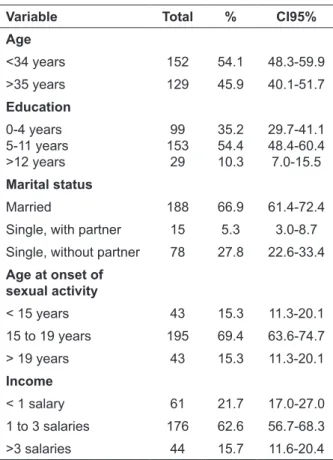
Table 1 summarizes the characteristics of the 281 women involved in the study.
Regarding the time elapsed since the last Pap test, 244 women (86.9%) reported having taken the test within the last three years, 130 women (46.3%) took the test within the last year, 114 women (40.6%) between one and three years ago, and 37 participants (13.2%) had the test more than three years ago.
Table 1 – Sociodemographic variables of the interviewed women. Manaus-AM, 2008
Variable Total % CI95%
Age
<34 years 152 54.1 48.3-59.9
>35 years 129 45.9 40.1-51.7
Education
0-4 years 5-11 years >12 years
99 153
29
35.2 54.4 10.3
29.7-41.1 48.4-60.4 7.0-15.5
Marital status
Married 188 66.9 61.4-72.4
Single, with partner 15 5.3 3.0-8.7
Single, without partner 78 27.8 22.6-33.4
Age at onset of sexual activity
< 15 years 43 15.3 11.3-20.1
15 to 19 years 195 69.4 63.6-74.7
> 19 years 43 15.3 11.3-20.1
Income
< 1 salary 61 21.7 17.0-27.0
1 to 3 salaries 176 62.6 56.7-68.3
>3 salaries 44 15.7 11.6-20.4
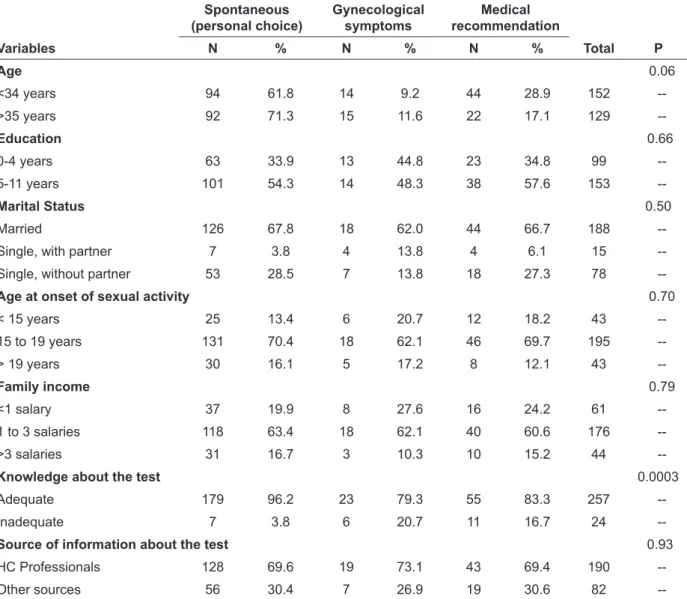
In terms of the reasons for taking the Pap test, 186 women (66.2%) reported they sought out the test spontaneously (personal choice), 66 women (23.5%) took the test under medical recommenda-tion, and 29 women (10.3%) mentioned gynecologi-cal symptoms as the main reason for their taking the test. The women’s mean age stratiied by the reason for taking the latest Pap test showed that the mean age of those who took the test spontane-ously (186 women) was 35.8 years, for those with gynecological symptoms (29 women) the mean age was 34.8 years, and for those who took the test under medical recommendation (66 women), the mean age was 31.7 years. Table 2 lists the women’s reported reasons for taking the latest Pap test, ac-cording to the sociodemographic variables.
professionals were more likely to have taken
the test within the last three years, compared to those informed by other sources (χ
2=6.96; p<0.01;
OR=0.39; CI 95%=0.19-0.80).
Table 2 – Reason for taking the Pap test, according to sociodemographic variables. Manaus-AM, 2008
Spontaneous (personal choice)
Gynecological symptoms
Medical recommendation
Variables N % N % N % Total P
Age 0.06
<34 years 94 61.8 14 9.2 44 28.9 152
-->35 years 92 71.3 15 11.6 22 17.1 129
--Education 0.66
0-4 years 63 33.9 13 44.8 23 34.8 99
--5-11 years 101 54.3 14 48.3 38 57.6 153
--Marital Status 0.50
Married 126 67.8 18 62.0 44 66.7 188
--Single, with partner 7 3.8 4 13.8 4 6.1 15
--Single, without partner 53 28.5 7 13.8 18 27.3 78
--Age at onset of sexual activity 0.70
< 15 years 25 13.4 6 20.7 12 18.2 43
--15 to 19 years 131 70.4 18 62.1 46 69.7 195
--> 19 years 30 16.1 5 17.2 8 12.1 43
--Family income 0.79
<1 salary 37 19.9 8 27.6 16 24.2 61
--1 to 3 salaries 118 63.4 18 62.1 40 60.6 176
-->3 salaries 31 16.7 3 10.3 10 15.2 44
--Knowledge about the test 0.0003
Adequate 179 96.2 23 79.3 55 83.3 257
--Inadequate 7 3.8 6 20.7 11 16.7 24
--Source of information about the test 0.93
HC Professionals 128 69.6 19 73.1 43 69.4 190
--Other sources 56 30.4 7 26.9 19 30.6 82
--It was shown that 257 women (91.5%) were aware that the Pap test is used to screen for cervical cancer. A statistically signiicant association was found between the women knowing the purpose of the Pap test and their spontaneous seeking out of the test (χ2=16.49; p<0.001).
DISCUSSION
UCC disproportionately affects women who are vulnerable and at a social disadvantage, and the cultural and socioeconomic contexts have been considered to be important factors in explaining screening disparities.11-12 In spite of the attempts
to establish cytology-based screening programs,
in most developing countries there have been no reductions in UCC mortality rates.13-14 The
imple-mentation and maintenance of effective screening programs demands infrastructure at a level that few developing regions are capable of offering. Therefore, the data are concentrated among three essential areas: the broad screening of women within the age group at risk; the offering of a reli-able test; and guaranteeing adequate treatment.
that most services are limited to younger women who seek primary healthcare, prenatal care, and family planning.15 This method of screening is
also characterized by frequent repetition of tests, heterogeneous quality of the test, lack of control regarding the introduction of new technologies, and poor monitoring.16
Therefore, the reality of the studied popula-tion is a situapopula-tion in which the spontaneous de-mand is prevalent and opportunistic treatment is performed on women at low risk, younger than 35 years of age, who often take the test not as a means of self-care regarding cancer, but, rather, aiming at the treatment/prevention of other conditions that are often equivocated.
With the purpose to improve the imple-mentation of UCC prevention programs, the Pan-American Health Organization established a Regional Strategy for the Prevention and Control of Cervical Cancer in 2008, comprised of seven essential items, including education information.
17 It is necessary to invest in informing women
about cervical cancer prevention, and to educate the population so that the demand for the Pap test meets the screening proposal, i.e., screening women who are most excluded and at highest risk. Education increases the level of alertness towards the importance of performing preventive tests and can improve the way individuals under-stand information about routine assessments, com-munication with the healthcare professional and the interpretation of the results.18-19 In this study, the women’s knowledge regarding the purpose of the Pap test was signiicantly associated with the spontaneous search for the test (personal choice regarding taking the test) (p=0.0003), validating the idea that information increases the search for preventive care. The origin of this information is an important factor, as in the present study it was observed that receiving information at the Health Center was associated with a greater proportion of tests taken within the last three years (p=0.008). In this sense, it is inferred that the origin of the information about the Pap test is a strong indicator of behavior change among women and, conse-quently, affects their willingness to voluntarily take the test. However, the present study data must be conirmed by population sampling studies, because limitations of the selection bias may occur due to sampling by convenience, as in this study.
Other challenges, such as dificulty in access-ing medical appointments/tests and geographic barriers must be overcome, in order to support a
high-quality screening program, which are impor-tant predictors of the underutilization of the test. Thus, assuring the availability of eficient health-care services is essential to increase the utilization of the Pap test as a screening tool.20
Therefore, recognizing there are innumer-able factors that can contribute to the failure of a screening program, it is essential to assess the target population when planning effective inter-ventions. In this sense, it is important to implement active recruitment strategies that reach, particu-larly, women at a socioeconomic disadvantage.
FINAL CONSIDERATIONS
The profile of the studied population in Manaus-AM is similar to that observed in other Brazilian cities. The present study data suggest that preventive care regarding uterine cervical cancer represent a form of organization that is based on opportunistic demand, which implies that performing the Pap test is associated with the women’s spontaneous search for the service and the opportunity of taking the test among a set of other health care procedures.
Considering the adequacy of UCC control strategies, interventions should be developed with the purpose to facilitate accessibility and educate women who do not take the test. From this per-spective, the local Uniied Health System should promote information and education programs to sensitize the population regarding the importance and recommended frequency of the Pap test. Ac-tions to control UCC should be extended to com-munity centers and schools, using a participative approach, as a way to train the community to as-sume an active role in controlling factors related to their health condition. The greatest challenge is to have a health system of universal access that provides women with high quality services for the prevention, diagnosis and treatment of cervi-cal cancer, so as to reduce the heavy burden of the disease.
REFERENCES
1. Thuler LCS. Mortalidade por câncer do colo do útero
no Brasil. Rev Bras Ginecol Obstet. 2008 Jan-Mai; 30(5):216-8.
2. Parkin DM, Bray F, Ferlay J, Pisani P. Global cancer
statistics, 2002. CA Cancer J Clin. 2005 Mar-Abr; 55(2):74-108.
3. Ministério da Saúde (BR), Instituto Nacional de
4. Ministério da Saúde (BR). Instituto Nacional de
Câncer. Estimativas 2009: incidência de Câncer no Brasil. Brasília (DF): MS; 2009.
5. Mendonça VG, Lorenzato FRB, Mendonça JG,
Menezes TC, Guimarães MJB. Mortalidade por câncer do colo do útero: características sociodemográicas das mulheres residentes na cidade de Recife, Pernambuco. Rev Bras Ginecol Obstet. 2008 Jan-Mai; 30(5):248-55. 6. World Health Organization. Manual on the
prevention and control of common cancers. Geneva (SW): World Health Organization; 1998.
7. Corrêa DAD, Villela WV. O controle do câncer do
colo do útero: desaios para implementação de ações programáticas no Amazonas, Brasil. Rev Bras Saúde Materno Infantil. 2008 Out-Dez; 8(4):491-7.
8. Pinho AA. Fatores associados à realização do Teste Papanicolaou entre mulheres em idade reprodutiva no município de São Paulo [dissertação]. São Paulo (SP): Universidade de São Paulo, Programa de Pós-Graduação em Saúde Materno-Infantil; 2002.
9. Gamarra CJ. Conhecimentos, atitudes e práticas
do exame Papanicolaou em mulheres de Puerto Leoni, Argentina: uma contribuição à enfermagem de saúde pública [dissertação]. Rio de Janeiro (RJ): Universidade Federal do Rio de Janeiro, Programa de Pós-Graduação em Enfermagem; 2004.
10. Ministério da Saúde (BR), Instituto Nacional de
Câncer.Falando sobre o câncer do colo do útero.
Brasília (DF): MS; 2002.
11. Smith RA, Cokkinides V, Brooks D, Saslow D,
Brawley OW. Cancer screening in the United States, 2010: a review of current American Cancer Society
guidelines and issues in cancer screening. CA Cancer
J Clin. 2010 Mar-Abr; 60(2):99-119.
12. Spadea T, Bellini S, Kunst A, Stirbu I, Costa G. The
impact of interventions to improve attendance in
female cancer screening among lower socioeconomic groups: a review. Prev Med. 2010 Abr; 50(4):159-64.
13. Organización Panamericana de la Salud (OPS).
Análisis de la situación del cáncer cervicouterino en América Latina y el Caribe. Washington, D.C.: OPS; 2004.
14. Pinho AA, França-Junior I. Prevenção do câncer de
colo do útero: um modelo teórico para analisar o acesso e a utilização do teste de Papanicolaou. Rev Bras Saúde Mater Infant. 2003 Jan-Mar; 3(1):95-112.
15. Vale DBAP, Morais SS, Pimenta AL, Zeferino, LC.
Avaliação do rastreamento do câncer do colo do útero na Estratégia Saúde da Família no município de Amparo, São Paulo, Brasil.Cad Saúde Pública. 2010 Fev; 26(2):383-90.
16. Arbyn M, Rebolj M, De Kok IM, Fender M, Becker N, O’Reilly M, et al. The challenges of organising cervical screening programmes in the 15 old member states of the European Union. Eur J Cancer. 2009 Out; 45(15):2671-8.
17. Luciani S, Andrus JK. Uma estratégia da Organização
Pan Americana de Saúde para prevenção e controle do câncer cervical na América Latina e Caribe. Reprod Health Matters. 2008 Dez; 16(31):71-8. 18. Sabates R, Feinstein L. The role of education in
the uptake of preventative health care: the case of cervical screening in Britain. Soc Sci Med. 2006 Jun; 62(12):2998-3010.
19. Zeferino LC. O desaio de reduzir a mortalidade por
câncer do colo do útero. Rev Bras Ginecol Obstet. 2008 Jan-Mai; 30(5):213-5.
20. Arrossi S, Ramos S, Paolino M, Sankaranarayanan R. Desigualdades sociais na cobertura do Papanicolaou:
identificando a subutilização do rastreamento de câncer cervical na Argentina. Reprod Health Matters. 2008 Dez; 16(31):60-70.
Correspondence to: Dina Albuquerque Duarte Corrêa Rua JK, 226, Conjunto Morado do Sol