Seamless R and C++ Integration:
Rcpp and RInside
Dirk Eddelbuettel
Debian Project
Joint work with Romain François
Invited seminar presentation
Institute for Statistics and Mathematics
Preliminaries
We assume a recent version of
R
so that
Preliminaries
We assume a recent version of
R
so that
install.packages(c("Rcpp","RInside","inline"))
gets us current versions of the packages
All examples shown should work ’as is’ on Linux, OS X and
Windows
provided a complete
R
development environment
We assume a recent version of
R
so that
install.packages(c("Rcpp","RInside","inline"))
gets us current versions of the packages
All examples shown should work ’as is’ on Linux, OS X and
Windows
provided a complete
R
development environment
Preliminaries
We assume a recent version of
R
so that
install.packages(c("Rcpp","RInside","inline"))
gets us current versions of the packages
All examples shown should work ’as is’ on Linux, OS X and
Windows
provided a complete
R
development environment
The
R Installation and Administration
manual is an
excellent start if you need to address the preceding point
In particular, one must use the same compilers used to
build
R
in order to extend or embed the
R
engine
We assume a recent version of
R
so that
install.packages(c("Rcpp","RInside","inline"))
gets us current versions of the packages
All examples shown should work ’as is’ on Linux, OS X and
Windows
provided a complete
R
development environment
The
R Installation and Administration
manual is an
excellent start if you need to address the preceding point
In particular, one must use the same compilers used to
build
R
in order to extend or embed the
R
engine
However, there is a known issue with the current RInside /
Outline
1
Extending R
Why ?
The standard API
Inline
2
Rcpp
Overview
New API
Examples
Motivation
Chambers.Software for Data Analysis: Programming with R. Springer, 2008
Chambers (2008) opens chapter 11 (
Interfaces I:
Using C and Fortran)
with these words:
Chambers.Software for Data Analysis: Programming with R. Springer, 2008
Chambers (2008) opens chapter 11 (
Interfaces I:
Motivation
Chambers (2008) then proceeds with this rough map of the
road ahead:
Chambers (2008) then proceeds with this rough map of the
road ahead:
Motivation
Chambers (2008) then proceeds with this rough map of the
road ahead:
Against:
It’s more work
Chambers (2008) then proceeds with this rough map of the
road ahead:
Against:
Motivation
Chambers (2008) then proceeds with this rough map of the
road ahead:
Against:
It’s more work
Bugs will bite
Potential platform
dependency
Chambers (2008) then proceeds with this rough map of the
road ahead:
Against:
It’s more work
Bugs will bite
Potential platform
dependency
Motivation
Chambers (2008) then proceeds with this rough map of the
road ahead:
Against:
It’s more work
Bugs will bite
Potential platform
dependency
Less readable software
Chambers (2008) then proceeds with this rough map of the
road ahead:
Against:
It’s more work
Bugs will bite
Potential platform
dependency
Less readable software
In Favor:
Motivation
Chambers (2008) then proceeds with this rough map of the
road ahead:
Against:
It’s more work
Bugs will bite
Potential platform
dependency
Less readable software
In Favor:
New and trusted
computations
Speed
Chambers (2008) then proceeds with this rough map of the
road ahead:
Against:
It’s more work
Bugs will bite
Potential platform
dependency
Less readable software
In Favor:
New and trusted
computations
Speed
Motivation
Chambers (2008) then proceeds with this rough map of the
road ahead:
Against:
It’s more work
Bugs will bite
Potential platform
dependency
Less readable software
In Favor:
New and trusted
computations
Speed
Object references
Chambers (2008) then proceeds with this rough map of the
road ahead:
Against:
It’s more work
Bugs will bite
Potential platform
dependency
Less readable software
In Favor:
New and trusted
computations
Speed
Object references
Motivation
Chambers (2008) then proceeds with this rough map of the
road ahead:
Against:
It’s more work
Bugs will bite
Potential platform
dependency
Less readable software
In Favor:
New and trusted
computations
Speed
Object references
So is the deck stacked against us?
1
Extending R
Why ?
The standard API
Inline
2
Rcpp
Compiled Code: The Basics
R
offers several functions to access compiled code: we focus
on
.C
and
.Call
here. (
R Extensions
, sections 5.2 and 5.9;
Software for Data Analysis
).
R
offers several functions to access compiled code: we focus
on
.C
and
.Call
here. (
R Extensions
, sections 5.2 and 5.9;
Software for Data Analysis
).
The canonical example is the convolution function:
1 void convolve (double ∗a , i n t ∗na , double ∗b , 2 i n t ∗nb , double ∗ab )
3 {
4 i n t i , j , nab =∗na +∗nb−1 ; 5
6 f o r( i = 0 ; i < nab ; i ++) 7 ab [ i ] = 0 . 0 ;
Compiled Code: The Basics cont.
The convolution function is called from
R
by
The convolution function is called from
R
by
1 conv<−function( a , b ) 2 .C( " convolve " , 3 as.double( a ) , 4 as.i n t e g e r(length( a ) ) , 5 as.double( b ) , 6 as.i n t e g e r(length( b ) ) ,
7 ab = double(length( a ) + length( b )−1 ) )$ab
As stated in the manual, one must take care to coerce all the
arguments to the correct
R
storage mode before calling
.C
as
Example: Running the convolution code via .C
All these files are at
http://dirk.eddelbuettel.com/code/rcppTut
Turn the C source file into a dynamic library using
R CMD SHLIB convolve.C.c
Turn the C source file into a dynamic library using
R CMD SHLIB convolve.C.c
Load it inside an
R
script or session using
Example: Running the convolution code via .C
All these files are at
http://dirk.eddelbuettel.com/code/rcppTut
Turn the C source file into a dynamic library using
R CMD SHLIB convolve.C.c
Load it inside an
R
script or session using
dyn.load("convolve.C.so")
Use it via the
.C()
interface as shown on previous slide
Turn the C source file into a dynamic library using
R CMD SHLIB convolve.C.c
Load it inside an
R
script or session using
dyn.load("convolve.C.so")
Use it via the
.C()
interface as shown on previous slide
All together in a helper file
convolve.C.sh
#!/bin/sh
R CMD SHLIB convolve.C.c
Compiled Code: The Basics cont.
Using
.Call, the example becomes
Using
.Call, the example becomes
1 # include <R . h> 2 # include < Rdefines . h> 3
4 extern "C" SEXP convolve2 (SEXP a , SEXP b ) 5 {
6 i n t i , j , na , nb , nab ; 7 double ∗xa , ∗xb , ∗xab ; 8 SEXP ab ;
9
10 PROTECT( a = AS_NUMERIC( a ) ) ; 11 PROTECT( b = AS_NUMERIC( b ) ) ;
12 na = LENGTH( a ) ; nb = LENGTH( b ) ; nab = na + nb−1 ; 13 PROTECT( ab = NEW_NUMERIC( nab ) ) ;
14 xa = NUMERIC_POINTER ( a ) ; xb = NUMERIC_POINTER ( b ) ; 15 xab = NUMERIC_POINTER ( ab ) ;
16 f o r( i = 0 ; i < nab ; i ++) xab [ i ] = 0 . 0 ; 17 f o r( i = 0 ; i < na ; i ++)
18 f o r( j = 0 ; j < nb ; j ++) xab [ i + j ] += xa [ i ] ∗xb [ j ] ; 19 UNPROTECT( 3 ) ;
Compiled Code: The Basics cont.
Now the call simplifies to just the function name and the vector
arguments—all other handling is done at the C/C++ level:
1
conv
<
−
function
( a , b ) .
C a l l
( " convolve2 " , a , b )
Now the call simplifies to just the function name and the vector
arguments—all other handling is done at the C/C++ level:
1
conv
<
−
function
( a , b ) .
C a l l
( " convolve2 " , a , b )
In summary, we see that
Compiled Code: The Basics cont.
Now the call simplifies to just the function name and the vector
arguments—all other handling is done at the C/C++ level:
1
conv
<
−
function
( a , b ) .
C a l l
( " convolve2 " , a , b )
In summary, we see that
there are different entry points
using different calling conventions
Now the call simplifies to just the function name and the vector
arguments—all other handling is done at the C/C++ level:
1
conv
<
−
function
( a , b ) .
C a l l
( " convolve2 " , a , b )
In summary, we see that
there are different entry points
using different calling conventions
Example: Running the convolution code via .Call
Turn the C source file into a dynamic library using
R CMD SHLIB convolve.Call.c
Turn the C source file into a dynamic library using
R CMD SHLIB convolve.Call.c
Load it inside an
R
script or session using
Example: Running the convolution code via .Call
Turn the C source file into a dynamic library using
R CMD SHLIB convolve.Call.c
Load it inside an
R
script or session using
dyn.load("convolve.Call.so")
Use it via the
.Call()
interface as shown previously
Turn the C source file into a dynamic library using
R CMD SHLIB convolve.Call.c
Load it inside an
R
script or session using
dyn.load("convolve.Call.so")
Use it via the
.Call()
interface as shown previously
All together in a helper file
convolve.Call.sh
#!/bin/sh
R CMD SHLIB convolve.Call.c
Outline
1
Extending R
Why ?
The standard API
Inline
2
Rcpp
Overview
New API
Examples
inline
is a package by Oleg Sklyar et al that provides the
Compiled Code: inline
inline
is a package by Oleg Sklyar et al that provides the
function
cfunction
which can wrap Fortran, C or C++ code.
1
## A s i m p l e F o r t r a n example
2code
<
−
"
3
i n t e g e r i
4do 1 i =1 , n ( 1 )
51 x ( i ) = x ( i )
∗∗
3
6
"
7
cubefn
<
−
c f u n c t i o n ( s i g n a t u r e ( n= " i n t e g e r " , x= " numeric " ) ,
8
code , c o n v e n t i o n = " . F o r t r a n " )
9x
<
−
as
.
numeric
( 1 : 1 0 )
10
n
<
−
as
.
i n t e g e r
( 1 0 )
11
cubefn ( n , x )
$
x
inline
is a package by Oleg Sklyar et al that provides the
function
cfunction
which can wrap Fortran, C or C++ code.
1
## A s i m p l e F o r t r a n example
2code
<
−
"
3
i n t e g e r i
4do 1 i =1 , n ( 1 )
51 x ( i ) = x ( i )
∗∗
3
6
"
7
cubefn
<
−
c f u n c t i o n ( s i g n a t u r e ( n= " i n t e g e r " , x= " numeric " ) ,
8
code , c o n v e n t i o n = " . F o r t r a n " )
9x
<
−
as
.
numeric
( 1 : 1 0 )
10
n
<
−
as
.
i n t e g e r
( 1 0 )
11
cubefn ( n , x )
$
x
cfunction
takes care of compiling, linking, loading, . . . by
placing the resulting dynamically-loadable object code in the
Example: Convolution via .C with inline
Using the file
convolve.C.inline.R
1 r e q u i r e( i n l i n e ) 2
3 code<− " i n t i , j , nab =∗na +∗nb−1 ; 4
5 f o r ( i = 0 ; i < nab ; i ++) 6 ab [ i ] = 0 . 0 ;
7
8 f o r ( i = 0 ; i <∗na ; i ++) { 9 f o r ( j = 0 ; j <∗nb ; j ++) 10 ab [ i + j ] += a [ i ] ∗b [ j ] ;
11 }
12 " 13
14 f u n<−c f u n c t i o n ( s i g n a t u r e ( a= " numeric " , na= " numeric " , 15 b= " numeric " , nb= " numeric " , 16 ab= " numeric " ) ,
17 code , language= "C" , c o n v e n t i o n = " . C" ) 18
19 f u n ( 1 : 1 0 , 10 , 1 0 : 1 , 10 , numeric( 1 9 ) )$ab
1 r e q u i r e( i n l i n e )
2 code<− " i n t i , j , na , nb , nab ; 3 double∗xa , ∗xb , ∗xab ; 4 SEXP ab ;
5
6 PROTECT( a = AS_NUMERIC( a ) ) ; PROTECT( b = AS_NUMERIC( b ) ) ; 7 na = LENGTH( a ) ; nb = LENGTH( b ) ; nab = na + nb−1 ; 8 PROTECT( ab = NEW_NUMERIC( nab ) ) ;
9
10 xa = NUMERIC_POINTER ( a ) ; xb = NUMERIC_POINTER ( b ) ; 11 xab = NUMERIC_POINTER ( ab ) ;
12 f o r ( i = 0 ; i < nab ; i ++) xab [ i ] = 0 . 0 ; 13
14 f o r ( i = 0 ; i < na ; i ++) 15 f o r ( j = 0 ; j < nb ; j ++) 16 xab [ i + j ] += xa [ i ] ∗xb [ j ] ; 17
18 UNPROTECT( 3 ) ; 19 r e t u r n ( ab ) ; " 20
21 f u n<−c f u n c t i o n ( s i g n a t u r e ( a= " numeric " , b= " numeric " ) , 22 code , language= "C" )
23
Outline
1
Extending R
Why ?
The standard API
Inline
2
Rcpp
Overview
New API
Examples
Compiled Code: Rcpp
In a nutshell:
Rcpp
makes it easier to interface C++ and
R
code.
In a nutshell:
Rcpp
makes it easier to interface C++ and
R
code.
Using the
.Call
interface, we can use features of the C++
Compiled Code: Rcpp
In a nutshell:
Rcpp
makes it easier to interface C++ and
R
code.
Using the
.Call
interface, we can use features of the C++
language to automate the tedious bits of the macro-based
C-level interface to
R.
One major advantage of using
.Call
is that richer R
objects (vectors, matrices, lists,
. . .
in fact most SEXP
types incl functions, environments etc) can be passed
directly between
R
and C++ without the need for explicit
passing of dimension arguments.
In a nutshell:
Rcpp
makes it easier to interface C++ and
R
code.
Using the
.Call
interface, we can use features of the C++
language to automate the tedious bits of the macro-based
C-level interface to
R.
One major advantage of using
.Call
is that richer R
objects (vectors, matrices, lists,
. . .
in fact most SEXP
types incl functions, environments etc) can be passed
directly between
R
and C++ without the need for explicit
passing of dimension arguments.
By using the C++ class layers, we do not need to
Compiled Code: Rcpp
In a nutshell:
Rcpp
makes it easier to interface C++ and
R
code.
Using the
.Call
interface, we can use features of the C++
language to automate the tedious bits of the macro-based
C-level interface to
R.
One major advantage of using
.Call
is that richer R
objects (vectors, matrices, lists,
. . .
in fact most SEXP
types incl functions, environments etc) can be passed
directly between
R
and C++ without the need for explicit
passing of dimension arguments.
By using the C++ class layers, we do not need to
manipulate the SEXP objects using any of the old-school C
macros.
inline
eases usage, development and testing.
1 r e q u i r e( i n l i n e ) 2 code<− ’
3 RcppVector <double > xa ( a ) ; 4 RcppVector <double > xb ( b ) ; 5
6 i n t nab = xa . s i z e ( ) + xb . s i z e ( )−1 ; 7 RcppVector <double > xab ( nab ) ;
8 f o r ( i n t i = 0 ; i < nab ; i ++) xab ( i ) = 0 . 0 ; 9
10 f o r ( i n t i = 0 ; i < xa . s i z e ( ) ; i ++) 11 f o r ( i n t j = 0 ; j < xb . s i z e ( ) ; j ++) 12 xab ( i + j ) += xa ( i ) ∗xb ( j ) ; 13
14 RcppResultSet r s ; 15 r s . add ( " ab " , xab ) ; 16 r e t u r n r s . g e t R e t u r n L i s t ( ) ; 17 ’
18
Outline
1
Extending R
Why ?
The standard API
Inline
2
Rcpp
Overview
New API
Examples
Rcpp: The ’New API’
Rcpp was significantly extended over the last few months to
permit more natural expressions. Consider this comparison
between the R API and the new Rcpp API:
1 SEXP ab ;
2 PROTECT( ab = a l l o c V e c t o r (STRSXP, 2 ) ) ; 3 SET_STRING_ELT ( ab , 0 , mkChar ( " f o o " ) ) ; 4 SET_STRING_ELT ( ab , 1 , mkChar ( " bar " ) ) ; 5 UNPROTECT( 1 ) ;
Rcpp was significantly extended over the last few months to
permit more natural expressions. Consider this comparison
between the R API and the new Rcpp API:
1 SEXP ab ;
2 PROTECT( ab = a l l o c V e c t o r (STRSXP, 2 ) ) ; 3 SET_STRING_ELT ( ab , 0 , mkChar ( " f o o " ) ) ; 4 SET_STRING_ELT ( ab , 1 , mkChar ( " bar " ) ) ; 5 UNPROTECT( 1 ) ;
Rcpp: The ’New API’
Rcpp was significantly extended over the last few months to
permit more natural expressions. Consider this comparison
between the R API and the new Rcpp API:
1 SEXP ab ;
2 PROTECT( ab = a l l o c V e c t o r (STRSXP, 2 ) ) ; 3 SET_STRING_ELT ( ab , 0 , mkChar ( " f o o " ) ) ; 4 SET_STRING_ELT ( ab , 1 , mkChar ( " bar " ) ) ; 5 UNPROTECT( 1 ) ;
1 C h a r a c t e r V e c t o r ab ( 2 ) ; 2 ab [ 0 ] = " f o o " ; 3 ab [ 1 ] = " bar " ;
Data types, including STL containers and iterators, can be
nested and other niceties. Implicit converters allow us to
combine types:
Rcpp was significantly extended over the last few months to
permit more natural expressions. Consider this comparison
between the R API and the new Rcpp API:
1 SEXP ab ;
2 PROTECT( ab = a l l o c V e c t o r (STRSXP, 2 ) ) ; 3 SET_STRING_ELT ( ab , 0 , mkChar ( " f o o " ) ) ; 4 SET_STRING_ELT ( ab , 1 , mkChar ( " bar " ) ) ; 5 UNPROTECT( 1 ) ;
1 C h a r a c t e r V e c t o r ab ( 2 ) ; 2 ab [ 0 ] = " f o o " ; 3 ab [ 1 ] = " bar " ;
Data types, including STL containers and iterators, can be
nested and other niceties. Implicit converters allow us to
combine types:
1 s t d : : v e c t o r <double> vec ; 2 [ . . . ]
Rcpp: The ’New API’
Rcpp was significantly extended over the last few months to
permit more natural expressions. Consider this comparison
between the R API and the new Rcpp API:
1 SEXP ab ;
2 PROTECT( ab = a l l o c V e c t o r (STRSXP, 2 ) ) ; 3 SET_STRING_ELT ( ab , 0 , mkChar ( " f o o " ) ) ; 4 SET_STRING_ELT ( ab , 1 , mkChar ( " bar " ) ) ; 5 UNPROTECT( 1 ) ;
1 C h a r a c t e r V e c t o r ab ( 2 ) ; 2 ab [ 0 ] = " f o o " ; 3 ab [ 1 ] = " bar " ;
Data types, including STL containers and iterators, can be
nested and other niceties. Implicit converters allow us to
combine types:
1 s t d : : v e c t o r <double> vec ; 2 [ . . . ]
3 L i s t x ( 3 ) ; 4 x [ 0 ] = vec ; 5 x [ 1 ] = " some t e x t " ; 6 x [ 2 ] = 4 2 ;
1 / / With Rcpp 0 . 7 . 1 1 or l a t e r we cando: 2 s t d : : v e c t o r <double> vec ;
3 [ . . . ]
4 L i s t x = L i s t : : c r e a t e ( vec , 5 " some t e x t " ,
6 42) ;
Functional programming in both languages
In
R, functional programming is easy:
1 R> data( f a i t h f u l ) ; l a p p l y( f a i t h f u l , summary) 2 $e r u p t i o n s
3 Min . 1 s t Qu . Median Mean 3 r d Qu . Max . 4 1.60 2.16 4.00 3.49 4.45 5.10 5
6 $w a i t i n g
7 Min . 1 s t Qu . Median Mean 3 r d Qu . Max . 8 43.0 58.0 76.0 70.9 82.0 96.0
In
R, functional programming is easy:
1 R> data( f a i t h f u l ) ; l a p p l y( f a i t h f u l , summary) 2 $e r u p t i o n s
3 Min . 1 s t Qu . Median Mean 3 r d Qu . Max . 4 1.60 2.16 4.00 3.49 4.45 5.10 5
6 $w a i t i n g
7 Min . 1 s t Qu . Median Mean 3 r d Qu . Max . 8 43.0 58.0 76.0 70.9 82.0 96.0
We can do that in C++ as well and pass the
R
function down to
the data that we let the STL
transform
function iterate over:
1 s r c<− ’ Rcpp : : L i s t i n p u t ( data ) ; 2 Rcpp : : F u n c t i o n f ( f u n ) ; 3 Rcpp : : L i s t o u t p u t ( i n p u t . s i z e ( ) ) ;
4 s t d : : t r a n s f o r m ( i n p u t . begin ( ) , i n p u t . end ( ) , o u t p u t . begin ( ) , f ) ; 5 o u t p u t . names ( ) = i n p u t . names ( ) ;
6 r e t u r n o u t p u t ; ’
Exception handling
Automatic catching and conversion of C++ exceptions:
R> library(Rcpp); library(inline)
R> cpp <- ’
+
Rcpp::NumericVector x(xs); // automatic conversion from SEXP
+
for (int i=0; i<x.size(); i++) {
+
if (x[i] < 0)
+
throw std::range_error("Non-negative values required");
+
x[i] = log(x[i]);
+
}
+
return x;
// automatic conversion to SEXP
+ ’
R> fun <- cppfunction(signature(xs="numeric"), cpp)
R> fun( seq(2, 5) )
[1] 0.6931 1.0986 1.3863 1.6094
R> fun( seq(5, -2) )
Error in fun(seq(5, -2)) : Non-negative values required
R> fun( LETTERS[1:5] )
Exception handling: Usage
We attempted to automate forwarding of exceptions from
the C++ layer to the
R
layer.
We attempted to automate forwarding of exceptions from
the C++ layer to the
R
layer.
This works (thanks to some
gcc
magic) on operating
Exception handling: Usage
We attempted to automate forwarding of exceptions from
the C++ layer to the
R
layer.
This works (thanks to some
gcc
magic) on operating
system with an X in their name, but not on Windows.
We therefore once again recommend to wrap code with
try {
and
} catch( std::exception &ex) {
forward_exception_to_r(ex);
} catch(...) {
::Rf_error("c++ exception (unknown reason)");
}
We attempted to automate forwarding of exceptions from
the C++ layer to the
R
layer.
This works (thanks to some
gcc
magic) on operating
system with an X in their name, but not on Windows.
We therefore once again recommend to wrap code with
try {
and
} catch( std::exception &ex) {
forward_exception_to_r(ex);
} catch(...) {
::Rf_error("c++ exception (unknown reason)");
}
Because this is invariant, we provide macros
BEGIN_RCPP
Exception handling: Usage
We attempted to automate forwarding of exceptions from
the C++ layer to the
R
layer.
This works (thanks to some
gcc
magic) on operating
system with an X in their name, but not on Windows.
We therefore once again recommend to wrap code with
try {
and
} catch( std::exception &ex) {
forward_exception_to_r(ex);
} catch(...) {
::Rf_error("c++ exception (unknown reason)");
}
Because this is invariant, we provide macros
BEGIN_RCPP
and
END_RCPP.
We provide a variant
cppfunction
of
inline::cfunction
which automatically inserts these
at the beginning and end of the code snippets.
1
Extending R
Why ?
The standard API
Inline
2
Rcpp
Overview
New API
Example: Convolution using new Rcpp
Using the file
convolve.Call.Rcpp.new.R
1 r e q u i r e( i n l i n e ) 2
3 code<− ’
4 Rcpp : : NumericVector xa ( a ) ; / / a u t o m a t i c c o n v e r s i o n from SEXP 5 Rcpp : : NumericVector xb ( b ) ;
6
7 i n t n_xa = xa . s i z e ( ) ; 8 i n t n_xb = xb . s i z e ( ) ; 9 i n t nab = n_xa + n_xb−1 ; 10
11 Rcpp : : NumericVector xab ( nab ) ; 12
13 f o r ( i n t i = 0 ; i < n_xa ; i ++) 14 f o r ( i n t j = 0 ; j < n_xb ; j ++) 15 xab [ i + j ] += xa [ i ] ∗xb [ j ] ; 16
17 r e t u r n xab ; / / a u t o m a t i c c o n v e r s i o n t o SEXP 18 ’
19
20 f u n<−c p p f u n c t i o n ( s i g n a t u r e ( a= " numeric " , b= " numeric " ) , code ) 21
22 f u n ( 1 : 1 0 , 1 0 : 1 )
Speed comparison
See the directory
Rcpp/examples/ConvolveBenchmarks
In a recently-submitted paper, the following table summarises
the performance of convolution examples:
Implementation
Time in
Relative
millisec
to R API
R API (as benchmark)
32
RcppVector<double>
354
11.1
NumericVector::operator[]
52
1.6
NumericVector::begin
33
1.0
Table 1: Performance for convolution example
In a recently-submitted paper, the following table summarises
the performance of convolution examples:
Implementation
Time in
Relative
millisec
to R API
R API (as benchmark)
32
RcppVector<double>
354
11.1
NumericVector::operator[]
52
1.6
NumericVector::begin
33
1.0
Table 1: Performance for convolution example
Another Speed Comparison Example
Regression is a key component of many studies. In
simulations, we often want to run a very large number of
regressions.
Regression is a key component of many studies. In
simulations, we often want to run a very large number of
regressions.
R
has
lm()
as the general purposes function. It is very
Another Speed Comparison Example
Regression is a key component of many studies. In
simulations, we often want to run a very large number of
regressions.
R
has
lm()
as the general purposes function. It is very
powerful and returns a rich object—but it is not
lightweight
.
For this purpose,
R
has
lm.fit(). But, this does not
provide all relevant auxiliary data as
e.g.
the standard error
of the estimate.
Regression is a key component of many studies. In
simulations, we often want to run a very large number of
regressions.
R
has
lm()
as the general purposes function. It is very
powerful and returns a rich object—but it is not
lightweight
.
For this purpose,
R
has
lm.fit(). But, this does not
provide all relevant auxiliary data as
e.g.
the standard error
of the estimate.
For the most recent
Introduction to High-Performance
Another Speed Comparison Example
Regression is a key component of many studies. In
simulations, we often want to run a very large number of
regressions.
R
has
lm()
as the general purposes function. It is very
powerful and returns a rich object—but it is not
lightweight
.
For this purpose,
R
has
lm.fit(). But, this does not
provide all relevant auxiliary data as
e.g.
the standard error
of the estimate.
For the most recent
Introduction to High-Performance
Computing with R
tutorial, I had written a hybrid R/C/C++
solution using the GNU GSL.
We complement this with a new C++ implementation
around the Armadillo linear algebra classes.
1 lmGSL<−function( ) { 2 s r c<− ’
3
4 RcppVectorView <double > Yr ( Ysexp ) ; 5 RcppMatrixView <double > Xr ( Xsexp ) ; 6
7 i n t i , j , n = Xr . dim1 ( ) , k = Xr . dim2 ( ) ; 8 double c h i 2 ;
9
10 g s l_m a t r i x ∗X = g s l_m a t r i x_a l l o c ( n , k ) ; 11 g s l_v e c t o r ∗y = g s l_v e c t o r_a l l o c ( n ) ; 12 g s l_v e c t o r ∗c = g s l_v e c t o r_a l l o c ( k ) ; 13 g s l_m a t r i x ∗cov = g s l_m a t r i x_a l l o c ( k , k ) ; 14
15 f o r ( i = 0 ; i < n ; i ++) { 16 f o r ( j = 0 ; j < k ; j ++) {
17 g s l_m a t r i x_s e t ( X , i , j , Xr ( i , j ) ) ; 18 }
19 g s l_v e c t o r_s e t ( y , i , Yr ( i ) ) ; 20 }
21
22 g s l_m u l t i f i t_l i n e a r_workspace ∗wk = 23 g s l_m u l t i f i t_l i n e a r_a l l o c ( n , k ) ; 24 g s l_m u l t i f i t_l i n e a r ( X , y , c , cov ,&chi2 , wk ) ; 25 g s l_m u l t i f i t_l i n e a r_f r e e ( wk ) ;
26 RcppVector <double > S t d E r r ( k ) ;
28 f o r ( i = 0 ; i < k ; i ++) { 29 Coef ( i ) = g s l_ vector _get(c, i ) ; 30 S t d E r r ( i ) =
31 s q r t( g s l_ matrix _get(cov, i , i ) ) ; 32 }
33
34 g s l_ matrix _f r e e ( X ) ; 35 g s l_ vector _f r e e ( y ) ; 36 g s l_ vector _f r e e (c) ; 37 g s l_ matrix _f r e e (cov) ; 38
39 RcppResultSet r s ; 40 r s .add( " c o e f " , Coef ) ; 41 r s .add( " s t d e r r " , S t d E r r ) ; 42
43 r e t u r n = r s . g e t R e t u r n L i s t ( ) ; 44 ’
45 ## t u r n i n t o a f u n c t i o n t h a t R can c a l l 46 ## args redundant on Debian/Ubuntu 47 f u n<−
48 c p p f u n c t i o n ( s i g n a t u r e ( Ysexp =" numeric " , 49 Xsexp =" numeric " ) , src ,
50 i n c l u d e s =
51 " # i n c l u d e < g s l/g s l_m u l t i f i t . h > " , 52 cppargs="−I/u s r/i n c l u d e " ,
Linear regression via Armadillo: lmArmadillo example
Also see the directory
Rcpp/examples/FastLM
1 l m A r m a d i l l o<−function( ) { 2 s r c<− ’
3 Rcpp : : NumericVector y r ( Ysexp ) ;
4 Rcpp : : NumericVector Xr ( Xsexp ) ; / / a c t u a l l y an n x k m a t r i x 5 s t d : : v e c t o r < i n t > dims = Xr . a t t r ( " dim " ) ;
6 i n t n = dims [ 0 ] , k = dims [ 1 ] ;
7 arma : : mat X ( Xr . begin ( ) , n , k , f a l s e ) ; / / use advanced a r m a d i l l o c o n s t r u c t o r s 8 arma : : c o l v e c y ( y r . begin ( ) , y r . s i z e ( ) ) ;
9 arma : : c o l v e c c o e f = s o l v e ( X , y ) ; / / model f i t
10 arma : : c o l v e c r e s i d = y−X∗c o e f ; / / t o comp . s t d . e r r r o f t h e c o e f f i c i e n t s 11 arma : : mat covmat = t r a n s ( r e s i d )∗r e s i d/( n−k ) ∗arma : : i n v ( arma : : t r a n s ( X )∗X ) ; 12
13 Rcpp : : NumericVector c o e f r ( k ) , s t d e r r e s t r ( k ) ;
14 f o r ( i n t i =0 ; i <k ; i ++) { / / w i t h RcppArmadillo t e m p l a t e c o n v e r t e r s 15 c o e f r [ i ] = c o e f [ i ] ; / / t h i s would n o t be needed b u t we o n l y 16 s t d e r r e s t r [ i ] = s q r t ( covmat ( i , i ) ) ; / / have Rcpp . h here
17 } 18
19 r e t u r n Rcpp : : L i s t : : c r e a t e ( Rcpp : : Named ( " c o e f f i c i e n t s " , c o e f r ) , / / Rcpp 0 . 7 . 1 1 20 Rcpp : : Named ( " s t d e r r " , s t d e r r e s t r ) ) ;
21 ’ 22
23 ## t u r n i n t o a f u n c t i o n t h a t R can c a l l
24 f u n<− c p p f u n c t i o n ( s i g n a t u r e ( Ysexp= " numeric " , Xsexp= " numeric " ) , 25 src , i n c l u d e s = " # i n c l u d e < a r m a d i l l o > " ,
26 cppargs= "−I/u s r/i n c l u d e " , l i b a r g s = "−l a r m a d i l l o " ) 27 }
fastLm
in the new
RcppArmadillo
release does even better:
1 # include < RcppArmadillo . h>
2 extern "C" SEXP fastLm (SEXP ys , SEXP Xs ) { 3 t r y {
4 Rcpp : : NumericVector y r ( ys ) ; / / c r e a t e s Rcpp v e c t o r from SEXP 5 Rcpp : : N u m e r i c M a t r i x Xr ( Xs ) ; / / c r e a t e s Rcpp m a t r i x from SEXP 6 i n t n = Xr . nrow ( ) , k = Xr . n c o l ( ) ;
7
8 arma : : mat X ( Xr . begin ( ) , n , k , f a l s e) ; / / reuses memory and a v o i d s e x t r a copy 9 arma : : c o l v e c y ( y r . begin ( ) , y r . s i z e ( ) , f a l s e) ;
10
11 arma : : c o l v e c c o e f = arma : : s o l v e ( X , y ) ; / / f i t model y ~X 12 arma : : c o l v e c r e s = y−X∗c o e f ; / / r e s i d u a l s 13
14 double s2 = s t d : : i n n e r_p r o d u c t ( r e s . begin ( ) , r e s . end ( ) , r e s . begin ( ) ,double( ) )/( n−k ) ; 15 / / s t d . e r r o r s o f c o e f f i c i e n t s
16 arma : : c o l v e c s t d e r r = arma : : s q r t ( s2∗arma : : diagvec ( arma : : i n v ( arma : : t r a n s ( X )∗X ) ) ) ; 17
18 r e t u r n Rcpp : : L i s t : : c r e a t e ( Rcpp : : Named ( " c o e f f i c i e n t s " ) = coef , 19 Rcpp : : Named ( " s t d e r r " ) = s t d e r r , 20 Rcpp : : Named ( " d f " ) = n−k ) ; 21 } catch( s t d : : e x c e p t i o n &ex ) {
22 f o r w a r d_e x c e p t i o n_t o_r ( ex ) ; 23 } catch( . . . ) {
Linear regression via GNU GSL: RcppGSL
See
fastLm
in the RcppGSL package (on R-Forge)
We also wrote
fastLm
in a new package
RcppGSL:
1 extern "C" SEXP fastLm (SEXP ys , SEXP Xs ) { 2 BEGIN_RCPP
3 RcppGSL : : v e c t o r <double> y = ys ; / / c r e a t e g s l data s t r u c t u r e s from SEXP 4 RcppGSL : : m a t r i x <double> X = Xs ;
5 i n t n = X . nrow ( ) , k = X . n c o l ( ) ; 6 double c h i s q ;
7 RcppGSL : : v e c t o r <double> c o e f ( k ) ; / / t o h o l d t h e c o e f f i c i e n t v e c t o r 8 RcppGSL : : m a t r i x <double> cov ( k , k ) ; / / and t h e c o v a r i a n c e m a t r i x 9 / / t h e a c t u a l f i t r e q u i r e s working memory we a l l o c a t e and f r e e 10 g s l_m u l t i f i t_l i n e a r_workspace ∗work = g s l_m u l t i f i t_l i n e a r_a l l o c ( n , k ) ; 11 g s l_m u l t i f i t_l i n e a r ( X , y , coef , cov , &chis q , work ) ;
12 g s l_m u l t i f i t_l i n e a r_f r e e ( work ) ; 13 / / e x t r a c t t h e d i a g o n a l as a v e c t o r view 14 g s l_v e c t o r_view d i a g = g s l_m a t r i x_d i a g o n a l ( cov ) ;
15 / / c u r r e n t l y t h e r e i s not a more d i r e c t i n t e r f a c e i n Rcpp : : NumericVector 16 / / t h a t t a k e s advantage o f wrap , so we have t o do i t i n two s t e p s 17 Rcpp : : NumericVector s t d e r r ; s t d e r r = d i a g ;
18 s t d : : t r a n s f o r m ( s t d e r r . begin ( ) , s t d e r r . end ( ) , s t d e r r . begin ( ) , s q r t ) ; 19 Rcpp : : L i s t r e s = Rcpp : : L i s t : : c r e a t e ( Rcpp : : Named ( " c o e f f i c i e n t s " ) = coef , 20 Rcpp : : Named ( " s t d e r r " ) = s t d e r r , 21 Rcpp : : Named ( " d f " ) = n−k ) ;
22 / / f r e e a l l t h e GSL v e c t o r s and m a t r i c e s−−as these are r e a l l y C data s t r u c t u r e s 23 / / we cannot t a k e advantage o f a u t o m a t i c memory management
24 c o e f . f r e e ( ) ; cov . f r e e ( ) ; y . f r e e ( ) ; X . f r e e ( ) ; 25 r e t u r n r e s ; / / r e t u r n t h e r e s u l t l i s t t o R 26 END_RCPP
27 }
lm lm.fit lmGSL lmArmadillo Comparison of R and linear model fit routines
time in milliseconds
0 50 100 150 200 250
longley (16 x 7 obs)
simulated (10000 x 3)
The small
longley
example exhibits less
variability between
methods, but the larger
data set shows the gains
more clearly.
Another Rcpp example (cont.)
lm lm.fit lmGSL lmArmadillo Comparison of R and linear model fit routines
ratio to lm() baseline
0
10
20
30
40 longley (16 x 7 obs)
simulated (10000 x 3)
Source: Our calculations, seeexamples/FastLM/inRcpp.
By dividing the
lm
time by
the respective times, we
obtain the ’possible gains’
from switching.
One caveat,
measurements depends
critically on the size of the
data as well as the cpu
and libraries that are
used.
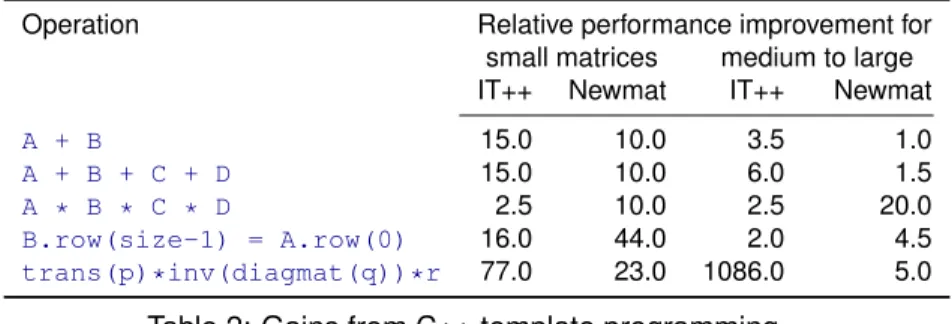
Possible gains from template meta-programming
Armadillo uses delayed evaluation (via recursive template and
template meta-programming) to combine several operations
into one expression reducing / eliminating temporary objects.
Operation
Relative performance improvement for
small matrices
medium to large
IT++
Newmat
IT++
Newmat
A + B
15.0
10.0
3.5
1.0
A + B + C + D
15.0
10.0
6.0
1.5
A * B * C * D
2.5
10.0
2.5
20.0
B.row(size-1) = A.row(0)
16.0
44.0
2.0
4.5
trans(p)*inv(diagmat(q))*r
77.0
23.0
1086.0
5.0
Table 2: Gains from C++ template programming
Seehttp://arma.sourceforge.net/speed.htmlfor details.
1
Extending R
Why ?
The standard API
Inline
2
Rcpp
From RApache to littler to RInside
See the file
RInside/standard/rinside_sample0.cpp
Jeff Horner’s work on
RApache
lead to joint work in
littler,
a scripting / cmdline front-end. As it embeds
R
and simply
’feeds’ the REPL loop, the next step was to embed R in proper
C++ classes:
RInside.
Jeff Horner’s work on
RApache
lead to joint work in
littler,
a scripting / cmdline front-end. As it embeds
R
and simply
’feeds’ the REPL loop, the next step was to embed R in proper
C++ classes:
RInside.
1 # include < R I n s i d e . h> / / f o r t h e embedded R v i a R I n s i d e 2
3 i n t main (i n t argc , char ∗argv [ ] ) { 4
5 R I n s i d e R( argc , argv ) ; / / c r e a t e an embedded R i n s t a n c e 6
7 R [ " t x t " ] = " H e l l o , w o r l d!\ n " ; / / a s s i g n a char∗ ( s t r i n g ) t o ’ t x t ’ 8
9 R . parseEvalQ ( " c a t ( t x t ) " ) ; / / e v a l t h e i n i t s t r i n g , i g n o r i n g any r e t u r n s 10
Another simple example
See
RInside/standard/rinside_sample8.cpp
(in SVN, older version in pkg)
This example shows some of the new assignment and
converter code:
1
2 # include < R I n s i d e . h> / / f o r t h e embedded R v i a R I n s i d e 3
4 i n t main (i n t argc , char ∗argv [ ] ) { 5
6 R I n s i d e R( argc , argv ) ; / / c r e a t e an embedded R i n s t a n c e 7
8 R [ " x " ] = 10 ; 9 R [ " y " ] = 20 ; 10
11 R . parseEvalQ ( " z<−x + y " ) ; 12
13 i n t sum = R [ " z " ] ; 14
15 s t d : : c o u t << " 10 + 20 = " << sum << s t d : : e n d l ; 16 e x i t ( 0 ) ;
17 }
1 # include < R I n s i d e . h> / / f o r t h e embedded R v i a R I n s i d e 2 # include <iomanip >
3 i n t main (i n t argc , char ∗argv [ ] ) {
4 R I n s i d e R( argc , argv ) ; / / c r e a t e an embedded R i n s t a n c e 5 SEXP ans ;
6 R . parseEvalQ ( " suppressMessages ( l i b r a r y ( f P o r t f o l i o ) ) " ) ; 7 t x t = " lppData<−100∗LPP2005 . RET [ , 1 : 6 ] ; "
8 " ewSpec<− p o r t f o l i o S p e c ( ) ; nAssets<−n c o l ( lppData ) ; " ; 9 R . pa rse Ev al ( t x t , ans ) ; / / prepare problem
10 const doubledvec [ 6 ] = { 0 . 1 , 0 . 1 , 0 . 1 , 0 . 1 , 0 . 3 , 0 . 3 } ; / / w e i g h t s 11 const s t d : : v e c t o r <double> w( dvec , &dvec [ 6 ] ) ;
12 R . a s s i g n ( w, " w e i g ht s v e c " ) ; / / a s s i g n STL vec t o R ’ s ’ w e i g h ts v e c ’ 13
14 R . parseEvalQ ( " s e t W ei g h t s ( ewSpec )<− w e ig h t s v ec " ) ;
15 t x t = " e w P o r t f o l i o<− f e a s i b l e P o r t f o l i o ( data = lppData , spec = ewSpec , " 16 " c o n s t r a i n t s = \ " LongOnly \ " ) ; " 17 " p r i n t ( e w P o r t f o l i o ) ; "
18 " vec<−getCovRiskBudgets ( e w P o r t f o l i o @ p o r t f o l i o ) " ;
19 ans = R . pa rse Ev al ( t x t ) ; / / a s s i g n covRiskBudget w e i g h t s t o ans 20 Rcpp : : NumericVector V ( ans ) ; / / c o n v e r t SEXP v a r i a b l e t o an RcppVector 21
22 ans = R . pa rse Ev al ( " names ( vec ) " ) ; / / a s s i g n columns names t o ans 23 Rcpp : : C h a r a c t e r V e c t o r n ( ans ) ;
24
25 f o r ( i n t i =0 ; i <names . s i z e ( ) ; i ++) {
And another
parallel
example
See the file
RInside/mpi/rinside_mpi_sample2.cpp
1 / / MPI C++ API v e r s i o n o f f i l e c o n t r i b u t e d by J i a n p i n g Hua 2
3 # include <mpi . h> / / mpi header
4 # include < R I n s i d e . h> / / f o r t h e embedded R v i a R I n s i d e 5
6 i n t main (i n t argc , char ∗argv [ ] ) { 7
8 MPI : : I n i t ( argc , argv ) ; / / mpi i n i t i a l i z a t i o n 9 i n t myrank = MPI : :COMM_WORLD. Get_rank ( ) ; / / o b t a i n c u r r e n t node rank 10 i n t nodesize = MPI : :COMM_WORLD. Get_s i z e ( ) ; / / o b t a i n t o t a l nodes r u n n i n g . 11
12 R I n s i d e R( argc , argv ) ; / / c r e a t e an embedded R i n s t a n c e 13
14 s t d : : s t r i n g s t r e a m t x t ;
15 t x t << " H e l l o from node " << myrank / / node i n f o r m a t i o n 16 << " o f " << nodesize << " nodes!" << s t d : : e n d l ;
17 R . a s s i g n ( t x t . s t r ( ) , " t x t " ) ; / / a s s i g n s t r i n g t o R v a r i a b l e ’ t x t ’ 18
19 s t d : : s t r i n g e v a l s t r = " c a t ( t x t ) " ; / / show node i n f o r m a t i o n
20 R . parseEvalQ ( e v a l s t r ) ; / / e v a l t h e s t r i n g , i g n . any r e t u r n s 21
22 MPI : : F i n a l i z e ( ) ; / / mpi f i n a l i z a t i o n 23
24 e x i t ( 0 ) ; 25 }
RInside workflow
C++ programs compute, gather or aggregate raw data.
Data is saved and analysed before a new ’run’ is launched.
C++ programs compute, gather or aggregate raw data.
Data is saved and analysed before a new ’run’ is launched.
RInside workflow
C++ programs compute, gather or aggregate raw data.
Data is saved and analysed before a new ’run’ is launched.
With
RInside
we now skip a step:
collect data in a vector or matrix
C++ programs compute, gather or aggregate raw data.
Data is saved and analysed before a new ’run’ is launched.
With
RInside
we now skip a step:
collect data in a vector or matrix
RInside workflow
C++ programs compute, gather or aggregate raw data.
Data is saved and analysed before a new ’run’ is launched.
With
RInside
we now skip a step:
collect data in a vector or matrix
pass data to
R
— easy thanks to
Rcpp
wrappers
pass one or more short ’scripts’ as strings to
R
to evaluate
C++ programs compute, gather or aggregate raw data.
Data is saved and analysed before a new ’run’ is launched.
With
RInside
we now skip a step:
collect data in a vector or matrix
pass data to
R
— easy thanks to
Rcpp
wrappers
pass one or more short ’scripts’ as strings to
R
to evaluate
pass data back to C++ programm — easy thanks to
Rcpp
RInside workflow
C++ programs compute, gather or aggregate raw data.
Data is saved and analysed before a new ’run’ is launched.
With
RInside
we now skip a step:
collect data in a vector or matrix
pass data to
R
— easy thanks to
Rcpp
wrappers
pass one or more short ’scripts’ as strings to
R
to evaluate
pass data back to C++ programm — easy thanks to
Rcpp
converters
resume main execution based on new results
C++ programs compute, gather or aggregate raw data.
Data is saved and analysed before a new ’run’ is launched.
With
RInside
we now skip a step:
collect data in a vector or matrix
pass data to
R
— easy thanks to
Rcpp
wrappers
pass one or more short ’scripts’ as strings to
R
to evaluate
pass data back to C++ programm — easy thanks to
Rcpp
converters
resume main execution based on new results
RInside workflow
C++ programs compute, gather or aggregate raw data.
Data is saved and analysed before a new ’run’ is launched.
With
RInside
we now skip a step:
collect data in a vector or matrix
pass data to
R
— easy thanks to
Rcpp
wrappers
pass one or more short ’scripts’ as strings to
R
to evaluate
pass data back to C++ programm — easy thanks to
Rcpp
converters
resume main execution based on new results
A number of simple examples ship with
RInside
nine
different examples in
examples/standard
C++ programs compute, gather or aggregate raw data.
Data is saved and analysed before a new ’run’ is launched.
With
RInside
we now skip a step:
collect data in a vector or matrix
pass data to
R
— easy thanks to
Rcpp
wrappers
pass one or more short ’scripts’ as strings to
R
to evaluate
pass data back to C++ programm — easy thanks to
Rcpp
converters
resume main execution based on new results
A number of simple examples ship with
RInside
nine
different examples in
examples/standard
Outline
1
Extending R
Why ?
The standard API
Inline
2
Rcpp
Overview
New API
Examples
Quoting from the page at Google Code:
About Google ProtoBuf
Quoting from the page at Google Code:
Protocol buffers are a flexible, efficient, automated mechanism for
serializing structured data—think XML, but smaller, faster, and
simpler.
You define how you want your data to be structured once, then
you can use special generated source code to easily write and
read your structured data to and from a variety of data streams
and using a variety of languages.
Quoting from the page at Google Code:
Protocol buffers are a flexible, efficient, automated mechanism for
serializing structured data—think XML, but smaller, faster, and
simpler.
You define how you want your data to be structured once, then
you can use special generated source code to easily write and
read your structured data to and from a variety of data streams
and using a variety of languages.
You can even update your data structure without breaking
deployed programs that are compiled against the "old" format.
Google ProtoBuf
1 R> l i b r a r y( RProtoBuf ) ## l o a d t h e package
2 R> r e a d P r o t o F i l e s ( " addressbook . p r o t o " ) ## a c q u i r e p r o t o b u f i n f o r m a t i o n 3 R> bob<−new( t u t o r i a l . Person , ## c r e a t e new o b j e c t
4 + e m a i l = " bob@example . com " , 5 + name = " Bob " ,
6 + i d = 123 )
7 R> w r i t e L i n e s ( bob$t o S t r i n g ( ) ) ## s e r i a l i z e t o s t d o u t 8 name : " Bob "
9 i d : 123
10 e m a i l : " bob@example . com " 11
12 R> bob$e m a i l ## access and/o r o v e r r i d e 13 [ 1 ] " bob@example . com "
14 R> bob$i d <−5 15 R> bob$i d 16 [ 1 ] 5 17
18 R> s e r i a l i z e ( bob , " person . pb " ) ## s e r i a l i z e t o compact b i n a r y f o r m a t