Quadrante, Vol. XXI, N.º 2, 2012
Introduction
he word rational is often associated with reasoning and ‘being reasonable’. Henri Poin-caré (1956) expressed surprise that people ind mathematics diicult to learn, because from his perspective it is entirely rational, and humans are rational beings. Jonathon Swift (1726) had however already challenged this notion, proposing that human beings are at best ‘animals capable of reason’.
Teaching students to reason mathematically seems therefore to belong to a disputed domain between ‘they do it already so it is only a matter of evoking and provoking it and drawing it to attention’ and ‘it requires speciic and explicit teaching in order to come to students’ minds when required’. Indeed many teachers would claim from their expe-rience that it is diicult to persuade students to use various forms of reasoning such as reasoning by contradiction or by contrapositive. On the one hand very young children reason empirically (they pick up patterns in human and non-human behaviour and act as if they have internalised these); on the other hand they don’t seem to know what to do when asked to justify something mathematically. he stance taken here is that there are delicate shifts of attention involved in reasoning ‘reasonably’1 in mathematics, and that teachers can be of considerable support if they are attuned to these diferent ways of attending.
In this paper we briely describe two tasks that we conjecture can provoke young stu-dents to display mathematical reasoning, and report the responses to these tasks of some students in grades 4 and 7. We use the theoretical framework of structures of attention (Mason 2003) to highlight diferent aspects of student’s reasoning.
heoretical frameworks
We draw on the literature concerning the shifts in student thinking expected in mathe-matics in the primary years, a spectrum of development from explaining to yourself to justifying to others, and distinctions between ways of attending which are necessary in order to reason ‘reasonably’.
John Mason
University of Oxford & Open University
Hélia Oliveira
Instituto de Educação da Universidade de Lisboa
Ana Maria Boavida
Shifts in epistemology and justiication
Hans Freudenthal (1991) observed that somewhere in primary school there is or can be an epistemological shift from the twin justiications of “it just is” and “a respected ‘other’ (adult) said so” (e.g. it is on the internet, or other media) to “it must be so because I can provide a reason”. Such a shift is one of the concerns of this paper.
Of course providing reasons is fraught with diiculty. One diiculty is seeing the need for, and then providing the warrant for the ‘reason’ and how it pertains to the thing being explained. Another is chasing back the chain of reasons to some irm foundation. It is said that Diderot came across a copy of Euclid, and on opening it at some page beca-me intrigued, inding himself following the chains of reasoning backwards, justifying the justiications, until he reached the axioms. School mathematics rarely establishes irm foundations, so there has to be some classroom norm or agreement about what is taken as ‘intuitively clear’ and what needs justifying. he tasks presented here are perhaps unu-sual in having clear ‘foundations’ as to what can be assumed and what not.
here is a time when many children become enamoured of asking ‘why?’ over and over. hey soon discover that adults become agitated or exasperated. Children may perhaps be experiencing the mathematical-philosophical search for irm foundations which in mathematics connects with the Frege-Russell-Whitehead enterprise, and more generally with the social-science search for an objective method to provide certain know-ledge. It may also be that children enjoy getting adults upset, and of course there may be a mixture of the two impulses. It is also possible that one of the ways in which children’s reasoning powers are undermined is that adults give sequences of ‘why?’ short shrift, cut-ting of the ‘game’.
A mathematical assertion of some generality may take one of three forms: ‘something must be so’ (with conditions speciied), ‘something cannot be so’ (again with conditions speciied), or ‘it depends: it can be so but it can also not be so’. For example, consider a whole number n which is divisible by the number f: n may be the sum of f consecutive numbers (it depends); if f is odd, then n must be the sum of f consecutive numbers; if f is even then n cannot be the sum of f consecutive numbers.
Justifying and explaining
he essence of the epistemological shift from say-so to reasoning seems to lie in recogni-sing that an assertion can have a diferent status in diferent contexts. It may be a con-jecture, with weak or strongly suggestive evidence, or it may be justiied. he justiica-tion may be adequate in one community but not in another. his is where the sequence of ‘convince yourself, convince a friend, convince a sceptic’ (Mason, Burton & Stacey 1982/2010) provides stepping stones from a ‘sense of’ why a conjecture is correct to a
publicly acceptable justiication.
trying to convince a sceptic you attempt to meet all possible objections. Learning to be sceptical of other people’s explanations is a valuable way to become better at convincing sceptics yourself.
Attention
he stance taken in this paper is that mathematical reasoning requires particular forms of attention. Not only must the justiier and the audience be attending to the same things but they must be attending in the same ways. Mason (2003, 2010) delineates three dif-ferent macro structures and ive didif-ferent forms or microstructures of attention:
Macro Structure of Attention Micro Structure of Attention Focus: fuzzy or sharp
Scope: broad or narrow Multiplicity: single or multiple
Holding wholes (gazing) Discerning details
Recognising relationships in a particular situation Perceiving properties as being instantiated Reasoning on the basis of agreed properties
Holding wholes refers to the way in which the human perceptual system can ‘take in’ a sce-ne as a ‘whole’, and this is often experienced in mathematics when gazing at a diagram without particularly distinguishing diferent component parts. Discerning Details refers to the act of discerning speciics, treating sub-wholes, which can be held or gazed at, and treated as entities. Recognising relationships refers to the search for relationships between discerned details as entities, which cannot be done unless those details have been distin-guished. Perceiving properties involves a subtle but vital shift from dwelling in the particu-larities of relationships to perceiving these as instances of some more general relationship (property). Reasoning on the basis of agreed properties refers to formal reasoning using only agreed properties (axioms, assumptions). he claim is that experientially these ive struc-tures are very diferent states.
he three macro structures are important phenomenologically but diicult for an ex-ternal observer to discern. Although the ive forms of micro structure of attention were arrived at by an analytical route based on ancient psychology, there is a very close match between these forms of attending and the van Hiele levels (Burger & Shaunessy, 1986; Clements & Battista, 1991) which originally arose in the consideration of geometric rea-soning (Dina Van Hiele – Geldof: see Fuys, Geddes & Tischler, 1985) and which were then applied more generally (van Hiele, 1986). he one major diference is that whereas van Hiele levels are usually seen as developmental states or phases which can be used to classify the thinking of students at diferent times, the ive ways of attending can be ex-perienced in quick succession and in no particular order.
instantiated, because only then does it make sense to look for students to develop ‘reaso-nable’ mathematical reasoning based solely on ‘agreed properties’, that is, to results pre-viously justiied.
he tasks
he Secret Places task
he task “Where is the secret place?”, originated by Tom O’Brien (2006), is to ind a ge-neral strategy to locate the secret place in as few clicks as possible.
Usually, children quickly realise that it doesn’t matter which number you click irst, so it might as well always be place number 1. his is what mathematicians mean by the phrase ‘without loss of generality’, and is based on an underlying sense or awareness of symmetry.
As O’Brien demonstrates, when the task is presented in a manner suitable to the age group, even very young children naturally make use of case-by-case reasoning, and de-ductive chains of “if … then …”, sometimes involving contradiction.
Although inding the minimum number of clicks needed for p places is on the edge of arithmetic, it only requires the same type of reasoning, so the task can be used with a wide range of ages. he applet has a variety of ways to extend the task, with more places at the table, more secret places, and extending the spread for turning red. here is even a two-dimensional version which afords access to the notion of nearness on diferent to-pological surfaces.
he Magic Square task
he aim of the task “Magic squares” is to engage students in thinking structurally (alge-braically) without recourse to ‘checking’ with actual numbers.
Magic squares
A magic square is a square array of numbers with the property that the sum of the entries in each row, each column, and both main diagonals is the same. In igure 1 below the sum of the cells involving the solid line is
Where is the secret place?
the same as the sum of the cells involving the dashed line, no matter what numbers appear in the 3 by 3 magic square. It follows then that in the igu-re 2 below the sum of the shaded cells equals the sum of the speckled cells.2
Figures 1, 2 and 3
he task is to ind other ways to shade and speckle cells so that the sum of the shaded cells equals the sum of the speckled cells and to justify your claim. As a challenge, use this experience to explain why, in the igure 3, the sum of the solids must be the same as the sum of the speckled cells.
As the aim of the task is to encourage students to think structurally, if they ask about how many actual magic squares there are, or how they can be constructed, then a sepa-rate task may be constructed and proposed to them. It is important to get students to re-lect on the diferences between constructing your own, constructing your own that you think will be hard to re-construct for others, and re-constructing one that you are given. One possible extension for this task would be: “Find ways to shade and speckle cells in a 4 by 4 magic square so that the sum of the shaded squares equals the sum of the spe-ckled cells. Construct one which is really hard to re-construct. Suggestion: start simply and build up a library of patterns”.
Research question
Our research question was ‘What sorts of reasoning would students make use of when invited to work on the Magic Square Reasoning task and the Secret Places task?’. Our analytic framework was the structures of attention, so we were looking for evidence of what diferent students attended to, and how. he conjecture to be investigated in this paper is whether from data collected about students work on tasks that call for justiica-tion, the notion of forms or structures of attention can shed light on what students are doing.
Secret places reasoning
Setting and method
pairs: André and David; Isabel and Gabriela3. Each pair of students explored the task for about 30 minutes without the presence of the other peers. he teacher, Manuel and one researcher (one of the authors) were present to make notes about what was said and what else they noticed. he sessions were held on the same day and in sequence. he sessions with the two pairs of students were audio recorded and the records were transcribed. he examples of the students’ thinking presented in this section were selected and translated from the above-mentioned transcription.
Students worked on the task in three phases: a period of familiarization, a period of work on the ive place version (which is how the applet starts), and then a period of work on the six-place and seven-place versions, each with just one secret place to ind.
First phase: Familiarization
he main goal of this phase was to help students to understand the background of the task and the functioning of the applet4 (Mason, 2010a). he teacher began by showing each pair of students the computer screen as shown in igure 15 and explaining orally ba-ckground information related to the task.
As he did so, he asked the students to click on numbers representing the people arou-nd the table in order to see if they uarou-nderstood what the appearance of the red aarou-nd the blue colours meant. hen he suggested they make some trials to better understand how the applet works and how they could discover the secret place.
During this phase, students were not faced with any restriction about the number of clicks they could use. Furthermore, nothing was said that might decrease the level of de-mand of the task.
Second phase: To discover the secret place at a table with 5 people using as few clicks as possible
After being sure that students had no doubts about the meaning of the colours, either the teacher or the researcher told the students that they now faced the ‘true challenge’: “How to discover the secret place with the fewest possible number of clicks”. his challenge
was put orally, emphasizing the words “the fewest possible number clicks”. he students had available a sheet of paper with the formulation of the task that they could consult if they so wished.
Immediately, students began to click on one of the numbers and to draw some clusions about whether it was, or was not, the secret place. here were no diiculties con-cerning the functioning of the applet or the meaning of the colours. However, it was not always easy to get students to think before they acted in order to reduce the number of clicks. Furthermore, it was not always simple for students to express the reasoning that led them to make some decisions. Almost all the interventions made by the teacher or the researcher were intended exclusively to encourage relection and explanation or jus-tiication of students’ reasoning.
hird phase: To discover the secret place at a table with a number of places over 5 using as few clicks as possible
he teacher proposed to the students that they now consider six places at the table, and then later, seven places. In both cases, students were told that there was only one secret place. he students formulated conjectures more easily in the third phase than in the se-cond phase and their reasoning spontaneously became more explicit.
Observations
First pair of students: André and David
André and David played eight games in total: two games in the irst phase; three in the se-cond phase; and three in the third phase (two with six places and one with seven places).
First phase: Familiarization
First game. hey began by clicking on the num-ber 5 and immediately after that they chose the number 1. Figure 2 shows the colours obtained. hey then agreed that the secret place had to be 4. hey justiied this by saying that 5 is red and therefore the secret place could be 5, or 1 or 4. As 1 was blue, “this means that 1 cannot be”. “It is 4 because 4 is the only one that remains
adjacent to 5”.
A very short time after, they started develo-ping other hypotheses. However, they did not think, on their own, that the fact of a number being blue excludes the possibility of the two adjacent places be the secret place:
David: No, but if 4 is also red, [the secret place] can also be the 3 … André: Or 5 …
David: Yeah, or 5.
Notice that their justiication is partial: it is also necessary to mention that 5 cannot be the secret place because if it were, 1 would show red. heir attention seems to be focu-sed on one place at a time, and on recognising the relationship between where the secret place is, and showing red when clicked. Perhaps this ‘relationship’ has not yet become a property to be instantiated several times, or perhaps their attention is single and nar-rowly focused.
he students started to relect on the consequences of a number being blue only af-ter being asked about which numbers would be red if 5 is the secret place (this question was correctly answered) and by the teacher emphasising that 1 is blue. From there, new conjectures immediately emerged about which number could be the secret place:
Teacher: See, 1 is blue ... (Figure 3)
David: So the secret place may be 3 or 4. 5 can no longer be.
André: Yes, 5 can no longer be, becau-se 1 is blue … (…) Or … 2 can also be [the secret place].
David: No, 2 cannot be … 1 is blue! André: Oh… yes. It is true. But if this [points to 2] appears red, that [points to 3] can be [the secret place].
Teacher: Let us try …
David: If 2 appears red and 3 appears red, the secret place will be 3.
David clicks on the number 3 (Figure 3) and says: “As 5 and 3 turn red, it is 4”. His collea-gue agrees.
he teacher and the researcher tried to expand students’ thinking in order to understand whether they had ‘forgotten’ the idea that ‘3 can be the secret place’ or whether they re-jected this hypothesis intentionally due to ‘good’ reasons. We concluded that the rejec-tion was not intenrejec-tional:
David: It can still be 3 because we do not know the colour of the num-ber 2.
hen David clicks on 2 and says: “It’s blue! So it can only be 4”. André agrees with his colleague’s answer.
André’s “But if …” again suggests a focus on one place at a time and then use of the property which speciies when a place shows red, as does David’s “it can still be 3”. It
seems that attention is on the red-result, and then reasoning on the basis of knowing which places will turn red when clicked. hey may not yet have appreciated the informa-tion provided by a blue result.
Second game. First, the students click on 3. hey exclude this number as the secret place, “because it has turned blue”. Next, they choose 1 and see that it turned red (Figure 4). At
this point, and on their own initiative, they reasoned that there are certain numbers that cannot now be secret places, without needing to click on them, that is, they start to make inferences based on what they know about the rules of the game and the colours they get:
David: Can be 1 or 2 or 5 … No! 2 cannot be because of 3 that is blue. André: hese two [numbers] can no longer
be [points to 2 and to 3] (…) And 4 … 4 cannot be …
David: Yes, 4 cannot be. (…) So or it is 1 or 5. (…) Because of the 3 … is blue (…) For example, if this [points to 4] turns red, it cannot be [the secret place] because the 3 is blue.
(…)
André: And if 2 also come out red, it can no longer be [the secret place] because of this here [points to 3] that is not red.
David begins to use multiple pieces of information, allowing his attention to be multiply focused, at least sequentially. What is not yet clear is whether, as is likely, their reasoning is based in the particularities of the relationships in this case, as distinct from being aware of the scope of generality of their reasoning. hey seem immersed in the relationships in this situation, and are not yet perceiving these as instances of properties that hold more generally.
Having excluded, as secret places, the numbers 2, 3 and 4, one of them clicks on 2. He justiies his decision by saying: “It was to know whether it was red or blue … because if it was red, 1 was the only [secret place]”. Since 2 is blue, the students quickly conclu-ded that the secret place can only be 5. hey don’t pause to consider the consequences of it being red, so they are not yet perceiving the task as being about a strategy but rather locating the secret place in this instance.
Second phase: To discover the secret place with the fewest possible number of clicks
hird game. he exploration of each of the three games of this phase seems to have been greatly facilitated by the experience obtained earlier. For example, in the third game, the irst of this phase (Figure 5), the students immediately excluded the numbers adjacent to a blue number as possible secret places, and they provided reasons for doing so.
his inference was maintained in all of the following games:
David: We’re thinking … [the secret place], or it may be 2 … André: Or 1 …
David: Or 2, or 1 … yes, or 2 or 1. (…) Teacher: Or 2 or 1. Why cannot 5 or 3 be the secret place?
David: Because 4 … is already blue. (…)
Teacher: How many numbers have you have eliminated as possible secret places?
André: hree. he 5 …
David: he 3 and the 4 … (…) Now we are sure that the secret place is 1 or is 2.
André: Well … (…) But if we clicked here [pointing to 3] and if it turns blue, we know that it is this [points to 1].
One of the students clicked on number 3, which turned blue. he immediate conclu-sion was that the secret place was at place 1. At this point they started to verbalize the following regularity: the circle must have three red numbers side-by-side. hey stated that if 1 is the real secret place, as they think it is, 5 and 2 must turn red. hey clicked on 2 and on 5 which both turned red.
here is clear evidence that they have internalised properties associated with blue and red places and are instantiating these in the particular coniguration. It is interesting that they end up clicking all the places, in order to conirm their deductions. One rea-son that the applet never conirms a deduction is to try to encourage students to be sa-tisied by their reasoning without seeking external validation (from the machine or from an expert).
Fourth game. In this game the students used the regularity identiied in the previous game to eliminate some numbers as secret places. Moreover, another strategy began to emerge for eliminating some numbers that could not be the secret place.
Figure 6 shows the irst number selected and the corresponding colour. When they observed that 2 was red, David said at once that 4 cannot be the secret place:
Teacher - David, you said that 4 couldn’t be the secret place. Why? André: But it can be …
David: Becaus … the secret place can only be 1 or 3 …
André: Oh! Yes … because there are only three numbers and they must be side-by-side.
Teacher: But why did you say, so sud-denly, that 4 cannot be?
David: Because … he 4 … If … If 4 turns red it is 3 …
Teacher: You are saying that if 4 turns red, 3 is the secret place? Is that it? David: Yes. If 5 turns red, the place is 1. (…) And if 3 turns red …
André: he secret place is 2.
David: It is the 2 … his is the reason why 4 can no longer be [the secret place].
here are classic ambiguities in their speech which are truly proleptic, in the sense that everyone involved knows what is intended. For example in “If 4 turns red it is 3” the it referring to the secret place, and in “there are only three numbers” there is an unspoken taken as shared meaning that there are only three numbers which will show red when clicked.
It is possible that André, in his irst quoted utterance, is thinking in general: in other situations it could indeed be 4, but then agrees that in this case it cannot be 4. Alterna-tively he hasn’t yet applied his red-coloured reasoning when he makes his irst utterance. In this episode, David did not mention that 2 could also be the secret place, but he adds this information later. He seems to infer, more quickly than André, that 4 cannot be the secret place because, since number 2 is red, if 4 also turns red, the secret place must be 3 since the three red numbers must be side-by-side (be consecutive). Later, and for the same reasons, David excluded 5 as a possible secret place. His colleague does not immediately understand his exclusion:
David: And I also think that 5 cannot be the secret place. André: No! I think 5 can be.
David: No … Because, look here [pointing to the computer screen] … No way!
André: Oh, you’re right!
David: 5 cannot be. hese two [points to 4 and 5] cannot be secret places.
In this game, students were very committed to using as few clicks as possible with the result that there was some unrelective thinking concerning the identiication of the se-cret place. Sometimes, they had diiculties to express their reasoning clearly. For exam-ple, when students used the expression “this number can be”, it was not always easy to understand whether they were referring to the colour red or to the possibility that the number could be the secret place:
André: Try the 1 here …
(David clicks on 1 that turns red) David and André: It is the 2. Teacher: Why is it the 2?
André: Because here … oh no! … it can also be the 5. (…)
Teacher: Why do you think that it can be 5, André?
André: I think it can be …
Teacher: Secret Place … we’re talking about the secret place …
David: Yes, the secret place.
André: Ah, the secret place … I think that 5 cannot be.
David begins to focus on the minimum number of clicks needed to discover, with cer-tainty, the location of the secret place. He begins by stating that the minimum is three, because there must be “three red numbers side-by-side”. However, later he changes his opinion:
David: here can also be only two [clicks]. Imagine that we choose 1 and 3 and the numbers turn red ... (...) he secret place can only be 2 because the three red numbers need to be side-by-side.
his is immediate evidence of reasoning by using a counter-example to disprove previous reasoning. He is also taking into account multiple pieces of information, and reasoning with them as agreed properties.
Fifth game. hey began the third game by saying: “Let’s try this”. hat is, they wanted to discover the secret place with just two clicks.
his suggests a conjecture that their desire had initiated some unrelective thinking concerning the identiication of the secret place. We also noted this behaviour during the fourth game. Moreover, on some occasions, it seems that when André knew that a num-ber could not be the secret place, he was sure that this numnum-ber would show blue. hat is, it seems that he consider that A⇒B is equivalent to ~A⇒~B.
Perhaps there is some slippage between showing red when clicked and being the se-cret place.
Teacher: You clicked on two numbers, did you not? First you chose the number 3 which turned blue and after that you chose the number 5 whi-ch turned red (Figure 8).
André: I know which is it [the secret place]. It is 1. (...) Because this [poin-ts to 4] can no longer be as 3 is blue and this [poin[poin-ts to the 2] cannot also be because the 3 is blue. (...) he secret number must be between two red
numbers. (...) So 4 and 2 can no lon-ger be because on this side is a blue number ... that’s why it can only be the 1. (...) We have found it with only two clicks.
Again there may be some slippage between showing red and being the secret place. Al-ternatively, the excitement of the reasoning blocks out recognising other possibilities. In other words, attention might be focused on consequences but not on discerning the consequences on each place in turn.
In order for students to begin thinking that in this situation there could be other pos-sibilities for the secret place (diferent from 1), it was felt necessary to intervene in order to focus their attention on the image on the computer screen, as well as on what they had said previously:
Teacher: So, you are saying that the secret place must be the number 1, because … What you were saying was that three red numbers must be si-de-by-side … Here is this blue number …
André: he red ones will be 5, 1 and 2
Teacher: he red numbers will be 5, 1 and 2 … David: But, 5 may also be the secret number.
André: Oh, that is true … he number 5 can also be the secret one. David: Imagine that the 2 turns blue … the 5 can also be because it is 1, 5, 4 …
Here David is imagining a possibility, transcending the need to click and test, and so opening the way to thinking more algorithmically, based on instantiating properties ra-ther than recognising implications of relationships when clicked.
hird phase: A number of places greater than 5.
Sixth game. In this game, apparently, André, acts as if A⇒B is equivalent to ~A⇒~B. and quickly uses this claim to identify the secret place. His colleague’s ideas led him to ponder his claim more deeply and to change his position:
Teacher: You clicked on 2 and it came out blue, did it not? [Figure 9] David: 1 and 3 can no longer be. (…) Because 2 is blue …
André: It is the 5! [the secret place] David: he 5, already?!!!
André: Because of ... look, 1 and 3 can no longer be … It’s the same thing
we have said before. In the centre is already a blue …
David: But, imagine … he secret place can also be the 4 … imagine the 6 is blue! he-se numbers side-by-side [points to 3, 4 and 5] can be red.
André: Oh! Yes … the 4 can be …
he need to consider each place in turn, and to apply the current information to it, is beginning to displace the desire to jump to immediate conclusions. Again it is associated with imagining and considering possibi-lities and how the properties provide information.
Seventh and eighth games. In the seventh game the idea begins to emerge that after we know where the place of one red number, a good strategy is to identify whether the remaining red numbers are on the right side or on the left side of the known number. his idea is used later on in the eighth game:
Example with six places (igure 10):
André: I think 4 cannot be. (…) Because the three red numbers … they must be side-by-si-de …
David: Yes, 4 cannot … it is like this or like that… [starting from 1, the student moved his inger to illustrate the clockwise hands’ ment and the counter clockwise hands’ move-ment]. We can never reach 4 (…) Because 4 is the number that is further away from 1 …
here is some as yet unspoken reasoning in order to jus-tify the claim, but the notion of three red numbers side--by-side (consecutive) is beginning to emerge as a pro-perty to be applied rather than a relationship recognised in an earlier game.
Eighth game — seven places
David: 7 is red … so 3 and 4 can no longer be. André: Yes.
Teacher: Why?
David: Because it is like this: three and three [starting from 7, he made the movements A and B, represented in igure 11]. Because 3 and 4 are
Figure 9
the numbers that are further away from 7, and because the three red numbers must be side-by-side.
Note again the prolepsis associated with ‘further’: what seems to be intended is that they are ‘further than 3 positions away from 7‘, as suggested by the movements of the ingers. But saying fully what you are seeing is not always easy to do. he property of the three reds being consecutive is now being mani-fested in gesture and in words.
he interactions of the pair of students give evi-dence of a gradual movement of an awareness (the consecutive property of the red places) from a
rela-tionship recognised in a particular situation to a property perceived as applying in many places. here is evidence of growing conidence, the use of gesture to instantiate a pro-perty and the beginnings of explicit articulation.
Second pair of students: Isabel and Gabriela
Isabel and Gabriela played six games in total, two in the irst phase, one in the second and three in the third (one with six places and two with seven places). he activity of this pair was generally similar to the activity of the irst group so it will not be described with so much detail. Our focus now is on the main diferences observed between the two groups.
One of these diferences is that Isabel and Gabriela arrived at some conclusions qui-ckly and with more autonomy than their colleagues. For example, in the irst game they quickly conjectured that if a number turns blue, the adjacent numbers cannot be secret places. After some trials, they justiied this conjecture. he justiication process was simi-lar to the one used by David and André:
Gabriela: he 2 cannot be because of 3. Teacher: 2 cannot be. What is it about 3? Gabriela: It’s blue.
Teacher: And then?
Gabriela: If 2 is the secret place, 3 must be red, but 3 is blue … So 2 can-not be (…) And 5 cancan-not also be because the next is 4 and 4 is blue.
hey seem to have turned the relationships associated with a blue-place into a property that can be applied in various situations. his makes it possible for them to use this in-formation in their reasoning. heir utterances display a degree of prolepsis similar to that of the irst pair of students.
he property ‘the three red numbers must be side-by-side’ and its use emerged early in the third game (second phase). he decision to move to the third phase was made by the students after playing only one game during the second phase. Under their own ini-tiative it was also decided to move to a table with seven places after playing just one game with six places. his suggests a sense of conidence, of having a good grasp of how to ind the secret place, even though they had not formulated an algorithm or tried to minimise the number of clicks necessary.
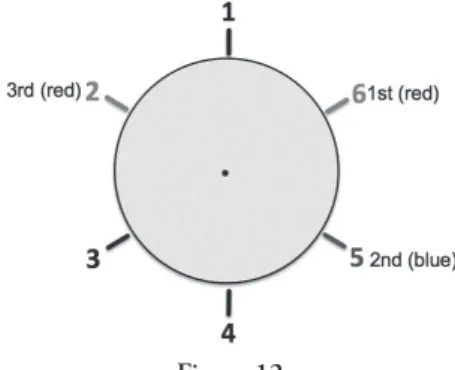
Figure 12 shows the three irst choices made by the students in the fourth game (the irst game of the third phase) and the order of these choices.
he interchange presented below reveals that one of the students (Gabriela) conjectu-red that the three blue numbers must also be side-by-side. Her colleague did not seem very convinced and tried to discover the secret pla-ce using only on the property conpla-cerning the red numbers:
Gabriela: First, I clicked on 6 and it turned red and then on 5 and it tur-ned blue. I think the red numbers must be side-by-side and the blue numbers must also be side-by-side. If 6 is red and 5 is blue, 2 and 1 can be the secret place. 4 and 5 can no longer be becau-se 5 is blue. hey will be blue.
Teacher: Isabel, I would like to hear you...
Isabel: 5 cannot be the secret place because it is blue. So, to have the three numbers side-by-side, as we saw in the other game, the possibilities [to the secret places] that I still see is 2 or 1.
Teacher: 2 or 1 … We don’t know yet … (…)
Isabel: Now I chose 2 because then we can see if the red numbers would look like this [she moves her hand in the counter clockwise way, starting from 6] or on this side [she moves her hand in the clockwise way, starting from 4].
Teacher: So, what number do you think is the secret place? Gabriela: It’s 1.
Teacher: What do you think, Isabel? (…)
Isabel: Gabriela said she thought the blues had to be side-by-side and that the 4 had to be blue. But there is also the possibility of having the three
red numbers here [pointing to the numbers 6, 1 and 2] or here [pointing to the numbers 3, 2 and 1].
Gabriela: But if so, then there are two secret places! ... Teacher: here is only one secret place.
In her last utterance Gabriela displays deductive reasoning followed by contradiction in order to show that Isabel’s conjecture does not hold. here is a lovely ambiguity that of-ten arises, as people confuse the colour displayed when clicking, and being the secret pla-ce. his is evident when Gabriela says that since 6 is red and 5 is blue, that 2 can be the secret place. Place 2 is too far from 6 to make 6 blue. Indeed, by the ‘three reds side-by-side’ reasoning 1 must be the secret place.
Later, Gabriela displays a mix of deductive and contradiction reasoning in order to justify why place 1 is the secret place and why the blue numbers must also be in a row:
Gabriela: I think it cannot be as Isabel said, because there are six places and half of six is three. So if the numbers are red and blue, three are red and three are blue. Because the secret place is red and it has a red number on each side. he reds must be side-by-side. I think the secret place is 1 be-cause 6, 1 and 2 are together. 3, 4 and 5 are also together but 5 is blue and 3 and 4 will turn blue … 2 and 6 are red and 1 will also be red.
Here the proleptic “the reds must be side-by-side” refers to the places that will display red when clicked.
his reasoning is diferent from any other reasoning made by the students of the other groups. Isabel seems to be convinced by the argument of her colleague. Indeed, during the next game (the ifth) Isabel tried to discover the secret place by using the pro-perty that ‘the three red numbers must be side-by-side and the three blue numbers must also be side-by-side’. However, during this game the students struggle with a question: Can the number of red numbers be greater than 3? Eventually they exclude this possibi-lity based on the fact that there is only one secret place:
Isabel: Now there are seven places. As seven is an odd number, it cannot be half … It must be four side-by-side or three. Red or blue …
Teacher: You are considering the number of red numbers and blue num-bers? How many are red?
Gabriela: Yes. hree or four.
Isabel: hree? … Because … to be side-by-side … (…)
Teacher: Isabel, I do not know what do you think about this … Isabel: I agree with Gabriela.
Here there is another clear example of reasoning by contradiction, a form of reasoning often thought to be too diicult even for senior high-school students.
Next, the students began to try to identify a strategy that allows them to igure out quickly where the three red numbers and the four blue numbers might be in the cir-cle. Figure 14 shows the irst four choices made by the students during the ifth game. he following interchange indicates why they choose the numbers and why they have followed the order shown:
Teacher: Isabel, why at this point (3rd click) did you choose 7?
Isabel: I have always been jumping a number to see if they turned blue or red … I was thinking that when I found a red one, I would click on the two bers that are on each side of the red num-ber. But now ... I do not know … 6 can no longer be the secret place because the number that is next to it is 5 … it is blue. Teacher: So where do you think the se-cret place may be? here is only one sese-cret place …
Gabriela: I think the secret place is 1. Teacher: Why?
Isabel: Because 6 cannot be because it is next to 5 which is blue; 4 cannot be because it is next to two blue numbers; 2 cannot be because it is next to a blue …
Gabriela: But it [the secret place] could be 7 …
Isabel: And also 1. 1 is adjacent to 2 and we have not clicked yet on 2 … Teacher: What possibilities do we have for the secret place?
Isabel and Gabriela: Either 1 or 7.
he interaction reveals that Isabel may have developed a strategy of clicking on a number that was next but one to a place which already had a blue colour, but next to a number which had a red colour. heir attention seemed to be on inding a red place. Using this strategy, the students were able to eliminate some numbers. However, they realised that the clicks up to that point were not suicient to identify the secret place. hey hadn’t fully internalised the information yielded by a click in order to discover that clicking on 6 or 2 would give them the information they wanted. here is a residual desire to click
on where you think the secret place might be, despite the fact that this is often less infor-mative than clicking elsewhere.
hey then decided to make a fourth click. However, they noted that it was still not possible to ind out where was the secret place:
Isabel: We have to click on another number … On 1. It turns red … (…)
Gabriela: 1 and 7 may be also … [the secret place]
Isabel: I think we now have to click on 2 or on 6 to see which number can be released (…) I think we still have to spend one more click.
A click on 2 or 6 would have enabled them to deduce the location of the secret place. Clicking on 1 contradicts Isabel’s apparent current strategy and is less informative than clicking on 2 or 6.
At the end of the ifth game, the students were unhappy because they felt they had used too many clicks to discover the secret place. his may be why in the last game they changed their strategy. he interaction presented below illustrates how they conducted this game, but since they got a red immediately, a diferent part of their strategy came into play:
Gabriela: 3 may be [the secret place] be-cause it is red (Figure 15).
Teacher: Now what is the next number you will choose?
Isabel: 2. If 2 turns blue, 3 cannot be [the secret place] because it is next to a blue number. If 2 turns red the secret place can be either 2 or 3.
(Isabel clicks on number 2; it turns red) Teacher: And now? What is useful so as to use as few clicks as possible?
Gabriela: To click on 1 or 4. If 4 turns blue, the secret place is 2. If the 4 turns red, the secret place is 3.
(Gabriela clicks on the number 4; it turns blue) Isabel and Gabriela: he secret place is the 2.
Gabriela: Because it is next to 1... and as the three red numbers must si-de-by-side, the number 1 must be red and 7, 6, 4 and 5 must be blue num-bers. herefore, as 2 is between two red numbers … it is the secret place. he trajectory of reasoning of this second pair of students seems to depend on what detail
is focused on irst. his pair paid attention to the information revealed by a blue,
reas the irst pair concentrated on the reds. Each time they got a blue they excluded the adjacent places from the possible positions of the secret place.
Isabel used a strategy of clicking a place next but one to a place whose colour is known to be blue, or perhaps, not clicking a place adjacent to one that is blue. he two strategies are not identical, since one says where to click and the other says where not to click. Even though she announced the second she may easily have been enacting the irst.
Magic Square Reasoning
Setting and method
he Magic Square Reasoning was used by the teacher Cláudia with two diferent grade 7 classes (aged 12) in a lesson lasting 90 minutes. One researcher (one of the authors) was present, taking notes, videotaping the lesson and supporting the students work by cla-rifying some aspects of the tasks during their activity. he written sheets of all students were collected and analysed. Students’ names are pseudonyms.
Lesson descriptions
he task was proposed to students much as here. In the irst class, the teacher read the task with the students, highlighting the properties of a magic square (equal sum of co-lumns, lines and diagonals). She asked them to draw magic squares on the sheet she gave them. No other suggestions or questions were made in the irst phase of the lesson. he students worked mainly in pairs.
Students appeared to be unclear about what they were supposed to do. he teacher in the classroom explained to the pairs that they should try to ind blue and red cells for which the respective sums are the same. he students started to draw some pictures.
he irst class
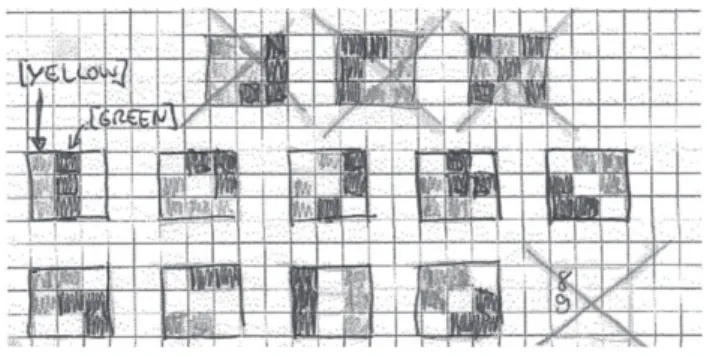
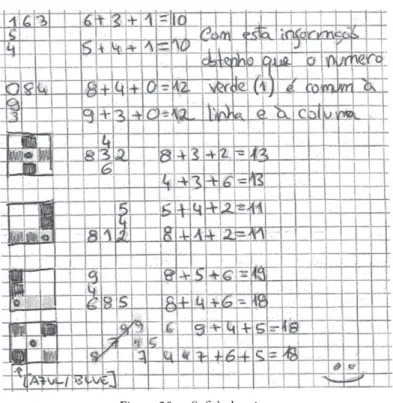
Students started to draw squares with the same number of blue and red cells (or yellow and green), as shown in the work of Rui (igure 15).
Figures were crossed out because they were deemed not to display the required rela-tionship. he fact that colours diferent from those in the task were used suggests that the student had discerned the detail of cell colour not as a signiicant attribute in itself, but as an indicator of a relationship. He was aware that the speciic colours were not relevant, but rather that the colours distinguished two sets of squares. In other words, he was at-tending to some relationship between the diferent colours not the colours themselves.
than being something to deduce; perhaps he ignored this aspect, at least at irst. In the right hand bottom corner there are some numerals in cells suggesting some sort of a link to cell values.
Another student drew diagrams for a 4 by 4 square which also suggest that her atten-tion was centred in instantiaatten-tions of the property of having the same number of squares of each colour, augmented by some sort of patterned relationship between the cells of the two colours (igure 16).
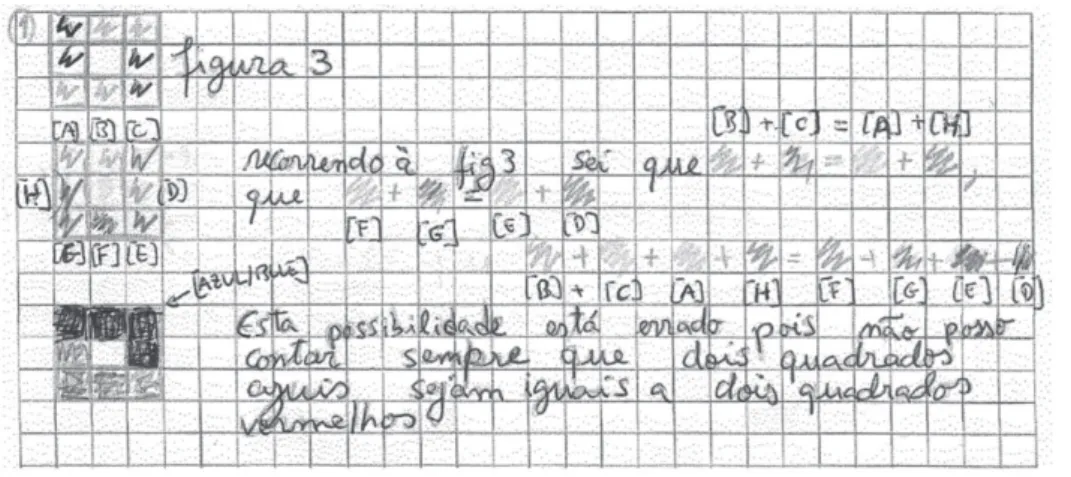
At least one student appeared to have misinterpreted the task. he fact that the sum of any two red cells equals the sum of any two blue cells seems to have been taken as a fact, so the task turns into one about patterns and perhaps symmetry (igure 17).
he multi-coloured second drawing and his commentary uses colours as signiiers for unknown numbers. he reasoning is beautiful, but starts from an inappropriate assump-tion about a property (any two reds and any two blues have the same sum) which is then instantiated in the several colours. From a teacher’s perspective, he is frustratingly close to employing precisely the kind of reasoning intended by the task’s author.
After talking with the teacher about this, Nuno appreciates that it is not possible to conclude that the drawing displays a valid relationship, and inally he writes: “his
pos-Figure 15.—Rui’s drawings
sibility is wrong because I cannot conclude that always the [sum of ] two blue squares equals the [sum of ] two red squares”.
As is so common in human interactions, and particularly in classrooms, students make sense of what they hear, in their own terms. In other words, there are several tasks: the task as imagined by the author, the task as intended by the teacher, the task as inter-preted by the students, and the task as actually enacted by the students. Here they discer-ned individual cells and the fact that they could colour some of them in one colour and some of them in another. However they appeared to be unaware of an imposed property that characterises magic squares (row, column and diagonal sums being equal). he stu-dents acted within what they were personally stressing (and consequently ignoring). hey start to attend to the geometric patterns formed by the blue and red cells, drawing several squares with the same amount of red and blue cells. hey overlooked the conditions that the numbers in the magic square must fulil. hey may, if they thought about cell values and sums, have considered that the sum of the same number of blue and red cells would always be equal, but they may not have attended to this property.
he second class
From this irst experience with the task, the teacher and the researcher understood that it was necessary to emphasize the properties that characterise a magic square. hey conjec-tured that maybe it would help students to understand the involved relationship if they started by analysing the second picture in the task and inviting students to think about why the relation holds in that case. Later with another grade 7 class, the teacher started by discussing with them what a magic square is and asking students to concentrate on the claim about the equality in the second igure and the reasons for its validity. After that she asked for other examples.
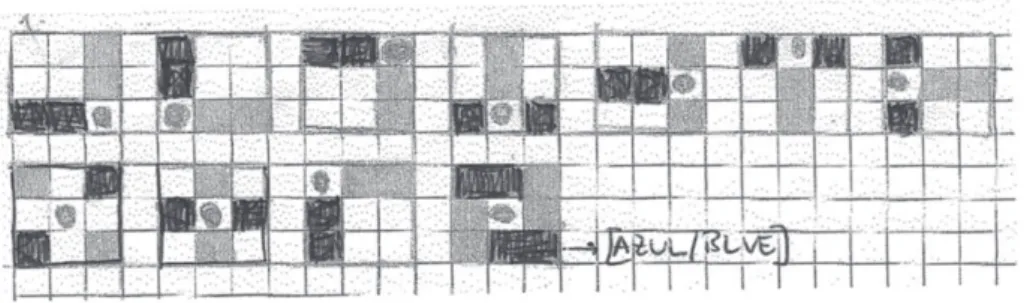
Many students noticed that the red and blue cells in igure 2 come from lines of cells with one cell in common. hey drew several examples of patterns with the same charac-teristic, marking the common cell in some way. André’s drawings are typical (igure 18). his student also marks a cell that is common to two lines of cells. he last igure, which is igure 3 of the task, could be seen as three pairs of lines of cells all with a com-mon element, or a copy of the third igure of the task, or the combination of the previous two drawings with the colours reversed. A circulating teacher needs to be careful about what they assume the diagram means for the student.
What are the students actually attending to? A teacher dwelling in the mathematics (the constant sum property) so that the sum of cells with one colour must be equal to the sum of cells of the other might overlook or over interpret what students are attending to. Here it could be that the relationship ‘lines of cells sharing a common cell’ is in the fore-ground of attention.
Some students drew examples like André but also specialized by inserting some num-bers (igure 19).
Interestingly, the third igure in the irst row is not a valid design, and it seems as though there has been an attempt by the student to check it using numbers. Although Soia uses numbers, presumably to check the equality of sums property, she does not use a magic-square coniguration. Might she be instantiating the property but unaware of, or forgetting that the numbers are supposed to come from a magic square (igure 20)? Soia explains:
I obtained this information by changing the colours and the positions of each square (cell). With this information I obtain that the [irst] green number [1] is common both to the line and the column.
What she says suggests that she is starting from the sum of the red and the blue cells being equal, and conirming that including the common cell preserves the equality. he task is ofering opportunity to use the pr operty of preserving equations by subtracting the same thing from both sides (eliminating what is common) in order to deduce rela-tionships. he relationship between what she is doing and what the task designer inten-ded (one is a ‘doing’ and the other an ‘undoing’) is available for discussion. he fact that the green (common) numbers can be any number she likes (ignoring the magic square
Figure 19.—Manuel’s drawings with numbers
for a moment) is available for discussion so that she experiences the generality of what she is doing.
What can we make of what the students are doing with the numbers? Are they con-irming to themselves that if the cell lines have the same sum then so do the shaded squa-res with the common cell missing or are they conirming that if the coloured cell sums are equal then so are the corresponding lines of cells? A relationship has been recognized and turned into a property that is instantiated, but the relationship does not make use of the background magic square structure. So the particular instances of the numbers re-veals attention focused on the algebraic property that can also be described as ‘you can subtract the same thing from both sides of an equation and still preserve the equality’. Some students look at the third igure in the task as resulting from combining two simpler igures already identiied as ‘true’ (the ones that have one common cell between the groups of red and blue cells). (See igure 21)
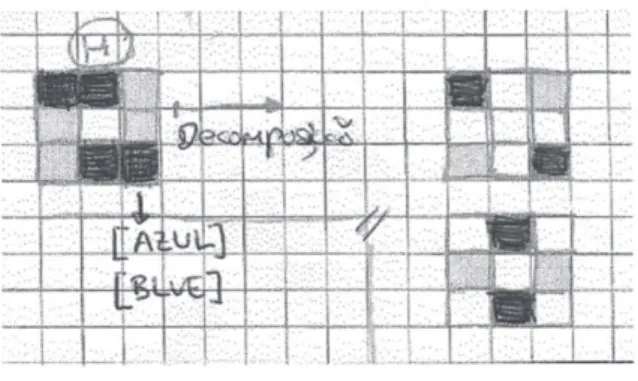
his is the sort of reasoning that was intended, though whether Tiago appreciates what the diagram says mathematically in terms of sums is open to question. he same happens with some of the work the students do with the 4 by 4 squares (igure 22).
Pedro claims that “the igure 4 is true” because in a magic square the sums of the cells in each diagonal are equal. From there he notices that by decomposition of that square he can obtain igures 2 and 5, and considers that these two are also ‘true’. Since the igu-res were probably drawn in sequence, the second igure suggests that attention has shif-ted back to ‘two reds and two blues’ as acceptable conigurations, or else the conigura-tion of diagonals in the 3 by 3 case has been extended to the 4 by 4 case.
his provides a clear example of how reasoning on the basis of agreed properties de-pends on being clear about the ‘agreed properties’. Although the diagonal sums are in-deed equal, there seems to be some underlying assumption that pairs of coloured squares are also equal.
João presented a conjecture to the whole class concerning igure C: “the igure will hold ‘true’ only if the all squares were equal” (igure 23).
However Ruben disagreed and, after working for while on his own, explained why:
My colleague João presented this conjecture [see igure in drawing below] and said that to make this conjecture [true] it would be necessary to repeat numbers and I tried to ind a way of using diferent numbers in the magic square in order for the sum [of the blue and red cells] to add to the same number . But I did not succeed. Because 9, 4 and 3 adds to 16 but 1, 6 and 7 adds to 14. herefore it is not equal, so this conjecture is very diicult to obtain in a magic square” (igure 24).
Ruben starts with an actual magic square but then tries to make modiications to it, perhaps seeking an example where the three red and the three blue do indeed have the same sum. he lovely conclusion “this conjecture is very diicult to obtain in a magic square” leaves open the possibility that it can be done, without stressing that it certainly does not always hold. It is a pity to have to make use of a particular magic square, becau-se the idea of the task is to avoid using empirical reasoning or example-checking so as to maintain attention on the process of reasoning on the basis of agreed properties. hus, looking at the diagram eliminating the two pairs of coloured cells that we do know are equal, one red and one blue cell remain, and these can only be equal if the cells contain the same number (which never happens in a proper magic square).
Ruben articulated the intended reasoning as follows:
Figure 22.—Pedro’s drawings with 4 by 4 squares
In a magic square the sum of each line, column or diagonal as to be the same. In this case if the white cell is common to both, these (points to the blue cells) will be equivalent to the same so that when added to these (points to the red cells) they will result in the same number.”
After having his attention drawn again to the second igure of the task, Nuno also arti-culates the reasoning behind it:
the sums of the two [pairs of ] cells have to be equal, because if they have one common element, the same value has to be distributed among the two other squares [cells] in order the sum to be the same. However the values in each square [cell] may be diferent as long as the sum [of both cells] is the number x that added with the common value [to the other two cells] is equal to the desired number in the magic square.
Nuno, like other students, applied this kind of reasoning to the 4x4 magic square. But he questions himself whether the last igure he draws is “true” (igure 25).
Figure 24.—Ruben’s examples
Attention seems to be focused on what diferent row and column conigurations mi-ght look like where the sums are equal. he ifth one with the diagonal in a third colour might be presenting the fact that row, column and main diagonal sums are all equal. his is a good example of how being rather more systematic in exploring the row and columns of the 4 by 4 square, the student is drawn to question other possibilities.
Overall relections
We investigated in this paper one conjecture concerning whether the notion of forms or structures of attention can shed light on what students are doing on tasks that call for justiication. here are many instances, in Secret Places, of spontaneous use of rea-soning by contradiction as well as deduction, showing that young children have access to this sort of reasoning, and raising the question of how teachers might be able to draw upon these undoubted powers in their teaching. However there are several rivers to cross, for example between reasoning in a particular situation and formulating reasoning that works in general, between having to conirm a deduction in the particular and not nee-ding to conirm it, and between innee-ding the secret place eiciently and developing an al-gorithm that always works no matter what sequence of reds and blues are revealed. In this task, the natural prolepsis seen is likely to be a factor in clarifying the reasoning and in developing an algorithm for inding the secret place in the fewest clicks. he shift in perception, in what is attended to, that is signalled by indeinite pronouns and by ‘missing nouns’ may lie at the heart of diiculties in reasoning, rather than the actual
rea-soning itself being diicult.
he children tackling Secret Places displayed conident and efective use of both de-duction and reasoning by way of contradiction. hey quickly assimilated the ‘axioms’ or properties they had available for reasoning. Sometimes, especially at irst, they concen-trated on one place at the table, and the consequences of its colour, without bringing to bear other information they had. Each of the two pairs nevertheless began to take into account multiple foci consisting of information from the colours of more than one place. hey all quickly adopted a property-perceiving stance, though for some this developed during initial play with the applet.
Whereas some of the students earlier in the report focused their attention in unintended ways so that the properties they were working with were not those intended (e.g. dia-grams must have equal numbers of the two colours), students who appreciated the dei-ning properties of a magic square were able to reason efectively using those properties as axioms.
As a teacher trying to foster and sustain mathematical reasoning, it is all too easy to misinterpret what students intend with a diagram, so listening to what students say in justiication is important. But there is more. If teachers listen for what they expect, they are likely to misinterpret what they hear as what they are expecting, or else to classify as incorrect perfectly valid reasoning based on an unintended property. Brent Davis (1996) distinguishes listening to from listening for, and one way to work on this is to try to be sensitive to indications of what details students are discerning, what relationships they are recognising, and what properties they are perceiving as being instantiated.
Experience with this task showed that students’ can reason mathematically. Howe-ver, even though their reasoning can take a form which is valid in general, it can be fou-nded on inappropriate or unintefou-nded assumptions, including a particular instance. he astute teacher pays close attention to the unspoken assumptions being made, and is on the lookout for evidence that students have appreciated the available scope of generality. his applies not simply to this task but to any and all mathematical lessons.
One way to pose the Magic Squares task so as to stress the deining property of a ma-gic square would be to provide one or more speciic instances of mama-gic squares as test examples. However the intention of the task was to invoke reasoning without recourse to speciic numbers, thereby activating algebraic thinking without identifying it as such. In workshops in the UK with teachers, Mason usually starts with a very brief glimpse of a particular and familiar 3 by 3 magic square, then fades out the numbers, in order to emphasise that the speciic numbers are of no interest.
By interpreting students utterances as evidence about both what they were focusing on and the structure of their attention, it was possible to gain insight into children’s na-tural powers of reasoning, and to suggest ways of working with children in order to de-velop those powers so that they could reason reasonably in mathematics in the future.
Acknowledgements
he authors are grateful to the teachers, Cláudia Torres and Manuel Pereira, and to their students who worked on the tasks and provided us with rich data.
Notes
3 he students’ names are pseudonyms.
4 Available from http://mcs.open.ac.uk/jhm3/Applets%20&%20Animations/ Applets%20&%20Animations.html (item 12).
5 he image on the computer screen is colored. For instance, the box concerning “New Mystery Pla-ce” is yellow as well as the inside of the circumference. he box labeled “Hot Marker” is red and the “Cold Marker” is blue.
References
Burger, W. & Shaunessy, J. (1986). Characterizing the van Hiele levels of development in geometry. Journal for Research in Mathematics Education, 17 (1), 31–48.
Clements, D. & Battista, M. (1991). Van Hiele levels of learning geometry. In F. Furinghetti (Ed.), Pro-ceedings of PME XV (Vol I, pp. 223–230). Assisi.
Davis, B. (1996). Teaching mathematics: towards a sound alternative. New York: Ablex. Freudenthal, H. (1991). Revisiting mathematics education: China lectures. Dordrecht: Kluwer. Fuys, D., Geddes, D. & Tischler, R. (Eds.) (1985). English translation of selected writings of Dina van
Hiele-Geldof and Pierre van Hiele. Brooklyn: Brooklyn College School of Education. (ERIC docu-ment 289 697)
Kline, M. (1980). Mathematics: the loss of certainty. New York: Oxford University Press.
Mason, J. (2003). Structure of attention in the learning of mathematics. In J. Novotná (Ed.), P rocee-dings of the International Symposium on Elementary Mathematics Teaching (pp. 9–16). Prague: Char-les University.
Mason, J. (2010). Attention and intention in learning about teaching through teaching. In R. Leikin & R. Zazkis (Eds.), Learning through teaching mathematics: development of teachers’ knowledge and expertise in practice (pp. 23–47). New York: Springer.
Mason, J. (2010a). Revealing Shapes: applet freely available for use or download at mcs.open.ac.uk/ jhm3/Applets%20&%20Animations/Applets%20&%20Animations.html (accessed May
2012)
Mason, J., Burton, L. & Stacey, K. (1982/2010). hinking Mathematically (Second Extended Edition). Harlow: Prentice Hall (Pearson).
O’Brien, T. (2006). What is Fifth Grade? Phi Beta Kappan, January, 373–376.
Poincaré, H. (1956 reprinted 1960). Mathematical creation: lecture to the Psychology Society of Pa-ris. In J. Newman (Org.), he World of Mathematics (pp. 2041–2050). London: George Allen & Unwin.
Swift, J. (1726). (Ed. Herbert Davis). Gulliver’s Travels. (Vol XI, p. 267). Oxford: Blackwell.
van Hiele, P. (1986). Structure and Insight: a theory of mathematics education. Developmental Psychology Series. London, UK: Academic Press.
between pairs of students and teacher probes were taped and transcribed, and, in the second one, students’ written responses were collected as well. In both cases, the data were analysed using the ivefold framework of microstructure of attention. he irst case gives evidence that young stu-dents can reason ‘reasonably’ but that there are delicate shifts which may require sensitivity on the part of the teacher to help students progress. In the second case, the data analysis shows that these students displayed the power to reason ‘reasonably’ in mathematics, and that diiculties can be accounted for in terms of not only what was being attended to, but the form of that attention.
Keywords: Mathematical reasoning; structures of attention; mathematical tasks; basic education
Resumo. Foram propostas duas tarefas a alunos portugueses do ensino básico para os encorajar a raciocinar matematicamente sem o recurso a cálculos, com o objetivo de procurar evidências sobre diferentes formas de atenção (Mason, 2003) e de usar essas evidências para reletir sobre as tarefas e sobre a capacidade dos alunos raciocinarem “com razoabilidade” em matemática. A primeira ta-refa, centrada na localização de um lugar secreto usando uma applet, foi resolvida por dois pares de alunos do 4.º ano de escolaridade. A segunda, envolvendo a estrutura de quadrados mágicos, foi proposta a duas turmas do 7.º ano de escolaridade. Em qualquer dos casos, procedeu-se à gra-vação e transcrição das interações entre alunos e professor e na segunda tarefa recolheram-se, ain-da, as resoluções escritas dos alunos. Os dados obtidos foram analisados usando um modelo com-posto por cinco formas ou microestruturas de atenção. No caso da primeira tarefa, evidencia-se que as crianças são capazes de raciocinar “com razoabilidade” mas que o seu progresso depende de mudanças subtis que requerem sensibilidade por parte do professor. A análise de dados relativos à segunda tarefa, revela, igualmente, que os alunos mostram poder para raciocinar “com razoabili-dade”. Revela, ainda, que as suas diiculdades podem ser explicadas não só em termos daquilo que é o objeto da atenção mas também da forma desta atenção.
Palavras chave: Raciocínio matemático; estruturas da atenção; tarefas matemáticas; ensino básico.
JOHN MASON
University of Oxford & Open University
HéLIA OLIVEIRA
Instituto de Educação da Universidade de Lisboa
ANA MARIA BOAVIDA
Escola Superior de Educação do Instituto Politécnico de Setúbal