249 249 249 249 249 Mem Inst Oswaldo Cruz, Rio de Janeiro, Vol. 93, Suppl. I: 249-253, 1998
Chronic Carriers of Hepatitis B Surface Antigen in an
Endemic Area for Schistosomiasis Mansoni in Brazil
JC Serufo/
+, CMF Antunes*, RA Pinto-Silva, R Gerspacher-Lara, AAM Rayes,
SC Drummond**, CMF Reis, MJ Martins, SA Mingoti***, JR Lambertucci
Departamento de Clínica Médica, Faculdade de Medicina, UFMG, Av. Alfredo Balena 190, 30130-100 Belo Horizonte, MG, Brasil *Departamento de Parasitologia, Instituto de Ciências Biológicas, UFMG **Fundação
Nacional de Saúde ***Departamento de Estatística, ICEX, UFMG, Belo Horizonte, MG, Brasil
Data on the association of schistosomiasis and hepatitis B in field-based studies are scarce. Two areas have been selected for this study: i) Queixadinha, endemic for schistosomiasis, with a population of 693 individuals, and ii) Capão, a control non-endemic area, with 515 inhabitants. Sera of all indi-viduals in both areas were tested for hepatitis B infection, yearly, from 1994 to 1997. In the first area hepatitis B was found in 32.1% of children up to one year old and reached a peak of 68.7% in the age range of 15 to 19 years. In the control area the prevalence of hepatitis B was under 5% up to 19 years of age and the highest prevalence was observed in adults over 45. HBsAg was detected in 9.4% of the individuals living in the endemic area for schistosomiasis and in 1.4% of the controls (OR=4.98; 95%CI=3.7-6.7). The index of chronicity of HBsAg was not statistically different in the studied areas (8.1% x 7.3%; OR = 1.09; 95%CI= 0.42-3.03), nor was it different for people with and without
schisto-somiasis in Queixadinha (8.7% x 7.0%). We conclude that the Schistosoma mansoni infection has not
altered the course of hepatitis B in the studied area.
Key words: Schistosoma mansoni - hepatitis B - chronic hepatitis B - HbsAg carriers
Data on the association of Schistosoma mansoni infection and hepatitis B virus (HBV) in endemic areas are rather few. In hospital-based series, the carrier rate of HBV in patients with hepatosplenic schistosomiasis was higher than in the controls (Guimarães 1973, El-Raziky et al. 1979, Guimarães et al. 1981, El-Badrawy et al. 1983, Hammad et al. 1990, Ghaffar et al. 1991, Farghaly & Barakat 1992, Darwish et al. 1992), whilst in field-based studies controversy on the strength of the associa-tion still remains (Bassily et al. 1979, Hyams et al. 1986, Eltoum et al. 1991).
Some authors have suggested that infection with the hepatitis B virus in patients with schisto-somiasis tend to evolve more frequently to chro-nicity and may also induce a more severe form of schistosomiasis (Lyra et al. 1976, Bassily et al. 1983, Hunter et al. 1983, Daneshmend et al. 1984, Coelho et al. 1985, Van der Borch 1987, Pereira et al. 1994).
This work was partially supported by CNPq, Capes and National Health Foundation (Brazil).
+Corresponding author. Fax: +55-31-241.6402. E-mail:
[email protected] Received 4 May 1998 Accepted 31 August 1998
In previous works a series of hindrances have impaired a convincing statistical analysis of data. The problems included miscalculation of sample sizes in the majority, the absence of control groups or the inadequate selection of groups and/or major losses of patients during follow up in some, and the low accuracy of old laboratory tests used to diagnose hepatitis B in studies made in the seven-ties (Serufo & Lambertucci 1997, Serufo 1997).
This is the first field-based study on the asso-ciation of hepatitis B and schistosomiasis in Brazil in which the index of chronicity for hepatitis B was compared in endemic and nonendemic areas. We conclude that schistosomiasis did not alter the course of hepatitis B in a rural community of Bra-zil.
MATERIALS AND METHODS
Study area - Two areas have been selected for
250 250 250 250
250 Hepatitis B and Schistosomiasis JC Serufo et al.
these two communities are located 350 km apart, they present similar social, economic and hygiene conditions.
Subjects - A census was made and 693
indi-viduals of Queixadinha (92.8% of the total popu-lation (mean age 22.9, range 0-86; 51.2% females, 48.8% males) and 515 individuals of Capão (95.9% of the total population, mean age 28.2, range 0-83; 48.5% females, 51.5% males) underwent clinical, and ultrasonographic examination and laboratory tests following a standard protocol. All had 2-4 stool examinations by the Kato-Katz technique (Katz et al. 1972); the prevalence of S. mansoni infection in Queixadinha was 66% based on two stool examinations, and only one patient in Capão was found eliminating eggs of the worm in the stools (he almost certainly acquired the infection in another district). Patients with schistosomiasis were classified into two groups: hepatointestinal (eggs in the stools with or without periportal fi-brosis) and hepatosplenic (eggs in the stools, sple-nomegaly on palpation or/and severe periportal fi-brosis on ultrasound) (Lambertucci 1993). In-formed consent was obtained from the patients for this study and the protocol has been reviewed and approved by the Ethical Committee of the Faculty of Medicine, Federal University of Minas Gerais.
Ultrasonography - All individuals older than 5
years were submitted to abdominal ultrasonogra-phy using real-time equipment with Hitachi EUB-200 electronic linear 3.5 MHz transducers; the in-ner diameter of the portal vessels and the thick-ness of the vessels and the gall-bladder wall were measured. Periportal fibrosis and splenomegaly were defined according to the standard protocols of the World Health Organization (WHO 1991), as adapted by others (Rosenberg et al. 1991, Pinto-Silva et al. 1994, Gerspacher-Lara et al. 1997).
Serological diagnosis of hepatitis B and
defi-nitions -Blood samples were obtained of all
indi-viduals in both areas, yearly, from 1994 to 1997. Sera were tested for the following hepatitis B mark-ers: hepatitis B surface antigen (HBsAg), anti-HBsAg and anti-HBcAg using the enzyme immu-noassay kit for HBV (Hepanostika, Organon Teknika, Boxtel, Holland). Hepatitis B has been studied admitting four definitions: (1) Hepatitis B: individuals showing any positive serological marker of hepatitis B; (2) HBsAg positives: those who tested positive for hepatitis B surface antigen in the first exam; (3) HBsAg carriers: those who tested positive two times for HBsAg with one year of interval; (4) Index of chronicity: the frequency of HBsAg carriers among those with any positive serological marker of hepatitis B.
In both areas no history of exposure to the trans-fusion of blood or blood products was obtained.
All individuals denied the use of intravenous il-licit drugs or acupuncture. Besides, no tattoo marks were found during clinical examination.
Data analysis - Statistical tests (chi-square,
ANOVA and Student’s t) for comparison of pro-portions and means were performed with aid of Epiinfo version 6 software (Dean et al. 1990). The statistical significance of the results was tested at a 5% level. ROC (receiver operating characteristic) curves were built to compare ultrasonographic data in patients with and without hepatitis B (Hanley & McNeill 1990). Multivariable logistic regression analysis was used to adjust for confounders (Norusis 1992). A hierarchical Cluster Analysis was used to identify possible clustering among cases of hepatitis B. The Average and Single link-age methods were used for grouping the data. The Euclidean distance was used as a similarity mea-sure (Johnson & Wichern 1992).
RESULTS
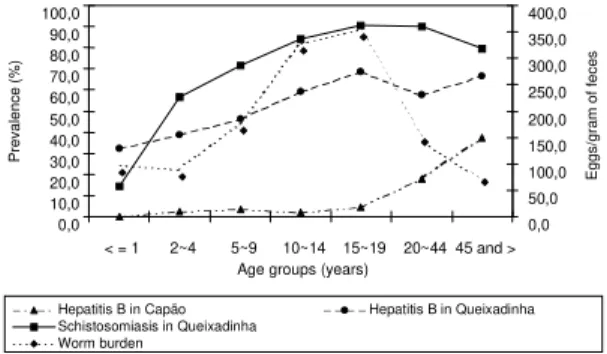
The prevalence of schistosomiasis, the worm burden and the serological markers of hepatitis B in each age group are depicted in the Fig. 1. In Queixadinha, serological markers of hepatitis B were found in 32.1% of children up to one year old and reached a peak of 68.7% in the age range of 15 to 19 years. In the control area the preva-lence of serological markers was under 5% up to 19 years of age and the highest prevalence was observed in adults over 45.
0,0 10,0 20,0 30,0 40,0 50,0 60,0 70,0 80,0 90,0 100,0
< = 1 2~4 5~9 10~14 15~19 20~44 45 and >
Age groups (years)
0,0 50,0 100,0 150,0 200,0 250,0 300,0 350,0 400,0
Hepatitis B in Capão Hepatitis B in Queixadinha
Schistosomiasis in Queixadinha Worm burden
Prevalence (%)
Eggs/gram of feces
Fig. 1: prevalence of schistosomiasis, worm burden and hepa-titis B in each age group in the studied areas.
251 251251 251251 Mem Inst Oswaldo Cruz, Rio de Janeiro, Vol. 93, Suppl. I, 1998
the prevalence of chronic carriers of HBsAg was found in people with or without schistosomiasis (8.7% x 7.0%). The index of chronicity of HBsAg was not statistically different in the studied areas (8.1% x 7.3%; OR=1.09; 95% CI = 0.42-3.03).
There was a homogeneous distribution of schis-tosomiasis in Queixadinha whereas the distribu-tion of hepatitis B, in the same area, occurred in familial clusters.
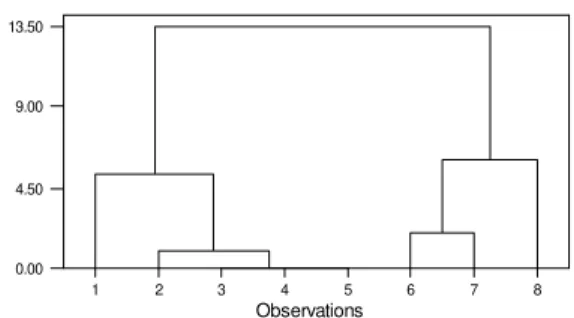
There was a significant grouping among the cases of chronic carriers of hepatitis B in Queixadinha in all areas studied. A typical dendogram of the cluster procedure is shown in Fig. 2. Area 27 was considered in two levels of similarity: at the similarity level of 90% the dendogram indicates the existence of four groups {1} {2,3,4,5} {6,7} {8}; at a level of 70% the individuals could be partitioned in only two groups as {1,2,3,4,5} and {6.7.8}.
Parameters of morbidity, such as hepatomegaly, splenomegaly, worm burden (number of eggs in the stools), periportal fibrosis, portal vein diam-eter and thickness of the vessels and of the gall-bladder wall measured by ultrasonography were evaluated in regard to the presence or absence of serological markers of hepatitis B. No variable studied correlated in any way with hepatitis B. No confounders were identified in the multivariate analysis.
S. mansoni infection. This is consistent with some
previous field-based studies (Domingo et al. 1983, Eltoum et al. 1991).
The prevalence of chronic carriers of HBsAg was similar for people with or without schistoso-miasis in the endemic area. The index of chronic-ity for hepatitis B infection was not different in both areas (endemic or non-endemic) showing that schistosomiasis did not change the course of hepa-titis B in the endemic area studied.
Clinical and ultrasonographic markers of mor-bidity were not associated with hepatitis B virus infection. The history of bleeding from esofageal varices in the endemic area was not frequent and most individuals with hepatosplenomegaly and periportal fibrosis looked healthy. It has been sug-gested that the sickest move to big cities where they receive the necessary attention they need (i.e., surgery for portal hypertension, and/or endoscopic sclerotherapy of esofageal varices) and also expose themselves to medical manipulation and blood transfusion that increase their chances of being infected with the hepatitis B virus (Strauss et al. 1988). Therefore, the population examined in this study is quite different from the one described in the wards of general hospitals. Moreover, the popu-lations studied did not present the usual risks for hepatitis B described for urban areas (parenteral treatment, dental manipulations, tattoing) and trans-mission of hepatitis was probably from mother-to-child, child-to-child and by sexual intercourse (Leichtner et al. 1981, Coltorti et al. 1984, Franks et al. 1989, Hurie et al. 1992). Other markers for sexually transmitted diseases such as FTA-abs (per-formed in randomly selected sera of 250 individu-als of each area) resulted negative (Serufo 1997). This study showed that in an endemic area there was no association between the HBsAg carrier state and schistosomiasis, with or without periportal fi-brosis.
The results have shown that there was a sig-nificant grouping among the cases of chronic car-riers of hepatitis B in Queixadinha. The final num-ber of clusters for each area was chosen according to the similarity level. For most of the areas a 90% similarity level was used. An exploratory analysis of the final clusters for each area has indicated that the variables related to geographical proximity of the cases were more determinant in forming the groups. Considering that in the specific case of Queixadinha geographical proximity also indicates blood relative relationship among the cases, it could be concluded that a family factor has influenced the grouping of the cases.
The State of Minas Gerais has been defined by the Ministry of Health as an area of low preva-lence of hepatitis B infection and this view is
de-1 2 3 4 5 6 7 8
0.00 4.50 9.00 13.50
Observations Distance
Fig. 2: dendogram of the cluster analysis performed for the chronic carriers of hepatitis B cases observed in the area 27 of Queixadinha using the Average linkage method.
DISCUSSION
252 252 252 252
252 Hepatitis B and Schistosomiasis JC Serufo et al.
rived mostly from surveys made using the sera of blood bank donors (Zuckerman 1985, CNE/FNS/ MS 1996, Serufo et al. 1996). In this study the high prevalence of hepatitis B in Queixadinha (9.4% for HBsAg marker) calls for a reevaluation of the vac-cination policy for hepatitis B defined for the State. In areas like Queixadinha vaccination for hepatitis B must be adopted without delay.
ACKNOWLEDGEMENTS
To Benedita Braz Siqueira, Andréia de Fátima Barbosa Pires, Simone Gonçalves dos Santos, Reinaldo Vieira Rosa, José Carlos Serufo Filho, Angela Serufo, Carla Serufo, Neide Fernandes de Castro, Ludgério Rodrigues Neto, José Maria Bernardes and Silvana Romano da Silva for technical support and Dr Rosângela Teixeira for helping in the clinical examination of pa-tients. To the Organon Teknika for providing the ELISA kits to test the sera for hepatitis B markers and the Micra Biotechnology Laboratory for carrying out the serologi-cal tests.
Note: while the present paper was being analyzed by the referees of the Mem Inst Oswaldo Cruz, Dr Tavares Neto had the summary of his thesis (Livre Docência) on hepa-titis B and schistosomiasis published in the Rev Soc Bras Med Trop 31: 411-413, 1998. In his thesis Dr Tavares Neto did not find an association between the presence of hepatits B and C markers and the hepatosplenic form of schistosomiasis in an endemic area.
REFERENCES
Andrade ZA, Sadigursky M, Gomes LS 1978. Hepatite crônica ativa e esquistossomose descompensada. Rev Ass Med Bras24: 366-368.
Bassily S, Dunn MA, Farid Z, Kilpatrick ME, El-Masry NA, Kamel IA, El-Alamy M, Murphy BL 1983. Chronic hepatitis B in patients with schistosomiasis mansoni. Am J Trop Med Hyg86: 67-71.
Bassily S, Farid Z, Higashi GI, Kamel IA, El-Masry NA, Watten RH 1979. Chronic hepatitis B antigenaemia in patients with hepatosplenic schistosomiasis. Am J Trop Med Hyg82: 248-251.
CNE/FNS/MS - Centro Nacional de Epidemiologia, Fundação Nacional de Saúde, Ministério da Saúde 1996. Proposta de Vacinação da Hepatite B. Bol Epidemiol1: 12.
Coelho HSM, Fogaça HS, Hércules HC, Carneiro AJV, Lemme EMO, Toledo JA 1985. Hepatite crônica associada à esquistossomose hepatoesplênica. Estudo clínico-evolutivo de 19 casos. GED4: 41-44. Coltorti M, Del Vecchio BC, Caporaso N 1984.
Famil-ial clustering of HBV infection and chronic liver disease. Front Gastrointest Res8: 169-179. Daneshemend TK, Homeida M, Satir AA, Vandervelde
EM 1984. Increased hepatitis B infection in hepatosplenic schistosomiasis in the Sudan. East African Med J61: 133-135.
Darwish MA, Shaker M, Raslan O, Raouf TA 1992. Hepatitis B and D viral infections among schistoso-mal patients in Egypt. J Egypt Publ Hlth Assoc67: 547-563.
Dean JA, Dean AG, Burton A, Dicker R. EpiInfo Ver-sion 5 1990. A Word Processing, Database, and Sta-tistics System for Epidemiology on Microcomputer. Georgia, USD Inc, Stone Mountain.
Domingo EO, Lingao AL, Tiu E, Lao JY, Olveda RM 1983. HBV exposure and HBsAg positive rates in schistosomiasis japonica: study in a Philippine com-munity endemic for both infections. Southeast Asian
J Trop Med Pub Hlth14: 456-462.
El-Badrawy N, El-Rooby A, Hunter S, Kamel I, Abdel-Gawad Z 1983. Association of HBsAg with hepatosplenic schistosomiasis II. A clinic-pathologi-cal study of HBsAg and anti-HBs in serum. J Egyp
Med Assoc66: 571-582.
El-Raziky EH, Zakaria S, El-Kalouby AH, Shaker ZA, Ata AA, El-Battawy Y 1979. Prevalence of HBsAg in schistosomiasis. (A) General aspects. Egypt J
Bil-harziasis6: 1-10.
Eltoum IA, Ghalib HW, A-Gadir AF, Suliaman SM, Homeida MMA 1991. Lack of association between schistosomiasis and hepatitis B virus infection in Gezira-Managil area, Sudan. Trans R Soc Trop Med
Hyg85: 81-82.
Farghaly AG, Barakat RMR 1992. Association between chronic hepatitis B carrier state and schistosomia-sis. J Egypt Publ Hlth Assoc67: 607-621.
Franks AL, Berg CJ, Kane MA, Browne BB, Sikes RK, Elsea WR, Burton AH 1989. Hepatitis B virus infec-tion among children born in the United States to South-east Asian refugees. N Engl J Med321: 1301-1305. Gerspacher-Lara R, Pinto da Silva R, Rayes AAM,
Drummond SC, Lambertucci JR 1997. Ultrasonog-raphy of periportal fibrosis in schistosomiasis mansoni in Brazil. Trans R Soc Trop Med Hyg91: 307-9.
Ghaffar YA, Fattah SA, Kamel M, Badr RM, Mahomed FF, Strickland GT 1991. The impact of endemic schistosomiasis on acute viral hepatitis. Am J Trop
Med Hyg45: 743-750.
Guimarães RX 1973. Frequência de Antígeno Austrália
em Indivíduos Normais, Índios do Parque Nacional do Xingú e Portadores de Esquistossomose Mansônica, Thesis, Escola Paulista de Medicina, São Paulo, SP, 153 pp.
Guimarães RX, Silva EC, Nigro SP, Kimura RT, Takeda A, Almeida FMR 1981. Sistemas antigênicos da hepatite B na esquistossomose mansônica. Arq
Gastroenterol 18: 145-151.
Hammad HA, El-Fattah MMZ, Moris M, Madina EH, El-Abbasy AA, Soliman ATM 1990. Study on some hepatic functions and prevalence of hepatitis B sur-face antigenaemia in Egyptian children with schis-tosomal hepatic fibrosis. J Trop Pediatr36: 126-127. Hanley JA, McNeill BJ 1982. The meaning and use of the area under a Receiver Operating Characteristic (ROC) curve. Radiology143: 29-36.
Hunter S, El-Badrawy, Kamel I, Khalil S, Hammam S, El-Rooby A 1983. Association of HBsAg with hepatosplenic schistosomiasis I - Relation of HBsAg in liver cells, to histophatological diagnosis of liver biopsy. J Egypt Med Assoc66: 559-570.
trans-253 253253 253253 Mem Inst Oswaldo Cruz, Rio de Janeiro, Vol. 93, Suppl. I, 1998
mission of hepatitis B virus infection to United States-born children of Hmong refugees. Pediatrics
89: 269-273.
Hyams KC, El Alamy MA, Pazzaglia G, El Ghorab NM, Sidhom O, Habib M, Dunn MA 1986. Risk of hepa-titis B infection among Egyptians infected with
Schistosoma mansoni. Am J Trop Med Hyg35: 1035-1039.
Johnson RA, Wichern DW 1992. Applied Multivariate
Statistical Analysis, 3rd ed., New Jersey, Prentice-Hall, 692 pp.
Katz N, Chaves A, Pellegrino J 1972. A simple device for quantitative stool thick-smear technique in schis-tosomiasis mansoni. Rev Inst Med Trop São Paulo
14: 397-400.
Lambertucci JR 1993. Schistosoma mansoni: pathologi-cal and clinipathologi-cal aspects, p.195-225. In Jordan P, Webbe G, Sturrock RF (eds), Human
Schistosomia-sis, Cab International, Wallingford.
Lambertucci JR, Gerspacher-Lara R, Pinto da Silva RA, Barbosa MM, Teixeira R, Barbosa HF, Serufo JC, Rezende DF, Drummond SC, Rayes AAM 1996. O projeto Queixadinha: a morbidade e o controle da esquistossomose em área endêmica no nordeste de Minas Gerais, Brasil. Rev Soc Bras Med Trop 29: 127-135.
Leichtner AM, Leclair J, Goldman DA, Shumacher RT, Gewolb IH, Katz AJ 1981. Horizontal nonparenteral spread of hepatitis B among children. Ann Int Med
94: 346-349.
Lins ALGP 1993. Contribuição ao Estudo dos
Marcadores Sorológicos das Hepatites B e C na Esquistossomose Mansônica, Thesis, Faculdade de Medicina, Universidade de São Paulo, São Paulo, 150 pp.
Lyra LGC 1975. Antígeno Austrália na Esquistossomose
Mansônica Forma Hepatoesplênica, Thesis. Faculdade de Medicina, Universidade Federal da Bahia, Salvador, 115 pp.
Lyra LGC, Rebouças G, Andrade ZA 1976. Hepatitis B surface antigen carrier state in hepatosplenic schis-tosomiasis. Gastroenterology 71: 641-645.
Norusis MJ 1992. SPSS/PC+ Advanced Statistics:
ver-sion 5.0, Chicago, SPSS Inc., 546 pp.
Pereira LMMB, Melo MCV, Lacerda C, Spinelli V, Domingues ALC, Massarolo P, Mies S, Saleh MG, McFarlane IG, Williams R 1994. Hepatitis B virus infection in schistosomiasis mansoni. J Med Virol
42: 203-206.
Pinto-Silva RA, Abrantes WL, Antunes CMF, Lambertucci JR 1994. Sonographic features of por-tal hypertension in schistosomiasis mansoni. Rev Inst
Med Trop São Paulo36: 355-361.
Rosenberg HK, Markowitz RI, Kolberg, H, Park C, Hubbard A, Bellah RD 1991. Normal splenic size in infants and children: Sonographic measurements. Am
Roentgen Ray Soc157: 119-121.
Serufo JC 1997. A Associação entre a Hepatite B e a
Esquistossomose Mansônica: uma Falácia Ecológica, Thesis, Faculdade de Medicina, Universidade Federal de Minas Gerais, 204 pp. Serufo JC, Lambertucci JR 1997. Esquistossomose e
hepatites virais: uma revisão. Rev Soc Bras Med Trop
30: 313-322.
Serufo JC, Pinto da Silva RA, Gerspacher-Lara R, Teixeira R, Santos SG, Lambertucci JR 1996. Alta prevalência da hepatite B em área endêmica de esquistossomose. Rev Soc Bras Med Trop 28 (suppl 1): 106.
Strauss E, Gayotto LCC, Lacet CM, Caly WR, Bellesa MAO, Silva LC, Valentim JF, Ribeiro LT, Vasconcelos MCL, Fukushima J 1988. Hepatitis B virus and mansonic schistosomiasis: a non-specific association. Hepatology 8: 1330.
Van der Borch CA 1987. The association of chronic hepa-titis B infection with chronic schistosomiasis mansoni in Kenya. East Afr Med J64: 95-101. WHO-World Health Organization 1991. Meeting on
ul-trasonography in schistosomiasis: Proposal for a practical guide to the standardized use of ultrasonog-raphy in the assessment of pathological changes. Cairo, WHO, 32 pp.
254 254 254 254