MICROBIAL DEGRADATION OF SULFENTRAZONE IN A BRAZILIAN RHODIC HAPLUDOX SOIL
Camila O. Martinez1, Celia Maria M. S. Silva2, Elisabeth F. Fay2*, Rosangela B. Abakerli3, Aline H. N. Maia2, Lucia R. Durrant1
1
Faculdade de Engenharia de Alimentos, Universidade Estadual de Campinas, Campinas, SP, Brasil; 2Embrapa Meio Ambiente, Jaguariúna, SP, Brasil; 3Centro Pluridisciplinar de Pesquisas Químicas, Biológicas e Agrícolas, Universidade Estadual de
Campinas, Campinas, SP, Brasil.
Submitted: September 26, 2008; Returned to authors for corrections: February 19, 2009; Approved: July 22, 2009.
ABSTRACT
Sulfentrazone is amongst the most widely used herbicides for treating the main crops in the State of São
Paulo, Brazil, but few studies are available on the biotransformation of this compound in Brazilian soils.
Soil samples of Rhodic Hapludox soil were supplemented with sulfentrazone (0.7 µg active ingredient
(a.i.) g-1 soil) and maintained at 27ºC. The soil moisture content was corrected to 30, 70 or 100 % water holding capacity (WHC) and maintained constant until the end of the experimental period. Herbicide-free
soil samples were used as controls. Another experiment was carried out using soil samples maintained at a
constant moisture content of 70% WHC, supplemented or otherwise with the herbicide, and submitted to
different temperatures of 15, 30 and 40º C. In both experiments, aliquots were removed after various
incubation periods for the quantitative analysis of sulfentrazone residues by gas chromatography.
Herbicide-degrading microorganisms were isolated and identified. After 120 days a significant effect on
herbicide degradation was observed for the factor of temperature, degradation being higher at 30 and 40º
C. A half-life of 91.6 days was estimated at 27º C and 70 % WHC. The soil moisture content did not
significantlyaffect sulfentrazone degradation and the microorganisms identified as potential sulfentrazone
degraders were Nocardia brasiliensis and Penicillium sp. The present study enhanced the prospects for
future studies on the bio-prospecting for microbial populations related to the degradation of sulfentrazone,
and may also contribute to the development of strategies for the bioremediation of sulfentrazone-polluted
soils.
Key words: herbicide, degradation, microorganisms, half-life
INTRODUCTION
Herbicides deserve special attention since their dissipation,
persistence and transformation indicate their effectiveness as
products and their potential danger to the microbiota and to the
quality of the environment. The herbicide sulfentrazone
[N-[2,4-dichloro-5-[4-(difluoromethyl)-4,5-dihydro-
3-methyl-5-oxo-1H-1,2,4-triazol-1-y1] phenyl] methanesulfonamide] is
one of the most widely used in soybean and sugarcane crops in
the State of São Paulo, which is the second largest producer of
both these crops in Brazil (11, 14).
Sulfentrazone is stable in the soil, with a half-life (DT50) of 121 days in sandy soils and 302 days in clay soils (7).
Besides being highly persistent, it is highly mobile (mean
partitioning coefficient, Koc= 43; mean sorption coefficient, Kd < 1), and shows good vertical (to ground water) and horizontal
leaching potentials (10). In addition to the water contamination
problem, the microbial diversity could be intensely affected by
the continued use of this herbicide (17), although it can be
mineralized by microorganisms. Its availability to soil
microorganisms depends on temperature and moisture factors,
since both affect its adsorption to the soil, influencing its
bioactivity and persistence (6).
There is a lack of studies characterizing the environmental
fate of sulfentrazone under a range of conditions likely to be
encountered in Brazil. In environments with tropical climates,
weathering is favored by conditions of high temperature and
precipitation associated with good drainage, resulting in the
formation of soils with a 1:1 accumulation clay minerals and
iron and aluminum oxides (31).In Brazil, the oxisols comprise
about 50 to 60 % of all the land (26).
Thus, the objective of this study was to determine the
effects of temperature and moisture on the dissipation of
sulfentrazone under controlled laboratory conditions, with
particular attention to the isolation and identification of
potentially degradation microorganisms.
MATERIALS AND METHODS
The biotransformation of sulfentrazone was evaluated in
Rhodic Hapludox soil samples (40), a class of oxisols. The
investigation consisted of two separate laboratory soil
incubations. The first incubation experiment tested the effects
of moisture variations and the second, the effects of
temperature variations on the biotransformation of
sulfentrazone, using the product concentration recommended
for field use in both tests. For this study, the soil samples were
collected from areas that had no previous register of
sulfentrazone application. The soil studied presented the
following chemical and physical characteristics: pH in water
5.01; organic matter 21 g dm-3; potential acidity 88 mmolc dm -3
; aluminium 19 mmolc dm-3; iron 83 mmolc dm-3; clay 37.3 %; silt 16.2 %; total sand 46.6 %; textural classification Loamy.
Soils and treatments
Effect of moisture variations: Ten soil subsamples were
collected at random from a depth of 0-10 cm. In the laboratory
the subsamples were mixed and homogenized to form a
composite sample, and then air-dried, sieved (2 mm mesh) and
refrigerated at 4ºC before the incubation tests. The soil pH,
residual moisture content and water holding capacity (WHC)
were determined according to the methods proposed by
Embrapa (9). One hundred and fifty grams of the composite
soil sample were transferred to 500 ml Erlenmeyer flasks and
corrected for the humidity to give 30, 70 and 100% WHC, and
maintained at 27°C for seven days before adding the herbicide.
At the end of this period, technical grade sulfentrazone (92%
purity, FMC Corporation) was applied by mixing an aqueous
suspension into the experimental units at the same soil
concentration rate used in the field (0.7 µg g-1 soil), and maintaining the desired soil moisture levels. Soil samples
without the addition of herbicide were used as the controls.
Three replicate flasks were used for each treatment. Soil
samples were taken 14, 30, 60, 120, 180 and 255 days after
treatment, and evaluated using gas chromatography to
determine the amount of herbicide degraded.
Effect of temperature variations: another experiment
was carried out using soil samples with (0.7 µg g-1 soil) and without the addition of herbicide, all corrected for soil moisture
content at the 70% WHC level and incubated at three different
temperatures: 15, 30 and 40°C. Three replicates were made for
each treatment. The residues of sulfentrazone were quantified
by gas chromatography after 14, 30, 60 and 120 days of
incubation.
Extraction and analysis of residual sulfentrazone and
its metabolites from the soil samples: The extraction of
sulfentrazone from soil (10 g) was carried out using a mixture
at 40°C. Three replicate flasks were used for each treatment.
The sample cleanup and sulfentrazone enrichment was carried
out in solid phase cartridges of C8 and silica gel. The
sulfentrazone identification and quantification were made by
gas chromatography and electron capture detention in a column
DB 608 (30m x 0,53mm x 0.83 m). The detection limit
(LOD) was fixed at 0.01 µg mL-1 and the limit of quantification (LOQ) was 0.05 mg kg-1. The validation in the soil was carried out at the spiked level of 0.05 mg kg-1. The efficiency of the applied method was evaluated as function of recovery of the
pesticide in fortified samples. All the recoveries were within
the acceptability range of 70 and 120%.
The metabolite 3-hydroxymethylsulfentrazone (HMS) was
identified by high performance liquid chromatography
(HPLC)7. The chromatographic conditions were as follows: Shimadzu chromatograph, C18 reverse-phase column, flow of
1 ml min-1, room temperature, detection using a diode array detector (DAD), UV 254nm, 24:75 to 60:40 gradient in 60
minutes, with the mobile phase consisting of 0.5% acetonitrile
and acetic acid.
Isolation and characterization of
sulfentrazone-degraders: the enriched soils (10g) with and without the
addition of sulfentrazone, incubated for 120 days at 27oC and 70% WHC, were aseptically suspended in 90 ml of distilled
water for two minutes using a Vortex mixer. Serial dilutions of
the suspensions (10-2; 10-3 and 10-4) were transferred to a minimal medium (NaNO3 3 g; K2HPO4 1 g; MgSO4.7H2O 0.5 g; KCl 0.5 g; FeSO4.7H2O 0.01 g; agar 16 g; H2O 1000 ml) with sulfentrazone (0.7 µg i.a ml-1 medium) added as the sole carbon and energy source. Herbicide-free medium was used as
the control. After incubation for 2; 7 and 17 days at 27oC, the individual colonies of bacteria, actinomycetes and fungi grown
in the medium were respectively picked and transferred to new
minimum liquid medium (99 ml). After serial dilution, 1
ml-aliquots of the 10-1 dilution were inoculated into Erlenmeyer flasks containing 99 ml of the same medium plus the herbicide
at different concentrations (2.1; 4.2 and 7.0 µg i.a ml-1 medium). The cultures were transferred three times over a fifty
day period. The microorganisms were isolated after vortexing
in a 0.1% Tween 80 solution and streaking on solid medium.
The selected strains were then purified in a medium containing
sulfentrazone (7.0 µg i.a ml-1; ten-fold the field rate) as the sole carbon source.
The effect of the herbicide on the soil culturable
microbiota (< 10 % of real environmental indigenous
microbiota), measured by the number of colony-forming units
(CFU), was evaluated by comparing the mean number of CFUs
in soil samples with or without sulfentrazone, using Student's
test with Satterthwaite's approximation (30). The TTEST
Procedure of the SAS System (28) was used. It is now
generally accepted that even more than 99% of microbes are
unculturable with the commonly established methods (38).
The isolated bacterial and actinomycetes strains were
identified by an analysis of their fatty acid-methyl esters
(FAMEs) using the Microbial Identification System developed
by Microbial ID (21). Cell fatty acids were extracted according
to Sasser (29). Fatty acid methyl-esters from each strain were
separated using a Hewlett-Packard gas chromatography model
fitted with a fused silica column (25 m x 0.2 mm internal
diameter). FAME peaks were named by the MISsoftware, and
bacterial strains were identified using the MIS “Aerobia
Library” (Version TSBA50).
The fungal stock cultures were maintained at 4oC on Sabourad medium (39). The procedure for the strain
identification was adapted from Nogueira and Barroso (24) for
visualization; and the images were obtained by scanning
electron microscopy and identified with the help of a specific
manual (4).
Statistical analysis: The influence of moisture and
incubation period on the remaining amount of sulfentrazone
(RASulf) was investigated using variance analysis and
Snedecor's F tests (22). The same analysis was performed to
evaluate the effect of temperature on RASulf. The influence of
temperature and moisture on the mean degradation rate was
quantified by RASulf on the last evaluation date, since the
initial amount (0.7 µg g-1) was constant for all treatments. To accomplish this, t tests were performed for contrasts between
moisture levels. Analysis of variance and t tests for contrasts
were performed using the MIXED Procedure of the SAS
System (28). Where significant differences between RASulf
means arose for any of the contrasts evaluated, we selected the
factor level (temperature or moisture) with the lowest RASulf
(highest degradation rate) to fit degradation models and to
estimate half-life values (in cases where RASulf was lower
than 50% on the last evaluation date). Nonlinear, negative
exponential type models were fitted (Equation 1).
RASulf (t) = 1 - a.exp (-b.t) + e; a > 0; b > 0 (Equation 1)
Where RASulf (t) is the fraction of sulfentrazone
remaining in time t, a is the maximum degradation attained, b
is the parameter related to the degradation velocity in the
descending phase, and e is the random error associated with
each observation. The half-life corresponds to the t value for
which the predicted RASulf (t) value is equal to 0.50. The
Gauss-Newton method (3), implemented in the SAS System's
NLIN Proc (28) was used to fit the models. The above negative
exponential model is adequate for describing degradation
process for which the velocity of degradation is not constant
over time. At time zero, the remaining fraction (RASulf(t)) is
equal to one; according to the proposed model, the fraction
RASulf(t) decreases asymptotically to zero, which is consistent
with the process being modeled.
RESULTS
The factor of moisture had no significant effect on
sulfentrazone degradation (t test for contrasts; P > 0.30). At
100% of WHC, no degradation of the herbicide was verified
for up to 255 days of incubation. At 30 to 70% of WHC,
degradation was similar to the highest degradation value,
reaching 41% (RASulf = 0.41 g g-1) after 255 days of incubation at 30% WHC and 36% at 70% WHC in the same
period.
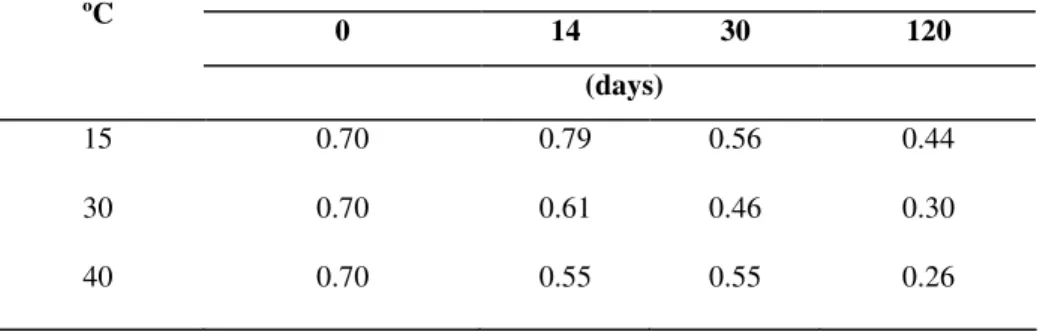
There was an effect of temperature on sulfentrazone
degradation (F test, P < 0.0005). Herbicide degradation was
higher at temperatures of 30 and 40ºC and there was no
difference between the two (Table 1), an increase in the
degradation rate being observed after 60 days for all
treatments. According to the data observed, the highest
degradation was 63.2% (QRSulf = 0.26 g g-1) followed by 56.7%, after 120 days of incubation at 40ºC and 30 ºC
respectively. The half-life estimate for sulfentrazone was 91.6
days in the treatment that provided the greatest sulfentrazone
degradation (40º C and 70 % WHC). Figure 1 shows the fitted
degradation curve and the estimates for the parameters and
of the corresponding model were 1.3456 (s.e. = 1.49) and
0.0051 (s.e. = 0.007), respectively.
Table 1. Mean values for the remaining amount of sulfentrazone ( g g-1) in a Rhodic Hapludox soil with time, under different temperature levels (ºC).
Mean values for the remaining amount of sulfentrazone (µg g-1)
0 14 30 120
ºC
(days)
15 0.70 0.79 0.56 0.44
30 0.70 0.61 0.46 0.30
Figure 1. Sulfentrazone degradation in a Rhodic Hapludox soil with time at 40ºC and 70% WHC. The dotted vertical line
indicates the half-life value: 91.6 days (— fitted negative exponential model, observed values).
The presence of the metabolite 3-hydroxymethyl
sulfentrazone (HMS) in the soil samples incubated at 30º C and
70 % WHC was observed, coinciding with the disappearance
of the parental compound. Although, the analyses to detect the
parent compounds and metabolites were done on all the
sampling dates, the presence of the metabolite
3-hydroxymethyl sulfentrazone (HMS) was only observed under
these conditions.
It was observed that bacterial growth was inhibited by the
presence of the herbicide: there was a mean reduction of 400
thousand CFUs in relation to the control (t test, P = 0.0140).
However the growth of fungi and actinomycetes was favored
by the presence of the herbicide, observing increases of 98 and
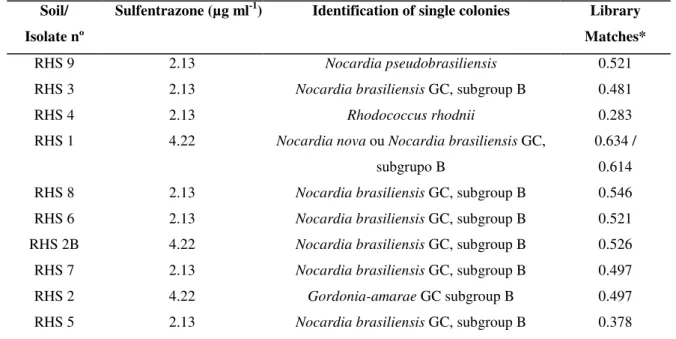
290 thousand CFUs, respectively (Table 2). The bacterial strain
Nocardia brasiliensis GC subgroup B was selected as a
potentialsulfentrazone degrader (tolerant to a rate of 4.2 µg ml -1
), with a similarity index of 0.614 obtained by means of
comparison against the TSBA 40 library database (Table 3).
Taking into consideration the greater herbicide concentration
used, the selection made by the herbicide permitted the
identification of these strains as possible herbicide degraders.
Penicillium sp. was the only fungal strain isolated as a possible
sulfentrazone degrader in a culture medium with sulfentrazone
as the only carbon and energy source.
Table 2. Evaluation of the effect of the herbicide sulfentrazone on the mean number of microbial colony-forming units isolated in
a Rhodic Hapludox soil. Application of Student's t Test.
Organisms Sulfentrazone (0.7µg g-1)
Meanb (CFU)
Lower limitb Upper limitb p valuec
Actinomycete Absent 233.33 175.965 290.70
Actinomycete Present 523.33 312.060 734.61
Actinomycete Differencea 290.00 0.02135
Bacterium Absent 433.33 225.001 641.67
Bacterium Present 33.33 18.991 47.68
Bacterium Difference -400.00 0.01401
Fungi Absent 11.33 -19.327 41.99
Fungi Present 109.33 77.295 141.37
Fungi Difference 98.00 0.00069
a) Difference between numbers of CFU in samples with or without sulfentrazone. b) Value 1,000 times smaller than the observed (divided by 1,000).
Table 3. Identification of bacterial strains using MIS, in a Rhodic Hapludox Soil. These microorganisms were isolated in a
medium supplemented with sulfentrazone in different concentrations, as a sole carbon and energy source.
Soil/
Isolate nº
Sulfentrazone (µg ml-1) Identification of single colonies Library Matches*
RHS 9 2.13 Nocardia pseudobrasiliensis 0.521
RHS 3 2.13 Nocardia brasiliensis GC, subgroup B 0.481
RHS 4 2.13 Rhodococcus rhodnii 0.283
RHS 1 4.22 Nocardia nova ou Nocardia brasiliensis GC,
subgrupo B
0.634 /
0.614
RHS 8 2.13 Nocardia brasiliensis GC, subgroup B 0.546
RHS 6 2.13 Nocardia brasiliensis GC, subgroup B 0.521
RHS 2B 4.22 Nocardia brasiliensis GC, subgroup B 0.526
RHS 7 2.13 Nocardia brasiliensis GC, subgroup B 0.497
RHS 2 4.22 Gordonia-amarae GC subgroup B 0.497
RHS 5 2.13 Nocardia brasiliensis GC, subgroup B 0.378
*Library matches are expressed on a scale of 0 to 1, with a match of 0.6 or greater considered good to the species level.
DISCUSSION
The dissipation of sulfentrazone is an important aspect to
be exploited, due to its characteristics and the contamination
potential of the herbicide (1, 10). According to Hatzios (16),
the primary method for the dissipation of sulfentrazone in soil
is considered to be microbial degradation, and the reported
half-life (DT50) is from 110 to 280 days depending on the soil and environmental conditions.
Researchers have demonstrated that the rate of herbicide
degradation can be strongly influenced by the soil moisture
content and temperature, due to interference of these
parameters on the soil microorganisms (18, 27, 36, 43). Weber
& Weed (45) reported that higher soil temperatures and
moisture contents enhanced the degradation of triazine, and
degradation has been reported to be faster in moist soil than in
dry soil (44). Soil moisture content was the more critical
parameter with respect to herbicides that required microbes to
degrade them (34), and soil microbes thrive in warm, moist
soils, resulting in faster degradation (12).
With respect to the moisture content, in the present
research carried out under laboratory conditions, sulfentrazone
degradation was approximately 40 % up to 225 days at 30 and
70 % WHC. However there was no degradation at 100 % WHC
where anaerobic microorganisms, both obligatory and
facultative, predominate, indicating that sulfentrazone
degradation occurs specifically by aerobic organisms. The
mechanism of degradation in aerobic soil has not been
reported, but some data are available on the effects of soil type,
and the results obtained in other Brazilian soils have confirmed
the above affirmation (20).
Sulfentrazone dissipation was not significantly affected by
variations in soil moisture content, but increased with
increasing temperature. The degradation rates of the herbicide
at 30 and 40ºC were similar. The results presented here show
that the half-life of sulfentrazone decreased with increasing
temperature at the moisture level tested. Its half-life was 91.6
days at 40ºC and 70% WHC, a temperature higher than the
values found under natural field conditions in temperate
climates.
Increased degradation rates of many herbicides with
(27). The results suggest that the DT50 value for sulfentrazone in the surface of tropical soils may be shorter than previously
reported in the Herbicide Handbook (42). In this paper, the
changes found in the composition of the microbial community
and other soil properties as a result of handling under
laboratory conditions, cannot be considered as equivalent to
those occurring under real field conditions, where the influence
of soil structure on the soil microbiota affects herbicide
degradation. Furthermore, the resistance of soil
microorganisms to soil drying and rewetting is influenced by
their metabolic activity, which is determined by their type and
physiological state. Other soil-related factors are not excluded,
but appear to be of only minor importance.
The sources of degradation after drying and rewetting are
organic substrates derived from microorganisms killed by the
drying process and, to a larger extent, from other non-living
soil organic matter. The contribution of the non-biomass soil
organic carbon to the mineralization flush after soil drying and
remoistening is largely dependent on the localization of the
microorganisms in the soil structure relative to their substrates
(13, 41).
Despite favorable conditions for microbial activity in soils,
the biodegradation of herbicides may be hampered due to their
poor bioavailability as result of limitations in mass transfer via
processes of sorption, desorption or dissolution.
The adsorption of sulfentrazone increases with increasing
soil acidity (15). The soil under study showed a low pH value,
below the pKa value of the herbicide (6.56), and thus it appears
that the molecule was in its neutral form, in which solubility is
reduced (37), increasing adsorption. The contribution of the Fe
and Al oxides and hydroxides was quite important, because the
surface charge depends on the pH, and adsorption is an
outcome of ionic bonding between the minerals and the acid
grouping of the molecule at low pH values (2). The soil
moisture content did not significantly affect the microbial
activity in this study, but could alter the distribution of the
sulfentrazone between the solution and the sorbed phases.
Since the soil under study had had no previous contact
with the herbicide, an adjustment phase (lag phase) of the
microorganisms to the compound was observed, the duration
varying according to the treatment. Soil supplementation with
sulfentrazone can introduce a selective process amongst the
natural populations, which favors the growth of adapted strains
that can survive in the presence of the contaminant, while less
specialized ones tend to disappear.
After the lag period, the microorganisms were capable of
degrading the herbicide, as corroborated by the presence of the
metabolite 3-hydroxymethyl sulfentrazone, which is known to
be less toxic than sulfentrazone (8). Besides being less toxic,
the metabolite is more polar and more mobile in the soil
environment than the parent compound. This shows that,
despite the lack of information in the literature about the
microbial degradation route of sulfentrazone, the disappearance
of the parent compound coinciding with the appearance of the
metabolite at the end of the experimental period was in
accordance with the metabolism of the herbicide in plants and
animals (19). Thus HMS was shown to be one of the
components in the metabolic degradation route of this
herbicide by microorganisms in soil. Ohmes et al. (25) showed
that microbial degradation is an important mechanism for
sulfentrazone dissipation, since its degradation was very low in
autoclaved soils.
With regard to the effect of sulfentrazone on the soil
microflora, the molecule reduced the growth of the culturable
bacterial community. Due the adaptation period, even though
culturable bacterial counts may drop, degradation of the
herbicide may be enhanced due to the imposed selection.
However, highly adapted strains are less likely to grow on
culture media in the laboratory, which can explain the CFU
reduction observed, even though the pesticide was being
degraded. Furthermore, this reduction could have been the
result of stimulation of culturable fungal growth by the
herbicide, which is also influenced by the acidic pH of the soil.
Despite the lack of references about potential
sulfentrazone degraders, in this paper the microorganisms
isolated as potential sulfentrazone degraders were Nocardia
brasiliensis and Penicillium sp. Studies exist about the
other organic compounds (5, 18, 23, 32, 33, 35).
CONCLUSION
The results presented here showed that the dissipation of
sulfentrazone was primarily a biological process and indicated
its dependence on the temperature, which suggests that the
DT50 value for sulfentrazone in the surface of tropical soils may be shorter than previously thought, although the present
data were obtained from laboratory incubations. The present
study enhanced the prospects for future studies on the
bio-prospecting for microbial populations related to the
degradation of sulfentrazone, and may also contribute to the
future development of strategies for the bioremediation of
sulfentrazone-polluted soils.
ACKNOWLEDGMENTS
Financial support for this project was provided by The
State of São Paulo Research Foundation (Fundação de Amparo
à Pesquisa do Estado de São Paulo — (FAPESP). We would
also like to thank to two anonymous reviewers for their
valuable advice and constructive criticism which greatly
improved the manuscript.
REFERENCES
1. Agrofit. (2004). Available at:
http://extranet.agricultura.gov.br/agrofit_cons/principal_agrofit_cons. Acessed 9 set 2008.
2. Alves, P.L.C.A.; Marques Jr, J.; Ferraudo, A.S. (2004). Soil attributes and the efficiency of sulfentrazone on control of purple nutsedge (Cyperus rotundus L.). Sci. Agric. 61 (3), 319-325.
3. Bard, J. (1970). Comparison of gradient methods for the solution of the nonlinear parameter estimation problem. SIAM J. Numer. Anal. 7 (1), 157-186.
4. Barnett, H.L.; Hunter, B.B. (1972). Illustrated Genera of Imperfect Fungi. Burgess Publishing, Minneapolis.
5. Benezet, H.J.; Knowles, C.O. (1982). Microbial degradation of thidiazuron and its photoproduct. Arch. Environ. Contam. Toxicol. 11 (1), 107-110.
6. Beulke, S.; Brown, C.D.; Fryer, C.J.; Van Beinum, W. (2004). Influence of kinetic sorption and diffusion on pesticide movement through aggregated soils. Chemosphere 57 (6), 481-490.
7. Chen, A. (2003). Sulfentrazone.In: Lee, P.W. (ed). Handbook of Residue Analytical Methods for Agrochemicals, vol. 1. John Wiley, Chichester, p.564-577.
8. Dayan, F.E.; Armstrong, B.M.; Weete, J.D. (1998). Inhibitory activity of sulfentrazone and its metabolic derivatives on soybean (Glycine max) protoporphyrinogen oxidase. J. Agric. Food Chem, 46 (5), 2024-2029. 9. Embrapa. Centro Nacional de Pesquisa de Solos. (1997). Manual de
Métodos de Análise de Solo. Embrapa-CNPS, Rio de Janeiro.
10. EPA. (2003). Federal register: Sulfentrazone; pesticide tolerances.
Available at:
http://www.epa.gov/fedrgstr/EPA-PEST/2003/September/Day-4/p24011.htm. Acessed 16 set. 2008. 11. Fairbanks, M. (2005). Defensivos agrícolas ampliam mercado. Available
at: http://www.quimica.com.br/revista/qd396/defensivos_agricolas.htm. Acessed 16 set. 2008.
12. Fay, E.F.; Silva, C.M.M.S. (2004). Persistência de moléculas xenobióticas. In: Silva, C.M.M.S., Fay, E. F. (eds). Agrotóxicos & Ambiente. Embrapa Informação Tecnológica, Brasília, DF, p. 221-257. 13. Gordon, H.; Haygarth, P.M.; Bardeett, R.D. (2008). Drying and rewetting
effects on soil microbial community composition and nutrient leaching.
Soil Biol. Biochem. 40, 302-311.
14. Governo do Estado de São Paulo. (2005). Agricultura. Available at:
http://www.saopaulo.sp.gov.br/invista/numeros/agric.htm. Acessed 15 maio 2005.
15. Grey, T.L.; Walker, R.H.; Hancock, H.G. (1997). Sulfentrazone adsorption and mobility affected by soil and pH. Weed Sci. 45 (5), 733-738.
16. Hatzios, K.K. (1998). Supplement to Herbicide Handbook. 7th ed. Weed Science Society of America, Lawrence, p. 67-69.
17. Johnsen, K.; Jacobsen, C.S.; Torsvik, V.; Sorensen, J. (2001). Pesticide effects on bacterial diversity in agricultural soils – a review. Biol. Fert. Soils 33 (6), 443-453.
18. Kodama, T.; Ding, L.; Yoshida, M.; Yajima, M. (2001). Biodegradation of an s-triazine herbicide, simazine. J. Mol. Catal. B Enzym. 11 (4-6), 1073-1078.
19. Martinez, C.O.; Silva, C.M.M.S.; Fay, E.F.; Abakerli, R.B.; Maia, A.H.N.; Durrant, L.R. (2008). The effects of moisture and temperature on the degradation of sulfentrazone. Geoderma 147, 56-62.
20. Martinez, C.O. (2006). Biotransformação do herbicida sulfentrazona em solos brasileiros. Campinas, Brasil, 109p. (M.Sc. Dissertation. Universidade Estadual de Campinas).
21. MIDI. (2001). Microbial Identification System Operating Manual. MIDI, Inc., Newark.
22. Montgomery, D.C. (1991). Design and Analysis of Experiments. John Wiley, New York.
24. Nogueira, N.L.; Barroso, P.A.V. (1998). Microscopia eletrônica aplicada aos estudos de ecologia microbiana. In: Melo, I.S., Azevedo, J.L. (eds).
Ecologia Microbiana. Embrapa-CNPMA, Jaguariúna, p. 279-307. 25. Ohmes, G.A.; Hayes, R.M.; Mueller, T.C. (2000). Sulfentrazone
dissipation in a Tennessee soil. Weed Technol. 14, 100-105.
26. Regitano, J.B.; Alleoni, L.R.F.; Tornisielo, V.L. (2001). Atributos de solos tropicais e a sorção de imazaquin. Sci. Agric. 58, 801-807. 27. Sahid, I.B.; Teoh, S.S. (1994). Persistence of terbuthylazine in soils. Bull.
Environ. Contam. Toxicol. 52 (2), 226-230.
28. SASInstitute. (2004). SAS/STAT 9.1 users guide. SAS Institute Inc, Cary, NC.
29. Sasser, M. (1990). Identification of Bacteria by Gas Chromatography of Cellular Fatty Acids. Microbial ID, Inc., Newark.
30. Satterthwaite, F.W. (1946). An approximate distribution of estimates of variance components. Biometrics Bul.l 2 (6), 110-114.
31. Silva, A.A.; Oliveira Junior, R.S.; Castro Filho, J.E. (1998). Avaliação da atividade residual no solo de imazaquin e trifuralin através de bioensaios com milho. Acta Sci. 20, 291-295.
32. Silva, T.M.; Stets, M.I.; Mazzetto, A.M.; Andrade, F.D.; Pileggi, S.A.V.; Fávero, P.R.; Cantú, M.D.; Carrilho, E.; Carneiro, P.I.B.; Marcos Pileggi, M. (2007). Degradation of 2,4-d herbicide by microorganisms isolated from brazilian contaminated soil. Braz. J. Microbiol. 38, 522-525. 33. Smith, D.; Alvey, S.; Crowley, D.E. (2005). Cooperative catabolic
pathways within an atrazine-degrading enrichment culture isolated from soil. FEMS Microbiol. Ecol. 53 (2), 265-273.
34. Strek, H.J. (2005). The science of Dupont’s soil residual herbicides in Canada. In: van Acker, R.C. (ed). Soil Residual Herbicides: Science and Management. Canadian Weed Science Society, Quebec, p.31-44. (Topics in Canadian Weed Science, v.3).
35. Strzelec, A. (1975). The influence of glucose on simazine decomposition.
Acta Microbiol. Pol. Ser B Microbiol. Appl. 7 (2), 91-96.
36. Taylor-Lovell, S.; Sims, G.H.; Wax, L.M. (2002). Effects of moisture, temperature, and biological activity on the degradation of isoxaflutole in soil. J. Agric. Food Chem. 50 (20), 5626-5633.
37. Tomlin, C.D.S. (2000). The Pesticide Manual: a world compendium.
British Crop Protection Council,Croydon, UK.
38. Torsvik, V.; Goksoyr, J.; Daae, F.L. (1990). High diversity in DNA of soil bacteria. Appl. Environ. Microbiol. 56, 782-787.
39. Tuite, J. (1969). Plant Pathology Methods: fungi and bacteria. Burgess, Minneapolis.
40. USDA Soil Conservation Service, Soil Survey Staff. (1975). Soil Taxonomy: a basic system of soil classification for making and
interpreting soil surveys. U.S. Government Printing Office, Washington, DC.
41. Van Gestel M.; Merckx, R.; Vlassak, K. (1993). Microbial biomass responses to soil drying and rewetting: The fate of fast- and slow-growing microorganisms in soils from different climates. Soil Biol. Biochem. 25, 109-123.
42. Vencill, W.K. (2002). Herbicide Handbook. 8th ed. Weed Science Society of America, Lawrence.
43. Walker, A.; Moon, Y.H.; Welch, S.J. (1992). Influence of temperature, soil moisture and soil characteristics on the persistence of alachlor.
Pestic. Sci. 35 (2), 109-116.
44. Walker, A.; Zimdahl, R.L. (1981). Simulation of the persistence of atrazine, linuron and metolachlor in soil at different sites in the USA.
Weed Res. 21, 255-265.