SCREENING AND ISOLATION OF HALOPHILIC BACTERIA PRODUCING INDUSTRIALLY IMPORTANT ENZYMES
Sumit Kumar1, Ram Karan1, Sanjay Kapoor2, S.P. Singh3, S.K. Khare1*
1
Department of Chemistry, Indian Institute of Technology, Delhi, New Delhi, India; 2Department of Plant Molecular Biology,
University of Delhi South Campus, New Delhi, India; 3Department of Biosciences, Saurashtra University, Rajkot, Gujarat, India.
Submitted: November 08, 2011; Returned to authors for corrections: December 15, 2011; Approved: June 07, 2012.
ABSTRACT
Halophiles are excellent sources of enzymes that are not only salt stable but also can withstand and carry out
reactions efficiently under extreme conditions. The aim of the study was to isolate and study the diversity
among halophilic bacteria producing enzymes of industrial value. Screening of halophiles from various
saline habitats of India led to isolation of 108 halophilic bacteria producing industrially important
hydrolases (amylases, lipases and proteases). Characterization of 21 potential isolates by morphological,
biochemical and 16S rRNA gene analysis found them related to Marinobacter, Virgibacillus, Halobacillus, Geomicrobium, Chromohalobacter, Oceanobacillus, Bacillus, Halomonas and Staphylococcus genera. They belonged to moderately halophilic group of bacteria exhibiting salt requirement in the range of 3-20%.
There is significant diversity among halophiles from saline habitats of India. Preliminary characterization of
crude hydrolases established them to be active and stable under more than one extreme condition of high
salt, pH, temperature and presence of organic solvents. It is concluded that these halophilic isolates are not
only diverse in phylogeny but also in their enzyme characteristics. Their enzymes may be potentially useful
for catalysis under harsh operational conditions encountered in industrial processes. The solvent stability
among halophilic enzymes seems a generic novel feature making them potentially useful in non-aqueous
enzymology.
Key words: Halophiles, Biodiversity, Halophilic enzymes, Hydrolases, Solvent-stable.
INTRODUCTION
Screening of new source of novel and industrially useful
enzymes is a key research pursuit in enzyme biotechnology.
For applications in industrial processes, the enzymes should be
stable at high temperature, pH, presence of salts, solvents,
toxicants etc. In this context, the halophiles have emerged as a
vast repository of novel enzymes in recent years. Enzymes
derived from halophiles are endowed with unique structural
features and catalytic power to sustain the metabolic and
physiological processes under high salt conditions. Some of
these enzymes have been reported to be active and stable under
more than one extreme condition (14, 17, 30).
Halophiles have mainly been isolated from saltern
crystallizer ponds, the Dead Sea, solar lakes and hypersaline
lakes (24, 34). Culture dependent diversity studies on
halophiles have been done from Tunisian Solar Saltern (4),
Tuzkoy salt mine, Turkey (6), Howz Soltan Lake, Iran (28) and
hypersaline environments in south Spain (29). In Indian
context, the halophilic diversity has been limited to the marine
salterns near Bhavnagar (9), Lonar Lake (16) and Peninsular
coast (26). Enzymatic diversity among halophiles of Indian
origin has hardly been profiled. A systematic study on diversity
of halophiles from different saline habitats of India would be of
great importance, especially comparison of biochemical,
metabolic and enzymatic characteristics among them.
The present study focuses on the (i) isolation of moderate
halophiles from various saline habitats of India viz. coastal
regions of Gujarat, Goa, Kerala and Sambhar Salt Lake,
Rajashthan (ii) screening for industrially important enzymes
(especially amylases, lipases and proteases) and (iii) studying
novel properties in these enzymes.
MATERIALS AND METHODS
Isolation of enzyme producing halophiles
Soil and water samples were collected from Sambhar Salt Lake (Rajasthan, 26°58′N75°05′E), sea coast of Kozhikode (Kerala, 11°25′N75°77′E), Goa (Goa, 15°59′N73°73′E), Nagoa (Diu, 20°71′N70°92′E), Somnath (Gujarat, 20°88′N70°40′E), Veraval (Gujarat, 20°91′N70°35′E) and Triveni Sangam
(Gujarat, 20°71′N70°97′E).
Halophiles were isolated by salt (100.0/200.0 gL-1, NaCl)
and substrate (starch/ olive oil/ gelatin) enrichment. The
isolation media contained (gL-1): NaCl 100.0/200.0; Starch/
olive oil/ gelatin 10.0; MgSO4.7H2O 0.4; MgCl2.6H2O 0.7;
CaCl2.2H2O 0.5; KH2PO4 0.3; K2HPO4 0.3; (NH4)2SO4 0.5;
0.01% of trace elements solution containing (gL-1) metal: B
0.26; Cu 0.5; Mn 0.5; Mo 0.06 and Zn 0.7 (27). Different
dilutions of soil or water samples were added to the above
medium and incubated at 30 ºC for 96h. The growth was
diluted 10 times and plated on complete medium agar (gL-1):
glucose 10.0; peptone 5.0; yeast extract 5.0; KH2PO4 5.0; agar
30.0; and NaCl 100.0. Resultant colonies were purified by
repeated streaking on complete media agar. The isolates were
stored at 4 ºC and sub-cultured at 15 days intervals.
Screening of hydrolase activities
Hydrolase producing bacteria among the isolates were
screened by plate assay on starch, tributyrin and gelatin agar
plates for amylase, lipase and protease respectively.
Amylolytic activity of the cultures was screened on starch
nutrient agar plates containing gL-1: starch 10.0; peptone 5.0;
yeast extract 3.0; agar 30.0; NaCl 100.0. The pH was from 7.0
to 10.0 depending on experimental conditions. After incubation
at 30 ºC for 72h, the zone of clearance was determined by
flooding the plates with iodine solution. The potential amylase
producers were selected based on ratio of zone of clearance
diameter to colony diameter.
Proteolytic activity of the isolates was similarly screened
on gelatin nutrient agar plates containing 10.0 gL-1 of gelatin.
The isolates showing zones of gelatin clearance upon treatment
with acidic mercuric chloride were selected and designated as
protease producing bacteria.
Lipase activity of the cultures was screened on tributyrin
nutrient agar plates containing 1% (v/v) of tributyrin. Isolates
that showed clear zones of tributyrin hydrolysis were identified
as lipase producing bacteria.
Identification and characterization of potential halophilic isolates
For identification of strains by 16S rRNA gene
sequencing, the genomic DNA was extracted by PrepManTM
Ultra sample preparation kit (Applied Biosystems Inc, CA,
USA). The 16S rRNA gene sequence was obtained by using
MicroSeq® 16S rRNA gene sequencing kit containing
universal primers (Applied Biosystems Inc., CA, USA). The
identification of phylogenetic neighbours was initially carried
out by the BLAST (1) and megaBLAST (35) programmes
names. The 50 sequences with the highest scores were then
selected for the calculation of pairwise sequence similarity
using global alignment algorithm, which was implemented at
the EzTaxon server (http://www.eztaxon.org/) (7). The
phylogenetic tree was constructed using CLC genomics
workbench 4.0.3 (CLC Bio, Denmark).
The biochemical characterization was carried out by
HiBio-ID Test Kits.
Production of hydrolases
Hydrolase activities of the isolate exhibiting larger zone of
clearance on plate were further confirmed by assaying
enzymatic activity in broth. The isolates were seeded into the
medium containing (gL-1): gelatin/starch/olive oil 10.0; peptone
5.0; yeast extract 5.0; NaCl 50.0-200.0 and pH 7.0. The
incubation was carried out at 150 rpm and 30 °C for 96h. The
cells were harvested by centrifugation at 10,000xg for 10 min
at 4 °C and cell free supernatant was assayed for respective
enzymatic activities.
Enzyme assay
Amylase was assayed following the method of Bernfeld
(5) using starch as a substrate. One unit of amylase activity was defined as the amount of enzyme releasing 1 μmol of maltose equivalent per minute from soluble starch under assay
conditions. Lipase activity was determined using p-nitrophenol
palmitate (pNPP) as substrate following the method described
by Kilcawley et al. (18). One unit of lipase activity was defined as the amount of enzyme liberating 1 nmol of pNP
(p-nitrophenol) per minute under standard assay conditions.
Protease activity was measured by using casein as a substrate
following the method of Shimogaki et al. (31). One unit of protease activity is defined as the amount of enzyme liberating
1 µg of tyrosine per minute under assay conditions.
Characterization of enzymes
pH optimum was determined by assaying the enzyme at
various pH ranging from 5.0 to 10.0 using 0.1 M sodium
acetate buffer (pH 5.0-5.5), 0.1 M sodium phosphate buffer
(pH 6.0-7.5) and 0.1 M Tris-HCl buffer (pH 8.0-10.0).
The effect of salt on enzymatic activity was determined by
varying salt concentrations (0-20% NaCl) in the assay mixture.
For determining the temperature optima, assay was carried out
at various temperatures (30-80 ºC). The thermal stability of
enzymes was determined by preincubating at various
temperatures (40-80°C), and estimating the residual activity in
aliquots withdrawn at various time intervals. Maximum
temperature at which enzyme retained 100% activity for 1h
was determined. Other conditions were kept same as per
standard assay procedures.
Organic solvent stability
Three millilitres of enzyme was mixed with 1.0 mL of
organic solvents in screw capped tubes. The mixture was
incubated at 30 ºC with constant shaking at 200 rpm for 24h.
Samples were withdrawn from aqueous phase and residual
enzyme activity estimated. Enzyme incubated without solvent
was treated as control.
All the experiments were done in triplicate and the
variation was within ±5%.
RESULTS AND DISCUSSION
Isolation of halophiles and screening of hydrolase producers
Halophiles have been perceived as a potential source of
industrially useful enzymes endowed with exceptional
stabilities. The present study was undertaken to screen stable
enzymes from halophiles occurring in saline habitats of India.
The site dependent diversity of halophiles from west coast,
south coast and Salt Lake located in western part of India was
investigated. A total of 108 halophilic isolates producing
hydrolases were isolated by salt (NaCl) and substrate (starch/
olive oil/ gelatin) enrichment.
Distributions of hydrolytic activity among the isolates are
one predominant enzyme, protease (33), lipase (23) and
amylase (22) respectively. Nine isolates produced both lipase
and protease, whereas one isolate showed all three activities.
Based on ratio of zone of clearance diameter to colony
diameter, twenty one isolates were selected for further study.
Table 1. Sampling sites and distribution of hydrolases producing halophiles
Characterization of halophilic isolates
Among the selected isolates, sixteen were Gram-positive and
five Gram-negative. The isolates generally grew in the salt range
of 3-20% NaCl, with an optimum requirement of about 5% salt
indicating them to be moderately halophilic according to the
classification of Kushner (20). The isolates grew in alkaline pH
range at average pH~ 7.5-8.0.
Identification by 16S rRNA gene analysis
The 16S rRNA gene analysis related their grouping in nine
major genus; Marinobacter, Virgibacillus, Halobacillus,
Geomicrobium, Chromohalobacter, Oceanobacillus, Bacillus,
Halomonas and Staphylococcus. Gram-negative isolates of
Marinobacter, Chromohalobacter and Halomonas genus belonged
to Gamma-Proteobacteria and Gram-positive isolates of
Virgibacillus, Halobacillus, Geomicrobium, Oceanobacillus and
Bacillus belonged to Firmicutes.
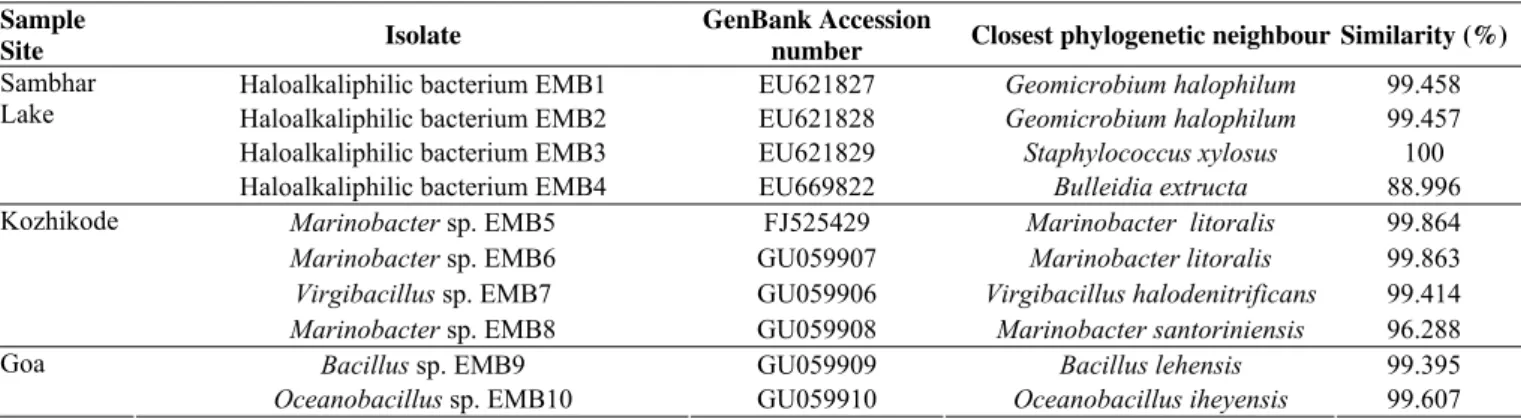
The GenBank accession numbers of the isolates along with
their closest phylogenetic neighbour are presented in Table 2.
Geomicrobium was the most common genus, six halophilic
isolates affiliated to this genus showed similarity to Geomicrobium
halophilum. The genus Marinobacter was found only from the
Kozhikode. Virgibacillus was represented from Kozhikode,
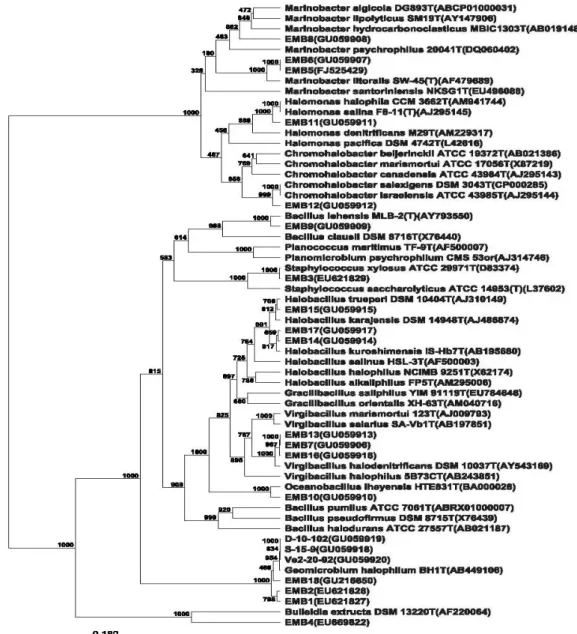
Triveni Sangam and Nagoa. The phylogenetic association of the
isolates is shown in Figure 1. All the nine genus obtained in
present study, are commonly occurring in various saline habitats
across the globe. Presence of Marinobacter, type isolate
Marinobacter hydrocarbonoclasticus has been reported from
Meditteranean sea (13). Halobacillus litoralis (33),
Oceanobacillus iheyensis (21) and Geomicrobium halophilum (10)
have been isolated from Great Salt Lake, Iheya ridge and soil
samples from Japan respectively.
Table 2. 16S rRNA gene identification of halophilic bacterial isolates producing potent hydrolases
Enzymes present
Sample site Sample type pH Temperature
( oC)
Gram- positive isolates
Gram- negative
isolates
Amylase Lipase Protease
Kozhikode, Kerala Sea water and sand 7.6 31.2 3 9 5 5 4
Nagoa, Diu Sea water and soil 7.9 30.6 9 8 6 7 7
Somnath, Gujarat Sea water 7.7 30.5 7 11 4 9 8
Triveni Sangam, Gujarat Sea water and soil 7.8 31.5 9 12 7 5 11
Veraval, Gujarat Sea water 7.7 30.3 4 5 2 5 5
Goa Sea water 7.7 30.6 4 7 2 3 8
Sambhar Salt Lake, Rajasthan Soil and water 7.8 35.0 11 9 7 4 11
Sample
Site Isolate
GenBank Accession
number Closest phylogenetic neighbour Similarity (%)
Haloalkaliphilic bacterium EMB1 EU621827 Geomicrobium halophilum 99.458
Haloalkaliphilic bacterium EMB2 EU621828 Geomicrobium halophilum 99.457
Haloalkaliphilic bacterium EMB3 EU621829 Staphylococcus xylosus 100
Sambhar Lake
Haloalkaliphilic bacterium EMB4 EU669822 Bulleidia extructa 88.996
Marinobacter sp. EMB5 FJ525429 Marinobacter litoralis 99.864
Marinobacter sp. EMB6 GU059907 Marinobacter litoralis 99.863
Virgibacillus sp. EMB7 GU059906 Virgibacillus halodenitrificans 99.414
Kozhikode
Marinobacter sp. EMB8 GU059908 Marinobacter santoriniensis 96.288
Bacillus sp. EMB9 GU059909 Bacillus lehensis 99.395
Goa
Table 2. Continuation.
Chromohalobacter sp. EMB12 GU059912 Chromohalobacter israelensis 100
Virgibacillus sp. EMB13 GU059913 Virgibacillus halodenitrificans 99.23
Triveni Sangam
Halobacillus sp. EMB14 GU059914 Halobacillus kuroshimensis 99.609
Halobacillus sp. EMB15 GU059915 Halobacillus trueperi 99.414
Virgibacillus sp. EMB16 GU059916 Virgibacillus halodenitrificans 99.219
Halobacillus sp. EMB17 GU059917 Halobacillus kuroshimensis 99.608
Nagoa
Haloalkaliphilic bacterium D-10-102 GU059919 Geomicrobium halophilum 100
Halomonas sp. EMB11 GU059911 Halomonas salina 99.795
Haloalkaliphilic bacterium EMB18 GU216650 Geomicrobium halophilum 99.796
Somnath
Haloalkaliphilic bacterium S-15-9 GU059918 Geomicrobium halophilum 100
Veraval Haloalkaliphilic bacterium Ve2-20-92 GU059920 Geomicrobium halophilum 100
Figure 1. Phylogenetic inference based on 16S rRNA gene analysis of halophilic isolates. Each organism is preceded by its NCBI
Screening and preliminary characterization of the halophilic enzymes
Since the basic objective of study was to screen novel/
stable enzymes among halophiles, the isolates were grown in
culture media to obtain crude enzyme for further
characterization. Amylase, lipase and protease were chosen for
the study, considering their high industrial usage. Maximum
amylase was produced by Marinobacter sp. EMB8. Lipase and protease production level were maximum in Marinobacter sp. EMB5 and Bacillus sp. EMB9 respectively.
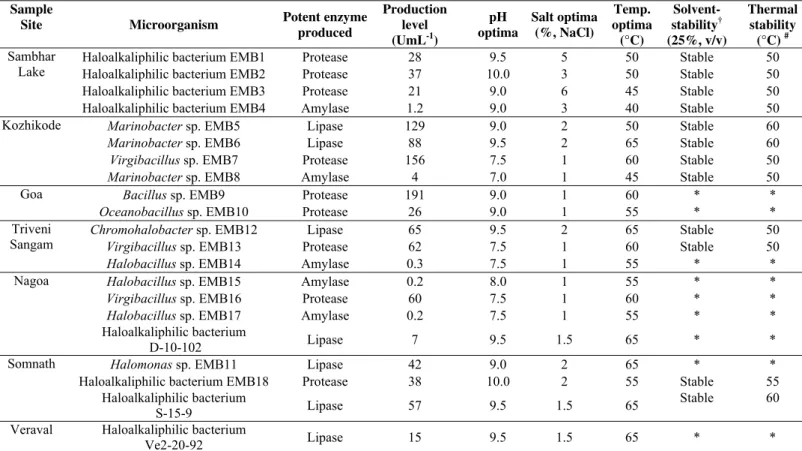
Crude enzymes were partially characterized to investigate
their properties and stability (Table 3). Their optimum salt
requirement in most cases was in the range of 1-2%. These
were optimally active at pH 9.0 or above, in general. Their
temperature optimum ranged between 50-65°C. Interestingly,
all the hydrolases were stable in organic solvents. Based on
these results, hydrolases from moderate halophiles can be
categorized to be alkaline in nature, moderate in salt
requirement and endowed with solvent stability, a common
novel feature among all.
Table 3. Preliminary characterization of halophilic enzymes
* Not defined
† Solvent stability checked in hexane, cyclohexane, decane, dodecane and toluene
# Stability for 1h
Prominent amylase, lipase and protease producers have
been reported from Salinivibrio, Halomonas and Salinivibrio genus respectively from different hypersaline environment of
south Spain (29). Study from Howz Soltan Lake, Iran showed
majority of amylase producers were Oceanobacillus and
Halobacillus. Gracibacillus and Halomonas produced lipase and Virgibacillus produced protease (28). The hydrolase producing ability was also observed in moderately halophilic
bacteria from Marinobacter, Chromohalobacter and Halomonas genera from the Tunisian Solar Saltern (4).
Sample
Site Microorganism Potent enzyme
produced
Production level (UmL-1)
pH optima
Salt optima (%, NaCl)
Temp. optima (°C)
Solvent-stability† (25%, v/v)
Thermal stability
(°C) #
Haloalkaliphilic bacterium EMB1 Protease 28 9.5 5 50 Stable 50
Haloalkaliphilic bacterium EMB2 Protease 37 10.0 3 50 Stable 50
Haloalkaliphilic bacterium EMB3 Protease 21 9.0 6 45 Stable 50
Sambhar Lake
Haloalkaliphilic bacterium EMB4 Amylase 1.2 9.0 3 40 Stable 50
Marinobacter sp. EMB5 Lipase 129 9.0 2 50 Stable 60
Marinobacter sp. EMB6 Lipase 88 9.5 2 65 Stable 60
Virgibacillus sp. EMB7 Protease 156 7.5 1 60 Stable 50
Kozhikode
Marinobacter sp. EMB8 Amylase 4 7.0 1 45 Stable 50
Bacillus sp. EMB9 Protease 191 9.0 1 60 * *
Goa
Oceanobacillus sp. EMB10 Protease 26 9.0 1 55 * *
Chromohalobacter sp. EMB12 Lipase 65 9.5 2 65 Stable 50
Virgibacillus sp. EMB13 Protease 62 7.5 1 60 Stable 50
Triveni Sangam
Halobacillus sp. EMB14 Amylase 0.3 7.5 1 55 * *
Halobacillus sp. EMB15 Amylase 0.2 8.0 1 55 * *
Virgibacillus sp. EMB16 Protease 60 7.5 1 60 * *
Halobacillus sp. EMB17 Amylase 0.2 7.5 1 55 * *
Nagoa
Haloalkaliphilic bacterium
D-10-102 Lipase 7 9.5 1.5 65 * *
Halomonas sp. EMB11 Lipase 42 9.0 2 65 * *
Haloalkaliphilic bacterium EMB18 Protease 38 10.0 2 55 Stable 55
Somnath
Haloalkaliphilic bacterium
S-15-9 Lipase 57 9.5 1.5 65
Stable 60
Veraval Haloalkaliphilic bacterium
In the present work, amylase from Marinobacter sp. EMB8, Halobacillus sp. EMB14, EMB15 and EMB17 and Haloalkaliphilic bacterium EMB4 have shown noticeable
production level (up to 4.0 UmL-1). Among halophiles amylase
production has been previously reported from Halomonas meridiana (8) and Chromohalobacter sp. TVSP 101 (25). Amoozegar et al. (2) have characterized Halobacillus sp. MA-2 amylase, which exhibited pH optima at 7.5-8.5 and
temperature optima at 50 ºC. As compared to this, all three
isolates of Halobacillus sp. although have pH optima in 7.5-8.0 range and temperature optimum in the range 55-60 ºC.
Amylase from a Marinobacter genus is being reported for the first time to best of our knowledge.
Marinobacter sp. EMB5, Marinobacter sp. EMB6, Halomonas sp. EMB11, Chromohalobacter sp. EMB12 and four Geomicrobium sp. isolate were found to be potent lipase producers (up to 129.0 UmL-1). Marinobacter lipolyticus (22) and Chromohalobacter sp. (29) have been previously described for lipase production. The lipase from Geomicrobium sp. is being reported for the first time to best of our knowledge. Till
date very few halophilic lipases have been characterized, these
are from Salicola sp. IC10 (23) and Salinivibrio sp. strain SA-2 (3). Solvent stability has not been reported in any these cases,
which is highlight of Geomicrobium sp. lipase characteristics in present study.
Three isolates belonging to Virgibacillus sp., Geomicrobium sp. and one each Oceanobacillus and Bacillus sp. were potent protease producers (up to 191 UmL-1). All the
Virgibacillus sp. isolates were only protease producers irrespective of site of their isolation. Virgibacillus sp. SK33 protease has been reported to be salt tolerant and stable in
organic solvents (32).
Solvent stability a generic novel feature in halophiles Solvent stability as a generic feature marks these novel
enzymes for further study. Solvent stability has been observed
as a novel trait among the halophilic enzymes in recent years
(15). Solvent stability in halophilic enzymes may be attributed
to the fact that they work in low water activity caused by high
salt surroundings. Such enzymes are potentially useful in
synthesis applications (12). Halophilic hydrolases investigated
in present study were stable in 25% (v/v) concentration of
hexane, cyclohexane, decane, dodecane and toluene.
Amylase from Haloarcula sp. strain S-1 remained active and stable in presence of 66% benzene, toluene and chloroform
(11). Solvent stable proteases have been reported from
Halobacterium salinarum (19) and Geomicrobium sp. EMB2 (17).
All the 108 hydrolase producers isolated from diverse
saline habitats of India belong to moderate halophiles category.
Moderately halophilic bacteria constitute the most versatile
group of microorganisms that could be used as a source of
salt-adapted enzymes. These have advantage over extreme
halophiles in that they do not have a strict salt requirement and
grow in wide salt range. Solvent stability of amylase, lipase
and protease from these halophilic isolates make them
potentially useful for application in non-aqueous enzymology
for synthesis of oligosaccharides, esters and peptides.
ACKNOWLEDGEMENTS
The financial support by the Department of Biotechnology
(Government of India) is gratefully acknowledged. Author SK
is grateful to the Council of Scientific and Industrial Research
(CSIR), India, for Research Fellowship.
REFERENCES
1. Altschul, S.F.; Madden, T.L.; Schaeffer, A.A.; Zhang, J.; Zhang, Z.; Miller, W.; Lipman, D.J. (1997). Gapped BLAST and PSI-BLAST: a new generation of protein database search programs. Nucleic Acids Res. 25, 3389-3402.
2. Amoozegar, M.A.; Malekzadeh, F.; Malik, K.A. (2003). Production of amylase by newly isolated moderate halophile, Halobacillus sp. strain MA-2. J. Microbiol. Meth. 52, 353–359.
J. Basic Microbiol. 48, 160-167.
4. Baati, H.; Amdouni, R.; Gharsallah, N.; Sghir, A.; Ammar, E. (2010). Isolation and characterization of moderately halophilic bacteria from Tunisian solar saltern. Curr. Microbiol. 60, 157-161.
5. Bernfeld, P. (1955). Amylase, α and β. Meth. Enzymol. 1, 149-158. 6. Birbir, M.; Ogan, A.; Calli, B.; Mertoglu, B. (2004). Enzyme
characteristics of extremely halophilic archaeal community in Tuzkoy salt mine, Turkey. World J. Microbiol. Biotechnol. 20, 613-621. 7. Chun, J.; Lee, J.-H.; Jung, Y.; Kim, M.; Kim, S.; Kim, B.K.; Lim, Y.W.
(2007). EzTaxon: a web-based tool for the identification of prokaryotes based on 16S ribosomal RNA gene sequences. Int. J. Syst. Evol. Microbiol. 57, 2259-2261.
8. Coronado, M.; Vargas, C.; Hofemeister, J.; Ventosa, A.; Nieto, J.J. (2000). Production and biochemical characterization of an α-amylase from the moderate halophile Halomonas meridiana. FEMS Microbiol. Lett. 183, 67–71.
9. Dave, S.R.; Desai, H.B. (2006). Microbial diversity at marine salterns near Bhavnagar, Gujarat, India. Curr. Sci. 90, 497-499.
10. Echigo, A.; Minegishi, H.; Mizuki, T.; Kamekura,M.; Usami, R. (2010). Geomicrobium halophilum gen. nov., sp. nov., moderately halophilic and
alkaliphilic bacteria isolated from soil samples. Int. J. Syst. Evol. Microbiol. 60, 990–995.
11. Fukushima, T.; Mizuki, T.; Echigo, A.; Inoue, A.; Usami, R. (2005). Organic solvent tolerance of halophilic α-amylase from a Haloarchaeon, Haloarcula sp. strain S-1. Extremophiles. 9, 85–89.
12. Gaur, R.; Gupta, A.; Khare, S.K. (2008). Purification and characterization of lipase from solvent tolerant Pseudomonas aeruginosa PseA. Process Biochem. 43, 1040-1046.
13. Gauthier, M.J.; Christen, B.R.; Fernandez, L.; Acquaviva, M.; Bonin, P.; Bertrand, J.-C. (1992). Marinobacter hydrocarbonoclasticus gen. nov,, sp. nov,, a new, extremely halotolerant, hydrocarbon-degrading marine bacterium. Int. J. Syst. Bacteriol. 42, 568-576.
14. Gomes, J.; Steiner, W. (2004). The biocatalytic potential of extremophiles and extremozymes. Food Technol. Biotechnol. 42, 223-235.
15. Gupta, A.; Khare, S.K. (2009). Enzymes from solvent-tolerant microbes: Useful biocatalysts for non-aqueous enzymology. Crit. Rev. Biotechnol. 29, 44-54.
16. Joshi, A.A.; Kanekar, P.P.; Kelkar,A.S.; Shouche,Y.S.; Wani, A.A.; Borgave, S.B.; Sarnaik, S.S. (2008). Cultivable bacterial diversity of alkaline Lonar Lake, India. Microb. Ecol. 55, 163–172.
17. Karan, R.; Khare, S.K. (2010). Purification and characterization of a solvent stable protease from Geomicrobium sp. EMB2. Environ. Technol. 31, 1061-1072.
18. Kilcawley, K.N.; Wilkinson, M.G.; Fox, P.F. (2002). Determination of key enzyme activities in commercial peptidase and lipase preparations from microbial or animal sources. Enzym. Microb. Tech. 31, 310–320.
19. Kim, J.; Dordick, J.S. (1997). Unusual salt and solvent dependence of a protease from an extreme halophile. Biotechnol. Bioeng. 55, 471–479. 20. Kushner, D.J. (1985). The Halobacteriaceae. In: Woese, C.R., Wolfe
R.S. (eds). The Bacteria, Vol. 8, Academic Press, London, p.171–214. 21. Lu, J.; Nogi, Y.; Takami, H. (2001). Oceanobacillus iheyensis gen. nov.,
sp. nov., a deep-sea extremely halotolerant and alkaliphilic species isolated from a depth of 1050m on the Iheya Ridge. FEMS Microbiol. Lett. 205, 291-297.
22. Martín, S.; Márquez, M.C.; Sánchez-Porro, C.; Mellado, E.; Arahal, D.R.; Ventosa, A. (2003). Marinobacter lipolyticus sp. nov., a novel moderate halophile with lipolytic activity. Int. J. Syst. Evol. Microbiol. 53, 1383–1387.
23. Moreno, M.L.; Garcia, M.T.; Ventosa, A.; Mellado, E. (2009). Characterization of Salicola sp. IC10, a lipase- and protease-producing extreme halophile. FEMS Microbiol. Ecol. 68, 59-71.
24. Oren, A. (2002). Molecular ecology of extremely halophilic Archaea and Bacteria. FEMS Microbiol. Ecol. 39, 1-7.
25. Prakash, B.; Vidyasagar, M.; Madhukumar, M.S.; Muralikrishna, G.; Sreeramulu, K. (2009). Production, purification, and characterization of two extremely halotolerant, thermostable, and alkali-stable α-amylases from Chromohalobacter sp. TVSP 101. Process Biochem. 44, 210–215. 26. Raghavan, T.M.; Furtado, I. (2004). Occurrence of extremely halophilic
Archaea in sediments from the continental shelf of west coast of India. Curr. Sci. 86, 1065–1067.
27. Rahman, R.N.Z.R.A.; Leow, T.C.; Salleh, A.B.; Basri, M. (2007). Geobacillus zalihae sp. nov., a thermophilic lipolytic bacterium isolated
from palm oil mill effluent in Malaysia. BMC Microbiol. 7, 77-86. 28. Rohban, R.; Amoozegar, M.A.; Ventosa, A. (2009). Screening and
isolation of halophilic bacteria producing extracellular hydrolases from Howz Soltan Lake, Iran. J. Ind. Microbiol. Biotechnol. 36, 333-340. 29. Sánchez-Porro, C.; Martín, S.; Mellado, E.; Ventosa, A. (2003).
Diversity of moderately halophilic bacteria producing extracellular hydrolytic enzymes. J. Appl. Microbiol. 94, 295–300.
30. Sellek, G.A.; Chaudhuri, J.B. (1999). Biocatalysis in organic media using enzymes from extremophiles. Enzym. Microb. Tech. 25, 471-482. 31. Shimogaki, H.; Takeuchi, K.; Nishino, T.; Ohdera, M.; Kudo, T.; Ohba,
K.; Iwama, M.; Irie, M. (1991). Purification and properties of a novel surface active agent and alkaline-resistant protease from Bacillus sp., Y. Agric. Biol. Chem. 55, 2251–2258.
32. Sinsuwan, S.; Rodtong, S.; Yongsawatdigul, J. (2010). Purification and characterization of a salt-activated and organic solvent-stable heterotrimer proteinase from Virgibacillus sp. SK33 Isolated from Thai Fish Sauce. J. Agric. Food. Chem. 58, 248–256.
Syst. Evol. Microbiol. 46, 492-496.
34. Ventosa, A.; Nieto, J.J.; Oren, A. (1998). Biology of moderately halophilic aerobic bacteria. Microbiol. Mol. Biol. Rev. 62, 504–544.
35. Zhang, Z.; Schwartz, S.; Wagner, L.; Miller, W. (2000). A greedy algorithm for aligning DNA sequences. J. Comput. Biol. 7, 203-214.