Nonlocal Description of the Nuclear Interaction
L. C. Chamon
1, B. V. Carlson
2, L. R. Gasques
1, D. Pereira
1, C. De Conti
2, M. A. G. Alvarez
1,
M. S. Hussein
1, M. A. Cˆandido Ribeiro
3, E. S. Rossi Jr.
1, and C. P. Silva
1 1. Departamento de F´ısica Nuclear, Instituto de F´ısica da Universidade de S˜ao Paulo,Caixa Postal 66318, 05315-970, S˜ao Paulo, SP, Brazil 2. Departamento de F´ısica, Instituto Tecnol´ogico de Aeron´autica,
Centro T´ecnico Aeroespacial, S˜ao Jos´e dos Campos, SP, Brazil 3. Departamento de F´ısica, Instituto de Biociˆencias, Letras e Ciˆencias Exatas,
Universidade Estadual Paulista, S˜ao Jos´e do Rio Preto, SP, Brazil
Received on 30 October, 2002
Extensive systematizations of theoretical and experimental nuclear densities and of optical potential strengths extracted from heavy-ion elastic scattering data analyses at low and intermediate energies are presented. The energy-dependence of the nuclear potential is accounted for within a model based on the nonlocal nature of the interaction. The systematics indicates that the heavy-ion nuclear potential can be described in a simple global way through a double-folding shape, which basically depends only on the density of nucleons of the partners in the collision. The possibility of extracting information about the nucleon-nucleon interaction from the heavy-ion potential is investigated.
I
Introduction
The optical potential plays a central role in the description of heavy-ion collisions, since it is widely used in studies of the elastic scattering process as well as in more complicated re-actions through the DWBA or coupled-channel formalisms. This complex and energy-dependent potential is composed of the bare and polarization potentials, the latter containing the contribution arising from nonelastic couplings. In prin-ciple, the bare (or nuclear) potential between two heavy ions can be associated with the fundamental nucleon-nucleon in-teraction folded into a product of the densities of the nuclei [1]. Apart from some structure effects, the shape of the nu-clear density along the table of stable nuclides is nearly a Fermi distribution, with diffuseness approximately constant and radius given roughly byR = r0 A1/3, whereAis the
number of nucleons of the nucleus. Therefore, one could ex-pect a simple dependence of the heavy-ion nuclear potential on the number of nucleons of the partners in the collision.
The elastic scattering is the simplest process that occurs in a heavy-ion collision because it involves very little re-arrangement of matter and energy. Therefore, this process has been studied in a large number of experimental inves-tigations, and a huge body of elastic cross section data is currently available. The angular distribution for elastic scat-tering provides unambiguous determination of the real part of the optical potential only in a region around a particular distance [2] hereafter referred as the sensitivity radius (RS). At energies close to the Coulomb barrier the sensitivity ra-dius is situated in the surface region. In this energy region, the systematization [3, 4] of experimental results for
poten-tial strengths at the sensitivity radii has provided an univer-sal exponential shape for the heavy-ion nuclear potential at the surface region.
In a recent review article [2] the phenomenon of rain-bow scattering was discussed, and it was emphasized that the real part of the optical potential can be unambiguously extracted also at very short distances from heavy-ion elastic scattering data at intermediate energies. However, differ-ently from the case for the surface region (low energy), a systematization of potential strengths at the inner distances has not been performed up to now, probably because the resulting phenomenological interactions have presented sig-nificant dependence on the bombarding energies. Several theoretical models have been developed to account for this energy-dependence through realistic mean field potentials. A recent model [5, 6, 7, 8] associates the energy-dependence of the heavy-ion bare potential with nonlocal quantum ef-fects related to the exchange of nucleons between target and projectile. Using this model, we have realized [8] a system-atization of potential strengths extracted from elastic scat-tering data analyses, considering both: low (near-barrier) and intermediate energies. The systematics confirms that the heavy-ion nuclear potential can be described in a very simple global way.
II
The nuclear densities
requires a previous systematization of the nuclear densities. We adopt the two-parameter Fermi (2pF) distribution (Eq. 1) to describe the nuclear densities.
ρ(r) = ρ0 1 +exp¡r−R0
a
¢ (1)
In our theoretical calculations, the charge distribution of the nucleus (ρch) has been obtained by folding the proton distri-bution of the nucleus (ρp) with the intrinsic charge distribu-tion of the proton in free space (ρchp)
ρch(r) =
Z
ρp(~r′)ρchp(~r−r~′)d~r′ , (2) where ρchp is an exponential with diffuseness achp = 0.235 f m. In an analogous way, we have defined the mat-ter density of the nucleus by folding the nucleon distribu-tion of the nucleus with the intrinsic matter distribudistribu-tion of the nucleon, which is assumed to have the same shape of the intrinsic charge distribution of the proton. For conve-nience, the charge and matter distributions are normalized to the number of protons and nucleons, respectively.
In order to systematize the heavy-ion nuclear densi-ties [8], we have calculated theoretical distributions for a large number of nuclei using the Dirac-Hartree-Bogoliubov (DHB) model [9]. We have also used the results of previous systematics for charge distributions [10, 11], extracted from electron scattering experiments, as a check of our DHB re-sults. Along the table of stable nuclides, the diffuseness for the nucleon and matter densities spread around the average values ¯an = 0.50 f mand¯am = 0.56 f m, respectively. A small dispersion of about 0.025 f maround these aver-age values is expected due to effects of the structure of the nuclei. We have determined the radiiR0for the 2pF
distri-butions assuming that the corresponding root-mean-square
radii should be equal to those of the theoretical (DHB) den-sities. The nucleon and matter densities give very similar radii, which are well described by the following linear fit:
R0= 1.31A1/3−0.84f m. (3)
Due to effects of the structure of the nuclei, theR0 values
spread around this linear fit with dispersion of0.07f m.
III
The double-folding potential
The double-folding potential has the form [1]
VF(R) =
Z
ρ1(r1)ρ2(r2)vN N(R~ −r~1+r~2)d ~r1d ~r2,
(4) whereRis the distance between the centers of the nuclei,ρi are the respective nucleon distributions, andvN N(~r)is the effective nucleon-nucleon interaction. The success of the folding model can only be judged meaningfully if the effec-tive nucleon-nucleon interaction employed is truly realistic. The most widely used realistic interaction is known as M3Y [1, 2], which can usually assume two versions: Reid and Paris.
The six-dimensional integral (Eq. 4) can easily be solved by reducing it to a product of three one-dimensional Fourier transforms [1], but the results may only be obtained through numerical calculations. In order to provide analytical ex-pressions for the folding potential, we consider, as an ap-proximation, that the range of the effective nucleon-nucleon interaction is negligible in comparison with the diffuseness of the nuclear densities. In this zero-range approach, the double-folding potential can be obtained from:
⌋
vN N(~r)≈V0δ(~r)⇒VF(R) = 2πV0
R
Z ∞
0
r1ρ1(r1)
" Z R+r1
|R−r1|
r2ρ2(r2)dr2
#
dr1. (5)
⌈
The Fermi distribution may be represented, with precision better than 3% for anyrvalue, by:
ρ0 1 +exp¡r−R0
a
¢ ≈ρ0C
µr−R
0
a 
, (6)
C(x≤0) = 1−7
8e x+3
8e 2x,
(7)
C(x≥0) =e−x µ
1−7
8e −x+3
8e −2x¶.
(8)
This approximation is particularly useful in obtaining ana-lytical expressions for integrals that involve the 2pF distribu-tion. If both nuclei have the same diffusenessa, the double-integral (Eq. 5) can be solved analytically using the approx-imation represented by Eq. 6, and the result expressed as a sum of a large number of terms, most of them negligible for
a≪ R0. Rather simple expressions can be found after an
elaborate algebraic manipulation:
⌋
VF(R≤R2−R1+a)≈V0ρ01ρ02 4 3πR
3 1
(
1 + 9.7
µ a R1
¶2 −
·
0.875
µR3 2
R3 1
−1

+ a
R1
µ
2.4 + R 2 2
R2 1
¶¸
e−(R2−R1)/a )
,
VF(R2−R1+a≤R≤R1+R2)≈V0ρ01ρ02 4
3πR 3
µ
1 1 +ζτ
¶ ½ τ2
·
3 8 +
τ
4 +ζ
τ2 16
¸
+ 2.4η2 ·
1−5
8η−ζτ 2+
µ
5 4η−
1 2
¶ eε+
µ
1 +5 8η

e−(ε+2R1/a) ¸¾
, (10)
VF(R≥R1+R2)≈V0ρ01ρ02πa2Rg(τ) (1 +s/a) e−s/a, (11)
⌈
where s = R−(R1 +R2), R = 2R1R2/(R1 +R2),
ζ = R/(R1+R2), τ = s/R, η = a/R,ε = s/a,R1
and R2 are the radii of the nuclei (hereafter we consider
R2≥R1). The functiongis given by:
g(τ) =1 +τ+τ
2ζ/3 +η+ (η+ 1/2)e−ε
1 +ζτ . (12)
We define the reduced folding potential at the surface region by:
Vred(s≥0) = VF
ρ01ρ02πa2Rg(τ)
. (13)
Taking into account Eqs. 11 and 13, the reduced potential can be represented by the following system-independent ex-pression:
Vred(s≥0)≈V0(1 +s/a)e−s/a . (14)
However, it is not clear that one can find a simple form for such a system-independent quantity at inner distances from Eqs. 9 and 10. In Section V, the reduced potential is useful for addressing the potential strength systematization. Thus we defineVredfors≤0through the following trivial form:
Vred(s≤0) =V0. (15)
The end of this section is devoted to the study of the effect on the folding potential of a finite range for the ef-fective nucleon-nucleon interaction. The tri-dimensional delta function,V0δ(~r), can be represented through the limit
σ→0applied to the finite-range Yukawa function
Yσ(r) =V0 e
−r/σ
4πrσ2 . (16)
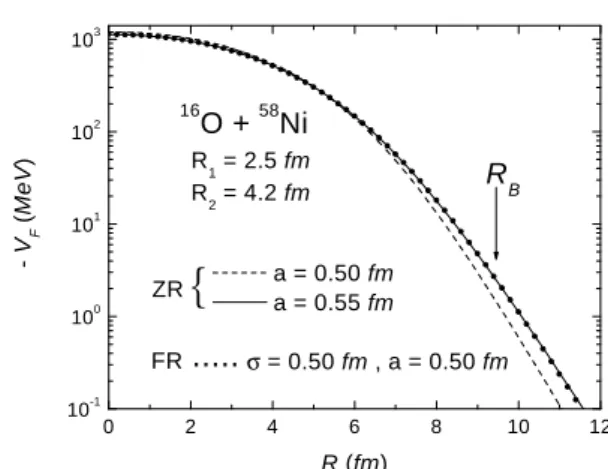
Fig. 1 shows a comparison of folding potentials in the zero-range approach (Eq. 5) with the result obtained (from Eq. 4)
using an Yukawa function for the effective nucleon-nucleon interaction. The finite range is not truly significant at small distances, and can be accurately simulated at the surface, within the zero-range approach, just by slightly increasing the diffuseness of the nuclear densities.
0 2 4 6 8 10 12
10-1
100 101 102 103
···
R
B
R1 = 2.5 fm R2 = 4.2 fm 16
O + 58Ni
FR ZR
{
-
VF
(
M
e
V
)
R (fm)
a = 0.50 fm a = 0.55 fm
σ = 0.50 fm , a = 0.50 fm
Figure 1. Double-folding potentials for 2pF distributions with dif-ferent diffuseness values (a) that may represent the16O +58Ni
system. The potentials have been calculated in the zero-range ap-proach (ZR) or with a finite-range (FR) Yukawa function for the effective nucleon-nucleon interaction.
IV
Nonlocal
description
of
the
nucleus-nucleus interaction
When dealing with nonlocal interactions, one is required to solve the following integro-differential equation
⌋
−~
2
2µ∇
2Ψ(R~) + [V
C(R) +Vpol(R, E) +ıWpol(R, E)] Ψ(R~) +
Z
U(R, ~~ R′) Ψ(R~′)d ~R′=EΨ(R~). (17)
⌈
VCis the Coulomb interaction assumed to be local.Vpoland Wpolare the real and imaginary parts of the polarization po-tential and contain the contribution arising from nonelastic channel couplings. The corresponding nonlocality, called the Feshbach nonlocality, is implicit through the energy-dependence of these terms.U(R, ~~ R′)is the bare interaction
and the nonlocality here, the Pauli nonlocality, is solely due to the Pauli exclusion principle and involves the exchange of nucleons between target and projectile.
U(R, ~~ R′) =V N L
à ~ R+R~′
2
!
1
π3/2b3e
−(|R~−R~′|/b)2 ,
(18) where b is the range of the Pauli nonlocality. Introduced in this way, the nonlocality is a correction to the local model, and in theb → 0limit Eq. 17 reduces to the usual Schr¨oedinger differential equation. The range of the non-locality can be found through b ≈ b0m0/µ [17], where
b0 = 0.85 f mis the nucleon-nucleus nonlocality
param-eter [12],m0is the nucleon mass, andµis the reduced mass
of the nucleus-nucleus system.
The relation between the nonlocal interaction and the folding potential is obtained from [6]
VN L(R) =VF(R). (19) Due to the central nature of the interaction, it is convenient to write down the usual expansion in partial waves, and the integro-differential equation can be recast into the following form [8]:
⌋
~2
2µ
d2uℓ(R)
dR2 +
·
E−VC(R)−Vpol(R, E)−ıWpol(R, E)−ℓ(ℓ+ 1)~
2
2µR2
¸
uℓ(R) =
Z ∞
0
Vℓ(R, R′)uℓ(R′)dR′. (20)
When confronting theory and experiment, one usually relies on the optical model with a local potential. This brings into light the issue of extracting from Eq. 20 a local-equivalent (LE) potential
VLE(R, E) +ıWLE(R, E) = 1
uℓ(R)
Z ∞
0
Vℓ(R, R′)uℓ(R′)dR′. (21)
⌈
The presence of the wave-function in Eq. 21 indicates that the LE potential is complex and also ℓ- and energy-dependent. For neutron-nucleus systems, the LE potential is only weaklyℓ-dependent, and an approximate relation to describe its energy-dependence has been obtained [12]. A generalization of this relation for the ion-ion case is given by [5, 6]:
VLE(R, E)≈VF(R)e−γ[E−VC(R)−VLE(R,E)], (22) withγ = µb2/2~2. The local-equivalent potential is quite
well described by Eq. 22 for anyℓvalue [8], except at very small distances (R ≈ 0) that are not probed by heavy-ion experiments. At near-barrier energies, E ≈ VC(RB) +
VLE(RB), the effect of the Pauli nonlocality is negligible andVLE(R, E)≈VF(R), but the higher the energy is, the greater is the effect. At energies about200 M eV /nucleon
the local-equivalent potential is about one order of magni-tude less intense than the corresponding folding potential
(see examples in Refs. [5, 6]).
In a classical physics framework, the exponent in Eq. 22 is related to the kinetic energy (Ek) and to the local relative speed between the nuclei (v) by
v2= 2
µEk(R) =
2
µ[E−VC(R)−VLE(R, E)] ; (23)
and Eq. 22 may be rewritten in the following form
VLE(R, E)≈VF(R)e−[m0b0v/(2 ~)]2
≈VF(R)e−4v2/c2,
(24) wherecis the speed of light. Therefore, in this context the effect of the Pauli nonlocality is equivalent to a velocity-dependent nuclear interaction (Eq. 24). Another possible interpretation is that the local-equivalent potential may be associated directly with the folding potential (Eq. 25), with an effective nucleon-nucleon interaction (Eq. 26) dependent on the relative speed (v) between the nucleons
⌋
VLE(R, E) =VF =
Z
ρ1(r1)ρ2(r2)vN N(v, ~R−r~1+r~2)d ~r1d ~r2, (25)
vN N(v, ~r) =vf(~r)e−4v
2
/c2
. (26)
⌈
V
Systematization of the nuclear
po-tential
As already mentioned, the angular distribution for elastic scattering provides an unambiguous determination of the real part of the optical potential in a region around the
this fact has allowed the determination of the potential in a wide range of near-barrier distances, RB ≤ RS ≤ RB + 2f m. With the aim of avoiding ambiguities in the potential systematization, we have selected “experimental” (extracted from elastic scattering data analyses) potential strengths at the corresponding sensitivity radii, from works in which the
RS has been determined or at least estimated. In several ar-ticles, the authors claim that their data analyses at interme-diate energies have unambiguously determined the nuclear potential in a quite extensive region of interaction distances. In such cases, we have considered potential strength “data” in steps of1f mover the whole probed region.
The experimental potential strengths represent the real part of the optical potential, which corresponds to the addi-tion of the bare and polarizaaddi-tion potentials. The contribuaddi-tion of the polarization to the optical potential depends on the particular features of the reaction channels involved in the collision, and is therefore quite system-dependent. If this contribution were very significant, it would be too difficult for one to set a global description of the heavy-ion nuclear interaction. In the present work, we neglect the real part of the polarization potential and associate the experimental po-tential strengths (VExp) with the bare interaction (VLE). The success of our findings seems to support such a hypothesis.
In analysing experimental potential results for such a wide energy range and large number of different sys-tems, we consider quite appropriate the use of system-and energy-independent quantities. We have removed the energy-dependence from the experimental potential strengths through the calculation of the corresponding fold-ing potential strengths, VF−Exp, based on Eq. 22. The system-dependence of the potential data set has then been removed with the use of the experimental reduced potential,
Vred−Exp. Fors≥0this quantity was calculated from Eq. 13, and for inner svalues we have adopted the following simple definition
Vred−Exp=V0 VF−Exp
VF−T eo
, (27)
withVF−T eo calculated through Eq. 5. The other useful quantity is the distance between surfaces:s=RS−(R1+
R2), whereRS is associated to the sensitivity radius, and the radii of the nuclei have been obtained from Eq. 4.
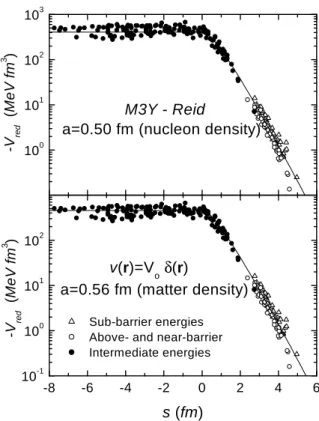
In Fig. 2 (bottom), the experimental reduced potential strengths are confronted with the theoretical prediction (Eqs. 14 and 15). The fit to the data in the inner region (s ≤ 0) results unambiguously in the valueV0=−456M eV f m3,
and is quite insensitive to the diffuseness parameter. The fit for s ≥ 0 is sensitive to both: V0 anda, and the
cor-responding best fit values area = 0.56 f mand the same
V0 found for the inner region. The standard deviation of
the data set around the best fit (solid line in Fig. 2 - bot-tom) is 25%, a value somewhat greater than the dispersion (20%) expected to arise from effects of the structure of the nuclei [8]. We believe that the remaining difference comes
from two sources: uncertainties of the experimentally ex-tracted potential strengths and the contribution of the polar-ization potential that we have neglected in our analysis. We point out that the best fit diffuseness value,a = 0.56 f m, is equal to the average diffuseness found (Section II) for the matter distributions and greater than the average value (a= 0.50f m) of the nucleon distributions. This is a con-sistent result because we have calculated the reduced po-tential strengths based on the zero-range approach (through Eqs. 5, 13 and 27). As discussed in Section III, the effect of a finite-range for the effective nucleon-nucleon interac-tion can be simulated, within the zero-range approach, by increasing the diffuseness of the (nucleon) densities of the nuclei.
100
101
102
103
-8 -6 -4 -2 0 2 4 6
10-1
100
101
102
M3Y - Reid
a=0.50 fm (nucleon density)
-V
red
(
M
e
V f
m
3 )
Sub-barrier energies Above- and near-barrier Intermediate energies
v(r)=V oδ(r)
a=0.56 fm (matter density)
-V
red
(
M
e
V f
m
3 )
s (fm)
Figure 2. Comparison between experimental and theoretical re-duced potentials in the context of the zero-range (bottom) or finite-range (top) approachs.
In order to characterize the importance of the Pauli nonlocality, we have also obtained the reduced potential strengths through calculations performed without the cor-rection (Eq. 22) due to the energy-dependence of the LE po-tential, i.e. associating the experimental potential strengths directly with the folding potential. The quality of the cor-responding fit is similar to that obtained with the nonlo-cality, but theV0andaparameters are significantly
V0 = −274 M eV f m3, seem to result in an unrealistic
nucleon-nucleon interaction.
VI
The effective nucleon-nucleon
in-teraction
After removing the energy-dependence of the experimental potential strengths, the corresponding results are compatible with the double-folding potential in the zero-range approach (Eq. 5), provided that the matter densities of the nuclei be adopted in the folding procedure instead of the nucleon den-sities. In this section, we study the consistency of our results for the nuclear potential in the case that the double-folding model is treated in the more common interpretation: the nu-cleon distributions and a finite-range nunu-cleon-nunu-cleon inter-action are assumed in Eq. 4. With the purpose of keeping the comparison between experimental and theoretical results through the use of system-independent quantities, it is nec-essary to change the definition of the experimental reduced potential
Vred−Exp=Vred−T eo VF−Exp
VF−T eo
, (28)
whereVF−T eois now calculated through Eq. 4. Vred−T eo is still obtained from Eqs. 14 and 15, with theV0
parame-ter being associated to the volume integral of the effective nucleon-nucleon interaction (actually, this same procedure has also been adopted in the zero-range case)
V0= 4π
Z
vN N(r)r2dr . (29)
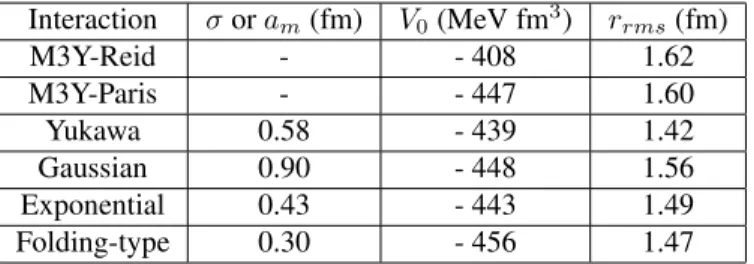
The effective nucleon-nucleon interaction should be based upon a realistic nucleon-nucleon force, since our goal is to obtain a unified description of the nucleon-nucleon, nucleon-nucleus and nucleus-nucleus scattering. A realistic interaction should match the empirical values for the volume integral and root-mean-square radius of the nucleon-nucleon interaction,V0 ≈ −430 M eV f m3andrrms ≈ 1.5 f m, that were extrapolated from the main features of the optical potential for the nucleon-nucleus scattering atEnucleon = 10M eV [1, 18, 19, 20]. The M3Y interaction has been de-rived [1] with basis on theG-matrix for two nucleons bound near the Fermi surface, and certainly is representative of realistic interactions. In table 1 are presented the volume integral and root-mean-square radius for several nucleon-nucleon interactions used in this work, including the M3Y at10M eV /nucleon.
Table 1:The width, volume integral and root-mean-square radius for several effective nucleon-nucleon interactions considered in this work.
Interaction σoram(fm) V0(MeV fm3) rrms(fm)
M3Y-Reid - - 408 1.62
M3Y-Paris - - 447 1.60
Yukawa 0.58 - 439 1.42
Gaussian 0.90 - 448 1.56
Exponential 0.43 - 443 1.49
Folding-type 0.30 - 456 1.47
The M3Y interaction is not truly appropriate for use in the context of the nonlocal model, because it already contains a simulation of the exchange effects included in its knock-on term. Furthermore, according to the nonlocal model the energy-dependence of the local-equivalent poten-tial should be related only to the finite range of the Pauli nonlocality, but the knock-on exchange term in the M3Y in-teraction is also energy-dependent. Therefore, the use of the M3Y in the nonlocal model would imply a double counting of the energy-dependence that arises from exchange effects. In Section IV, we have demonstrated that the LE potential is identical with the double-folding potential for energies near the barrier, which are in a region around 10M eV /nucleon. In this same energy range, the folding potential with the M3Y interaction have provided a very good description of elastic scattering data for several heavy-ion systems [1].
Thus, we believe that an appropriate nucleon-nucleon inter-action for the nonlocal model could be the M3Y “frozen” at10 M eV /nucleon [6], i.e. considering the parameters of the Reid and Paris versions as energy-independent val-ues. Fig. 2 (top) shows a comparison between experimental and theoretical heavy-ion reduced potentials, in which the “frozen” M3Y-Reid was considered for the nucleon-nucleon interaction. We emphasize that no adjustable parameter has been used in these calculations, but even so a good agree-ment between data and theoretical prediction has been ob-tained. The “frozen” M3Y-Paris provides similar results.
also used the Gaussian (Eq. 30) and the exponential (Eq. 31), which reduce to the tri-dimensional delta function in the limitσ→0,
Gσ(r) =V0
e−r2
/2σ2
(2π)3/2σ3 , (30)
Eσ(r) =V0
e−r/σ
8πσ3 . (31)
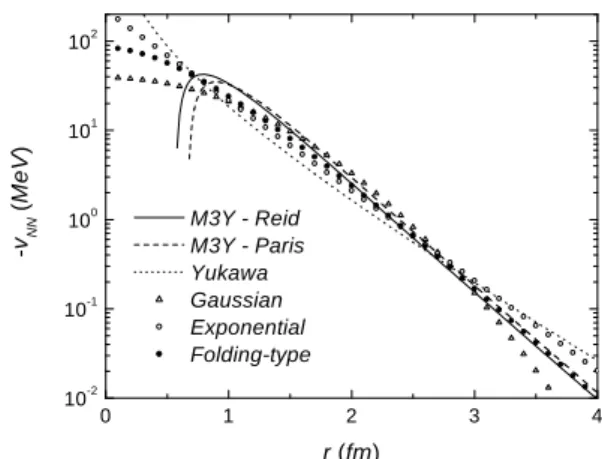
The fits to the heavy-ion potentials obtained with all these functions are of similar quality and comparable with that for the M3Y interaction. The resulting best fit widths (σ), vol-ume integrals and corresponding root-mean-square radii are found in table 1. All theV0andrrmsvalues, including those of the M3Y, are quite similar. Also the “experimentally” ex-tracted intensity of the nucleon-nucleon interaction in the region1≤r≤3f mseems to be rather independent of the model assumed for this interaction (see Fig. 3).
In Section V, we have demonstrated that the major part of the “finite-range” of the heavy-ion nuclear potential is re-lated only to the spatial extent of the nuclei. In fact, even considering a zero-range for the interactionvN N in Eq. 5, the shape of the heavy-ion potential could be well described just by folding the matter densities of the two nuclei. One
would ask whether the finite-range shape of the effective nucleon-nucleon interaction can be derived in a similar way. Thus, we have considered a folding-type effective nucleon-nucleon interaction built from:
0 1 2 3 4
10-2 10-1 100 101
102
-v
NN
(
M
e
V
)
r (fm)
M3Y - Reid M3Y - Paris Yukawa Gaussian Exponential Folding-type
Figure 3. The complete set of effective nucleon-nucleon interac-tions considered in this work.
⌋
vN N(~r)≈vf(r) = Z
ρm(r1)ρm(r2)V0δ(R~−r~1+r~2)d ~r1d ~r2=
2πV0
r
Z ∞
0
r1ρm(r1) "
Z r+r1
|r−r1|
r2ρm(r2)dr2 #
dr1,
(32) ⌈
whereV0=−456M eV f m3as determined by the
heavy-ion potential analysis, andρmis the matter density of the nucleon. Based on the intrinsic charge distribution of the proton in free space, which has been determined by elec-tron scattering experiments, we have assumed an exponen-tial shape for the matter density of the nucleon
ρm(r) =ρ0e−r/am . (33)
Of course,ρ0 andam are connected by the normalization condition of the density. The integration of Eq. 32 results in
vf(r) = V0
64π a3
m
e−r/am
µ
1 + r
am
+ r
2
3a2
m 
. (34) The folding-type and the M3Y interactions provide very similar fits of the reduced heavy-ion potential strengths. The
folding-type nucleon-nucleon interaction results in realistic volume integral and root-mean-square radius (see table 1), and it is also quite similar to both versions of the M3Y in-teraction in the surface region (see Fig. 3).
The folding-type interaction in the context of the nonlo-cal model provides a very interesting unification between the descriptions of the nucleus-nucleus, nucleon-nucleus and ef-fective nucleon-nucleon interactions. This can be appreci-ated through the comparison between Eqs. 24 and 26, with the subtle detail that VF (in Eq. 24) andvf (in Eq. 26) can both be calculated by folding the matter densities in the zero-range approach, and with the sameV0 value.
There-fore, the interaction between two nuclei (or nucleons) can be obtained from
⌋
VLE(R) = Z
ρ1(r1)ρ2(r2)V0δ(R~−r~1+r~2)e−4v
2
/c2
d ~r1d ~r2 (35)
⌈
whereV0 = −456M eV f m3,ρiare the matter densities, andvis the relative speed between the nuclei (or nucleons). All these findings seems to be quite consistent. However, the best fit value obtained for the diffuseness (am = 0.30f m)
in the EMC effect [21], but should be contrasted with the opposite picture of a smaller nucleon inside the nucleus as advanced within the concept of color transparency [22].
VII
Conclusion
The experimental potential strengths considered in the present systematics have been obtained at the correspond-ing sensitivity radii, a region where the nuclear potential is determined from the data analyses with the smallest de-gree of ambiguity. The Fermi distribution was assumed to represent the nuclear densities, with parameters consistent with an extensive amount of theoretical (DHB calculations) and experimental (electron scattering experiments) results. The potential data set is well described in the context of the nonlocal model, by the double-folding potential in the zero-range as well as in the finite-zero-range approaches. The disper-sion of the potential data around the theoretical prediction is 25%, which is compatible with the expected effects aris-ing from the variation of the densities due to the structure of the nuclei. If the nonlocal interaction is assumed, the heavy-ion potential data set seems to determine a few char-acteristics of the effective nucleon-nucleon interaction, such as volume integral and root-mean-square radius, in a model-independent way.
The description of the bare potential presented in this work is based only on two fundamental ideas: the folding model and the Pauli nonlocality. We have avoided as much as possible the use of adjustable parameters, and in the case of the “frozen” M3Y interaction no adjustable parameters were necessary to fit the experimental potential strengths. Nowadays, the other important part of the heavy-ion interac-tion, the polarization potential, is commonly treated within a phenomenological approach, with several adjustable pa-rameters which usually are energy-dependent and vary sig-nificantly from system to system. The association of the nonlocal bare potential presented in this work with a more fundamental treatment of the polarization should be the next step toward a global description of the nucleus-nucleus in-teraction.
This work was partially supported by Fundac¸˜ao de Am-paro `a Pesquisa do Estado de S˜ao Paulo (FAPESP).
References
[1] G. R. Satchler and W. G. Love, Phys. Rep.55, 183 (1979). [2] M. E. Brandan and G. R. Satchler, Phys. Rep.285, 143 (1997)
, and references therein.
[3] P. R. Christensen and A. Winther, Phys. Lett. B65, 19 (1976).
[4] C. P. Silva, M. A. G. Alvarez, L. C. Chamon, D. Pereira, M. N. Rao, E. S. Rossi Jr., L. R. Gasques, M. A. E. Santo, R. M.
Anjos, J. Lubian, P. R. S. Gomes, C. Muri, B. V. Carlson, S. Kailas, A. Chatterjee, P. Singh, A. Shivastava, K. Mahata and S. Santra, Nucl. Phys. A679, 287 (2001).
[5] M. A. C. Ribeiro, L. C. Chamon, D. Pereira, M. S. Hussein and D. Galetti, Phys. Rev. Lett.78, 3270 (1997).
[6] L. C. Chamon, D. Pereira, M. S. Hussein M. A. C. Ribeiro and D. Galetti, Phys. Rev. Lett.79, 5218 (1997).
[7] L. C. Chamon, D. Pereira and M. S. Hussein, Phys. Rev. C58, 576 (1998).
[8] L. C. Chamon, B. V. Carlson, L. R. Gasques, D. Pereira, C. De Conti, M. A. G. Alvarez, M. S. Hussein, M. A. Candido Ribeiro, E. S. Rossi Jr., C. P. Silva, Phys. Rev. C66, 014610 (2002).
[9] B. V. Carlson and D. Hirata, Phys. Rev. C62, 054310 (2000).
[10] H. De Vries, C. W. De Jager and C. De Vries, Atomic Data and Nucl. Data Tables36, 495 (1987).
[11] E. G. Nadjakov, K. P. Marinova and Y. P. Gangrsky, Atomic Data and Nucl. Data Tables56, 133 (1994).
[12] F. Perey and B. Buck, Nucl. Phys.32, 253 (1962).
[13] T. H. R. Skyrme, Philos. Mag.1, 1043 (1956).
[14] G. Ripka, Nucl. Phys.42, 75 (1963).
[15] W. Bauhoff, H. V. von Geramb and G. Palla, Phys. Rev. C27, 2466 (1983).
[16] W. E. Frahn and R. H. Lemmer, Nuovo Cimento 5, 1564 (1957).
[17] D. F, Jackson and R. C. Johnson, Phys. Lett. B49, 249 (1974).
[18] F. D. Bechetti and G. W. Greenlees, Phys. Rev.182, 1190 (1969).
[19] G. W. Greenlees, G. J. Pyle and Y. C. Yang, Phys. Rev.171, 1115 (1968).
[20] G. W. Greenlees, W. Makofske and G. J. Pyle, Phys. Rev C1, 1145 (1970).
[21] J. J. Aubert, G. Bassompierre, K. H. Becks, C. Best, E. B ¨ohm, X. de Bouard, F. W. Brasse, C. Broll, S. Brown, J. Carr, R. W. Clifft, J. H. Cobb, G. Coignet, F. Combley, G. R. Court, G. D’Agostini, W. D. Dau, J. K. Davies, Y. D´eclais, R. W. Dobinson, U. Dosselli, J. Drees, A. W. Edwards, M. Edwards, J. Favier, M. I. Ferrero, W. Flauger, E. Gabathuler, R. Gamet, J. Gayler, V. Gerhardt, C. G¨ossling, J. Haas, K. Hamacher, P. Hayman, M. Henckes, V. Korbel, U. Landgraf, M. Leenen, M. Maire, H. Minssieux, W. Mohr, H. E. Montgomery, K. Moser, R. P. Mount, P. R. Norton, J. McNicholas, A. M. Os-borne, P. Payre, C. Peroni, H. Pessard, U. Pietrzyk, M. Rith, M. Schneegans, T. Sloan, H. E. Stier, W. Stockhausen, J. M. Th´enard, J. C. Thampson, L. Urban, M. Villers, H. Wahlen, M. Whalley, D. Williams, W. S. C. Williams, J. Williamson, and S. J. Wimpenny, Phys. Lett. B123, 275 (1983).