Nuclear Structure in Nonmesonic Weak
Decay of Hypernuclei
F. Krmpoti´c
Departamento de F´ısica, Universidad Nacional de La Plata,
C. C. 67, 1900 La Plata, Argentina
and D. Tadi´c
Physics Department, University of Zagreb, 10 000 Zagreb, Croatia
Received on 30 October, 2002
A general shell model formalism for the nonmesonic weak decay of the hypernuclei has been developed. It involves a partial wave expansion of the emitted nucleon waves, preserves naturally the antisymmetrization between the escaping particles and the residual core, and contains as a particular case the weakΛ-core coupling formalism. The hypernuclei are grouped having in view theirA−1cores, that is in those with even, even-odd and even-odd-even-odd cores. It is shown that in all three cases the nuclear structure manifests itself basically through Pauli Principle, and very simple expressions are derived for the neutron and proton induced decays rates,Γn
andΓp, which does not involve the spectroscopic factors. For the strangeness-changing weakΛN → N N
transition potential we use the One-Meson-Exchange Model (OMEM), which comprises the exchange of the complete pseudoscalar and vector meson octets (π, η, K, ρ, ω, K∗). We evaluate3
H,4H,4ΛHe, 5 ΛHe,
11 B,
12 ΛC,
16 ΛO,
17 ΛO, and
28
ΛSihypernuclei, with commonly used parametrization for the OMEM, and compare the
results with the available experimental information. The calculated ratesΓN M = Γn+ Γpare consistent with
the data, but the measurements ofΓn/p= Γn/Γpare not well accounted for by the theory. It is suggested that, unless additional degrees of freedom are incorporated, the OMEM parameters should be radically modified.
I
Introduction
Hypernuclear physics adds another flavor (strangeness) to the traditional nuclear physics, and its goal is to study the behavior of hyperons (Λ,Σ,Ξ,Ω) in the nuclear environ-ments, which are now bound system of neutrons, protons and one or more hyperons. Interesting strange nuclei with strangeness S = −1are theΛ hypernuclei, in which aΛ hyperon, having a mass of1116MeV and zero charge and isospin, replaces one of the nucleons. Same as the freeΛ hy-peron, they are mostly produced via the strong interactions, i.e.,in the reaction processesπ+n→ΛK+,K−n→π−Λ
andK−p→π0Λ, by making use of the pion (π) and kaon
(K) beams. They also basically decay through the weak in-teractions, as the freeΛdoes. Yet, as it is well known and explained below, there are some very important differences in the corresponding decaying modes.
First, it should be remembered that the freeΛ hyperon decays nearly 100 % of the time by the Λ → N π weak-mesonic mode (Fig. 1):
Λ→
½
p+π− (64.1%)
n+π0 (35.7%),
Figure 1. The mesonic (nonleptonic) decay vertexHWΛN π.
with the total transition rateΓ0 π−+ Γ
0
π0 = Γ0= 2.50·10−6 eV (which corresponds to the lifetimeτ0 = 2.63·10−10
sec). For the decay at rest the energy-momentum conserva-tion implies
+MΛ=MN+ p 2 N
2MN
+pp2
π+m2π; pN ≡ pπ.
Therefore the energy released is
Q0=MΛ−MN −mπ∼= 37MeV,
and the kinetic energies and momenta in the final state are:
TN = (MΛ−MN) 2+m2
π
2MΛ
∼
= 5MeV;
Tπ = Q0−TN ∼= 32MeV,
pN ≡ pπ =
q
It is clear that the isospin is changed by∆T = 1/2and3/2 and its projection by∆MT = −1/2in the freeΛ → N π
decay. More, as
⌋ • Λ→n+π0:
|ni|π0i ≡ |1/2,−1/2i|10i= r
1
3|1/2,1; 1/2,−1/2i + r
2
3|1/2,1; 3/2,−1/2i
• Λ→p+π−:
|pi|π−i ≡ |1/2,1/2,i|1,−1i=−
r 2
3|1/2,1; 1/2,−1/2i + r
1
3|1/2,1; 3/2,−1/2i,
one sees that the above experimental data can be accounted for fairly well by neglecting the|1/2,1; 3/2,−1/2icomponents in these relations (∆T = 1/2rule). In fact, one getsΓπ−/Γπ0 = 2, while the experimental result is64.1/35.7 = 1.80.
Assuming the∆T = 1/2rule, the phenomelogical weak Hamiltonian for the process depicted in Fig. 1 can be expressed as:
HWΛN π = −iGFm2πψN(Aπ+Bπγ5)φπ·τψΛ
µ 0 1
¶
, (1)
⌈
whereGFm2π = 2.21×10⁻⁷ is the weak coupling
con-stant. The empirical constantsAπ= 1.05andBπ=−7.15,
adjusted to the observables of the freeΛdecay, determine the strengths of parity violating and parity conserving am-plitudes, respectively. The nucleon,Λ and pion fields are given byψN andψΛandφπ, respectively, while the isospin
spurion µ
0 1
¶
is included in order to enforce the em-pirical ∆T = 1/2 rule. (Note that: ψNφπ · τψΛ =
¡
ψpφπ0+
√
2ψnφπ−,
√
2ψpφπ+−ψnφπ0¢Λ).
The free Λ hyperon weak decay is radically modified in the nuclear environment because the nucleon and the hy-peron now move, respectively, in the mean fields UN and
UΛ, which come from theN N andNΛinteractions. UN
and UΛ are characterized by the single particle energies
(s.p.e.)εN andεΛand we have to differentiate between:
1.Mesonic Decay (MD): The basic process is again rep-resented by the graph shown in Fig. 1 and described by the hamiltonian (1). Yet, the energy-momentum conservation is different:
MΛ = MN −εΛ+ε↑N+
p2 A
2MA
+p
p2 π+m2π;
pA = −pπ
whereMA=AMN andpAare, respectively, the mass and
the momentum of the whole nucleus;Ais the mass number, andε↑N are the s.p.e. of the loosely bound states above the Fermi energyεF
N. They are of the order of a few MeV, while
εΛis the energy of the0s1/2state and goes from−11.7MeV
for13ΛCto−26.5MeV for208Λ P b[1]. Thus, the correspond-ing Q-values
QM =MΛ−MN−mπ+εΛ−ε↑N,
are significantly smaller thanQ0, particularly for medium
and heavy nuclei. The experimental decay rates Γπ− +
Γπ0 = ΓM ≡ΓM(Λ→N π) are of the order ofΓ0only for nuclei withA≤4, and they rapidly fall as a function of nu-clear mass. For instance, in12ΛC:Γπ0/Γ0= 0.217±0.084 andΓπ−/Γ0 = 0.052+0−0..063035. This hindrance effect, as is
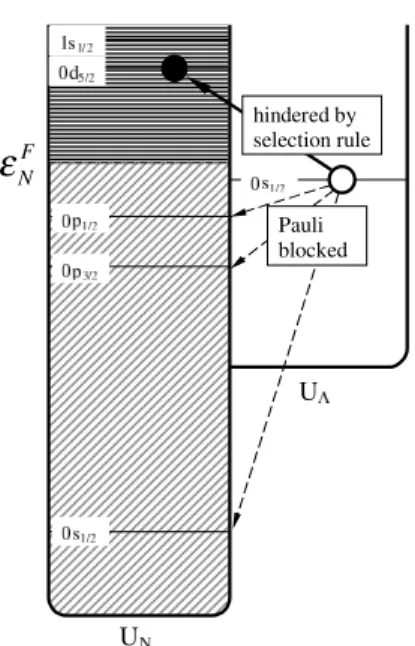
il-lustrated in Fig. 2 for the hypernucleus17ΛO, is due to Pauli principle. In fact, the population of states that are below the Fermi level, with energiesε↓N ≤ εF
N, is totally blocked by
the Pauli principle, while transitions to states that lie above
εF
N are strongly hindered due to the selection rule∆N= 0,
N being the harmonic oscillator quantum numbers. That is, only a few second forbidden transitions (∆N= 2) can occur in the case of17ΛO, and it is clear that the degree of
forbiddi-ness increases withA.
2. Nonmesonic Decay: New nonmesonic decay (NMD) channels ΛN → N N become open inside the nucleus, where there are no pions in the final state. The corre-sponding transition rates can be stimulated either by protons, Γp ≡ Γ(Λp → np), or by neutrons,Γn ≡ Γ(Λn → nn).
The energy-momentum conservation and the Q-value are, respectively:
MΛ = MN −εΛ−ε↓N+
p2 1
MN +
p2 2
MN +
p2 A
AMN;
Figure 2. Schematic picture of the hypernuclear mesonic decay in
17
ΛO: The population of occupied states0s1/2,0p3/2 and0p1/2,
which are below the Fermi levelεF
N, is totally blocked by the Pauli
principle, while transitions to the weakly bound empty states0d5/2
and1s1/2, which lie aboveεFN, are strongly hindered by the
selec-tion rule∆N= 0.
and
QN M =MΛ−MN+εΛ+ε↓N,
wherep1andp2 are the momenta of the two outgoing
nu-cleons. As the mean value ofε↓N is ∼ 30MeV one gets
thatQN M ∼120−135MeV, which is basically the kinetic
energy of the two particles that are ejected from the hyper-nucleus. This means that the nonnesonic decay process pos-sesses a large phase space in the continuum, as is outlined in Fig. 3 for the case of the hypernucleus17ΛO. The theoret-ical models reproduce fairly well the experimental values of the total widthΓN M = Γn+ Γp(ΓexpN M ∼= Γ0) but the ratio
Γn/p≡Γn/Γp(0.5≤Γexpn/p≤2) remains a puzzle.
Very often it is assumed that the hypernuclear NMD ΛN → N N is triggered via the exchange of a virtual me-son, and the obvious candidate is the one-pion-exchange (OPE) mechanism, where the strong Hamiltonian
HSN N π = igN N πψ¯Nγ5π·τψN, (2)
(with gN N π = 13.4) accompanies the weak Hamiltonian
(1). Following the pioneering investigations of Adams [12] several calculations have been done within this coupling scheme yielding: Γ(OPE)N M ∼= Γ0 andΓ(OPE)n/p ∼= 0.1−0.2 [14-39]. The importance of the ρmeson in the weak de-cay mechanism was first discussed by McKellar and Gibson [13], and the present-day consensus is, however, that the ef-fect of theρ-meson on bothΓN MandΓn/pis small [21, 23,
24, 26, 38]. The full one meson-exchange model (OMEM),
which encompasses all pseudoscalar mesons (π, η, K) and all vector mesons (ρ, ω, K∗), has been also considered by
several authors [23, 24, 33, 34, 35, 36, 38]. From these works we have learned that, although theKmeson contri-bution significantly increases the ratioΓn/p, the OMEM is
unable to account for the corresponding experimental val-ues.
Figure 3. Schematic picture of the hypernuclear nonmesonic de-cay in17ΛO: The hyperonΛand one of the nucleons from the
occu-pied states0s1/2,0p3/2and0p1/2are expelled into the large phase
space in the continuum, becoming free nucleons with momentap1
andp2.
Figure 4. The nonmesonic weak decay modeΛ +N →N+N. In the one meson exchange model a weak vertexHW is always combined with a strong vertexHS.
combined with a strong BBM coupling. The strong one is determined experimentally with some help from the SU(3) symmetry, and the involving uncertainties have been copi-ously discussed in the literature [40-43]. It is the weak BBM couplings which could become the largest source of errors. In fact, only the weakNΛπamplitude can be taken from the experiment, at the expense of neglecting the off-mass-shell corrections. All other weak BBM couplings are derived the-oretically by usingSU(3) andSU(6)w symmetries, octet
dominance, current algebra, PCAC, pole dominance, etc. [18,24,25,44-51]. Assortments of such methods have been developed and employed for a long time in weak interac-tion physics to explain the hyperon nonleptonic decays. One should also keep in mind that both the strong and weak BBM couplings, as well the meson masses, can become signifi-cantly renormalized by the nuclear environment [51].
The nuclear structure frameworks utilized in the liter-ature for the formal derivations of the NMD rates are: i) the nuclear matter, and ii) the nuclear shell model. There
are relatively few works where the second method was em-ployed, and up to quite recently all they were involved the technique of coefficients of fractional parentage, with the spectroscopic factors (SF) explicitly appearing in the expres-sions for the transition rates [19, 24, 29, 37]. At variance, Barbero et al. [38] have developed a fully general shell model formalism and have specified it for hypernuclei with odd-mass core, such as4ΛH,4ΛHe,12ΛC, and28ΛSi, were the cores are:3H,3He,11Cand27Si. Here we also discuss the hypernuclei with even-even and odd-odd number of protons and neutrons, namely5ΛHeand17ΛO, and3ΛH, and11ΛB.
II
Shell Model Formalism
The shell model framework for the NMD rates has been de-veloped in detail in Ref. [38] and here we will just sketch the main steps, employing the same notation. One starts from Fermi’s Golden Rule for the decay rate,
⌋
Γ = 2π X
SMSJFMFT MT Z
|hp1p2SMS, JFMF;T MT|V|JIMIi|2
× δ(ǫp1+ǫp2+EF− EI)
dp1
(2π)3
dp2
(2π)3, (3)
whereV is the weak hypernuclear potential, and the wave functions for the kets|p1p2SMS, JFMF;T MTiand|JIMIiare
assumed to be antisymmetrized and normalized. After performing: 1) the transformation to the relative and center of mass (c.m.) momenta,pandP, and angular momentalandL, and 2) the angular momentum couplings: l+L=λ,λ+S=J one obtains:
ΓtN =
16M3 N
π Jˆ
−2 I
X
SλlLT JJFα Z ∆αF
0
dǫqǫ(∆α F−ǫ)
×
¯ ¯ ¯ ¯ ¯ ¯
X
jNjΛ
M(pP lLλSJT;jΛjN, tN)hJI||
³
a†jNtNa†jΛtΛ´
J||J α Fi
¯ ¯ ¯ ¯ ¯ ¯
2
, (4)
whereJˆ≡√2J + 1,P = 2√MNǫ,p=pMN(∆−ǫ),∆αF =EI− EFα−2MN,tΛ=−1/2,tp= 1/2,tn=−1/2, and the
labelαgoes over all final states with the same spin and parity. Thus, that the NMD rates, in principle, depend on both: i) the nuclear structure effects through the two-particleNΛparentage coefficientshJI||
³
a†jNtNa
† jΛtΛ
´
J||JFi, and on the transition
potential via the elementary transition amplitudes
M(pP lLλSJT;jΛjN, tN) =
1
√
2[1−(−)
l+S+T]
× (pP lLλSJ;T MT =tΛ+tN|V|jΛjNJ;tΛtN). (5)
Here(· · · |V| · · ·)is the direct matrix element and the factor in front takes care of the antisymmetrization. To evaluate the nuclear matrix element one has to carry out thejj−LSrecoupling and the Moshinsky transformation [52] on the ket|jΛjNJ):
|jΛjNJ) = ˆjΛˆjN
X
λ′S′nlNL
ˆ
λ′Sˆ′
lΛ 12 jΛ
lN 12 jN
λ′ S′ J
(nlNLλ′|nΛlΛnNlNλ′)|nlNLλ′S′J), (6)
When the hyperon is assumed to be weakly coupled to theA−1core, which implies that the interaction ofΛwith core nucleons is disregarded, one has that|JIi ≡ |(JCjΛ)JIi, whereJCis the spin of the core, and gets
hJI||
³
a†jNtNa†jΛtΛ´
J||JFi = (−)
JF+J+JIJˆJˆ
I
½
JC JI jΛ
J jN JF
¾
hJC||a†jNtN||JFi. (7)
To evaluate the one-particle spectroscopic amplitudeshJC||a†jNtN||JFiwe will use the BCS approximation and, it will be assumed that the even-even, odd-even and odd-odd cores are described, respectively, as zero, one and two quasiparticle states. Correspondingly, the state|JCigoes into|BCSi,b†j1t1|BCSiand(b
† j1t1b
†
j2t2)J2|BCSi, where|BCSiis the BCS vacuum andb†j =uja†j−vjajis the quasiparticle creation operator [38]. In all three cases the NMD rate can be cast in the form:
ΓtN = X
jN
J=jN+jΛ X
J=|jN−jΛ|
v2
jNFJ(jNtN)RJ(jNtN), (8)
where
RJ(jNtN) =
16M3 N
π
Z ∆jN tN
0
dǫqǫ(∆jNtN −ǫ) X
SlLλT
M2(pP lLλSJT;jΛjN, tN), (9)
and
∆jNtN =MΛ−MN +ǫjΛtΛ+ǫjNtN. (10) The geometrical factorsFJ(jNtN)are:
1. Even-Even core:|JCi → |BCSi,
FJ(jNtN) = ˆjΛ−2Jˆ2 (11)
2. Odd-Even core:|JCi →b†j1t1|BCSi,
FJ(jNtN) = Jˆ2
j1+jN X
JF=|j1−jN| £
1 + (−)JFδ
j1jNδtNt1 ¤ ˆ
J2 F
½
j1 jN JF
J JI jΛ
¾2
. (12)
3. Odd-Odd core:|JCi →(b†j1t1b
†
j2t2)J2|BCSi,
FJ(jNtN) = δtNt1Jˆ
2Jˆ2 2
J1+j2 X
JF=|J1−j2| ˆ
JF2
j1+jN X
J1=|j1−jN| ˆ
J12
£
1 + (−)J1δ
j1jN ¤
½
JF j2 J1
j1 jN J2
¾2½
JF JI J
jΛ jN J2
¾2
+ (j1t1)↔(j2t2) (13)
It is clear that in (13)t2=−t1.
⌈
The nuclear structure manifests itself basically through the factors FJ(jNtN), which are engendered by the Pauli
principle. Their values for a few cases are given in Table 1. We would like to stress that the quantum numbersj1t1and
j2t2stand for the hyperon partners in the initial state, and
thatjN runs over all proton and neutron occupied states in
the initial nucleus. It is amazing to notice that the the last three equations are valid for any hypernucleus, which could be so light as 3ΛH or so heavy as208Λ P b. One should also add that the Eq. (8) contains the same physics as the Eq. (5)
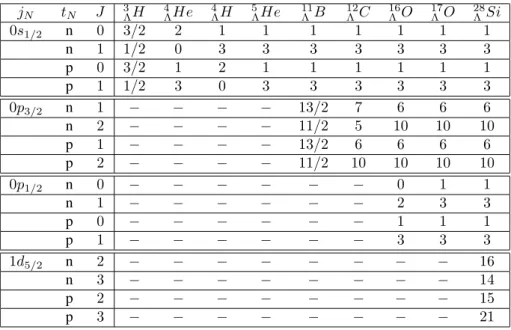
in Ref. [24] or the Eq. (30) in Ref. [37], with the advan-tage that we do not have to deal with spectroscopic factors. Of course, neither the initial and final wave functions are needed. From the results displayed in Table 1 it can be seen that in all three cases the coefficientsFJ(jNtN)are of the
Table 1. Values of(2jN + 1)FJ(jNtN). The quantum numbers(j1, t1, JI)in odd-even core nuclei are:(0s1/2,−1/2,0)for 4
ΛHe,(0s1/2,1/2,0)for4ΛH,(0p3/2,−1/2,1)for12ΛC,(0p1/2,−1/2,1)for16ΛO, and(0d5/2,−1/2,2)for28ΛSi. Similarly,
(j1, t1, j1, t1;J2JI)in odd-odd core nuclei are:(0s1/2,−1/2,0s1/2, 1/2;1,1/2) for3ΛHe, and(0p3/2,−1/2,0p3/2, 1/2;3,5/2)
for11ΛB.
jN tN J 3ΛH 4ΛHe 4ΛH 5ΛHe 11ΛB 12ΛC 16ΛO 17ΛO 28ΛSi
0s1/2 n 0 3/2 2 1 1 1 1 1 1 1
n 1 1/2 0 3 3 3 3 3 3 3
p 0 3/2 1 2 1 1 1 1 1 1
p 1 1/2 3 0 3 3 3 3 3 3
0p3/2 n 1 − − − − 13/2 7 6 6 6
n 2 − − − − 11/2 5 10 10 10
p 1 − − − − 13/2 6 6 6 6
p 2 − − − − 11/2 10 10 10 10
0p1/2 n 0 − − − − − − 0 1 1
n 1 − − − − − − 2 3 3
p 0 − − − − − − 1 1 1
p 1 − − − − − − 3 3 3
1d5/2 n 2 − − − − − − − − 16
n 3 − − − − − − − − 14
p 2 − − − − − − − − 15
p 3 − − − − − − − − 21
III
Numerical Results and Discussion
The numerical values of the parameters necessary to specify the transition potential, were taken from Ref. [24], where, in turn, the strong couplings have been taken from Refs. [39, 40] and the weak ones from Ref. [23]. The energy difference∆jNtN in (10) is evaluated from the experimen-tal single nucleon and hyperon energies. It is a general be-lief nowadays that, in any realistic evaluation of the hyper-nuclear NMD rates, the finite nucleon size (FNS) and the short range correlations (SRC) have to be included simulta-neously. Therefore, in the present paper both the FNS and SRC renormalization effects are considered, in the way de-scribed in Ref. [38]. Under these circumstances, and be-cause of the relative smallness of pion mass, the transition is dominated by the OPE [24, 38].
The numerical calculations were done in the extreme shell model, which implies that the pairing factorsvjN were taken to be equal to one (zero) for the occupied (empty) levels. Thus, from the nuclear structure point of view, the only free parameter is the harmonic oscillator length
b. We evaluate it from the relation b = 1/√~ωMN, and the oscillator energy was estimated from the relation~ω = 45A−1/3−25A−2/3MeV, which is frequently used for light
nuclei.
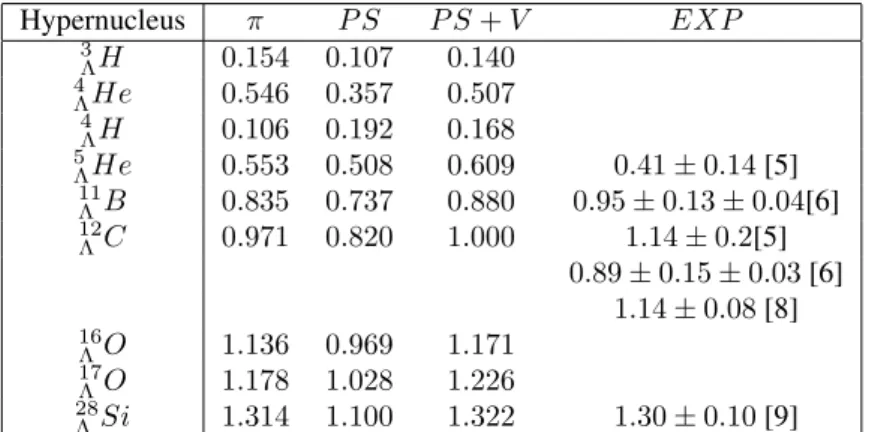
The calculations forΓN M andΓn/pare confronted the
experimental data in Tables 2 and in 3, respectively. Three different OMEM have been employed for the transition po-tential. Namely: (π) only the pion was taken into the ac-count, (P S) all three pseudoscalar mesons (π+η +K) were included, and (P S+V) also the vector (ρ+ω+K∗) mesons are considered. The same remarks are pertinent here
as in the study [38] where only12ΛChas been analyzed. That is: (1) the simple OPE model accounts for ΓN M, but it
fails badly regardingΓn/p, (2) whenη andK mesons are
included, the total transition rate is only slightly modified, while Γn/p change significantly, coming somewhat closer
to the measured values, and (3) the results are not drastically modified when all vector mesons are built-in.
IV
Summary and Conclusions
The shell model formalism for the nonmesonic weak de-cay of the hypernuclei involves a partial wave expansion of the emitted nucleon waves and preserves naturally the antisymmetrization between the escaping particles and the residual core. The general expression (4) is valid for any nuclear model and it shows that the nonmesonic transition rates should depend, in principle, on both: (i) the weak transition potential, through the elementary transition ampli-tudesM(pP lLλSJT;jΛjN, tN), and (ii) the nuclear
struc-ture, through the two-particle NΛ parentage coefficients
hJI||
³
a†jNtNa
† jΛ
´
J||JFi. The latter explicitly depend on
the initial and final wave functions. Yet, as explained in Ref. [38], and because of: a) the inclusive nature of the nonmesonic decay, and b) the peculiar properties of the co-efficientsFJ(jNtN), this dependence is washed out. In this
Table 2. Nonmesonic decay ratesΓN M in units ofΓ0= 2.50·10−6eV. The symbolsπ, PS and V stand, respectively, for the
transition potentials activated by the pion, the pseudo-scalar (π+η+K), and the vector (ρ+ω+K∗) mesons. Experimental
data are shown for comparison.
Hypernucleus π P S P S+V EXP
3
ΛH 0.154 0.107 0.140 4
ΛHe 0.546 0.357 0.507 4
ΛH 0.106 0.192 0.168 5
ΛHe 0.553 0.508 0.609 0.41±0.14[5] 11
ΛB 0.835 0.737 0.880 0.95±0.13±0.04[6] 12
ΛC 0.971 0.820 1.000 1.14±0.2[5]
0.89±0.15±0.03[6] 1.14±0.08[8]
16
ΛO 1.136 0.969 1.171 17
ΛO 1.178 1.028 1.226 28
ΛSi 1.314 1.100 1.322 1.30±0.10[9]
Table 3. Then/pratios for several hypernuclei. See the Table 2 caption.
Hypernucleus π P S P S+V EXP
3
ΛH 0.491 0.664 0.506 4
ΛH 2.996 24.60 10.43 4
ΛHe 0.108 0.045 0.061 0.25±0.13 [7] 5
ΛHe 0.160 0.539 0.320 0.93±0.55 [5]
1.97±0.67[6]
11
ΛB 0.167 0.515 0.318 1.04+0−0..5948[5]
2.16±0.58+0−0..4595[6]
12
ΛC 0.137 0.416 0.258 1.33+1−0..1281[5]
1.87±0.59+0−1..3200[6] 1.17−+00..09+008−0..2018[10] 16
ΛO 0.138 0.458 0.279 17
ΛO 0.159 0.518 0.315 28
ΛSi 0.145 0.477 0.294 1.38
+0.13+0.27 −0.11−0.25[10]
We reproduce satisfactorily the data for the total tran-sition rates with the OMEM parametrization from the lit-erature [24], but then/p-ratios are not well accounted for. Thus, after having acquired full control of the nuclear struc-ture involved in the process, and after having convinced our-selves that the nuclear structure correlations can not play a crucial role, we firmly believe that the currently used OMEM should be radically changed. Either its parametriza-tion has to be modified or addiparametriza-tional degrees of freedom have to be incorporated, such as the factorizable terms [53], the axial-vector-meson exchanges [54], or the correlated the correlated2πfrom Ref. [37].
The authors acknowledge the support of ANPCyT (Ar-gentina) under grant BID 1201/OC-AR (PICT 03-04296), of CONICET under grant PIP 463, of Fundaci´on Antor-chas (Argentina) under grant 13740/01-111, and of Croatian Ministry of Science and Technology under grant#119222. D.T. thanks the Abdus Salam ICTP Visiting Scholar pro-gramme for travel fares. F.K. is a Fellow of the CONICET Argentina. We would like to thank A.P. Gale˜ao, C. Barbero
and E. Bauer for very helpful and illuminating discussions.
References
[1] Q.N. Usmani, and A.R. Bormer, Phys. Rev. C60, 055215 (1999).
[2] A. Montwill, P. Moriarty, D. H. Davis, T. Pniewski, T. Sobczak, O. Adamovi´c, U. Krecker, G. Coremans-Bertrand, and J. Sacton, Nucl. Phys. A234, 413 (1974).
[3] K.J. Nield, T. Bowen, G. D. Cable, D. A. DeLise, E. W. Jenk-ins, R. M. Kalbach, R. C. Noggle, and A. E. Pifer Phys. Rev. C13, 1263 (1976).
Mougey, H. Nifenecker, P. Perrin, S. Polikanov, C. Ristori, and G. Tibell, Phys. Lett. B192, 312 (1987).
[5] J. J. Szymanski, P. D. Barnes, G. E. Diebold, R. A. Eisen-stein, G. B. Franklin, R. Grace, D. W. Hertzog, C. J. Maher, B. P. Quinn, R. Rieder, J. Seydoux, W. R. Wharton, S. Bart, R. E. Chrien, P. Pile, R. Sutter, Y. Xu, R. Hackenburg, E. V. Hungerford, T. Kishimoto, L. G. Tang, B. Bassalleck, and R. L. Stearns, Phys. Rev. C43, 849 (1991).
[6] H. Noumi, S. Ajimura, H. Ejiri, A. Higashi, T. Kishimoto, D. R. Gill, L. Lee, A. Olin, T. Fukuda, and O. Hashimoto, Phys. Rev. C52, 2936 (1995).
[7] V.J.Zeps, Nucl. Phys. A639261c (1998).
[8] H. Bhang, S. Ajimura, K. Aoki, T. Hasegawa, O. Hashimoto, H. Hotchi, Y. D. Kim, T. Kishimoto, K. Maeda, H. Noumi, Y. Ohta, K. Omata, H. Outa, H. Park, Y. Sato, M. Sekimoto, T. Shibata, T. Takahashi, and M. Youn, Phys. Rev. Lett.81, 4321 (1998).
[9] H. Park, H. Bhang, M. Youn, O. Hashimoto, K. Maeda, Y. Sato, T. Takahashi, K. Aoki, Y. D. Kim, H. Noumi, K. Omata, H. Outa, M. Sekimoto, T. Shibata, T. Hasegawa, H. Hotchi, Y. Ohta, S. Ajimura, and T. Kishimoto, Phys. Rev. C61, 054004 (2000).
[10] O. Hashimoto, S. Ajimura, K. Aoki, H. Bhang, T. Hasegawa, H. Hotchi, Y. D. Kim, T. Kishimoto, K. Maeda, H. Noumi, Y. Ohta, K. Omata, H. Outa, H. Park, Y. Sato, M. Sekimoto, T. Shibata, T. Takahashi, and M. Youn, Phys. Rev. Lett.88, 042503 (2002).
[11] J-H. Jun, Phys. Rev. C63, 044012 (2001);
[12] J.B. Adams, Phys. Rev.156, 1611 (1967).
[13] B. H. J. McKellar, and B. F. Gibson, Phys. Rev. C30, 322 (1984).
[14] K. Takeuchi, H. Takaki, and H. Band¯o, Prog. Theor. Phys.73 (1985) 841.
[15] D.P. Heddle and L.S. Kisslinger, Phys. Rev. C33, 608 (1986).
[16] H. Band˜o, T. Motoba, and ˇZofka, Int. J. Mod. Phys. A21 (1990) 4021.
[17] J. Cohen, Prog. Part. Nucl. Phys. 25, 139, edited by A. Faessler, (Pergamon, 1990).
[18] W.M. Alberico, A. De Pace, M. Ericson, and A. Molinari, Phys. Lett. B256, 134 (1991).
[19] A. Ramos, E. van Meijgaard, C. Bennhold, and B.K. Jen-nings, Nucl. Phys. A644, 703 (1992).
[20] A. Ramos, E. Oset, and L. L. Salcedo, Phys. Rev. C50, 2314 (1995).
[21] A. Parre˜no, A. Ramos, and E. Oset, Phys. Rev. C51, 2477 (1995).
[22] A. Parre˜no, A. Ramos, and C. Bennhold, Phys. Rev. C52, R1768 (1995): C54, 1500 (E) (1996).
[23] J. F. Dubach, G. B. Feldman, B. R. Holstein, and L. de la Torre, Ann. Phys. (N.Y.)249, 146 (1996).
[24] A. Parre˜no, A. Ramos, and C. Bennhold, Phys. Rev. C56, 339 (1997).
[25] A. Ramos, M.J. Vicente-Vacas, and E. Oset, Phys. Rev. C55, 735 (1997).
[26] E. Oset and A. Ramos, Prog. Part. Nucl. Phys.41, 191, edited by A. Faessler, (Pergamon, 1998).
[27] A. Parre˜no, A. Ramos, C. Bennhold, and K. Maltman, Phys. Lett. B435, 1 (1998).
[28] T. Inoue, M. Oka, T. Motoba, and K. Itonaga, Nucl. Phys. A633, 312 (1998).
[29] K. Itonaga, T. Ueda, T. Motoba, Nucl. Phys. A639, 329c (1998).
[30] A. Parre˜no, A. Ramos, N.G. Kelkar, and C. Bennhold, Phys. Rev. C59, 2122 (1999).
[31] W. M. Alberico and G. Garbarino, Phys. Lett. B486, 362 (2000).
[32] W. M. Alberico, A. De Pace, G. Garbarino, and A. Ramos, Phys. Rev. C61, 044314 (2000).
[33] K. Sasaki, T. Inoue, and M. Oka, Nucl. Phys. A669, 331 (2000), Erratum-ibid A678, 455 (2000).
[34] K. Sasaki, T. Inoue, and M. Oka, Nucl. Phys. A678, 455 (2000).
[35] A. Parre˜no and A. Ramos, Phys. Rev. C65, 015204 (2001); A. Parre˜no, A. Ramos, and C. Bennhold, Phys. Rev. C65, 015205 (2001)
[36] E. Oset, D. Jido, and J.E. Palomar, Nucl.Phys. A691, 146 (2001); D. Jido, E. Oset, and J.E. Palomar, Nucl.Phys. A694, 525 (2001).
[37] K. Itonaga, T. Ueda, T. Motoba, Phys. Rev. C65, 034617 (2002).
[38] C. Barbero, D. Horvat, F. Krmpoti´c, T. T. S. Kuo, Z. Naranˇci´c, and D. Tadi´c, Phys. Rev. C66, 055209 (2002).
[39] M.N. Nagels, T.A. Rijken, and J.J. de Swart, Phys. Rev. D15, 2547 (1977).
[40] P.M.M. Maessen, Th. A. Rijken. and J.J. de Swart, Phys. Rev. C40, 2226 (1989).
[41] D. Halderson, Phys. Rev. C48, 581 (1993).
[42] A. Parre˜no, A. Ramos, C. Bennhold, and D. Halderson, in Dynamical Features of Nuclei and Finite Fermi Systems, (World Scientific, Singapore, 1994) p. 318.
[43] B. Desplanques, J. Donoghue, and B. R. Holstein, Ann. Phys. (N.Y.)124, 449 (1980).
[44] R. E. Marshak, Riazuddin, and C.P. Ryan: Theory of Weak Interactions in Particle Physics, (Wiley Interscience, New York, 1969).
[45] L. de la Torre, Ph.D. thesis, University of Masschusetts, 1982.
[46] L.B. Okun: Leptons and Quarks (North Holland, Amster-dam,1982).
[47] E.D. Commins and P.H. Bucksbaum: Weak Interactions of Leptons and Quarks (Cambridge University Press, Cam-bridge, 1983).
[48] G. Nardulli, Phys. Rev. C38, 832 (1988).
[49] C. Barbero, D. Horvat, F. Krmpoti´c, Z. Naranˇci´c, and D. Tadi´c, Fizika B10, (2001) 1, and Fizika B10, (2001) 307.
[50] C. Barbero, D. Horvat, F. Krmpoti´c, Z. Naranˇci´c, M.D. Scadron, and D. Tadi´c,
Jour. Phys. G27, (2001) B21.
[51] G.E. Brown and M. Rho, Phys.Rept.363, 85 (2002).
[52] M. Moshinsky, Nucl. Phys.13, 104 (1959).
[53] E. Fischbach and D.Tadi´c Phys. Rep. C6, 125 (1973).