Article
J. Braz. Chem. Soc., Vol. 22, No. 7, 1371-1378, 2011. Printed in Brazil - ©2011 Sociedade Brasileira de Química
0103 - 5053 $6.00+0.00
A
*e-mail: [email protected]
Solid-Phase Microextraction for Determination of Anilino-Pyrimidine,
Dimethylcarbamate and Thiadiazine Pesticides in Irrigation Project Surface Water
Clóvis F. Silva Filho,a,b Elissandro S. Emídioa and Haroldo S. Dórea*,a
aDepartamento de Química, Universidade Federal de Sergipe, Av. Marechal Rondon, s/n,
Jardim Rosa Elze, 49100-000 São Cristóvão-SE, Brazil
bUniversidade Federal do Vale do São Francisco, Campus Petrolina, Av. José de Sá Maniçoba, s/n,
Centro, 56304-917 Petrolina-PE, Brazil
O objetivo deste trabalho foi desenvolver um método analítico por microextração em fase sólida (SPME) para a determinação de resíduos dos pesticidas pirimetanil, pirimicarbe e buprofezina em águas supericiais de áreas de irrigação por cromatograia a gás acoplada a espectrometria de massas (GC-MS). O método SPME foi otimizado apresentando os seguintes valores: tipo de ibra (polidimetilsiloxano, PDMS 100 µm), velocidade de agitação da amostra (900 rpm), pH 7, tempo de extração (30 min) e tempo de dessorção (7 min). A linearidade foi estabelecida na faixa de 0,1 a 4,0 µg L−1 com coeicientes de determinação (R2) > 0,991. A precisão apresentou valores
de desvio padrão relativo (RSD) < 15% para os pesticidas com limites de detecção (LOD) e quantiicação (LOQ) variando de 0,04 a 0,1 µg L−1 e 0,1 a 0,2 µg L−1, respectivamente. Amostras
de águas supericiais do Platô de Neópolis em Sergipe (Brasil) e do Distrito de Irrigação Senador Nilo Coelho de Petrolina em Pernambuco (Brasil) foram analisadas, encontrando valores para buprofezina de até 0,14 µg L−1 e pirimicarbe abaixo do limite de quantiicação. Pirimetanil não
foi detectado nas amostras.
The objective of this work was to develop a solid-phase microextraction (SPME) technique for the determination of residues of the pyrimethanil, pirimicarb and buprofezin pesticides in surface waters from irrigated areas, with analysis by gas chromatography-mass spectrometry (GC-MS). The optimized method used a 100 µm polydimethylsiloxane (PDMS) iber, agitation speed of the sample of 900 rpm and pH 7.0. Extraction and desorption times were 30 and 7 min, respectively. Linearity was achieved in the concentration range 0.1-4.0 µg L−1, and coeficients of determination
(R2) were > 0.991. Precision, expressed as relative standard deviation (RSD), was < 15%, and limits
of detection (LOD) and quantiication (LOQ) were in the ranges 0.04-0.1 µg L−1 and 0.1-0.2 µg L−1,
respectively. Surface water samples were collected from irrigated regions of the Platô de Neópolis in Sergipe State (Brazil) and from Distrito de Irrigação Senador Nilo Coelho in Pernambuco State (Brazil). Concentrations of buprofezin were < 0.14 µg L−1, while those of pirimicarb were lower
than the limit of quantiication (LOQ). Pyrimethanil was not detected in the samples.
Keywords: surface water, pyrimethanil, pirimicarb, buprofezin, SPME, GC-MS
Introduction
Pesticides are substances used in agriculture to increase the quantity and quality of produce. Their inappropriate usage can lead to contamination of both surface and subterranean hydric systems. Transfer routes of pesticides to surface waters include drainage, lateral percolation, surface and subsurface run-off, erosion, drift and volatilization.1
Brazil represents 16% of the global pesticide market, with sales of more than 780,000 tons of these materials in 2009, and occupies sixth place of the global ranking for pesticide imports, with an increase of 236% between 2000 and 2007.2 Such a situation demands the existence of control structures, as well as research to provide capacity for effective monitoring of pesticides in the environment, especially in hydric resources.
(Directive 98/83/EC) has established a value of 0.1 µg L−1 as the maximum permissible concentration for a single pesticide, and values of 0.5 µg L−1 and 1-3 µg L−1 for total pesticides in drinking water and surface waters, respectively.3 In Brazil, guidance on concentration limits in environmental waters is provided by Resolution No. 357 (2005) of the National Environment Council (CONAMA), which states maximum permissible values for several substances. However, current legislation does not encompass most of the pesticides currently in use.
It is therefore vital that research is conducted concerning those pesticides that are not yet included in the resolution, but are nonetheless intensively used in agriculture. The fact that these substances are present at trace levels in water demands the use of highly sensitive and reliable analytical techniques for their detection. In response to this need, in recent years there has been increasing interest in sample preparation techniques able to preconcentrate target analytes from the matrix, while minimizing interferences, solvent consumption and costs.
Determination of pesticides in aqueous samples is normally preceded by an extraction step and the commonest techniques employed are liquid-liquid extraction (LLE) or solid phase extraction (SPE). Solid-phase microextraction (SPME) is an attractive alternative option that has seen rapid recent growth in usage, due to the existence of a vast ield of potential applications, especially where liquid samples are involved.4 The SPME technique offers simple sample preparation, with the elimination of organic solvents minimizing waste generation and occupational exposure. It is extremely fast, versatile, low cost and provides excellent precision.5
Gas chromatography coupled with mass spectrometry (GC-MS) is an excellent analytical technique for the determination of thermally stable non-polar or moderately polar compounds, and is especially useful for the simultaneous detection of compounds possessing different chemical properties.6
The use of pyrimethanil,7,8 pirimicarb9-11 and buprofezin12,13 at environmental water were based in gas chromatography or high performance liquid chromatography coupled with mass spectrometry (GC and HPLC-MS, respectively). Sample preparation techniques were based at liquid-liquid extraction7 and solid-phase extraction,8-13 with limits of detection at µg L-1 to ng L-1 range. However, a few works was applied in analysis of the real water samples with the pesticide studies in the present work.
The objective of this work was to develop and validate a multi-target compound analytical method for the determination of three pesticides (Figure 1) belonging to different chemical groups: pyrimethanil (aniline-pyrimidine),
pirimicarb (dimethylcarbamate) and buprofezin (thiadiazine), all of them have been authorized for use by the Brazilian National Health Surveillance Agency (ANVISA). SPME was used for sample extraction and GC-MS for analysis. Samples of surface water for analysis were collected from irrigated regions of northeast Brazil.
Experimental
Reagents, standards and materials
Micropearl sodium hydroxide (Synth, Brazil), hydrochloric acid (Nuclear, São Paulo, Brazil) and sodium chloride (Reagen, Rio de Janeiro, Brazil) were all analytical grade. Acetone (Merck, Darmstadt, Germany) was HPLC grade. Ultrapure water was provided from a Milli-Q system (Millipore, Milford, MA, USA).
Stock standard solutions were prepared separately in acetone at concentrations of 100 µg mL−1 (pyrimethanil), 280 µg mL−1 (pirimicarb) and 150 µg mL−1 (buprofezin), and stored at –18 ºC. A working standard solution containing the three pesticides was prepared by dilution of the stock solutions to give inal pesticide concentrations of 10 µg L−1. This solution was used in the optimization experiments and for method validation. The physicochemical properties of the pesticides are provided in Table 1.
The solid-phase microextraction employed ibers of polydimethylsiloxane (PDMS, 7 and 100 µm), polyacrylate (PA, 85 µm) and polydimethylsiloxane/divinylbenzene (PDMS/DVB, 65 µm), all obtained from Supelco (Bellefonte, PA, USA).
SPME procedure
Aliquots of 5 mL of the aqueous samples were conditioned at pH 7 in 10 mL vials itted with silicone/Telon
N N
H3C
H3C
OCON(CH3)2
N(CH3)2
N S
N O
NC(CH3)3 CH(CH3)2 N
H N N
CH3
CH3
(2)
(3) (1)
Figure 1. Chemical structures of the pesticides: (1) pyrimethanil,
septum caps. The SPME device containing the fiber (previously conditioned at 280 oC for 30 min) was inserted through the vial septum, and the iber exposed directly (direct immersion solid-phase microextraction, DI-SPME) in the center of the sample. The sample was agitated with a magnetic stirring bar for 30 min at 900 rpm and ambient temperature (26 oC). The iber was then withdrawn into the needle, and the device immediately inserted into the chromatograph injector for desorption of the analytes (7 min at 250 oC).
Instrumentation
During optimization of the extraction method the analytical technique used was gas chromatography with lame ionization detection (GC-FID). A Shimadzu (Kyoto, Japan) Model 17A chromatograph was itted with a Supelco MDN-5 column (30 m × 0.25 mm × 0.25 µm; 5% phenyl, 95% dimethylpolysiloxane). The injector temperature was 250 ºC, and the splitless time was 2 min. The column oven temperature was initially 80 ºC, then ramped to 280 ºC at 10 ºC min−1, with a total analysis time of 20 min. The detector temperature was 300 ºC. Helium (99.995%) was used as the carrier gas at a low rate of 1.3 mL min−1 (equivalent to a linear velocity of 31.4 cm s−1). Hydrogen (99.995%) and synthetic air (99.997%) were used as the FID fuel and oxidant gases, respectively. The make-up gas was nitrogen (99.996%). The chromatograms were recorded and processed using Shimadzu GC Solutionsoftware.
A Shimadzu Model QP5050A GC-MS system was used during method validation and sample analyses. The separation column was a J&W Scientiic DB−5 (30 m × 0.25 mm × 0.25 µm; 5% phenyl, 95% dimethylpolysiloxane). Chromatographic conditions were the same as those described for the GC-FID system. The mass spectrometer detector contained a 70 eV electron ionization source and a quadrupole mass analyzer, operated
in scan mode for identiication purposes and in selected ion monitoring (SIM) mode for compound quantiication. The interface temperature was 280 oC. In the SIM mode the selected ion fragments were (m/z) 183, 198 and 199
(pyrimethanil), 72, 166 and 238 (pirimicarb), and 105, 172 and 305 (buprofezin).
Sampling
Six water samples were collected from separate irrigation tanks installed at the Platô de Neópolis fruit production project, in the municipality of Neópolis (Sergipe State, Brazil: 10°19’12”S, 36°34’46”W) on the right hand bank of the São Francisco River. The fruit produced here include mango, acerola, pineapple, papaya, passion fruit, banana, grape, ig, date, kiwi, dwarf coconut, cashew and citrus.
Four water samples were collected from different tanks or irrigation canals at the Distrito de Irrigação Senador Nilo Coelho project (Pernambuco State, Brazil: 09º14’-09º27’S, 40º50’-40º23’W), situated on the left hand bank of the São Francisco River, where the main products are mango and grape. 40 mL of sample were collected in pre-cleaned lasks at each sampling point. Samples were stored under refrigeration at 4 oC and extracted within 48 h.
Results and Discussion
Optimization of extraction parameters (DI−SPME)
Experiments to determine the best extraction procedure considered the nature of the SPME iber, sample salinity and pH, agitation speed and times of extraction and desorption. 10 µg L−1 concentrations of the pesticides were prepared in 5 mL aliquots of ultrapure water. All tests were performed in triplicate and the mean values of the GC-FID chromatogram peak areas calculated.
Table 1. Physicochemical properties of the pesticides and assessment of the risk of contamination of surface waters using the criteria of Goss
Pesticide Molar mass / (g mol−1) Class Toxicitya
Solubility in water at 20 oC /
(mg L−1)
log Kow
KH /
(Pa m3 mol−1, 25 ºC) pKa
Koc / (cm3 g−1)
DT50 soil (days) Goss
Pyrimethanil 199.11 fungicide III 121 2.84 3.60 × 10⁻³ 3.52 301 55 MPTAS/
MPTDWc
Pirimicarb 238.39 insecticide II 3100 1.7 3.30 × 10⁻⁵ 4.4 388 86 MPTAS/
HPTDWc
Buprofezin 305.44 insecticide and acaricide
III 0.46 4.93 2.8 × 10⁻² ndb 2722 50 HPTAS/
MPTDWc
Source: IUPAC;14atoxicity: II – moderately toxic; III – slightly toxic; bnd: non-dissociable; cHPTAS, MPTAS and LPTAS: high, medium and low potential
Selection of iber and extraction mode
The extraction efficiencies of the PDMS (7 and 100 µm), PA (85 µm) and PDMS/DVB (65 µm) ibers were compared in direct extraction mode using an agitation speed of 900 rpm at ambient temperature (26 ºC) and with an extraction time of 30 min. The ibers were pre-conditioned in the chromatograph injector, using the times and temperatures recommended by the manufacturer (which are speciic to each type of iber). Only the 100 µm PDMS iber showed a response for the three pesticides, with the largest signal obtained for buprofezin (Figure 2), so this iber was used in all subsequent experiments. The PA iber should be in principle the most eficient for pirimicarb, since the compound is highly soluble in water and has a low Kow compared to the other pesticides. However, iber selection cannot rely solely on the physicochemical properties of the compounds. The complex processes of adsorption/ desorption of the pesticides by the ibers are not governed only by considerations of solubility or hydrophobicity.15
The direct (DI-SPME) and headspace (HS-SPME) extraction modes were compared. The DI-SPME technique is normally more sensitive and is the method of choice for analysis of clean aqueous samples.16 The headspace mode gave no signal for the pesticides studied, which are quite involatile as shown by their low Henry’s constant (KH) values (Table 1). Hence, direct extraction using the 100 µm PDMS iber was employed in further development of the method.
Sample agitation
The quantity of analyte extracted depends on the speed with which the SPME process achieves equilibrium in
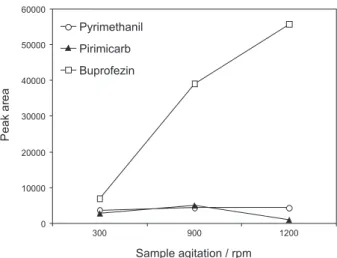
mass transfer between the aqueous phase and the iber.17 Agitation speeds of 300, 900 and 1200 rpm were tested, and the best extraction eficiency was achieved at 900 rpm (Figure 3). At higher speed there was a reduction in the extraction of pirimicarb, while pyrimethanil showed no change in extraction eficiency according to agitation speed. Buprofezin did not achieve equilibrium at speeds up to 1200 rpm, however higher speeds did not improve the extraction eficiencies of the other compounds.
Desorption time
A high temperature or a long desorption time is usually needed to ensure complete desorption of analytes extracted by the iber. The SPME method may be inluenced by carryover due to incomplete desorption, especially when the analytes have high afinity for the iber coating.18
Desorption periods between 1 and 10 min were used in order to determine the time required for complete analyte desorption at an injector temperature of 250 oC. A memory effect was observed for buprofezin (using a concentration of 10 µg mL−1). The residual amounts remaining after 5 min of desorption were less than 5%, so a desorption time of 7 min was chosen to ensure full release of the compounds.
Effect of sample pH
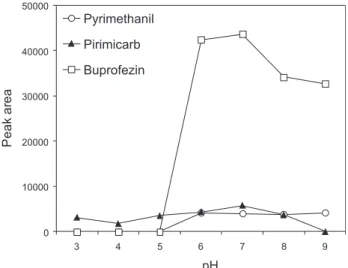
When the afinity of an adsorbent for an analyte is determined primarily by hydrophobic interactions, it can be enhanced by maintaining the analyte molecules in a non-ionized form.18 The inluence of pH (at values of 3, 4, 5, 6, 7, 8 and 9) on the eficiency of extraction of the pesticides was investigated using an extraction time of 30 min without any salt addition. For pyrimethanil and buprofezin, the extraction eficiency reduced signiicantly at acid pH, with no extraction achieved at pH ≤ 5 (Figure 4). According to its
Figure 2. Determination of extraction eficiencies (in direct mode) using
different types of SPME iber.
pKa value (Table 1), at acid pH the pyrimethanil molecule exists in ionized form, hence hindering interaction with the PDMS iber. Nakamura and Daishima19 reported that buprofezin was clearly decomposed under acidic conditions in aqueous solution.
Varying the pH between 6 and 9 produced, no noticeable change in extraction of pyrimethanil was observed, however extraction of buprofezin and pirimicarb was reduced under alkaline conditions (at pH 8 and 9). In light of these observations, an optimized pH 7 was adopted. In previous work, pyrimethanil and pirimicarb, as well as other pesticides, were extracted more eficiently at pH 7 from samples of grapes and apples.20 In a study for four organosulfur insecticides present in water, buprofezin was also found to be more readily extracted at pH 7.21
Extraction time
The inluence of extraction time (1, 5, 10, 20, 30 or 60 min) was investigated after optimization of the above described parameters. Pirimicarb and pyrimethanil reached states of equilibrium after around 10 min, while the extraction of buprofezin continued to increase even after 60 min (Figure 5). This can be explained, at least in part, by the high molar mass of buprofezin, compared to the other two pesticides (Table 1). High molecular weight compounds require longer equilibration times due to their smaller diffusion coeficients, since the time required to reach equilibrium is inversely proportional to the diffusion coeficient.22
For analytical purposes, it is not essential to reach equilibrium, however method parameters (including extraction time, agitation speed and iber position in the vial) need to be carefully controlled to avoid inaccuracies.23 An extraction time of 30 min was chosen here to provide a
good eficiency of extraction of all three pesticides without introducing unduly long analysis times.
Ionic strength
The increase of the ionic strength of the medium can increase pesticide extraction eficiency, and the salting-out effect is especially effective for highly polar compounds.24 Sodium chloride (NaCl) was added to the solutions at concentrations of 1 and 3% (m/v). None of the pesticides studied showed any signiicant increase of the extraction eficiency in the presence of NaCl, so its usage was not considered further. Higher NaCl concentrations were not employed due to possible reduction of the useful lifetimes of the ibers by formation of salt crystals on the surfaces.25 Similar conclusions have been reached in other studies.20,26
Validation of the method
After deining the optimized SPME conditions, the method was validated according to the procedure described in the Experimental section. Validation considered robustness, linearity and precision parameters and limits of detection and quantiication.
Robustness was assessed using a full 24 factorial design, with small adjustments of extraction time (29 and 31 min), desorption time (6 and 8 min), pH (6 and 8) and agitation speed (800 and 1000 rpm). A total of 18 experiments were performed, two of which were undertaken at the central point between the two levels in order to estimate experimental repeatability (Table 2). The tests were conducted in a random sequence, and the results expressed as the pesticide peak areas. The obtained Pareto diagrams showed that the alterations of the experimental parameters caused no signiicant differences in the responses, for all Figure 4. Inluence of the pH value on extraction.
three pesticides. The results obtained for buprofezin are shown in Figure 6. The method can therefore be considered to be robust with respect to the parameters examined.
The results obtained for the validation parameters are provided in Table 3. Linearity was determined in the concentration range 0.1-4.0 µg L−1, employing seven concentration levels (in duplicate). The coeficients of determination (R2) were greater than 0.991.
The method precision was measured as the repeatability obtained for the analysis of seven replicates at analyte concentrations of 0.2 µg L−1 in ultrapure water. The values obtained were 5.0% (pyrimethanil), 9.6% (buprofezin) and 14.7% (pirimicarb), which were considered satisfactory.
The detection limit was calculated as the concentration that produced a signal three times larger than the average baseline noise, measured using the sample blank. The limit of quantiication (LOQ) was deined as the lowest concentration in which the analytes could be measured with an RSD lower than 20%. The values obtained were below those required by the European Community (1-3 µg L−1) for analyses of surface waters.
Analysis of environmental samples
Assessment of the theoretical potential for the pesticides to contaminate surface waters was initially performed, using the criteria proposed by Goss.27 These criteria are based on the compound classiication into two groups, those that can be transported dissolved in water, and those that are transported associated with suspended sediment. The method considers the half-life of the compound in soil (DT50 in soil), its solubility in water and the constant of adsorption by soil organic matter (Koc). Pesticides are classiied as having high, medium or low potential for transport associated with the sediment or dissolved in water, using these physicochemical parameters.
According to the criteria of Goss (Table 1), buprofezin shows high potential for transport associated with suspended sediment (HPTAS). Pyrimethanil and pirimicarb showed medium potential for sediment-associated transport (MPTAS), which was the principle mechanism for their transport in surface waters. In the case of transport dissolved in water, buprofezin and pyrimethanil showed medium potential (MPTDW), while pirimicarb showed high potential (HPTDW).
Following validation, the method was applied in analysis of the surface water samples collected from the irrigated Table 2. Variables, levels and matrix for evaluation of robustness using
a full 24 factorial design
Variable Level
Low (−1) Central (0) High (+1) (A) Agitation speed / rpm 800 900 1000
(B) pH 6 7 8
(C) Extraction time / min 29 30 31
(D) Desorption time / min 6 7 8
Experiment A B C D
1 −1 −1 −1 −1
2 −1 −1 1 −1
3 −1 1 −1 −1
4 −1 1 1 −1
5 −1 −1 1 −1
6 1 −1 1 −1
7 −1 1 1 −1
8 1 1 1 −1
9 −1 −1 −1 1
10 1 −1 −1 1
11 −1 1 −1 1
12 1 1 −1 1
13 −1 −1 1 1
14 1 −1 1 1
15 −1 1 1 1
16 1 1 1 1
17 0 0 0 0
18 0 0 0 0
Figure 6. Factorial design Pareto diagram for assessment of the robustness of the method (for buprofezin).
Table 3. Results of validation of the proposed SPME method for the pesticides studied (n = 7)
Pesticide Linear range / (µg L−1) Linear regression equation R2 Precision / (RSD, %) LOD / (µg L−1) LOQ / (µg L−1)
Pyrimethanil 0.1-4.0 y = 529385x + 60943 0.999 5.0 0.05 0.10
Pirimicarb 0.2-4.0 y = 4426x + 8499 0.997 14.7 0.10 0.20
areas. Four within ten samples contained detectable pesticides, as shown in the obtained chromatograms (Figure 7). Buprofezin was found in two samples from Platô de Neópolis, one at a concentration of 0.14 µg L−1 and the other one below the LOQ. Pirimicarb was detected in two samples from Distrito de Irrigação Senador Nilo Coelho, at concentrations below the LOQ. Pyrimethanil was not detected in any of the analyzed samples. All the pesticide concentrations were below the European Community limit values for surface waters. The results were generally in agreement with the preliminary analysis by the method of Goss, in which buprofezin and pirimicarb were classiied as HPTAS and HPTDW, respectively.
Pyrimethanil, pirimicarb and buprofezin have been analyzed in surface waters in several earlier studies.8,26,28 The average concentrations obtained were 0.19 µg L−1 (buprofezin), 0.003 µg L−1 (pirimicarb) and 0.019 µg L−1 (pyrimethanil). Other research at Platô de Neópolis has identiied the presence of other pesticides, including methyl parathion, bifenthrin, pyraclostrobin and azoxystrobin, in surface waters of the region.16,29
Conclusions
An analytical method employing DI-SPME and GC-MS was developed for the determination of three pesticides (pyrimethanil, pirimicarb and buprofezin), belonging to different chemical classes, in agricultural irrigation waters. Optimization of the SPME extraction eficiency was shown to be crucial in improving the sensitivity of the technique. The quantiication limits achieved (0.1-0.2 µg L−1) were lower than the European Community limit values for surface waters. The presence of buprofezin and pirimicarb was detected in water samples, demonstrating that
pesticides applied in fruit plantations could contaminate surface hydric systems.
Acknowledgments
The authors thank the Banco do Nordeste do Brasil (Convênio BNB/ETENE/UFS) for financial support (process no. 2346/07-01) and the Universidade Federal do Vale do São Francisco, Petrolina Campus for enabling Clóvis Fernandes de Sá Filho to undertake postgraduate research.
References
1. Silva, D. R. O.; Avila, L. A.; Agostinetto, D.; Magro, T. D.; Oliveira, E.; Zanella, R.; Noldin, J. A.; Cienc. Rural2009, 39, 2383.
2. http://www. portal.anvisa.gov.br accessed in July 2010. 3. López-Blanco, C.; Gómez-Álvarez, S.; Rey-Garrote, M.;
Cancho-Grande, B.; Simal-Gándara, J.; Anal. Bioanal. Chem.
2006, 384, 1002.
4. Goncalves, C.; Alpendurada, M. F.; J. Chromatogr., A2002,
963, 19.
5. Costa, L. L. F.; Sant’ana, E. S.; Suchara, E. A.; Benato, V. S.; Carasek, E.; Quim. Nova2008, 31, 79.
6. Sabin, G. P.; Prestes, O. D.; Adaime, M. B.; Zanella, R.; J. Braz. Chem. Soc.2009, 20, 918.
7. Gómez, M. J.; Gómez-Ramos, M. M.; Agüera, A.; Mezcua, M.; Herrera, S.; Fernández-Alba, A. R.; J. Chromatogr., A2009, 1216, 401.
8. Rodrigues, A. M.; Ferreira, V.; Cardoso, V. V.; Ferreira, E.; Benoliel, M. J.; J. Chromatogr., A2007, 1150, 267.
9. Pitarch, E.; Portolés, T.; Marín, J. M.; Ibáñez, M.; Albarrán, F.; Hernández, F.; Anal. Bioanal. Chem. 2010, 397, 2763. 10. Mansilha, C.; Melo, A.; Rebelo, H.; Ferreira, I. M. P. L.
V. O.; Pinho, O.; Domingues, V.; Pinho, C.; Gameiro, P.; J. Chromatogr., A2010, 1217, 6681.
11. Carabias-Martínez, R.; García-Hermida, C.; Rodríguez-Gonzalo, E.; Ruano-Miguel, L.; J. Sep. Sci. 2005, 28, 2130. 12. Tanabe, A.; Kawata, K.; Bull. Environ. Contam. Toxicol.2009,
82, 705.
13. Hernández, F.; Sancho, J. V.; Pozo, O.; Lara, A.; Pitarch, E.; J. Chromatogr., A2001, 939, 1.
14. http://sitem.herts.ac.uk/aeru/iupac/index.htm accessed in July 2010.
15. Lambropoulou, D. A.; Konstantinou, I. K.; Albanis, T. A.; J. Chromatogr., A2000, 893, 143.
16. Filho, A. M.; dos Santos, F. N.; Pereira, P. A. P.; Microchem. J.
2010, 96, 139.
17. Goncalves, C.; Alpendurada, M. F.; J. Chromatogr., A2002,
968, 177.
Figure 7. Chromatograms obtained using DI-SPME/GC-MS
(A): pesticides (5 µg L−1) in ultrapure water; (B) and (C): samples
containing concentrations < LOQ and 0.14 µg L−1, respectively,
18. Pawliszyn, J.; Solid Phase Microextraction: Theory and Practice, 1st ed., Wiley-VCH: New York, 1997.
19. Nakamura, S.; Daishima, S.; Anal. Bioanal. Chem. 2005, 382, 99.
20. Amvrazi, E. G.; Tsiropoulos, N. G.; J. Chromatogr., A2009, 1216, 7630.
21. Zhao, Y. L. E.; Zhu, W.; Gao, H.; Zhou, Z.; J. Chromatogr., A
2009, 1216, 885.
22. Scheyer, A.; Morville, S.; Mirabel, P.; Millet, M.; Anal. Bioanal. Chem. 2006, 384, 475.
23. Yao, Z. W.; Jiang, G. B.; Liu, J. M.; Cheng, W.; Talanta2001, 55, 807.
24. Eisert, R.; Levsen, K.; J. Am. Soc. Mass Spectrom.1995, 6, 1119.
25. Berrada, H.; Font, G.; Molto, J. C.; J. Chromatogr., A2000, 890, 303.
26. Giordano, A.; Fernández-Franzón, M.; Ruiz, M. J.; Font, G.; Picó, Y.; Anal. Bioanal. Chem.2009, 393, 1733.
27. Goss, D.W.; Weed Technol.1992, 6, 701.
28. Planas, C.; Puig, A.; Rivera, J.; Caixach, J.; J. Chromatogr., A
2006, 1131, 242.
29. Pinheiro, A. S.; de Andrade, J. B.; Talanta2009, 79, 1354.
Submitted: September 14, 2010