(1) Universidade Federal dos Vales do Jequitinhonha e Mucuri (UFVJM); Diamantina, MG, Brasil.
Conlict of interest: non-existent
Association between neuropsychomotor development
and biological and environmental risk factors
in early childhood children
Associação entre o desenvolvimento neuropsicomotor e fatores de risco
biológico e ambientais em crianças na primeira infância
Jéssica Teixeira de Carvalho Zago(1)
Priscilla Avelino Ferreira Pinto(1)
Hércules Ribeiro Leite(1)
Juliana Nunes Santos(1)
Rosane Luzia de Souza Morais(1)
Received on: October 10, 2016 Accepted on: April 27, 2017
Mailing address:
Rosane Luzia de Souza Morais Departamento de Fisioterapia UFVJM Rodovia MGT 367 - Km 583 - nº 5000 Alto da Jacuba – Diamantina/MG CEP: 39100-000
E-mail: [email protected] [email protected]
ABSTRACT
Objective: to verify the association between infant development and biological and environmental risks. Methods: 30 children between 0-30 months, living in a town in Minas Gerais, Brazil, attending a Health
Center, were selected. The inclusion criteria were children who had a history of prematurity and/or, mode-rate to severe malnutrition and other risk factors. Their development was assessed through the Denver II test and the quality of stimulation in the home environment assessed by the Home Observation for Measurement of the Environment (HOME).
Results: 60% of the environments were considered to be at risk for child development and 43.3%
pre-sented inadequate development. The main domain affected was the language. Higher maternal education and bi-parental families showed a relationship with proper child development. Neonatal complications and hospitalization in intensive care units were more common in children who failed the test. The parents’ low receptivity and the availability of materials at home were factors associated with the children’s worst development performance.
Conclusion: the results show that the high-risk children in this study had a developmental delay,
espe-cially in the language area. These delays are associated with low maternal education, single-parent home, parents’ responsiveness and neonatal complications.
Keywords: Child Development; Child Language; Infant, Premature; Malnutrition
RESUMO
Objetivo: avaliar a associação entre o desenvolvimento infantil e riscos biológicos e ambientais. Métodos: foram selecionadas 30 crianças (0 a 30 meses), residentes em uma cidade no Vale do
Jequitinhonha, Minas Gerais, Brasil, atendidas pelo Centro Viva Vida de Referência Secundária. Os crité-rios de inclusão foram: crianças que tinham história clínica de prematuridade e/ou desnutrição moderada à grave e outros fatores neonatais de risco. As crianças foram avaliadas quanto ao desenvolvimento por meio do teste Denver II e a qualidade de estímulo no ambiente domiciliarfoi avaliada pelo Home Observation for Measurement of the Environment (HOME).
Resultados: das 30 crianças avaliadas, 60% dos ambientes foram considerados de risco para o
desen-volvimento infantil e 43,3% apresentou desendesen-volvimento inadequado. O principal domínio afetado foi o da linguagem. Maior escolaridade materna, constituição familiar biparental apresentaram associação com o adequado desenvolvimento infantil. A presença de intercorrências neonatais e necessidade de internação no centro de terapia intensiva foram mais presentes nas crianças que falharam no teste. A menor recepti-vidade dos pais e disponibilidade de materiais para aprendizagem no domicílio foram fatores associados
ao pior desempenho das crianças no Denver II.
Conclusão: as crianças de alto risco do presente estudo apresentaram atraso no desenvolvimento, espe
-cialmente no domínio linguagem. Esses atrasos estão associados à baixa escolaridade materna, à rela-ção monoparental, receptividade dos pais e intercorrências neonatais.
INTRODUCTION
Child development is a process of continuity and changes in the different domains of human behavior – motor, cognitive/language, and psychosocial – that occurs during childhood1. It is a multifaceted process in
which intrinsic factors to the child, related to its genetic inheritance, and biological factor interact with external factors, coming from the physical, social, cultural and emotional environment in which the child lives2.
Biological factors are those related to pre, peri and postnatal events, such as gestational age and/or birth
weight, possible physical deiciencies, child’s health
and nutritional status, both from the point of view of energy support, and of micronutrients3. Children who
present biological risks are considered to be at high risk and are vulnerable to developmental delays or even atypical development3.
Prematurity and malnutrition are examples of biological risk factors. They have been related to
children’s mortality and morbidity and, in some cases,
leading to neuropsychomotor developmental delay4,5.
Preterm birth is deined as the one whose gestation
ends between the 20th and 37th weeks or between 140
and 257 days after the irst day of the last menstrual
period6. According to Ramos and Cuman5 (2009),
there are numerous causes leading to a baby to be born prematurely, especially those related to the female genital tract, placental changes (placenta previa and premature detachment) and excess/decrease of
amniotic luid. In addition, there are other factors such
as maternal age, maternal infections, and primiparity. However, in most cases, the cause is unknown.
External factors are those related to the environment
in which the child lives. The family’s socioeconomic status, as well as the parents’ level of education play a
role in the quality of the home environment, in the possi-bilities of interaction between parents and children, in the routines established by the family, as well as in the affordance of resources fostering child development available at home7-9. The home environment, the irst
environment experienced by the infant in early life, has been pointed out as the main extrinsic factor that potentializes child development8.
According to the World Health Organization, inadequate cognitive stimulation, malnutrition, iodine
deiciency and iron deiciency anemia are considered
the main risk factors for changes in child devel-opment (WHO)10 in developing countries. Such risk
factors for child development are predominant in the
Jequitinhonha Valley region, which possibly predis-poses infants in this locality to greater vulnerability.
In this context, there is in the Jequitinhonha Valley the “Centro Viva Vida de Referência Secundária (CVVRS)“ (Living Life Center of Secondary Reference).
This center is part of the Government of Minas Gerais’
Viva Vida Program, which is constituted by a team with physicians, nurses, nutritionist, psychologist and social services. They receive high biological risk children, i.e., preterm babies, with low birth weight and/or who had had perinatal asphyxia, as well as those with alterations in the bloodspot test, with moderate or severe malnu-trition and/or with respiratory diseases, such as asthma and frequent pneumonia11.
Therefore, the objective of this study is to assess the neuropsychomotor development of children with biological and environmental risk, attending the CVRRS and living in the city of Diamantina, as well as verify
possible association between the family’s socio-cultural
and environmental characteristics and aspects of
children’s neuropsychomotor development.
METHODS
This is a cross-sectional study approved by the Research Ethics Committee of the Federal University of the Jequitinhonha and Mucuri Valleys under number 39495414.2.0000.5108.
The study population consisted of all children’s
records, from 0 to 30 months old, living in Diamantina-MG, attended by the Centro Viva Vida (Living Life Center Secondary Reference), with a clinical history of preterm (gestational age lower than 37 weeks) and/or clinical diagnosis of moderate to severe malnutrition (below the third percentile of the growth curve)12.
The following was considered as exclusion criteria: lack of telephone number or address for the initial
contact with the family; no location of the child’s
parents/guardians after three home visits; and the absence of the signed Free and Informed Consent Term.
Initially, 76 medical records itting the inclusion
criteria were included. Of these, 46 were excluded and, thus, 30 were the sample of the present study.
A semi-structured form was used to collect
sociode-mographic data on the child’s pre, peri and postnatal
has access and that allow to classify them in economic levels in a descending scale that goes from A to E13.
DENVER II, a developmental screening test, was used to evaluate child development. The test consists of 125 items distributed in four areas of development: personal-social (aspects of child socialization inside
and outside the family environment); ine motor (eye/
hand coordination, manipulation of small objects); language (sound production, ability to recognize, understand and use language); and gross motor (body motor control such as sitting and walking)14. During
the test, an age line is plotted on the map of assessed
items, and, according to the child’s performance,
the answers are categorized as Pass (P); Fail (F); Refusal (R), and No Opportunity (NO). Thus, caution is considered when a child does not perform or refuses to perform an activity that is already performed by 75 to 90% of children of that age. Similarly, it is considered a delay when the child does not perform or refuses to perform an activity that is already performed by more than 90% of children of the same age. The test is
classiied as (A) normal when it does not present any
item with delay and at most one single caution; (B) abnormal when presenting two or more delays; (C) suspect when presenting a delay and/or two or more
cautions; and (D) untestable according to the child’s number of refusals and the inventory14.
The Home Observation Instrument for Measurement of the Environment (HOME) was used to assess the stimulus quality in the home environment. HOME has six categories: (I) parental responsivity; (Ii) acceptance of the child; (III) organization of the environment; (IV) learning materials; (V) parental involvement; (VI) variety in experience. According to the HOME manual,
scores lower than or equal to 27 points, that is, ive
points below the reference median of the instrument, represent an environment at risk for child development.
According to the speciications of the manual15,it is also
possible from the reference medians to establish risk points for each subscale.
It should be emphasized that Denver II and HOME are international standardized instruments and, although their psychometric measures have not yet
been oficially analyzed in Brazilian children, they are
currently used in Brazil by health professionals7.
Two previously trained examiners, Physiotherapy
students, collected the data at the child’s home. The
evaluations took about 40 minutes each. The parents or guardians who accepted the invitation to participate in the study signed the free and informed consent form.
The children were divided into two normative categories, according to their performance at Denver II. Group I consisted of children with adequate devel-opment, that is, they were able to carry out the activities proposed by the items of the test, in which the line age went through it or could not perform, but they were still between 25-75%. Group II consisted of children with delay/caution, those who could not perform the activities in the items, in which 75-100% of children of the same age can. According to the test pattern, a
speciic database was created for this study in SPSS
19.0 software.
Frequency distribution of the categorical variables involved in the evaluation was carried out for the purpose of a descriptive analysis. The inferential statis-tical analysis of the data included the application of the
chi-square test, taking as reference values of p≤0.05.
RESULTS
We evaluated thirty children. 50% were male, 66.7% had a neonatal diagnosis of preterm and low birth weight infants (PTNLBW); 13.3% were preterm newborns (PTN) and 20% were low birth weight newborns (LBWN).
For preterm infants, we considered the corrected age, with the mean at the time of evaluation being 15.6 months (± 8.9 months), with a minimum of 3 and a maximum of 29 months.
As for the gestational history, 13 mothers (44.3%) had some kind of intercurrence during gestation, such as hypertension, diabetes mellitus, preeclampsia, and others.
As for the type of delivery, we found that 53.3% of the children were born by normal birth, of which 6.7% used the forceps.
As for neonatal complications, 20 neonates (66.7%) presented some type of intercurrence; 13 infants required intensive care and were hospitalized in an intensive care unit for an average of 24 days, with a minimum of 1 and a maximum of 96 (average 15 days); 3 remained on mechanical ventilation, and 4 required phototherapy.
As for the children’s family, 66.7% lived in two-parent
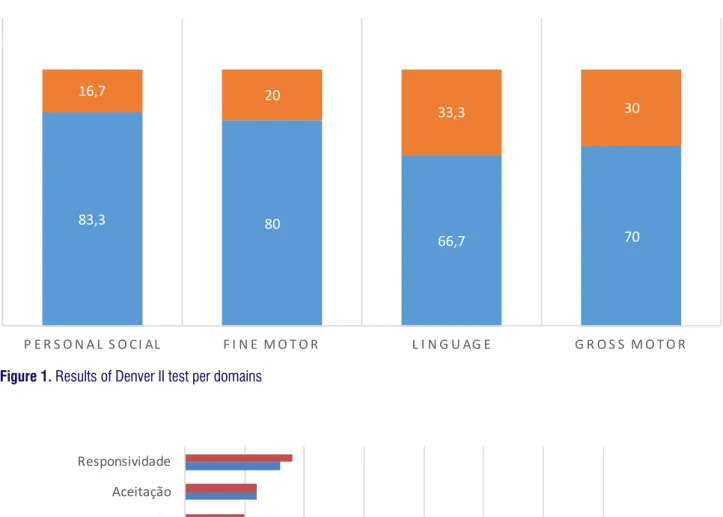
and/or delay from the domains tested in Denver II, followed by the gross motor (Figure 1).
Figure 2 shows the results of the subscales and total sum of HOME. It is observed that the results found are
almost all below the Home’s referral medians and that
60% of the family environments were considered to be at risk for child development. When the subscales are analyzed, 80% of the homes are at risk for “parental involvement” and 60% for “learning materials”.
maximum of 58 years, and only 48.1% had completed high school and/or attended higher education.
As for family economic classiication, according to
ABEP, 3 families (10%) belonged to class B1; 6 (20%) to class B2; 5 (16.7%) to class C1; 7 (23.3%) to class C2; 7 (23.3%) to class D and 2 (6.7%) to class E.
As for children’s neuropsychomotor development,
it was observed that 17 children (56.7%) had normal test results and 3 (10%) were untestable. The item of language presented the highest percentage of caution
83,3 80
66,7 70
16,7 20
33,3 30
P E R S O N A L S O C I AL F I N E M O T O R L I N G U AG E G R O S S M O T O R Adequate Caution/Delay
Figure 1. Results of Denver II test per domains
Figure 2. Medians obtained in each subscale compared to HOME reference medians
0 5 10 15 20 25 30 35
Total Variedade Envolvimento Materiais de aprendizagem Organização Aceitação Responsividade
There was an association between Denver II results and the types of families (two-parent or single-parent) (Table 2).
The association between Denver II outcomes and maternal schooling is shown in Table 1.
Table 1. Association between the domains and the overal result of Denver II test and mother’s schooling
Mother’s schooling
Up to Elementary Education Secondary Education and/or
Higher Education X2 test p value
N % N %
Denver PS Adequate 9 36 16 64 1.000 0.32
Delay/caution 3 60 2 40
Denver MF Adequate 7 29.2 17 70.8 5.868 0.01*
Delay/caution 5 83.3 1 16.7
Denver LGG Adequate 9 45 11 55 0.625 0.42
Delay/caution 3 30 7 70
Denver MG Adequate 9 42.9 12 57.1 0.238 0.62
Delay/caution 3 33.3 6 66.7
Denver Total Normal 7 41.2 10 58.8 0.023 0.88
Retest 5 38.5 8 61.5
PS = Personal social, MF = Fine Motor, LGG = Language, MG = Gross Motor. Chi-square test. *p≤0.05
Table 2. Association between the domains and the overal result of Denver II test and the family type.
Type of family
Two-parent Single-parent
X2 test p value
N % N %
Denver PS Adequate 17 68 8 32 0.120 0.72
Fail 3 60 2 40
Denver MF Adequate 16 66.7 8 33.3 0.000 1.00
Fail 4 66.7 2 33.3
Denver LGG Adequate 16 80 4 20 4.800 0.02*
Fail 4 40 6 60
Denver MG Adequate 15 71.4 6 28.6 0.714 0.39
Fail 5 55.6 4 44.4
Denver Total Normal 14 82.4 3 17.6 4.344 0.03*
Retest 6 46.2 7 53.8
There was no association between neuropsycho-motor development and socioeconomic status, as well as gestational history and maternal age.
As for neonatal complications, one or more inter-currences were considered and these presented
statistically signiicant results when associated with the
Denver II test (Table 3). However, being admitted to the
intensive care unit was not considered in this analysis. This parameter was analyzed separately and is shown in Table 4.
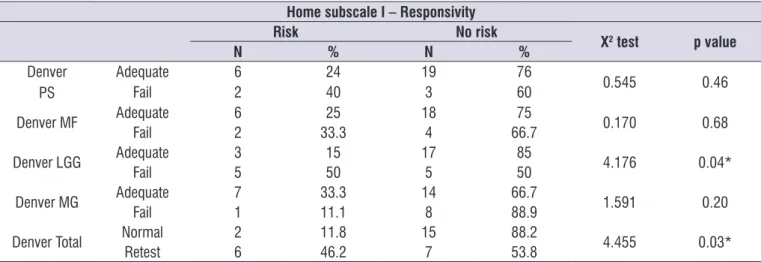
The association between Denver II and HOME
showed statistically signiicant results in subscales I
and IV. They are shown in Tables 5 and 6.
Table 3. Association between the domains and the overal result of Denver II test and the presence of neonatal complications
Neonatal complications
No Yes
X2 test p value
N % N %
Denver PS Adequate 9 36 16 64 0.480 0.48
Fail 1 20 4 80
Denver MF Adequate 8 33.3 16 66.7 0.000 1.00
Fail 2 33.3 4 66.7
Denver LGG Adequate 10 50 10 50 7.500 0.00*
Fail 0 0 10 100
Denver MG Adequate 9 42.9 12 57.1 2.857 0.09
Fail 1 11.1 8 88.9
Denver Total Normal 9 52.9 8 47.1 6.787 0.00*
Retest 1 7.7 12 92.3
PS = Personal social, MF = Fine Motor, LGG = Language, MG = Gross Motor. Chi-square test. *p≤0.05
Table 4. Association between the neuropsychomotor development and the admission at the intensive care unit
Admission at ICU
No Yes
X2 test p value
N % N %
Denver PS Adequate 14 56 11 44 0.429 0.51
Fail 2 40 3 60
Denver MF Adequate 12 50 12 50 0.536 0.46
Fail 4 66.7 2 33.3
Denver LGG Adequate 14 70 6 30 3.696 0.01*
Fail 2 20 8 80
Denver MG Adequate 13 61,9 8 38.1 2.066 0.15
Fail 3 33.3 6 66.7
Denver Total Normal 12 70.6 5 29.4 4.693 0.03*
Retest 4 30.8 9 69.2
preterm and low birth weight children using the Bayley
III scale and also found statistically signiicant changes
in language (29.3%)18. Therefore, children born with
low birth weight, preterm or another perinatal risk factor may present adequate motor development and yet present a delay in language development19-21. Thus,
since we found a great change in the language domain, we came up with some hypotheses, such as parental schooling, socioeconomic level, biparental relationship, neonatal intercurrences, as well as the environment in which these children are inserted.
The irst hypothesis is related to the socioeconomic
level, given that children who belong to economically disadvantaged families have less access to health services, nutrition, education and culture7. Although
studies indicate that the family’ socioeconomic level
Table 5. Association between Denver II and HOME Subscale I
Home subscale I – Responsivity
Risk No risk
X2 test p value
N % N %
Denver PS
Adequate 6 24 19 76
0.545 0.46
Fail 2 40 3 60
Denver MF Adequate 6 25 18 75 0.170 0.68
Fail 2 33.3 4 66.7
Denver LGG Adequate 3 15 17 85 4.176 0.04*
Fail 5 50 5 50
Denver MG Adequate 7 33.3 14 66.7 1.591 0.20
Fail 1 11.1 8 88.9
Denver Total Normal 2 11.8 15 88.2 4.455 0.03*
Retest 6 46.2 7 53.8
PS = Personal social, MF = Fine Motor, LGG = Language, MG = Gross Motor. Chi-square test. *p≤0.05
Table 6. Association between Denver II and HOME Subscale IV
HOME Subscale IV – Learning Materials
Risk No risk
X2 test p value
N % N %
Denver PS Adequate 14 56 11 44 5.250 0.02*
Fail 0 0 5 100
Denver MF Adequate 11 45.8 13 54.2 0.033 0.85
Fail 3 50 3 50
Denver LGG Adequate 12 60 8 40 4.286 0.03*
Fail 2 20 8 80
Denver MG Adequate 12 57.1 9 42.9 3.087 0.07
Fail 2 22.2 7 77.8
Denver Total Normal 11 64.7 6 35.3 5.129 0.02*
Retest 3 23.1 10 76.9
PS = Personal social, MF = Fine Motor, LGG = Language, MG = Gross Motor. Chi-square test. *p≤0.05
DISCUSSION
Neonatal context and environmental factors play an important role in a child neuropsychomotor devel-opment. Therefore, this study aimed at verifying if the neonatal intercurrences and socio-demographic factors interfere in the typical development of children who were born with some type of risk. The study results show that the development domain most associated with risk factors was the linguistic. This corroborates
with indings from the literature, in which preterm or
low birth weight children are at greater risk for delays in language development16,17.
may interfere in children development, we did not
observe signiicant associations between these two
variables in this study. Thus, it is suggested that other factors have negatively interfered in language devel-opment, as will be discussed below.
Maternal schooling signiicantly interferes with children’s neuropsychomotor development, so the
higher the schooling, the greater the protection factor for development20,22. In this context, we noticed that
the mother’s lower level of education was associated
with impaired neuropsychomotor development only
in the domain of ine adaptive motor skills. One study
reported that a high maternal schooling is related to
the children’s ine motor performance23. Thus, we
suggested that greater access to information is related to greater availability of toys and, consequently, to a
better stimulation of ine motor skills. Previous studies indicate that preterm children present signiicantly
worse performance in writing, in sensory-motor tasks, manipulative tasks, visuomotor integration, visuo-perceptive tasks and sensorial awareness when compared to children born at term24.
The single-parent family was associated, in this
study, with the child’s worst development, especially
with regard to language. The literature is emphatic
in afirming the importance of maternal and paternal
presence as predictors of typical childhood devel-opment25. In this context, we observed that children
whose mothers live with a partner in the family environment have greater stimulation and have a better language development20,26. As far as language
is concerned, the dialogical model experienced by the children in their routine gives them more interactive stimuli22. In this sense, it is possible to emphasize the
importance of family structure, especially for at-risk children.
Moreover, neonatal complications or the need for hospitalization at the intensive care unit were also more likely to atypical development, especially in the language domain. These results are supported by
previous indings, which reported that children who
underwent oxygen therapy presented central nervous system impairment27. This impairment may be explained
by the intensiication of free radical production by
oxygen therapy, which can cause diffuse hypomielin-ization, which is associated with chronic neurological damage, promoting a possible developmental delay28.
Besides these factors mentioned as determinants for the delay in child development in our study, we believe that the home environment quality was also
relevant. More than half of the home environments were considered to be at risk for child development. This was mainly due to the items “supply of learning material” and “parent involvement”. Our results are in agreement with other Brazilian studies that used the HOME test in the context of economically disadvantaged families7.
Thus, when associating the HOME subscales with the language domain in Denver II, we observed a
statis-tical signiicance in subscale I, which addresses the parents’ responsivity with the child. The results indicate
that those parents who were more communicative had children with lower risk of language delay, according to the Denver II evaluation, suggesting that the mother-child dyad plays an important role in adequate development.
The subscale IV of HOME, “learning material”,
had a statistically signiicant relationship, but inverse
to Denver II. That is, children who had language delay in the Personal Social domain and who had an
abnormal or suspect result in the Denver II test had the right toys according to HOME. However, the analysis suggests that the fact of possessing toys does not predict the typical neuropsychomotor development in these children. When studying the relationships between environment, socioeconomic level and motor development in children, the authors found that the socioeconomic level and home affordances explain a
very low percentage of children’s motor performance, suggesting that these children’s toys may not be the
most adequate29.
As limitations of this study, we can mention that Denver II is a screening test and does not have a diagnostic function, but rather indicates the need for a deeper investigation30. Also, Denver II and HOME need
studies that target their adaptations and validations in the Brazilian versions. However, given the scarcity of validated Brazilian instruments in the child development area, Denver II and HOME are instruments that have been widely used in other researches because they are fast and relatively easy to apply and provide guidance on child development 7,9,31.
CONCLUSION
Adequate neuropsychomotor development depends on intrinsic and extrinsic factors related to the child. The
indings indicate that high-risk children are more likely
the environment in which the child lives, especially
regarding the parents’ responsivity is directly related to
the typical development.
ACKNOWLEDGEMENT
We would like to express our tanks to the Fundação de Amparo à Pequisa de Minas Gerais (FAPEMIG), the employees of Centro Viva Vida de Referência Secundária, the children and families participating in the project.
REFERENCES
1. Short-DeGraff MA, Palisano RJ. Human development for occupational and physical therapists: Williams & Wilkins, 1988.
2. Engle PL, Black MM. The effect of poverty on child development and educational outcomes. Annals of the New York Academy of Sciences. 2008;1136(1):243-56.
3. Figueiras AC, Souza ICN, Rios VG, Benguigui Y. Manual para vigilância do desenvolvimento infantil no contexto da AIDPI. 2005.
4. Mansur SS, Neto F. Desenvolvimento neuropsicomotor de lactentes desnutridos. Braz J Phys Ther. 2006;10(2):185-91.
5. Ramos HÂdC, Cuman RKN. Risk factors for prematurity: document search. Escola Anna Nery. 2009;13(2):297-304.
6. Ramos J, Martins S, Valério E, Muller A, Freitas F, Magalhães J. Nascimento pré-termo. In: Freitas F, Martins SHC, Ramos JGL, Magalhães J.A, organizadores. Rotinas em obstetrícia. Porto Alegre (RS): Artmed; 2001, p. 69-80.
7. Souza Morais RL, Carvalho AM, de Castro Magalhães L,. O Contexto Ambiental e o Desenvolvimento na Primeira Infância: Estudos Brasileiros. J. Phys. Educ. 2016;27(1): 2-14.
8. Deilipo ÉC, Frônio JdS, Teixeira MTB, Leite ICG, Bastos RR, Vieira MdT, et al. Opportunities in the home environment for motor development. Rev. Saúde Pública. 2012;46(4):633-41.
9. Pinto FCA, Isotani SM, Sabatés AL, Perissinoto J. Denver II: comportamentos propostos comparados aos de crianças paulistanas. Rev. CEFAC. 2015;17(4):1262-9.
10. Walker SP, Wachs TD, Grantham-McGregor S, Black MM, Nelson CA, Huffman SL et al. Inequality in early childhood: risk and protective
factors for early child development. The Lancet. 2011;378(9799):1325-38.
11. Vida. Centro Viva de Referência Secundária. [Acesso em 30/11/2013]. Disponível em: http://
www.ufjf.br/hu/iles/2009/05/centro-viva-vida3.pdf.
12. Group WMGRS. WHO Child Growth Standards: Length/height-for-age, weightfor-age, weight-for-length, weight-for-height and body mass index-for-age: Methods and development. Geneva: World Health Organization. 2006;156.
13. Associação Brasileira de Empresas de Pesquisa
(ABEP). Critério de classiicação econômica
Brasil. 2011 [Acesso em 20/10/2011]. Disponível em: http://www.abep.org/novo/Content. aspx?ContentID=301.
14. Frankenburg WK, Dodds J, Archer P, Bresnick B, Maschka P, Edelman N, et al. Denver II: technical manual. Denver: Denver Developmental Materials; 1992.p.15.
15. Bradley RH, Caldwell BM, Corwyn RF. The child care HOME inventories: Assessing the quality of family child care homes. Early. Child. Res. Q. 2003;18(3):294-309.
16. Monteiro-Luperi TI, Bei-Lopes DM, Diniz EMA, Krebs VL, Carvalho WB. Linguistic performance in 2 years old preterm, considering chronological age and corrected age. CoDAS. 2016;28(2):118-22 17. Custódio ZAO, Crepaldi MA, Cruz RM. Development
of children born preterm evaluated by the Denver-II
test: a review of the Brazilian scientiic production. Psicol. Relex. Crit. 2012;25(2):400-6.
18. Volpiano Fernandes L, Goulart AL, Nunes dos Santos AM, Carvalho de Moraes Barros M, Campos Guerra C, Israel Kopelman B. Avaliação do neurodesenvolvimento de prematuros de muito baixo peso ao nascer entre 18 e 24 meses de idade corrigida pelas escalas Bayley III. Rev. bol. ped. 2014;53(2):94-104.
19. Caldas CSO, Takano OA, Mello PRB, Souza SCd, Zavala AAZ. Language abilities performance of children born preterm and low birth weight and associated factors. Audiol. Commun. Res. 2014;19(2):158-66.
20. Scopel RR, Souza VC, Lemos SMA. A inluência do ambiente familiar e escolar na aquisição e no desenvolvimento da linguagem: revisão de literatura. Rev. CEFAC. 2012;14(4):732-41.
prematuridade: uma revisão sistemática. R. bras. ci. Saúde. 2013;17(3):301-8.
22. Zerbeto AB, Cortelo FM, Élio Filho B. Association between gestational age and birth weight on the language development of Brazilian children: a systematic review. J. Pediatr. 2015;91(4):326-32. 23. Corsi C, Santos MM, Marques LA, Rocha NA. Impact
of extrinsic factors on ine motor performance of
children attending day care. Rev Paul Pediatr. No prelo 2016.
24. Pinheiro RC, Martinez CMS, Fontaine A. Visual motor integration and overall development of preterm and at term children at the beginning of schooling. J. Hum. Growth Dev. 2014;24(2):181-7. 25. Crestani AH, Mattana F, Moraes AB, Souza
APR. Fatores socioeconômicos, obstétricos, demográicos e psicossociais como risco
ao desenvolvimento infantil. Rev. CEFAC. 2013;15(4):847-56.
26. Hart SA, Petrill SA, DeThorne LS, Deater-Deckard K, Thompson LA, Schatschneider C, et al.
Environmental inluences on the longitudinal
covariance of expressive vocabulary: measuring the home literacy environment in a genetically sensitive design. J. Child Psychol. Psychiatry. 2009;50(8):911-9.
27. Araújo ATC, Eickmann SH, Coutinho SB. Fatores associados ao atraso do desenvolvimento motor de crianças prematuras internadas em unidade de neonatologia. Rev. Bras. Saude Mater. Infant. 2013;13(2):119-28.
28. French HM, Reid M, Mamontov P, Simmons RA, Grinspan JB. Oxidative stress disrupts oligodendrocyte maturation. J Neurosci Res.. 2009;87(14):3076-87.
29. Nascimento Junior JRA, Ferreira L, Vissoci JRN, Silva PN, Caruzzo NM, Vieira JLL. Socioeconomic level and home environment affordances: implications for infant motor performance. Rev.
educ. is/UEM 2014;25(4):651-62.
30. Moura DR, Costa JC, Santos IS, Barros AJ, Matijasevich A, Halpern R et al. Natural history of suspected developmental delay between 12 and 24 months of age in the 2004 Pelotas birth cohort. J Paediatr Child Health. 2010;46(6):329-36.
31. Celikkiran S, Bozkurt H, Coşkun M. Denver