ORIGINAL ARTICLE
Disordered eating behaviors and body image in male
athletes
Fernanda Reistenbach Goltz,
1Lucia Marques Stenzel,
2Cla´udia Dornelles Schneider
11Department of Nutrition, Universidade Federal de Cieˆncias da Sau´de de Porto Alegre (UFCSPA), Porto Alegre, RS, Brazil.2Department of
Psychology, UFCSPA, Porto Alegre, RS, Brazil.
Objective:To identify disordered eating behaviors and body image dissatisfaction, as well as their relationship to body fat (BF), among male athletes in high risk sports for eating disorders.
Methods:One hundred and fifty-six male athletes were divided into the following categories: weight-class sports, sports where leanness improves performance, and sports with aesthetic ideals. BF was assessed and three questionnaires were used: the Eating Attitudes Test; the Bulimic Investigatory Test, Edinburgh; the Body Shape Questionnaire.
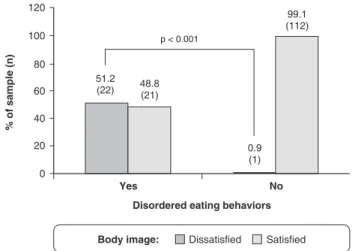
Results:Disordered eating behaviors and body image dissatisfaction were found in 43 (27.6%) and 23 athletes (14.7%), respectively, and an association was detected between the two variables (p,
0.001). Athletes with and without disordered eating behaviors did not differ in %BF (11.065.2% and 9.864.0%, respectively; p = 0.106). However, athletes with body image dissatisfaction had higher %BF than those who were satisfied (12.665.9% and 9.763.9%, respectively; p = 0.034). There were no differences in BF, frequency of disordered eating behaviors, and body image dissatisfaction between sports categories.
Conclusion: Nearly one-quarter of athletes showed disordered eating behaviors, which was associated with body image dissatisfaction. Athletes with higher %BF were more likely to be dissatisfied with body image. There was no difference in eating behavior and body image between athletes from different sports categories.
Keywords: Athletes; body composition; body image; eating behavior; eating disorders
Introduction
Achieving and maintaining the desired body shape for a sport involves eating control practices to adjust the body to the requirements and demands of competitive sports environments.1Participation in sports that require a low body fat (BF) percentage or low body weight has been described as a risk factor for the development of eating disorders. More precisely, sports that place athletes at a higher risk are: a) those in which weight classes are involved, such as wrestling; b) those in which leanness is thought to improve performance, such as long-distance running; c) those in which subjective judging and aesthetic ideals coexist, such as skating.2,3
Athletes looking for improved performance are more likely to adopt risky behaviors, such as restrictive eating, fasting, frequent skipping meals, diet pills, laxatives, diuretics, enemas, and purging. These behaviors, also including overeating and binge eating, have been extensively described in the literature by the term disordered eating. When weight concerns and such behaviors become a focus of their athletic existence, some of the athletes may be diagnosed with a clinical
eating disorder. Moreover, athletes who do not fit the ideal body type for their sport are more likely to experience both internal and external pressure to achieve that specific body shape, which may predispose them to body image dissatisfaction.1,4,5
The relationship between athletic participation and the development of eating disorders is further strengthened by athletes’ individual characteristics. These include determination, perfectionism, condescension, obsession, and competitiveness, which are common to clinical patients with eating disorders. Such personality traits can thus increase the risk of developing disordered eating behaviors and also lead to unhealthy body self-percep-tion, which are particularly concerning for athletes, given their higher physiological demands.1,6,7
The lower prevalence of eating disorders in males compared to females contributed to men being largely overlooked in previous research studies.8This gap in the
literature has even originated the belief that men were not affected by these disorders.3,7,8 The difference in preva-lence of the disorders between women and men, however, has changed significantly over the last decades. Twenty years ago, the relationship between sexes in the diagnosis of anorexia nervosa was one man for every 15 women. Currently, this ratio can reach 1:4 in the general population,9 and up to 1:2 among athletes.10In males, eating disorders
are more common among athletes, especially those whose sport requires strict weight control.8,11
Correspondence: Cla´udia Dornelles Schneider, Rua Sarmento Leite, 245/611, CEP 90050-170, Porto Alegre, RS, Brazil.
E-mail: [email protected]
Submitted Mar 15 2012, accepted Jun 17 2012.
Thus, the purpose of this study was to identify disordered eating behaviors and body image dissatisfac-tion, and their relationship to BF percentage, among male athletes in high risk sports for eating disorders.
Methods
Participants
A convenience sample of 156 male athletes from the Brazilian states of Rio Grande do Sul and Santa Catarina was divided into three categories: 52 competing in weight-class sports: jiu-jitsu, judo, karate, and rowing; 52 in sports in which leanness is thought to improve performance: athletics, swimming, triathlon, and horse racing; and 52 in sports with aesthetic ideals: ballet, dance, artistic gymnastics, and skating.
Inclusion criteria were as follows: male athletes aged 18 years or older, who competed in one of the sports described above; trained at least 5 hours a week; practiced the sport for more than 1 year; participated in at least one competition during the last year; and signed the informed consent form. We excluded athletes who practiced two or more sports that were classified into different categories and those who did not completely fill out the questionnaires.
To encourage participation in the study, athletes were informed of the opportunity to receive anthropometric results. The protocol was approved by the Research Ethics Committee of the Universidade Federal de Cieˆncias da Sau´de de Porto Alegre (protocol no. 1285/ 10, January 13, 2011).
Instruments
We used the three most widely used questionnaires in studies of self-reported eating disorders,12 in their translated and validated Brazilian Portuguese versions.
The Eating Attitudes Test (EAT-26) measures restric-tive eating behaviors, such as dieting and fasting, and bulimic behaviors, such as excessive food intake and self-induced vomiting.13,14 A score of 21 or higher indicates behaviors suggestive of abnormal eating, and was used as a threshold value to indicate disordered eating behaviors in this study.13 The EAT-26 has demonstrated adequate reliability in athlete populations in previous studies.4,15
The Bulimic Investigatory Test, Edinburgh (BITE) is used to identify subjects with binge eating and compen-satory behaviors, providing information on cognitive and behavioral aspects of bulimia nervosa.16,17 The results are classified into two subscales. In the symptoms scale, a score of 20 or higher is indicative of bulimia nervosa; 10-19 suggests an unusual eating pattern; and below 10 is within normal limits. In the severity scale, a score of 5 or higher is considered clinically significant, and 10 or higher indicates a high degree of severity.12In order to adapt the questionnaire to our study population, we excluded question 7 from Part 1 of the BITE, which referred to menstrual periods. In this study, a BITE score
of 10 or higher was considered indicative of disordered eating behaviors.
The Body Shape Questionnaire (BSQ) assesses body shape concerns, self-depreciation due to physical appearance, and the experience of feeling fat.18-20 Results are classified into four levels of body image dissatisfaction: a score below 81 indicates no dissatisfac-tion about body shape; 81-110, mild dissatisfacdissatisfac-tion; 111-140, moderate dissatisfaction; and higher than 111-140, severe dissatisfaction.21 The BSQ has demonstrated adequate reliability in the athletic population.4A score of 81 or higher in the BSQ was used to identify body image dissatisfaction among the study participants.
We considered the presence of disordered eating behaviors when observed a positive result in EAT-26 and/or in BITE scores.
Data collection
We visited several teams and sports clubs to find athletes who met all the inclusion criteria. These athletes were then invited to participate and informed about the purpose of the study and the methodology. In order to avoid reluctance to participate in the study, the researcher did not mention the word eating disorders during the approach. Data collection occurred on the day, time and place prearranged with each athlete who consented to participate.
The athletes then received an envelope containing the three questionnaires to be completed individually. They were asked not to write their names on the question-naires, which were identified by numbers known only by the researchers. The participants were ensured that their answers would be confidential and that trainers would not have access to individual results, but to aggregate results only.
Next, anthropometric measurements were taken, including body weight, height, and seven skinfold sites, as described by Jackson and Pollock in 1978.22
We used a caliper with 80 mm capacity and 1 mm precision (CescorfH, Porto Alegre, Brazil) to measure the chest, mid-axillary, triceps, subscapular, supra-iliac, abdominal, and medial thigh skinfolds. These measures were then used to estimate body density and BF percentage. Body weight was measured using a cali-brated portable digital scale with 150 kg capacity and 100 g precision (PlennaH, Sa˜o Paulo, Brazil). Height was measured with a portable stadiometer with a capacity of 2 m and 1 mm precision (SecaH, Hamburg, Germany).
Data analysis
The data was initially tested for normality using the Kolmogorov-Smirnov test. Quantitative variables were described using the mean and the standard deviation for symmetric distributions, and the median and interquartile range for asymmetric distributions. Qualitative variables were described in absolute and relative frequencies.
Associations between qualitative variables were analyzed using the Pearson’s chi-square test.
The Mann-Whitney test was used for comparisons of BF percentage between athletes with and without disordered eating behaviors, and between those with and without body image dissatisfaction. Statistical ana-lyses were performed using the SPSS 18.0 at a 0.05 significance level.
Results
The characteristics of the athletes are described in Table 1. The athletes in sports in which leanness is thought to improve performance had the highest training volume, with a median of 24.0 hours/week (25th-75th percentile, 10.1-29.5; p = 0.001) compared with the other two groups. Regarding the length of engagement in sport practice, the athletes in weight-class sports trained for longer than those in sports in which leanness is thought to improve performance (11.0 years [25th-75th percentile, 6.6-17.0] and 6.5 years [25th-75th percentile, 2.6-10.8], respectively; p = 0.017).
Of the total sample, we identified 43 athletes (27.6%) with disordered eating behaviors. The prevalence across sports categories was 30.8% in weight-class sports, 26.9% in sports in which leanness is thought to improve performance, and 25% in sports with aesthetic ideals (p = 0.799).
Body image dissatisfaction scores were identified in 23 of the athletes (14.7%). Body image dissatisfaction was found to be associated with disordered eating behaviors as shown in Figure 1.
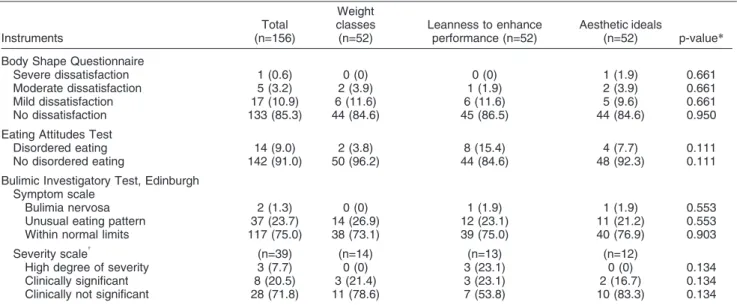
The frequency distribution of results according to the final scores on each questionnaire are shown in Table 2, indicating that there was no difference between the three sports categories.
However, when the scores for each questionnaire were analyzed across sports categories, the group of sports in which leanness is thought to improve performance had a higher EAT-26 score than the weight-class sports group (9.0 [25th-75th percentile, 6.0-14.0] and 6.0 [25th-75th percentile, 3.0-9.8], respectively; p = 0.015).
Although no significant differences were found in BF percentage between athletes with and without disordered eating behaviors (10.965.2% and 9.864.0%, respec-tively; p = 0.373), athletes with body image dissatisfaction had a higher BF percentage than those who were satisfied with their own image, as shown in Figure 2.
Discussion
In the present study, we identified disordered eating behaviors in approximately one-quarter of all participating athletes. This prevalence seems to be high, in agreement with what has been described in literature, suggesting that participation in sports which emphasize leanness, or impose weight restrictions, may be associated with an increased risk of developing disordered eating behaviors. Our findings are strongly supported by previous studies on eating disorders in the athletic population. Although lower than the prevalence found in the present study (18% vs. 30.8%), Sundgot-Borgen & Torstveit reported that athletes participating in weight-class sports had the highest prevalence of eating disorders and disordered eating behaviors.23 Johnson et al. analyzed sports with and without emphasis on leanness and found that 9.5% and 38% of male athletes were at risk of developing anorexia nervosa and bulimia nervosa, respectively.24
Milligan & Pritchard found that 9% of male athletes participating in sports with and without emphasis on leanness engaged in disordered eating behaviors.4
It is also important to highlight that the combination of systematic and strenuous physical exercises with dis-ordered eating behaviors represents a strong risk factor for future progression to serious cases.25 In our study, athletes competing in sports in which leanness is thought to improve performance had a significantly greater training load than athletes in the other two categories. Table 1 Characteristics of the athletes, mean (standard deviation)
Variables
Weight classes (n=52)
Leanness to enhance performance (n=52)
Aesthetic ideals
(n=52) p-value*
Age (years) 26.0 (7.1)a 31.7 (10.8)b 25.8 (8.9)a 0.006
Weight (kg) 77.1 (9.7)b 70.1 (11.9)a 68.9 (9.6)a
,0.001
Height (m) 1.77 (0.07)b 1.74 (0.1)a,b 1.73 (0.07)a 0.039
Body mass index (kg/m2) 24.6 (2.9)b 22.7 (2.3)a 23.0 (2.6)a 0.003
Body fat (%) 10.1 (3.7) 10.2 (5.0) 10.1 (4.4) 0.962
Values followed by the same letter do not differ by the Mann-Whitney test at the 0.05 significance level. *Kruskal-Wallis test.
More than half of the 43 athletes with disordered eating behavior scores were dissatisfied with their body image. Body image dissatisfaction has been identified as a relevant factor in the development of disordered eating behaviors in athletes of both sexes.4,5,26,27 Our results indicate that 14.7% of athletes are dissatisfied with their body image, which is lower than the prevalence of athletes with disordered eating behaviors (27.6%). Pritchard et al. found a higher prevalence of disordered eating behaviors in athletes compared with non-athletes, but no difference in body image dissatisfaction between both groups.28Similar results were reported by Byrne & McLean, who did not find differences in body image dissatisfaction between athletes and non-athletes, or between athletes in sports with and without emphasis
on leanness. Nevertheless, these authors found higher rates of eating disorders in athletes than in non-athletes, especially in sports emphasizing leanness. These results suggest that the demands of a sport to meet rigid body requirements, even in the absence of high levels of body dissatisfaction, may be sufficient to lead to the develop-ment of disordered eating behaviors.29
There was no significant difference in the classification of the results from the EAT-26, BITE, and BSQ between the three sports categories. Even though each of these categories has its specific weight or BF requirements, our results suggest that athletes in all three groups reported similar eating behaviors and body self-evaluation.
However, when the scores for each questionnaire were analyzed, the group of sports in which leanness is thought to improve performance had a higher EAT-26 score than the weight-class sports group. Despite the small differ-ence, it is important to note that athletes such as wrestlers frequently reduce their weight shortly before a competition in order to qualify for a lower weight category, and thus gain a competitive advantage over their opponents. Drastic weight fluctuations over short periods of time may commonly occur in these athletes throughout the year.3,30 It is possible, however, that the abnormal behaviors occur only in pre-competitive periods and thus, do not reflect the athletes’ regular eating patterns.10This is not the case for athletes competing in sports in which leanness is thought to improve performance. These athletes need to maintain a low body weight throughout the competitive season, and thus, may continuously engage in dietary restrictions and other risky behaviors.
Although athletes with and without disordered eating behaviors did not differ in BF percentage, athletes with body image dissatisfaction had a higher BF percentage than those who were satisfied with their own image. This result suggests that athletes with higher BF levels may feel that they do not meet the ideal body shape for their Table 2 Frequency distribution of body image dissatisfaction and disordered eating behavior, n (%)
Instruments
Total (n=156)
Weight classes (n=52)
Leanness to enhance performance (n=52)
Aesthetic ideals
(n=52) p-value*
Body Shape Questionnaire
Severe dissatisfaction 1 (0.6) 0 (0) 0 (0) 1 (1.9) 0.661
Moderate dissatisfaction 5 (3.2) 2 (3.9) 1 (1.9) 2 (3.9) 0.661
Mild dissatisfaction 17 (10.9) 6 (11.6) 6 (11.6) 5 (9.6) 0.661
No dissatisfaction 133 (85.3) 44 (84.6) 45 (86.5) 44 (84.6) 0.950
Eating Attitudes Test
Disordered eating 14 (9.0) 2 (3.8) 8 (15.4) 4 (7.7) 0.111
No disordered eating 142 (91.0) 50 (96.2) 44 (84.6) 48 (92.3) 0.111
Bulimic Investigatory Test, Edinburgh Symptom scale
Bulimia nervosa 2 (1.3) 0 (0) 1 (1.9) 1 (1.9) 0.553
Unusual eating pattern 37 (23.7) 14 (26.9) 12 (23.1) 11 (21.2) 0.553
Within normal limits 117 (75.0) 38 (73.1) 39 (75.0) 40 (76.9) 0.903
Severity scale{ (n=39) (n=14) (n=13) (n=12)
High degree of severity 3 (7.7) 0 (0) 3 (23.1) 0 (0) 0.134
Clinically significant 8 (20.5) 3 (21.4) 3 (23.1) 2 (16.7) 0.134
Clinically not significant 28 (71.8) 11 (78.6) 7 (53.8) 10 (83.3) 0.134
*Pearson’s chi-square test.
{Used when abnormal values in the symptoms scale were detected.
sport, and are therefore more prone to being dissatisfied with their body image. Body image dissatisfaction reveals that these athletes see their bodies as anything less than ideal, either being too fat or not muscular enough.4It is known that, in general, men’s preferred body image is muscular.11Given the fact that the BSQ does not provide
information focusing on a specific ideal of body image, it is not possible to know if its results indicate a desire to lose BF, gain muscle mass, or both.
Subclinical disorders are more commonly observed than diagnosable eating disorders.7Athletes and their coaches must therefore be informed about risk behaviors that precede the development of eating disorders for an early diagnosis and control, and to prevent severe cases.25 A study by Byrne & McLean, for instance, found that 5% of male athletes participating in sports emphasizing leanness met full diagnostic criteria for anorexia nervosa or bulimia nervosa.29 Another study found, however, that although 78% of athletic trainers felt it was their role to identify and help athletes with eating disorders, only 27% felt effective in doing so.31Coaches and trainers need to be vigilant about weight fluctuations and unhealthy eating habits,15 and should also understand and continuously convey that a lower BF or weight does not necessarily correlate with improved performance.3
The questionnaires used in the present study have been widely used in athletes. However, they have not been specifically tested for external validity with athletic populations, and the Brazilian Portuguese versions of these instruments have not been validated for screening athletes, which, consequently, may generate inaccurate results.32 The psychometric properties of the Brazilian Portuguese versions of these questionnaires as well as their ability to identify cases of abnormal eating behavior in our population have been questioned. For instance, Nunes et al. found that the EAT-26 showed low validity coefficients for sensitivity and positive predictive value, as well as a poor temporal stability.33 It is important to note that, although there is another available version of the questionnaire with better psychometric properties, it has been validated for adolescent girls in the city of Ribeira˜o Preto,34while the version by Nunes et al. was carried out in a representative sample of 513 women aged 12-29 years from the city of Porto Alegre, Southern Brazil.33
Moreover, self-report data rely on honest responses by participants, and thus have inherent limitations.6There is a general tendency for athletes to underreport their symptoms to protect their athletic departments, or perhaps because of denial or personal protection.3It is possible that athletes with higher levels of disordered eating behaviors and/or body image dissatisfaction chose not to participate in the study, since participation was voluntary. Despite the possibility that our findings are underestimated, the results still show significant values.
Athletes were not asked about competition periods at the time of data collection. Considering that pre-compe-titive periods may represent an increased risk for disordered eating behaviors among athletes, especially
in weight-class sports, such information could have enriched the analysis and discussion of our findings.
The instruments used in the present study do not provide a clinical diagnosis, but they can identify precursor symptoms of the disorders. For a diagnosis, athletes who presented with abnormal values in these instruments should be referred for clinical evaluation conducted by a specialist.
In summary, the three sports categories analyzed had a significant prevalence of disordered eating behaviors, which was associated with body image dissatisfaction. Athletes with a higher BF percentage are more likely to be dissatisfied with their body image, which may be related to the existence of body shape stereotypes in the sports analyzed.
Our results found no differences in eating behaviors and body image between athletes in different sports categories, thus suggesting that requirements regarding weight and body shape are similarly distributed in the sports studied.
We suggest that further research, including the assess-ment of athletes’ dietary intake and habits and information on competition periods, will provide a better understanding of the epidemiology of disordered eating behaviors and body image dissatisfaction in male athletes.
Acknowledgements
The authors thank Dr. Brian Rush for his review of this manuscript.
Disclosure
The authors report no conflicts of interest.
References
1 Sundgot-Borgen J, Torstveit MK. Aspects of disordered eating continuum in elite high-intensity sports. Scand J Med Sci Sports. 2010;20:112-21.
2 Filaire E, Rouveix M, Pannafieux C, Ferrand C. Eating attitudes, perfectionism and body-esteem of elite male judoists and cyclists. J Sports Sci Med. 2007;6:50-7.
3 Baum A. Eating disorders in the male athlete. Sports Med. 2006;36:1-6.
4 Milligan B, Pritchard M. The relationship between gender, type of sport, body dissatisfaction, self esteem and disordered eating behaviors in division I athletes. Athl Insight. 2006;8:32-46. 5 Martinsen M, Bratland-Sanda S, Eriksson AK, Sundgot-Borgen J.
Dieting to win or to be thin? A study of dieting and disordered eating among adolescent elite athletes and non-athlete controls. Br J Sports Med. 2010;44:70-6.
6 DePalma MT, Koszewski WM, Romani W, Case JG, Zuiderhof NJ, McCoy PM. Identifying college athletes at risk for pathogenic eating. Br J Sports Med. 2002;36:45-50.
7 Petrie TA, Rogers R. Extending the discussion of eating disorders to include men and athletes. J Couns Psychol. 2001;29:743-53. 8 Melin P, Arau´jo AM. [Diagnosing eating disorders in men: a clinical
challenge]. Rev Bras Psiquiatr. 2002;24:73-6.
9 Teixeira PC, Costa RF, Matsudo SMM, Corda´s TA. [Physical exercises in patients with eating disorders]. Rev Psiquiatr Clin. 2009;36:145-52.
11 Weltzin TE, Weisensel N, Franczyk D, Burnett K, Klitz C, Bean P. Eating disorders in men: update. J Mens Health Gend. 2005;2:186-93. 12 Corda´s TA, Neves JEP. Escalas de avaliac¸a˜o de transtornos
alimentares. Rev Psiquiatr Clin. 1999;26:41-7.
13 Garner DM, Olmsted MP, Bohr Y, Garfinkel PE. The eating attitudes test: psychometric features and clinical correlates. Psychol Med. 1982;12:871-8.
14 Nunes MA, Bagatini LF, Abuchaim AL, Kunz A, Ramos D, Silva JA, et al. [Eating disorders: considerations about the Eating Attitudes Test (EAT)]. Rev ABP-APAL. 1994;16:7-10.
15 Pritchard M, Rush P, Milligan B. Athletic Insight [Internet]. Risk factors for disordered eating in high school and college athletes. 2007 [cited 2012 Jan 17]. http://www.athleticinsight.com/Vol9Iss3/ EatingDisorderRiskFactors.htm
16 Henderson M, Freeman CP. A self-rating scale for bulimia. The ‘BITE’. Br J Psychiatry. 1987;150:18-24.
17 Corda´s TA, Hochgraf PB. [The ‘‘BITE’’: tool for evaluation of bulimia nervosa - Portuguese version]. J Bras Psiquiatr. 1993;42:141-4. 18 Cooper PJ, Taylor MJ, Cooper Z, Fairbum CG. The development
and validation of the body shape questionnaire. Int J Eat Disord. 1987;6:485-94.
19 Corda´s TA, Castilho S. Imagem corporal nos transtornos alimen-tares. Instrumento de avaliac¸a˜o: Body Shape Questionnaire. Psiquiatr Biol. 1994;2:17-21.
20 Di Pietro M, Silveira DX. Internal validity, dimensionality and performance of the Body Shape Questionnaire in a group of Brazilian college students. Rev Bras Psiquiatr. 2009;31:21-4. 21 Cooper PJ, Taylor MJ. Body image disturbance in bulimia nervosa.
Br J Psychiatry Suppl. 1988;32-6.
22 Jackson AS, Pollock ML. Generalized equations for predicting body density of men. Br J Nutr. 1978;40:497-504.
23 Sundgot-Borgen J, Torstveit MK. Prevalence of eating disorders in elite athletes is higher than in the general population. Clin J Sport Med. 2004;14:25-32.
24 Johnson C, Powers PS, Dick R. Athletes and eating disorders: the National Collegiate Athletic Association study. Int J Eat Disord. 1999;26:179-88.
25 Oliveira FP, Bosi MLM, Viga´rio PSV, Vieira RS. [Eating behavior and body image in athletes]. Rev Bras Med Esporte. 2003;9:348-56. 26 Torres-McGehee TM, Monsma EV, Gay JL, Minton DM,
Mady-Foster AN. Prevalence of eating disorder risk and body image distortion among National Collegiate Athletic Association Division I varsity equestrian athletes. J Athl Train. 2011;46:431-7.
27 Rosendahl J, Bormann B, Aschenbrenner K, Aschenbrenner F, Strauss B. Dieting and disordered eating in German high school athletes and non-athletes. Scand J Med Sci Sports. 2009;19:731-9. 28 Pritchard ME, Milligan B, Elgin J, Rush P, Shea M. Comparisons of risky health behaviors between male and female college athletes and non-athletes. Athl Insight. 2007;9:67-78.
29 Byrne S, McLean N. Elite athletes: effects of the pressure to be thin. J Sci Med Sport. 2002;5:80-94.
30 Kukidome T, Shirai K, Kubo J, Matsushima Y, Yanagisawa O, Homma T, et al. MRI evaluation of body composition changes in wrestlers undergoing rapid weight loss. Br J Sports Med. 2008;42:814-8. 31 Vaughan JL, King KA, Cottrell RR. Collegiate athletic trainers’
confidence in helping female athletes with eating disorders. J Athl Train. 2004;39:71-6.
32 Bonci CM, Bonci LJ, Granger LR, Johnson CL, Malina RM, Milne LW, et al. National athletic trainers’ association position statement: preventing, detecting, and managing disordered eating in athletes. J Athl Train. 2008;43:80-108.
33 Nunes MA, Camey S, Olinto MTA, Mari JJ. The validity and 4-year test-retest reliability of the Brazilian version of the Eating Attitudes Test-26. Braz J Med Biol Res. 2005;38:1655-62.