Interlocution among problem solvers
collaborating online: a case study with
prospective teachers
Marcelo A. Bairral
*, Arthur B. Powell
**Abstract
We present case studies of the discursive interactions of teams Brazilian prospective teachers to understand participation and growth in mathematical thinking through their construction of mathematical ideas and reasoning as they collaboratively solve challenging, open-ended combinatorial problems online. The findings suggest that participants’ discursive interactions fall within four interlocution properties, that interpretive and negotiatory interlocution support the development of mathematical thinking, and that deliberate attention to these properties in instructional practice may yield benefits for learners. Identifying and analyzing these two properties the researcher can obtain more information regarding prospective teachers’ development of professional knowledge, particularly, epistemological, didactic and mediation.
Key words
virtual environment; VMT-Chat; interactions; Mathematical reasoning.
*
Instituto de Educação, Programa de Pós-Graduação em Educação, Contextos Contemporâneos e Demandas Populares (PPGEduc) da Universidade Federal Rural do Rio de Janeiro (UFRRJ), Brasil. [email protected]
**
Introduction
Communicative interactions are implicit in thinking and increased understanding. Mathematics education researchers have theorized close links between communication and thinking (SFARD, 2008) and between mathematical discourse and collaborative group or social cognition (MARTIN, TOWERS et al., 2006; POWELL, 2006; STAHL, 2009a). The work of Toulmin
(1969) and Walton (1992; 2007) have been employed to understand, respectively, formal and informal mathematical argumentation (ABERDEIN, 2006; INGLIS, MEIIA-RAMOS et al., 2007; RASMUSSEN e STEPHAN, 2008;
STEPHAN e RASMUSSEN, 2002; WEBER, MAHER et al., 2008). These
investigations have concerned mathematics students in presential, classroom environments and, except for Weber, Maher, Powell, and Stohl Lee (2008), examined argumentation among advanced mathematical thinkers. Collectively, these studies have yielded insights into how such students develop mathematical arguments. Nevertheless, little research exists on how unsophisticated mathematical thinkers such as average-performing high school students or how prospective mathematics teachers engage in thoughtful mathematical discourse, particularly in online communicative environment, collaborating to solve challenging, open-ended problems. Building on previous work (BAIRRAL, POWELL et al., 2007; POWELL e LAI,
Conceptual framework
Our conceptual framework for collecting and analyzing data rests on two theoretical ideas: links between communication and thinking and interlocution. In offline as well as online environments, users express objects, relations, and other ideas graphically as text and as inscriptions, which are special instances of the more general semiotic category of signs. A sign is a human product—an utterance, gesture, or mark—by which a thought, command, or wish is expressed. As Sfard notes, “in semiotics every linguistic expression, as well as every action, thought or feeling, counts as a sign” (SFARD, 2000). A sign expresses something and, therefore, is meaningful and as such communicative, at the very least, to its producer and, perhaps, to others. Some signs are ephemeral such as unrecorded speech and gestures, while others like drawings and monuments persist. Whether ephemeral or persistent, a sign’s meaning is not static; its denotation and connotation are likely to shift over time in the course of its discursive use.
As a discursive entity, a sign is a linguistic unit that can be said to contain two, associated components. Saussure (1983) proposes that a sign is the unification of the phonic substance that we know as a “word” or signifier and the conceptual material to which it refers or signified. He conceptualizes the
or perceptual reality. Consider, for example, the signifieds cursor, mauve, and zero. They index ideas that not all linguistic communities choose to lexicalize
or represent.
Signs can be considered to represent ideas. However, Sfard (2000) argues that a sign is constitutive rather than strictly representational since meaning is not only presented in the sign but also comes into existence through it. Specifically, she states that mathematical discourse and its objects are
mutually constitutive: It is the discursive activity, including its continuous
production of symbols, that creates the need for mathematical objects; and these mathematical objects (or rather the object-mediated use of symbols) that, in turn, influence the discourse and push it into new directions (p. 47, original emphasis).
This theoretical stance on the mutually constitutive nature of meaning and sign provides a foundation for analysis of the discursive emergence of mathematical ideas, reasoning, and heuristics. On the one hand, signs can represent encoded meanings that based on previous discursive interactions interlocutors can grasp as they decode them. On the other hand, through moment-to-moment discursive interactions, interlocutors can create signs and, during communicative actions, achieve shared meanings of the signs. In this sense, the sameness of meaning for interlocutors that allows for successful communication is not something pre-existing but rather an achievement of communicative acts. Such accomplishment may compel interlocutors to bring into existence signs to further their discourse.
(2000) illustrate how learners work “in a world of inscriptions, so that, over time, the natural and inscribed worlds become mutually articulated” and the importance of a “shared history of inscription” (p. 357). In mathematics, the invention, application, and modification of appropriate symbols to express and extend ideas are constitutive activities in the history of mathematics (STRUIK, 1948/1967).
For researchers in mathematics education and in computer-supported collaborative learning, the arbitrariness of signifieds is a more significant point about Saussure’s observation concerning the arbitrariness of signs. The reason is that the conceptual material that a person (or a small group of people) lexicalizes, for example, with pencil and paper, with text in a chat window, or with drawn objects on a shared, digital workspace indicates to what that user attends, her insight into material reality that is external or internal to her mind. The inscriptions of individuals working online in a small-group or team provide observers, who must interpret meanings constituted in the inscriptions, evidence of individual and collective thinking. The small group’s inscriptions present ideas it chooses to attend and lexicalize or symbolize. By analyzing the unfolding and use of inscriptions, researchers can understand how participants constitute their mathematical ideas, reasoning, and heuristics, the meanings they attribute to their inscriptions, and how their inscriptions influence emergent meanings. As Speiser, Walter and Maher (2003) underscore, what counts as mathematical in analyzing inscriptions is not the inscription itself, which are “tools or artifacts, but rather how the students have chosen to work” (p. 22, original emphasis) with their
inscriptions.
spaces for re-presentation and revision of ideas—to access subjective sense
rather than to merely assess what has been learned” (pp. 52-53, original
emphasis). Finally, Davis posits hermeneutic listening as “more negotiatory, engaging, and messy, involving the hearer and the heard in a shared project…an imaginative participation in the formation and the transformation of experience through an ongoing interrogation of the taken-for-granted and the prejudices that frame perception and actions” (p. 53). He further describes that, in this mode of listening, a teacher participates in “the unfolding of possibilities through collective action” (p. 53, original emphasis). Martin (2001) provides evidence for how the listening patterns of a teacher can occasion opportunities for students “to construct and modify their own images in response to her interventions” (p. 251).
Both Martin (2001) and Davis (1996) inquire into teacher listening and its consequent impact on the growth of student understanding. Our study broadens this scope of inquiry as well as applies and extends Davis’s categories to analyze not just listening but rather discursive practices of learners in conversational exchanges in an online environment. Building on Davis’s theory (1996), we employ the conceptual category of interlocution to denote the discursive practices of actors in conversational exchanges, as developed by Powell (2003), to investigate the interlocution of students in presential situations to guide our inquiry into how online participants’ discursive exchanges structure their interactions and contribute to growth in their mathematical understanding. The concept of interlocution has these four interactive properties:
• Evaluative: an interlocutor maintains a non-participatory and
evaluative stance, judging statements of his or her conversational partner as either right or wrong, good or bad, useful or not.
• Informative: an interlocutor requests or announces factual data to
satisfy a doubt, a question, or a curiosity (without evidence of judgment).
• Interpretive: an interlocutor endeavors to tease out what his or her
meaning; an interlocutor engages an interlocutor to think aloud as if to discover his or her own thinking.
• Negotiatory: an interlocutor engages and negotiates with his or her conversational partner; the interlocutors are involved in a shared project; each participates in the formation and the transformation of experience through an ongoing questioning of the state of affairs that frames their perception and actions.
It is worth noting that in presential situations, when students are engaged in this category of interlocution, they are open to what Powell (2006) terms “socially emergent cognition.” That is, participants engaged in negotiatory interlocution have the potential to develop jointly mathematical ideas and reasoning that are not the a priori insight of a interlocutor but rather emerge in the discourse of the interlocutors and later is reflective of each interlocutor’s understanding.
The four properties of interlocution are neither hierarchical nor mutually exclusive; a unit of meaningful interaction may have more than one interlocutory property. Interlocution as a conceptual category in our research enables us to track the participation, changes in understanding, and autonomy of learners in their construction of mathematical ideas and reasoning. Moreover, as researchers, we have found that tracking interlocution allow us to analyze how conversational partners exchange meanings, ideas, and concepts, which, for us, are indicators of collaboration on the given mathematical task.
The tasks that we use provide opportunities for decision-making, which becomes an invitation for collaboration. Similar to characteristics of rich mathematical tasks that Lo and Gaddis (2010) identify, characteristics of tasks that we use include the following:
1. Accessible
2. Connect with prior mathematical knowledge
3. Encourage connections among different mathematical ideas 4. Admit multiple ways to solve and solutions
When research participants engage with tasks with these characteristics, particularly, in virtual environments, the data generated tend to allow researchers to analyze in detail the development of mathematical ideas and reasoning through participants’ inscriptions and interlocution.
We believe that technological mediation—through ICT—has a crucial influence on the comprehensive development of domains of Professional Content Knowledge (PCK). In this study we consider three intertwined domains in the PCK of the prospective teachers: epistemological, mediation and didactic. These domains are summarized in the following table.
Epistemological Mediation Didactic •Base mathematics
teaching on the mental powers of learners (Gattegno, 1987). •Discussing objects and relations among them.
•Motivation regarding ICT. •The use of different representations (writing, inscriptions, etc.) to form and exchange
mathematical ideas and reasoning.
•Posing and solving problems.
•Challenging tasks to promote communication and collaborative work.
We build on this to track properties of interlocution, which allow researchers to investigate different ideas and reasoning that emerge in specific sequences of chat interactions.
Research context and data source
The data come from an ongoing research project, eMath now in its sixth
year, a collaborative project among researchers in United States and Brazil1,
conducted among prospective teachers and among students in public and private secondary schools in working- and middle-class, suburban and urban districts. Overall, our longitudinal study aims to contribute basic scientific understanding of cognitive behaviors as well as pedagogical conditions for which mathematics learning occurs as a process of sense making in online environments. For this case study, data come from Brazilian prospective
1
teachers from Juiz de Fora in Minas Gerais, who engaged combinatorial tasks in an online communication portal—Virtual Math Teams (VMT)—developed with support from the National Science Foundations in the USA by researchers at Drexel University (STAHL, 2009b). The participants only communicated among themselves in a VMT chat room, working in seven teams of four and had no prior experience with the type of task proposed. Researchers were present in each team and followed the interactions of each team without any interventions and used logged interactions of each team as the source of data and considered each team as a unit of analysis.
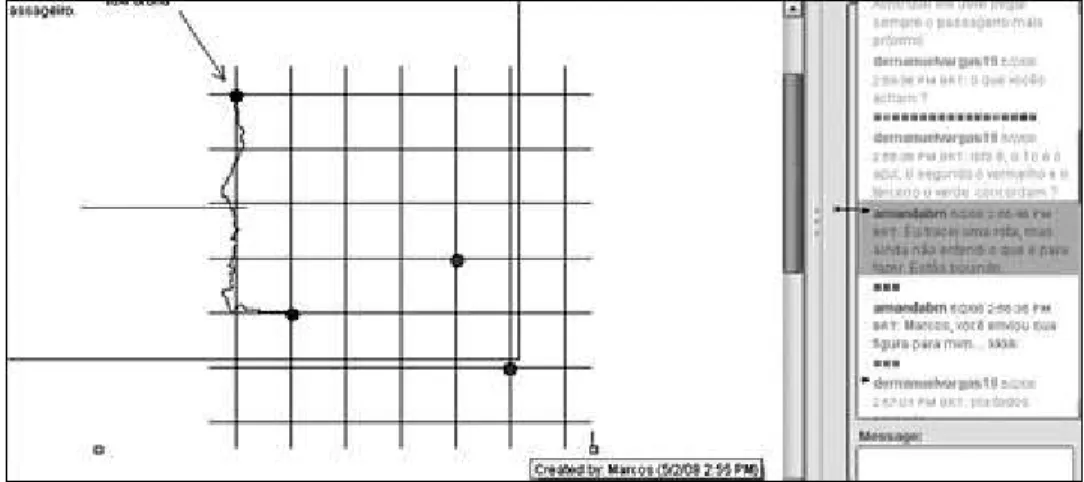
For each team, their VMT environment (http://vmt.mathforum.org/VMTLobby/) contain two dynamic spaces: the whiteboard and the chat (see Figure 1). The environment creates a log of each team’s discursive interactions (chat postings and whiteboard inscriptions). Using a VMT-Replayer, researchers can exhaustively review the enfolding interactions. The prospective teachers engaged the following task:
The Taxicab Problem
A taxi driver is given a specific territory of a town, shown below. All trips originate at the taxi stand. One very slow night, the driver is dispatched only three times; each time, she picks up passengers at one of the intersections indicated on the map. To pass the time, she considers all the possible routes she could have taken to each pick-up point and wonders if she could have chosen a shorter route. What is the shortest route from a taxi stand to each of three different destination points? How do you know it is the shortest? Is there more than one shortest route to each point? If not, why not? If so, how many? Justify your answer.
In the next section, we first present discursive practices interlocutors employ as they interact collaboratively to understand and resolve mathematical tasks. Later we discuss how these interactions influence the growth of their mathematical ideas.
Figure 1. The whiteboard, with Taxicab Problem
grid, and chat spaces of VMT
Results
The future teachers exhibited diverse interlocution patterns. From a session that contained 178 turns of chat, in turns 51 to 59 below, participants’ refine their ideas about the problem and about how to determine the minimum number of shortest paths from the taxi stand to destination points2.
2
51 Elder The nº of paths to blue is the combination of (5,1), that is, (b,b,b,b,d) where b=down and d=right
52 amandabm Then for the blue point there are 5, red 7, and green 10
53 demanuelvargas19 that’s it Amanda
54 Marcos that’s it yes
55 Marcos But problem is to know how many shortest paths exists
57 Elder For the red point there are (4,3), (d,d,d,d,b,b,b)
58 demanuelvargas19 that is it Elder
59 Elder all of these cases have the shortest path, they are equal
This chat excerpt evidences interlocution patterns that are informative, interpretive, and evaluative. Informatively, Elder introduces the notion of
combination (turn 51). In turn 52, amandabm interprets an unstated aspect of Elder’s statement, concerning the total number of units or street blocks from
the taxi stand to each given destination point, and frames her contribution as a question. Afterward, both demanuelvargas19 and Marcos evaluate
amandabm’s contribution, and the latter reminds amandabm about their goal.
Before turn 51, in the fifth previous chat turn, amandabm confirms her
understanding of the metric in this problem but expresses a doubt about how the team was constructing paths, as she says: “Wow…I think that our interpretation was completely wrong after this explanation” (turn 46). It appears that for this participant how the group constructs paths does not contribute insights.
In the following interactive chat sequence, amandabm tries to understand
155 Elder I think that the nº of paths is actually 2C(b+d,d) 156 Wallace for example, to arrive at blue, we must use 5 steps, being 4 down and 1 to the right
157 amandabm
Wow, but that would give 840 paths for the red? Is it really that or did I make a mistake with the formula?
158 Elder You made a mistake
159 Wallace well, to go there will be 35 paths
160 Wallace also to return
While amandabm tries to follow Wallace’s reasoning, Elder judges amandabm’s statement as incorrect. Wallace also negotiates the meaning of Edler’s statement in turn 155, and senses that since there are 35 shortest
paths to reach the red destination point, and says “also to return,” meaning 35 paths to return from there to the taxi stand.
Shortly thereafter, amandabm offers how to calculate a combination, and is
informed by Wallace how to write correctly her formula.
171 amandabm *I also typed wrong: C= p! / (n – p!)
172 Wallace Amanda, C(n,p)=n!/(n-p!)]
173 amandabm Wow... Thanks... I really made a mistake...
In this sequence of turns, Wallace informs amandabm how to write correctly the idea she seems to express in turn 171. Here is a case of informative interlocution, and amandabm responds appreciatively.
Discussion
The four properties of interlocution appear in various moments in the participants’ discursive interactions. The same interlocution can evidence different interlocution properties and, consequently, different aspects of mathematical thinking emerge. Furthermore, different interlocution interactions yield different outcomes and influence the development of mathematical ideas and reasoning in diverse ways. For instance, though the informative interaction of Wallace with amandabm corrected the latter’s
formula (turn 172), the evaluative discursive interactions that Wallace and Elder engage with amandabm failed to help that participant to distinguish between permutations and combinations.
Regarding prospective teachers’ PCK (for instance, epistemological + didactic + mediation) on this particular virtual environment, the space and task encourages and facilitates collaboration, and stimulates particular behaviors; continuously interacting and making observations, written and inscriptions observations lead to questions and specific to general cases.
Importantly, the data suggest that among our four interlocution properties (1) interpretive and negotiatory interlocution have the potential for advancing the mathematical understanding of individual learners working in a small group and (2) the personal or individual understanding of a learner is intermeshed with the understanding of his or her interlocutors. In sum, interpretive and negotiatory interlocutions support the development of the participants’ mathematical ideas and reasoning. This observation raises instructional questions for us about how best to help learners in an online, collaborative environment engage these properties of interlocution as a deliberate feature of their conversational interactions. We suspect that the theoretical and pedagogic application of deliberative discourse (MICHAELS, O'CONNOR et al., 2008) may yield interesting insights for future research on
References
ABERDEIN, A. The Informal Logic of Mathematical Proof. In: R. Hersh (Org.).
18 Unconventional Essays on the Nature of Mathematics. New York: Springer,
2006, p.56-70
BAIRRAL, M. A.; POWELL, A. B. et al. Análise de Interações de Estudantes do
Ensino Médio em Chats. Educação e Cultura Contemporânea, 2007, v.4, n.7,
p.113-138.
DAVIS, B. Teaching Mathematics: Toward a Sound Alternative. New York: Garland, 1996.
DÖRFLER, W. Means for Meaning. In: P. Cobb; E. Yackel, et al (Ed.). Symbolizing and Communicating in Mathematics Classrooms: Perspectives on Discourse, Tools, and Instructional Design. Mahwah, NJ: Lawrence Erlbaum Associates, 2000, p. 99-131
GATTEGNO, C. The Science of Education: Part 1: Theoretical Considerations. New
York: Educational Solutions, 1987.
INGLIS, M., MEIIA-RAMOS, J. P. et al. Modelling Mathematical Argumentation:
The Importance of Qualification. Educational Studies in Mathematics, 2007,
v.66, n.1, p. 3-21.
LEHRER, R.; L. SCHAUBLE, et al. The Interrelated Development of Inscription and Conceptual Understanding. In: P. Cobb, E. Yackel, et al (Org.). Symbolizing and Communicating in Mathematics Classrooms:Perspectives on Discourse, Tools, and Instructional Design. Mahwah, NJ: Lawrence Erlbaum Associates, 2000,
p.325-360
LESH, R.; R. LEHRER. Iterative Refinement Cycles for Videotape Analyses of Conceptual Change. In: A. E. Kelly e R. Lesh (Org.). Handbook of Research Data Design in Mathematics and Science Education. Mahwah, NJ: Lawrence Erlbaum,
2000, p. 665-708
LO, J.-J.; K. GADDIS. Problem Centered Learning for Prospective Elementary School Teachers: Focusing on Mathematical Tasks. In: A. Reynolds (Org.).
Problem-Centered Learning in Mathematics: Reaching All Students. Saarbrücken,
MARTIN, L.; J. TOWERS, et al. Collective Mathematical Understanding as
Improvisation. Mathematical Thinking and Learning, 2006, v.8, n.2, p.149-183.
MARTIN, L. C. Growing Mathematical Understanding: Teaching and Learning as Listening and Sharing. In: R. Speiser, C. A. Maher, et al (Org.). Proceedings of the Twenty-Third Annual Meeting of the North American Chapter of the
International Group for the Psychology of Mathematics Education (Snowbird,
Utah). Columbus, OH: ERIC, 2001, p.245-253.
MICHAELS, S.; C. O'CONNOR, et al. Deliberative Discourse Idealized and
Realized: Accountalble Talk in the Classroom and in Civic Life. Studies in Philosophy and Education, 2008, v.27, n.4, p. 283-297.
POWELL, A. B. "So Let's Prove It!": Emergent and Elaborated Mathematical Ideas and Reasoning in the Discourse and Inscriptions of Learners Engaged in a Combinatorial Task. Tese (doutorado). Department of Learning and Teaching,
Rutgers, The State University of New Jersey, New Brunswick, 2003.
POWELL, A. B. Socially Emergent Cognition: Particular Outcome of Student-to-Student Discursive Interaction During Mathematical Problem Solving.
Horizontes, 2006, v.24, n.1, p. 33-42.
POWELL, A. B.; F. F. LAI. Inscription, Mathematical Ideas, and Reasoning in Vmt. In: G. Stahl (Org.). Studying Virtual Math Teams. New York: Springer,
2009, p. 237-259
RASMUSSEN, C.; M. STEPHAN. A Methodology for Documenting Collective Activity. In: A. E. Kelly, R. A. Lesh, et al (Org.). Handbook of Design Research Methods in Education: Innovations in Science, Technology, Engineering, and Mathematics Learning and Teaching. New York: Routledge, 2008.
SAUSSURE, F. D. Course in General Linguistics. London: Duckworth, 1983.
SFARD, A. Symbolizing Mathematical Reality into Being—or How Mathematical Discourse and Mathematical Objects Create Each Other. In: P. Cobb, E. Yackel, et al (Orgs.). Symbolizing and Communicating in Mathematics Classrooms: Perspectives on Discourse, Tools, and Instructional Design. Mahwah, NJ:
Lawrence Erlbaum Associates, 2000, p.37-98
SPEISER, B.; C. WALTER, et al. Representing Motion: An Experiment in
Learning. The Journal of Mathematical Behavior, 2003, v.22, n.1, p.1-35.
SPEISER, B.; C. WALTER, et al. Preservice Teachers Undertake Division in Base
Five: How Inscriptions Support Thinking and Communication. In: D. S. Newborn, P. Sztajn, et al (Orgs.). Proceedings of the Twenty-Fourth Annual Meeting of the North American Chapter of the International Group for the Psychology of Mathematics Education (Athens, Georgia). Columbus, OH: ERIC,
2002, p.1153-1162
STAHL, G. Mathematical Discourse as Group Cognition. In: G. Stahl (Org.).
Studying Virtual Math Teams. New York: Springer, 2009a, p. 31-40
STAHL, G. (Org.). Studying Virtual Math Teams. Science and Society. New York:
Springer, Science and Societyed. 2009b.
STEPHAN, M.; C. RASMUSSEN. Classroom Mathematical Practices in Differential Equations. Journal of Mathematical Behavior, 2002, v.21, p. 459-490.
STRUIK, D. J. A Concise History of Mathematics. New York: Dover, 1948/1967. TOULMIN, S. The Uses of Arguments. Cambridge: Cambridge, 1969.
WALTON, D. N. The New Dialectic. Buffalo, NY: University of Toronto, 1992.
WALTON, D. N. Dialog Theory for Critical Argumentation. Philadelphia: John
Benjamins, 2007.