DOI: 10.5935/2359-4802.20170024
ORIGINAL ARTICLE
Mailing Address: Carolina Campos Tassini
Rua Tiradentes, 1730. Postal Code 14400550, Centro, Franca, São Paulo, SP – Brazil E-mail: [email protected]; [email protected]
Assessment of the Lifestyle of University Students in the Healthcare Area Using the
Fantastic Questionnaire
Carolina Campos Tassini,1 Gabriela Ribeiro do Val,1 Sarah da Silva Candido,2 Cynthia Kallás Bachur1,2
Universidade de Franca,1 Franca; Universidade de São Paulo,2 USP, Ribeirão Preto – Brazil
Manuscript received October 20, 2016; revised November 28, 2016; accepted March 01, 2017.
Abstract
Background: The constant concern about quality of life nowadays has incited individuals to seek parameters for disease prevention. Along with that, arise a need to investigate and the ability to measure elements that characterize an appropriate lifestyle.
Objective: To compare the factors determining the quality of life of students in the healthcare area using the Fantastic questionnaire.
Methods: Descriptive, cross-sectional, population study. The sample was obtained by convenience and comprised medical and physical therapy students of both sexes and any ethnicity, attending a private institution of higher education, who agreed to fill out the questionnaire voluntarily. The Fantastic instrument used in this study has 25 closed questions that explore nine domains including physical, psychological, and social lifestyle components.
Results: In total, 57 university students participated, of whom 28 (15%) were physical therapy students and 29 (50.8%) were medical students. The mean age was 23 ± 2 years, and 40 (70.1%) were female and 17 (28.8%) were male. The overall rating was "regular", and none of the participants scored in the "very good" and "excellent” categories. The domains that mostly required change among medical students related to nutrition and physical activity, while among physical therapy students they related to cigarette, drugs, and alcohol.
Conclusion: According to the data collected using the Fantastic questionnaire, there was a remarkable need for improvement in the management of the quality of life of physical therapy and medical students, therefore allowing some social and educational measures through health promotion and disease prevention. (Int J Cardiovasc Sci. 2017;30(2):117-122)
Keywords: Quality of Life, Chronic Disease / prevention & control; Students, Medical; Students, Health Sciences; Surveys and Questionnaires.
Introduction
according to the World Health Organization, chronic diseases are responsible for approximately 86.0% of the deaths and 77.0% of the diseases in Europe.1-3 The main etiology of these diseases are a set of factors fundamentally connected to lifestyle, linked by means of individual choices over the life course.4
The Fantastic Lifestyle questionnaire (Annex 1) is an instrument developed in 1984 by Wilson and Ciliska, from
the Department of Family Medicine at the University of McMaster, Canada, and validated in Brazil by Añe et al. in 2008.5 This instrument aims at addressing the main factors that characterize a health-appropriate lifestyle. Several studies have confirmed the validity and good level of the questionnaire in determining the lifestyle of both healthy and unhealthy individuals.6
physical or man-built environment, personal attitudes, individual capabilities, and services for the promotion, maintenance, and restoration of health.7 In general, changes in lifestyle are not an easy task and may be accompanied by resistance. This often prevents an individual from maintaining for a long time the changes requested by a multidisciplinary team, such as regular physical activity, weight control, moderate consumption of alcohol and salt, cessation of smoking, and stress reduction.8 University life, both for teachers and students, is marked by major changes in the psychosocial and professional spheres, in which the individual is able of consolidating autonomic habits and behaviors due to the distance from his family. Such factors can contribute to both harm and benefit the individual’s lifestyle. The greatest changes at this stage occur with regard to diet, physical exercise, sex life, stress, and consumption of alcohol, drugs, and tobacco.9
The constant concern related to quality of life nowadays has instigated individuals to seek parameters to prevent diseases. Considering that, it becomes necessary to investigate and measure the elements that characterize an adequate lifestyle.10 The objective of this study was to compare the determinants of quality of life among students in the healthcare area with application of the Fantastic questionnaire.
Methods
this was a descriptive, cross-sectional, epidemiological, population study developed in 2015. The sample for this study was obtained by convenience and comprised students in the healthcare area (medicine and physical therapy), without distinction of sex or ethnicity, at a private institution of higher education. These students agreed to fill out the questionnaire voluntarily according to their time availability, without interfering with their daily and academic activities. The Fantastic instrument, used in this study, comprises 25 closed questions that explore nine domains on physical, psychological, and social lifestyle components, identified with the acronym FANTASTIC: F - family and friends, A - physical activity/affiliation, N - nutrition, T - tobacco, A - alcohol and other drugs, S - sleep/stress, T - work/type of personality, I - insight, and C - health and sexual behaviors. The items have five options as answers, with numeric values ranging from 0 to 4. The sum of the scores from all domains derives the global score, which ranges from 0 to 100 points, stratifying the individual into five levels of behavior: 0 to 34 (needs
improvement), 35 to 54 (regular), 55 to 69 (good), 70 to 84 (very good), and 85 to 100 (excellent). The lower the score, the greater the need for change.10
All information obtained during data collection were stored in the software Microsoft Excel and then transferred to the statistical software Stata 9.0 for calculation of absolute and relative frequencies. Quantitative variables were described by mean and standard deviation. This study was approved by the Research Ethics Committee, protocol CAAE no.: 48487515.0.0000.5495.
Statistical analysis
To analyze the variables, we used the Mann-Whitney nonparametric test, with a significance level of p ≤ 0.05.
Results
a total of 57 university students participated in the study, including 28 (15%) physical therapy students and 29 (50.8%) medical students. Of all, 40 (70.1%) were female, and 17 (28.8%) were male, and their mean age was 23 ± 2 years. The distribution of the mean age and the anthropometric characteristics of the participants are described in Table 1.
As for the students' lifestyle, the mean global score was 48.1 ± 10.50, which falls into the category of 35 to 54 points, i.e., "regular". In the present study, none of the participants scored in the category "very good" or "excellent". Table 2 shows the participants' scores and classifications.
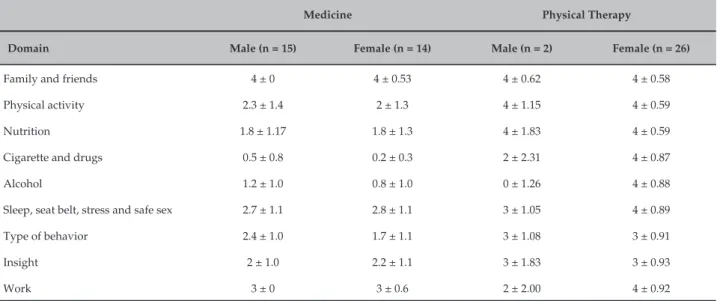
The domains that mostly demonstrated a need for change were related to the consumption of cigarettes, drugs, and alcohol in both sexes among the medical students, and alcohol consumption for males and the type of behavior for females among the physical therapy students, as described in Table 3.
Both physical therapy and medical students reported healthy practices in the domain "family and friends" since most reported having with whom to talk about important issues, in the same proportion that they receive and provide affection.
Table 1 – Anthropometric characteristics of the sample, with values presented as mean ± standard deviation. Franca, 2015
Male (n = 17) Female (n = 40)
Age (years) 24 ± 2.23 23 ± 2.34
Weight (kg) 80 ± 13.70 65 ± 15.2
Height (m) 1.78 ± 0.07 1.65 ± 0.05
BMI (kg/cm²) 25 ± 3.52 24 ± 5.11
n: number of participants; kg: kilogram; cm: centimeter; BMI: body mass index.
Table 2 – Students' scores obtained with the Fantastic Lifestyle questionnaire. Franca, 2015
Needs improvement 0 to 34 points Regular 35 to 54 points Good 55 to 69 points
Physical therapy 0 (0%) 25 (89.2%) 3 (10.7%)
Medicine 1 (0.29%) 22 (75.8%) 6 (20.6%)
Table 3 – Description (mean and standard deviation) of the domains of the Fantastic questionnaire, divided by sex and course. Franca, 2015
Medicine Physical Therapy
Domain Male (n = 15) Female (n = 14) Male (n = 2) Female (n = 26)
Family and friends 4 ± 0 4 ± 0.53 4 ± 0.62 4 ± 0.58
Physical activity 2.3 ± 1.4 2 ± 1.3 4 ± 1.15 4 ± 0.59
Nutrition 1.8 ± 1.17 1.8 ± 1.3 4 ± 1.83 4 ± 0.59
Cigarette and drugs 0.5 ± 0.8 0.2 ± 0.3 2 ± 2.31 4 ± 0.87
Alcohol 1.2 ± 1.0 0.8 ± 1.0 0 ± 1.26 4 ± 0.88
Sleep, seat belt, stress and safe sex 2.7 ± 1.1 2.8 ± 1.1 3 ± 1.05 4 ± 0.89
Type of behavior 2.4 ± 1.0 1.7 ± 1.1 3 ± 1.08 3 ± 0.91
Insight 2 ± 1.0 2.2 ± 1.1 3 ± 1.83 3 ± 0.93
Work 3 ± 0 3 ± 0.6 2 ± 2.00 4 ± 0.92
In regards to eating habits, this study showed in the "nutrition" domain that physical therapy students consume more servings of fruits and vegetables that medical students. On the other hand, medical students reported eating more sugar, salt, and foods with excess fat. In this dimension, the question "am I within a
In the domain "tobacco, alcohol, and drugs" among the main practices, we estimated that 23 (76%) medical students and 24 (85%) physical therapy students had not consumed cigarettes within the prior 5 years. In all, 21 (75%) physical therapy students and 20 (66%) medical students reported consuming less than seven doses of drinks during the week, while 13 (43%) medical students reported occasionally drinking more than four doses of alcoholic beverages on one occasion, with a similar number of physical therapy students reporting the same. Additionally, 23 (82%) physical therapy students reported never having driven after consuming alcoholic beverages; among the medical students, 20 (66%) reported having sometimes driven after consuming alcoholic beverages. None of the students in both courses reported consuming some type of drug, 25 (83%) medical students and 19 (67%) physical therapy students reported never having used drugs that could be purchased without a prescription. Among the physical therapy and medical students, 19 (67%) and 19 (63%), respectively, reported consuming drinks containing caffeine (coffee, tea, or colas) one to two times per day.
On the domain "sleep and stress", eight (28%) physical therapy students and 10 (33%) medical students reported rarely sleeping well or feeling relaxed. In all, 13 (43%) medical students indicated feeling able sometimes to cope with day-to-day stress, while 10 (35.7%) physical therapy students reported almost always knowing how to deal with daily stress. Additionally, 13 (46%) physical therapy students almost always relax and enjoy their free time, in contrast to only 10 (33%) medical students who reported being able to do so.
In the domain "work, type of behavior, and insight", the medical students reported feeling more in a hurry when compared with the physical therapy students. On the other hand, physical therapy students reported feeling less nervousness and hostility, and appeared to be more satisfied with the work and functions that they had compared with the medical students, who in turn reported feeling more disappointed and overwhelmed than the physical therapy students.
In relation to the last domain, "sexual behavior, health, and others", we observed that 19 (67%) physical therapy students reported always using condoms, while 15 (50%) medical students reported using condoms with relative frequency.
Discussion
As this study used a convenience sample comprising students in the healthcare area, we observed a limitation of the participants in terms of lack of time availability to fill out the questionnaire, especially among medical students.
The insertion of youths in the university is a period of change marked by the conquering of more autonomy and responsibility. The environmental transformation with the entry into the university world brings new interference in an environment in which students often take root or initiate unhealthy behaviors such as smoking or consuming alcoholic beverages and illicit drugs. Increased demands, responsibility, and stress of the studies imposed by the university have been responsible for the emergence of physical and emotional problems in these students.11
The emotional and personal demands bring great adversities with the progression of the academic life. Universities offer the skills necessary for a proper professional exercise on the offered course but may become an appropriate place for the acquisition of habits that make these students and future professionals susceptible to various types of diseases.12
The quantification of lifestyle is known to be a challenging and imprecise task because it comprises several dimensions that are naturally difficult to be measured directly in an objective manner. Based in the domains "habits and addictions addressed" assessed during the study, we found that medical and physical therapy students in general fit into the categories "needs improvement" (1.6%), "regular" (79.6%), and "good" (15.2%), and that none of the participants scored in the category "very good" or "excellent". These results differ from those obtained in the study by Rodriguez Añez et al.,6 in which a survey using the Fantastic questionnaire among graduate and postgraduate students with a mean age of 21.3 years showed that 82.3% had lifestyle levels between "good" and ''very good''.
Overall, the consumption of illicit substances and alcohol has increased among graduate students. In this sense, more and more alternatives have been sought out to help individuals cope with such impact, including activities and training to face the stress imposed by the university’s demands and measures to prevent the use of these substances harmful to health through early detection of this setback. The deficiency of effective policies against the use of drugs, alcohol, and tobacco by students has been observed in several studies. However, none of the Brazilian medical schools are heading actions against this problem, such as activities and training sessions enabling the best ways to deal with the stress imposed by the universities.14-16
In terms of "sleep" and "stress", many students had difficulty in reconciling leisure, sleep, free time, and activities demanded by the university, and reported feeling tired and stressed with the daily routine. Camargo and Bueno17 claimed that it is often difficult to find a balance between physiological and psychological needs and requirements of the work organization, and that this conflict may trigger an emotional change that is often not elaborated, resulting in effects on physical and mental health.
In the present study, many medical students reported poor eating habits in the "nutrition" domain. With the university routine, adolescents adopt practical and fast habits, such as a preference for industrialized products, low intake of fruits, vegetables and legumes, and omission of meals. The routine of irregular eating is considered a fundamental behavior to the development of obesity, diabetes, hypertension, and chronic diseases, which contribute to public spending in the health area.17,18
Medical students presented the worst scores in the "physical activity" domain. Similar to findings in the literature, a sedentary lifestyle is perpetuated in beginning students, as well as in those completing the studies.19 Silva et al.20 have reported that there is a need to guide students toward a healthy lifestyle and stimulate them to practice physical activity as a way of improving a sedentary lifestyle and its impact on health.
A study conducted by Vieira et al. has shown that the habit of practicing sports in Brazilian universities is deficient and needs encouragement to prevent a sedentary lifestyle. Less than half of the adolescents had the habit of practicing physical activity, and most of those who practiced it did not exceed 4.5 hours weekly.21 The incentive to sports is able to
indirectly improve other domains such as stress and consumption of alcohol, cigarettes, and drugs, as well as adequate eating habits, reducing the risk of chronic diseases. These observations emphasize the importance of this domain.
The results show that the questionnaire has a high-quality classification ability. Having no change in the items that determine lifestyle, the individuals are reclassified. This is important during intervention programs, which promote lifestyle in order to improve health and quality of life. Positive changes in the classification demonstrate that the questionnaire is reaching the expected results. The Fantastic lifestyle questionnaire is a tool to help different professionals get to know individuals evaluated in primary care, as well as to guide them toward a better quality of life.13
Conclusion
The data obtained in the present study using the Fantastic questionnaire suggest a need for intervention in the quality of life of medical and physical therapy students through educational programs, as well as the implementation of means to encourage the promotion of health and improvement of quality of life.
Author contributions
Conception and design of the research: Tassini CC, Val GR, Candido SS, Bachur CK. Acquisition of data: Tassini CC, Val GR, Candido SS, Bachur CK. Analysis and interpretation of the data: Tassini CC, Val GR, Candido SS, Bachur CK. Statistical analysis: Tassini CC, Val GR, Candido SS, Bachur CK. Writing of the manuscript: Tassini CC, Val GR, Candido SS, Bachur CK. Critical revision of the manuscript for intellectual content: Tassini CC, Val GR, Candido SS, Bachur CK.
Potential Conflict of Interest
No potential conflict of interest relevant to this article was reported.
Sources of Funding
There were no external funding sources for this study.
Study Association
1. World Health Organization. (WHO). Global status report on alcohol and health. Geneva; 2011. [Cited in 2014 Aug 28]. Available from http:// www.who.int/substance_abuse/publications/global_alcohol_report/ msbgsruprofiles.pdf
2. World Health Organization. (WHO). Global strategy to reduce the harmful use of alcohol. Geneva; 2010. [Cited in 2014 Aug 28]. Available from: http://www.who.int/substance_abuse/activities/gsrhua/en/
3. World Health Organization. (WHO). Europe. A strategy to prevent chronic disease in Europe: a focus on public health action. The CINDI vision. 2004. [Cited in 2014 Aug 28]. Available from: http://www.who. int/en/health-topics/noncommunicable-diseases/cancer/publications/ pre-2009/a-strategy-to-prevent-chronic-disease-in-Europe-a-focus-on-public-health-action-the-cindi-vision
4. Portugal. Ministério da Saúde. Direção-Geral da Saúde. Programa nacional de intervenção integrada sobre determinantes da saúde relacionados com os estilos de vida. 2003. [Acesso em 2016 jun 01]. Disponível em: http://static. publico.pt/docs/pesoemedida/DGS_Programa_Nacional_Intervencao_ Integrada_Determinantes_Saude_Relacionados_Estilos_Vida_2003.pdf
5. Wilson DM, Nielsen E, Ciliska D. Lifestyle assessment: testing the FANTASTIC instrument. Can Fam Physician. 1984;30:1863-6.
6. Rodriguez Añez CR, Reis RS, Pretroski EL. Brazilian Version of a Lifestyle Questionnaire: Translation and Validation for Young Adults. Arq Bras Cardiol. 2008;91(2):92-8.
7. Canadian Society for Exercise Physiology. (CSEF). The Canadian Physical Activity, Fitness and Lifestyle Appraisal: CSEP's guide to health active living. 2nd ed. Ottawa; 2003.
8. Spinel LF, Püschel VA. Perfil de estilo de vida de pessoas com doença cardiovascular. Rev Gaúcha Enferm. 2007;28(4):534-41.
9. Dinger MK, Waigandt A. Dietary intake and physical activity behaviors of male and female college students. Am J Health Promot. 1997;11(5):360-2.
10. Elliott WJ. Secondary hypertension: renovascular hypertension. In: Black H, Elliott WG. (editors). Hypertension: a companion to Braunwald’s heart disease. Philadelphia: Elsevier; 2007. p. 93-105.
11. Grácio JC. Determinantes do consumo de bebidas alcoólicas nos estudantes do ensino superior de Coimbra. [Dissertação]. Coimbra: Universidade de Coimbra; 2009.
12. Loureiro E, McIntyre T, Mota-Cardoso R, Ferreira MA. [The relationship between stress and life-style of students at the Faculty of Medicine of Oporto]. Acta Med Port. 2008;21(3):209-14.
13. Silva LV, Malbergier A, Stempliuk Vde A, de Andrade AG. [Factors associated with drug and alcohol use among university students]. Rev Saúde Pública. 2006;40(2):280-8.
14. Ramos-Dias JC, Libardi MC, Zillo CM, Igarashi MH, Senger MH. Quality of life among 100 medical students at the Catholic University in Sorocaba, São Paulo. Rev Bras Educ Med. 2010;34(1):116-23.
15. Costa LF, Alfani AC, Del Nero TO, Chade MC, Greghl V, Tribist AL, et al. Comparação do uso de drogas entre acadêmicos do curso de medicina da Pontifícia Universidade Católica de São Paulo. Rev Fac Cienc Med Sorocaba. 2004;6(1):7-14.
16. err-Corrêa F, Andrade AG, Bassit AZ, Boccuto NM. Alcohol and drug use by Unesp medical students. Rev Bras Psiquiatr. 1999;21(2):95-100.
17. Camargo RA, Bueno SM. Leisure, life besides work for a soccer team of hospital workers. Rev Latino Am Enfermagem. 2003;11(4):490-8.
18. Cansian AC, Gollino L, Alves JB, Pereira EM. Assessment of intake of fruit and vegetables among college students. Nutrire. 2012;37(1):54-63.
19. Feitosa EP, Dantas CA, Andrade-Wartha ER, Marcellini PS, Mendes-Neto RS. Hábitos alimentares de estudantes de uma Universidade pública no Nordeste, Brasil. Alim Nutr Araraquara. 2010;21(2):225-30.
20. Santos JJ, Silva R. Estilos de vida de estudantes universitários: comparação entre ingressantes e concluintes. [Relatório Técnico-científico]. Porto: Universidade Fernando Pessoa; 2012.
21. Vieira VC, Priore SE, Ribeiro SM, Franceschini SC, Almeida LP. Socioeconomic, nutritional and health profile of adolescents recently admitted to a Brazilian public university. Rev Nutr. 2002;15(3):273-82.