Trans-in-formaçâo 4(1,2,3). jan/dez.. 1992 55
THE RELlABILlTVOF TWO CITATIONCHECKING
TECHNIQUEMEASUREMENTINSTRUMENTS
Silas Marques de Oliveira PUCCAMP
RESUMO
OLIVEIRA.S.M. Fidedignidade de duas técnicas de checagem de instrumen-tos de medida. Tranalnformeção, 4 (1,2,3): 55
-
79, 1992.A importância da aplicação de instrumentos de medidas fidedignos quando se avalia o valor da coleção de uma biblioteca é discutidamente, tudo. O teste-reteste de fidedignidade foi usado para determinar a fidedigni-dade de duas técnicas diferentes de medida de citação. especificamente, citações derivadas de periódicos e derivados de monografias. O chi-quadra-do para igualdade de proporções demonstrou que os periódicos podem ser instrumentos mais fidedignos sendo levantadas questões quanto a fidedig-nidade das monografias.
Unltermos: fidedignidade, avaliaçãode coleção. instrumentos de avaliação.
1
-
INTRODUCTlONOne of the most serious problems that exists in the library is collection development. In 1977 BAUGHMAN (1977, p. 241) stated that during the 1960's, "the prevailing slogan 'the bigger the better' oled one to believe that excellence relates directly to the quantity of volumes that the library holds". He continues, "Ironically this solgan has forged the librarian's action into the kiva of materiais administration rather than meaningful collection develop-ment - the raison d'etre of the library."
However, continous assessment of the library's holdings is vital to an effective collection development plan. ALA's (1979) Guldellnes for
Trans-in-formação 4(1,2,3), jan/dez., 1992 56
determine whetherthe collection is meeting its purpose, or is serving its users or even in which ways or areas it is deficient or strong. Evaluative methods are needed to gather information on the scope, quality, accessiblity and usefulness of the existing collection so that collection development can respond to the current needs of the library's users, avoid waste of resources, and unbalanced growth.
AIthough the evaluation of library holdings is an essential managerial task, very few studies address the reliability of the instruments used to
measure the collection's strengths and weaknesses. One commonly used measurement of collection strenghts is the "citation checking technique" (CC1). CCT attempts to assess collections through the comparison of cita-tions in publishecd sources with the holdings of the library. Two assumpcita-tions of CCT are: (1) citatoins are an indicator of use; (2) the library's ownership of sources cited in published works or dissertations is an indicator of the quality of strength of the collection.
There have been numerous applications of CCT to collection evalua-tion: BLAND, 1980; CHAMBERS, 1973; COMER, 1981; BROADUS, 1971; MARTlN, 1952; SINEATH, 1970; STEWART, 1970; STRAYER, 1971, to men-tion only a few. However, Since there has not been a consistent effort to determine the reliability of the measuring instruments used in applying CCT, the purpose of this study is to undertake an analysis of two different CCT measurement instruments in an attempt to determine their reliability. A meas-urement instrument is characterized by the type of source trom which the citations are gathered and by parameters of research design utilized.
2
-
THE CONCEPT OF RELlABIUTYReliabillty is seen as an indication of stability in research results. In order to have confidence in the results of a research study, it is necessary that the measuring Instrument utllized in the investigation be reliable. The term "reliablllty" is most commonly used to characterize consistent, dependable, and stable research methods, instruments or results.
This study uses "reliabã'lity" as GOVE (1961, p. 1917) defines it: "lhe extent to which an experiment, test, or measuring procedure yielcls the sarne result on repeated trials." The findings of this study could have significance in the determinatlon of which of the measurement instruments tested Is more
reliable for collection evaJuation purposes. If either of these is found to be rellable, library managers wllI possess an adequate measurement instrument to accomplish thelr most important mission
-
bring together people and information in a meaningtul way.--6 Trans-in-formação 4(1,2,3), jan/dez., 1992 57
Several research methods specialists emphasize the replicability as-pect of research as a means of testing the reliability of the instrumento KlDDER
(1980), p. 7) observes that "generallyspeaking. research is considered to 00... reliable when the findings are repeatable. Regardlng the designo the re-searcher should ask whether the conclusions are... repeatable (reliable). Regardlng the measurement process, the concern should be with whether the sources of observations are... repeatable (rellable). "For BUSHA & HAR-TER (1980, p. 97), "when studles are repeated, the reliabllity of prevlous research data can be tested. "
Commenting on research deslgns, POWELL (1985, p. 37) also de-fends the notlon of belng able to replicate. He states that "reliable research flndings are repeatable. That is to say, if a study Is duplicated, or exactly repeated, utilizing the same procedures and techniques, the results should 00 the same. And, withln limlts, the findings of a study hlgh in reliability can be generalized beyond the particualr conditions In the research, at least so long as the conditions remaln essentially the same."
Analyzing the main co~cepts of these statements. one concludes that In order to test the rellability of a measurement instrument, it Is necessary to test the results more than once. But the results should be retested in settings as similar as posslble. A measurement is generally considered to be reliable when the error component Is reasonably small and does not fluctuate greatly trom one observatlon to another.
The "Test-Retest" reliability test was used in this study. Employing this technique, the researcher uses the same data collection Instrument to obser-ve or collect scores two or more times from the same group of subjects, under conditlons whlch are judged to be very similar. The results of these measure-ments are compared to determine thelr similarity. KINNEAR & TA YLOR (1987)
explain that this approach assumes that the greater the discrepancy In the results the greater the random error present in the measurement process and the lower the reliability.
3
-
CHARACTERISTICS OF CCTAs noted earlier, CCT ia a process of developing a list of citations gathered form different sources and comparing it against the library's files to determine the percentage the library has in its own collection Presumably, a hlgh percentage of items found indicates successful collection development. In contrast to standard blbllographic lists which are compiled by experts, CCT is built based on the bibliographies, footnotes and references in primary sources such as books. journals and dissertations. Usually there are no J selection criteria for the compilation of these lists from a set of source
Trans-in-formação 4(1,2,3), jan/dez., 1992
documents. The items which form the lists are most frequently selected at random from the prlmary sources without any consideration for their contents. More often than not, the sources which contain the citations that make up the citation IIsts are chosen based on pre-established criteria, such as subject area, perlod of coverage, languages, etc.
These IIsts are intended to be used in a specific study, usually to evaluate the collection of a specific library. The specificity of purpose in compiling these IIsts Is its asset when compared to other list-checking techniques. The fact that a IIst is generated randomly means that personal biases are less likely to enter into the selection of the citations. Since CCT is based on the principie that the actual use of material is indicative of its relevance to current research, the results of CCT studies are quantitative and empirically based data trom whlch a qualitative judgment can be made about the abillty of a collection to support research in a specified area. The CCT process Is often used to determine whether or not a specific scholarly work could have been written with the resources of the library being evaluated. Thus, CCT presents a unique characteristlc which distlnguishes it from other evaluatlon methods
-
while Ituses quantltative data Italso permlts a judgment to be made on the quallty of the collectlon.Several other advantages of CCT are mentioned in the library and information scienca Ilterature:
(a) The cltatlons gathered for the evaluation are limlted to a restricted segment ofthe collection. COALE (1965) argues that the size ofthe collection poses a problem to most methods of evaluation, but CCT permlts evaluatlon In selected subject areas wlthln the collection.
(b) Some of the cltatlons wlll be of a peripheral nature, whlch willallow the evaluator to verify if a library lacks materiais on subjects tangential to a specific area. Commentlng on this aspect ofthe CCT, COALE (1965. p. 174) mentions that a library "mlght have quite a good special collection and yet be a poor placa for a scholar to work if many necassary titles tangential to his subjcet are lacking." AIso LANCASTER (1977), COMER (1981), and other authors consider the collectlo~ stronger if it is able to offer tangential material to Its users. There is a greater probabllity that a list developed using CCT will contain marginal materiais because it is formed by selecting items at random.
(c) "The collection is evaluated not against some theoretical list of best books, but against IIsts of sources actually consulted by scholars writlng In the fleld." This advantage offered by LANCASTER (1977, p. 176) is supported
by other authors, such as PRICE (1963) and BONN (1974). PRICE (1963) comments that there appears to be an average conscientiousness in giving credit to papers that have provided the foundation for the work. This is in accordance wlthBONN (1974) who states that the fact that a source is actually
--
Trans-in.formaçAo 4(1,2,3), jan/dez., 1992 59
used to SUpport research is per se an indication of its value or quality. Itis also Indicative of its relevance to current research, produclng empirical data for a qualltative judgment about the ability of a colle01ion to support research, thus OOlnga useful item to be checked against the colle01ion which is OOlng evaluated.
(d) Specially compiled lists are much more effe01ive than stand. ardized, published lists, LANCASTER (1977), COMER (1981), BONN (1974) and MCINNIS (1983) ali agree with this statement. BONN (1974, p. 275, 279) emphasizes this in two passages:
"Especially complled lists that are tailored to the particular IIbrary or IIbraries and for well defined purposes are generally considered much more reliable as evaluators of quality than are the readily available published IIsts."
"For the most fruitful resuhs the checklists used must be carefully sele01ed or especially ccompiled to match the needs of the survey and the g08ls and obje01lves of the library or libraries OOingsurveyed."
(e) CCT can easily be undertaken by a competent searcher or expe-rienced cataloguer. Slnce this technique does not Involve any type of content analysis, a responslble person wlth a good knowledge of sampling technique can undertake thls evaluation processo There is no risk of content misinter.. pretation, and It allows for great economy of time and money.
Ahhough the CCT is chara01erized by numerous advantages. it is not free from IImltatlons. Several authors present shortcomings of this technique. BROADUS (1977a & 1977b) points out several disadvantages in the use of the CCT as a tool for colle01lon evaluatlon purposes. A fundamental is that it shows what scholars have done. whereas the more important question is what they should have done; there is no way to tell whether authors really consuh the materiais which are best for their purposes; does not make distin01ions between the best and the worst titles mentioned; the method would be difficuh or Impossible to use for evaluatln a general colle01ion, because of the difficulty of constructing a muhi-subject checklist from cltation counts.
NISONGER (1983, p. 164, 168) also suggests several disadvantages of this
technique: "Themost recently published Ilteratureis not included or, at
minimum, is
underrepresented; abstra01s and indexes are seldom cited;
secondary sources are underrepresented;
and the technique is orlentedtowards the needs of library
patrons who publish."Trans-in-formação 4(1,2,3), jan/dez., 1992 60
analysis a viable means, and perhaps, the best objective approach to collec-tlon evaluation.
The ideal tool for evaluatlng a cOllection, according to NISONGER
(1983, p. 163)is a "scientifically based, versatile collection evaluation techni-que that results in empirical data and can be implemented at a relatively low cost to the library... the use of citation checking as an evaluation tool", he comments, "promeses to meet many of the above criteria" Thus, one Is led to agree with NISONGER's (1980, p. 337) finalremarks about this evaluation technlque: The CCT actually "does measure the depth of the collection and, consequently, would constitute a valid evaluation tool." The fact that many authors have reported studies using this technique suggests that they share Nlsonger's view.
4. CHARACTERISTlCS OF CCT STUDIES
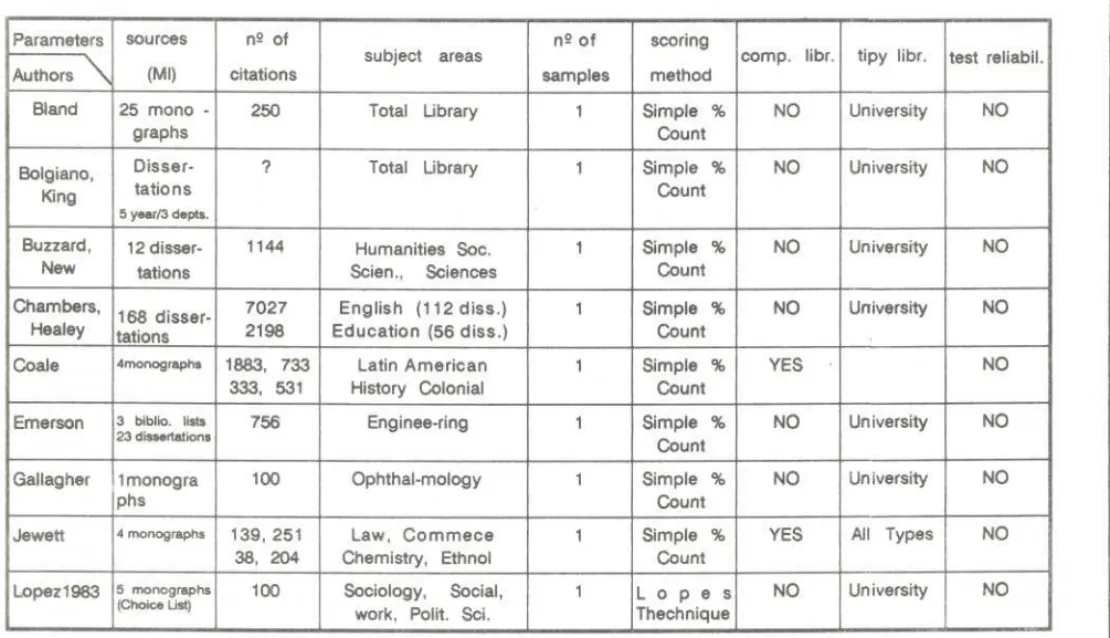
Fourteen studies which applied the CCT to evaluate library collectlons or parts of them have been identified. The majority of these evaluations were conducted at academic/unlverslty librarles. Investlgators have used different types of documents as sources of citations. The numbers of citations used in these studies also varies, from 250, BLAND (1980) to 7.000, CHAMBERS &
HEAlEY (1973). AI though it is evident that there is a tendency towards evaluating areas of the social sciences, the evaluative studies did not present any unlformlty in relation to the subjcet areas of the collection which were evaluated. Except forthe works of LOPEZ(1983)and NISONGER(1980), ali of the CCT studies reported in the library and informatlon science literature used a sim pie percentage count of matches between the list of citations and the library holdings to measure the strength of the collection.
These parameters for research design used in those studies are summarized in Table I. As the Table demonstrates, there is no uniformlty in their use. However, we observe that most of those investigations did not question the reliablllty of the measurement instruments used to evaluate the respectlve IIbrary collectíons.
AI
though OUVEIRA (1986)1 and also PORTA & LANCASTER (1988)2 compared the results when dlfferent CCT measure-ment instrumeasure-ments were used to evaluate portíons of the Universlty of iIIlnois' library collection, only NISONGER (1980, 1983) attempted to test the reliabillty of several of these instruments.5 . ~ETHODOLOGY
The two dlfferent measurement instruments (MI) to be tested are labeled MI "A" and MI "B" MI "A' is a list 01 references based on citations
-TABLE I. PARAMETERS OF RESEARCH DISIGNIN IN CITATION CHECKING TECHNIQUE STUDIES
~ 1/1 .1.. ::I ir 3 to
~ N ~ ~.::I
Q: CD ~
-~
~
Parameters sources n2 01 n201 scoring
Authors
'\
subject areas comp. libr. tipy libr. test reliabil.
(MI) citations samples method
Bland 25 mono
-
250 Total Ubrary 1 Simple % NO University NOgraphs Count
Bolgiano, Disser- ? Total Ubrary 1 Simple % NO University NO
King tations Count
5 YN1/3depla.
Buzzard, 12 disser- 1144 Humanities Soc. 1 Simple % NO University NO
New tations Seien., Seiences Count
Chambers, 168 disser- 7027 English (112 diss.) 1 Simple % NO University NO
Healey tations 2198 Education (56 diss.) Count
CoaJe 4monographa 1883, 733 Latin American 1 Simple % YES NO
333, 531 History Colonial Count
Emerson 3 blbllo.11m 756 Enginee-ring 1 Simple % NO University NO
23disaeftatlons
Count
Gallagher 1monogra 100 Ophthal-mology 1 Simpie % NO University NO
phs Count
Jewett 4monograph. 139,251 Law, Commece 1 Simple % YES Ali Types NO
38, 204 Chemistry, Ethnol Count
Lopez1983 5 monographs 100 Sociology, Social, 1 L o p e s NO University NO
(Choic:eUst)
- - ---
- - ---
--
-
----TABLE I. PARAMETERS OF RESEARCH DISIGNIN IN CITATlON CHECKING TECHNIQUE STUDIES
/
.... j; :J 'I' :i' S' 3
i ~ N ~ ~.
a ID
r
~
~
Parametera sources n2 of n20f scoring
Authors subject
areas campo libr. type libr. test reabil.
(MI) citations samples method
Nisonger blbIiographleal 100 Mediev. Freneh LIt., 2 lOPEZ NO University YES
1980 Itals Family Therapy , TECHNIQUE
Amer. Novel, Mod. British History
Nisonger PeriodicaJ 142, 142 Political Sciences 2 for eaeh Slmple % YES Universlty YES
1983 Articles 150, 150 Count
Oliveira Per. Artie. 220 Library 1 for each Slmple % NO University NO
Index 158 Adminlstration Count
JournaJ
Popovich 31 2805 Business 1 Slmple % NO University NO
issertation Management Count
s
Porta, IndexJoumal 500 Irrigation 1 for each Slmple % NO Univeraity NO
lancaster Ooc:uments 819 Count
Denv.d 500
Joumal Articles
Webb 4 246, 1396 Mediev. Studies 1 Slmple % NO ? NO
blbliographleal 1910, 181 Art Hist., Physics Count
lista Political Sciene.
1 5 283.282, Reference Servlces 3 for eaeh Slmple % NO university YES
monographs 234 Count
This Study 15 Perlod.
Trans-in-formação 4(1.2.3), jan/dez. 1992 63
randomly selected from monographs on the subjcet of Reference Services, and MI "8" is a Ilst based on citations randomly selected from articles publlshed in journals of the same subject area. Monographs. journallssues, and Individual journal articles used as sources for citations were also chosen at random trom library holdings dealing with Reference Services.
Monographs and journal articles were chosen as sources of citations which formed MI"A" and MI "8" respectively, because these materiais
repre-sent
two of the three sources for measurement most used in CCT studies. Three semples of citations were gathered to test MI "A" and three to test MI "B". Each sample was compared against the holdings of the Universlty of lIIinols's Ilbrary system In order to determine the percentage held In its collection. This procedure would determine if the three samples within MI "A" and the three samples within MI "8" yield consistent results. The conslstency In the results withln a speclfic MI is an indication of reliabilityThls study will test the following null hypotheses:
(a) There Is no slgnlficant dlfference In the results when dlfferent samples of citatlons derived from monographs (MI"A") are matched agalnst a IIbrary's collection, and
(b) there Is no signlficant dlfference In the results when dlfferent samples of citations derived from journal articles (MI "8") are matched against a library's collection.
The subject area chosen to evaluate the collection in this study
was
"reference servlces". Several factors led to this choice:
1) It is an easy area to identify; 2) it has well delineated boundaries; 3) the library owns a reasonable number of nonographs on the area, leading to better sampling procedures; 4) the library owns enough periodical titles in the area, which allows the sampling of three dlfferent sets of references, each trom a dlfferent tltle chosen at random.
Five monographs were randomly selected as sources of cltatlons for each of the samples that would test the reliability of MI "A" Slnce uniqueness of citations was needed in order to test the reliability of the MI. each sample was formed without replacement, that is, once a monograph had been chosen to form part of a particular sample, it was not returned to the original population of monographs from which other samples would be selected
The orlglnallist of monographs from which the samples for MI"A" were drawn was derived trom a search on the Full Bibliographic Retrieval System of the Universlty of IlIInois' Llbrary using the subjcet headings "reference service" and "reference services" This search yielded 104 monographs, of whlch 39 were relevant. The titles of the other publicatlons carrled elther the words "reference" of "service" or even both In thelr tltles but with a connotation
Trans-in-formação 4(1,2,3), jan/dez., 1992 64
Since a set of five documents (5 monographs for MI "A" and 5 issues of the same periodlcal title for MI "B") was used as sources for a sample of citations, a muhistage sampling proportional to size of the population was used to form each sample of citations to be checked against the library's collection. Therefore, in order to establish the size of each sample, it was
necessary to first identify the total population size of citations in each set of sources (5 items) after the elimination of citations of unpublished materiais, duplicate citations wlthin each source, and unidentifiable references. The total population size of each set was identified by adding the number of usable citations contalned in each of the tive documents that formed a sample.
The size of each sample, therefore, was determined by identifying the population size and its corresponding sample size in the "Table For Determi-nlng Sample Size From a Given Population" published by the National Education Assoclation (KREJCIE & MORGAN 1970). Next, the proportion represented by the sample size In relation to the total population was calcu-lated. This percentage value was used to determine the number of citations that was selectsed, at random, from each document that formed a specific set of sources. If the sample size indicated by the Table was 20% of the total population (number of usable citations in ali five documents of a set), 20% of the usable citatlons from each document of the set were randomly selected. The final sample size was obtalned by adding the total number of citations derived from each document of the set.
Ali of the citations were randomly selected from the bibliographies, footnotes and references ofthe source material. Samplel of MI"A" conslsted of 283 citations taken from the flrst set of five monographs, chosen at random from the 39. Sample 11consisted of 282 citiations taken from the second set offlVe monographs, and samplelll was formed by 234 citations extracted from the third set of tive monographs.
The three periodlcals for MI "B", The Reference
Ubrarlan,
RQ and Medlcal Reference Servlces Quaterly, were randomly selected from the five journals specialized on "Reference Service" available at the University's library system. Five volumes of each title were also chosen at random. Next, one issue from each volume was rándomly selected. It was the randomly selected issue fromeach
volume that was used as the source of citatons for samples I, li, and 11Iof MI "B". Thus, sample I consisted of 297 citations selected at random from the blbliographies, footnotes and reference notes of ali artlcles published in volumes 5,11,12, 14 and 16 (also selected at random) of The Reference Ubrarlan. Samplell consisted of 133 citations derived in the same manner, from v.5/n.3. v.121n.3. v.15/n.1, v.16/n.3 and v.20/n.1 of RQ. TheTrans-in-formação 4(1,2,3), jan/dez., 1992 65
procedure. The issues randomly selected fromMedlcal Reference Servlces Quarterly were: v.1/n.1, v.2In.3, v.4/n.2, v.5/n.4 and v.6/n.3.
It was assumed the five volumes from each title are representative of ali volumes in that title. To this date, RQ has published 27 volumes, The Reference Llbrarlan 18, and Medlcal Reference Servlces Quarterly only 6. It was also assumed that any one issue was representative of ali the issues in any onevolume, which in every case, consisted of no more than four issues. The citations in the resulting samples were then searched In the computerized and card catalogs of the Unlversity of IlIinois' Library. The percentage of matches, in each sample, resulting from the search was then recorded by type of material. Since the results of each MI consisted of three independent groups and also represented repeated measurements from the same population, thethree results, firstfrom MI"A" andthen from MI"B", were submited to the chi saquare test for equality of proportlons. By applying this test, it was possible to determine whether the differences among the results of the samples within each MI was significat or not. In order to verlfy if the differences were due to chance alone. the resulting chi-square value of each variation was then compared to Its corresponding critlcal alpha value at the .05 and .01 levei, thus determining the reliability of each variatlon for the two CCT measurement instruments.
6
-
ANAL VSIS OF THE RESUL TSThe preceding section has outlined procedures followed in gathering the data for thls study. This section presents a description of the data and an analysis of the findings resultlng from these procedures. The three samples of citatíons drawn from the monographs will first be presented, followed by an exposition of the results obtained from the matching ofthe citations against the library's holdlngs.
6.1 - Results of Measurement Instrument "A"
Trans-in-formação 4(1,2,3), jan/dez., 1992
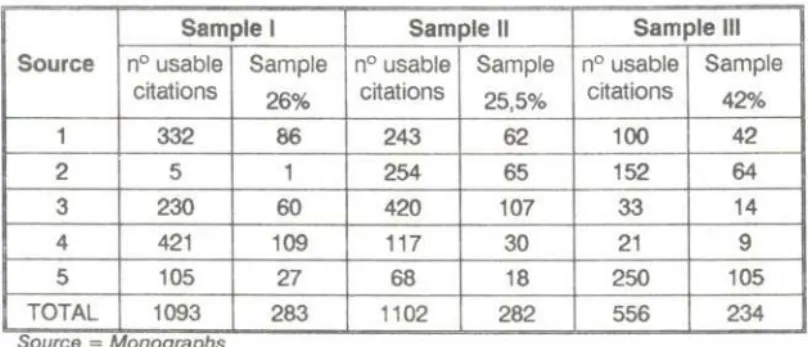
sample size almost doubled, that is, 42%, which yielded 234 citations to be compared against the collection. Adding the results trom the three samples, it is verified that a total ot 799 citations was selected trom 2751 usable ones
and matched against the University of IlUnois' library collection in order to test the reliability of MI "A" of the CCT.
Table li. Total Population of citations and sample size
for the sources In each sample of mi "A"
Source = Monographs
Slnce this study proposes only to verify the reliability of the measure-ment instrumeasure-ments, the differences In sample sizes will not matter. as long as the sampling technique remalns uniform tor each sample. Only by chance would the number ot usable citations and the corresponding sample size tor each evaluatlon be the same.
The varlation between the number ot usable citations In each source
Is Interesting to note. Conslderlng ali sources in the three samples, there is a wlde range. Source number 4 in sample I yielded 421 useful citatlons while source number 2 in that same sample yielded only tive citatlons. These sources are also responslble for the largest and the smallest contrlbutions to sample I, (with 109 citatlons from source number 4 and only one citation was from source number 2.
The average numberofusable citations in the sources tormlng sample I is 219, varying from 5 to 421 citations. In sample SII the average is 220, varying trom 68 to 420 citations and in sample 11Iit is 111, varying from 21 to 250 citations.
The results of the matching process ot the citations in each sample against the library's collctlon are arranged by the type of publication that each 66
Sample I Sample li Sample /li
Source nOusable Sample nOusable Sample n° usable Sample
citatlons 26% citations
25,5% citatlons 42%
1 332 86 243 62 100 42
2 5 1 254 65 152 64
3 230 60 420 107 33 14
4 421 109 117 30 21 9
5 105 27 68 18 250 105
6
~-IS
:a
:>r:a
a
lia
:ia
to
as
)Ia
~.
to
)Ia
ch
Trans-in-formação 4(1,2,3), jan/dez., 1992 67
eitation represents. Tables 111,IV,and V present these results for samples 1,11, and 11I of MI MA".
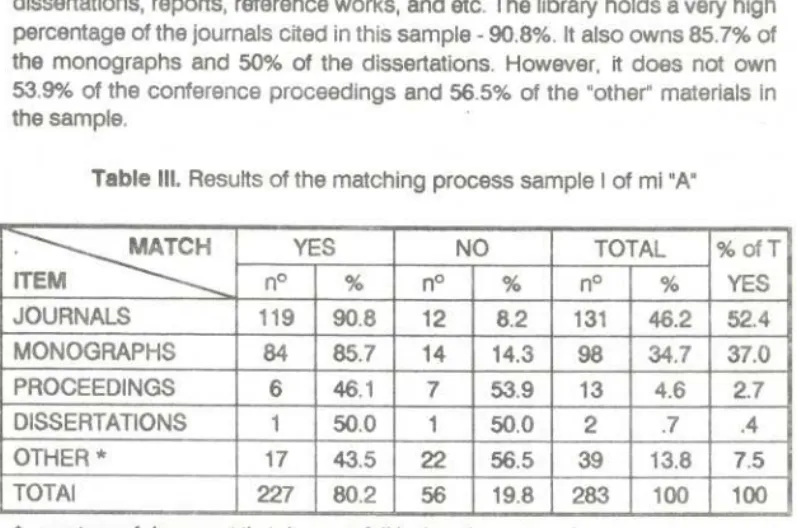
As Table 3 demonstrates, the IIbraryojwns 80.2% of the 283
docu-ments Insample I. Of these 227 items owned, 52.4%, that is, more than half
are journals, 37% are monographs and 10.6% are eonferenee proceedlngs,
dlssertations, reports, referenee works, and ate. The IIbraryholds a very hlgh
pereentage of the journals eited inthis sample - 90.8%. Italso owns 85.7% of
the monographs and 50% of the dissertations. However, it does not own
53.9% of the eonferenee proeeedlngs and 56.5% of the .other" materiais In
the sample.
.
Table 11I.Results of the matehing proeess sample I of ml"AM
*
-
any type of document Ihat does not fali in lhe olher categories.- The percetages of columm 2 representa lhe percetage of items held by lhe librery. The percetages of columm 4 represents lhe percetage of items not held not lhe librery.
The percetage figures of columm 6 are indicative of lhe percetages Ihat the especific item represents in relation to ali olher items checked againstlhe collection of lhe Ilbrery. The percetage of matches Ihat lhe specific item representa in relation to alI matches.
It Is noted that the five monographs that were randomly selected as sourees of eltatlons for sample I elted more journal than any other type of document, but also, the IIbrary holds a larger pereentage of thls type of material compared to the other types In the same sample.
As ean be seen in Table IV,the tive monographs that were ehosen as sources for sample 11of MI "A",ylelded a total of 282 eltations, of whleh the IIbrary owns 265, that Is, 94%. Of these, 72.1 are journals, 18.9 are mono-graphs, and 9.0% are ali other types of materiais, Ineludlng dissertatlons and eonferenee proceedlngs.
YES
NO
TOTAL
%ofT
ITEM
nO%
nO
%
n°
%
YES
JOURNALS
119
90.8
12
8.2
131
46.2
52.4
MONOGRAPHS
84
85.7
14
14.3
98
34.7
37.0
PROCEEDINGS
6
46.1
7
53.9
13
4.6
2.7
DISSERT
ATlONS
1
50.0
1
50.0
2
.7
.4
OTHER*
17
43.5
22
56.5
39
13.8
7.5
Trans-in-formaçAo 4(1.2.3}. jan/dez., 1992 68
Table IV.Results OSthe matchlng process sarnple 11of mi "A"
Althoughthe number of cltatlons In sample
I (283) and in sarnple11(282) are almost the sarne the IIbrary hords a larger percentage of the cltatlons In sampreli,94.0% compared to 80.2""'. Just as observed in sampre I, the library holds a very large percentage of the joumal cltations in this sample
-96.9%. It also holds 90.9% of the monographs and holds 50% of the dlsser-tations, as in sample I. Two differences are observed here. Whlle the IIbrary holds less than half of the conference proceedings and of the "other" materiais in sample I, It holds ali of the conference proceedings and of the "other" materiais In sarnple I, It holds ali of the conference proceedlngs and77.7%(14 out of 18) of the
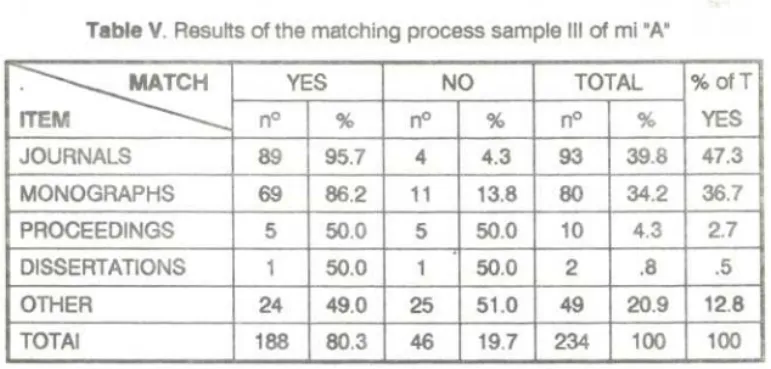
"other" materiais forming sample 11.The results of the matching between the cltations in sarnple 11Iof MI "A" and the IIbrary holdings are presented in Table V. The fave monigraphs that formed sarnple 11Iof MI"A" ylelded a total of 234 citations whlch were matched against the IIbrary's collection. The library holds 80.3%. that is a total of 188 documents. This percentage is almost equal to the percentage held when the cltatlons In sample I were matched agalnst this sarne collectlon, (80.2%),
although sample Ils larger. Of the 188 documents held by the library, 47.3% arejoumals, 6.7% aremonográphs, 12.8% are "other" materiais and 3.2 % are conference proceedings and dissertations. As observed In sarnples I and li, the IIbrary holds a larger proportlon of the joumals clted Inthis sampre than any other material, 1nthls case, 95.7%. This percentage Is very ciosa to the one obtalned In sample 11.The IIbrary also owns 86.2% of the monographs, 50% of the conference proceedings and dlssertatlons, and nearly halfof the
"other"types of
materiais.
YES NO TOTAL %ofT
ITEM no % no % nO % YES
JOURNALS 191 96.9 6 3.1 197 69.9 72.1
MONOGRAPHS 50 90.9 5 9.1 55 19.5 18.9
PROCEEDINGS 8 100.0 O O 8 2.8 3.0
DISSERTATlONS 2 50.0 2 50.0 4 1.4
.7
OTHER
14 77.7 4 22.3 18 6.4 5.3-
-18
Trans-in-formaçAo4(1,2,3), jan/dez., 1992 69Table V. Results of the matching process sample 11Iof ml "A"
These results are very similar to the tindings in sample I. Again it 15 noted that, as in samples I and li, this sample of tive monographs cited more joumals than any other type of materiais. And once more, the IIbrary holds a
larger percentage of thase as compared to other types of documents cited. Two Interestlng tendencies are observed when comparing the results of these three samples. Flrst, the types of documents were cited in the same frequency order in every samples 1stjournals, 2nd books. 3rd Mother" mate-riais, 4th conference proceedings and 5th dissertatlons. Second, In every case the IIbrary ojwned a larger percentage of the journals cited than any other type of materiais.
In order to test the flrst null hypotheses of this study, whlch Is: "there Is no slgnlficant difference In the results when different samples of citatlons derived from monographs are matched against a library's collection," it is necessary to compare the total frequency of matches obtalned In each sample and test if the differences are slgniflcant or noto The chl-square (x2)
test for equaJity of proportlons was applled.
A Y?-equal to 26.71 Is obtained when these results are caJculated. The degrees of freedom for six cases Is 2. The alpha value at a significance levei of .05 for 2 degrees of freedom Is 5-9 and at a levei of .01 Is 9,2. The chi-square vaJue, 26.71 Is larger then the alpha values, Indlcating that the differences In
the results of the three samples are statlstlcal\y slgnificant and therefore the null hypothesis is rejected and the alternative hypothesis accepted. The results obtaJned uslng different samples of citatlons drawn from monograhs are not constant, and therefore not repllcable. Therefore, MI "A" (I.e. Mono-graphs) mlght not be a rellable Instrument for collection evaJuatlon purposes when applled to the "reference servlces" area of the Unlversity of IlIInol8'
YES NO TOTAL %ofT
ITEM no % no % no % YES
JOURNALS 89 95.7 4 4.3 93 39.8 47.3
MONOGRAPHS 69 86.2 11 13.8 80 34.2 36.7
PROCEEDINGS 5 50.0 5 50.0 10 4.3 2.7
DISSERTATIONS 1 50.0 1 50.0 2
.8
.5
OTHER 24 49.0 25 51.0 49 20.9 12.8
Trans-in-formaçio 4(1,2,3), lan/dez., 1992 70
IIbrary, because the dlfferences In the results are statlstically signiflcant and not due to chance alone.
8.2 - Resulta ar Meaaurement
Instrument "B"A second study was developed uslng similar procedures to test the rellablllty ar another CCT measurement Instrument. Whereas for MI "A" ran-domly selected monographs on Reference SelVices were used as sources of
cltatlons, for MI "B" the cltatlons were derlved trom artlcles ofperlodlcals on Reference Servlces also selected at random trom 5 joumals speclalized In' Reference Servlce held by the Unlverslty ar IlIInols' library system.
At flrst, three Journals speclalized In "reference servlces" were random-Iy selected. They were: The Reference Ubrarlan, RQ, and Medlcal Refer-ence Servlces Quarterly. Each tltle represents a dlfferent sample. Flve volume (years) were then randomly selected from each tltle. The final sample
ar cltat!ons trom each group of tive volumes was derlved from ali the artlcles published In one ofthe Issuesln each volume, also selected at random. Table VI presents thetotal numberar usable cltatlons and the corresponding sample
sizefor each one of thefive sources that formed the three samples of cltations used In MI"B".
Table VI.Total populatlon ar cltatlons and sample size for the sources In each sample of ml "B"
The tive sources In sample I (5lssues ar The Reference
Ubrarlan)
ar
thls MI ylelded 1314 usable cltatlons. The correspondlng sample size Indica-ted In the "Table For Determinlng Sample Size From a Glven Populatlon"1s 297, whlch represents 22.6%. A very different figure was obtalned after determlnlng the usable cltatlons In the sources that formed sample11.Out of
-
-Sample I Sample \I Sample 11I
Source nOusable Sample nOusable Sample nOusable Semple
cltatlons 22.6% cltations
66,8% cltatlons 64.2%
1 224 51 84 55 17 11
2 222 50 46 30 101 64
3 166 38 37 24 30 19
4 328 74 ., 24 19 30 19
5 374 84 8 5 37 25
Trans-in-formaç1o 4{1,2,3},jan/dez., 1992 71
199 usable citatlons,133 (66.8%) were randomly selected thus forming
sample 11of references to be matched against the library'scollection.A similar
sample slze was arrlved at for sample 11I.Out of 215 citatlons,
138
(64.2%)were randomly selected.
By addlng the totalnumber of citatlonsIn alithree samples, a totalof
568 citatlons were selected trom 1728 usable ones. The average number of
usable citationscited by the tivesources thatformed sample 1.15262.8 (hlgh
of 374 and low of 166): Insample 11thlsaverage Ismuch lower,only
39.8
(hlghof 84 and low of 8),and In sample 11Ithe average 18 43 citatlons(hlgh of 101
and low of 17).The discrepancy In the number of citatlonscontalned In the
sources Insample Iwhen compared withthe sources of the othertwo samples
15due to the factthatthe journalused in sample I,The Reference Ubrarlan,
only publlshes entlre volume without dlviding them by issues as do the other
two Journals.Therefore, itIs naturalthat itwould yield a larger number of
articlesand consequently, more citations.
Thls phenomenon dld not affectthe resultsof thisstudy becauS9, as
can be observed InTables VII,VIII,and IX,the differenceInthe resultsobtalned
from samples 11and 11I,which had a similarnumber of usable citationsand
similarsamples slzes, 15 greater
(6.8%) than
the difference in the resultsderlved trom samples I and 11 (1.6%) which were formed by completely
differentnumbers of usable citationsand also sample slzes. The average
sample slzeof cltatlonsderived from the sources insample Ies 59.4 cltations,
In sample 111526.6 and in sample 11I1527.6citatlons.
The resultsof the matchlng process between the cltatlonsfrom the
Referençe
Ubrarlan
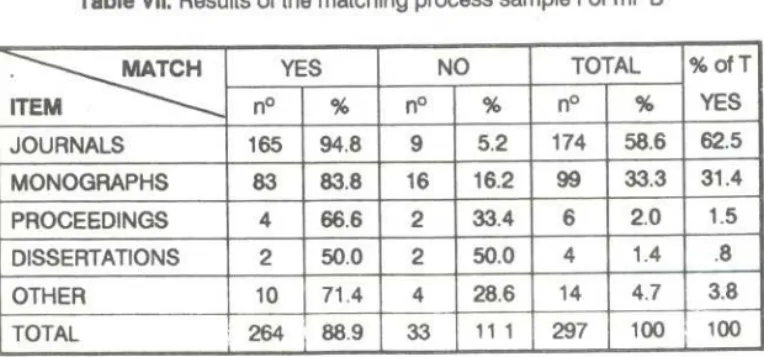
that constltuted sample I and the Unlversity of IlIInols'librarycollectlonare presented In Table VII.This Table, as alithe previous
ones demonstratlng the results for MI "A", is arranged by the types of
documents represented inthe samples.
Table VII. Results of the matchlng process sample I of mi "B"
YES
NO
TOTAL
%ofT
ITEM nO % nO % nO %
YES
JOURNALS 165 94.8 9 5.2 174 58.6 62.5 MONOGRAPHS 83 83.8 16 16.2 99 33.3 31.4 PROCEEDINGS 4 66.6 2 33.4 6 2.0 1.5
DISSERTATlONS 2 50.0 2 50.0 4 1.4 .8
OTHER 10 71.4 4 28.6 14 4.7 3.8
TOTAL
'
264
i 88.9Trans-tn-formaçAo 4(1,2,3), jan/dez., 1992 72
The IIbrary owns 88.9% 01the 297 documents that formed sample I 01 thls MI. Ofthe 264 documents owned by the library,62.5% are journals, 31.4%
are monographs and 6.1 % comprlses conference proceedings, dissertations and "OIher" types 01 materiais.
The IIbrary holds a hlgh percentage 01the journals presented In sample I - 94.8%. 11owns 83.8% of the monographs, 66.6% 01 the conference proceedlngs, 50% 01 the dlssertatlons and 71.4% 01 ali "Olhe r" types 01 materiais that formed sample I. The artlcles that formed the sources 01 eitatlons for sample Iln MI "B" eited more journals than any other type 01 documento Agaln, the IIbrary holds a larger pereentage 01 thls type 01 material compared to lhe others that formed thls sample.
As can be seen InTable VIII,the artlelesfromRQthat were chosen as sources for sample 11of MI"B", ylelded a total of 133 usable eitatlons, 01which the IIbrary owns 116, that Is,87.2%. Of these, 53.4% are journals a37.1% are
monographs and 9.5% corresponds to conference proceedings, disserta. tlons and other types 01 materiais, sueh as reports, reference works ate.
Table VIII. Results 01 the mataehlng process sample 11of MI "B"
I
r
I
r
Table VIII shows that the IIbrary holds 91.2% 01 the total number 01 joumals eitecl by the sources that formecl sample 1101 MI "B". It also holds
81.1% 01 lhe monographs, ali 01 the conference proceedlngs and dlsserta-tlons and 85.7% (6 out 01 7) 01the "OIher" types 01 materiais.
Thls samplels characterlzecl by two unlque results. 11is the only sample of whleh Ihellbrary held ali 01lhe dlssertatlons In the sample and aIso the one trom whlehthe IIbrary matehed the largest pereentage 01the "other" types 01 materiais
-
85.7%.YES NO TOTAL %o1T
ITEM nO % no % nO % YES
JOURNALS 62 91.2 6 8.8 68 51.1 53.4
MONOGRAPHS 43 81.1 10 18.9 53 39.8 37.1
PROCEEDINGS 3 100.0 O O 3 2.3 2.6
DISSERTATlONS 2 100.0 O O 2 1.5 1.7
OTHER 6 85.7 1 14.3 7 5.3 5.2
Trans-in-formaçio 4(1,2,3), jan/dez., 1992 73
The results of the
matchlng
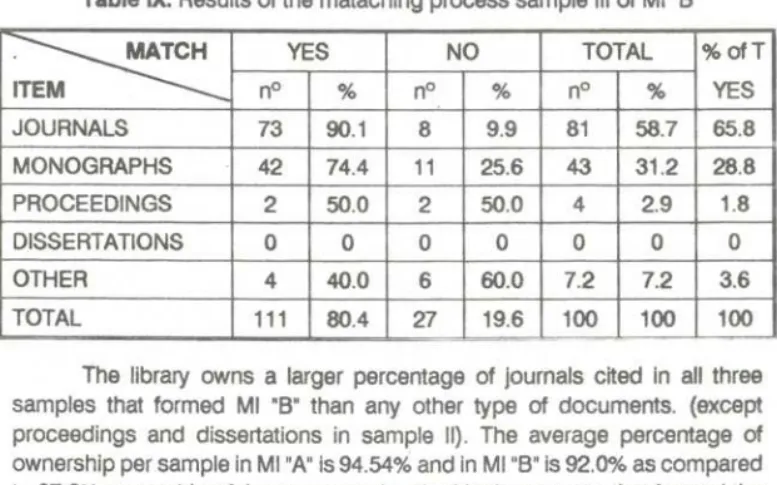
between the cltatlons In sample 11Iand the library holdlngs are presented In Table IX. The articles publlshed by five dlfferent issues of the Medlcal Reference Servlcea Quarterly whlch formedsample 11Iof MI "B" ylelded a total of 138 useful cltatlons. The IIbrary holds 111 of those, that Is,80.4% whlch Is the lowest percsentage of ownershlp when
compared to the other san1ples In thls Mio Of the 111 documents owned by the library, 65.8% are journals, 28.8% are monographs and 5.4% are conte-rence proceedlngs and "other" types of materiais. There were no dlssertatlons
clted In thlssample. The IIbraryholds
90.1%
of the journais clted,74,4" ofthe monographs, 50" ofthe conterence proceedlngs and less than half,40% of the "other" materiais.
Table IX. Results of the matachlng process sample 11Iof MI "B"
l'he IIbraryowns a larger percentage of journals clted In alithree
samples that formed MI "B" than any other type of documents. (except
proceedings and dissertationsin sample 11).The average percentage of
ownershlp per sample InMI"A" Is
94.54%
and In MINB" is92.0%
as comparedto 87.6% ownership of the monographs clted in the sources thatformed the
samples In MI"A" and 79.8% In MI "B".
Inordertotestthesecond nullhypotheslsofthlsstudy-"ThereIsno
significantdlfferenceInthe resultswhen dlfferentsamples of cltatlonsderlved
trom journalarticlesare matched against a IIbrary'scollectlon",the chl-square
test for equallty of proportlons was agaln applled. Sample
I
ylelded264matches and 33 misses; sample 11ylelded 116 matches and 17 misses; and
sample 11Iylelded 111 matches and 27 misses.
Il'}sertlngthese resultsIntothe 'I?-formula, a value of 5.6 Is obtalned.
Slnce the alpha values of 5.9 at .05 and of 9.2 at .01 leveifor 2 degrees of
treedom Is largerthan the obtalned chl-squared value of 5.6.the dlfferences
of the resultsineach sample are not statlstlcallyslgnificant and therefore. the
YES
NO
TOTAL
" ofT
ITEM
nO
"
nO
"
n°
"
YES
JOURNALS
73
90.1 8 9.9 81 58.7 65.8 MONOGRAPHS 42 74.4 11 25.6 43 31.2 28.8 PROCEEDINGS 2 50.0 2 50.0 4 2.9 1.8DISSERTATlONS O
O
O
O
O
O
O
OTHER
4
40.0 6 60.0 7.2 7.2 3.6TOTAL 111 80.4 27 19.6 100 100 100
-Trans-in-formação 4(1.2,3), jan/dez., 1992 74
second null hypothesis Is accepted. The results obtained trom different
samples of citations cited by journal articles are tairly constant and replicable. Therefore, the MI "B" of the CCT tested In thls study can be said to be rellable When applled to evaluate the "reterence servlces" collectlon of the Unlverslty of IlIInols' IIbrary.
7
-
CONCLUSIONThe findlngs of this study demonstrated a tendency tor certaln types
of material to be clted more often In a specific type of CCT MI. In MI "A" and
In MI"B", ali of the samples cited more journals then any other type ot materiais.
Journals n,~presented on average 53.0% of documents cited by the sources
that formed the samples In MI "A" and 56.1% of the documents cited by sources that tormed the samples in MI"B".3 Due to this pattem of citatlons,
the results of collectlon evaluations using these two measurement
instru-ments mlght be blasecl favorably towards a library whlch is known to hold
comprehensive collections of perlodicals, and biased against one which does not concentrate Its acquisition efforts In this type of material.
To date, there have been only a tew investigations which attempted to
compare the results of dlfferent CCT measurement instruments. NISONGER
(1983) investigated two different measurement instruments using two different
samples for each. PORTA & LANCASTER (1988) studled the coverage of the
Unlverslty of IIlInols' IIbrary 00 Irrlg81loo by applylng three dlfferent CCT
measurement Instruments using one sample of citatlons In each; and
OUVEI-RA (1986) evaluated the Unlverslty of IIlInols' IIbrary collectlon on IIbrary
management uslng two dlfferent measurement Instruments with one sample of citations for each. The lack of repllcation of these studles prevents one trom
derlvlng
any
definitlve conclusions about the rellablllty of the measurement Instruments usad.Thls study narrowed this gap and elucldated some of the questlons regarding the rellablllty of different CCT measurement instruments. By testing two dlfferent measurement Instruments uslng three dlfferent samples tor each and st81istically testing the slgnlficance of the different results, it was posslble to check, the rellabillty of two of the most common CCT measurement instruments used to assess the strength of library collections.
The results indlcated th81 whlle citations drawn from monographs
mlght not be 8 rellable Instrument for evaluatlng IIbrary collections, citatlons
drawn trom journal articles could be a useful and appropriate instrument for
---Trans-in-formação 4(1,2,3), jan/dez., 1992 75
assessing library collections. This is not to say that the investigation of the problem is completed. It is not possible to make broad generalizations. Further studies should attempt to test these same measurement instruments using a larger number of samples, applied in other types of libraries with different characteristics and also used to evaluate different subject areas.
An aspect that merits further attention is the scsoring method. There are no established criteria for choosing the method by which the results are scored. Almost ali of the studies reported inthe library and information science literature have simply checked the listof citations against the library's holdings and calculated the percentage of ownership. This scoring method does not take into account good items owned by the library which were not included on the list.
The emphasis should not be only on the overall percentage of matches because there are many variables involved that could influence and alter the final results, depending on their presence or not. For example, number of foreign materiais included. comprehensiveness and up-to-dateness of the source materiais which yielded the citations to be checked againt the collec-tion, number of years or period covered by the sources, quantity of marginal materiais selected. size of the sample used etc. Any one of these variables could alter and affect the results. that is, the percentage of matches or hits between the list of citations and the collection being evaluated. It would be logical to thinkthat a more comprehensive
source. or one that includes more
foreign materiais, or a more up-to-date source, or one that covers a longer period, would yield a greater number of citations less likely to be held by a library than a more specialized or a more domestic source or one that covers a shorter period would.
It is also essential that other mesurement instruments be tested using a uniform procedure lide that developed for this study
-
citations ofdocuments
cited in index journals; citations indexed in secondary sources, such as bibliographies, index journals. literature reviews, as well as citations cited in
dissertations. Afterthese studies
havebeen accomplished itmight be
possi-ble to determine which are the reliapossi-ble CCT measurement instruments. Only after obtaining the results of a serie of research studies as described above will librarians be able to answer some of the fundamental questionl) regarding the CCT, obtaining a better understanding of Its process, determining its actual value as a collection evaluation instrument, and defining its real contribution to the library science field. This study is an important step towards the achievement of this goal.
Trans-in-formação 4(1,2,3), jan/dez., 1992 76
SUMMARY
\
I
I
I
1
OLIVEIRA. S.M. de The reliability of Iwo citationtechnique measurement instruments.Translnformação, 4 (1,2,3): 55 - 79, 1992.
The importance of app/ying reliable measurement instruments when assessing the value of a library collection is discussed in this study. The Test-retest reliability
test
is used to determine the reliability of two differentcitation-checking technique measurement instruments
-
namely, citationsderived from periodicals and citations derived from monographs. A chi-squa-re test for equality of proportions demonstrated that periodicals can be reliable instruments while questions are raised regarding the reliability of monographs.
Key words: reliability. evaluation of co/lection. measurement instruments.
REFERENCES
American
Library Association. Collection Development Committee (1979)."Guidelinesfor Collection Development."Perkings, D.L., ed. ALA, Chicago.Baughman, J.C. (1977). Towards a structural approach to collection development.
College
and Research Ubrarles 38, 241-248.Bland, R.N. (1980). College textbooks as a tool for collection evalua-tion, analysis and retrospective collection development. Llbrary Acqulsltlons 4, 193-197.
Bolgiano, C.E. and King, M.K (1978).Profiling a periodicals collectlon.
College and Research Ubrarles 39, 99-104.
Bonn, G.S. (1974). Evaluation of the collection. Llbrary Trends, 22, 265-304.
Broadus, R.N. (1971).The literatureof the social sciences: a survey of citation studies. Internatlonal Social Sclence Journal 23, 238.
Trans-in-formação 4(1,2,3), jan/dez.. 1992 77
Broadus, R.N. (1977b).The appllcation of citatlon analysls to IIbrary
collectionbuilding.Advances In Ubrarlanshlp 7,229-335.
Busha, C.H. and Harter, S.P (1980) Researchr Methods In
Ubra-rlanshlp: Technique ahd Interpretation. Academlc Press, New
York.
Buzzard, M.L.and New,0.1.(1983)Investigationof collection support
for doctoral research. College and Research Ubrarles, 44,
469-75.
Chambers, G.R.and Healey,J.S. (1973).Joumal citations Inmaster's
theses: one measurement of a journal collection. Journal of the
Amerlcan Soclety for Informatlon Sclence, 24, 397-401.
Coale, R. (1965). EvaJuatlonof a research librarycollection. Ubrary
Quarterly,35,173-184.
Comer, C. (1981). Listchecking as a method for evaluation of IIbrary
collectlons. Collectlon Bulldlng, 3, 26-34.
Emerson, W.L.(1957).Adequacy of engineering resources for
docto-raJresearch in a universitylibrary.College and Research
Ubra-rles, 18, 455-460.
Gallagher, K.E.(1981).The appllcation of selected evaluative
measu-res to the IIbrary'smonographic ophthalmology collection.Bulletln
of the Medlcal Ubrary Assoclatlon, 69, 36-39.
Gove, P.B. (1961).Webster's Thlrd New Internatlonal DlctJonary of
the Engllsh Language: Unabridged. G &C Merriam,Springfield,
IL.
Jewett, C.C. (1849). Report of the Assistant Secretary relativeto the
IIbrary.Annual report of the Board of Regents of the
Smlthso-nlan Instltute, 3, 34-47.
Kidder, L. (1981). Research Methods In Social Relatlons. 4th. ed.
Holt,Rirnhart&Winston, NewYork.
Kinnear,T.C. and Taylor, J.R. (1987). Marketlng Research: an
Ap-plled Approach. 3rd. ed. McGraw-HIII,
NewYork.
Trans-in-formaçAo 4(1,2,3), jan/dez., 1992 78
Lancaster, F.W.(1977).The Measurement and Evaluatlon of Llbrary
Servlces.IRP, Washington D.C.pp. 165-206.
Lopez, M.D. (1969). A gulde for beglnnlng blbllographers. Llbrary
Resourcea &Technlcal Servlces, 13, 462-70.
Lopez,M.D.(1983).TheLopezcitationtechnlqueofln-depthcollectlon
evaluatlon expllcated. College and Research Llbrarles, 4, 251-5.
Martin, P. G. (1952). Characteristles
of the Llterature Used by
Authors of Books on Polltlcal Toples, Unpubllshed dissertation,
Unlversltyof Chicago.
Mclnnls,M.R.(1971).Research collections: an approach tothe
asses-amem of quality. IPLOQuarterly, 13, 11-22.
Mosher, P.H. (1984). Quality and library collections. Advances In
Ubrarlanshlp, 13, 211-238.
Nlsonger,T.E. (1980).An In-depthcollectlonevaluation at the
Unlver-slty of Manltoba IIbrary:a test of the Lopez methad. Ubrary
Re-sourcea &Teehnlcal Servlees, 24, 329-337.
Nisonger, T.E. (1983). A test of two citatlon checking techniques for
evaluatingpolltlcalscience collections
Inuniversitylibraries.Llbra-ry Resourees
&
TeehnlcalServlees,
27,163-174.
Oliveira,S.M. (1986). Evaluatlon of the Llbrary Management
Col-lectlon of the Unlverslty of IlIInols' Ubrary &Informatlon
Selen-ee
Llbrary,
Unpubllshed
paer,
University
of IlIinois at
Urbana-Champalgn.
Popovlch, C.J. (1978).The characteristics of a collectionfor research
In buslness/management.College
and Researeh Ubrarles, 39,110-117.
Porta, MA and Lancaster, F'w. (1988). Evaluation of a scholarly
collection In a specific subJect area by bibllographlc checklng: a
comparisonofsources.
Ubrl, 38, 131-139.Powell,
R.R. (1985).Basle Research Methods for Llbrarlans. Ablex,Norwood.
Price,D.S.(1963).LIttle
Selence,Blg Sclence.ColumblaUniversity
Press, New York.Sineath,T.W.(1970).The
RelatlonshlpBetweenSlze of Research
Ubrary Collectlon and the Support of Faculty
Trans-in-formaçAo 4(1,2,3), jan/dez., 1992 79