An assessment of the maxilla after rapid
maxillary expansion using cone beam computed
tomography in growing children
Jessica L. Woller1, Ki Beom Kim2, Rolf G. Behrents3, Peter H. Buschang4
Introduction: With the advent of cone beam computed tomography (CBCT), it is now possible to quantitatively evalu-ate the effects of rapid maxillary expansion (RME) on the entire maxillary complex in growing patients. Objective: The purpose of this study is to use three-dimensional images to evaluate the displacement that occurs at the circummaxillary sutures (frontonasal, zygomaticomaxillary, intermaxillary, midpalatal, and transpalatal sutures) following rapid maxillary expansion in growing children. Methods: The CBCT scans of 25 consecutively treated RME patients (10 male, 15 female) with mean age of 12.3 ± 2.6 years, were examined before expansion and immediately following the last activa-tion of the expansion appliance. Results: Statistically significant (P < 0.05) amounts of separation were found for the displacement of the bones of the frontonasal suture, the intermaxillary suture, the zygomaticomaxillary sutures, and the midpalatal suture. The change in angulation of the maxillary first molars due to RME was also statistically significant. There was no statistically significant displacement of the transpalatal suture. Conclusions: Rapid maxillary expansion results in significant displacement of the bones of circummaxillary sutures in growing children.
Keywords:Palatal expansion technique. Orthodontics. Cone beam computed tomography. Cranial sutures.
How to cite this article: Woller JL, Kim KB, Behrents RG, Buschang PH. An assessment of the maxilla after rapid maxillary expansion using cone beam computed tomography in growing children. Dental Press J Orthod. 2014 Jan-Feb;19(1):26-35. doi: http://dx.doi.org/10.1590/2176-9451.19.1.026-035.oar
» The authors report no commercial, proprietary or financial interest in the products or companies described in this article.
» Patients displayed in this article previously approved the use of their facial and in-traoral photographs.
Contact address: Ki Beom Kim E-mail: [email protected]
1 Former resident, Department of Orthodontics, Center for Advanced Dental
Education, Saint Louis University.
2 Assistant professor, Department of Orthodontics, Saint Louis University. 3 Professor, Head of the Department of Orthodontics, Saint Louis University. 4 Adjunct professor, Department of Orthodontics, Saint Louis University and
Baylor University.
Submitted: January 27, 2011 - Revised and accepted: May 03, 2011
Introdução: com o advento da tomografia computadorizada de feixe cônico (TCFC), hoje é possível avaliar quantita-tivamente os efeitos da expansão rápida da maxila (ERM) em todo o complexo maxilar em pacientes em crescimento.
Objetivo: este estudo usou imagens tridimensionais para avaliar o deslocamento das suturas circum-maxilares (fronto-nasal, intermaxilar, palatina mediana e palatina transversa) após a expansão rápida da maxila em crianças em crescimento.
Métodos: imagens de TCFC de 25 pacientes tratados consecutivamente com ERM (10 meninos, 15 meninas) com idade média de 12,3 ± 2,6 anos foram obtidas e examinadas antes da expansão e imediatamente após a última ativação do aparelho expansor. Resultados: houve deslocamento estatisticamente significativo (p < 0,05) dos ossos da sutura frontonasal, intermaxilar, zigomaticomaxilar e palatina mediana. A alteração na angulação dos primeiros molares supe-riores devido à ERM também foi estatisticamente significativa. Não houve deslocamento estatisticamente significativo da sutura palatina transversa. Conclusões: a expansão rápida da maxila resultou em deslocamentos significativos dos ossos das suturas circum-maxilares em crianças em crescimento.
INTRODUCTION
Rapid maxillary expansion (RME) is the most com-mon orthopedic procedure used to correct a maxilla with transverse discrepancy. Heavy orthopedic forces are used to separate the two halves of the maxilla at the
midpalatal suture.1 Indications for RME include the
need to correct posterior crossbite and to increase arch perimeter in patients with a tooth-size arch-length
dei-ciency to address crowding.2,3
Along with the opening of the midpalatal suture,4,5
RME has an efect on the entire maxillary complex.6-9
According to Starnbach et al,10 palatal expansion does
not only separate the midpalatal suture, but the circum-zygomatic and circummaxillary sutural systems as well. Speciically, the nasal, the zygomaticomaxillary, and the zygomaticotemporal are some of the sutures afected
by RME. Studies employing dry skulls,7 rhesus
mon-keys11-14 and inite element models (FEM)15,16,17 have
proved these sutures to be afected, but the descriptions tend to be qualitative in nature, except for the stress lev-els calculated by the FEM studies.
While there are signiicant contributions from all of these past studies, there are weaknesses associated with each type of study mentioned above. Studies on dry skulls lack the sot tissues that can hamper the efects of RME, particularly the connective tissue that forms the suture between bones. Rhesus monkeys have a sig-niicantly diferent maxillary anatomy in comparison to humans. The biggest problem FEM faces is the fact that the computer program used for the study is only as good as the model upon which it is based. FEM studies that examined RME were based upon one dry human skull each. Additionally, FEM studies do not demonstrate longitudinal efects, only a particular instant in time.
Many studies5,8,18-29 have attempted to quantify the
changes that occur in the maxillary complex as a result of RME. Several studies have extensively reviewed the changes occurring at the midpalatal suture, the
dentoal-veolar structures, and the nasal cavities.9,25,28,30-33 However,
the limitations of clinical examinations and two-dimen-sional radiography inhibit the analysis of what is occur-ring at the sutural levels in orthodontic patients. The in-troduction of cone beam computed tomography (CBCT)
in Orthodontics34,35 now permits the examination of the
craniofacial complex in living, growing subjects.
The purpose of this study is to use three-dimen-sional images to evaluate the changes that occur at the
circummaxillary sutures, including the frontonasal, zygomaticomaxillary, intermaxillary, midpalatal, and transpalatal ones, following rapid maxillary expansion in growing children. In addition, the relationship be-tween the midpalatal suture and the other sutures are also analyzed.
MATERIAL AND METHODS
Patient selection
This investigation is a retrospective study ap-proved by the Saint Louis University Institutional Review Board (#15727). The records of 25 consecu-tively treated patients (10 male, 15 female) were cho-sen from the records of private practice based on the following selection criteria:
Inclusion criteria
1. Diagnosis included a finding of skeletal transverse discrepancy, while treatment plan included the use of a rapid maxillary expan-sion appliance.
2. Complete set of CBCT images including one prior to appliance delivery and one taken im-mediately after the active expansion phase of treatment.
Exclusion criteria
1. Patients with craniofacial anomalies, including cleft lip and palate.
2. Patients with orthodontic appliances present prior to the start of treatment with rapid max-illary expansion.
Patients’ mean age at the time of the irst imaging ap-pointment in this study was 12.3 ± 2.6 (8.3 to 17.8 years). The second CBCT image was taken on an average of 22.8 ± 5 days ater the irst image (14 to 37 days).
The expander was activated two-quarter turns of the expansion screw (0.2 mm each turn) at the time of delivery, followed by a one-quarter turn twice a day. Activation of the screw continued until the trans-verse discrepancy was overcorrected to the point in which the palatal cusps of the maxillary molars were in edge-to-edge contact with the buccal cusps of the opposing mandibular teeth.
Imaging
Cone beam computed tomography scans were
taken using the Classic i-CAT® (Imaging Sciences
International, Inc., Hatfield, USA) cone beam CT scanner. All scans were taken by the same technician using either the 16 x 13 or the 16 x 22 centimeter field of view with a voxel size of 0.4 millimeters. Patients were positioned in a vertical seat with their head stabilized in the headrest to prevent any unwanted movement during the 20-second scan, teeth together in centric occlusion, and the Frankfort Horizontal plane parallel to the floor, as determined by the ex-ternal auditory meatus and soft-tissue orbitale.
Each patient was scanned at two different time
points: T0 and T1. The first image (T0) was obtained
prior to the delivery of the expander and represented the subject’s baseline condition prior to expansion.
The second time point (T1) was taken at the
ap-pointment immediately following the last activation of the expansion appliance.
The analysis measured changes of the alveolar bone and maxillary sutures following rapid maxillary expansion with consistent landmark identification using the Dolphin 3-D software (Dolphin Imaging & Management Solutions, Chatsworth, USA).
Each scan had a number randomly assigned and loaded into the three-dimensional software so that each scan was analyzed without the operator iden-tifying the patient. First, each scan was oriented by locating the midpoint between both foramina spino-sum (ELSA), and assigning to it x = 0, y = 0, and z = 0 coordinates (Fig 4). The following points were then located: 1) the superior-lateral border of the exter-nal auditory meatus (SLEAM) on both right and left sides, and 2) the mid-dorsum of the foramen mag-num (MDFM). An axial-horizontal plane (x-y plane) was determined by using the right and left SLEAM points and ELSA. A sagittal-vertical plane (z-y plane) was determined perpendicular to the x-y plane and passing through points ELSA and MDFM. These points have shown a high intra-reliability when lo-cated with 3D images, which makes the x-y and z-y planes formed by these points an adequate way to standardize the orientation of 3D images.
Landmark location
Two-dimensional axial images were created per-pendicular to the coronal plane and used to measure the amount of midpalatal and transpalatal suture sep-aration on the external surface of each suture.
The midpalatal suture was measured adjacent to four locations: the first molar, the contact area be-tween the first and second premolars, the canine, and the most anterior point of the maxillary dental arch.
The central groove of each first molar was identi-fied by locating the crown of the molar on an axial image and marking the central groove. An axial sec-tion through the hard palate was then created, and the mesial edge of the midpalatal suture was marked
Figure 1 - Frontal skull showing evaluated areas.
A) Frontonasal suture; B) Zygomaticomaxillary
suture; C) Intermaxillary suture (ANS).
Figure 2 - Axial view of a skull showing evalu-ated areas. A) Midpalatal suture; B) Transpalatal suture; C) PNS.
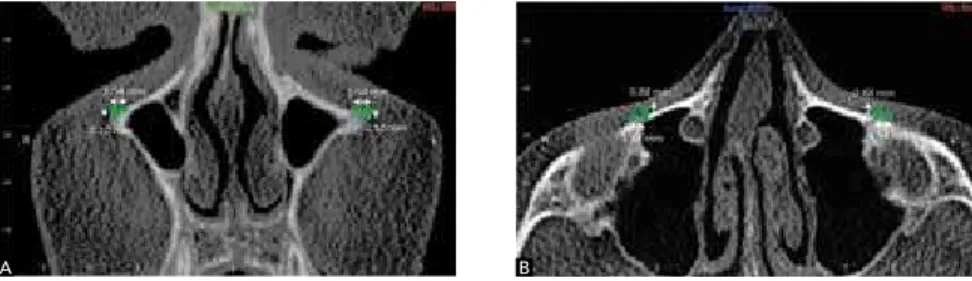
Axial sections were used in the appropriate locations to locate and measure the mesial edges of the intermax-illary suture at ANS (Fig 8) as well as the proximal and distal edges of the zygomaticomaxillary sutures which were located and marked on both inferior (Fig 9) and superior (Fig 10) borders of the zygomaticomaxillary suture on both right and let sides.
To determine the amount of appliance expansion, the outer edges of an unactivated 7-mm Dentaurum expansion screw (Dentaurum, Ispringen, Germany) were measured with digital calipers. In the post-ex-pansion scans, the outer edges of the expost-ex-pansion screw were marked in the coronal slice at the maxillary irst molars (Fig 11).
The A point and the posterior nasal spine (PNS) were identiied on a sagittal section (Fig 12).
To establish the amount of maxillary irst molar angulation, the long axis of each irst molar was deter-mined by identifying the center of the pulp chamber on axial slices at several levels. Then, the angle of the each molar was calculated to the occlusal plane (Fig 13). on both right and left sides. The same procedure was
followed for the other areas of the midpalatal suture, as described above (Fig 5). To verify if the external surface of the suture was being marked, coronal slices were viewed for the places where the suture edges were marked and corrected if necessary.
The transpalatal suture was measured at ive areas along the suture. The irst area identiied was in the mid-line, established by the junction of the midpalatal and transpalatal sutures. The proximal and distal edges of the transpalatal suture were marked at the midline, as well as at 6, 12, and 18 millimeters to the let (Fig 6). The mil-limetric grid on the axial image was used to determine the landmarks to the let of the midline. To verify if the external surface of the suture was being marked, coronal slices were viewed for the places where the suture edges were marked and corrected if necessary.
The displacement of the frontonasal suture was de-termined by locating and marking the superior and in-ferior edges of the frontonasal suture on the external surface in the midline on a sagittal section (Fig 7).
Figure 4 - CBCT image after orientation.
Figure 7 - Sagittal slice through the midline, with the frontonasal suture marked.
Figure 5 - Axial slice through the palate showing the midpalatal suture.
Figure 8 - Axial slice through the hard palate, with the intermaxillary suture marked at ANS on the right and left sides.
Figure 6 - Axial slice through the palate showing the transpalatal suture.
at a particular location or the amount of appliance ex-pansion. These calculations were done for all of the x, y, and z coordinates for both time intervals.
Statistics
All statistics were calculated using the SPSS 14.0 Statistical Software (SPSS Inc., Chicago, Illinois, USA) on a personal computer. Descriptive statis-tics were calculated for all suture width measure-ments and for appliance expansion as well as maxil-lary first molar angulation and change in position of A point and PNS.
For each landmark described above, the x, y, and z
coordinates were recorded at both T0 and T1 for each
patient. The value in millimeters for each coordinate was entered into an Excel sotware spreadsheet (Mi-crosot, Redmond, Washington, USA). To calculate the width of each suture, the distance between the two edges was calculated for each coordinate. To calcu-late the amount of expansion, the diference between the right and let sides of the expansion jackscrew was computed for each coordinate. Analytical geometry was used to convert each set of coordinates into a sin-gle value. The resulting value was the width of a suture Figure 10 - Axial slice showing the left superior
border of zygomaticomaxillary suture.
Figure 11 - Post-expansion coronal slice at the central groove of the maxillary first molar, with the expansion screw in the center.
To calculate intra-examiner reliability, 25% of the CBCT scans were re-measured to test the reliability of landmark identiication with an intraclass correlation coeicient. Reliability of scan orientation was also cal-culated using the intraclass correlation coeicient by re-orienting 25% of the CBCT scans and using the cranial base landmarks basion and anterior clinoid pro-cess of sella turcica for comparison.
Non-parametric statistics were used due to the small
sample size.37 Changes in measurements between pre
and post expansion for each of the sutures were analyzed using single-tailed Wilcoxon signed rank tests with a level of signiicance set at P < 0.05. Kendall’s Tau-b cor-relations with a signiicance level set at P < 0.05 were calculated to assess the relationships between the vari-ous sutures and the amount of expansion.
RESULTS
The intraclass correlation coefficient proved the measurements and orientation to be very reliable. Cronbach’s Alpha measurement of 0.947 showed that there was no significant difference between the original measurements made and the repeated mea-surements performed on a sample that was random-ly selected and represented in 25% of the sample. Likewise, Cronbach’s Alpha measurement of 0.967 showed that there was no significant difference be-tween the original orientation made and the repeated orientation performed on a sample that was randomly selected and represented in 25% of the sample.
Descriptive statistics for the changes in suture width
measurements between T0 and T1 as well as the amount
of appliance expansion are listed in Table 1.
Figure 14 - Frontonasal suture movements in Y and Z planes (sagittal slice).
Figure 17 - Inferior zygomaticomaxillary suture movements in X and Z planes (axial slice).
Figure 18 - Midpalatal suture movements in X and Z planes (axial slice).
Figure 19 - Movements in Y and Z planes (sagittal slice) of A point (right) and PNS (left).
Figure 15 - Intermaxillary suture movement at ANS in X plane (axial slice).
Figure 16 - Superior zygomaticomaxillary suture movements in A) X and Y planes (coronal slice) and B) X and Z planes (axial slice).
Measurement (mm) n Minimum Value
Maximum
Value Mean ± SD
Appliance expansion 25 1.8 6.8 4.2 ± 1.1*
Frontonasal suture displacement 25 0.1 1.8 0.6 ± 0.4*
Intermaxillary suture displacement 25 0.0 3.1 1.9 ± 0.8*
Right superior zygomaticomaxillary suture displacement 25 0.3 3.6 1.2 ± 0.9*
Left superior zygomaticomaxillary suture displacement 25 0.0 1.7 0.6 ± 0.4*
Right inferior zygomaticomaxillary suture displacement 25 0.4 4.2 1.1 ± 0.9*
Left inferior zygomaticomaxillary suture displacement 25 0.4 3.7 1.2 ± 0.8*
Midpalatal suture displacement at maxillary irst molar 25 0.1 2.0 0.9 ± 0.5*
Midpalatal suture displacement at contact between maxillary irst and second premolar 25 0.1 2.4 0.8 ± 0.6*
Midpalatal suture displacement at maxillary canine 25 0.2 2.8 1.1 ± 0.7*
Midpalatal suture displacement at the most anterior point of the maxillary dental arch 25 0.5 3.0 1.5 ± 0.6*
Transpalatal suture displacement at the palatal midline 25 0.3 3.3 1.2 ± 0.8
Transpalatal suture displacement 6 mm to left to palatal midline 25 0.1 1.5 0.7 ± 0.4
Transpalatal suture displacement 12 mm to left to palatal midline 25 0.1 2.3 0.7 ± 0.5
Transpalatal suture displacement 18 mm to left to palatal midline 25 0.0 2.8 0.6 ± 0.6
Table 1 - Descriptive statistics of sutural displacement (T1-T0).
Statistically signiicant diferences were found for the sutural displacement of the frontonasal suture (z= -3.714, P < 0.001), the right superior zygomatico-maxillary suture (z= -3.951, P < 0.001), the right infe-rior zygomaticomaxillary suture (z= -2.677, P < 0.007), the let superior zygomaticomaxillary suture (z= -3.415, P < 0.001), the let inferior zygomaticomaxillary suture (z= -3.633, P < 0.001), the intermaxillary suture, as measured at ANS (z= -4.200, P < 0.001), and all land-marks along the midpalatal suture (P < 0.001). There was no statistically signiicant displacement regarding the transpalatal suture at any of the measured land-marks. A point had a statistically signiicant movement ater RME, however, PNS did not, even though it had 1.03 millimeters of movement downward.
When the individual x, y, and z coordinates were evaluated, the movement of the edges of the sutures was found to be signiicant in some directions. The results are listed in Table 2. Figures 14 to 18 demonstrate the signiicant movements for each assessed suture. Figure 19 demonstrates the movement of A point and PNS.
Kendall’s correlations showed weak relationships be-tween the midpalatal suture at the irst molar and the frontonasal suture (t = 0.261, P < 0.036) as well as the su-perior border of the zygomaticomaxillary suture and the midpalatal suture at: the most anterior aspect of the dental
arch (t = 0.418, P < 0.002), the contact between irst and second premolars (t = 0.322, P < 0.012), and at the irst molar (t = 0.364, P < 0.006). There was also a weak re-lationship between the inferior border of the zygomati-comaxillary suture and the midpalatal suture at the most anterior aspect of the dental arch (t = 0.261, P < 0.034).
The diference in angulation of the maxillary irst molars to the occlusal plane was statistically signiicant (right: z = -3.135, P < 0.001, let: z = -3.586, P < 0.001) before and ater RME. Prior to RME, the right irst molar had an average angulation of 87.3° while the let irst molar had an average angulation of 84.4°. Ater RME, the right irst molars crown tipped buccally with an average resulting angle of 82.3° and the let irst mo-lars crown also tipped buccally with an average result-ing angle of 78.8°. Usresult-ing geometry to calculate the in-tramolar angle, the pre-RME angle between right and let maxillary irst molars was 12.3° and ater RME it increased to 22.7°.
DISCUSSION
To date, there are a number of methods for studying the efects of rapid maxillary expansion. However, the literature does not reach a consensus regarding which approach is superior. In addition, the use of non-dis-torted three-dimensional imaging is a relatively new
X Y Z
Frontonasal suture
z value
sig (one-tailed) movement (mm)
-3.115 -2.642
NS 0.001 0.004
-0.33 0.22
Intermaxillary suture (ANS)
z value sig (one-tailed)
movement (mm)
-4.203
0.001 NS NS
1.82
Superior border of zygomaticomaxillary suture
z value sig (one-tailed)
movement (mm)
-5.505 -2.894 -6.037
0.001 0.002 0.001
1.54 -0.1 0.88
Inferior border of zygomaticomaxillary suture
z value
sig (one-tailed) movement (mm)
-5.475 -5.761
0.001 NS 0.001
1.32 1.82
Midpalatal suture at maxillary irst molar
z value sig (one-tailed)
movement (mm)
-3.46 -2.236
0.001 0.01 NS
0.64 -0.02
Midpalatal suture at contact of maxillary irst and second premolar
z value
sig (one-tailed) movement (mm)
-3.353 -2.432
0.001 NS 0.008
0.6 -0.12
Midpalatal suture at maxillary canine
z value
sig (one-tailed) movement (mm)
-3.742 -1.732
0.001 0.04 NS
0.86 -0.01
Midpalatal suture at the most anterior point of the dental arch
z value sig (one-tailed)
movement (mm)
-4.186
0.001 NS NS
1.2
A point
z value
sig (one-tailed) movement (mm)
-1.672
NS NS 0.05
-2.99 -1.39
Table 2 - Significant movement of individual coordinates.
technique being in Orthodontics used to quantify the skeletal and dental efects of rapid maxillary expansion.
Although there are many studies5,8,18-28 regarding
rapid maxillary expansion, very few have used cone
beam computed tomography technology.25
The sample size of 25 was substantially larger than the one used in many other three-dimensional studies. This gave more power to the statistical analyses to reveal sig-niicant diferences when they existed. This sample was also unique in the fact that the CBCT images were taken relatively close together, with the second image occur-ring shortly ater the active expansion of the appliance was inished. This eliminates most of the remodeling and growth, as well as relapse that appears in other studies.
The midpalatal suture exhibited signiicant dis-placement due to RME, with the amount of displace-ment being greater in the anterior than in the posterior.
As this result is consistent with previous studies,5,8,18-28
the displacement of other sutures was of more interest for this study. Many studies have concluded that the palatal shelves tip down as well as move apart trans-versely during RME. In this study, only the transverse movement was shown to be signiicant along the mid-palatal sutures edges. There was signiicant downward movement at the contact of the irst and second premo-lars, but the amount was only a fraction of a millimeter.
In studies carried out with rhesus monkeys, Starnbach10
noted that during RME, there was increased cellular activ-ity at the zygomaticomaxillary suture, indicating bone for-mation at that suture. In contrast, another study conducted
by Gardner13 on a diferent group of rhesus monkeys did
not demonstrate any activity at that suture during RME.
FEM studies15,16,17 have suggested that the
and inferior borders of these sutures, which is more
con-sistent with the results that Starnbach10
showed histologi-cally. Previous RME studies carried out with children did not assess zygomaticomaxillary sutures, most likely due to the diiculty in identifying the suture on posteroanterior or lateral cephalograms. When the individual planes are evaluated, the superior borders of the zygomaticomaxillary suture move transversely by an average of 1.54 mm, but the borders move slightly downward (0.1 mm) and forward (0.88 mm) as well. The inferior borders of the of the zygo-maticomaxillary suture also move transversely by an aver-age of 1.32 mm, and forward by an averaver-age of 1.82 mm. These indings are consistent with the accepted fact that the entire maxilla moves down and forward with RME.
The frontonasal suture proved to have a signiicant amount of displacement, with an average displacement of only 0.6 mm. The movement of the borders of this suture was also in a down and forward direction, as ex-pected. However, other studies have suggested that the greatest response to maxillary expansion outside of the
oral cavity is found at this suture.12
The intermaxillary suture is usually included as an extension of the midpalatal suture, since it appears to be continuous with that suture. The displacement of the intermaxillary suture was measured at its most apical landmark, the ANS. It is interesting to note that this is the only suture with signiicant displacement which had a signiicant correlation with the amount of expansion of the appliance. The only signiicant movement was in a transverse direction at ANS.
Assessment of A point showed a signiicant displace-ment backward. A point also had an average displacedisplace-ment of nearly 3 mm downward, but this was not statistically signiicant. Additionally, PNS had an average downward displacement of about 1 mm, which was not statistically signiicant. Studies have shown contradictory results re-garding the tipping of the palatal plane, with some studies showing that the posterior tipping was greater than that at the anterior aspect, while other studies show no signii-cant tipping. Even with some relatively large downward measurements, this study proved that the tipping of the palatal plane is not signiicant with RME.
The lack of signiicant change in the transpalatal
suture appears to conirm a prior study7 carried out
with dried skulls and human patients in which the pal-atine bones do not separate from the maxillary bones
under the forces of palatal expansion. Timms7
pro-posed it was the connection to the sphenoid bone that prevented the sutural displacement and the pterygoid processes from simply bending in response to the ex-pansion forces. While the separation of the transpalatal suture was not statistically signiicant, there was some separation in some patients. A larger sample size may be able to refute or conirm these results.
Only the external surfaces of sutures were examined during this study. The changes that occurred during RME were recorded in all three planes of space. The ele-ment of time was disregarded, since there was, on average,
only about 3 weeks between T0 and T1. While the subjects
were all growing children, the amount of growth that oc-curs over 3 weeks is negligible.
The RME appliance for this study was directly attached to the maxillary irst molars, and one would expect that the molars would tip buccally as a result of the expansion forces. While there were individual variations, the molars did as predicted with about a 10 degree increase in the in-termolar angle as a result of RME.
This study has established the fact that circummaxillary sutures are afected by RME in growing children, and that the movements of facial bones can be reliably quantiied in three planes of space using CBCT. The overall forward and downward movement of the maxilla can be seen, as well as the transverse changes. Individual assessment of the changes occurring at the maxillary molars can also be performed. The results of this study provide a link among the prior stud-ies carried out with non-human primates, dry skulls and computer models, and describe what actually occurs in the sutures in patients, as the result of RME treatment.
CONCLUSIONS
1. Isaacson RJ, Ingram AH. Forces produced by rapid maxillary expansion. Angle Orthod. 1964;34(3):261-70.
2. Proit WR. Contemporary Orthodontics. 3rd ed. Saint Louis: Mosby; 2000. 3. Bell RA. A review of maxillary expansion in relation to rate of expansion and
patients age. Am J Orthod. 1982;81(1):32-7.
4. Haas AJ. Rapid expansion of the maxillary dental arch and nasal cavity by opening the midpalatal suture. Angle Orthod. 1961;31(2):73-90.
5. Bishara SE, Staley RN. Maxillary expansion: clinical implications. Am J Orthod Dentofacial Orthop. 1987;91(1):3-14.
6. Chaconas SJ, Caputo AA. Observation of orthopedic force distribution produced by maxillary orthodontic appliances. Am J Orthod. 1982;82(6):492-501. 7. Timms DJ. A study of basal movement with rapid maxillary expansion. Am J
Orthod. 1980;77(5):500-7.
8. Baydas B, Yavuz I, Uslu H, Dagsuyu IM, Ceylan I. Nonsurgical rapid maxillary expansion efects on craniofacial structures in young adult females. A bone scintigraphy study. Angle Orthod. 2006;76(5):759-67.
9. Habersack K, Karoglan A, Sommer B, Benner KU. High-resolution multislice computerized tomography with multiplanar and 3-dimensional reformation imaging in rapid palatal expansion. Am J Orthod Dentofacial Orthop. 2007;131(6):776-81.
10. Starnbach HK, Bayne DI, Cleall JF, Subtelny JD. Facioskeletal and dental changes resulting from rapid maxillary expansion. Angle Orthod. 1966;36(2):152-64. 11. Cleall JF, Bayne DI, Posen JM, Subtelny JD. Expansion of the midpalatal suture in
the monkey. Angle Orthod. 1965;35(1):23-35.
12. Starnbach HK, Cleall JF. The Efects of splitting the midpalatal suture on the surrounding structures. Am J Orthod. 1964;50:923-4.
13. Gardner GE, Kronman JH. Cranioskeletal displacements caused by rapid palatal expansion in the rhesus monkey. Am J Orthod. 1971;59(2):146-55.
14. Marcotte MR. The instantaneous transverse changes in the maxilla due to diferent points of force application. J Dent Res. 1977;56(5):465-70. 15. Jafari A, Shetty KS, Kumar MK. Study of stress distribution and displacement of
various craniofacial structures following application of transverse orthopedic forces: a three-dimensional FEM study. Angle Orthod. 2003;73(1):12-20. 16. Boryor A, Geiger M, Hohmann A, Wunderlich A, Sander C, Martin Sander F, et al.
Stress distribution and displacement analysis during an intermaxillary disjunction: a three-dimensional FEM study of a human skull. J Biomech. 2008;41(2):376-82. 17. Gautam P, Valiathan A, Adhikari R. Stress and displacement patterns in the
craniofacial skeleton with rapid maxillary expansion: a inite element method study. Am J Orthod Dentofacial Orthop. 2007;32(1):5.e1-11.
18. Akkaya S, Lorenzon S, Ucem TT. A comparison of sagittal and vertical efects between bonded rapid and slow maxillary expansion procedures. Eur J Orthod. 1999;21(2):175-80.
19. Cameron CG, Franchi L, Baccetti T, McNamara JA Jr. Long-term efects of rapid maxillary expansion: a posteroanterior cephalometric evaluation. Am J Orthod Dentofacial Orthop. 2002;121(2):129-35; quiz 193.
20. Chang JY, McNamara JA Jr, Herberger TA. A longitudinal study of skeletal side efects induced by rapid maxillary expansion. Am J Orthod Dentofacial Orthop. 1997;112(3):330-7.
REFERENCES
21. Chung C-H, Font B. Skeletal and dental changes in the sagittal, vertical, and transverse dimensions after rapid palatal expansion. Am J Orthod Dentofacial Orthop. 2004;126(5):569-75.
22. Cross DL, McDonald JP. Efect of rapid maxillary expansion on skeletal, dental, and nasal structures: a postero-anterior cephalometric study. Eur J Orthod. 2000;22(5):519-28.
23. Silva Filho OG, Boas MC, Capelozza Filho L. Rapid maxillary expansion in the primary and mixed dentitions: a cephalometric evaluation. Am J Orthod Dentofacial Orthop. 1991;100(2):171-9.
24. Davis WM, Kronman JH. Anatomical changes induced by splitting of the midpalatal suture. Angle Orthod. 1969;39(2):126-32.
25. Garrett BJ, Caruso JM, Rungcharassaeng K, Farrage JR, Kim JS, Taylor GD. Skeletal efects to the maxilla after rapid maxillary expansion assessed with cone-beam computed tomography. Am J Orthod Dentofacial Orthop. 2008;134(1):8. e1-8.e11.
26. Krebs A. Expansion of the midpalatal suture studied by means of metallic implants. Eur Orthod Soc Rep. 1958;34:163-71.
27. Krebs A. Midpalatal suture expansion studies by the implant method over a seven-year period. Eur Orthod Soc Rep. 1964;40:131-42.
28. Lione R, Ballanti F, Franchi L, Baccetti T, Cozza P. Treatment and posttreatment skeletal efects of rapid maxillary expansion studied with low-dose computed tomography in growing subjects. Am J Orthod Dentofacial Orthop. 2008;134(3):389-92.
29. Wertz RA. Skeletal and dental changes accompanying rapid midpalatal suture opening. Am J Orthod. 1970;58(1):41-66.
30. Phatouros A, Goonewardene MS. Morphologic changes of the palate after rapid maxillary expansion: a 3-dimensional computed tomography evaluation. Am J Orthod Dentofacial Orthop. 2008;134(1):117-24.
31. Felippe NLO, Silveira AC, Viana G, Kusnoto B, Smith B, Evans CA. Relationship between rapid maxillary expansion and nasal cavity size and airway resistance: short- and long-term efects: short- and long-term efects. Am J Orthod Dentofacial Orthop. 2008;134(3):370-82.
32. Rungcharassaeng K, Caruso JM, Kan JY, Kim J, Taylor G. Factors afecting buccal bone changes of maxillary posterior teeth after rapid maxillary expansion. Am J Orthod Dentofacial Orthop. 2007;132(4):428.e1-8.
33. Podesser B, Williams S, Crismani AG, Bantleon HP. Evaluation of the efects of rapid maxillary expansion in growing children using computer tomography scanning: a pilot study. Eur J Orthod. 2007;29(1):37-44.
34. Palomo JM, Kau CH, Palomo LB, Hans MG. Three-dimensional cone beam computerized tomography in dentistry. Dent Today. 2006;25:130-5. 35. Kau CH, Richmond S, Palomo JM, Hans MG. Three-dimensional cone beam
computerized tomography in orthodontics. J Orthod. 2005;32(4):282-93. 36. Lagravère MO, Hansen L, Harzer W, Major PW. Plane orientation for
standardization in 3-dimensional cephalometric analysis with computerized tomography imaging. Am J Orthod Dentofacial Orthop. 2006;129(5):601-4. 37. Pett MA. Nonparametric statistics for health care research; statistics for small