ARTIGO ARTICLE
1 Departmento de Odontologia, Universidade Estadual da Paraíba. R. Juvêncio Arruda s/n, Bodoncogó. 58.430-800 Campina Grande PB Brasil.
Alcohol consumption among adolescents:
attitudes, behaviors and associated factors
Consumo de bebida alcoólica entre adolescentes:
atitudes, comportamentos e fatores associados
Resumo Avaliar as atitudes e os comportamen-tos relacionados ao uso do álcool e seus fatores associados entre escolares da rede pública de Cam-pina Grande (PB). Foi um estudo transversal com 574 adolescentes entrevistados por meio de for-mulário semiestruturado. Os testes estatísticos foram o Qui-quadrado e o Exato de Fisher (signi-ficância de 5%). Dos adolescentes, 54,5% experi-mentou o álcool, destes, 6,7% faz uso pesado. A maioria experimentou o álcool na faixa etária de 11 a 14 anos (42,8%), 26,3% dos menores com-praram bebidas e a cerveja foi o tipo mais consu-mido (43,8%). O risco de experimentar a bebida alcoólica foi maior entre adolescentes de 16 a 19 anos (OR = 4,44; p < 0,001), entre os que não tinham religião (OR = 4,36; p = 0,002), entre os que trabalhavam (OR = 2,13; p = 0,012) e os que tinham relacionamento regular/ruim com o pai (OR = 2,18; p = 0,010). Os resultados do presente estudo ressaltam a complexidade do tema e a ne-cessidade de uma atenção especial para a popula-ção adolescente. As políticas públicas não são su-ficientes, o apoio de uma família, a escola e a socie-dade são essenciais para combater o uso precoce de álcool e suas consequências.
Palavras-chave Adolescente, Alcoolismo, fatores de risco, estudantes
Abstract The scope of this paper is to assess the attitudes and behaviors regarding alcohol use and analyze associated factors among schoolchildren in public schools of Campina Grande in the state of Paraíba. A cross-sectional study was carried out involving 574 adolescents, with the application of a semi-structured questionnaire. The chi-square test and Fisher’s exact test were used (5% level of significance). Among the adolescents 54.5% had drunk alcohol and 6.7% of them were heavy drink-ers. The majority of them drank alcohol between 11 and 14 years of age (42.8%); 26.3% of the ado-lescents purchased alcoholic beverages; and beer was the most drink most consumed (43.8%). The risk of alcohol drinking was higher between 16 and 19 years of age (OR = 4.44; p < 0.001), among those without religious affiliation (OR = 4.36; p = 0.002), among those who worked (OR = 2.13; p = 0.012) and among those who had a fair to poor relationship with their father (OR = 2.18; p = 0.010). The results of this study underscore the complexity of this issue and the need to pay par-ticular attention to the adolescent population. Pub-lic poPub-licies alone are not sufficient. Support from family, school and society is essential to curtail early alcohol use and its consequences.
Key words Adolescent, Alcoholism, Risk factors, Students
Ana Flávia Granville-Garcia 1
Marayza Alves Clementino 1
Monalisa da Nóbrega Cesarino Gomes 1
Ramon Targino Firmino 1
Gabriella Lima Arrais Ribeiro 1
Granville-Garcia AF
Introduction
Adolescence is marked by considerable existen-tial conflicts as well as exposure and vulnerability to substance abuse. Young people have greater problems regarding alcohol intake. Moreover, early initiation in alcohol use is one of the most important predictors of future health, socio-cul-tural and economic problems¹. The following factors are considered facilitators of alcohol use among adolescents: lifestyle, high levels of stress and anxiety, low self-esteem, depressive symp-toms, susceptibility to peer pressure and prob-lems associated with school2-4.
Even in small amounts, alcohol use has a number of consequences, such as risky sexual behavior, increased suicide rate, violence, juvenile delinquency, familial conflicts, conflicts with friends, a greater risk of accidents and illicit drug use and is therefore considered a serious public health problem2,3,5-8. Alcohol is the only
psycho-tropic drug accepted and even encouraged by society9, which allows early contact (even prior
to 11 years of age) and increases the risk of future dependence10,11. In a study carried out in
Austra-lia, 19.2% of adolescents reported consuming one or more drinks in the previous three months12.In
Portugal, approximately 50% of adolescents re-port having experimented with alcohol13. In the
United States, it is estimated that 4.6% of adoles-cents between 12 and 17 years of age have a de-pendence on alcohol14. Studies carried out in Brazil
report prevalence values of alcohol experimenta-tion ranging from 48.3 to 71.4% in adolescence, as well as a 27.3% frequency of regular use, 22.1% frequency of drunkenness at some time in life and 8.9% frequency of heavy use10,15.
There are few alcohol prevention programs in Brazil and rules restricting the advertising of alcoholic beverages are questionable16.As in
oth-er countries, alcohol use among Brazilian ado-lescents is an under-explored issue that needs to be discussed. The determination of the epidemi-ological profile of alcohol use and analysis of behaviors, attitudes and associated factors could contribute toward a better understanding of this complex problem and guide the drafting of health programs aimed at the prevention and combat-ing of alcohol use in adolescence.
The aim of the present study was to assess the association between attitudes and behaviors regarding alcohol use and analyze associated fac-tors among adolescents at public schools in north-eastern Brazil.
Methods
A cross-sectional study was carried out involv-ing 574 male and female adolescents between 10 and 19 years of age at public schools in the city of Campina Grande, state of Paraíba, Brazil. The participants were selected from a population of 11,228 students, with the sample corresponding to 5.11% of this population. Campina Grande had approximately 386 thousand inhabitants and is divided into six districts. It is an industrialized city with considerable cultural, social and eco-nomic disparities. Mean monthly income per capita is 110 US dollars and the human develop-ment index is 0.7217.
Two-stage sampling was performed to ensure representativity. Schools were randomly selected from each district of the city in the first stage and schoolchildren were randomly selected from each school in the second stage. The sample size was calculated based on a 5% margin of error, 95% confidence level and an expected prevalence value of 50%. A 1.3 correction factor was applied to compensate for the design effect. The minimal sample was estimated to be 496 schoolchildren, to which 20% was added to compensate for pos-sible losses, totaling 596 schoolchildren.
Eligibility criteria
.
Adolescents aged 10to 19 years, enrolled in the schools selected for the study, who autho-rized (adults) or whose parents/guardians (mi-nors) authorized their participation by signing a statement of informed consent.Data acquisition
Data acquisition was carried out between August and December 2010 by three previously calibrated researchers using a self-administered semi-structured questionnaire previously used by the Brazilian Information Center on Psychotro-pic Drugs18. The questions addressed the use of
alcohol (intake pattern, type of beverage, com-pany, location of use and purchasing of alcoholic beverages) and associated factors (gender, age group, schooling, work, religion, practice of sports, relationship with parents and parents’ profile). Alcohol intake was defined based on the following categories:
.
Use in lifetime: use at least once in theindi-vidual’s lifetime;
.
Use in previous year: use at least once in the.
Use in previous month: use at least once in the 30 days prior to the interview;.
Frequent use: use six or more times in the 30days prior to the interview;
.
Heavy use: use 20 or more times in the 30days prior to the interview.
Contact with the school was initially made to schedule the data acquisition procedure and de-liver the statements of informed consent. The reliability of the responses was tested using the “face validation” method on 10% of the inter-viewees. For such, the researcher asked the re-spondents to explain what they understood by each question in their own words19. None of the
interviewees exhibited any difficulty in answering the items on the questionnaire. Test-retest reli-ability was determined with a seven-day interval between applications of the questionnaire. Agree-ment between tests was 80%.
The administration of the questionnaire last-ed a period of 10 minutes. After the question-naires were returned to the researchers, an edu-cational lecture was given on the consequences of alcohol use.
All data were analyzed using the Statistical Package for Social Sciences (SPSS for Windows, version 18.0, SPSS Inc, Chicago, IL, USA). The chi-squared test and Fisher’s exact test were used to determine associations between the variables and experience with alcohol, with the level of sig-nificance set to 5% (p < 0.05).
Ethical considerations
Authorization from the State of Paraíba Sec-retary of Education was obtained prior to the survey carried out at the schools. This study re-ceived approval from the Human Research Eth-ics Committee of the Universidade Estadual da
Paraíba (Brazil), in compliance with Resolution
196/9620 of the Brazilian National Health
Coun-cil. Participants over 18 years of age and parents/ guardians of participants under 18 years of age signed a statement of informed consent prior to the onset of the study. Anonymity was ensured in all cases.
Results
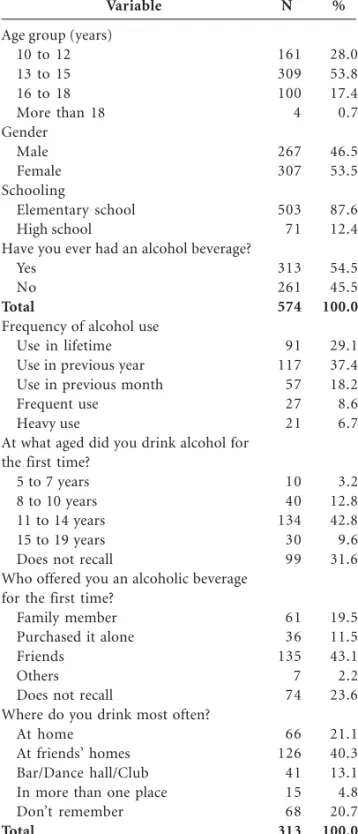
A total of 574 schoolchildren participated in the present study. Twenty-two individuals refused to participate, corresponding to a loss rate of 3.7%. Table 1 displays the characterization of the sam-ple with regard to age, gender, schooling and
al-cohol use. The majority of the adolescents were between 13 to 15 years (53.8%), female (53.5%) and attended elementary school (87.6%). A total of 54.5% had experimented with alcohol, 6.7% of whom made heavy use of this substance. The largest portion of the sample began drinking
be-Variable
Age group (years) 10 to 12 13 to 15 16 to 18 More than 18 Gender
Male Female Schooling
Elementary school High school
Have you ever had an alcohol beverage? Yes
No
Total
Frequency of alcohol use Use in lifetime Use in previous year Use in previous month Frequent use
Heavy use
At what aged did you drink alcohol for the first time?
5 to 7 years 8 to 10 years 11 to 14 years 15 to 19 years Does not recall
Who offered you an alcoholic beverage for the first time?
Family member Purchased it alone Friends
Others Does not recall
Where do you drink most often? At home
At friends’ homes Bar/Dance hall/Club In more than one place Don’t remember
Total
N
161 309 100 4
267 307
503 71
313 261
574
91 117 57 27 21
10 40 134 30 99
61 36 135 7 74
66 126 41 15 68
313 %
28.0 53.8 17.4 0.7
46.5 53.5
87.6 12.4
54.5 45.5
100.0
29.1 37.4 18.2 8.6 6.7
3.2 12.8 42.8 9.6 31.6
19.5 11.5 43.1 2.2 23.6
21.1 40.3 13.1 4.8 20.7
100.0
Table 1. Characterization of sample, distribution
Granville-Garcia AF
tween 11 and 14 years of age (42.8%). Friends offered alcoholic beverages the first time (43.1%) and were the most frequent form of company during alcohol consumption (40.3%).
A total of 26.3% had purchased alcoholic bev-erages personally. The most cited location of pur-chase was the supermarket (45.7%). Beer was the most often cited type of alcohol (43.8%) and 29.7% drank three or more glasses (Table 2).
In the bivariate analysis, experience with alco-hol was associated with age group, religion, type of religion, schooling, scholastic delay, number of days absent from school and work (Table 3).
Significant associations were found between the use of alcoholic beverages and relationship with one’s father, relationship with one’s mother and relationship between parents (Table 4).
After the adjustment of the model, the risk of drinking was greater among those participants between 16 and 19 years of age, those without religion and those with a fair/poor relationship with their father (Table 5).
Discussion
Alcohol is the first psychotropic substance con-sumed by children and adolescents and abuse of this drug can have a negative effect on develop-ment10. High alcohol intake in this phase of like
and the consequences of this practice constitute a phenomenon seen worldwide8,21.
In the present study, 54.5% of the adolescents had contact with alcoholic beverages. Despite the high prevalence, this figure is lower than that found in the recent Brazilian National School Health Survey, which reports a prevalence value of 71.4% among adolescent schoolchildren10.
Analyzing the frequency of use, 8.6% and 6.7% of those who had contact with alcohol made fre-quent and heavy use of this substance, respec-tively. The high consumption of alcohol among adolescents has been reported in a number of studies, with prevalence values ranging from 3.3% to 16.4%2,6,8,12,15,22,23. Moreover, one cannot
dis-count the possibility of the occurrence of infor-mation bias, as a stigma is attached to alcohol use due to the fact that it is illegal for minors. It is therefore possible that this practice was under-reportEdição. However, the self-administered questionnaire with the assurance of anonymity may have minimized this possibility.
The lowest age reported regarding the first experimentation with alcohol was five years and the most common age range at which alcohol was first used was between 11 and 14 years. The in-creasingly earlier initiation into alcohol use has been described in previous studies8,10,13,23. These
findings underscore the need for educational and prevention programs in the school setting aimed at combating alcohol use beginning at an early age, as occurs with anti-smoking campaigns in schools.
The influence of friends was clearly expressed when the participants were asked who offered alcoholic beverages the first time and the loca-tion at which they drank with greater frequency. A possible explanation for this is the need for acceptance and the imitation of habits practiced by peers, which are common aspects of adoles-cence. Similar circumstances are reported in the literature4,24,25.
In Brazil, the sale of alcoholic beverages to minors is prohibited by Article 243 of the Child and Adolescent Statute (Law 8.069/9026) and
ar-ticle 63 of the Penal Misdemeanors Law. More-over, prohibiting the sale of alcohol to minors is among the measures proposed by the World Health Organization for reducing alcohol
con-Variable
Have you ever personally bought an alcoholic beverage? No
Tried but was not successful Yes
Total
Where have you purchased alcoholic beverages? Supermarket
Bar/Club/Party Others Bar/Mini Mart
Total
What type of alcoholic beverage do you usually drink? Beer
Wine
Hard cider or sparkling white wine Liqueur
Cachaça/Whiskey/Vodka/Brandy Rum
More than one type of beverage
How many glasses did you have the last time you drank? Just a sip
Less than one glass 1 to 2 glasses 3 glasses 4 or more glasses
Total
n
407 16 151
574
69 59 17 6
151
137 65 26 7 28 2 48
83 85 52 23 70
313 %
70.9 2.8 26.3
100.0
45.7 39.1 11.3 4.0
100.0
43.8 20.8 8.3 2.2 8.9 0.6 15.3
26.5 27.2 16.6 7.3 22.3
100.0
Table 2. Distribution of participants according to purchasing of
sumption among this portion of the population27.
Nonetheless, 26.3% of the participants reported purchasing alcoholic beverages personally and 45.7% of these individuals bought the substance from supermarkets. The lack of monitoring the sale of alcoholic beverages to minors is a prob-lem reported in other countries as well28.
Beer was the most often cited type of alco-holic beverage (43.8%), as reported in previous studies involving this age group29. In this respect,
it seems that adolescents are influenced by the media and tend to associate alcohol intake with pleasure28. There is no rigorous control in Brazil
regarding the times alcoholic beverages are ad-vertised on television, which may contribute to this influence. Moreover, young people tend not to associate beer with alcoholism16.
Based on restrictive measures regarding the sale of alcohol to minors, there is a tendency to-ward binge drinking among adolescents, which
Variable
Age group 10 to 12 13 to 15 16 to 19 Gender
Male Female
Do you have religion? Yes No Which religion? None Catholic Evangelist Other Schooling Elementary school High school Scholastic delay None 1 to 2 years 3 or more years Number of absences from school in previous 30 days
None 1 to 3 4 to 8 9 or more Do you work?
No
Yes, formally Yes, informally Practice of sports
Yes No Total group N 57 178 78 157 156 203 110 110 127 72 4 260 53 98 151 64 190 95 14 14 261 3 49 191 122 313 % 35.4 57.6 75.0 58.8 50.8 50.4 64.3 64.3 57.5 42.1 36.4 51.7 74.6 43.4 58.8 70.3 50.7 60.1 56.0 87.5 52.0 75.0 72.1 56.8 51.3 54.5 Yes N 104 131 26 110 151 200 61 61 94 99 7 243 18 128 106 27 185 63 11 2 241 1 19 145 116 261 % 64.6 42.4 25.0 41.2 49.2 49.6 35.7 35.7 42.5 57.9 63.6 48.3 25.4 56.6 41.2 29.7 49.3 39.9 44.0 12.5 48.0 25.0 27.9 43.2 48.7 45.5 No p-value
p(1)< .001*
p(1) = 0.055
p(1) = .002*
p(1) < .001*
p(1) < .001*
p(1) < .001*
p(1) = .010*
p(2) = .003*
p(1) = 0.186
*: Significant association to 5.0% level; **: Not possible to determine due to very low frequencies; (1): Pearson’s chi-squared test; (2): Fisher’s exact test N 161 309 104 267 307 403 171 171 221 171 11 503 71 226 257 91 375 158 25 16 502 4 68 336 238 574 % 100.0 100.0 100.0 100.0 100.0 100.0 100.0 100.0 100.0 100.0 100.0 100.0 100.0 100.0 100.0 100.0 100.0 100.0 100.0 100.0 100.0 100.0 100.0 100.0 100.0 100.0 Total
OR (95% CI)
1.00 2.48 (1.67 to 3.68) 5.47 (3.16 to 9.48)
1.38 (0.99 to 1.92) 1.00
1.00 1.78 (1.23 to 2.57)
3.16 (0.89 to 11.21) 2.36 (0.67 to 8.31) 1.27 (0.36 to 4.51)
1.00
1.00 2.75 (1.57 to 4.83)
1.00 1.86 (1.30 to 2.67) 3.10 (1.84 to 5.21)
** ** ** ** ** ** **
1.25 (0.90 to 1.75) 1.00
Table 3. Bivariate analysis of socio-demographic variables, religion, practice of sports and experience with
alcohol. Campina Grande-PB, 2012.
Granville-Garcia AF
is characterized by four or more drinks for fe-males and five or more drinks for fe-males on a single occasion30. In the United States, 90% of
youths demonstrate this behavior31. A study
car-ried out in Brazil reports that 11.37% of the schoolchildren surveyed exhibited this type of behavior once a week and 1.65% participated in binge drinking nearly every day22. In the present
study, 22.3% of those who had experimented with alcohol exhibited this behavior. It should be stressed that binge drinking can lead to alcohol intoxication and an increase in the incidence of stroke32. This type of behavior has also been
as-sociated with an increase in violence, cigarette smoking, illicit drug use, traffic accidents, risky sexual behavior, depression and suicide30,31,33.
The literature reports associations between alcohol intake and age group, gender, religion, level of schooling, scholastic problems (scholas-tic delay, number of absences from school in pre-vious 30 days), financial autonomy, the practice
of sports and familial problems15. In the present
study, however, the adjusted model revealed that only the following variables were associated with alcohol intake: age group, type of religion, work and relationship with one’s father.
Students between 16 and 19 years of age were at greater risk for alcohol use (OR = 4.44; 95% CI: 2.81-7.86; p < 0.001), which corroborates findings reported in previous studies1. It appears
that familial monitoring is reduced with the in-crease in the age of adolescents and independence and increased confidence may be possible causes of a greater propensity toward drinking.
Based on findings reported in previous stud-ies, greater alcohol consumption was expected among the male gender22,30,34.However, this
gen-der predilection was not found in the present study, which is in agreement with findings de-scribed in a previous study conducted in south-ern Brazil1. Moreover, similarity in alcohol
in-take between genders is reported in a national
Variable
Relationship with father Good
Fair Poor
Relationship with mother Good
Fair Poor
Relationship between parents Do not live together Good
Fair Poor Father’s profile
Authoritarian Moderate Liberal Mother’s profile
Authoritarian Moderate Liberal
Total group
N
254 49 10
277 32 4
74 197 37 5
115 150 48
114 128 71
313 %
51.3 73.1 83.3
52.6 78.0 66.7
64.9 50.5 63.8 41.7
58.4 55.4 45.3
58.5 52.7 52.2
54.5 Yes
N
241 18 2
250 9 2
40 193 21 7
82 121 58
81 115 65
261 %
48.7 26.9 16.7
47.4 22.0 33.3
35.1 49.5 36.2 58.3
41.6 44.6 54.7
41.5 47.3 47.8
45.5 No
p-value
p(1) < .001*
p(2) = .003*
p(1) = .016*
p(1) = 0.086
p(1) = 0.397
*: Significant association to 5.0% level; **: Not possible to determine due to very low frequencies; (1): Pearson’s chi-squared test; (2): Fisher’s exact test
N
495 67 12
527 41 6
114 390 58 12
197 271 106
195 243 136
574 %
100.0 100.0 100.0
100.0 100.0 100.0
100.0 100.0 100.0 100.0
100.0 100.0 100.0
100.0 100.0 100.0
100.0 Total
OR (95% CI)
**
**
**
**
**
**
2.59 (0.77 to 8.69) 1.43 (0.45 to 4.58) 2.47 (0.70 to 8.75)
1.00
1.69 (1.05 to 2.73) 1.50 (0.95 to 2.35)
1.00
1.29 (0.83 to 2.00) 1.02 (0.67 to 1.55)
1.00
Table 4. Bivariate analysis of relationship with parents, relationship between parents, parents’ profile and
experience with alcohol. Campina Grande-PB, 2012.
survey35. This may reflect greater permissiveness
regarding alcohol use on the part of the female gender1. On the other hand, one must bear in
mind that adolescence is a difficult period of con-flicts in which bio-psychosocial changes occur and youths are prone to having new experiences, regardless of gender36.
It is believed that practicing a religion binds individuals to a group with shared values and norms, in which there is an explicit condemna-tion of drug use37. In the present study,
adoles-cents who reported having no religion were at greater risk for alcohol use (OR = 4.36; 95% CI: 1.10-17.09; p = 0.002). Although the participants were not asked whether they practiced their reli-gion, it seems that belief in religious values alone may have had a positive influence over these ad-olescents. Previous studies report religious atti-tudes as a protective factor against alcohol
use15,37,38.In the present study, adolescents
per-taining to an evangelist church had a lower risk of alcohol consumption (OR = 1.97; 95% CI: 0.51-7.71; p = 0.002). This is in agreement with a na-tional study that reports that evangelist adoles-cents are more conservative and tend to drink less alcohol39.
Authors report a higher level of schooling as a risk factor for alcohol use39. However, despite
the association between these variables in the bi-variate analysis, level of schooling did not remain associated with alcohol use in the final model. It is therefore likely that the level of schooling is dependent upon age, which remained associated with alcohol use39.
Regarding scholastic delays, studies indicate a weak association or an absence of an associa-tion between this variable and alcohol use1,34. In
agreement with such findings, no association was detected between scholastic delay and alcohol use in the present study. It is likely that the lack of scholastic yield is associated with the need to work, as the sample was composed exclusively of pub-lic school students, with a consequently less priv-ileged socioeconomic status and possibly a need to work. Truancy on the part of adolescents who make use of alcohol has been reported in the lit-erature1,5,10,15. In the present study, however, the
number of absences in the previous 30 days lost its significance in the model after controlling for confounding variables. Similar to what occurred regarding scholastic delays, it is likely that anoth-er aspect, such as having a job, may have
influ-Variable
Age group 10 to 12 13 to 15 16 to 19 Religion
None Catholic Evangelist Other
N° of absences in 30 days
None 1 to 3 4 or more Work
Yes No
Relationship with father Good
Fair/poor
Relationship with mother Good
Fair/poor
OR in bivariate analysis (95% CI)
1.00 2.48 (1.67 to 3.68) 5.47 (3.16 to 9.48)
3.16 (0.89 to 11.21) 2.36 (0.67 to 8.31) 1.27 (0.36 to 4.51)
1.00
1.00 1.47 (1.00 to 2.14) 2.10 (1.05 to 4.17)
2.40 (1.39 to 4.14) 1.00
1.00 2.80 (1.64 to 4.79)
1.00 2.95 (1.47 to 5.93)
p-value
p < 0.001*
p = 0.002*
p = 0.128
p = 0.012*
p= 0.010*
p = 0.116
Table 5. Adjusted analysis of variables studied and alcohol use. Campina Grande-PB, 2012.
Adjusted OR (95% CI)
1.00 2.14 (1.42 to 3.22) 4.44 (2.51 to 7.86)
4.36 (1.10 a17.09) 3.44 (0.88 13.36) 1.97 (0.51 to 7.71)
1.00
1.00 1.43 (0.95 to 2.15) 1.65 (0.78 to 3.47)
2.13 (1.18 to 3.83) 1.00
1.00 2.18 (1.21 to 3.94)
1.00 1.86 (0.86 to 4.06)
Granville-Garcia AF
enced this variable, as absence from school may reflect a necessity to work40.
Adolescents who held jobs were at greater risk for alcohol use (OR = 2.13; 95% CI: 1.18-3.83; p = 0.012). Financial independence and increased contact with adults in the workplace are reported to be possible causal factors of alcohol intake among working adolescents15,22. Moreover, the
stress caused by labor activities as well as parties and leisure activities in the company of work-mates may also play an important role.
As reported in previous studies1,41, no
associ-ation was found between the practice of sports and alcohol use. This is likely due to the negative effects alcohol can have on physical endurance and strength42.
Having a fair/poor relationship with one’s father denoted a greater risk for alcohol use (OR = 2.18; 95% CI: 1.21-3.94; p = 0.010). Authoritar-ian parental attitudes and a poor relationship with one’s father are reported to have a positive association with alcoholism in adolescence15,43,44.
Despite the importance of mothers in the nuclear family and the fact that they are very often re-sponsible for transmitting societal values22, the
influence of the relationship with one’s mother lost its significance in the analysis in the present study. Studies report that a united family, the fol-lowing of familial values, the discussion of prob-lems at home and parental monitoring are pro-tective factors against exposure to alcohol10,23,25,45,
suggesting that the family plays an important role in controlling substance abuse.
It should be stressed that alcohol is one of the most consumed drugs in the country and causes considerable harm to the Brazilian population. However, preventive measures have been incon-sistent, which has allowed increasingly sophisti-cated advertising campaigns to promote the con-sumption of this substance46.
The results of the present study underscore the complexity of this issue and the need to pay particular attention to the adolescent population. Prohibitive national measures in recent decades have had little effect. Public policies with preven-tive educational campaigns are needed, but alone are not sufficient. Therefore, complementary
in-terventions involving individuals and the environ-ment in which they live are necessary46. Support
from one’s family, school and society is essential to combating early alcohol use and its consequenc-es. Considerable progress has been made in rela-tion to tobacco use, as there has been a clear re-duction in smoking over the years. Similar progress could be made in relation to alcohol use among adolescents. These issue merit deep reflec-tion, as there has been an increase in alcohol use among youths over the years in Brazil, which has been associated with an increase in the prevalence of disease as well as traffic accidents, violence and a consequent increase in the risk of death46,47.
Considering the few studies on this topic, there is a need for periodic population-based investi-gations in different regions of Brazil, which could increase the capacity for monitoring alcohol use and further contribute to the discussion on this issue34. In this regard, the findings of the present
study can contribute to outlining programs aimed at reducing alcohol consumption in ado-lescence, which is a vulnerable period of life with regard to experimentation with both licit and il-licit drugs, especially alcohol and tobacco36.
Despite the limitations imposed by the cross-sectional study design, which does not allow the determination of causality, the present study of-fers a representative profile of alcohol intake among adolescent schoolchildren in the city of Campina Grande in northeastern Brazil. Further studies are needed to broaden knowledge regard-ing this serious public health problem.
Conclusion
Collaborations
MA Clementino, GLA Ribeiro, NCM Gomes and Firmino RT participated in the literature review, methodology, analysis and discussion of the data and drafting the article; MBLD Smith participat-ed in the analysis and discussion of data, draft-ing and correction of the article; AF Granville-Garcia devised directed and coordinated the study, participated in the analysis and discussion of data, drafting and correcting the article.
References
Strauch ES, Pinheiro RT, Silva RA, Horta BL. Uso de alcohol por adolescentes: estudio de base po-blacional. Rev Saude Publica 2009; 43(4):647-655. Copeland WE, Angold A, Shanahan L, Dreyfuss J, Dlamini I, Costello EJ. Predicting persistent alco-hol problems: a prospective analysis from the Great Smoky Mountain Study. Psychol Med 2012; 42(9): 1925-1935.
Marsiglia FF, Ayers S, Gance-Cleveland B, Mettler K, Booth J. Beyond primary prevention of alcohol use: a culturally specific secondary prevention pro-gram for Mexican heritage adolescents. Prev Sci 2011; 13(3):241-251.
Richmond MJ, Merelstein RJ, Metzger A. Hetero-geneous friendship affiliation, problem behaviors, and emotional outcomes among high-risk adoles-cents. Prev Sci 2012; 13(3):267-277.
Doku D, Koivusilta L, Rimpelä A. Socioeconomic differences in alcohol and drug use among Ghana-ian adolescents. Addict Behav 2011;13(3):357-360. Lee C, Rose JS, Engel-Rebitzer E, Selya A, Dierker L. Alcohol dependence symptoms among recent onset adolescent drinkers. Addict Behav 2011; 36(12):1160-1167.
Hipwell A, Stepp S, Chung T, Durand V, Keenan K. Growth in alcohol use as a developmental predic-tor of adolescent girls’ sexual risk-taking. Prev Sci 2012; 13(2):118-128.
Costa JL, Troncoso ES, Gallego MP, Maza VTS, Barcenilla AC, Cubells CL, San Molina L. Perfil de los adolescentes que acuden a urgencias por in-toxicación enólica aguda. An Pediatr (Barc) 2011; 76(1):30-37.
Malta DC, Sardinha LMV, Mendes I, Barreto SM, Giatti L, Castro IRR, Moura Ld, Dias AJ, Crespo C. Prevalence of risk health behavior among adoles-cents: results from the 2009 National Adolescent School-based Health Survey (PeNSE). Cien Saude Colet 2010; 15(Supl. 2):3009-3019.
Malta DC, Mascarenhas MDM, Porto DL, Duarte EA, Sardinha LM, Barreto SM, Morais Neto OL. Prev-alence of alcohol and drug consumption among adolescents: data analysis of the National Survey of School Health. Rev Bras Epidemiol 2011; 14(1):136-146.
World Health Organization (WHO). About global alcohol database. Geneva: WHO; 2002.
Hodder RK, Daly J, Freund M, Bowman J, Hazell T, Wiggers J. A school-based resilience interven-tion to decrease tobacco, alcohol and marijuana use in high school students. BMC Public Health 2011; 11:722.
Fraga S, Sousa S, Ramos E, Dias S, Barros H. Alcohol use among 13-year-old adolescents: asso-ciated factors and perceptions. Public Health 2011; 125(7):448-456.
Caetano R, Babor T. Diagnosis of alcohol depen-dence in epidemiological surveys: an epidemic of youthful alcohol dependence or a case of measure-ment. Addiction 2006; 101(1):111-114.
1.
2.
3.
4.
5.
6.
7.
8.
9.
10.
11. 12.
13.
Granville-Garcia AF
Galduróz JC, Sanchez ZM, Opaleye ES, Noto AR, Fonseca AM, Gomes PLA, Carlini EA. Factores aso-ciados al uso pesado de alcohol entre estudiantes de las capitales brasileras. Rev Saude Publica 2010; 44(2):267-273.
Faria R, Vendrame A, Silva R, Pinsky I. Propaganda de alcohol y asociación al consumo de cerveza por adolescentes. Rev Saude Publica 2011; 45(3):441-447. Instituto Brasileiro de Geografia e Estatística (IBGE). Primeiros resultados do Censo 2010. [página na Inter-net]. [cited 2010 May 30]. Available from: http:// www.censo2010.ibge.gov.br/dadosdivulgados/index. php?uf=25.
Galduróz JC, Noto AR, Nappo SA, Carlini EA. Use of psychotropic drugs in Brazil: household survey in the 107 biggest Brazilian cities-2001. Rev Lat Am Enfermagem 2005; 13(Spec issue):888-895. Frankfort-Nachimias C, Nachimias D. Research methods in the social sciences. 4th Edition. London: Edward Arnold; 1992.
Brasil. Resolução 196, de 10 de outubro de 1996. Diretrizes e Normas Regulamentadoras de Pesqui-sas Envolvendo Seres Humanos. Diário Oficial da União 1996; 12 out.
Malone PS, Northrup TF, Masyn KE, Lamis DA, Lamont AE. Initiation and persistence of alcohol use in United States black, Hispanic, and white male and female youth, Addict Behav 2012; 37(3):299-305. Campos JA, Almeida JC, Garcia PPNS, Faria JB. Alcohol consumption among high school students in the municipality of Passos - MG. Cien Saude Colet 2011; 16(12):4745-4754.
Cordova D, Huang S, Pantin H, Prado G. Do the effects of a family intervention on alcohol and drug use vary by nativity status? Psychol Addict Behav 2012; 26(3):655-660.
Duncan AE, Agrawal A, Bucholz KK, Sartor CE, Madden PAF, Heath AC. Deconstructing the archi-tecture of alcohol abuse and dependence symp-toms in a community sample of late adolescent and emerging adult women: An item response approach. Drug Alcohol Depend 2011; 116(1-3):222-227. Manrique-Abril FG, Ospina JM, Garcia-Ubaque JC. Children and adolescents’ alcohol and tobacco consumption in Tunja, Colombia. Rev Salud Publi-ca 2011; 13(1):89-101.
Brasil. Lei 8.069, de 13 de julho de 1990. Dispõe sobre o Estatuto da Criança e do Adolescente e dá outras providências. Diário Oficial da União 1990; 16 jul.
Romano M, Duailib S, Pinsky I, Laranjeira R. Alco-hol purchase survey by adolescents in two cities of State of Sao Paulo, Southeastern Brazil. Rev Saude Publica 2007; 41(4):495-501.
Freisthler B, Gruenewald PJ, Treno AJ, Lee J. Eval-uating alcohol access and the alcohol environment in neighborhood areas. Alcohol Clin Exp Res 2003; 27(3):477-484.
Perera B, Torabi M, Kay NS. Alcohol use, related problems and psychological health in college stu-dents. Int J Adolesc Med Health 2011; 23(1):33-37. Miller JW, Naimi TS, Brewer RD, Jones SE. Binge drinking and associated health risk behaviors among high school students. Pediatrics 2007; 119(1):76-85. Brewer RD, Swahn MH. Binge drinking and violence. JAMA 2005; 294(5):616-618.
15.
16.
17.
18.
19.
20.
21.
22.
23.
24.
25.
26.
27.
28.
29.
30.
31.
Puddey IB, Rakic V, Dimmitt SB, Beilin LJ. Influ-ence of pattern of drinking on cardiovascular dis-ease and cardiovascular risk factors: a review. Ad-diction 1999; 94(5):649-663.
Kwan MY, Cairney J, Faulkner GE, Pullenayegum EE. Physical activity and other health-risk behaviors dur-ing the transition into early adulthood a longitudinal cohort study. Am J Prev Med 2012; 42(1):14-20. Horta RL, Horta BL, Pinheiro RT, Morales B, Strey MN. Tobacco, alcohol, and drug use by teenagers in Pelotas, Rio Grande do Sul State, Brazil: a gender approach. Cad Saude Publica 2007; 23(4):775-783. Carlini EA, Galduróz JCF, Silva AAB, Noto AR, Fonseca AM, Carlini CM, Oliveira LC, Nappo SA, Moura YG, Sanchez ZvM. II Levantamento domi-ciliar sobre o uso de drogas psicotrópicas no Brasil: estudo envolvendo as 108 maiores cidades do país, 2005. Brasília: SENAD; 2007.
Sampaio Filho FJL, Sousa PRM, Vieira NFC, Nóbre-ga MFB, Gubert FA, Pinheiro PNC. Perception of risk of school adolescents in relation to alcohol consumption and sexual behavior. Rev Gaucha En-ferm 2010; 31(3):508-514.
Gryczynski J, Ward BW, Social norms and the rela-tionship between cigarette use and religiosity among adolescents in the United States. Health Educ Behav 2011; 38(1):39-48.
Haber JR, Grant JD, Jacob T, Koenig LB, Heath A. Alcohol milestones, risk factors, and religion/spir-ituality in young adult women. J Stud Alcohol Drugs 2012; 73(1):34-43.
Moreno RS, Ventura RN, Brêtas JR. The use of al-cohol and tobacco by adolescents in the munici-pality of Embu, São Paulo, Brazil. Rev Esc Enferm USP 2010; 44(4):969-977.
Noal RB, Menezes AMB, Araújo CL, Hallal PC. Ex-perimental use of alcohol in early adolescence: the 11-year follow-up of the 1993 Pelotas (Brazil) birth cohort study. Cad Saude Publica 2010; 26(10):1937-1944.
Tavares BF, Beria JU, Lima MS. Factors associated with drug use among adolescent students in south-ern Brazil. Rev Saude Publica 2004; 38(6):787-796. Rodrigues ESR, Cheik NC, Mayer AF. Level of phys-ical activity and smoking in undergraduate students. Rev Saude Publica 2008; 42(4):672-678.
Piko BF, Balázs MA. Authoritative parenting style-and adolescent smoking style-and drinking. Addict Be-hav 2012; 37(3):353-356.
Malbergier A, Cardoso LRD, Amaral RA. Adolescent substance use and family problems. Cad Saude Pub-lica 2012; 28(4):678-688.
Schenker M, Minayo MCS. Risk and protective fac-tors and drug use among adolescence. Cien Saude Colet 2005; 10(3):707-717.
Noto AR, Galduróz JCF. O uso de drogas psicotrópi-cas e a prevenção no Brasil. Cien Saude Colet 1999; 4(1):145-151.
Galduróz JCF, Noto AR, Nappo SA, Carlini EA. Trends in drug use among students in brazil: anal-ysis of foru surveys in 1987, 1989, 1993 and 1997. Braz J Med Bio Res 2004; 37(4):523-531.
Artigo apresentado em 18/08/2012 Aprovado em 21/10/2012
Versão final apresentada em 30/10/2012 32.
33.
34.
35.
36.
37.
38.
39.
40.
41.
42.
43.
44.
45.
46.