Original Article
Artigo Original
Preparation and applicability of a test of
speech perception with pictures
Construção e aplicabilidade de um teste de
percepção de fala com figuras
Laís Flavia de Souza1 Gabriela Rosito Alvarez Bernardez
Braga2 Ana Lúcia Rios Mota2 Nelma Ellen Zamberlan-Amorim3 Ana Cláudia Mirândola Barbosa Reis1
Keywords
Auditory Perception Child Hearing Audiology Speech, Language and Hearing
Sciences
Descritores
Percepção Auditiva Criança Audição Audiologia Fonoaudiologia
Correspondence address:
Ana Cláudia Mirândola Barbosa Reis Departamento de Oftalmologia, Otorrinolaringologia e Cirurgia de Cabeça e Pescoço
Avenida Bandeirantes, 3900, Monte Alegre, Ribeirão Preto (SP), Brazil, CEP: 14049-900.
E-mail: [email protected]
Received: March 27, 2015
Accepted: November 02, 2015 Study carried out at Curso de Fonoaudiologia, Centro Integrado de Reabilitação do Hospital Estadual de Ribeirão
Preto, Faculdade de Medicina de Ribeirão Preto – FMRP, Universidade de São Paulo – USP - Ribeirão Preto (SP), Brazil
1Universidade de São Paulo – USP - Ribeirão Preto (SP), Brazil. 2Hospital Estadual de Ribeirão Preto - Ribeirão Preto (SP), Brazil.
3Hospital das Clínicas, Faculdade de Medicina de Ribeirão Preto – FMRP - Ribeirão Preto (SP), Brazil.
Financial support: Programa de Iniciação Cientíica Institucional/RUSP. Conlict of interests: nothing to declare.
ABSTRACT
Purpose: To prepare and apply support material for responses to the Speech Recognition Percentage Index (SRPI) test in children. Methods: This is a descriptive, exploratory study conducted in two phases: in the irst phase,
31 speech-language pathologists (referees) prepared material composed of regular, frequently used monosyllabic
and disyllabic words belonging to the vocabulary of children and igures that could represent these words; the
second phase consisted in the application of this material to 30 normal-hearing children aged 2 to 4 years and 11 months. Results: The material consisted of 25 words and six boards with six igures each. The word selection
criterion adopted by the referees included the initial phoneme and real, colorful igures familiar to the children. The mean scores of the children in the SRPI test were 93% (SD ± 8%) with the support of igures and 64% (SD ± 25%) without igure support. Comparison between the results obtained with and without the support of igures showed signiicant difference for 15 of the 25 test words, with higher scores with the use of supporting igures. Comparison between correct and incorrect responses using the support of igures showed signiicant
difference only for the word “dog” (“cão”) (p=0.0079). Conclusion: There was agreement among the referees
with respect to the words and igures. The SRPI test can be rapidly and easily applied, allowing evaluation and
systematic monitoring of speech perception ability regardless of child verbalization capacity.
RESUMO
Objetivo: construir e aplicar um material de apoio para respostas ao teste do índice percentual de reconhecimento de fala em crianças. Método: estudo descritivo exploratório. A primeira etapa, elaboração de um material, foi realizada pela avaliação de 31 fonoaudiólogos (juízes), com palavras monossílabas e dissílabas, regulares
e frequentes, que pertencem ao vocabulário das crianças e iguras que pudessem representar essas palavras.
A segunda etapa constituiu-se da aplicabilidade do material em 30 crianças na faixa etária de 2 a 4 anos e 11 meses, com audição normal. Resultados: o material foi constituído por 25 palavras e seis pranchas com
seis iguras. As palavras selecionadas pelos fonoaudiólogos tiveram como critério o fonema inicial e iguras reais, coloridas e próximas do cotidiano das crianças. A média de acertos apresentada pelas crianças no índice percentual de reconhecimento de fala com apoio das iguras foi de 93% (± 8% desvio padrão) e sem, de 64% (± 25% desvio padrão). Ao comparar os resultados obtidos com e sem o apoio das iguras, observou-se diferença signiicativa para 15 das 25 palavras do teste, sendo maior o número de acertos quando se utilizou com apoio de iguras. Na comparação entre os acertos e erros obtidos no teste, utilizando as iguras como apoio, houve diferença signiicativa apenas para a palavra “cão” (p=0,0079). Conclusão: houve concordância entre os juízes
em relação às palavras e iguras; a aplicação foi rápida e fácil, possibilitando a avaliação e o monitoramento
INTRODUCTION
Basic audiological assessment comprises pure-tone threshold audiometry and speech perception tests that evaluate since the ability of individuals to perceive sound with minimal intensity (Voice Detection Threshold - VDT and Speech Reception Threshold - SRT) to the ability of recognizing words (Speech Recognition Percentage Index - SRPI), expressed in percentage of correct responses to words. Word recognition tests are of great
importance in audiological diagnostics. To ensure eficiency, the
hearing assessment of an individual should not be restricted to the ability to perceive pure tones, as in pure-tone audiometry, because speech recognition cannot be presumed by pure-tone thresholds, which makes logoaudiometry (speech discrimination) an essential clinical tool(1).
Speech recognition tests commonly use the verbal responses given by individuals to infer auditory input; however, when used with small children or individuals who do not master the oral code, this procedure hinders the interpretation of responses, because these children use phonological processes to simplify their speech, or simply cannot verbalize.
Phonological processes are used to simplify the phonological rules involving sequences of sounds in the pronunciation of words to approach their correct pronunciation(1,2). When present,
phonological processes hamper the interpretation of the results of speech perception tests, considering that these tests require correct production of sounds for scoring, preventing examiners from distinguishing whether the child auditorily recognizes or
not the word and/or phoneme being assessed.
In clinical practice, during the application of audiological tests, most professionals perform the SRPI test in children
under 5 years of age, and often ind dificulties related to test
application because the process of acquisition of phonemes occurs in this age range. In this situation, results obtained without graphic support often do not correspond to the actual auditory speech recognition ability of this population. The lack
of standardized igures also hinders the systematization of
results and, consequently, the monitoring of child auditory perception development, especially in the presence of speech
and/or hearing disorders.
The national literature describes speech perception tests with the use of words and sentences(3-5), but does not report graphic
material with igures to conduct the SRPI test in children.
The international literature presents studies on speech perception
tests that consider the dificulty in the choice of vocabulary and
form of test presentation(6,7).
The preparation of a speech perception assessment tool
should consider whether the words and/or igures are known
by the children in order to ensure that they understand and
recognize the igure being used, thus preventing them from pointing any igure because they ignore it, interfering with the
evaluation results and producing distortions in the interpretation of these data.
The objective of this study was to prepare and verify the
applicability of support material using igures for responses to
the SRPI test in children according to gender and age.
METHODS
The present study was approved by the Research Ethics Committee of the institution where it was conducted - a hospital of high complexity care in the state of Sao Paulo - under protocol
no. 600/2014.
All parents/guardians of the participating children and the
speech-language pathologists were informed about the study objectives and agreed to participate by signing an Informed Consent Form (ICF) and a Child Assent Form (CAF) when necessary.
The study was designed in two phases: the irst phase
comprised the instrument development through careful analysis
of the words and igures to be used in the Speech Recognition
Percentage Index (SRPI) test - the material was evaluated by a panel of referees, 31 speech-language pathologists with expertise and clinical experience in the theme area; the second phase consisted in the instrument application to 30 normal-hearing children without complaints of changes in language acquisition
and/or development.
Preparation of the instrument
In the irst phase of this research, monosyllabic and disyllabic words were searched in articles from the speciic literature(3-4).
These words were selected based on the following criteria: 1) being able to be represented graphically; 2) belong to the children’s vocabulary, avoiding unfamiliar words and incoherent
igures; and 3) occurrence of Brazilian Portuguese consonant
and vowel phonemes in syllable onset regardless of the syllabic and stress patterns, considering that the purpose of the study was to evaluate whether the children perceived the sounds of the Portuguese language auditorily, and not to assess the speech performance of these individuals, limiting the number of words to 25, which corresponds to the number used in well-known speech recognition tests.
Ninety words were selected, but only 65 were in accordance with the three adopted criteria and were, therefore, included in the study.
The survey of igures that could represent the words chosen
was conducted through Google search engine at public domain websites Pixabay(8) and Shutterstock(9).
After selection of the words and igures to compose the material, a irst version of the instrument was created with at least
one word of regular use (phoneme-grapheme correspondence) and more frequently used words, according to the referees’
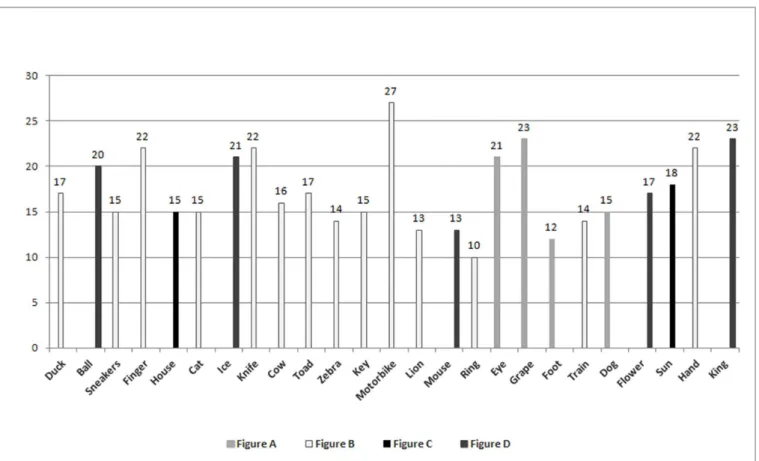
perception, and their respective igures - four for each word: two igures with real representation of the word (Figure 1A, B) and two with drawing representation (Figure 1C, D).
After preparation of the material and with the objective of
selecting the words and igures, 31 speech-language pathologists were invited to conduct an assessment of the irst version of
group with ≥20 years of experience (39%), followed by ten to
20 years (11.35%), and three to nine years (8.26%).
The referees had at least a degree in graduate studies; therefore, all of them had already attended a specialization, improvement, or development course and 71% had a strict sensu degree (master’s and/or doctorate). Most of them worked
in the area of Audiology (15%), followed by Language (10%), Oropharyngeal Dysphagia (4%), Orofacial Motricity (5%), Public Health (3%), Voice (3%), and Stuttering (2%). Most of these speech-language pathologists worked preferably with children (26%).
By means of a questionnaire divided into three situations:
identiication, evaluation of the list of words, and assessment of the list of igures, the referees were requested choose from
the “list of monosyllabic and disyllabic words” those they
considered appropriate for the material and the igure that
best represented the selected word from the boards containing
four igures. The researchers did not mention any criterion of
choice and did not demand an exact number of words, aiming to identify, spontaneously, the most common choice for both
the words and the igures.
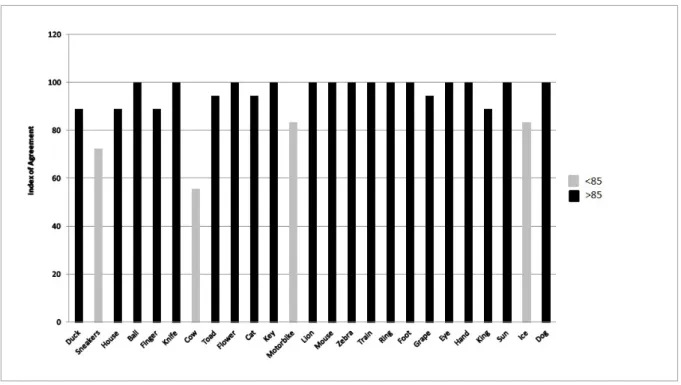
To quantify the degree of agreement among the speech-language pathologists during the revaluation process of the produced material, the percentage of agreement was used adopting values higher than 85%(10).
Based on the evaluation performed by the speech-language pathologists (referees), the study researchers prepared the second
version of the material, which was composed of 25 words with
their corresponding igures.
All real and/or drawing igures with percentage of agreement
higher than 85% were maintained, whereas those with an index lower than 85% were replaced following the suggestions of the
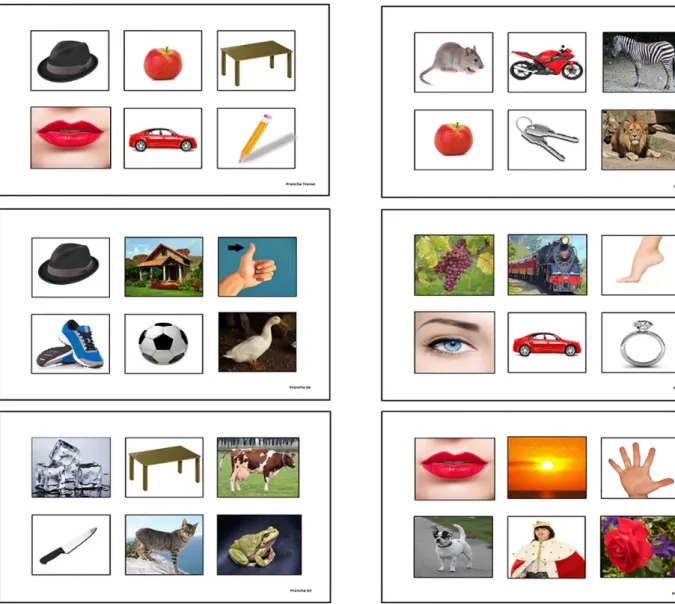
participating referees. Finally, the boards were deined, one for training and ive for the test, all containing six igures for the test, totaling 30 igures, 25 spoken and ive (one on each board) not spoken, to ensure that identiication would not occur
by exclusion.
After performing the modiications suggested by the referees and considering each item (igure/word), the second version
of the test (25 items) was developed, which was applied to a sample of 30 children under 5 years old (Figure 2).
Applicability of the instrument
In the second phase of the research, in order to improve the material prepared for the test, we applied it to a group of normal-hearing children aged 2 to 4 years and 11 months with
no complaints of alterations in language acquisition and/or
development. The children were approached in their family environment, by the contact of the researchers, and through spontaneous demand at the audiology clinic of the institution where this study was conducted.
Considering that in this age range variation regarding the acquisition of phonemes(11) may be observed, study participants
were divided into three age groups for analysis: children aged 2 to 2 years and 11 months, 3 to 3 years and 11 months, and 4 to 4 years and 11 months.
This phase was composed of the following procedures:
free-ield ludic audiometry of all individuals in the frequencies of
500, 1K, 2K, and 4K Hz. Subsequently, the Speech Recognition Percentage Index (SRPI) test was conducted with the prepared material in an acoustically-treated room, speakerphone, 60 dBHL,
under free-ield system. Aiming to control the acoustic signal at a speciic point in space, a working distance of 60 cm between
the chair and the speaker was established in this study. We also
controlled the azimuth angle, which was ixed at 0° for binaural
sound stimulation, and the elevation angle of the incident sound for each participant as a procedure for conducting measurements
in free ield, considering that the participants were normal-hearing
individuals.
An AC40, Interacoustics, audiometer was used to record the measures. In this phase, the children were told that they would hear several words and should point to the corresponding
igures. To conduct the auditory recognition of words by means
of identiication of their corresponding igures, boards containing six igures each were provided, in which children should identify the igure that corresponded to the word spoken by the examiner.
For this procedure, a second examiner, inside the cabin, changed the boards according to the presentation of the words.
Initially, a training session was conducted with a list of six words (Figure 2 - Training Board), so that the child could
understand the test strategy and had no dificulty regarding the
stimulus or the type of response required during the procedure. The same list of words was applied under the same conditions
previously presented, but without the support of igures. Thus the
children were verbally instructed that they would hear several words and should repeat them one by one. During this procedure, a second examiner annotated the children’s responses on a registration form, and used a voice recorder as an aid for further analysis and comparison of the phonation of words. Once the data were collected and recorded, the phonetic transcription and analysis of the observed phonological processes were conducted, allowing the researchers to identify the particularity of each
child with respect to the incorrect responses given in the SRPI
test, without the support of igures.
In both procedures, the examiner applied the complete list of words, without the use of repetitions and pauses between the phonemes. Introductory phrases were used during both
procedures. For the presentation of the list of igures, the
introductory sentence “Point to the _____” was used, whereas for the list of words the sentence “Repeat the word _____” was used. For both procedures, shields were used to prevent lip reading, as in the conventional SRPI test.
To meet the proposed objectives, the following statistical analyses were conducted: the Student’s t-test was used for
independent samples, the Pearson’s correlation coeficient
was used to quantify the correlation between two quantitative variables, and the Fisher’s exact test was applied to verify
the association between gender and responses (igures or list,
for each word). All analyses were performed using the SAS
9.2 software program at 5% statistical signiicance level.
The two-way ANOVA test was used to compare the application
time of the SRPI test with and without igures at the different
age ranges.
RESULTS
The results of the present study are presented in two phases: development of the instrument and test application.
Development of the instrument
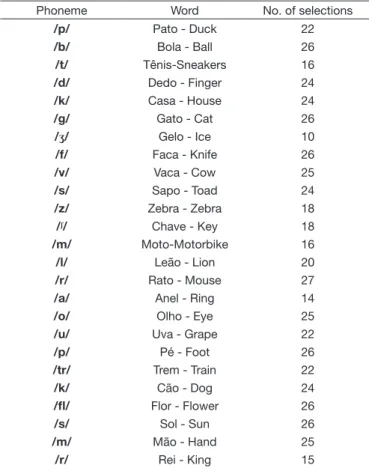
Table 1 shows the 25 most selected words and the number of speech-language pathologists (referees) that chose them. The list of words for the Speech Recognition Percentage Index (SRPI) test was prepared based on this information.
The referees showed preference for real, colorful igures that
belonged to the participants’ daily lives, as it can be observed in Figure 1.
Preference was shown for the igures of groups A and B; consequently, of the igures selected by the referees, 68% were
“real” and only 32% were “drawing” (C and D). Hence, we tried
to standardize the igures and choose the most selected among the real ones, so that all igures presented the same standard, “real” or “drawing”; the igures representing ball, house, ice,
mouse, train, sun and king, preferably chosen in the drawing
format, were replaced with the most selected igures among
the real ones.
Of the 25 inal igures, which were substituted by public domain images, four (16%) were replaced again because igures
with index of agreement lower than 85% were considered
inadequate to compose the inal material (Figure 3).
In addition to these four igures deemed inadequate (index of agreement <85%), six other igures were selected, all from
public domain websites, and reevaluated by the referees to compose the training board. The criterion used for selecting
these last six igures was the number of choices made by the
referees, that is, the most selected ones.
Thus six boards were prepared, namely, Training Board, Boards 1, 2, 3, 4 and 5 (Figure 2). For each board with six
igures, one of them, randomly positioned, was not spoken by
the examiner to prevent the child from identifying one of the
igures by exclusion, thus compromising the test reliability. Those same igures/words that were not spoken during the test
were used in the training board prior to the beginning of the assessment, ensuring that the child understood the test strategy.
Test application
All participants underwent ludic Pure-tone Threshold
Audiometry in free ield. After conirmation of auditory thresholds
within the normal range, the SRPI test was conducted with
and without the support of igures, according to the previously
described criteria.
The children’s ages ranged from 2 years and 1 month to 4 years and 11 months: 8 (26.66%) children aged 2 to 2 years and 11 months, 12 (40%) aged 3 years to 3 years 11 months, and 10 (33.33%) aged 4 to 4 years and 11 months. With respect to gender, most volunteers were boys (60%; n=18), whereas girls represented 40% (n=12) of the study sample.
With regard to mean application time, the whole procedure,
with and without the support of igures, was conducted in
5.23 min for the 2-year-old group of children, 3.81 min for the 3-year-old group, and 3.59 min for the 4-year-old group.
The SRPI test with the support of igures was applied with
mean time of 3.42 min to the 2-year-old group of children, 2.50 min to the 3-year-old group, and 2.25 min to the
4-year-old group. The SRPI test without the support of igures was
Table 1. Distribution of the most selected words, by phonemes, and the number of audiologists that have chosen them (n=31)
Phoneme Word No. of selections
/p/ Pato - Duck 22
/b/ Bola - Ball 26
/t/ Tênis-Sneakers 16
/d/ Dedo - Finger 24
/k/ Casa - House 24
/g/ Gato - Cat 26
/ӡ/ Gelo - Ice 10
/f/ Faca - Knife 26
/v/ Vaca - Cow 25
/s/ Sapo - Toad 24
/z/ Zebra - Zebra 18
/ᶴ/ Chave - Key 18 /m/ Moto-Motorbike 16
/l/ Leão - Lion 20
/r/ Rato - Mouse 27
/a/ Anel - Ring 14
/o/ Olho - Eye 25
/u/ Uva - Grape 22
/p/ Pé - Foot 26
/tr/ Trem - Train 22
/k/ Cão - Dog 24
/fl/ Flor - Flower 26
/s/ Sol - Sun 26
/m/ Mão - Hand 25
/r/ Rei - King 15
applied with mean time of 1.81 min to the 2-year-old group of children, 1.31 min to the 3-year-old group, and 1.34 min to the 4-year-old group (Table 2).
Comparison of the application times of the SRPI test with
the support of igures among the three age groups investigated showed statistically signiicant difference between the 2-year-old
participants and the other two age groups (p=0.0360 between the 2 and 3-year-old groups; p=0.0138 between the 2 and
4-year-old groups). No statistically signiicant difference was
observed regarding the application times of the SRPI test without
the support of igures among the three age groups analyzed.
Comparing the application times of the SRPI test with and
without the support of igures among the three age groups studied, the following statistical differences were identiied:
p=0.0015 for the 2-year-olds, p=0.005 for the 3-year-olds, and
p=0.0085 for the 4 year-olds (Table 2).
Association between the number of incorrect responses during the application of the SRPI test with and without the
Figure 3. Statement of the index of agreement of the Audiologists’ choices of figures/words
Table 2. Comparison between the application time of the Speech Recognition Percentage Index (SRPI) test, with and without the support of figures, for the three age groups assessed
Comparison Mean
(min)
Estimated difference
p value in the two-way
ANOVA test
L.L. U.L.
Groups in the 2-3-year age range - application of the SRPI with the support of Figures
3.42 0.9343 0.0360* 0.06750 1.8010
Groups in the 2-4-year age range - application of the SRPI with the support of Figures
2.50 1.1633 0.0138* 0.2661 2.0604
Groups in the 3-4-year age range - application of the SRPI with the support of Figures
2.25 0.2290 0.4990 –0.4665 0.9245
Groups in the 2-3-year age range - application of the SRPI without the support of Figures
1.81 0.5009 0.2012 –0.2909 1.2927
Groups in the 2-4-year age range - application of the SRPI without the support of Figures
1.31 0.4656 0.2487 –0.3533 1.2844
Groups in the 3-4-year age range - application of the SRPI without the support of Figures
1.34 –0.03535 0.9119 –0.6952 0.6245
Application time of the SRPI with and without the support of Figures - 2 years to 2 years and 11 months old
- 1.6217 0.0015* 0.7082 2.5352
Application time of the SRPI with and without the support of Figures - 3 years to 3 years and 11 months old
- 1.1883 0.0005* 0.5962 1.7805
Application time of the SRPI with and without the support of Figures - 4 years to 4 years and 11 months old
- 0.9239 0.0085* 0.2649 1.5830
*Statistically significant (p<0.05)
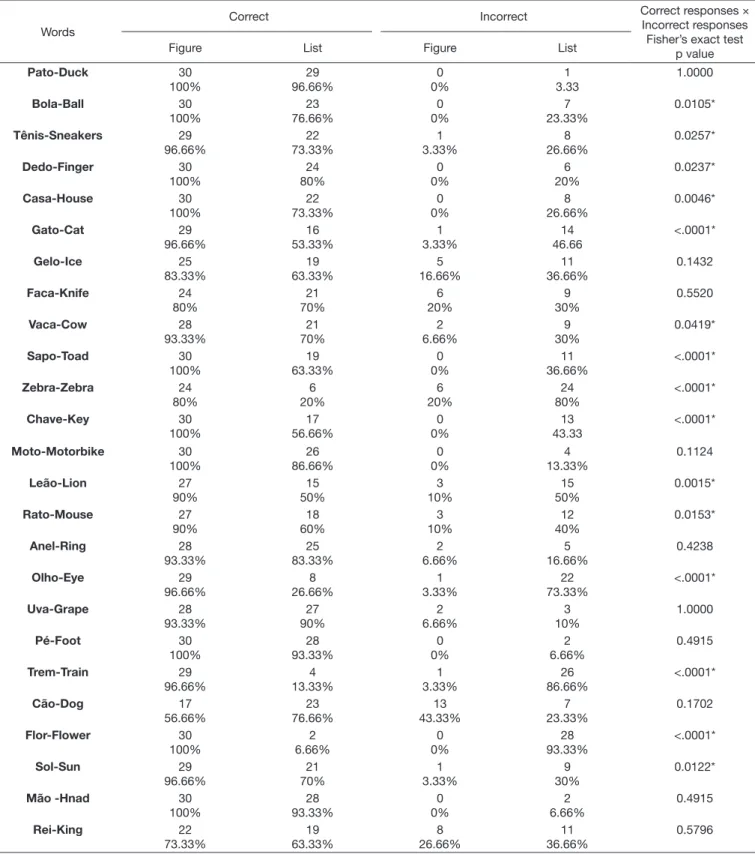
support of igures showed statistically signiicant difference for
15 of the 25 words, with higher number of correct responses
when the test was conducted with the support of igures, as
shown in Table 3.
When the SRPI test was applied with the support of igures,
the number of incorrect responses varied according to age, with
children aged 2 to 2 years and 11 months presenting 23 incorrect responses. Children aged 3 to 3 years and 11 months presented 26 incorrect responses, whereas those aged 4 to 4 years and
11 months presented only ive incorrect responses, most of them related to the identiication of the following igures: ice,
knife, zebra, dog, and king (Table 4).
Table 3. Correlation between correct and incorrect responses in the Speech Recognition Percentage Index (SRPI) test with and without the support of figures
Words
Correct Incorrect Correct responses ×
Incorrect responses Fisher’s exact test
p value
Figure List Figure List
Pato-Duck 30 100% 29 96.66% 0 0% 1 3.33 1.0000 Bola-Ball 30 100% 23 76.66% 0 0% 7 23.33% 0.0105* Tênis-Sneakers 29 96.66% 22 73.33% 1 3.33% 8 26.66% 0.0257* Dedo-Finger 30 100% 24 80% 0 0% 6 20% 0.0237* Casa-House 30 100% 22 73.33% 0 0% 8 26.66% 0.0046* Gato-Cat 29 96.66% 16 53.33% 1 3.33% 14 46.66 <.0001* Gelo-Ice 25 83.33% 19 63.33% 5 16.66% 11 36.66% 0.1432 Faca-Knife 24 80% 21 70% 6 20% 9 30% 0.5520 Vaca-Cow 28 93.33% 21 70% 2 6.66% 9 30% 0.0419* Sapo-Toad 30 100% 19 63.33% 0 0% 11 36.66% <.0001* Zebra-Zebra 24 80% 6 20% 6 20% 24 80% <.0001* Chave-Key 30 100% 17 56.66% 0 0% 13 43.33 <.0001* Moto-Motorbike 30 100% 26 86.66% 0 0% 4 13.33% 0.1124 Leão-Lion 27 90% 15 50% 3 10% 15 50% 0.0015* Rato-Mouse 27 90% 18 60% 3 10% 12 40% 0.0153* Anel-Ring 28 93.33% 25 83.33% 2 6.66% 5 16.66% 0.4238 Olho-Eye 29 96.66% 8 26.66% 1 3.33% 22 73.33% <.0001* Uva-Grape 28 93.33% 27 90% 2 6.66% 3 10% 1.0000 Pé-Foot 30 100% 28 93.33% 0 0% 2 6.66% 0.4915 Trem-Train 29 96.66% 4 13.33% 1 3.33% 26 86.66% <.0001* Cão-Dog 17 56.66% 23 76.66% 13 43.33% 7 23.33% 0.1702 Flor-Flower 30 100% 2 6.66% 0 0% 28 93.33% <.0001* Sol-Sun 29 96.66% 21 70% 1 3.33% 9 30% 0.0122*
Mão -Hnad 30
100% 28 93.33% 0 0% 2 6.66% 0.4915 Rei-King 22 73.33% 19 63.33% 8 26.66% 11 36.66% 0.5796
Table 4. Number of incorrect responses per word in the Speech Recognition Percentage Index (SRPI) test, with and without the support of figures, according to age range
Words
2 years old 3 years old 4 years old Total
Variables Incorrect response
Word × Age
SRPI SRPI SRPI SRPI Student’s t-test
p value Without
figures
With figures
Without figures
With figures
Without figures
With figures
Without figures
With figures
Without figures
With figures Pato
Duck
1 0 0 0 0 0 1 0 0.2376
-Bola Ball
5 0 2 0 0 0 7 0 0.0006*
-Tênis Sneakers
5 0 2 1 1 0 8 1 0.0035* 0.6846
Dedo Finger
4 0 1 0 1 0 6 0 0.0436*
-Casa House
5 0 2 0 1 0 8 0 0.0111*
-Gato Cat
6 1 6 0 2 0 14 1 0.0059* 0.3248
Gelo Ice
6 2 5 2 0 1 11 5 <.0001* 0.3981
Faca Knife
6 3 1 2 1 1 8 6 0.0097* 0.1567
Vaca Cow
7 1 0 1 2 0 9 2 0.0007* 0.4274
Sapo Toad
7 0 4 0 0 0 11 0 <.0001*
-Zebra Zebra
8 2 10 3 6 1 24 6 0.0446* 0.5039
Chave Key
8 0 4 0 1 0 13 0 0.0011*
-Moto Motobike
2 0 1 0 1 0 4 0 0.2852
-Leão Lion
7 1 7 2 1 0 15 3 0.0004* 0.1684
Rato Mouse
6 1 3 2 3 0 12 3 0.0717 0.4298
Anel Ring
3 1 2 1 0 0 5 2 0.0444* 0.2241
Olho Eye
8 0 9 0 5 0 22 0 0.0066* 0.1137
Uva Grape
3 1 0 1 0 0 3 2 0.0143* 0.6543
Pé Foot
2 0 0 0 0 0 2 0 0.0292*
-Trem Train
8 0 11 1 7 0 26 1 0.0709 0.6846
Cão Dog
5 6 1 6 1 1 7 13 0.0031* 0.0079*
Flor Flower
8 0 12 0 8 0 28 0 0.1538
-Sol Sun
4 1 5 0 0 0 9 1 0.0254* 0.1387
Mão Hand
1 0 1 0 0 0 2 0 0.3156
-Rei King
6 3 3 4 2 1 11 8 0.0084* 0.1440
Total 131 23 92 26 43 5 266 54 -
-*Statistically significant (p<0.05)
Statistically signiicant difference was observed only for the
word “dog” (p=0.0079) in the comparison between correct and
incorrect responses in the SRPI test with the support of igures. In the SRPI test without the support of igures, the incorrect
responses also varied according to age, with children aged 2 to 2 years and 11 months presenting 131 incorrect responses. Children aged 3 to 3 years and months presented 92 incorrect responses, whereas those aged 4 to 4 years and 11 months presented only 43 incorrect responses. Association between the correct and incorrect responses obtained in the SRPI test
without the support of igures showed statistically signiicant
difference for 19 of the 25 words when compared among the age groups (Table 4).
Statistical analysis using the Pearson’s correlation coeficient
showed association between the variable age with the results found during the application of the SRPI test with the support
of igures (p=0.0050), as well as without the support of igures
(p<0.0001).
No statistically signiicant difference was observed in the
correlation between both genders and the number of incorrect responses obtained in the SRPI test with and without the support
of igures (Table 5).
In addition to identifying the children’s correct and incorrect
responses, the SRPI test with the support of igures allowed
the examiner to transcribe the phonological processes used by the children. Although this was not the purpose of the present study, we considered elucidating to present the phonological processes recorded in the age range investigated (Figure 4).
Table 5. Number of incorrect responses per word in the Speech Recognition Percentage Index (SRPI) test according to gender
Words Incorrect responses
Fisher’s exact test p value Female Male
Pato - Duck 0 1 1.0000
Bola - Ball 2 5 0.6913
Tênis - Sneakers 3 6 0.7290
Dedo - Finger 1 5 0.3866
Casa - House 2 6 0.4571
Gato - Cat 5 10 0.5576
Gelo - Ice 6 10 1.0000
Faca - Knife 7 8 0.5587
Vaca - Cow 4 7 1.0000
Sapo - Toad 5 6 0.7412
Zebra - Zebra 9 21 0.1872
Chave - Key 4 9 0.5336
Moto - Motorbike 1 3 0.6434
Leão - Lion 6 12 0.5731
Rato - Mouse 5 10 0.7618
Anel - Ring 3 4 1.0000
Olho - Eye 8 15 0.5939
Uva - Grape 3 2 0.3803
Pé - Foot 1 1 1.0000
Trem - Train 10 17 0.7927
Cão - Dog 7 13 0.7804
Flor - Flower 11 17 1.0000
Sol - Sun 4 6 1.0000
Mão - Hand 1 1 1.0000
Rei - King 6 13 0.4095
DISCUSSION
A possible way to assess the reliability of an instrument concerns the degree of agreement between responses at two different “application moments” to the same individuals - the higher the index of agreement, the more reliable the instrument. In this study, analysis of the results showed a degree of agreement higher than 85% between the two applications to the same individuals(12).
Based on the evidence of the responses analyzed statistically, high agreement was observed among the participating individuals. Therefore, the instrument proposed in this study offers reliable bases for its use to assess the Speech Recognition Percentage Index (SRPI), in accordance with the arguments of previous studies which state that a test with known reliable and valid measures provides researchers and practitioners with possibilities of evaluating children in this age range. Most of the words selected by the speech-language pathologists were dissyllable. During the test application, the words used allowed rapid determination of the auditory speech recognition percentage
index of children. This information is consistent with indings
of other studies(3,4), showing that disyllable words, mainly those
of (cvcv) syllabic structure, can be satisfactorily used for testing the auditory speech perception of children.
For the selection of igures during the preparation of the
instrument material, the speech-language therapists showed a greater tendency to choose real images, some inserted in a context, others not.
The training conducted with six words and igures (Training
Board) prior to the actual application of SRPI test with the
support of igures proved to be effective in ensuring the
understanding of the activity and the task to be performed by
the children. We veriied that the children had no dificulty
in understanding the strategy. Some researchers(3-4,13) have
emphasized the importance of training before the actual test, proving to be important both for its rapid application and for the understanding of the proposed activity and the response to it. Although no training was conducted for the SRPI test without
the support of igures, the children did not present dificulties
in the repetition of the words heard, probably because this test
was applied after the SRPI test with the support of igures.
The application time for the SRPI test with the support of
igures was signiicantly longer than that of the test without igures, possibly because it was applied before the procedure without the support of igures, and the training part was not
conducted during the second test (Table 2). Another factor to be
considered was the fact that application time was signiicantly
longer for the group of children aged 2 years compared with
the other groups for the procedure with the support of igures
(p=0.0360 and p=0.138 compared with the 3 and 4-year-old groups, respectively). Similar duration was observed for the
application of tests with and without the support of igures
when comparing the 3 and 4-year-old groups.
The mean time allocated to the application of a speech perception test in children in this age range is satisfactory and feasible in services where protocols tend to comply with resolution principles and must meet regional demands. In this study, the
children presented a mean of correct responses in the SRPI test
with the support of igures of 93%, with standard deviation of
8%, and a mean of correct responses in the test without the
support of igures of 64%, with standard deviation of 25%. A low
percentage of correct responses for the recognition of words
without the support of igures had already been observed in a
previous study(14), with word recognition percentage below 88%.
The percentage of incorrect responses for the recognition of words in both procedures was higher for the younger children,
decreasing signiicantly with increasing age. These data
corroborate those of other studies(3,15), whose indings showed
that word recognition dificulty was also lower as children’s
age increased.
Association between the results obtained in the SRPI test, with
and without the support of igures, showed signiicant difference
for the following words: Ball, Sneakers, Finger, House, Cat, Cow, Toad, Zebra, Key, Lion, Mouse, Eye, Train, Flower, and Sun, with higher percentage of correct responses when the test
was conducted with the support of igures (Table 3).
During the application of the SRPI test with the support of
igures, the number of incorrect responses varied according to
age, considering that children aged 2 to 2 years and 11 months (n=8) presented 23 incorrect responses, children aged 3 to 3 years and 11 months (n=12) had 26 incorrect responses, and those
aged 4 to 4 years and 11 months (n=10) presented only ive
incorrect responses. The group of children aged 3 to 3 years and 11 months presented the highest number of incorrect responses; however, it is worth noting that this is the largest group (40% of the sample). It can be observed that the high percentage of
correct responses in the SRPI test with igures is related to age, type of response required (pointing the igure), and familiarity with the words and igures.
We noticed that familiarity with the word and the meaning that it represents for the child is as important as the speech stimuli used (monosyllabic or disyllabic). All of the words selected by the speech-language pathologists were recognized by most participants, except the word “dog” (“cão”), which showed the highest rate of incorrect responses during the test with the
support of igures for all ages (43.33%). This may be related
to the fact this word is not part of the repertoire of children in the age range studied - the most commonly used word is “dog” (“cachorro”) or the onomatopoeia “arf-arf” (“au-au”) for younger children.
Comparison between the correct and incorrect responses
obtained in the test using the support of igures showed statistically signiicant difference only for this word (“dog”)
(“cão”) (p=0.0079). The literature describes several studies on the familiarity of words to children; some of them(3,4,14,16-18) report
that children obtained higher percentage of correct responses for familiar words.
During the application of the SRPI test with the support
of igures, we observed that the younger children presented a
tendency to point to their own body when they were requested
to identify, on the boards, igures of body parts such as “hand”,
the extra igures (used to prevent a response by exclusion) had
not been spoken.
No statistically signiicant difference was observed regarding
the association between both genders and the incorrect responses
obtained in the SRPI test with the support of igures. Similar
results were found in a study(19), in which the authors observed
no signiicant difference when comparing the phonological
processes of individuals of both genders.
With respect to the SRPI test without the support of igures,
the children presented many incorrect responses, most of them related to phonological processes and characteristic of the age range(1,20). Two-year-old children presented 131 incorrect
responses, three-year-old children had 92 incorrect responses, and the four-year-olds presented 43 incorrect responses.
Statistically signiicant difference was found for most of
the words in the comparison of correct and incorrect responses
obtained in the SRPI test without the support of igures, as
shown in Table 3. This fact can be explained by the number and variability of phonological processes used by children of this age range. In this study, even with increasing age, children aged 4 to 4 years and 11 months still presented some phonological processes, which may justify the important percentage of incorrect responses presented by some of these children in the
SRPI test without the support of igures.
The number of phonological processes decreased with
increasing age. This inding is in agreement with those in the
studies by Ferrante et al.(19) and Silva et al.(21), who reported that
the number of phonological processes used by children decreased gradually with increasing age, as well as the variability of phonological processes. In this study, children aged 2 to 2 years and 11 months used 10 phonological processes during the time of test application, children aged 3 to 3 years and 11 months used nine phonological processes, and those aged 4 to 4 years and 11 months used only six phonological processes; these
indings corroborate those reported in a study by Silva et al.
(21). Those authors observed that, as children complete their
phonological inventory, there is a reduction of the variability of phonological processes.
The phonological processes most commonly used by children
according to Wertzner’s classiication(11) were as follows:
consonant cluster simpliication, syllable reduction, velar fronting, palatal fronting, liquid simpliication, plosivation of
fricative, posteriorization to velar, posteriorization to palatal, devoicing of plosives, devoicing of fricatives, among others. Of all the processes used, a higher rate of incorrect responses was observed for words with consonant cluster for all ages. According to the authors(11,19,21-23), consonant cluster is the last
process to stabilize in the child phonological system.
Therefore, the study results suggest that the material developed can be feasibly applied in the auditory speech perception test
and that both the words and the igures are appropriate for use
in the SRPI test with children aged 2 to 4 years and 11 months. Thus it was possible to observe how important the SRPI with
the support of igures can be in the assessment of children
under 5 years old.
CONCLUSION
We conclude that the material prepared with igures and
regular, frequently used monosyllabic and disyllabic words can be rapidly and easily applied to the Speech Recognition Percentage Index (SRPI) test in children in the age range studied, allowing assessment and systematic monitoring of speech perception ability regardless of child verbalization capacity.
ACKNOWLEDGEMENTS
The authors are grateful to Diego Henrique dos Santos Pereira for his support in formatting illustrations on the manuscript.
REFERENCES
1. Wilson RH, Strouse AL. Audiometria com estímulos de fala. In: Musiek FE, Rintelmann WF. Perspectivas atuais em avaliação auditiva. São Paulo: Manole; 2001. p. 21-62.
2. Gray S, Reiser M, Brinkley S. Effect of onset and rhyme primes in preschoolers with typical development and specific language impairment. Speech Lang Hear Res. 2012;55(1):32-44. PMid:22199187. http://dx.doi.
org/10.1044/1092-4388(2011/10-0203).
3. Silva RCL, Bevilacqua MC, Mitre EI, Moret ALM. Teste de percepção de fala para palavras dissílabas. Revista CEFAC. 2004;6(2):209-14. 4. Delgado EMC, Bevilacqua MC. Lista de palavras como procedimento de
avaliação da percepção dos sons da fala para crianças deficientes auditivas. Pró-Fono R Atual Cient. 1999;11(1):59-64.
5. Lacerda AP. Audiologia clínica. Rio de Janeiro: Guanabara Koogan; 1976. 199 p.
6. Cienkowski KM, Ross M, Lerman J. The Word Intelligibility by Picture Identification (WIPI) test revisited. J Educ Audiol. 2009;15:39-43. 7. Geers AE. Techniques for assessing auditory speech perception and lip
reading enhancement in young deaf children. Volta Review. 1994;96(5):85-96.
8. Pixabay. Banco de imagens e fotos livres de direitos. 2014 [citado em 2014
Maio 15]. Disponível em: http://pixabay.com/
9. Shutterstock. Banco de imagens, fotos e vetores livres de direitos. 2014
[citado em 2014 Maio 15]. Disponível em: http://www.shutterstock.com/.
10. Grant JS, Davis LL. Selection and use of contente experts for instrument development. Res Nurs Health. 1997;20(3):269-74. PMid:9179180.
http://dx.doi.org/10.1002/(SICI)1098-240X(199706)20:3<269::AID-NUR9>3.0.CO;2-G.
11. Wertzner HF. Fonologia. In: Andrade CRF, Befi-Lopes DM, Fernandes FDM, Wertzner HF. ABFW: teste de linguagem infantil nas áreas de fonologia, vocabulário, fluência e pragmática. São Paulo: Pró-Fono; 2000. p. 5-40. 12. Pasquali L. Testes referentes a construto: teoria e modelo de construção.
In: Pasquali L, organizador. Instrumentos psicológicos: manual prático de
elaboração. Brasília: LabPAM/IBAP; 2001. p. 37-71.
13. Barzaghi L, Madureira S. Percepção de fala e deficiência de audição: elaboração de um procedimento de avaliação da percepção auditiva das
plosivas. Distúrbios da Comunicação. 2005;17(1):87-99.
14. Magalhães LA, Cimonari PM, Novaes BCAC. Avaliação de percepção de fala em crianças com deficiência auditiva usuárias de aparelho de
amplificação sonora: a questão do instrumento e seus critérios. Rev Soc
Bras Fonoaudiol. 2007;12(3):221-32. http://dx.doi.org/10.1590/S1516-80342007000300010.
15. Berti LC, Falavigna AE, Santos JB, Oliveira RA. Desempenho perceptivo-auditivo de crianças na identificação de contrastes fonológicos entre as oclusivas. J Soc Bras Fonoaudiol. 2012;24(4):348-54. PMid:23306685.
http://dx.doi.org/10.1590/S2179-64912012000400010.
16. Angelo TCS, Bevilacqua MC, Moret ALM. Percepção da fala em deficientes
Cient. 2010;22(3):275-80. PMid:21103718. http://dx.doi.org/10.1590/ S0104-56872010000300020.
17. Bevilacqua MC, Tech EA. Elaboração de um procedimento de avaliação de percepção de fala em crianças deficientes auditivas profundas a partir de cinco anos de idade. In: Marchesan IQ, Zorzi JL, Gomes ICD, editores. Tópicos em Fonoaudiologia. São Paulo: Lovise; 1996. p. 411-33. 18. Orlandi ACL, Bevilacqua MC. Deficiência auditiva profunda nos primeiros
anos de vida: procedimento para avaliação da percepção da fala. Pró-Fono R Atual Cient. 1999;10(2):87-91.
19. Ferrante C, Borsel JV, Pereira MMB. Análise dos processos fonológicos em crianças com desenvolvimento fonológico normal. Rev Soc Bras Fonoaudiol. 2009;14(1):36-40. http://dx.doi.org/10.1590/S1516-80342009000100008. 20. Caumo DTM, Ferreira MIDC. Relação entre desvio fonológicos e processamento auditivo. Rev Soc Bras Fonoaudiol. 2009;14(2):234-40.
http://dx.doi.org/10.1590/S1516-80342009000200015.
21. Silva MK, Ferrante C, Borsel JV, Pereira MMB. Aquisição fonológica do português brasileiro em crianças do Rio de Janeiro. J Soc Bras Fonoaudiol. 2012;24(3):248-54. PMid:23128173. http://dx.doi.org/10.1590/S2179-64912012000300010.
22. Lamprecht RR. A aquisição da fonologia do português na faixa dos 2:9- 5:5. Let Hoje. 1993;28(2):99-106.
23. Pagan-Neves LO, Wertzner HF. Parâmetros acústicos das líquidas do Português Brasileiro no transtorno fonológico. Pró-Fono R Atual Cient. 2010;22(4):491-6. http://dx.doi.org/10.1590/S0104-56872010000400022.
Author contributions
LFS participated in the design and schedule of the study, literature survey, collection and analysis of data, writing of the manuscript, and approval of
the article inal version; GRABB participated in the collection, analysis and
interpretation of data, writing of the manuscript, and approval of the article
inal version; ALRM participated in the collection, analysis and interpretation of data, writing of the manuscript, and critical revision of the article inal version; NEZA participated in the analysis and interpretation of data, writing of the manuscript, and critical revision of the article inal version; ACMBR was the
study advisor and main researcher, participated in the design and schedule of the study, literature survey, collection and analysis of data, writing of the