AR
TICLE
1 Centro de Estudios en Salud, Población y Desarrollo Humano, Centro Universitario de Ciencias de la Salud, Universidad de Guadalajara. Sierra Mojada 950 Col, Independencia. 44340 Guadalajara México. [email protected] 2 Departamento de Estudos sobre Violência e Saúde Jorge Careli/Claves, Escola Nacional de Saúde Pública Sergio Arouca, Fundação Oswaldo Cruz. Rio de Janeiro RJ Brasil.
Violence deaths and its impact on life expectancy:
a comparison between Mexico and Brazil
Abstract Using official data, this study analyzed violent deaths (homicide, suicide, events of un-determined intent and deaths due to legal inter-vention) in Brazil and Mexico in the three-year periods 2002-2004 and 2012-14, the impact of these causes of death on life expectancy in both countries and the role of the different age groups in years of life expectancy lost (YLEL). Abridged life tables were constructed for both countries for both periods. Temporary life expectancy and YLEL between zero and 80 years by selected causes and age groups were calculated for each trienni-um. The leading cause of YLEL among men was homicide in both periods in Brazil (1.5 years) and in the second period in Mexico (one year). Violent deaths (VD) accounted for around 16% of YLEL in Brazil and 13% in Mexico in 2012-2014. Among women, YLEL due to homicides and suicides showed the greatest relative increase in both countries, although VD accounted for barely 3% of total YLEL. The highest percentage of YLEL due to VDwas found among the 15 to 29 year age groups in both countries and for both sexes. The increase in rates of VD in Mexico, above all among young people, has curbed further increas-es in life expectancy in recent years, increas-especially among men. Likewise, the high rates of VD in Brazil in both periods have hindered the growth of life expectancy.
Key words Violence, Homicide, Life expectancy,
Go
nzález-Pér
Introduction
Since the last century, the World Health Organi-zation (WHO)1 has recognized that violence is
not only a serious social problem, but also one of the most pressing problems in the field of health and an overlooked epidemic that has become one of the main causes of morbidity and premature death. According to the WHO, at the beginning of the twenty-first century, 90% deaths resulting from interpersonal violence worldwide occurred in developing countries1. Recent studies place
Latin America as one of the most violent regions on the planet, with homicide rates that are four times greater than the global average2.
Violence has accompanied humanity throughout history and is related to the social, political, economic and cultural features of any given community3. That said, violence is not an
inevitable part of the human condition, but rath-er a sociohistorical construction in response to the real moment in which we live4, a symptom
and reflection of social problems that require an-swers from different sectors of society, since it has a ripple effect across all walks of life at individual, group and national level5.
In practice, societies have developed an array of mechanisms, systems and institutions aimed at violence reduction and prevention with vary-ing degrees of success3. Despite these efforts,
mil-lions of people around the world are victims of the psychological, physical, social, and economic impacts of violence annually, whether or not it leads to death.
Brazil and Mexico are a good example of this. A recent report published by the Inter-American Development Bank showed that the economic costs of violence and crime among Latin Amer-ican countries in 2014 were highest in these two countries: US$124 billion in Brazil and US$41 billion in Mexico2. Although the size of these
countries’ respective economies may partially ex-plain why these countries top the list, their rank-ing leaves no room for doubt in relation to the huge impact that violence has on their societies. This is particularly the case when one considers the high level of homicides in the region. The av-erage social cost of homicide in these countries in the period 2010 and 2014 expressed as a per-centage of gross domestic product (GDP) was es-timated at 0.23% and 0.17%, respectively6, which
is among the highest on the continent.
However, the impact of violence (including self-inflicted, interpersonal, or collective vio-lence) on life expectancy, one of the best and
most commonly-used indicators of population health status, has so far been insufficiently stud-ied in both countries7-9. According to the Pan
American Health Organization (PAHO)10, life
expectancy at birth in Mexico has increased by around one and a half years over the last 10 years, while in Brazil it has increased by almost four years thanks to a notable decline in infant mor-tality in recent years. This raises the following question: would there have been further increas-es in both countriincreas-es if violence had not been such a pressing problem in recent decades?
In light of the above, this study aims to deter-mine the impact of mortality due to violence and other causes of death on life expectancy in Brazil and Mexico in the three-year periods 2002-2004 and 2012-2014 and the proportional impact of this cause on potential years of life lost across dif-ferent age groups.
Methods
A descriptive cross-sectional study was conduct-ed in Brazil and Mexico because they are the larg-est countries in Latin America in terms of land area, population and size of economy. Over 80 % of the population of these two countries live in urban areas. In 2104, gross national income per capita and the Gini coefficient was US$9,870 and 48.1, respectively, in Mexico, and US$11,790 and 52.9, respectively, in Brazil, which is above the av-erage for Latin America10.
Population and mortality data was obtained from the following official databases: the Nation-al HeNation-alth Information System of the Secretariat of Health (Sistema Nacional de Información en
Salud de la Secretaría de Salud)11 and the
Na-tional Population Council (Consejo Nacional de
Población12) in Mexico; and the Mortality
In-formation System (Sistema de Información sobre
Mortalidad - SIM) of the Ministry of Health in
Brazil13.
Causes of death were classified according to the International Classification of Diseases, Tenth Edition (ICD-10)14.The following
aúd
e C
ole
tiv
a,
22(9):2797-2809,
2017
identified as the fundamental cause of death on the death certificate15.
We also analyzed the following causes: Motor Vehicle Traffic Accidents (MVTAs) - [V02-V04 (.1, .9), V09.2-V09.3, V09.9, V12-V14 (.3-.9), V19.4-V19.6,V20-V28 (.3- .9), V29-V79 (.4-.9), V80.3-V80.5, V81.1, V82.1, V83-V86(.0-.3), V87.0-V87.8, V89.2, V89.9]; Mortality due to Diabetes Mellitus (E10-E14); Ischemic heart diseases (I20-I25) and Malignant neoplasms (C00-C97), all of which are among the main causes of death in each country. The three-year periods chosen for the study (2002-2004 and 2012-2014) allowed for a consistent analysis of changes over a ten-year period using only ICD-10 classifications.
According to PAHO criteria (percentage of underreported or poorly-defined causes of death under 10%) the quality of mortality data in Mexico was high for both periods, while in Brazil quality was considered high for the period 2012-2014 and “incomplete” for the period 2002-200416,17. However, studies evaluating the quality
of mortality data in Brazil in the first decade of this century have shown a clear improvement in information by sex, age and causes (with com-pleteness of information percentages of over 95% even in the case of assault)9,18. For this
rea-son, we decided to work with official mortality statistics disclosed by the respective governments of the two countries and correct data for situa-tions where data was not age and sex specific (under 1% of all deaths in each period)11,13 by
proportionally redistributing nonspecific data across all causes and for each specific examined cause according to the relative weight of each age group and by sex7.
Age-adjusted mortality rates were comput-ed for each category of violent death using the direct method, where the standard population was taken as the sum of the populations of both countries in the period 2012-2014. Abbreviated life tables by sex were then elaborated for both countries and both periods using the software EpiData v3.119. Elaborating three-year life tables
helps to reduce random variation in mortality rates that may distort data interpretation.
Using the life tables and the method proposed by Arriaga20-22, we calculated both temporary life
expectancy (TLE) between zero and 80 years, as a measure of variation in mortality, and poten-tial years of life lost (PYLL) between the two ages (in general, due to the causes under study, and by age group in each period). Each measure was calculated using the software EpiData v3.1. The
method proposed by Arriaga has been employed by various authors and is described in detail in the relevant literature9,20-23.
In practical terms, PYLL represents the dif-ference between the maximum possible number of years of life remaining between the two ages and TLE, which is the average number of years lived between these ages20, i.e. PYLL are years not
lived. The sum of years not lived by age group or cause provides the total PYLL attributable to each cause or each age group, as the case may be.
We calculated PYLL between zero and 80 years assuming the total absence of deaths (null mortality) between both ages. This assumption facilitates interpretation of the indicator: total PYLL between zero and 80 years is equal to the difference between the maximum possible num-ber of years of life remaining between each age if mortality is eliminated (in this case 80 years) and TLE between zero and 80 years (i.e., the average number of years actually lived)23.
Calculating the age-adjusted mortality rates using this method allows one to measure differ-ences in levels of mortality within and between populations. Furthermore, this index provides a value expressed in years of life expectancy that is easily understandable.
Results
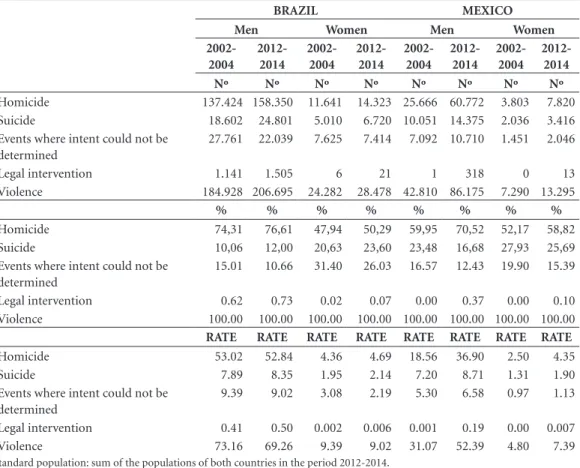
According to official statistics (Table 1), there were over 200,000 violent deaths in Brazil in both periods (209,210 in the period 2002-2004 and 235,173 in the period 2012-2014). Around 12% of victims were women. In Mexico, the number of violent deaths practically doubled between the two periods, increasing from 50,100 in the period 2002-2004 (14.6% women) to 99,470 in the peri-od 2012-2014 (13.4% women). In Brazil, violent deaths accounted for over 10% of total deaths among men and 2% among women in both pe-riods, while in Mexico they accounted for 5.5% among men and 1.2% among women in the pe-riod 2002-2004 and 8.3% among men and 1.8% among women in the period 2012-2014.
The leading cause of violent death was homi-cide: three in every four deaths among Brazilian men and seven in every 10 deaths among Mex-ican men in 2012-2014. Homicide was also the leading cause of violent death among women, although to a lesser degree.
Go
nzález-Pér
among men in the second period (2012-2014), when the homicide rate in Brazil was 43% higher than in Mexico, compared to almost three times higher in 2002-2004. This gap also narrowed among women: while the homicide rate in Brazil remained relatively stable over the two periods, in Mexico it almost doubled.
Similar adjusted suicide rates were found for both countries in both periods, although it should be noted that rates among Mexican men exceeded those among Brazilian men in the peri-od 2012-2014.
The rate of deaths caused by events where in-tent could not be determined was higher in Brazil for both sexes, despite a decrease in rates in this country between the two periods and an increase in Mexico. Finally, the rate of deaths due to legal intervention, albeit low, increased in all cases.
Overall adjusted mortality rates were lower in Mexico. However, a slight decrease in rates in Brazil together with an increase in Mexico means
that the overall gap between the two countries narrowed. This narrowing was particularly pro-nounced among women.
Table 2 shows that there was an increase in TLE between zero and 80 years among both sexes in Brazil and that this increase was more marked among men (1.67 years). This increase corre-sponds with a reduction in the number of PYLL among both men and women.
In contrast, in Mexico there was an increase in the number of PYLL among men (from 10.55 to 10.68 years) and a slight decrease among women, corresponding to a decrease in TLE of 0.13 years among men and an increase of 0.40 years among women.
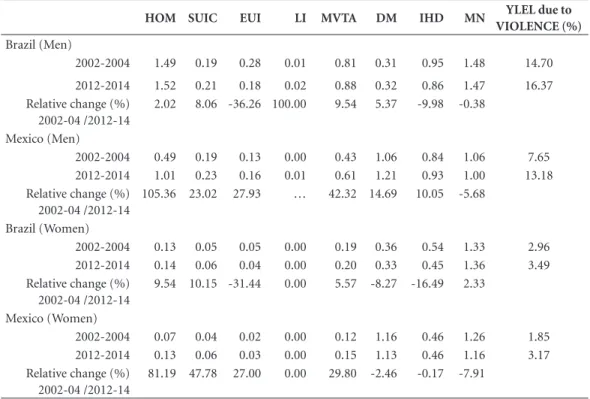
Table 3 shows that the leading cause of PYLL among Brazilian men in both periods was homi-cide, with a slightly higher rate than malignant neoplasms. The table also shows that there was a small increase in PYLL due to homicide, suicide and legal intervention. Overall, violent deaths ac-Table 1. Deaths (absolute and relative figures) and adjusted rates of mortality due to violence (per 100,000 population) by sex. Brazil and Mexico, 2002-2004 and 2012-2014.
BRAZIL MEXICO
Men Women Men Women
2002-2004
2012-2014
2002-2004
2012-2014
2002-2004
2012-2014
2002-2004
2012-2014
Nº Nº Nº Nº Nº Nº Nº Nº
Homicide 137.424 158.350 11.641 14.323 25.666 60.772 3.803 7.820
Suicide 18.602 24.801 5.010 6.720 10.051 14.375 2.036 3.416
Events where intent could not be determined
27.761 22.039 7.625 7.414 7.092 10.710 1.451 2.046
Legal intervention 1.141 1.505 6 21 1 318 0 13
Violence 184.928 206.695 24.282 28.478 42.810 86.175 7.290 13.295
% % % % % % % %
Homicide 74,31 76,61 47,94 50,29 59,95 70,52 52,17 58,82
Suicide 10,06 12,00 20,63 23,60 23,48 16,68 27,93 25,69
Events where intent could not be determined
15.01 10.66 31.40 26.03 16.57 12.43 19.90 15.39
Legal intervention 0.62 0.73 0.02 0.07 0.00 0.37 0.00 0.10
Violence 100.00 100.00 100.00 100.00 100.00 100.00 100.00 100.00
RATE RATE RATE RATE RATE RATE RATE RATE
Homicide 53.02 52.84 4.36 4.69 18.56 36.90 2.50 4.35
Suicide 7.89 8.35 1.95 2.14 7.20 8.71 1.31 1.90
Events where intent could not be determined
9.39 9.02 3.08 2.19 5.30 6.58 0.97 1.13
Legal intervention 0.41 0.50 0.002 0.006 0.001 0.19 0.00 0.007
Violence 73.16 69.26 9.39 9.02 31.07 52.39 4.80 7.39
Standard population: sum of the populations of both countries in the period 2012-2014.
aúd
e C
ole
tiv
a,
22(9):2797-2809,
2017
counted for over 16% of PYLL among men in the period 2012-2014, an increase compared to the period 2002-2004.
With regard to Mexico, homicide showed the largest increase in PYLL between the two peri-ods, more than doubling to become the second
leading cause of PYLL among men in the peri-od 2012-2014 behind diabetes mellitus. Despite this increase, PYLL due to homicide in Mexico among men remained lower than in Brazil. PYLL due to the rest of the causes and the percentage of PYLL due to these causes almost doubled over
Table 2. Temporary life expectancy (TLE) and years of life expectancy lost (YLEL) between zero and 80 years by sex. Brazil and Mexico, 2002-2004 and 2012-2014.
TLE YLEL
2002-2004
2012-2014
Change Change
Absolute Relative
2002-2004
2012-2014
Absolute Relative 2002-04 /
2012-14
2002-04 / 2012-14 (%)
2002-04 / 2012-14
2002-04 / 2012-14 (%)
Brazil (Men) 66.60 68.27 1.67 2.44 13.40 11.73 -1.67 -12.50
Mexico (Men) 69.45 69.32 -0.13 -0.19 10.55 10.68 0.13 1.25
Brazil (Women) 72.11 73.30 1.19 1.63 7.89 6.70 -1.19 -17.65
Mexico (Women) 72.91 73.31 0.40 0.55 7.10 6.70 -0.40 -5.62
Source: Authors’ elaboration based on data obtained from the National Health Information System (SINAIS, acronym in Spanish) in Mexico and Mortality Information System (SIM, acronym in Portuguese) of the Ministry of Health in Brazil.
Table 3. Years of life expectancy lost (YLEL) due to selected causes between zero and 80 years by sex. Brazil and Mexico, 2002-2004 and 2012-2014.
HOM SUIC EUI LI MVTA DM IHD MN YLEL due to VIOLENCE (%)
Brazil (Men)
2002-2004 1.49 0.19 0.28 0.01 0.81 0.31 0.95 1.48 14.70
2012-2014 1.52 0.21 0.18 0.02 0.88 0.32 0.86 1.47 16.37
Relative change (%) 2002-04 /2012-14
2.02 8.06 -36.26 100.00 9.54 5.37 -9.98 -0.38
Mexico (Men)
2002-2004 0.49 0.19 0.13 0.00 0.43 1.06 0.84 1.06 7.65
2012-2014 1.01 0.23 0.16 0.01 0.61 1.21 0.93 1.00 13.18
Relative change (%) 2002-04 /2012-14
105.36 23.02 27.93 … 42.32 14.69 10.05 -5.68
Brazil (Women)
2002-2004 0.13 0.05 0.05 0.00 0.19 0.36 0.54 1.33 2.96
2012-2014 0.14 0.06 0.04 0.00 0.20 0.33 0.45 1.36 3.49
Relative change (%) 2002-04 /2012-14
9.54 10.15 -31.44 0.00 5.57 -8.27 -16.49 2.33
Mexico (Women)
2002-2004 0.07 0.04 0.02 0.00 0.12 1.16 0.46 1.26 1.85
2012-2014 0.13 0.06 0.03 0.00 0.15 1.13 0.46 1.16 3.17
Relative change (%) 2002-04 /2012-14
81.19 47.78 27.00 0.00 29.80 -2.46 -0.17 -7.91
HOM: Homicide; SUIC: Suicide; EUI: Events of Undetermined Intent; MVTA: Motor Vehicle Traffic Accidents; DM: Diabetes Mellitus; IHD: Ischemic Heart Diseases; MN: Malignant Neoplasms
Go
nzález-Pér
the period, accounting for 13.2% of all PYLL be-tween zero and 80 years in the period 2012-2014.
It is important to note that, in both Mexico and Brazil, PYLL due to homicide among men were significantly greater than PYLL due to MVTAs in both periods, despite an increase in the latter in both countries. Together, PYLL due to violence and MVTAs accounted for almost one quarter of PYLL among men in Brazil and one fifth among men in Mexico during the period 2012-2014.
In contrast, the effect of violence on PYLL is less apparent among women in both countries, although the percentage increased between the two periods, reaching slightly over 3% in both countries. PYLL due to homicide showed the greatest relative increase among all causes, with similar values being observed in both Brazil and Mexico in the period 2012-2014. However, PYLL due to homicide were less than PYLL due to MV-TAs and the chronic degenerative diseases con-sidered by this study in both periods. Further-more, there was a small increase in PYLL due to suicide in both countries and due to events where intent could not be determined in Mexico.
Figure 1 shows PYLL due to homicide and suicide by age group and sex. While PYLL due to homicide among Mexican men increased across all ages (more than doubling for the age groups between 15 and 39 years), rates remained rela-tively stable, albeit higher than in Mexico, among Brazilian men, especially in younger age groups. It is also interesting to note that in Brazil there was an increase in PYLL among the 10 to 19 year age groups and that PYLL more than tripled in the 15 to 19 year age group in Mexico.
PYLL due to homicide also increased across all age groups among Mexican women, while among Brazilian women it increased in the 0 to 49 year age groups. This increase was particularly marked in the 15 to 39 year age groups among Mexican women and in the younger age groups among Brazilian women, where the highest rate of PYLL in the period 2012-2014 was found among the 15 to 19 year age group.
PYLL due to suicide increased across prac-tically all age groups among both Mexican and Brazilian men. Rates were highest in the 20 to 29 year age groups, where rates were higher among Mexican men. PYLL due to suicide among wom-en increased across almost all age groups in Mex-ico, while in Brazil the increase was particularly marked from the 25 year group onward. It is im-portant to note that PYLL was highest in the 15
to 19 year age group in both periods in Mexico and in the period 2012-2014 in Brazil.
Finally, the analysis of PYLL by cause and age in the period 2012-2014 (Figure 2) reveals that violent deaths, particularly homicide, ac-count for a little over one-half of PYLL among Brazilian men aged between 15 and 24 years and that the proportion of PYLL due to these causes was greatest in the 15 to 19 year age group. The findings also show that violent deaths together with deaths due to MVTA accounted for 70% of PYLL among the 15 to 24 year age groups. It is only after the age of 40 that the chronic degen-erative diseases considered by this study account for more PYLL than violence.
Violent deaths, particularly homicide, ac-counts for approximately 40% of PYLL among Mexican men aged between 15 and 29 years and the proportion of PYLL due to these causes was greatest in the 20 to 24 year age group. Violent deaths together with deaths due to MVTA ac-counted for around 60% of PYLL. As is the case with Brazil, it is only after the age of 40 that chronic degenerative diseases have a greater im-pact on PYLL than violence. In both countries, PYLL due to homicide among men aged between 15 and 39 years was greater than PYLL due to the three chronic degenerative diseases considered by this study combined.
In both countries, the impact of violent deaths on PYLL among women is greatest in the 15 to 24 year age groups (around 20%). This im-pact is particularly marked in the 15 to 19 year age group. Furthermore, in the 15 to 29 year age groups, violent deaths account for more PYLL than any other of the causes taken separately. Vi-olent deaths together with deaths due to MVTA account for between 30% and 40% of PYLL in the 15 to 24 years age groups in both countries.
aúd e C ole tiv a, 22(9):2797-2809, 2017 Discussion
The findings of this study reveal that despite a slight decrease in PYLL due to violent deaths (around two years) among Brazilian men, the proportional impact of these deaths on PYLL
in-creased: one-sixth of overall PYLL in the period 2012-2014 were due to violent deaths, particular-ly homicide, which was the cause that accounted for the largest number of PYLL in both periods (practically one and a half years in each peri-od). It can thus be concluded that the increase Figure 1. Years of life expectancy lost (YLEL) due to homicide and suicide by sex and age group. Brazil and Mexico, 2002-2004 and 2012-2014.
Source: Authors’ elaboration based on data obtained from the National Health Information System (SINAIS, acronym in Spanish) in Mexico and Mortality Information System (SIM), Ministry of Health, Brazil.
and Mexico, 2002-2004 and 2012-2014
0 0,05 0,1 0,15 0,2 0,25 0,3 0,35 0,4 < 1 1 - 4 5 - 9 1 0 -1 4 1 5 -1 9 2 0 -2 4 2 5 -2 9 3 0 -3 4 3 5 -3 9 4 0 -4 4 4 5 -4 9 5 0 -5 4 5 5 -5 9 6 0 -6 4 6 5 -6 9 7 0 -7 4 7 5 -7 9 MALE HOMICIDES
Brazil 02-04
Brazil 12-14
Mexico 02-04 Mexico 12-14 0 0,005 0,01 0,015 0,02 0,025 < 1 1 - 4 5 - 9 1 0 -1 4 1 5 -1 9 2 0 -2 4 2 5 -2 9 3 0 -3 4 3 5 -3 9 4 0 -4 4 4 5 -4 9 5 0 -5 4 5 5 -5 9 6 0 -6 4 6 5 -6 9 7 0 -7 4 7 5 -7 9 FEMALE HOMICIDES
Brazil 02-04
Brazil 12-14
Mexico 02-04 Mexico 12-14 0 0,005 0,01 0,015 0,02 0,025 0,03 0,035 0,04 0,045
< 1 1
- 4 5 - 9 1 0 -1 4 1 5 -1 9 2 0 -2 4 2 5 -2 9 3 0 -3 4 3 5 -3 9 4 0 -4 4 4 5 -4 9 5 0 -5 4 5 5 -5 9 6 0 -6 4 6 5 -6 9 7 0 -7 4 7 5 -7 9 MALE SUICIDES
Brazil 02-04
Brazil 12-14
Mexico 02-04 Mexico 12-14 0 0,002 0,004 0,006 0,008 0,01 0,012 0,014 0,016
< 1 1
- 4 5 - 9 1 0 -1 4 1 5 -1 9 2 0 -2 4 2 5 -2 9 3 0 -3 4 3 5 -3 9 4 0 -4 4 4 5 -4 9 5 0 -5 4 5 5 -5 9 6 0 -6 4 6 5 -6 9 7 0 -7 4 7 5 -7 9 FEMALE SUICIDES
Brazil 02-04
Brazil 12-14
Mexico 02-04
Go
nzález-Pér
in TLE among men, due, to a large extent, to a reduction in infant and early-age mortality rates, would have been greater but for these factors. In contrast, there was an increase in PYLL due to
violent deaths among women and homicide was the cause that accounted for the greatest rela-tive increase in PYLL, also hindering growth in TLE among women. The ratio between men and Figure 2. Percentage of years of life expectancy lost (YLEL) due to the causes considered in this study, by sex and age group. Brazil and Mexico, 2012-2014.
Source: Authors’ elaboration based on data obtained from the National Health Information System (SINAIS, acronym in Spanish) in Mexico and Mortality Information System (SIM, acronym in Portuguese) of the Ministry of Health in Brazil.
HOM: Homicide; SUIC: Suicide; EUI: Events of Undetermined Intent; MVTA: Motor Vehicle Traffic Accidents; DM: Diabetes Mellitus; IHD: Ischemic Heart Diseases; MN: Malignant Neoplasms
by sex and age group. Brazil and Mexico, 2012-2014
HOM: Homicide; SUIC: Suicide; EUI: Events of Undetermined Intent; MVTA: Motor Vehicle Traffic Accidents; DM: Diabetes Mellitus; 0% 10% 20% 30% 40% 50% 60% 70% 80% 90% 100% < 1 1 - 4 5 - 9 1 0 -1 4 1 5 -1 9 2 0 -2 4 2 5 -2 9 3 0 -3 4 3 5 -3 9 4 0 -4 4 4 5 -4 9 5 0 -5 4 5 5 -5 9 6 0 -6 4 6 5 -6 9 7 0 -7 4 7 5 -7 9 BRAZIL, MEN
HOM SUIC EUI LI MVTA
DM IHD MN OTHERS
0% 10% 20% 30% 40% 50% 60% 70% 80% 90% 100% < 1 1 - 4 5 - 9 1 0 -1 4 1 5 -1 9 2 0 -2 4 2 5 -2 9 3 0 -3 4 3 5 -3 9 4 0 -4 4 4 5 -4 9 5 0 -5 4 5 5 -5 9 6 0 -6 4 6 5 -6 9 7 0 -7 4 7 5 -7 9 MEXICO, MEN
HOM SUIC EUI LI MVTA
DM IHD MN OTHERS
0% 10% 20% 30% 40% 50% 60% 70% 80% 90% 100%
< 1 1
- 4 5 - 9 1 0 -1 4 1 5 -1 9 2 0 -2 4 2 5 -2 9 3 0 -3 4 3 5 -3 9 4 0 -4 4 4 5 -4 9 5 0 -5 4 5 5 -5 9 6 0 -6 4 6 5 -6 9 7 0 -7 4 7 5 -7 9 BRAZIL, WOMEN
HOM SUIC EUI LI MVTA
DM IHD MN OTHERS
0% 10% 20% 30% 40% 50% 60% 70% 80% 90% 100%
< 1 1
- 4 5 - 9 1 0 -1 4 1 5 -1 9 2 0 -2 4 2 5 -2 9 3 0 -3 4 3 5 -3 9 4 0 -4 4 4 5 -4 9 5 0 -5 4 5 5 -5 9 6 0 -6 4 6 5 -6 9 7 0 -7 4 7 5 -7 9 MEXICO, WOMEN
HOM SUIC EUI LI MVTA
aúd
e C
ole
tiv
a,
22(9):2797-2809,
2017
women of PYLL due to violence was 8.6:1 in the period 2002-2004 and 8.1:1 in the period 2012-2014.
There was a substantial increase in PYLL due to violence among both men and wom-en in Mexico (for all causes, with a particularly marked increase in PYLL due to homicide). The proportional impact of these causes on overall PYLL also increased: in the period 2012-2014, homicide was the second leading cause of PYLL among men (one year), behind only diabetes mellitus, and was the cause that accounted for the greatest relative increase in PYLL, thus con-tributing to a slight decline in TLE among men in the period under study.
Despite a decrease in PYLL due to chronic degenerative diseases among Mexican women, an increase in PYLL due to violence hindered growth in TLE among women. The ratio be-tween men and women of PYLL due to violence was 6.2:1 in the period 2002-2004 and 6.4:1 in the period 2012-2014.
The results also show that although the im-pact of violent deaths on PYLL continues to be greater in Brazil among both men and women, the gap between the two countries narrowed notably during the ten-year period under study. Furthermore, the findings show that life expec-tancy would have increased more during this period, especially among men, if rates of vio-lent death, particularly homicide, had not been so high and had not therefore caused so many PYLL. The combined effect on life expectancy of PYLL due to violent deaths and MVTAs, which are essentially avoidable causes, is even greater.
The gap in TLE between zero and 80 years between the two counties narrowed considerably during the period under study due to the impact of violent deaths, particularly among women, with rates reaching similar levels in both coun-tries in the period 2012-2014.
In general, the findings of this study are simi-lar to previous studies that show that both coun-tries have high levels of violence and some of the highest homicide rates in Latin America, espe-cially among men and young people, and that these factors influence life expectancy.
Salama24, for example, shows that there was
a reduction in life expectancy at birth at the be-ginning of the twenty-first century in cities such as Rio de Janeiro, São Paulo and Recife due to violence, while a study by Beltrão and Dellasop-pa9 revealed that there was an increase in PYLL
due to homicide and assault among men aged between 15 and 65 years in the last decades of
the last century. This study went on to show that figures stabilized in 2000 and 2005 at around 1.2 PYLL, which is similar, albeit slightly lower, than the level found by the present study for the pe-riod 2002-2004 across most ages. Similar results were obtained for women (0.1 PYLL compared to 0.13 found by the present study). PYLL was proportionally highest in the age groups 15 to 24 years among both men and women.
Likewise, various authors have reported an increase in homicide and suicide rates in Mexico and demonstrated the negative impact of this rise on TLE, particularly among men. These stud-ies emphasize the high number of PYLL due to these causes among young men and an increase in PYLL over the last decade. In this respect, one study showed that there was an increase in PYLL due to homicide among men in 10 states in the first decade of this century, showing that total PYLL due to this cause surpassed two in some cases7, while another study showed that PYLL
due to suicide among men and women in 2013 was 0.42 and 0.20, respectively, an increase com-pared to 200025.
While it is evident that supermortality among men due to violence is common to both countries, which means that the impact of deaths due to these causes on TLE is much more marked among men than in women, it is important to interpret these results from a gender perspective in order to gain a better understanding of this phenomenon. In predominantly sexist societies such as Mexico and Brazil, exercising mascu-linity implies having and exercising power. The power traditionally associated with masculinity from childhood in our societies fosters violent, extreme and risky behavior26. In such an
environ-ment, children are taught from an early age that violence is an accepted way of resolving conflicts. This helps us to understand why men are more likely than women to become involved in dan-gerous crime and shady dealings that are solved on the edge of the law (such as activities related to organized crime, particularly drug trafficking) and that put their lives at risk.
At the same time, however, we should not overlook the fact that there was also an increase in PYLL due to homicide among women in both countries during the period under study. It is ev-ident that the causes and contexts of male and female homicide differ27. Literature shows that
Go
nzález-Pér
net that offers these women protection, and the lack of capacity and effectiveness of the govern-ment to ensure adequate social coexistence in both countries.
Brazil and Mexico share another common feature: violence is particularly prominent among young people and therefore the number of PYLL due to these causes is particularly high at younger ages in both men and women. It is a fact that the social impact of homicide involving young people, be they victims or perpetrators, is greater, since violence at a younger age has a greater proportional impact on the overall social burden of premature death, injury and disabili-ty28. Furthermore, this phenomenon also reveals
the underlying social problems that contrib-ute to high youth homicide rates in Brazil and Mexico29-32: on the one hand, the presence of
organized crime, especially the drug cartels, that prey on the vulnerability of a considerable per-centage of young people caused by factors such as family breakdown, unemployment, and lack of access to quality education, using them to sell drugs on the streets of major cities or as heav-ily-armed soldiers and sicarios (child assassins); and, on the other, structural factors common to both countries, such as marked social inequality due to the uneven distribution of wealth, huge regional disparities in development, the lack of specific policies to address urban development, and, notably, the shocking levels of impunity and corruption in the countries’ public security and justice systems24,32-36. Together, these factors help
us to understand why violence has curbed the in-crease in life expectancy in these countries.
In this respect, it is also important to give due emphasis to the increase in suicide rates in the two countries among both sexes and the re-sulting impact on PYLL, which is greater among men. The increase in suicide rates in younger age groups, particularly in Mexico, paint a disturb-ing picture, not only from a social, economic and health point of view, but also in relation to public policy implications, given that suicide should be considered not only as a personal decision, but also as a social phenomenon that obeys sociocul-tural factors that directly influence suicidal be-havior25,36.
A last important aspect of violent behavior is deaths due to legal intervention, particularly among men. Although the impact of this cause on PYLL is practically null, the increase observed in both countries should not be overlooked. This is because it is the result of increasing repression rather than increased police effectiveness in
soci-eties where the police are marked by a repressive past inherited from dictatorial systems (Brazil), or where the army wages war on drug cartels without the effective implementation of social policy (Mexico). Repression is contributing fac-tor rather than a solution to violence24.
Finally, this study has a number of limita-tions. Firstly, official statistics are often subject to underreporting, particularly in less developed regions, which tends to lead to an underestima-tion of death rates and thus overestimate life ex-pectancy, despite the fact the coverage and qual-ity of the data are regarded as being satisfactory. Furthermore, mortality data produced in Brazil at the beginning of the century are not consid-ered reliable by the PAHO. Therefore, although reports by various authors on Brazilian mortality statistics in the first decade of this century allow us to be optimistic as to their quality9,18, the
esti-mates of this study should be treated with a cer-tain degree of caution.
Furthermore, as mentioned by previous stud-ies15, both countries showed a significant
propor-tion of deaths classified as events where intent could not be determined. This includes cases that otherwise could have been classified in other codes (principally homicide), which suggests that both homicide rates and PYLL due to this cause may have been underestimated.
Finally, in relation to the method employed to calculate PYLL, none of the three possible assumptions greatly alter (bias) the results. The null mortality assumption employed in this study is recommended by the literature23 since it
not only facilitates the interpretation of results, but also fully explains changes in TLE and the causes of death.
Despite the above limitations, the findings of the present study indicate with reasonable cer-tainty that life expectancy, particularly among men, would increase significantly in Brazil and Mexico if there were a decrease in the high lev-els of violence in both countries. In view of the unquestionable fact that life expectancy in Brazil and Mexico has reached relatively high levels and that, in the case of Mexico, growth has slowed over the last decade, a reduction in mortality due to homicide and other causes of violent death, particularly among young people, seems essential to achieving further increases in life expectancy in these two countries.
aúd
e C
ole
tiv
a,
22(9):2797-2809,
2017
problem of violence and the formulation and ef-fective implementation of public policies. These policies should be aimed not only at reshaping the justice system, reducing levels of impunity and corruption, tackling drug cartels and orga-nized crime, and reducing the number of illegal firearms in circulation, but also at encouraging the integration of adolescents and youth into social safety nets (family support, access to ed-ucation, the creation of adequately paid employ-ment, etc.) and reducing the social and economic inequalities that prevent people from fully exer-cising their citizenship5,31.
Furthermore, it is necessary to question the values related to the concept of hegemonic mas-culinity conveyed from the beginning of the
pro-cess of socialization, which implicitly leads to a lifestyle whereby men are more likely to be in-volved in violent acts and are exposed to a greater risk of death than women26; without forgetting
that it is necessary to strive towards true gender equality and the empowerment of women in or-der to reverse the upward trend in violent deaths among the female population.
Go
nzález-Pér
References
1. Krug EG, Dahlberg LL, Mercy JA, Zwi AB, Lozano R.
Informe mundial sobre la violencia y la salud.
Washin-gton: Organización Panamericana de la Salud, Oficina Regional para las Américas de la Organización Mun-dial de la Salud; 2003.
2. Jaitman L, Torre I. Un enfoque sistemático para medir el costo del crimen en 17 países de América Latina y el Caribe. In: Jaitman L, editor. Los costos del crimen y de la violencia: nueva evidencia y hallazgos en América
Latina y el Caribe. Washington: Banco Interamericano
de Desarrollo (BID); 2017.p. 21-32.
3. Dahlberg LL, Krug EG. Violence a global public health problem. Cien Saude Colet 2006; 11(2):277-292. 4. Minayo MC. Relaciones entre Procesos Sociales,
Vio-lencia y Calidad de Vida. Salud Colectiva 2005; 1(1):69-78.
5. Souza ER, Melo AN, Silva JG, Franco AS, Alazraqui M, Gonzalez-Perez GJ. Estudo multicêntrico da mortali-dade por homicídios em países da América Latina. Cien
Saude Colet 2012; 17(12):3183-3193.
6. Jaitman L, Torre I. Los costos directos de los homici-dios.In: Jaitman L, editor. Los costos del crimen y de la violencia: nueva evidencia y hallazgos en América Latina
y el Caribe. Washington: Banco Interamericano de
De-sarrollo (BID); 2017. p. 33-40.
7. González-Pérez GJ, Vega-López MG, Cabrera CE. Im-pacto de la violencia homicida en la esperanza de vida masculina de México. Rev Panam Salud Pública 2012; 32(5):335-342
8. Dávila-Cervantes CA, Pardo-Montaño AM. Magnitud y tendencia de la mortalidad por homicidios en Co-lombia y México, 2000-2011. Rev Panam Salud Pública
2014; 36(1):10-16.
9. Beltrão KI, Dellasoppa EE. El designio de los hombres. Años de vida perdidos en Brasil y en sus grandes re-giones, 1980 a 2005. Estudios Demográficos y Urbanos
2011; 26(2):299-343.
10. Organización Panamericana de la Salud (OPS).
Situa-ción de Salud en las Américas. Indicadores básicos, 2016.
Washington: OPS; 2016.
11. Dirección General de Información en Salud (DGIS). Base de datos de defunciones 1979-2010. México, DF: Sistema Nacional de Información en Salud. (SINAIS). 2015. [acceso 2017 Feb 10]. Disponible en: http://www. sinais.salud.gob.mx
12. Consejo Nacional de Población. México en cifras/ Proyecciones de la población 2010-2050/Datos de proyecciones/Estimaciones (1990-2010). México: CO-NAPO; 2014. [acceso 2017 Feb 13]. Disponible en: http://www.conapo.gob.mx/es/CONAPO/Proyecciones 13. Sistema de Informações sobre Mortalidade (SIM) do
Ministério da Saúde do Brasil. DATASUS. [acceso 2017 Feb 28]. Disponible en: http://www2.datasus.gov.br/ DATASUS/index.php?area=0205&id=6937
14. Organización Mundial de la Salud (OMS). Clasificación Estadística Internacional deEnfermedades y Problemas
relacionados con la Salud. 10ª Rev. Washington: OMS;
1995. (Publicación Científica 554)
15. Molinatti F, Acosta LD. Tendencias de la mortalidad por agresiones en mujeres de países seleccionados de América Latina, 2001-2011. Rev Panam Salud Pública
2015; 37(4/5):279-286. Collaborations
aúd
e C
ole
tiv
a,
22(9):2797-2809,
2017
16. Organización Panamericana de la Salud (OPS).
Situa-ción de Salud en las Américas. Indicadores básicos, 2015.
Washington: OPS; 2015.
17. Organización Panamericana de la Salud (OPS). Área de Análisis de Salud y Sistemas de Información Sanitaria (AIS). Situación de Salud en las Américas: Indicadores
Básicos 2005. Washington: OPS; 2005.
18. Alazraqui M, Spinelli H, Zunino MG, Souza ER. La ca-lidad de los sistemas de información de mortaca-lidad por violencias en Argentina y Brasil, 1990-2010. Cien Saude
Colet 2012; 17(12):3279-3288.
19. Xunta de Galicia, Organización Panamericana de la Sa-lud (OPS). EPIDAT 3.1.Análisis epidemiológico de datos
tabulados. La Coruña, Washington: Xunta de Galicia,
OPS; 2006.
20. Arriaga E. Los años de vida perdidos: su utilización para medir el nivel y el cambio de la mortalidad. Notas
Población 1996; 24(63):7-38.
21. Arriaga E. Measuring and explaining the change in life expectancies. Demography 1984; 21(1):83-96. 22. Agudelo-Botero M, Dávila-Cervantes CA. Efecto de las
muertes evitables y no evitables en la esperanza de vida en México, 1998-2000 y 2008-2010. Rev Panam Salud
Pública 2014; 35(2):121-127.
23. Bocco M. La relación entre los años de vida perdidos y la esperanza de vida: aplicaciones para el análisis de la mortalidad. Notas Población 1996; 24:39-60
24. Salama P. Homicidios, ¿es ineluctable la violencia en América Latina? Frontera Norte 2013; 25(49):7-27. 25. Dávila-Cervantes CA, Ochoa-Torres MP,
Casique-Ro-dríguez I. Análisis del impacto de la mortalidad por suicidios en México, 2000-2012. Salud Colectiva 2015; 11(4):471-484.
26. Souza ER. Masculinidade e violência no Brasil: contri-buições para a reflexão no campo da saúde. Cien Saude
Colet 2005; 10(1):59-70.
27. Coyne-Beasley T, Moracco KE, Casteel MJ. Adolescent femicide: A population-based study. Arch Pediatr
Ado-lesc Med 2003; 157(4):355-360.
28. Haagsma JA, Graetz N, Bolliger I, Naghavi M, Higashi H, Mullany EC, Abera SF, Abraham JP, Adofo K, Alshar-if U, Ameh EA, Ammar W, Antonio CAT, Barrero LH, Bekele T, Bose D, Brazinova A, Catalá-López F, Dan-dona L, DanDan-dona R, Dargan PI, Leo DD, Degenhardt L, Derrett S, Dharmaratne SD, Driscoll TR, Duan L, Ermakov SP, Farzadfar F, Feigin VL, Franklin RC, Gab-be B, Gosselin RA, Hafezi-Nejad N, Hamadeh RR, Hi-jar M, Hu G, Jayaraman SP, Jiang G, Khader YS, Khan EA, Krishnaswami S, Kulkarni C, Lecky FE, Leung R, Lunevicius R, Lyons RA, Majdan M, Mason-Jones AJ, Matzopoulos R, Meaney PA, Mekonnen W, Miller TR, Mock CN, Norman RE, Orozco R, Polinder S, Pour-malek F, Rahimi-Movaghar V, Refaat A, Rojas-Rueda D, Roy N, Schwebel DC, Shaheen A, Shahraz S, Skirbekk V, Søreide K, Soshnikov S, Stein DJ, Sykes BL, Tabb KM, Temesgen AM, Tenkorang EY, Theadom AM, Tran BX, Vasankari TJ, Vavilala MS, Vlassov VV, Woldeyohannes SM, Yip P, Yonemoto N, Younis MZ, Yu C, Murray CJL, Vos T, Balalla S, Phillips MR. The global burden of in-jury: incidence, mortality, disability-adjusted life years and time trends from the Global Burden of Disease study 2013. Inj Prev 2016; 22:3-18.
29. CEPAL. Panorama Social de América Latina 2008, Santiago de Chile, LC/G.2402-P/E., 2008. [acceso 2017 Mar 10]. Disponible en: http://www.cepal.org/publica-ciones/xml/2/34732/PSE2008
30. Freitez A, Romero D, Di Brienza M. La mortalidad ju-venil por causas violentas en Brasil y Venezuela, 1997-2007. Rev. Venez. de Econ. y Ciencias Sociales 2011; 17(2-3):211-237.
31. González-Pérez GJ, Vega-López MG, Muñoz A. Juven-tud, Homicidio y Esperanza de vida en México. In: Gutiérrez Rodríguez F, coordinador. Conducta
Violen-ta: Impacto biopsicosocial. Guadalajara: Ed.
Universita-ria; 2016. p. 41-62.
32. Waiselfisz JJ. Mapa da Violência 2011: os jovens do Bra-sil. São Paulo: Instituto Sangari, Ministério da Justiça; 2011
33. Consejo Nacional de Evaluación de la Política de De-sarrollo Social (CONEVAL). Evolución de las dimen-siones de la pobreza 1990-2014. [acceso 2016 Dic 15]. Disponible en: http://www.coneval.gob.mx/Medicion/ EDP/Paginas/Evolucionde-las-dimensiones-de-la-po-breza-1990-2014-.aspx
34. Amnistía Internacional. México bajo la sombra de la impunidad. [acceso 2015 Dic 14]. Disponible en: http://www.derechos.org/nizkor/mexico/doc/ai.html 35. Azevedo R, Cifali AC. Seguridad Pública, Política
Cri-minal y Penalidad en Brasil durante los Gobiernos Lula y Dilma (2003-2014). Cambios y Continuidades. In: So-zzo M, editor. Postneoliberalismo y penalidad en Amé-rica del Sur. Buenos Aires: CLACSO; 2016. p. 29-94. 36. Hernández-Bringas HH, Flores-Arenales R. El suicidio
en México. Papeles Poblac 2011; 68:69-101
Article submitted 15/01/2017 Approved 18/04/2017