ABSTRACT
Two maize varieties, viz. Sartaj and Deccan, have been evaluated according to their responses to chromium (Cr) in terms of specific physiological and biochemical attributes. During the exposure to Cr concentration (0, 50, 100, 200 and 300 µM) of potassium dichromate (K2Cr2O7) for seven days, significant changes of oxidative stress in terms of lipid peroxidation and protein oxidation were recorded along with other antioxidative pathways. It is revealed that irrespective of varieties, Sartaj was more prone to oxidative stress since the amount of superoxide due to Cr exposure was found to be significant, unlike the second variety, Deccan. In addition, for Sartaj the activity of NAD(P)H oxidase recorded a significant linear increase in a dose response manner.The changes of antioxidative enzymes recorded significant variation in both varieties under stress compared to control. However, Deccan maintains a consistent up regulation in SOD and GPX activities. Contrarily, APX activity was less sensitive to both varieties. The activation of antioxidative mechanisms due to the impact of Cr-induced oxidative stress has been described subsequently. The results deriving from this investigation might be effective for the selection of tolerant plant types under chromium contamination.
Keywords: antioxidative enzymes, MDA, protein oxidation, ROS.
Abbreviations: APX: Ascorbate peroxidase, AsA: Ascorbic acid, CAT: Catalase, DTT: Dithiothreitol, DNPH: Dinitrophenylhydrazine,
GPX: Guaiacol peroxidase, MDA: Malondialdehyde, PMSF: Phenylmercuric sulfonyl fluoride, PVP: Polyvinylpyrrolidone, PVPP: Polyvinylpolypyrrolidone, ROS: Reactive Oxygen Species, SOD: Superoxide dismutase.
Responses of the maize plant to chromium stress
with reference to antioxidation activity
Saborni Maiti
1, Nirmalia Ghosh
1, Chiranjib Mandal
1, Kingsuk Das
1, Narottam Dey
2and
Malay Kumar Adak
1*
1Department of Botany, Plant Physiology and Plant Molecular Biology Research Unit, University of Kalyani,
Kalyani, 741235, India.
2Department of Biotechnology, Visva-bharati University, Shantiniketan, 731235, India.
*Corresponding author: [email protected] Received: 5 July 2012; Accepted: 5 November 2012
INTRODUCTION
Chromium (Cr) is the 21st most abundant element in the Earth’s crust with an average concentration of 100 ppm (Emsley, 2001). It is a transition metal located in group VI B of the periodic table. Mainly due to tanning and chrome-plating industrial activities, large quantities of Cr compounds are discharged as liquid, solid and gas waste into the environment, and ultimately have significant adverse biological and ecologic effects (Kotas and Stasicka, 2000). Cr occurs in the environment
al., 2000; Gikas and Romanos, 2006; Zou et al., 2006). Being a heavy metal, Cr is a potential agent of oxidative stress, inducing oxidative damage to lipids, proteins and DNA-like biomolecules (Shanker et al., 2004). Cr changes in activity of antioxidant enzymes as well as of other enzymes in order to disrupt the nutrients and water balance (Pandey and Sharma, 2003). It is also reported that it could stimulate the formation of free radicals and reactive oxygen species (ROS) such as superoxide radicals (O2-), hydrogen peroxide (H
2O2) and
the hydroxyl radical (·OH). Furthermore, under natural growth conditions, plants are adapted to minimize the damages induced by ROS (Jinhua et al., 2009). In response to such abiotic stress, plants are also tuned to mitigate the oxidative stress by number of ways. Non-enzymatic and Non-enzymatic anti-oxidation cascades are common defense mechanisms as upregulated under such metal induced oxidative stress. This defense system is composed of antioxidant enzymes: superoxide dismutase (SOD), peroxidase with different variants (e.g., ascorbate peroxidase, guaiacol peroxidase and glutathione reductase), catalase (CAT). Some other non-enzymatic antioxidant moieties (e.g., ascorbic acid, glutathione, carotenoids, flavonoids, α-tocopherol etc.) are also important to quench the ROS developed under such condition (Gratão et al., 2005).
Maize (Zea mays L.), a typical cereal crop of temperate and subtropical zones is displayed as a variable stress tolerant plant under environmental extremities. By dint of the C4 advantages, maize is able to thrive well under the condition of soil moisture deficit coupled with high illumination inducing oxidative stress. Besides, maize plants have been reported to hyperaccumulate a number of heavy metals and Cr is one of them (Shanker et al., 2005).
Maize varieties have been reported with the illustration of wider adaptability to various abiotic stresses; however, in the present experiment the varieties Sartaj and Deccan have earlier been clarified with its potential for salinity stress (Uma et al., 1990). Since salinity stress is most integrally associated with oxidative damage, the way maize plants are to sensitize under heavy metal stress might be justified to observe. With this background, Deccan and Sartaj were investigated under the condition of heavy metals, e.g. Cr, as in the present case. Cr has already been mentioned to cause oxidative induction to change the cellular responses in many crop species. Therefore, maize being a potential practiser of C4 photosynthetic pathway, having to overcome the induction of oxidative stress under heavy metal contamination and how these two varieties
could be discriminated to accomplish the antioxidation pathway are our focus. The effects of Cr and subsequent antioxidative responses to different concentrations (0, 50, 100, 200 and 300 µM) applied to two maize varieties (viz, Sartaj and Deccan) are investigated. We describe the effects of different concentrations of Cr on growth attributes, generation of O2.-and H
2O2, membrane
lipid peroxidation, protein carbamylation along with the changes in activities of enzymatic antioxidation pathway, including SOD, guaiacol peroxidase (GPX) and ascorbate peroxidase (APX).
MATERIAL AND METHODS
Plant culture and chromium treatments: In order
Measurement of growth and biomass: Growth was measured in terms of shoot and root length along with their dry biomass. Shoot and root length were measured following the harvest in fresh samples. For dry biomass, 2 g of shoot and root tissue for each sample were dried at 80ºC for 48h and made complete dry until constant weights achieved.
Estimation of reactive oxygen species: superoxide
and hydrogen peroxide: To detect the generation of O2. -,
the method was adopted from Elstner and Heupel (1976), with some modification. One gram of leaf sample was thoroughly homogenized with 65 mM phosphate buffer (pH 7.8) and supernatant was saved following centrifugation at 5,000 gn, for 15 min, at 4°C. The assay mixture (2 mL) consisting of 0.9 mL of 65 mM phosphate buffer (pH 7.8), 0.1 mL of 10 mM of hydroxylamine hydrochloride and 1.0 mL of supernatant was incubated at 25°C for 30 minutes. 1 mL of 17 mM sulphanilamide and 1.0 mL of 7.0 mM
α-naphthylamine were added and incubated at 25°C for 20 minutes. The changes in absorbance against a reagent blank were recorded spectrophotometrically at 530 nm and generated O2.- was calculated from a
standard curve of nitrite salt.
H2O2 content was determined (Sun et al., 2006). Approximately 1.0 g leaf sample was crushed with liquid nitrogen followed by extraction of 0.1% (w/v) TCA. The supernatant was centrifuged at 12,000 gn for 20 minutes at 4°C. The assay mixture (consisting of 0.5 mL supernatant, 1 mL of 1.0 M KI and 0.5 mL of 10 mM potassium phosphate buffer, pH 7.0) was prepared. The absorbance of supernatant was read at 390 nm. The content of H2O2 was calculated from a standard curve.
Lipid peroxidation: For the lipid peroxidation,
malondialdehyde (MDA) content was determined. Leaf homogenate was extracted with 20% (w/v) trichloroacetic acid (TCA) containing 0.5% (w/v) thiobarbituric acid (TBA). MDA content was determined by reading the absorbance at 532 nm and corrected for nonspecific absorbance at 600 nm (Heath and Packer, 1968).
Protein oxidation assay:For protein oxidation, protein
carbonyl content was determined. It was measured by the reaction with di-nitro-phenyl-hydrazine (DNPH) (Verbeke et al., 2000). The leaf homogenate was extracted with 6% (w/v) SDS followed by 25 minutes incubation at room temperature (4°C). Afterwards, 10 mM DNPH in 10% TCA, being incubated with gentle shaking for 40 minutes. Precipitation of protein was done by 15% (w/v) TCA on ice for 15 min. The samples were centrifuged at 10,000 gn and
pellets were washed twice with 20% (w/v) TCA. Finally, the protein pellets were resuspended in 0.2 M sodium phosphate buffer (pH 7.0) and the absorbance was measured at 360 nm.
Determination of the NAD(P)H oxidase activity:
Leaf homogenate was extracted by 50 mM potassium phosphate buffer (pH 7.0) and centrifuged at 10,000 gn at 4°C for 20 minutes (Smiri et al., 2010). Finally, NAD(P) H oxidase activity was determined in an assay mixture containing 100 mM sodium acetate (pH 6.5), 1 mM MnCl2, 0.5 mM p-coumaric acid and 50 µg of protein (enzyme extract). Protein content was determined with BSA as standard (Bradford, 1976). The control set was done, and p-coumaric acid was withdrawn in the same assay mixture. The reaction was initiated by adding 0.2 mM NAD(P)H in the same assay mixture and incubated at 37oC for 5
minutes. The activity of NAD(P)H oxidase was recorded at A340nm. The enzyme activity was calculated from change of OD per g of protein with extinction coefficient of 0.622 mM-1 mm-1.
Assay of guaiacol peroxidase (EC 1.11.1.7):
The enzyme extract was prepared by thoroughly homogenizing the leaf tissues (1.0 g) in liquid nitrogen followed by 0.1 M potassium phosphate buffer (pH 7.0) under cold condition. The homogenate was centrifuged at 12,000 gn at 4°C for 15 min. The protein content of the supernatant was concentrated using 80% ammonium sulphate [(NH4)2SO4] precipitation followed by dialysis and lyophilization (Sambrook and Russell, 2001). The protein was measured according to Bradford (1976). The concentrated protein samples were used as sources of enzyme and incubated in an assay mixture containing 0.1 M phosphate buffer (pH 6.5), 1.5 mM O-dianicidine, 0.2 M H2O2, 50 μg of protein at 37°C. The absorbance was recorded at 430 nm using extinction coefficient of O-dianicidine (2.62 mM-1mm-1). One unit of enzyme
activity was determined as the amount of enzyme required changing the absorbance by 0.1 per unit time (Hu et al., 2009).
Assay of ascorbate peroxidase (EC 1.11.1.11):
APX activity was determined as described by De Leonardis et al. (2000), by measuring the decrease in absorbance at 290 nm in a reaction mixture containing 50 mM phosphate buffer pH 7.0, 500 mM AsA, 1 mM H2O2 and 100 µg of enzyme extract. The extinction coefficient of AsA (2.62 mM-1mm-1) was used to
calculate the APX activity.
Assay of superoxide dismutase (EC 1.15.1.1):
according to Alonso et al. (2001). Plant samples were homogenized with 50 mM potassium-phosphate buffer (pH 7.5) and then centrifuged at 20,000 gn for 30 minutes, at 4°C. Supernatant was added to a reaction mixture containing 50 mM phosphate buffer (pH 7.0), 13 mM methionine, 75 mM NBT, 100 mM EDTA and 2 mM riboflavin. The total mixture was kept for 10 min under 15-W fluorescent tubes of 40 μmol m-2 s-1 photon
flux density. The control set of reaction mixture was kept in the dark. The activity was calculated from the absorbance at 560 nm.
Statistical analysis: All the observations were
recorded with three replications (n=3) and data were expressed as mean±SE. The statistical analysis was performed with SPSS 10 statistical package (SPSS Inc., Chicago) by one-way ANOVA, taking p≤0.05 as significant followed by least significance difference (LSD) test taking p≤0.05 levels of significance (Gomez and Gomez, 1984).
RESULTS
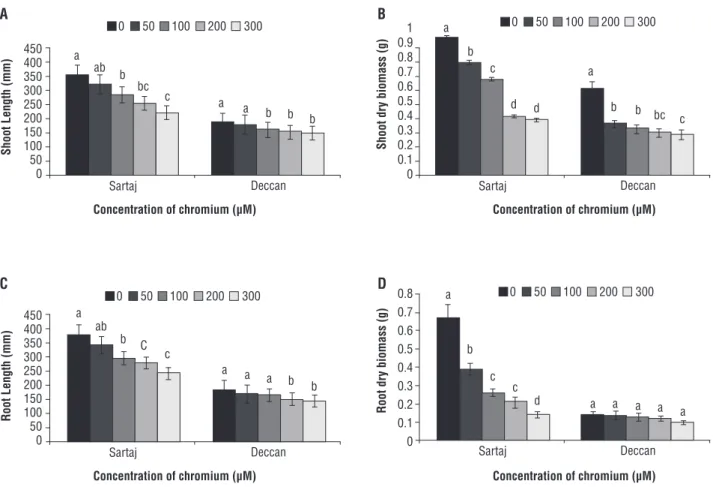
Plant growth: The oxidative exposure of Cr and its
impact were revealed in the present study for both the varieties. Plants were found to be morphologically weaker in relation to growth and vigor. However, to complete the experiment plants were collected for measurement of length and dry biomass of shoot and root. Cr exposure significantly inhibited (p≤0.05) plant length and biomass (Figure 1). A linear decrease of shoot length (Figure 1A) and dry biomass (Figure 1B) were recorded at different concentrations of Cr. Shoot length was reduced by 37.60 and 19.57% for varieties Sartaj and Deccan, respectively, at maximum concentration of Cr, i.e. 300 µM. Shoot biomass also decreased by 59 and 53% for Sartaj and Deccan at the same maximum concentration. Root length (Figure 1C) and its dry weight (Figure 1D) followed the similar trends of decreasing growth as that recorded in shoot. Root length was decreased by 36% and 21% in Sartaj and Deccan. Likewise, the loss of root biomass
Shoot Length (mm)
450 400 350 300 250 200 150 100 50 0
Sartaj Deccan
0 50 100 200 300 0 50 100 200 300
0 50 100 200 300 0 50 100 200 300
a
a a
ab b
b b b
bc c
Concentration of chromium (µM)
Root Length (mm)
450 400 350 300 250 200 150 100 50 0
Sartaj Deccan
a
a a
a ab
b
b b C
c
Concentration of chromium (µM)
Concentration of chromium (µM)
Concentration of chromium (µM)
Shoot dr
y biomass (g)
1 0.9 0.8 0.7 0.6 0.5 0.4 0.3 0.2 0.1 0
Sartaj Deccan
a
a b
b b
c bc c
d d
Root dr
y biomass (g)
0.8 0.7 0.6 0.5 0.4 0.3 0.2 0.1 0
Sartaj Deccan
a
a a a a
a b
c c
d
Figure 1. Changes in (A) shoot length, (B) root length, (C) shoot dry biomass, and (D) root dry biomass under different concentrations of Cr (VI) (0, 50, 100, 200 and 300 µM). Data are mean of three replicates ± SE, compared to control (0 µM) at p≤0.05. Different letters indicate significant differences among mean values within each variety (Student t-test, p≤0.05).
A B
was 79% for Sartaj and 32% for Deccan at the highest concentration of Cr (300 µM).
Hydrogen peroxide and superoxide radical content:
The oxidative stress in plants may be illustrated by showing the accumulation pattern of O2.- (Figure 2) and H
2O2 in the
tissue (Figure 3). Under each Cr concentration, the O2.-
and H2O2 generation increased significantly (p≤0.05) as compared to those under control condition irrespective of varieties.After seven days of incubation, the variety Sartaj recorded the increase of O2.- by 1.17 fold, 1.33 fold, 1.47
fold, 1.58 fold over control under 50, 100, 200 and 300 µM of Cr salt respectively. Likewise for Deccan, the increase of O2.- under the same concentrations of Cr was 1.04, 1.29,
1.33 and 1.48 fold respectively. Therefore, Sartaj recorded
more accumulation of O2.- than variety Deccan uniformly
over any concentration of Cr.
Similar findings for H2O2 accumulation strengthen the evidence for oxidative stress in plants irrespective of varieties. Thus a linear increase in H2O2 concentration was the feature for both varieties. The H2O2 content in Sartaj becomes almost 2 and 3 fold for 100 and 300 µM of Cr concentrations, respectively, compared to the control. However, for Deccan accumulation of H2O2 itwas 2 fold at 300 µM concentration of Cr over control.
Malondialdehyde content and protein oxidation:
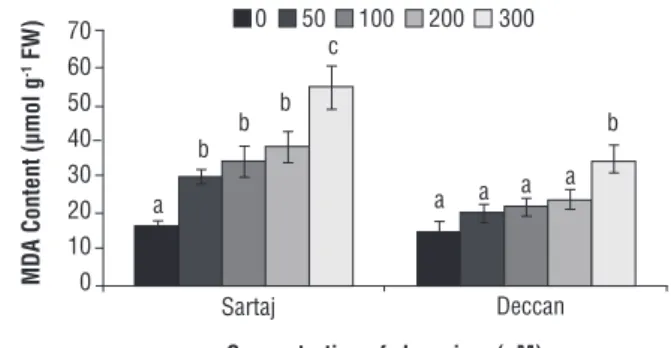
Malondialdehyde and carbonyl contents, measures of lipid peroxidation and protein oxidation respectively, were increased (p<0.05) in both varieties under Cr stress. For MDA the variety Sartaj proved to be more sensitive in terms of lipid peroxidation by 1.86, 2.15, 2.39 and 3.42 fold over control at different concentration of Cr. Deccan recorded 1.4, 1.5, 1.66 and 2.43 fold MDA content over control under those concentration of Cr (Figure 4).
Similarly, the carbonyl formation was found maximum in Sartaj (1.06, 1.73, 3.03 and 3.34 fold over control respectively for 50, 100, 200 and 300 µM of Cr salt), while comparatively lower in Deccan (1.6, 2.15, 2.58 and 3.66 fold over control respectively for the same concentration of Cr salt) (Figure 5).
Estimation of NAD(P)H oxidase: One of the source
of ROS at cellular level is furnished by the oxidation of NAD(P)H in intercellular spaces by membrane bound NAD(P)H oxidase activity, because NAD(P)H oxidase
O2.-(µ mol g
-1 fr
.wt.)
250
200
150
100
50
0
Sartaj Deccan
a ab a a
bc
b b b c
c
Concentration of chromium (µM) 0 50 100 200 300
Figure 2. Generation of superoxide in Sartaj and Deccan under different concentrations of Cr (0, 50, 100, 200 and 300 µM). Data are mean of three replicates ± SE, compared to the control (0 μM) at p≤0.05. Different letters indicate significant differences among mean values within each variety (Student t-test, p≤0.05).
H2 O2
(µmol g
-1 protein) 350
300
250
200
150
100
50
0
Sartaj Deccan 0 50 100
a a
a a a a b b
b c
Figure 3. Generation of hydrogen peroxide in Sartaj and Deccan under different concentrations of Cr (0, 50, 100, 200 and 300 µM). Data are mean of three replicates ± SE. Data are mean of three replicates ± SE, compared to the control (0 μM) at p≤0.05. Different letters indicate significant differences among mean values within each variety (Student t-test, p≤0.05).
MDA Content (µmol g
-1 FW) 70 60 50 40 30 20 10 0
Sartaj Deccan
a a a a
a b
b b b
c
Concentration of chromium (µM) 0 50 100 200 300
Figure 4. Malondialdehyde (MDA) content of Sartaj and Deccan under different concentrations of Cr (0, 50, 100, 200 and 300 µM). Data are mean of three replicates ± SE, compared to the control (0 µM) at p≤0.05. Different letters indicate significant differences among mean values within each variety (Student
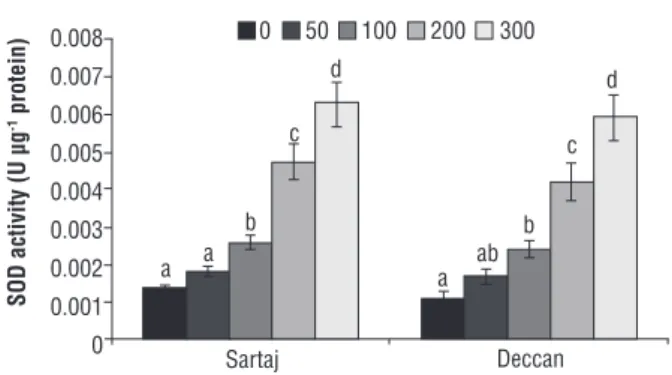
APX showed significant (p≤0.05) variation to Cr. The GPX activity was at maximum in Sartaj, with records of 1.08, 1.23, 1.88 and 1.96 fold over control (Figure 7). Deccan showed similar trends of GPX activity, i.e., 1.05, 1.25, 1.75 and 1.96 fold over control at different concentrations of Cr. The APX activity was also increased in both varieties under treatment. In comparison, the level of APX was higher in Sartaj (1.04, 1.08, 1.12 and 1.16 fold over control) than Deccan (1.01, 1.04, 1.08 and 1.16 fold over control) at every concentration of Cr (Figure 8). On the other hand, the SOD activity was stimulated in response to Cr. The trend of SOD activity was almost similar in two varieties, differing at most at 300 µM of Cr (Figure 9). It recorded 1.38, 2.0, 3.6 and 4.85 fold higher than the control in Sartaj, whereas 1.54, 2.18, 3.82 and 5.36 fold over control in Deccan.
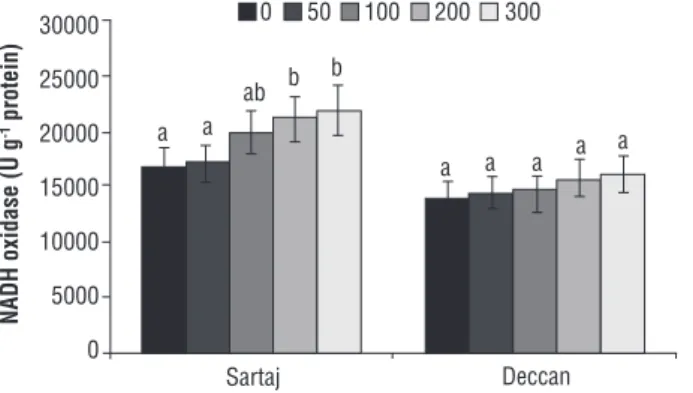
Figure 6. Changes in NAD(P)H oxidase content of Sartaj and Deccan under different concentrations of chromium (0, 50, 100, 200 and 300 µM). Data are mean of three replicates ± SE, compared to the control (0 µM) at p≤0.05. Different letters indicate significant differences among mean values within each variety (Student t-test, p≤0.05).
30000
25000
20000
15000
10000
5000
0
Sartaj Deccan a a
ab
a a a a a b b
NADH oxidase (U g
-1 protein)
0 50 100 200 300
140 120 100
80 60 40 20
0
Sartaj Deccan
a a a
b b
a a a a a
GPX (U µg
-1 of protein)
0 50 100 200 300
Figure 7. Assay of guaiacol peroxidase in Sartaj and Deccan under different concentrations of chromium (0, 50, 100, 200 and 300 µM). Data are mean of three replicates ± SE, compared to the control (0 µM) at p≤0.05. Different letters indicate significant differences among mean values within each variety (Student t-test, p≤0.05).
APX (U g
-1 protein) 40 35 30 25 20 15 10 5 0
Sartaj Deccan a a a a
a
a a a a a 0 50 100 200 300
Figure 8. Assay of ascorbate peroxidase in Sartaj and Deccan under different concentrations of chromium (0, 50, 100, 200 and 300 µM). Data are mean of three replicates ± SE, compared to the control (0 µM) at p≤0.05. Different letters indicate significant differences among mean values within each variety (Student t-test, p≤0.05).
Carbonyl (nmol mg
-1 protein) 1.8 1.6 1.4
1.2 1.0 0.8 0.6
0.4 0.2 0.0
Sartaj Deccan a
a a
b
bc b
d
c c
c
0 50 100 200 300
Figure 5. Protein carbonyl content of Sartaj and Deccan under different concentrations of Cr (0, 50, 100, 200 and 300 µM). Data are mean of three replicates ± SE, compared to the control (0 µM) at p≤0.05. Different letters indicate significant differences among mean values within each variety (Student t-test, p≤0.05). transfers electrons from NAD(P)H to O2 to form superoxide radical (O2-). Thus, in the present studies
plants were found to upregulate the NAD(P)H oxidase activity by varying concentration of Cr (Figure 6). The activity increased by 1.02, 1.18, 1.26 and 1.3 fold in variety Sartaj, whereas those were 1.04, 1.05, 1.14 and 1.17 fold in the case of Deccan. On comparative basis, Sartaj was recorded 1.35 fold higher than Deccan at the highest concentration of Cr.
Estimation of antioxidative enzymes: The
harbouring electron transport chain. Those include cell wall, apoplastic space, plasma membrane, chloroplast, mitochondria etc. But the production of ROS beyond the capacity of cells may create the oxidative damage (Dhir et al., 2009).
In the present experiment, a significant rise of O2- and H
2O2, regardless of varieties, is interesting
to notice. It could be considered as a preliminary outcome of oxidative induction. H2O2, by nature being not a typical radical, still, very often is regarded to be safe within the threshold level of tissue. Thus, with lower concentration of Cr both the varieties tended to minimize the H2O2 level, but peaked at 300 µM of Cr. Hydrogen peroxidemay act as a secondary messenger to trigger many physiological processes, as recorded under various biotic and abiotic stress. Inhibition of root cell by application of Cr had been reported by Arora et al. (2006) with moderate increase in H2O2 content. On the other hand, since O2.- is more reactive,
unstable and impermeable to biological membrane, it reacts with H2O2 to generate hydroxyl radicals. The latter, being the most potent ROS, plays a major role in membrane lipid peroxidation. The exposure exposure of Cr undoubtedly accelerates the oxidative damage in crop plants in natural environmental conditions by inducing lipid peroxidation (Dhindsa et al., 1981). Regarding the source of O2.- and
other ROS generation, there is some oxidase located in apoplastic spaces and ionically bound cell wall polymers, or even cell membrane bound becoming over activated. In the present experiment, NAD(P)H oxidase mediates the oxidation of NADH with simultaneous reduction of O2 to O2- and H
2O2.
This oxidase activity has a significant sharing in generation of oxidative bust with other membrane bound peroxidises and oxidases (Achary et al., 2007). Cr and other heavy metals are mostly observed with a significant expression of NADH oxidases activity in many plant species. Moreover, the variation in activities between the two varieties (Sartaj and Decan) is one more confirmation of oxidative stress under Cr induction. The variation in NAD(P)H oxidase activity could be regarded as discriminatory sensitivity of oxidative stress in terms of the same enzyme activity, as reported earlier (Sharma et al., 2012), under heavy metal stress. Meanwhile, the exposure to redox metals (in this case, the Cr) could be able to induce the ROS by Fenton type and other redox types of reaction. On the other hand, the impact of oxidative stress on plants could easily be justified through its lipid peroxidation and protein oxidation level.
SOD activity (U µg
-1 protein) 0.008 0.007 0.006 0.005 0.004 0.003 0.002 0.001 0
Sartaj Deccan
a a a ab
b b
d
c d
c
0 50 100 200 300
Figure 9. Assay of superoxide dismutase in Sartaj and Deccan under different concentrations of Cr (0, 50, 100, 200 and 300 µM). Data are mean of three replicates ± SE, compared to the control (0 µM) at p≤0.05. Different letters indicate significant differences among mean values within each variety (Student t-test, p≤0.05).
DISCUSSION
This is considered as a consequence of ROS imposed lipid peroxidation of cell membrane and other organelles (Ghosh et al., 2011). The level of MDA content recorded to induce differences between the two varieties is suggestive to their differential sensitivity to oxidative stress. Lipid peroxidation happens to be a crucial effect of ROS, where a chain of reactions are operated with different intermediates at successive levels of peroxidation. The physical structure of plant cell membrane is placing the fatty acid side chains in close proximity. Thereby, it enables the autocatalytic process in consecutive stress. Initially, lipids in the membrane are converted into alkaline radicals. In the propagation steps, it is converted into hydroperoxides, epoxide. Finally, fatty acids are produced and complete lipid peroxidation (Bhattacharjee, 2005). This is followed by an irreversible oxidation of protein moieties, and that turns over some carbonylated derivatives. Metal ions with strong redox potential (Cr being one of those) accelerate the the membrane peroxidation more rapidly than other non-redox metals (Dhir et al., 2009).
The accumulation of Cr in plant tissues happens in order to induce the alteration of metabolic reaction of plants with up or down regulation of enzymatic cascade. The antioxidative enzymes tolerant to Cr induced oxidative stress recorded a similar response. With the illustration of peroxidase activity taken both guaiacol and ascorbate as phenolic substances, plants were induced according to concentrations of Cr. Peroxidases in plants are commonly referred as monomeric heme containing enzymes which are able to catalize the reactions with phenolic moieties as electron donor to reduce H2O2 into H2O. The hyperactivity of peroxidase under Cr contaminated waste water in many aquatic plants has been implicated as constant detoxification of H2O2.. Our results are in conformity with earlier studies on upregulation of antioxidative enzymes under heavy metal (Shanker et al., 2005). Peroxidase is attributed to lignifications by the cross linking of phenolic residues in the cell wall matrix. This is probably forwarded for the rigidity of cell wall or shielding the membrane from peroxidation under the condition of metal stress (Bhattacharjee, 2005).
Likewise, APX enzyme is displayed with its variable isozymic forms for antioxidation processes of H2O2. In most cases, APX is responsible for such activities with cytosolic, chloroplastic, mitochondrial and other organelle under various metal stresses (Hu et al., 2007). Notably, in the present experiment the variety
Deccan recorded the highest activity only at 300 µM Cr concentration, whereas Sartaj recorded a steady linear increase against the increasing Cr concentrations. Two varieties showed discriminatory responses of APX to H2O2. To be more specific, APX is supposed to be less involved in H2O2 detoxification rather than the regulation of H2O2 as a signalling molecule (Cuypers et al., 2011). SOD is furnished with first line of defense, where O2
.-is d.-ismuted in H2O2 and O2. The accumulation of O2.-
or other free radicals in general could be detoxified by SOD. Cr, like other heavy metals, is quite efficient to induce SOD to detoxify the effect of O2.-. However,
a discriminatory pattern is also reported in many studies. Those findings are coordinated with variation of metal concentrations, duration of exposure, tissue types and even the valence of metals (Tanaka et al., 1996). Whatever the cases might be, the elevation of SOD activity in general is a clear indication to detoxify the O2- and other ROS in downstream pathways in
different cell organelle under metal stress. The two varieties in the present experiment established their differential antioxidation pathway under the same concentration of Cr. However, Sartaj proved to be more efficient in this process.
Acknowledgments: The work was supported by the DST-FIST programme, DST, Governemnt of India, New Delhi. Department of seed science, Bidhan Chandra Krishi Viswavidyalaya, Mohanpur, West Bengal, India is duly acknowledged for providing the maize seeds.
REFERENCES
Achary VM, Jena S, Panda KK, Panda BB (2008) Aluminium induced oxi-dative stress and DNA damage in root cells of Allium cepa L. Ecotoxicol. Environ. Saf. 70:300-310.
Alonso R, Elvira S, Castillo FJ, Gimeno BS (2001) Interactive effects of ozone and drought stress on pigments and activities of antioxidative en-zymes in pinus halepensis. Plant Cell Environ. 24:905-916.
Arora A, Saxena S, Sharma DK (2006) Tolerance and phytoaccumulation of chromium by three Azolla species. World J. Microbiol. Biotechnol. 22:97-100.
Bradford MM (1976) A rapid and sensitive method for the quantitation of microgram quantities of protein utilizing the principle of protein-dye binding. Anal. Biochem. 72:248-254.
Bhattacharjee S (2005) Reactive oxidative species and oxidative stress in plants: roles in stress, senescence and signal transduction in plants. Curr. Sci. 89:1113-1121.
Cuypers A, Smeets K, Ruytinx J, Opdenakker K, Keunen E, Re-mans T, Horemans N, Vanhoudt N, Van Sanden S, Van Belleghem F, Guisez Y, Colpaert J,Vangronsveld J (2011) The cellular redox state as a modula-tor in cadmium and copper responses in Arabidopsis thaliana seedlings. J. Plant Physiol. 168:309-316.
De Leonardis S, Dipierro N, Dipierro S (2000) Purification and characterization of an ascorbate peroxidase from potato tuber mitochon-dria. Plant Physiol. Biochem. 38:773-779.
Dhindsa RS, Plumb-Dhindsa P, Thorpe TA (1981) Leaf senescence: cor-related with increased levels of membrane permeability and lipid per-oxidation, and decreased levels of superoxide dismutase and catalase. J. Exp. Bot. 32:93-101.
Dhir B, Sharmila P, Pardha Saradhi P, Nasim SA (2009) Physiological and antioxidant responses of Salvinia natans exposed to chromium-rich wastewater. Ecotoxicol. Environ. Saf. 72:1790-1797.
Elstner EF, Heupel A (1976) Inhibition of nitrite formation from hydroxylammoniumchloride: a simple assay for superoxide dismutase. Anal. Biochem. 70:616-620.
Emsley J (2001) “Chromium”. Nature’s Building Blocks. In: An AZ Guide to the Elements, pp.495-498. Oxford University Press, Oxford, England.
Gomez KA, Gomez AA (1984) Statistical Procedures for Agricultural Re-search. Wiley, New York.
Gratão PL, Polle A, Lea PJ, Azevedo RA (2005) Making the life of heavy metal-stressed plants a little easier. Funct. Plant Biol. 32:481-494.
Gikas P, Romanos P (2006) Effects of trivalent (Cr (III)) and hexa-valent (Cr (VI)) chromium on the growth of activated sludge. J. Hazard Mater. 133:212-217.
Ghosh N, Adak MK, Ghosh PD, Gupta S, Sen Gupta DN, Mandal C (2011) Differential responses of two rice varieties to salt stress. Plant Biotech-nol. Rep. 5:89-103.
Hoagland D, Arnon DI (1950) The water culture method for growing plants without soil, College of Agriculture, University of California, Berke-ley, CA, USA. Calif. Agr. Expt. Sta. Cir. 347:1-32.
Heath RL, Packer L (1968) Photoperoxidation in isolated chloroplasts. I. Kinetics and stoichiometry of fatty acid peroxidation. Arch. Biochem. Biophys. 125:189-198.
Hu Y, Ge Y, Zang C, Zu T, Cheng W (2009) Cadmium toxicity and trans-location in rice seedlings are reduced by hydrogen peroxide treatments. Plant Growth Regul. 5:51-61.
Hu C, Zheng L, Hamilton D, Zhou W, Yang T, Zhu D (2007) Physiological responses induced by copper bioaccumulation in Eichhornia crassipes. Hydrobiologia 579:211-218.
Kotás J, Stasicka Z (2000) Chromium occurrence in the environment and methods of its speciation. Environ. Pollut. 107:263-283.
Liu D, Zou J, Wang M, Jiang W (2008) Hexavalent chromium up-take and its effects on mineral upup-take, antioxidant defense system and photosynthesis in Amaranthus viridis L. Bioresourc. Technol. 99:2628-2636.
Pandey N, Sharma CP (2003) Chromium interference in iron nutrition and water relations of cabbage. Environ. Exp. Bot.49:195-200.
Panda SK, Choudhury S (2005) Chromium stress in plants. Braz. J. Plant Physiol. 17:95-102.
Panda SK (2007) Chromium-mediated oxidative stress and ultrastructural changes in root cells of developing rice seedlings. J. Plant Physiol. 164:1419-1428.
Sambrook J, Russell DW (2001) Molecular cloning: a laboratory manual. Cold Spring Harbor Laboratory Press, Cold Spring Harbor, New York, USA.
Shanker AK, Djanaguiraman M, Sudhagar R, Chandrashekar CN, Pathmanabhan G (2004) Differential antioxidative response of ascorbate glutathione pathway enzymes and metabolites to chromium speciation stress in green gram (Vigna radiata (L.) R. Wilczek. cv CO4) roots. Plant Sci. 166:1035-1043.
Shanker AK , Cervantes C, Loza-Tavera H, Avudainayagam S (2005) Chromium toxicity in plants. Environ. Int. 31:739-753.
Sharma P, Jha AB, Dubey RS, Pessarakli M (2012) Reactive oxygen spe-cies, oxidative damage, and antioxidative defense mechanism in plants under stressful conditions. J. Bot. doi:10.1155/2012/217037.
Smiri M, Chaoui A, Rouhier N, Gelhaye E, Jacquot JP, El Ferjani E (2010) NAD pattern and NADH oxidase activity in pea (Pisum sativum L.) under cadmium toxicity. Physiol. Mol. Biol. Plants 16:305-315.
Sun X, Yuan S, Lin HH (2006) Salicylic acid decreases the levels of dehy-drin-like proteins in Tibetan hulless barley leaves under water stress. Z. Naturforsch. C 61:245-250.
Tanaka K, Takio S, Yamamoto I, Satoh T (1996) Purification of the cytosolic CuZn-superoxide dismutase (CuZn-SOD) of Marchantia palea-cea var. diptera and its resemblance to CuZn-SOD from chloroplasts. Plant Cell Physiol.37:523-529.
Uma MS, Viswanath DP, Rao MRG, Chimmad VP (1990) Salt tolerance of some maize genotypes. Crop Improvement 17:22-26.
Verbeke P, Siboska GE, Clark BF, Rattan SI (2000) Kinetin inhibits protein oxida-tion and glycoxidaoxida-tion in vitro. Biochem. Bioph. Res. Commun. 276:1265-1270.
Wang BJ, Sheu HM, Guo YL, Lee YH, Lai CS, Pan MH, Wang YJ (2010) Hexavalent chromium induced ROS formation, Akt, NF-kappaB, and MAPK activation, and TNF-alpha and IL-1alpha production in keratino-cytes. Toxicol. Lett. 198:216-224.
Zou J, Yu K, Zhang Z, Jiang W, Liu D (2009) Antioxidant response system and chlorophyll fluorescence in chromium (VI)-treated Zea mays (L.) seedlings. Acta Biol. Cracov. Bot. 51:23-33.