Structural Evolution of Silica Sols Modified with Formamide
R.F.S. Lenza#, W.L. Vasconcelos*
Federal University of Minas Gerais - Department of Metallurgical and Materials Engineering, 30160-030 Belo Horizonte - MG, Brazil
Received: November 21, 2000; Revised: June 28, 2001
In this work we investigated the influence of formamide on the acid-catalyzed sol-gel process by Fourier transform infrared spectroscopy (FTIR). Three silica sols were studied: Sol catalyzed with nitric acid without formamide, sol catalyzed with nitric acid containing formamide and sol catalyzed with a mixture of nitric acid and hydrofluoric acid and modified with formamide. Following the time evolution of both the Si-(OH) stretching vibration at around 950 cm-1and the Si-O-(Si) vibration between 1040 cm-1and 1200 cm-1we were able to describe the structural evolution of each sol. The curve of evolution of Si-(OH) stretching vibration corresponding to sol A has a simple asymptotic evolution. In the case of formamide containing sol, we observed a two-step structural evolution indicating that for the system containing formamide the polymerization goes through a temporary stabilization of oligomers, which can explain the non-variation of the Si-O(H) bond wavenumber for a certain time. Gelation times were of several days for gels without formamide and few hours for gels containing additive. The presence of additive resulted in a highly intercon-nected gel.
Keyworks:sol-gel, formamide, FTIR, structural evolution
1. Introduction
Sol gel is a low temperature method using chemical precursors that produces ceramics and glasses with better purity and homogeneity than high temperature conven-tional processes. Sol gel has produced a wide range of compositions (mostly oxides) in various forms, including powders, fibers, coatings and thin films, monoliths and composites, and porous membranes1-3.
The sol-gel process of silica involves the hydrolysis (1) and condensation (2,3) of alkoxides, such as tetraethoxysi-lane or tetramethoxysitetraethoxysi-lane. These monositetraethoxysi-lanes form on these reactions (1-3) many different linear, branched and cyclic intermediates1,4.
≡Si-OR + H2O→ ≡Si-OH + ROH, (1)
≡Si-OR + HO-Si≡ → ≡Si-O-Si≡+ ROH (2)
≡Si-OH + HO-Si≡ → ≡Si-O-Si≡+ H2O (3)
By controlling the synthesis conditions carefully, sol morphology can be directed towards branched polymeric systems or to particulate systems2. Control of relative rates of hydrolysis and polycondensation, and the respective
mechanisms of these reactions are the main tools for this difference1,2,5-7.
A great deal of effort has been devoted to improve the understanding of the various stages of the sol-gel process. It has been shown that besides pH, temperature of process, pressure, solvent, concentration of alkoxide, type and con-centration of catalysts and DCCA (Drying Control Chemi-cal Additive) play an important role in determining morphology of the resulting polymeric structure1,2,4. Be-sides the possibility of modifying the hydrolysis and poly-condensation reactions, it is now well known that addition of DCCA to a mixture of alkoxide, water and alcohol, improves the processing control of gels structure and proc-essability5,8. Formamide is a typical DCCA. Using this additive it is then possible to dry gels directly in an open container avoiding the cracking process. However, a sys-tematic study and a molecular level understanding of the effect of formamide and other additives is still lacking4,9, and the knowledge of their behavior is necessary to under-stand the reaction path of the technical process and opens a way to control properties of the resulting materials.
Numerous techniques have been employed in the study of sol to gel evolution, such as29SiNMR9,10, Raman
Spec-*e-mail: [email protected]
#
e-mail: [email protected]
troscopy11 and SAXS2. Among these methods, infrared spectroscopy has proven to be a very successful technique to follow the gelation process in silicate system1,7,8.
In the present study we shall investigate the effect of formamide on the gelation process of three different silica-gel systems by Fourier transform infrared spec-troscopy (FTIR). Some important conclusions are made concerning the structural evolution of the sols. The re-sults obtained are also compared with aggregation mod-els from literature.
2. Experimental Procedure
Polymeric silica sols were prepared by hydrolysis and condensation of tetraethoxysilane (Si(OEt)4, TEOS,
Aldrich, Co.) in alcohol (ethanol, Merck, Co.). As catalyst we used nitric acid (Merck, Co.). The molar ratios TEOS/H2O/EtOH/HNO3used were 1/10/6/0.085.In order
to study the effect of formamide as additive in the sol-gel process, three systems were prepared: Sol A was prepared without formamide; sols B and C were prepared with a molar ratio formamide/TEOS equal to 1. Sol C also con-tains a 0,5 mol/L of Hydrofluoric acid (Merck, Co.).
TEOS was carefully added to a mixture of water, acid and alcohol under vigorous stirring at 40 °C. Thus, an appropriate amount of formamide was added. In order to evaluate the influence of this additive on the gelation time and some structural properties of the gels obtained, sols were cast into plastic tubes after 30 min of mixture and gelled at room temperature and at 40 °C. The samples were keept in closed containers during gelation. The pHs of sols were measured by pHmeter Chemcadet 5986-50 of Cole Parmer Co. at intervals of 10 min.
The sols evolution was monitored in situ by FTIR spectroscopy by means of ATR mode (Attenuated Total Reflection). FTIR spectroscopy was performed using a FTIR Paragon–1000 of Perkin Elmer Co. with a triglyceride sulfate detector. 100µL of sols were pressed against a KRS-5 crystal and FTIR spectra were collected with a 4 cm-1resolution. Typically, 64 scans were accumu-lated for each spectrum, in the frequency range of 4000 cm-1 to 600 cm-1. Spectra were successively recorded from 1 min after addition of formamide up to fewer minutes before gelation, since after this point the spectra were poorly resolved by this technique. The solutions were maintained at 40 °C in closed containers under constant stirring. Spec-tral manipulations such as smoothing, baseline adjustment, normalization and peak deconvolution were performed. Voight function was used throughout and peak fitting was carried out until squared correlation coefficients with r2 greater than 0.995 were obtained. Specific surface areas and pore volumes of the samples were measured by nitrogen adsorption (Autosorb 1, Quantachrome, Co.). Prior to N2
sorption, samples were degassed at 100 °C for 12 h to remove physically adsorbed material from their surfaces. The specific surface areas were determined using BET plots1.
3. Results
Figure 1 presents the spectra of pure TEOS and spectra of sols after 1 min of reaction. We observed, through the bands centered on 1167 cm-1 and 784 cm-1 associated to vibration of Si-O(C2H5) group, that hydrolysis is not
com-plete after this time. It was observed in the spectrum of sol A that after 3 min of reaction no band due to alkoxide was present. On the other hand, spectra of sols B and C showed that the hydrolysis was not completed after 3 min of reac-tion.
Figure 2 shows spectra of sols after 5 min of reaction. One can observe that no band due to unhydrolyzed TEOS is present. Thus, we conclude that the hydrolysis reaction goes to completion in the early stage of the process. All the spectra present the same characteristic bands of silica-gel system, with exception of a strong band at about 1690 cm-1 characteristic of a C=O bond belonging to formate or amide groups, present in the spectra of sols containing for-mamide7.
Figure 1.Spectra of pure TEOS (a) and sols A (b); B (c) and C (d) after 1 min of reaction.
Formamide has a drastic effect on the hydrolysis of sol-gel systems. Compared to using only ethanol as a solvent, formamide causes a reduction in the hydrolysis rate, based on the disappearance of bands due to alkoxide. The effect of formamide was generally explained on the basis of hydrogen bonding and solvent viscosity. Although both ethanol and formamide exhibits higher values of both
ε, dielectric constant andµ, dipole moment, these values are larger to formamide (ε= 110 and 24.3,µ= 3.7 and 1.69 for formamide and ethanol, respectively) and is therefore expected that formamide to hydrogen bond more strongly to protons under acidic conditions, reducing the effective catalyst activity. In addition, the viscosity of formamide is approximately seven times greater than for ethanol, at 25 °C. It was postulated that the increased viscosity may reduce the ability of the nucleus to reorient during hydroly-sis reaction and reducing also the diffusion coefficients of reactive species within the solution, further reduces the hydrolysis rate1.
In order to study the sol-to-gel evolution we focused our FTIR study on the observation of both the Si-O(H) stretch-ing band at around 950 cm-1and the Si-O(-Si) stretching band between 1040 cm-1to 1200 cm-1 6,7,8,12,13.
The first band was deconvoluted in two peaks, a major one at approximately 950 cm-1, due to Si-O(H) bond stretching vibration6-8,14, and a smaller one at around 915 cm-1, associated to non-bridging free broken Si-O -bonds8,9,14,15. The evolution of the peak at around 950 cm-1 with time was followed for all sols (Fig. 3). The wavenum-ber of the Si-O(H) bond vibration increases with the strength of the bond and the degree of connection in the sol8. One can observe in Fig. 4 that whereas the curve corresponding to sol A has a simple asymptotic evolution, a plateau is observed for sols containing formamide. We thus concluded that in the presence of this DCCA, polym-erization goes through a temporary stabilization of oligom-ers, which can explain the non-variation of the Si-O(H)
bond wavenumber for a certain time. Viartet al.8related similar results in the system TMOS-water-methanol-for-mamide. The sols containing formamide evolve towards higher values of this wavenumber. The higher values for sols with formamide shows that the Si-O(H) bonds are stronger and belong to a more cross-linked structure. It is more pronounced for sol containing also HF, which reach high values of wavenumber of the Si-O(H) bond in very short time.
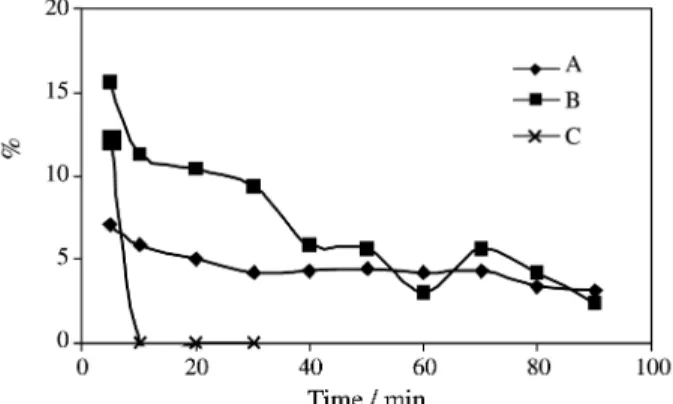
The peak at about 915 cm-1gives information on the size of the Si-based species, since it is observed only an average size of clusters, which is smaller than the dimension of (SiO)6rings8,15. This is explained by the strong decreasing
in the possibility of forming free broken bonds in larger clusters1,8,15. Figure 4 presents the time evolution of the proportion of the 915 cm-1peak area in the resulting band at 950 cm-1 for the sols. One can observe that that the proportion of oligomers containing less than 6 Si atoms noticeably decreases in all sols with time. Thus we con-cluded that in all sols studied in this work, polymerization goes through a stage where particles are small enough to allow the formation of Si-O free broken bonds and give absorption at 915 cm-1band . With time, these small oli-gomers then condense together leading to a rapid decrease of the 915 cm-1peak absorption. It can be noted that this peak area is more important and remains longer present for sol B that contain formamide. It is interesting to notice that, for sol B, the time during which small oligomers remain present coincides with the time of the plateau present in Fig. 3. Sol C presents these oligomers only before 10 min of reaction. After this time these oligomers condense to-gether with a very rapid decrease of the 915 cm-1area and a strong increase in the Si-O(H) peak wavenumber.
The Si-O-(Si) stretching vibration band can be decon-voluted in four or five peaks at around 1040 cm-1, 1080 cm-1, 1100 cm-1, 1160 cm-1and 1200 cm-1. Although infrared spectra of silica systems have been extensively
Figure 3.Time evolution of the position of the 950 cm-1infrared peak. The error values are smaller than 5%.
recorded, the lower frequency features have seldom been discussed and there is no agreement as to the exact struc-tural significance of the peaks occurring between 1000 cm-1 and 1260 cm-1. Though these features are generally ac-cepted to arise mostly from asymmetric stretching vibra-ti o ns o f Si -O- Si b r id g in g se qu en ce s, d iff eren t interpretations still hold15. The 1080 cm-1and 1200 cm-1 peaks, according to literature7,8,15, correspond respectively
to transversal optical and longitudinal optical asymmetric stretching modes of Si-O-(Si), AS1TO and AS1LO modes,
as observed in vitreous silica. The structure of vitreous silica consists of an assembly of Si-O-Si rings of various sizes in which each Si-O-Si belongs to a cyclic structure. It is reported that silica-gel is formed with cyclic and linear structures1. In this work we assigned that the 1080 cm-1and 1200 cm-1vibrations of Si-O-(Si) bonds belongs to cyclic structures1,7,8,12. The other peaks, 1040 cm-1, 1100 cm-1and 1160 cm-1, are assigned to stretching vibrations of Si-O-(Si), belonging to a more linear and less cross-linked struc-ture8,15. The 1040 cm-1, 1080 cm-1, 1100 cm-1and 1160 cm-1peaks appear as soon as the condensation takes place in the systems studied, whereas the 1200 cm-1peak appears after several minutes of reaction and it is present only in the spectra of gels containing formamide. The 1040 cm-1and 1080 cm-1 peaks are partially superimposed by the 1048 cm-1and 1075 cm-1peaks due to stretching vibration of C-O(H) belonging to ethanol. Thus, we subtract the ethanol spectrum from the spectra of sols. Figure 5 shows the ratio between the intensity of 1040 cm-1and 1080 cm-1
peaks. It can be observed that the intensity of 1080 cm-1 peak, which belongs to a more branched structure, in rela-tion to 1040 cm-1peak, belongs to more linear structure, increases after about 40 min for sol B, whereas it stays roughly constant for sol without formamide. The spectra of sol C could not be well resolved because its high viscosity after 20 min of reaction. We thus concluded that the
struc-ture of the sols containing formamide evolves towards the cross-linked structure of vitreous silica, and the sol A evolves to a more linear structure.
Table 1 presents the time of gelation for sols at room temperature and 40 °C. It can be noted that formamide has a drastic effect on the gelation process for these systems. Sol C, that also contains hydrofluoric acid, presents a shorter time of gelation. It is well known that F-has a high effectiveness in polymerization reactions, mainly due to its smaller ionic radius, versus that of the hydroxyl and that it performs the same function of tem-porarily increasing the coordination number of silicon. This ability to form five-coordinate transition state leads to more reactive silicon species, which can react faster with additional silanol groups, resulting in an accelera-tion of the rate of polymerizaaccelera-tion1,16,17.
Formamide, a protic solvent, is capable of forming significantly stronger hydrogen bonds to the reactant spe-cies and, compared to ethanol, formamide provides more extensive steric shielding around silicon preventing effi-cient condensation. This line of reasoning appears incon-sistent with the results of this work, which shows more extensive condensation in the formamide system. This contradiction may be explained by the partial hydrolysis of formamide to produce ammonia and formic acid.
HCONH2→HCOO-NH4+→HCOOH + NH3 (4)
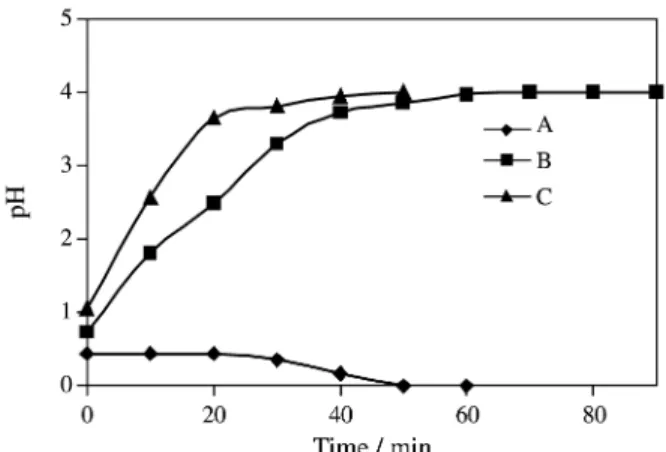
These reactions lead to a progressive increase of the solution pH with time, as can be observed in Fig. 6. Because
Table 1.Time of gelation of sols at room temperature and at 40 °C.
Sol Tgel (h) 25 °C Tgel(h) 40 °C
A 572±5 2±0.1
B 22±1 1±0.1
C 0.9±0.1 0.5±0.05
Figure 6.Time evolution of pH of sols.
base-catalyzed silanol condensation is generally observed to be first-order in [OH-]1, ammonia should increase the
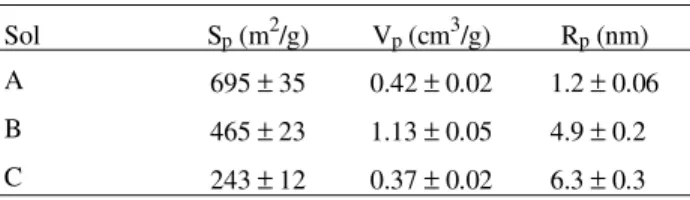
condensation rate. At pH ~ 4, the solubility of silica and the dissolution rate are quite low. Therefore, an effect of for-mamide additions may be to strengthen the gel by maximiz-ing the extent of condensation without reorganization into a particular structure. This is consistent with observations that formamide increases the microhardness of wet gels and correspondingly the pore size of dried gels, while maintain-ing a high surface area and large pore volume1,18. The values of structural properties such as specific surface area (Sp), specific pore volume (vp) and average pore radius (Rp)
for the silica gels heated to 400 °C obtained in this work are listed in Table 2. It can be seen that sol A has a fine pore structure, whereas sols B and C present coarser structure. These structural evolutions are consistent with the kinetic models of aggregation found in literature1: acidic in sol A,
evolving in a cluster-cluster aggregation, leading to more linear structure and basic for sols B and C, evolving in a monomer-cluster aggregation, leading to a more branched network1,8.
4. Conclusions
The kinetic of hydrolysis and polycondensation of silica-gel systems are affected by formamide. This addi-tive hydrolysis during reactions, increasing the pH of solutions and changing the mechanism of hydrolysis and condensation. In the absence of formamide, the sol struc-ture is poorly interconnected and the gel evolves to a microporous material. For sols containing formamide, a two-step structural evolution was observed. Condensa-tion leads to small oligomers that condense together in a more cross-linked structure, resulting in mesoporous materials. This effect is more pronounced for systems with F-.
Acknowledgement
The authors thank the financial support by CAPES and CNPQ.
References
1. Brinker, C.J.; Scherer, G.W. Sol-Gel Science: The Physics and Chemistry of Sol-Gel Processing, Aca-demic Press, inc. San Diego, CA., p. 907, 1990. 2. deLange, R.S.A.; Hehhink, J.H.A.; Kelzer, K.;
Burggraaf, A.J.Journal of Non-Crystalline Solids, v. 191, p. 1, 1995.
3. Lenza, R.F.S.; Vasconcelos, W. L. Materials Re-search, v. 2, n. 3, p. 197, 1999.
4. Winter, R.; Chan, J.B.; Frattini, R.; Jonas, J.Journal of Non-Crystalline Solids, v. 105, p. 214, 1988. 5. Sol-Gel Chemistry. http:// www.psrc.usm.edu/
mauritz/solgel.htm. 7/29/1999.
6. Schraml-Marth, M.; Walther, K.L.; Wokan, A.; Handy, B.E.; Baiker, A. Journal of Non-Crystalline Solids, v. 143, p. 93, 1992.
7. Orcel, G.; Phalippou, J.; Hench, L.L.Journal of Non-Crystalline Solids, v. 88, p. 114, 1986.
8. Viart, N.; Niznansky, D.; Rehspringer, J.L.Journal of Sol-Gel Scince and. Technology, v. 8, p. 183, 1997. 9. Sugahara, Y.; Okada, S.; Sato, S.; Kuroda, K; Kato, C.
Journal of Non-Crystalline Solids, v. 167, p. 21, 1994. 10. Voon Ng, L.; McCormick, A.V.Journal of. Physic
Chemistry, v. 100, p. 12517, 1996.
11. Ferreira, M.P. Caracterização Estrutural de Géis de Sílica Durante as Etapas Iniciais de Gelação e Se-cagem.Dissertação de Mestrado, Universidade Fed-eral de Minas Gerais, 146 p., 1996.
12. Hench, L.L.; West, J.K.Chemical Review, v. 90, p. 33, 1990.
13. Inokama, L.H.; Kurata, Y.; Hasegawa, S.Journal of Non-Crystalline Solids, v. 185, p. 249, 1995.
14. Lenza, R.F.S.; Vasconcelos, W.L.Ceramica, submit-ted for publication.
15. Almeida, R. M.; Pantano, C.G. Journal of Applied Physics, v. 68, n. 8, p. 4225, 1990.
16. Iller, R.K.The Chemistry of Silica, John Wiley ed., New York, 1979.
17. Lenza, R.F.S.; Vasconcelos, W.L. Journal of Non-Crystalline Solids, in press.
18. Orcel, G.; Hench, L.L; Artaki, I.; Jonas, J.; Zerda, T.W. Journal of Non-Crystalline Solids, v. 105, p. 223, 1988.
Table 2.Structural properties of silica gels.
Sol Sp(m2/g) Vp(cm3/g) Rp(nm)
A 695±35 0.42±0.02 1.2±0.06
B 465±23 1.13±0.05 4.9±0.2