ISSN 0104-6632 Printed in Brazil
www.abeq.org.br/bjche
Vol. 30, No. 04, pp. 825 - 834, October - December, 2013
Brazilian Journal
of Chemical
Engineering
KAOLIN AND COMMERCIAL FCC CATALYSTS
IN THE CRACKING OF LOADS OF
POLYPROPYLENE UNDER REFINARY
CONDITIONS
A. M. Ribeiro, H. F. Machado Júnior and D. A. Costa
*Departamento de Engenharia Química/IT/UFRRJ, Phone: + (55) (021) 37873742, BR-465, Km 07, CEP: 23890-000, Seropédica - RJ, Brasil.
E-mail: [email protected]
(Submitted: April 19, 2012 ; Revised: July 30, 2012 ; Accepted: August 13, 2012)
Abstract - The efficiency of Commercial FCC catalysts (low, medium and high activities) was evaluated by the catalytic cracking process of combined feeds of polypropylene (PP) and vaseline, using a microactivity test unit (M.A.T.) for the production of fuel fractions (gasoline, diesel and residue). The PP/vaseline loads, at 2.0% and 4.0% wt, were processed under refinery conditions (load/catalyst ratio and temperature of process). For the PP/vaseline load (4.0% wt), the production of the gasoline fraction was favored by all catalysts, while the diesel fraction was favored by PP/vaseline load (2.0% wt), showing a preferential contact of the zeolite external surface with the end of the polymer chains for the occurrence of the catalytic cracking. All the loads produced a bigger quantity of the gaseous products in the presence of highly active commercial FCC catalyst. The improvement in the activity of the commercial FCC catalyst decreased the production of the liquid fractions and increased the quantity of the solid fractions, independent of the concentration of the loads. These results can be related to the difficulty of the polymer chains to access the catalyst acid sites, occurring preferentially end-chain scission at the external surface of the catalyst.
Keywords:PP; Catalytic cracking; FCC catalyst; Gasoline fraction.
INTRODUCTION
Polymeric residues are the cause of increasing environmental concern in the developed world. In view of their non-biodegradability, most polymers are considered inappropriate for disposal. Because of these limitations, the tertiary or chemical recycling is growing in importance. Therefore, waste plastics are converted into monomers, fuels or valuable chemi-cals for the petrochemical industry (Lin & Yen, 2005; Cardona & Corma, 2000). The concept of recovery of valuable products from the waste plastics using various chemical reactions such as hydrolysis, alco-holysis, acidolysis, and pyrolysis is believed to be a promising approach. Pyrolysis or thermal cracking is
an important industrial process for obtaining basic raw materials of the petrochemical industry. Polyole-fins such as polyethylene (PE), polypropylene (PP) and polystyrene (PS) can be converted into clean fuel by pyrolysis process. Therefore, many researchers have made efforts to make the pyrolysis process economically viable (Dawood & Miura, 2002).
Hydrocracking and thermal cracking have been investigated in the laboratory, at the pilot plant level and in some semi-commercial plants that were constructed for the treatment of mixed plastic waste, even those containing chlorine. However, the yield of thermal cracking is low because it provides unsta-ble hydrocarbons with a wide range of boiling points. Thus, catalytic degradation is a means used to solve these problems. The addition of the catalyst is ex-pected to reduce the decomposition temperature, to promote faster decomposition and change products.
The description of cracking reactions during the degradation of plastics is quite difficult, because they are very complex. The method for determining the kinetics of the reaction depends on the technology of degradation of the plastic waste. For example, there are considerable differences in thermal degradation of plastic waste in the absence and presence of catalysts. The catalytic cracking of alkanes in the presence of acid catalyst generally occurs through a mechanism of the ionic type. According to this mechanism, the reactivity and selectivity differ from paraffins to olefins and branched to linear hydrocar-bons. Supposing a similar mechanism for catalytic pyrolysis of polymers, it is reasonable to expect that a modification in the structure of the polymer before pyrolysis catalyst can lead to further improved activity and selectivity (Dawood & Miura, 2002; Cardona & Corma, 2000; Angyal et al., 2007; Lin & Yang, 2008). There are different methods for carrying out the catalytic cracking of polymers: catalytic cracking of plastic wastes and liquid streams mixtures, thermal cracking plus catalytic upgrading, catalytic cracking of plastic wastes by direct contact with the catalyst, and hydrocracking. A simpler way of processing the plastics via catalytic cracking would consist in mix-ing the plastic wastes with a FCC feed, formmix-ing a slurry that is treated conventionally in the FCC unit of a refinery. The principal limitations to this solu-tion are the transportasolu-tion costs of the plastics from origin to the refinery, the need of important refining liquid streams necessary for taking into account the limited amount of plastics that can be mixed, and the restricted use of chlorine and other heteroatoms contained in the plastics that can negatively affect the FCC unit and catalyst (Cardona & Corma, 2000). Furthermore, the commercial FCC catalysts contain two main components: a zeolite (3.0% to 40% by weight) and a matrix. These components include a wide variety of materials which serve for different purposes of the refinery. A catalyst particle is actually a composite. The presence of zeolite in the FCC catalyst promotes high concentrations of
active sites, high thermal and hydrothermal stability and high selectivity. The matrix gives the FCC catalyst porosity, acidity, metal resistance, mechani-cal strength. The porosity allows the loading and product molecules to be released faster in the catalyst particle. The acidity of the matrix is an important factor in the efficiency of the cracking of heavy hydrocarbons (Baptista, 2005; Costa et al., 2004).
The effectiveness of the zeolite catalysis is due to some peculiar characteristics of these materials. Zeolites have high surface area and adsorption capacity. The structure of the zeolites enables the crea-tion of active sites such as acid sites, whose strength and concentration can be controlled according to the desired application, and the size of the channels and wells are compatible with most of the molecules of the raw materials used in industry. Zeolites also have a complex network of channels, giving them differ-ent shape selectivity, i.e., of reactant, product, and selectivity of the transition state. The amount of the active component (zeolite) in the composition of the catalyst adjusts the activity to the level desired, as well as the selectivity. The alterations in the composition of zeolite Y, like the ratio SiO2/Al2O3 (SAR = Silica Alumina Ratio), make possible the at-tainment of more convenient characteristics, depend-ing of the situation and application (Maia, 2002).
Several authors have studied the application of these catalysts to the pyrolysis of plastic materials (Vasile et al., 1985 and 1988; Beltrame et al., 1989; Audisio et al., 1992; Lin & White, 1995; Ochoa et al., 1996; Serrano et al., 2001; Aguado et al., 2001; Marcilla et al., 2003; Seo et al., 2003; Ribeiro et al., 2006).
Therefore, the objective of this work was the evaluation of the performance of commercial FCC catalysts (low, medium and high activities). The spe-cific objective was the evaluation of catalytic crack-ing of loads of polypropylene (PP) with vaseline (petroleum jelly), through a microactivity test unit (M.A.T.), for the production of combustible fractions (gasoline, diesel and residue).
MATERIALS AND METHODS
Materials
Vaseline (petroleum jelly), containing 95-99% paraffin, 0.4% aromatic compounds and 0.07% sulphur compounds, was used as solvent, and kaolin was used as an inert material. The catalysts were classi-fied in accordance with the percentage of zeolite Y (active component) contained in the commercial composition as: Low Activity (L.A.), Medium Activity (M.A.) and High Activity (H.A.).
Samples Characterization
The global chemical compositions of the kaolin samples (inert material) and of the catalysts were determined through analyses by X-Ray Fluorescence (FRX). The samples were analyzed on a Philips, model PW 1407 X-ray spectrometer with a Cr generating pipe and a proportional flow detector, 50 KV radia-tion and 40 mA. The spectrometer was connected to a microcomputer running the software PHILIPS PW1492. This analysis supplied the percentage by weight (% wt) of the oxides of sodium, aluminum, silicon and metals that compose the inert material and the commercial FCC catalysts.
The surface characterization (adsorption of N2 - Quant-Sorb) to obtain the values of the specific area and the micropore volume of the samples of catalysts (L.A., M.A. and H.A.) was determined by analyses with an ASAP (Accelerated Surface Area and Porosimetry) device, Micrometrics model 2400, through the isothermal adsorption and desorption of N2 at -196 ºC, using the method of Brunauer-Emmet-Teller (B.E.T.). The volume of microspores was determined by the t-plot method, combined with the equation of Harkins and Jura (BARRETT et al., 1951; GREGG & SING, 1982).
Loads of PP/Vaseline
The solubility of the polymers was tested versus vaseline (paraffin mixture) under stirring, heating and refluxing, in order to obtain polymer loads PP/ vaseline of 2.0 and 4.0% wt (by mass).
Catalytic Cracking Process
The process of catalytic cracking used in this work was based on the Standard Test Procedure - 20 ASTM D 3907 and on the test unit for microactivity evaluation (M.A.T.) existing in the Fábrica Carioca de Catalisadores S.A., which can be used to establish variations of space velocity, reaction time, tempera-ture etc. (Ribeiro, 2004).
In this work, the loads of different concentrations
of vaseline and PP/vaseline (2.0 and 4.0 % wt) were submitted to catalytic cracking test, in the real condi-tions used in the refinery (temperature, pressure and load/catalyst ratio, injection time of load). The samples of commercial FCC catalyst (L.A., M.A. and H.A.) were activated “in situ” for 20 min at 520 °C under a flow of nitrogen and at atmospheric pressure to eliminate any residual humidity. These loads were processed in the test unit (M.A.T.) versus kaolin and the commercial FCC catalysts. All cracking loads were performed in duplicate, in the microactivity test unit (M.A.T.), versus all of the FCC catalysts.
Conditions of Experimental Cracking
All samples were processed under the same experimental conditions (conditions for the refinery), considering the same standards adopted by the test microactivity unit existing at the Factory Carioca of Catalyst S.A. The experimental conditions used for the catalytic cracking were: furnace temperature of 520 °C, atmospheric pressure, injection time of 30 s, commercial FCC catalyst mass of 5.0 g, ratio between PP and vaseline of 2.0 and 4.0% wt, flow rate of feed (load) of 2.0 g/min, carrier gas flow rate (nitrogen) of 50 mL min-1 and purge time of 900 seconds. The total reaction time of cracking was 15 minutes and 30 seconds (injection time + bleed). The products of the catalytic cracking process were classified as liquids, solids and gaseous. Scheme 1 shows the diagram with the M.A.T. and the analyses of the products of the catalytic cracking of the propane.
The liquid fraction was collected in the test unit (M.A.T.) and weighed on an analytical balance. The gas chromatographic analysis provided only the composition of condensed fuel fractions.
The liquid fraction was analyzed on a Varian, Model 3300 Gas Chromatograph with flame ionization detector (FID), connected to a microcomputer. The solid product was analyzed by determination of the amount of coke. The gaseous product was calculated by the difference of liquid and solid products, its composition not being analyzed.
Gaseous
Products ProductsLiquid
Solid Products
Difference of Liquid
+ Solid
Gas Chromatograph
with FID
Microcomputer
Chromatogram
Determination of Coke Unit of Test of
Microactivity
(M.A.T)
Gaseous
Products ProductsLiquid
Solid Products
Difference of Liquid
+ Solid
Gas Chromatograph
with FID
Microcomputer
Chromatogram
Determination of Coke Unit of Test of
Microactivity
(M.A.T)
Scheme 1: Diagram of the M.A.T. and analyses of the products of the catalytic cracking of propane.
Analyses of the Products
The chromatograms were used to determine the retention times of the gasoline, diesel and residue limits, in accordance with the chromatograms of the components adopted as internal FCC standards, such as hexane (C6H14), used as minimum range limit (the lower molecular weight component) of the gasoline, dodecane (C12H26) as the maximum range limit (higher molecular weight component) of gasoline and range limit between gasoline and diesel, and icosane (C20H42) as the range limit between diesel and residue. These pure and mixed components were injected (0.5 μL) with the objective of getting the overlapping of the times of retention of the internal standards, establishing accurately the time of the start of retention and the end of each combustible band produced by the cracking. The chromatograms of the FCC standard with 50% gasoline (C5-C12); 30% Light Recycle Oils - LCO (C13-C20) containing the diesel fractions inside of this limit and 20% residue (above of C20) are shown in Figure 1. The dotted lines in the chromatograms were used as baseline for calculating the areas of the curves. The chromatograms were edited in Photoshop CS6 program, with the acquisition of two areas: total area and dotted area. These areas were vectorized in Corel Draw, and values calculated in the CAD program. The area of each chromatogram was calculated by the difference between the total area and the dotted area.
The percentage in weight of gasoline, diesel and residue were calculated using the areas between 0 – 11.6 min., 11.6 - 23 min. and above 23 minutes, in
each chromatogram. The percentage of liquid fraction was calculated by Equation (1).
m (g) liquid fraction
% liquid fraction 100
m(g) load
= ∗ (1)
where m (g) of the liquid fraction was obtained in the test unit (M.A.T.), m (g) of load = 1.0 g (for a load injection time of 30 s).
The percentage of gasoline by load was calcu-lated in accordance with Equation (2).
% gasoline in the chromatogram m (g) liquid fraction % Gasoline Load
m(g) load ∗
= (2)
where percentage of gasoline in the chromatogram was calculated from the area between 0 – 11.6 min., m (g) liquid fraction is obtained in the test unit (M.A.T.) and m (g) of load = 1.0 g (for a load injection time of 30 s).
The percentages of diesel fuel and residue per load were also calculated according to Equation (2), but using the areas between 11.6 – 23 min. and above 23 minutes.
The solid products were analyzed by the equipment LECO, model CS-125, for the determina-tion of the amount of carbon (coke formadetermina-tion), on the surface of the catalyst, and in the interior of its pores, after the reaction. The percentage in weight of coke formed in the FCC catalyst, due to cracking, was calculated by Equation (3).
% coke LECO m(g) catalyst % Coke by Load
m(g) load ∗
= (3)
where m (g) of catalyst = 5.0 g and m (g) of load = 1.0 g (for a load injection time of 30 s), % Coke by Load = % solid product.
The amount of gaseous products was determined by the difference between the liquid and solid prod-ucts, without specification of its compositions.
RESULTS AND DISCUSSION
Characterization of the Catalysts and Kaolin
The average size of kaolin (inert material) and the commercial FCC catalysts, of low, medium and high activities by analysis of Distribution of Particle Size has proved that they had particle sizes similar to or within the same size range, all around 77 μm. The Table 1 shows the particle size distribution of the Commercial FCC catalysts.
The global chemical composition of the inert material and catalysts, using the FRX technique, provides the quantities of constituent oxides (Na, Si
and Al), in accordance with the program for the equipment used for the samples of kaolin (inert material) and FCC catalysts of low, medium and high activity (L.A., M.A. and H.A.) (Table 2).
Table 1: Particle Size Distribution of the Commercial FCC catalysts.
Particle Size Distribution Samples
<149 <105 <80 <40 <20 TMP
Catalyst L.A. 95 80 56 16 1 74
Catalyst M.A. 90 73 51 14 1 78
Catalyst H.A. 90 72 49 12 1 80
L.A. – low activity, M.A. – medium activity, H.A. – high activity
Table 2: FRX analyses of the Commercial FCC catalysts and Kaolin.
Samples SiO2 (%)
Al2O3 (%)
SAR (%)
Na2O (%)
Re2O3 (%)
Kaolin 53.0 42.7 2.11 0.15 ---
Catalyst
L.A. 53.7 42.6 2.14 0.19 1.0
Catalyst
M.A. 54.1 41.4 2.22 0.26 2.54
Catalyst
H.A. 53.8 41.8 2.19 0.32 2.13
L.A. – low activity, M.A. – medium activity, H.A. – high activity
An important property of the zeolites is the possibility of the presence of Lewis and Brönsted acid sites. The Brönsted sites are found in the form of protons linked to oxygen atoms in the structure, and Lewis sites can be found in the form of charge compensation. The content of the active component (zeolite) in the formulation of the FCC catalyst adjusts the activity to the desired level, as well as selectivity. Changes in the composition of zeolite, like the ratio SiO2/Al2O3 (SAR), allow obtaining more convenient features, depending on each situation and application. Furthermore, one can also employ the inclusion of other compounds, such as rare earths (RE), which give greater stability to deactivation (Maia, 2002; Macedo, 2007; Moreno & Rajagopal, 2009).
The isotherms (Table 3) were used to calculate the areas and the microporous volume of the com-mercial FCC catalysts (L.A., M.A. and H.A.). The values of specific area and microporous volume of the catalysts showed that the catalyst of high activity had higher specific area and higher microporous volume values, as compared to the catalysts with medium and low activities. These results may indi-cate that the active sites (acid sites) may be more accessible to the loads, allowing the loads to remain longer times within this catalyst.
Table 3: Specific and external areas and microporous volume values for the Commercial FCC catalysts.
Samples
Specific Area (m2/g)
External Area (m2/g)
Microporous Volume
(cm3/g)
Catalyst L.A. 266 57.52 0.088
Catalyst M.A. 276 58.70 0.092
Catalyst H.A. 422 47.39 0.118
L.A. – low activity, M.A. – medium activity, H.A. – high activity
Loads of PP/Vaseline
The polypropylene (PP) was dissolved in vaseline (petroleum jelly) to obtain loads of different concen-trations (2.0 and 4.0% wt). The temperature of the complete solubilization of PP was below the flash point of the mineral oil, the base of the compound of the mixture of paraffin (188 °C). The resulting loads remained fluid at room temperature, and not just under heating, for periods greater than or equal to three days, depending of the load concentration.
Catalytic Cracking Process
The results obtained in the process with loads of PP/vaseline and the FCC commercial catalysts (of low, medium and high activity) allowed the determi-nation of the efficiency of this process for the pro-duction of combustible fractions (Gasoline, Diesel and Residue).
Analyses of the Products
Table 4 shows the retention times of the chroma-tograms obtained from FCC standard with 50% Gasoline (C5-C12); 30% Light Recycle Oils - LCO (C13-C20), containing the Diesel fractions and 20% Residue (above C20), used to calculate the percentages of gasoline, diesel and residue formed in the liquid products of the catalytic cracking of polypropylene.
Table 4: Limits of the liquid fractions in accordance with the retention time.
Limit of the fractions Retention Time (min.)
Gasoline (C5-C12) 0 – 11.607
Diesel (C13-C20) 11.607 – 23.030
Residue (> of C20) > 23.030
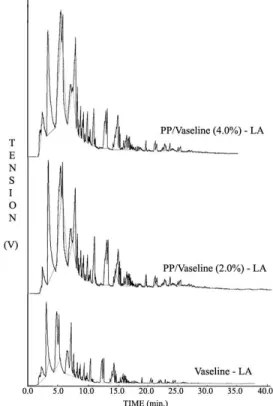
The chromatograms of the liquid products of the cracking of vaseline and loads of PP/vaseline (2.0 and 4.0% wt), in the presence of the kaolin, L.A., M.A. and H.A. catalysts are shown in Figures 2 – 5, respectively.
Figure 2: Chromatograms of liquid products of cracking of Vaseline and loads of PP/Vaseline (2.0 and 4.0% wt) in the presence of kaolin.
Figure 4: Chromatograms of liquid products of cracking of Vaseline and loads of PP/Vaseline (2.0 and 4.0% wt) in the presence of Commercial FCC catalyst – M.A. (medium activity).
Figure 5: Chromatograms of liquid products of cracking of Vaseline and loads of PP/Vaseline (2.0 and 4.0% wt) in the presence of Commercial FCC catalyst – H.A. (high activity)
These chromatograms were used to determine the retention time limits of gasoline, diesel and residue,
in accordance with the FCC standard chromatograms and the mixture FCC standard and pure hydrocar-bons, and also used to calculate the percentage of gasoline, diesel and the liquid residue formed during the catalytic cracking of polypropylene
The chromatograms obtained in the presence of kaolin and the Commercial FCC catalysts showed the same behavior for all the loads. However, the chromatograms obtained in the presence of kaolin are very different from the chromatograms in the presence of catalysts. The amount of liquid fractions obtained by the cracking of polypropylene in the presence of Commercial FCC catalysts (L.A., M.A. and H.A.) varied with the use of kaolin. Figure 6 shows the behavior of the cracking of loads of vase-line and PP/vasevase-line (2.0 and 4.0% wt), in relation-ship to the gasoline, diesel and residue products.
Figure 6: Liquid fractions of cracking of vaseline and PP/vaseline loads (2.0 and 4.0% wt) for production of gasoline (G), diesel (D) and residue (R).
Marcilla et al. (2006) reported in their work that zeolites show excellent properties as catalysts for the pyrolysis of plastic waste. They cause an important reduction in the decomposition temperature and allow more valuable gaseous products to be obtained. However, the pore size of the zeolites is limited to a maximum value of about 1.0 nm, which hinders the access of bulky molecules to the acid sites located inside the channels. On the other hand, Aguado et al. (2001) concluded in their work that the main components of the gasoline fraction (C5-C12) are formed predominantly via end-chain scission reactions. This fact is probably related to the strong acidity of the commercial FCC catalyst, although it might also be due to a preferential contact of the zeolite external surface with the end of the polymer chains.
produced by all the catalysts, mainly for catalysts of low and medium activity, due to the smaller size of the molecules that are susceptible to cracking. The cracking of the PP/vaseline load showed high varia-tion in the producvaria-tion of gasoline and diesel fracvaria-tions, depending on the catalyst and the load composition. However, the high activity catalyst (H.A.) showed better efficiency in the production of gasoline com-pounds (C5-C12) for the load PP/vaseline (4.0% wt) relative to the load PP/vaseline (2.0% wt).
The introduction of polypropylene in the load, in general, leads to an increase in the production of the gasoline fraction. This fact can be attributed to the concentration of the hydrocarbon molecules with higher accessibility to the acid sites to be cracked in the gasoline range (C5-C12). Higher concentrations of polypropylene in the load of PP/vaseline can in-crease the access to the acid sites within the pores of the catalyst and, at the same time, increase the concentration of polymer chains which can undergo scission at the end of the chain when they come into contact with the external surface of the catalyst, as in the studies of Marcilla et al. (2006) and Aguado et al. (2001). Therefore, higher concentrations of PP in the load, in the presence of the high activity catalyst (H.A.), presented the expected behavior for the production of gasoline due to the greater mass of the macromolecule available for this range of cracking.
Table 5 shows the values of percentage/Load for the fractions: gasoline, diesel and residue.
Table 5: Percentages of gasoline, diesel and residue, in presence of Commercial FCC catalysts.
Fraction/Load (%)
Loads Catalyst Gasoline
(G)
Diesel (D)
Residue (R)
Kaolin 13.71 41.20 2.59
L.A. 26.54 3.84 0.62
M.A. 24.21 5.84 0.46
Vaseline (paraffin
mixtures) H.A. 11.51 16.29 0.2
Kaolin 19.12 22.11 7.28
L.A. 19.75 8.18 0.57
M.A. 22.49 3.53 0.48
PP/vaseline (2% wt)
H.A. 13.16 10.76 0.59
Kaolin 32.77 13.59 6.14
L.A. 23.77 6.15 0.58
M.A. 24.42 2.61 0.47
PP/vaseline (4% wt)
H.A. 20.8 4.39 0.31
PP – Polypropylene;
L.A. – low activity, M.A. – medium activity, H.A. – high activity
It can be observed that the L.A. and M.A. catalysts presented better results in the production of the gasoline fraction for all the loads and the load of PP/vaseline (4.0% wt) showed the highest production values of gasoline fraction for all catalysts, but for
acceptable percentage of gasoline and diesel, the load concentration of 2.0% is more appropriate, in the presence of low catalytic activity. The cracking of the PP/ vaseline (4.0% wt) load, in the presence of catalysts of different activities (L.A., M.A. and H.A.), produced an average of 29.0% of liquid fraction, and approximately 23.0% of this charge is transformed into gasoline. However, the load of PP/vaseline (2.0% wt), in the presence of the different catalysts, produced an average of 26.5% of liquid fraction, with the formation of 18.5% of gasoline, on average, showing that the presence of higher concentration of polymer in the load increases the proportion of pro-duction of gasoline fraction.
Determination of Coke in the Solid Product
The coke formation in the solid product is greatest for kaolin, as expected. The percentage of coke varied according to the catalyst activity and concentration of load, but in general is lower than that obtained with the use of kaolin, which shows that thermal cracking occurred preferentially with the load of PP/vaseline. The coke is deposited on the surface of the catalyst or inside its pores. Table 6 shows the percentage in weight of coke calculated on the surface of the FCC catalyst by the cracking process, in accordance with Equation (3)
Table 6: Quantity of coke formed and deposited on the surface of the kaolin or of the commercial FCC catalysts.
Loads Catalysts Coke (%)
Coke/load (%)
Kaolin 0.77 3.85
L.A. 0.82 4.10
M.A. 1.37 6.85
Vaseline (paraffin mixture)
H.A. 1.39 6.95
Kaolin 0.76 3.55
L.A. 0.81 4.55
M.A. 0.87 5.80
2% wt PP
H.A. 1.37 6.70
Kaolin 0.52 2.60
L.A. 0.89 4.45
M.A. 1.04 5.20
4% wt PP
H.A. 1.47 7.35
PP – Polypropylene;
L.A. – low activity, M.A. – medium activity, H.A. – high activity
Determination of the Gaseous Products
The amounts of gaseous products were obtained by difference of (liquid + solid products). The results for gaseous product are shown in Table 7.
the activity of the commercial FCC catalyst decreased the production of the liquid fractions and increased the quantity of the solid fractions, independent of the concentration of the loads. However, the 4.0% wt PP/vaseline load produced around 30% and 61% by wt of liquid and gaseous combustibles, respectively.
Table 7: Liquid, solid and gaseous products for the vaseline and PP/vaseline loads.
Products (%)
Loads Catalysts
Liquid Solid Gaseous
Kaolin 57.50 3.85 34.65
L.A. 31.00 4.10 60.90
M.A. 30.50 6.85 61.35
Vaseline (Paraffin mixture)
H.A. 28.00 6.95 62.05
Kaolin 48.50 3.55 43.95
L.A. 28.50 4.55 62.95
M.A. 26.50 5.80 64.70
2% PP
H.A. 24.50 6.70 65.80
Kaolin 52.50 2.60 40.90
L.A. 30.50 4.45 61.05
M.A. 27.50 5.20 63.90
4% PP
H.A. 25.50 7.35 64.60
PP – Polypropylene;
L.A. – low activity; M.A. – medium activity; H.A. – high activity
Marcilla et al. (2006) and Xie et al. (2008) mentioned that the catalytic cracking of polymers (specifically polypropylene) usually uses solid-acid catalysts. However, this process in the presence of zeolites is limited by strong steric hindrance, due to both the bulky nature of the polypropylene and the small size of the zeolite micropores, producing, at the end, higher yields of gases and liquids and higher concentrations of branched hydrocarbons. In this study, the higher percentage of the gaseous products can be related to the greater difficulty of the polymer chains to access the pores of the catalyst, occurring contact of the polymer chains with the external surface of the catalyst and end-polymer chains, thus increasing the amount of gaseous products and solid and decreasing the amount of the liquid.
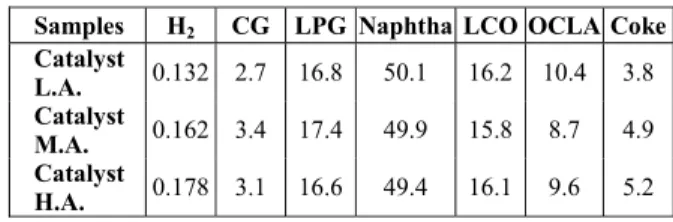
Table 8 shows the results of the catalyst micro-activity evaluation test (M.A.T.) realized by the Fábrica Carioca de Catalisadores S.A. with the commercial FCC catalysts and refinery load.
The pyrolytic products can be divided into a gas fraction, a liquid fraction consisting of paraffins, olefins, naphthenes and aromatics, and solid residues. Comparing the results of Tables 7 and 8 indicates that the liquid and gaseous fractions obtained from catalytic cracking of the PP/vaseline loads (2 and 4% wt) may be composed of (naphtha+LCO+OCLA) and (H2+CG+LPG), respectively. This comparison proves that the 2% and 4% wt PP/vaseline loads are very appropriate for producing liquid and gaseous fuels.
Table 8: Microactivity evaluation of the Commercial FCC catalysts and refinery load.
Samples H2 CG LPG Naphtha LCO OCLA Coke
Catalyst
L.A. 0.132 2.7 16.8 50.1 16.2 10.4 3.8
Catalyst
M.A. 0.162 3.4 17.4 49.9 15.8 8.7 4.9
Catalyst
H.A. 0.178 3.1 16.6 49.4 16.1 9.6 5.2
CG – fuel gas;
LPG – liquefied petroleum gas; LCO – light cycle oil; OCLA – residual oil
CONCLUSION
The catalytic cracking of loads of PP with petroleum jelly (vaseline), using commercial FCC catalysts of different activities (low, medium and high), provided good results for the production of combustible fractions, depending directly on the FCC catalysts and the PP/vaseline composition.
The production of expressive liquid (gasoline and diesel) and gaseous fractions from the catalytic crack-ing of polymers like polypropylene (PP) in the presence of Commercial FCC catalysts under refinery conditions makes this process a viable alternative for the development of new technologies for energy production.
REFERENCES
Abadie, E., Craqueamento Catalítico. CENPES – DIVEN (1985). (In Portuguese).
American Society for Testing and Materials, ASTM D 3907-92, Standard Test Method for Testing Fluid Catalytic Cracking (FCC) Catalysts by Microactivity Test (1992).
Aguado, J., Serrano, D. P., Sotelo, J. L., Van Grieken, R., Escola, J. M. Influence of the operating vari-ables on the catalytic conversion of a polyolefin mixture over HMCM-41 and nanosized HZSM-5. Ind. Eng. Chem. Res., 40, 5696 (2001).
Angyal, A., Miskolczi, N., Bartha, L., Petrochemical feedstock by thermal cracking of plastic waste. Journal of Analytical and Applied Pyrolysis, 79, 409 (2007).
Audisio, G., Bertini, F., Beltrame, P. L., Carniti, P., Catalytic degradation of polyolefins. Makromole-kulare Chemie, Macromolecular Symposia, 57, 191 (1992).
Barret, E. P., Joyner, L. G., Halenda, P. P., The determination of pore volume and area distribu-tions in porous substances. I. Computadistribu-tions from nitrogen isotherms. Journal of the American Chemi-cal Society, 73, 373 (1951).
Beltrame, P. L., Carniti, P., Audisio, G., Bertini F., Catalytic degradation of polymers: Part II - degradation of polyethylene. Polymer Degrada-tion and Stability, 26, 209 (1989).
Cardona, S. C., Corma, A., Tertiary recycling of polypropylene by catalytic cracking in a semi-batch stirred reactor use of spent equilibrium commercial FCC catalyst. Applied Catalysis B: Environmental, 25, 151 (2000).
Costa, A. F., Pinto, J. C., Salim, V. M. M., Karam, J. C., Preparo de catalisadores de FCC modificados com siloxanos para redução do índice de atrito e aumento da acessibilidade. Bol. Téc. Petrobras, Rio de Janeiro, 47, (2/4), Abr./Dez., 255 (2004). (In Portuguese).
Dawood, A., Miura K., Catalytic pyrolysis of g-irradiated polypropylene (PP) over HY-zeolite for enhancing the reactivity and the product selec-tivity. Polymer Degradation and Stability, 76, 45 (2002).
Gregg, S. J., Sing, K. S. W., Adsorption, Surface Area and Porosity. Academic Press, London (1982). Lee, K. H., Noh, N. S., Shin, D. H., Seo, Y.,
Com-parison of plastic types for catalytic degradation of waste plastics into liquid product with spent FCC catalyst. Polymer Degradation and Stability, 78, 539 (2002).
Lin, R., White, R. L., Effect of catalyst acidity and HZSM-5 channel volume on the catalytic crack-ing of polyethylene. Journal Applied of Polymer Science, 58, 1151 (1995).
Lin, Y. H., Yen, H. Y., Fluidized bed pyrolysis of polypropylene over cracking catalysts for pro-ducing hydrocarbons. Polymer Degradation and Stability, 89, 101 (2005).
Lin, Y. H., Yang, M. H., Chemical catalyzed recy-cling of polypropylene over a spent FCC catalyst and various commercial cracking catalysts using TGA. Thermochimica Acta, 470, 52 (2008). Luna, F. J., Schuchardt, U., Modificação de zeólitas
para uso em catálise. Química Nova, 24, 6, 885 (2001). (In Portuguese).
Macedo, J. L., Preparação e caracterização de mate-riais com base zeolítica para aplicação em catá-lise. D.Sc. Tese, Universidade Federal de Brasília – Distrito Federal (2007). (In Portuguese).
Maia, J. E. P. S., Craqueamento de cargas combinadas de óleo vegetal e gasóleo para produção de frações combustíveis sobre catalisadores de FCC.
M.Sc. Dissertação, Universidade Federal Rural do Rio de Janeiro - Rio de Janeiro (2002). (In Portuguese).
Marcilla, A., Gómez, A., Reyes-Labarta, J. A., Giner, A., Hernández, F., Kinetic study of polypropylene pyrolysis using ZSM-5 and equilibrium fluid catalytic cracking catalyst. Journal of Analytical and Applied Pyrolysis, 68, 467 (2003).
Marcilla, A., Gómez-Siurana, A., Berenguer, D., Study of the influence of the characteristics of different acid solids in the catalytic pyrolysis of different polymers. Applied Catalysis A: General, 301, 222 (2006).
Moreno, E. L., Rajagopal, K., Desafios da acidez na catálise em estado sólido. Química Nova, 32, 2, 538 (2009). (In Portuguese).
Ochoa, R., Van Woert, H., Lee, W. H., Subramanian, R., Kugler, E., Eklund, P. C., Catalytic degradation of medium density polyethylene over silica-alumina supports. Fuel, Processing Technology, 49, 119 (1996).
Ribeiro, A. M., Craqueamento catalítico de cargas combinadas de polímeros com vaselina utilizando catalisadores comerciais de FCC para produção de frações combustíveis. MSc. Dissertação, Universidade Federal Rural do Rio de Janeiro-Rio de Janeiro (2004). (In Portuguese).
Ribeiro, A. M., Costa, D. A., Machado Junior, H. F., Craqueamento catalítico de polietileno em con-dições de refinaria – produção de frações com-bustíveis. Polímeros: Ciência e Tecnologia, 16, 4, 312 (2006). (In Portuguese).
Seo, Y. H., Lee, K. H., Shin, D. H., Investigation of catalytic degradation of high-density polyethy-lene by hydrocarbon group type analysis. Journal of Analytical and Applied Pyrolysis, 70, 2, 383 (2003).
Serrano, D. P., Aguado, J., Escola, J. M., Garagorri, E., Conversion of low density polyethylene into petrochemical feedstocks using screw kiln reactor. Journal of Analytical and Applied Pyrolysis, 58, 789 (2001).
Vasile, C., Onu, P., Bãrboiu, V., Sabliovschi, M., Moroi, G., Catalytic decomposition of polyolefins. Acta Polymerica, 36, 10, 543 (1985).
Vasile, C.. Onu, P., Bãrboiu, V., Sabliovschi, M., Moroi, G., Gânju D., Florea, M., Catalytic decom-position of polyolefins. Acta Polymerica, 39, 6, 306 (1988).