Environmental Biology of Fishes 36: 337-343, 1993.
0
1993 Kluwer Academic Publishers. Printed in the Netherlands.The reproductive behavior of the longspine snipefish,
Macrorhamphosus scolopax (Syngnathiformes, Macrorhamphosidae)
Rui Filipe de O l i ~ e i r a ' , ~ , Vitor Carvalho Almadal & Maria de Fatima GiPUnidade de Investiga@o em Eco-Etologia, Instituto Superior de Psicologia Aplicada, R. Jardim do Tabaco 44, P-1100 Lisboa, Portugal;
Laboratbrio Maritimo da Guia, Universidade de Lisboa, Estrada do Guincho, P-2750 Cascais, Portugal; 3Aquario Vasco da Gama, R. Direita, Dafundo, P-1495, Lisboa, Portugal
Received 3.4.1992 Accepted 28.8.1992
Key words: Courtship, Spawning, Agonistic behavior, Courting color pattern
Synopsis
About two hundred Macrorhamphosus scolopax were observed in a large tank and their behavior was videotaped for subsequent analysis. When not disturbed, the fish moved slowly in a head-down position. Spawning in the tank took place in the last two hours before dark. Courting males change color and actively interact aggressively with other males. They push against each other while swimming in parallel or they charge their opponents with their erected dorsal spine directed at them. Courtship begins near the bottom. After following and swimming parallel to the female the two fish unite tightly by their caudal peduncle, with their ventral regions in close proximity and rise slowly in the water column. During the ascent, the genital papilla of the female extends repeatedly and contacts the genital region of the male.
Introduction
Syngnathiformes are generally assumed to be closely related to Gasterosteiformes (see Nelson 1984 for references on different views on this top- ic). Since both orders exhibit highly specialized but distinct modes of reproduction they provide excel- lent opportunities for comparative studies on the evolution of reproductive behavior. In view of this it is surprising to find that data on the behavior of Syngnathiformes are extremely scarce except for some syngnathids (Breder & Rosen 1966, Gronell 1984, Berglund et al. 1986a, 1986b, 1988, Svensson 1988, Berglund et al. 1989,1990). Indeed we could find only two references concerning the reproduc- tive behavior of Syngnathiformes other than the syngnathids (Fishelson 1966 for Solenostomus cya- nopterus and Tresher 1984 after a personal commu-
nication by A. Gronell for Aulostomus chinensis). This contrasts sharply with the wealth of etholog- ical information on sticklebacks (for references see Breder & Rosen 1966, Wootton 1976, 1984, Fitz- gerald & Wootton 1986). Any attempt to under- stand the origin of the peculiar egg-bearing of pipe- fishes and seahorses and to clarify their relation- ships with Gasterosteiformes will depend on de- tailed comparative studies on the reproductive behavior of the remaining syngnathiform families, especially those that lack parental care and spawn pelagic eggs. In this respect snipefishes are of spe- cial interest. The oldest known fossil of a syngnath- iform belongs to this family and according to Nel- son (1984, p. 251) 'resembles Macrorhamphosus in body shape but, among various differences, has some characters suggesting an affinity with the Gasterosteiformes'.
There are no published ethological data for the family Macrorhamphosidae. Bakanev (1985) stud- ied the responses to artificial light in M. scolopax
(gracilis form) and Hardy (1978), in a synopsis of the family, briefly mentions some aspects of loco- motion in Centriscops obliquus.
In this paper we present data on courtship, spawning and associated agonistic behavior of M.
scolopax. Some brief notes on more general as- pects of behavior are included in order to facilitate the description of the reproductive behavior pat- terns.
Material and methods
A group of about two hundred fish was observed in an exhibition tank at Vasco da Gama Aquarium, Lisbon, during the end of February 1992. Descrip- tions were based on frame-by-frame and slow mo- tion analysis of videotape recordings. A videocam- era (Sony V8 CCD-F450E) was used with no addi- tional illumination of the tank. A total of 3 h 30 min of selected interactions was analyzed. Observa- tions were concentrated on early morning and af- ternoon when visitors could not interfere with the fish. Qualitative observations distributed random- ly through the day were made to determine the time when courtship and spawning occur. Fish were caught by trawling off the Tejo River mouth (3S034'N, 0Y18'W) and off Espichel Cape (3S025' N, 09O14' W) at depths ranging from 25 to 85 m. About 200 fish were held in a 30001 tank, with a coarse sand bottom. The tank was an open- circulation system connected to a larger recircula- tion system that supplies the whole Aquarium. Wa- ter inflow was 2501 h-'. The water temperature reached a peak in September (24" C) and a mini- mum in January and February (14°C). The tank was subjected to a natural photoperiod receiving some dim light, with a supplement of fluorescent light from 09:OO to l8:OO h. The diet consisted of ground-up fish, frozen artemia and ovarian fish eggs.
Results
Morphological types, courting color pattern and identification of the sexes
M. scolopax exhibits wide morphological varia- tion. At one extreme, there are deep-bodied fish with a long serrated dorsal spine and a brick red- dish coloration (scolopax type). At the other ex- treme, there are elongated fish with a shorter non- serrated dorsal spine and a bluish grey coloration (gracilis type). Among these two extremes, a series of intermediate forms can be found (intermediate type) (Ehrich 1976).
All three morphological types were present in the tank (scolopax, gracilis and intermediate; S, G and I, respectively). Visual samples showed that 2.1% were type S, 72.5% type G and 25.4% type I (three counts: n l = 171; n2 = 178; n3 = 203; Type
S: max= 2.3%, min= 1.9%; Type G: max= 76.8%, min = 66.6%; Type I: max= 30.9%, min = 21.2%).
Some individuals that subsequently were shown to be actively courting, changed color near the end of the afternoon (Fig. 1). The brownish ventral area and the base of the dorsal spine became dark- er. The posterior part of the body became brick red, masking the silvery hue of the flanks. This dark area extended forward along the back and sides. Anterior to this dark area another brick red curved band also appeared. This pattern faded in a matter of seconds when the fish were disturbed or when food was introduced into the tank.
There are no data on external sexual dimorphism in this species. In the description presented in this paper the sex of the interacting fish were inferred based on the following criteria:
(1) Some individuals changed color in the after- noon to the courting color pattern.
(2) Only these individuals courted others.
(3) These individuals performed almost all the agonistic interactions observed.
(4) Some individuals displaying the normal color pattern showed a swollen and conspicuously black genital papilla of rounded shape. One of these fish had a swollen abdomen.
Fig. I. Male in the courting color pattern (for details see text).
posed of an individual with the courting color pattern and one individual with the normal color pattern and black genital papilla. We assumed that the courting individuals were males and those with the black genital papillae were females. Unfortunately, we could not kill and dissect fish to confirm their sex because they were in an exhibition tank and it was important to avoid any disturbance of the group. Thus the identifica- tion of the sexes should be taken with caution. Using our criteria, females were of all three morph- ological types but males were only of the types G
and I.
General aspects of behavior
Although this species is gregarious, forming mas- sive groups in natural waters, when in captivity and if not disturbed, they are scattered in the tank with no obvious schooling behavior. Most of the time the fish were stationary in the water column in a head-down position. While head-down, the fish sometimes rolled along its body axis by movements of the pectorals. They also rose or descended in the water column in this position. When swimming, the body was less vertical, the angle, in relation to the horizontal, decreasing with increasing swimming speed (approximately 30" in slow swimming and 0" in fast swimming), except when the fish swam up or down in which case the orientation of the body corresponded to the direction of the movement. When the fish were disturbed, for instance by plac- ing a hand net in the aquarium, they quickly aggre-
gated forming a compact mass near the surface. These aggregations also formed when the tank lights were turned off.
Agonistic behavior
The first sign of the onset of a social interaction was the approach of a fish that swam toward another instead of moving head-down. The approached fish, either male or female, typically reacted by raising its dorsal spine. In contrast, fish that occa- sionally approached each other while in a head- down position did not show this dorsal-spine erec- tion. Thus, the dorsal spine raising seems to be of social value among snipefish.
In inter-male interactions this state may be fol- lowed by several behavioral sequences. The two males may engage in horizontal parallel swimming pushing each other with the upper portion of their flanks. These charges were achieved through wide undulations of the body. This pattern could last from 1 to 5 seconds. These fights ended when one of the opponents fled by swimming away fast. A more asymmetrical form of inter-male aggression involved charging with the dorsal spine erected. After swimming rapidly toward an opponent one male rotated along its body axis, turned its dorsum to the other fish, erected its dorsal spine and threw itself against the opponent. The attacked fish was normally stationary in a head-down position while the swimming pass of the attacking fish was ori- ented toward its flank. This charge may follow a parallel swimming fight. In this case the charging
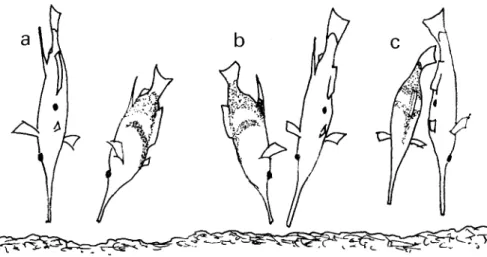
Fig. 2. Courtship and spawning sequence: a - courting male approaches the female; b - the male follows the female, changing from one of the female's flanks to the other; c- the male bends his caudal peduncle toward the female and gradually orients his abdomen toward that of the female; d - the pair is attached by the caudal peduncles with the ventral regions closely united; e - the pair rises slowly in the water column; f
-
when near the surface the pair disengages.fish swam away for a distance, a maneuver that allowed for accurate aiming and the acquiring of speed for the charge. The attacked male may be hit on the upper part of its flanks and more rarely on the abdomen or dorsal region. Males tended to avoid being charged by rolling along the body axis, minimizing the exposed area to the attacking fish. Upon being charged the attacked fish raised its dorsal spine.
The typically intermale agonistic patterns were seldom observed among fish without the courting color pattern. Agonistic interactions among indi- viduals recognized as females by their black genital papilla were not seen. We also observed males in the courting color pattern causing fish of indis- tinguishable sex to withdraw by a single lateral jerk of the body with the dorsal spine raised.
Courtship and spawning
All the courtship sequences occurred in the last two hours of light. The criteria for classifying behavior patterns as elements of courtship were as follows: (1) behavior directed by males in courting color to females with black genital papillae and (2) behav- ior that preceded effective pairing by the participa- nts. A survey of the five complete courtship and spawning sequences observed is summarized as fol- lows:
(1) All the courtship sequences started with the fish near the bottom. A male in courting color pattern swam slowly in an oblique stand with the head-down and approached a female. The approached female was head-down. When the male got within about a body length the female erected her dorsal spine. The pair was now head-down and parallel with the male less ver- tical than the female; his fin movements were more active than those of the female (Fig. 2a). (2) As the female slowly moved head-down or swam, the male followed. In the meantime, the male frequently changed his position from one of the female's flanks to the other (Fig. 2b). He moved either behind the female (the more common way) or he moved ahead of her. Typ- ically the male let the female go ahead of him,
turned to the other side of her and swam faster, becoming parallel again with her. After each change the two fish resumed their parallel posi- tions.
(3) With the pair in a head-down position, the male slowly bent his caudal peduncle and fin toward the female (for 3 to 5 seconds) forming an angle with the body axis of almost 90 de- grees (Fig. 2c). At the same time the male gradually oriented its abdomen toward that of the female. The female may also orient its ab- domen toward the male.
(4) The male moved his caudal peduncle against the female's caudal peduncle crossing it ven- trally, attaching himself to her, with the ab- domens of the two fish closely united (Fig. 2d).
( 5 ) The attached pair rose slowly in the water co- lumn. Apparently the male was dragged by the female whose caudal fin kept undulating. Dur- ing the ascent, which lasted for about one min- ute (n =
5;
mean = 66.2 sec; min = 49 sec; max = 79 sec) the genital papilla of the female extended repeatedly, assuming an elongated form that pointed toward the genital region of the male (Fig. 2e).(6) Upon reaching the surface the pair disengaged and the fish swam individually to the bottom (Fig. 2f).
The duration of the ascent and its interruption upon reaching the surface should be taken with caution as they can be an artifact caused by the limited depth of the tank. In one case, a pair re- peated the entire courtship and spawning sequence twice, initiating approach 59 seconds after the first descent to the bottom. The scheme outlined above was not fixed, with steps one and/or two sometimes being omitted.
We confirmed that spawning occurred in these interactions by using a plankton hand-net immedi- ately after the pair had ascended to the surface. The pelagic eggs were identical to those described by Hardy (1978).
Apart from successful mating sequences, many more courtship attempts were interrupted before reaching step four. In these cases, the courted fe- male moved from place to place apparently causing the male to cease courting. Males courted fish with-
out the black genital papillae but these attempts were never successful. Males never courted other males in the courting color pattern. With respect to unsuccessful episodes of courtship directed to fish without the black genital papillae, we observed a unique behavior pattern: during courting phases one or two the male, still head-down, moved to a position in which the sagittal planes of the two fish formed a right angle, the male became less oblique (forming an angle of about 20" to 30" with the horizontal), its snout pointing toward the female flank. While in this position the male approached the female. As he approached he raised his snout eventually touching the lower region of the other fish's flank. This movement was repeated in bouts of 1 to 4 repetitions. After this activity, the courting male resumed courting in phase one for a short period, after which he departed. The function of this behavior sequence is unclear.
We detected three types of interactions of con- specifics with the spawning pairs:
(1) During the ascent of one pair another male in courting color approached within about a body length and oriented its abdomen toward the united ventral regions of the spawners and as- cended for one second with them. Immediately after this probable sneak fertilization the in- truder moved away for a short distance and charged the spawning male with its dorsal spine, causing the termination of the act, after which the intruder fled away. The intruder was of the type G and the pair male was of type I. (2) Eight times we observed males with the court- ing color pattern interacting aggressively with males that were courting females. In all of the cases the intruding males tried to reach the females but were always forced away by the courting males.
(3) During one spawning several individuals in the normal color pattern gathered around the ris- ing pair, approaching them with their snouts. It seems probable that these intruders were eat- ing eggs.
Discussion
Although M. scolopax form large schools, overt agonistic interactions occur almost exclusively be- tween the courting males. Intermale aggression is probably important in competition for access to females and in particular in chasing away other males. Because the fish tend to be relatively sta- tionary within the school, and a male may court a specific female for many minutes, subsequently spawning in pairs, it is probably important for the reproductive success of each male to keep the area around the forming pair free of other males.
If the patterns of courtship of M. scolopax are shown to be widespread in the Syngnathiformes and represent the ancestral condition in the order they can throw light on the possible evolutionary origin of more specialized behaviors such as those of Solenostomidae (Fishelson 1966) and especially those of syngnathid species whose males bear eggs ventrally (Duncker 1915, Gronell 1984). Indeed the pronounced extensions of the genital papilla of the female during spawning and its orientation to the ventral region of the male could pave the way for the evolution of egg oviposition in the ventrum or ventral pouch of the males as in Syngnathus and
Hippocampus (Balon 1975). The attachment of the
pair by the use of the caudal peduncle may also have played a role in the specialized transfer of eggs from female to male in the Syngnathidae.
Alternatively, the behavior of M. scolopax may represent a secondary change to pelagic spawning from an egg-bearing ancestral condition. The last hypothesis is less parsimonious, since specialized forms of egg protection has been derived in several lineages from forms lacking it (Balon 1984). To test these alternatives more data on the breeding ethol- ogy and phyletic relationships among the Syn- gnathiformes are in great need.
Acknowledgements
The authors want to express their gratitude to the Director of the Vasco da Gama Aquarium, Diogo Puppe dos Santos for his support and enthusiasm during our work at the Aquarium. We also want to
thank Maria Am6lia Madureira who provided data on the captivity conditions, Francisco A. Martins for his dedication to the snipefish in the Aquarium, Claudia Faria and Emanuel Gon~alves who helped us during the observations, Pedro RC who kindly supplied us with bibliographical material that is difficult to obtain, Teresa Bento for drawing the figures and Hunter Halder who revised the En- glish. Finally we are grateful to two anonymous referees for their constructive criticism and sugges- tions. During the preparation of this article R.F.O. was supported by a grant from JNICT (BDI10321
IG-90).
References cited
Bakanev, V.S. 1985. Some peculiarities of behavior of slender snipefish from the Northeast Atlantic. pp. 78-85. In: P.A. Moiseev (ed.) Behavior of Comercial Fishes, VNIRO, Mos- kow. (In Russian).
Balon, E.K. 1975. Reproductive guilds of fishes: a proposal and definition. J. Fish. Res. Board Can. 32: 821-864.
Balon, E.K. 1984. Patterns in the evolution of reproductive styles in fishes. pp. 35-53. In: C.W. Potts & R.J. Wootton (ed.) Fish Reproduction: Strategies and Tactics, Academic Press, London.
Berglund, A., G . Rosenqvist & I. Svensson. 1986a. Reversed sex roles and parental energy investment in zygotes of two pipefish. Mar. Ecol. Prog. Ser. 29: 209-215.
Berglund, A , , G . Rosenqvist & I. Svensson. 1986b. Mate choice, fecundity and sexual dimorphism in two pipefish spe- cies (Syngnathidae). Behav. Ecol. Sociobiol. 19: 301-307. Berglund, A., G. Rosenqvist & I. Svensson. 1988. Multiple
matings and parental brood care in the pipefish Syngnathus typhle. Oikos 51: 184-188.
Berglund, A., G . Rosenqvist & I. Svensson. 1989. Reproduc- tive success of females limited by males in two pipefish spe- cies. Amer. Nat. 133: 506-516.
Berglund, A., G. Rosenqvist & I. Svensson. 1990. Male limita- tion of female reproductive success in a pipefish: effects of body size differences. Behav. Ecol. Sociobiol. 27: 129-133. Breder, C.M. Jr. & D.E. Rosen. 1966. Modes of reproduction
in fishes. Natural History Press, Garden City. 941 pp. Duncker, G . 1915. Revision der Syngnathidae. Mitt. Naturh.
Mus. 32: 9-120.
Ehrich, S. 1976. Zur taxonomie, Okologie und Wachstum von
Macrorhamphosus scolopax (Linnaeus, 1758) (Pisces, Syn- gnathiformes) aus dem subtropischen Nordostatlantik. Be- richte der Deutschen Wissenschaftlichen Kornmission fiir Meeresforschung 24: 251-266.
Fishelson, L. 1966. Solenostomus cyanopterus Blecker [sic] (Te- leostei, Solenostomidae) in Eilat (Gulf of Akaba). Israel Journal of Zoology 15: 95-103.
Fitzgerald, G.J. & R.J. Wootton. 1986. Behavioural ecology of sticklebacks, pp. 409-432. In: T.J. Pitcher (ed.) The Behavior of Teleost Fishes, Croom Helm, London.
Gronell, A.M. 1984. Courtship, spawning and social organiza- tion of the pipefish Corythoichthys intestinalis (Pisces, Syn- gnathidae) with notes on two congeneric species. Z. Tierpsy- chol. 65: 1-26.
Hardy, J.D. Jr. 1978. Development of fishes of the Mid-Atlantic bight - an atlas of egg, larval and juvenile stages. Volume 2: Anguillidae through Syngnathidae. Fish and Wildlife Service, U.S. Department of the Interior, Washington. 455 pp. Nelson, J.S. 1984. Fishes of the world, 2nd edition. John Wiley
& Sons, New York. 523 pp.
Svensson, I. 1988. Reproductive costs in two sex-role reversed pipefish species (Syngnathidae). J. Anim. Ecol. 57: 929-942. Thresher, R.E. 1984. Reproduction in reef fishes. T.F.H. Publi-
cations, Neptune City. 399 pp.
Wootton, R.J. 1976. The biology of sticklebacks. Academic Press, London. 387 pp.
Wootton, R.J. 1984. The functional biology of sticklebacks. Croom Helm, London. 272 pp.