Banco CTT
- Managing a Major Strategic Move -
Catarina Isabel Mação Borges | 152114345
Dissertation submitted in partial fulfilment of requirements for the degree of MSc in Business Administration, at the Universidade Católica Portuguesa.
Abstract
Title: Banco CTT – Managing a Major Strategic Move Author: Catarina Isabel Mação Borges
The main goal of the present dissertation is to explore the concept of “Diversification Strategy” and the main challenges of planning, implementing and managing it in the first years of operations. To address this strategy, a specific example of a Portuguese postal services’ incumbent, CTT – Correios de Portugal, S.A., that diversifies its business with the creation of a postal bank is covered. With the information on the international experience in this type of diversification and the current situation of the Portuguese retail banking sector, one can conclude that the postal bank may have the capacity to adapt to the demanding conditions due to a competitive advantage in some of the industry’s key success factors. This competitive advantage is identified when the company aligns its core competencies with the market characteristics. To preserve this benefit the company should assume a proactive role in exploring the external environment and be prepared for realignment situations. This initiative is crucial once several strategy-related, industry-related or company-related problems were identified during the analysis of the postal bank’s future. In both the short and the long run the postal bank will potentially face problems that may result in managerial changes such as acquisitions of other companies (to lower the risk exposure and gain more expertise in certain business areas), divestment in certain product lines and investment in foreign markets (to compensate the lower national revenues).
Resumo
Título: Banco CTT – Gerindo uma grande iniciativa estratégica Autor: Catarina Isabel Mação Borges
O principal objetivo desta dissertação é explorar o conceito de “Estratégia de Diversificação” e os principais desafios do planeamento, implementação e gestão do mesmo, durante os primeiros anos de operação. Para desenvolver este tema, é dada como exemplo a estratégia de diversificação do operador postal histórico CTT – Correios de Portugal, S.A. na criação do banco postal. Combinando a informação da experiência internacional neste tipo de diversificação com a situação atual do sector da banca de retalho em Portugal, é possível concluir que, devido à vantagem competitiva em alguns dos factores críticos de sucesso nesta indústria, o banco postal poderá ter capacidade para se adaptar às difíceis condições do mesmo. Esta vantagem competitiva é identificada aquando do alinhamento das competências centrais da empresa com as características do mercado. Para conservar esta vantagem, a empresa necessita de ter um papel proactivo no estudo dos fatores externos à mesma, de forma a estar preparada para situações de realinhamento. Esta é uma iniciativa muito importante, uma vez que foram identificados problemas relativos à estratégia de diversificação, à indústria da banca de retalho e à empresa, durante a análise do futuro do banco postal. Tanto no curto como no longo prazo, o mais provável será o banco postal defrontar-se com diferentes problemas, onde serão necessárias mudanças na sua gestão, tais como a aquisição de outras empresas, o desinvestimento em certos produtos e o investimento no mercado externo.
Contents
Abstract ... 2
Contents ... 4
List of Exhibits and Figures ... 6
Preface ... 9
Case Study ... 10
1.Introduction ... 10
2. Industry Analysis ... 11
The Postal Sector in Europe and Worldwide ... 11
The Postal Sector in Portugal ... 12
Competitive Environment ... 13
The Postal Banking Worldwide ... 14
International Benchmarks ... 15
The Retail Banking Sector in Portugal ... 17
Competitive Environment ... 19
3. CTT- Correios de Portugal: “The leader of the Portuguese Physical Communications Market” ... 21
The Company Today ... 21
Financial Services at CTT ... 22
Key Lessons from Past Initiatives in Postal Banking ... 23
The Retail Banking Opportunity ... 23
4.Conclusion ... 30
Case-Study Exhibits ... 31
Teaching Note ... 48
Synopsis ... 48
Teaching Objectives ... 48
Use of the Case ... 48
Suggested Assignment Questions ... 49
Analysis and Discussion ... 49
Teaching Note Exhibits ... 59
Diversification as a Growth Strategy ... 63
Corporate Performance Evaluation ... 64
Corporate Problem Solving ... 65
Sustainable Competitive Advantage ... 65
Core Competencies ... 66
Strategic Fit ... 67
Postal Banking Strategies ... 68
Retail Banking Strategies ... 69
Case References ... 70
Bibliography featured in the Literature Review ... 74
List of Exhibits and Figures
Case Study Exhibits
Exhibit 1. CTT’s Shareholders. ... 31
Exhibit 2. CTT’s Share Price Evolution. ... 31
Exhibit 3. CTT’s Dividend Yield Comparison to its peers. ... 31
Exhibit 4. Average annual evolution of European postal traffic between 2007 and 2011 (%). ... 32
Exhibit 5. Evolution of global letter-post volumes from 2006 to 2011 (indexed in year 2006 =100). ... 32
Exhibit 6. Use of certain services provided in post offices and postal agencies in Portugal (%). ... 32
Exhibit 7. Postal network indicators evolution in Portugal. ... 33
Exhibit 8. Universal Postal Services rules on services’ type, price and quality. ... 33
Exhibit 9. Evolution of Postal Services Providers in Portugal (in activity by 2013). ... 34
Exhibit 10. Notoriety and Utilization rates of CTT vs. other postal services providers. ... 34
Exhibit 11. Diversification Opportunities for Postal Operators. ... 34
Exhibit 12. Proportion on non-mail revenue to total revenue (2008). ... 35
Exhibit 13. Performance of postal operators by level of diversification (2008). ... 35
Exhibit 14. Evolution of the number of global postal savings accounts in developing countries and industrialized countries (in millions) ... 36
Exhibit 15. International Benchmark on Postal Banking Operators. ... 36
Exhibit 16. Evolution on Portuguese average households deposits (billion euros). ... 39
Exhibit 17. Evolution on Portuguese total households loans (billion euros). ... 40
Exhibit 18. Description of private customers in retail banking. ... 40
Exhibit 19. Portuguese retail banking institutions opinions about digitalization in the sector. ... 41
Exhibit 20. CTT’s business portfolio and its composition. ... 41
Exhibit 21. CTT’s main rewards. ... 42
Exhibit 23. CTT’s digital innovations. ... 43
Exhibit 24. Financial Services evolution at CTT. ... 44
Exhibit 25. Financial Services current Portfolio (including partnerships). ... 45
Exhibit 26. Banco CTT capital and investment estimates. ... 46
Exhibit 27. Results on market research regarding main factors affecting the choice of banking services provider and CTT’s competitive position on each factor. ... 46
Exhibit 28. Consumers’ opinion about the “no frills” product concept versus the current offer. ... 46
Exhibit 29. Revenues’ migration by type of service (taking in consideration revenues in 2014). ... 47
Exhibit 30. Pricing of different services across the retail banks in Portugal. ... 47
Exhibit 31. Banco CTT national coverage in 2016. ... 47
Teaching Note Exhibits
TN Exhibit 1. Identification of Banco CTT’s resources and, capabilities, competencies and core competencies (Step 1 and 2). ... 59TN Exhibit 2. Banco CTT’s position in the market, competitive advantages provided by the core competencies, and duration of competitive advantage (Steps 3, 4 and 5). ... 60
TN Exhibit 3. Identification of Retail Banking Key success factors. ... 61
TN Exhibit 4. Potential problems for Banco CTT in the next 5-10 years of operations in Portugal. ... 62
Figures
Figure 1: CTT performance since the IPO. ... 10Figure 2: Evolution in the number of post offices from 2001 to 2011. ... 12
Figure 3: Evolution of postal traffic between 2008 and 2014 (in units of objects) and correspondent share of the market in 2014. ... 12
Figure 4: Market share in 2014 for each type of service ... 13
Figure 5: Market share of the bigger postal services providers, including universal and non-universal services in 2014 ... 13
Figure 6: Sources of financial income for postal operators in 2011 ... 15
Figure 7: Summary of the main characteristics and financial indicators for the international benchmark. ... 16
Figure 8: Financial indicators for the Portuguese retail banking sector in 2015. ... 17
Figure 9: Summary of the main characteristics and financial indicators for the top 5 retail banking players in Portugal. ... 21
Figure 10: Summary of the main strategic assets for Banco CTT. ... 25
Figure 11: Long-term financial ambitions for Banco CTT after 2020 ... 26
Figure 12: Banco CTT product portfolio by provider and degree of competitive positioning ... 26
Figure 13: Banco CTT long-term strategy of postal offices distribution. ... 28
Figure 14: Strategic Fit Table ... 53
Preface
So many people made this dissertation possible, and I am grateful to all those who have helped and supported me.
I want to express my deep gratitude to my advisor, Professor João Simão Pires, for his insightful guidance and constant encouragement. The objective evaluation on my work greatly benefited me on the completion of this dissertation.
I am also deeply thankful to my family and friends for helping and encouraging me during this process. Special thanks for my colleague and friend, Cláudia Cerveira. Without her, it would have been much more difficult.
Finally, my genuine thanks to my dear boyfriend, João Amaral, who has supported me this far not only with his knowledge and thoughtfulness but also with caring and understanding.
Case Study
Banco CTT – Managing a Major Strategic Move
“We CTT, have in our DNA efficiency in everything we do. We are an innovative company that has been changing and adapting to the different realities and anticipating the trends. We are where the businesses and population are and sometimes more than that.”
− Francisco Lacerda, CTT’s Chief Executive Officer (CEO)
1. Introduction
It is the 19th of November 2015, the Capital Markets Day and Banco CTT’s launch day. It has been one year since the privatization of the incumbent company and two years since the entrance of CTT – Correios de Portugal in PSI 20i as well as the authorization to create a postal bank in Portugal.
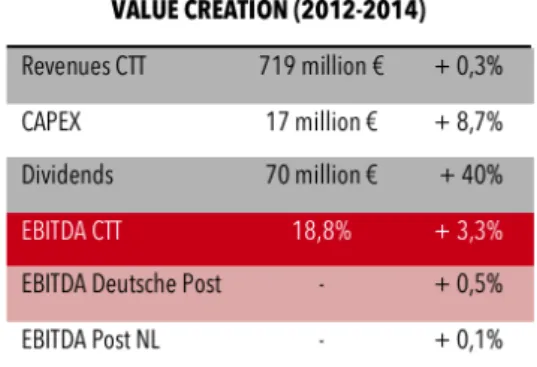
The results of the Initial Public Offering prove that CTT is an appealing investment: not only the trends on revenues have changed but shareholder value creation is being consistent. The share price is above the main index of PSI 20 and the dividend yield is attractive, particularly when compared with international peers (See Exhibits 1, 2 and 3).
Luís Pereira Coutinho, CEO of Banco CTT, has approximately one hour until the beginning of his speech to investors about the strategy for the new postal bank. As he glimpses his speech script, he is looking at the audience: corporate partners, bankers, CTT colleagues, specialized press… It took six months to prepare a presentation about one of the largest investments of the company and to gather all those people. And now, there is the CEO of the group, Francisco Lacerda giving the first words of clarification to those present in the room…
iBenchmark stock market index of companies that trade onthe main stock exchange of Portugal, which includes the prices of the twenty listed
companies with the largest market capitalization.
Figure 1: CTT performance since the IPO. (Source: CTT
“The industry as a whole is going through a significant transformation phase: globalization, digitalization, e-commerce, …CTT is working on this new reality: using data driven marketing is helping us trying to find growth levers on our core competencies and infrastructures. This implies adjustments in the business model and we are taking care of that (…).”
Luís Pereira Coutinho joined CTT Board in June 2014, right after leaving BCP’s executive commission. By that time, strategic decisions were being made. The erosion on the legacy business, the current crisis on the retail banking sector in Portugal, and also the successful international cases on postal players going beyond retail banking were considered when building the business model and making these decisions.
“We are the market leader in Mail-related Services by far (…) In Express & Parcels we are a serious operator due to a strong financial structure and to the ability to use our last mile distribution capacity of mailmen (…) In Financial Services (FS) we have been able to leverage on a strong brand. We have been providing financial services for more than 100 years and we have placed savings products for more than 50 years… FS at CTT is something that the public is used to… Thus, we are trying to deepen this business segment using a strong retail network well-spread in the country.”
While listening to Francisco Lacerda, Luís Pereira Coutinho started to think about how successful the company that he recently joined is, how far it has gone and what are the main challenges ahead… The company resources such as the brand, network and skills will be crucial to face the competition and to attract the public outside the room for this breakthrough called Banco CTT.
♦ Given the strategic fit between Banco CTT’s core competencies and the retail banking sector’s key success factors, should we expect the postal bank to have a potential competitive advantage? ♦ How should Banco CTT be evaluated while pursuing this diversification strategy?
♦ Which type of challenges may arise in the next 5-10 years? Which solutions may be adequate?
2. Industry Analysis
The Postal Sector in Europe and Worldwide
The technological development and the EU Regulation are common challenges that are significantly impacting the postal sector across the European countries. The trends are quite similar: gradual substitution of the physical mail by the electronic mail and progressive liberalization of the postal market [1].
The international posts, established for such a long period, are facing loss of relevance due to the digitalization era, loss of monopoly due to the liberalization and rising costs due to Universal Services Operations. The results are then, a propensity to decline both in the postal traffic volume and in the number of post offices (See Exhibits 4 and 5) [2]. As a consequence of the postal liberalization, new entrants are getting some share all over Europe. By targeting densely populated areas, focusing on business customers, lowering the frequency of delivery and benefiting from lower labour costs, they can charge lower prices to the customers [3].
As a response to the declining postal traffic volume and new entrants tactics, the international posts are trying to stimulate the demand through the expansion of mail service options, expansion of work-sharing and downstream access options and targeted pricing schemes. They are also trying to reduce some costs with the automation of some operations and post office closures [3].
The Postal Sector in Portugal
In the last 30 years, Postal Sector in Portugal has been facing the same trends of the other European Countries [1]. With the postal sector liberalization undertaken in 2012 and the privatization of CTT, new players have entered the market. These and the other changes observed, led to a decrease of 28,6% in the total traffic volume between 2008 and 2014 [4].
Figure 2: Evolution in the number of post offices from
2001 to 2011 (Sources: UPU Postal Statistics).
Figure 3: Evolution of postal traffic between 2008 and 2014 (in units of objects) and correspondent share of the market in 2014 (Sources:
The propensity to decrease comes from a diversified tendency across the mail-related services. While Non-express maili is facing a negative evolution due to digitalization effect, the Express Mailii has been benefiting with the electronic mail [4].
Clients using both the permanent post offices or postal agencies (52% of all individuals in Portugal during 2014) are mainly looking for services such as sending and receiving registered mail, express mail and parcels [5]. Besides, after mail-related services, financial services
such as the payment of services/taxes and money transfers are the most commonly used (See Exhibit 6) [4]. Associated with the decline in the number of objects carried by the postal services are the reduction of Postal Network Resources such as Human Resources and Access Points. (See Exhibit 7) [5].
Competitive Environment
Postal services providers are divided in universal services and non-universal services providers. Universal services are offered to both individuals and institutions and are more comprehensive than the non-universal services. They are used on a daily basis and thus, they have to follow strict rules regarding quality, prices and the needs of its clients (See Exhibit 8) [6]. By the end of 2014, Portugal had CTT as the universal services provider and 59 other non-universal services providers (See Exhibit 9) [6].
Postal services’ clients are usually looking for a service that minimizes costs, provides a quick solution, security and legal validity. Even with the entrance of new players, there is a very small rate of change among the providers. CTT Group is the consumers’ preference when it comes to notoriety and service usage, with 94,4% of the total market share for the postal traffic in 2014 (See Exhibit 10) [3].
Some projections and feedback given by CTT’s clients show that in the future there is a high chance that the individuals will use more than one service provider (51,6% of the clients) due to the type of recipient,
i Includes Correspondence, Editorial Mail and Direct Mail. ii Includes Express & Parcels.
Figure 5: Market share of the bigger postal
services providers, including universal and non-universal services in 2014 (Source: Anacom).
49,9%
2,6% 2,5%
44,9%
Correspondence Editorial Mail Direct Mail Parcels
Figure 4: Market share in 2014 for each type
speed of delivery and competitive prices [1], which indicates that CTT may loose some share for other providers. Besides, it is projected that postal traffic volume will continue to decline due to the economic crisis and the substitution of the physical correspondence by the electronic correspondence [4].
The Postal Banking Worldwide
Considered to be a novelty in Portugal, part of the history of 139 countries worldwide [7]. Postal banking primary days go back to 1861 when, in Great Britain, the need for financial inclusion of lower income and difficult access communities was perceived [8]. While banking institutions knew that these population layers had a higher probability to default, they had to charge them higher credit, leaving short possibility for these group of people to have access to banking accounts [2].
In countries such as the U.S., the banking institutions were against postal banking: they said that people that didn’t have a bank account “lack financial literacy” but in fact either they didn’t trust banks, or the bank outlets were no longer close to their residential area due to previous closure. In 1910 the U.S. Postal Services decided to introduce financial services and by 1934 they had $1.2 billion in assets. U.S. Postal Services were such a reliable institution in America and it operated under such low-cost financial services that they have reached 4 million users [7].
Today the financial inclusion problem remains in both developed and emerging countries. Global Findex Database shows that by 2012 there were about 2.5 billion adults without a formal bank account and the consequences are to pay for high-cost fringe lenders [8]. Postal banking come as an opportunity for both customers and the postal services providers. By operating with lower expenses, they are able to charge lower prices to the low-income class and, benefiting from the existing network of outlets they can have economies of scale. Plus, post offices are already located close to the “hard-to-reach” areas, and the communities have a long-term relationship with the postal services providers, enabling people to feel more comfortable towards the adherence and usage of the financial services [2].
The diversification of postal services to postal banking is a reality and it is one of the most common ways of answering to the decline of postal traffic (See Exhibits 11 and 12). Due to the evolution of the sector, the postal services incumbents had to take advantage of growing logistics and the existent network to provide a service that is a real need for the consumers and that is becoming a substantial weight of the total revenues (See Exhibit 13) [2]. “After banks, postal operators and their postal financial subsidiaries are the second biggest worldwide contributor to financial inclusion, far ahead of micro-finance institutions, money-transfer organizations, cooperatives, insurance companies, mobile money operators and all other providers of financial services” [9]. In 2009, there were almost 1 billion accounts worldwide held by postal financial institutions (19,2% market share of the global retail banking sector in 2009) (See Exhibit 14) [8]. In 2013, market critics estimate at least 1.1 billion of potential new account holders [10].
International Benchmarks
International postal banking players have been growing and expanding its financial services operations with common key success factors among them (See Exhibit 15).
First of all, they have been taking advantages of existing relevant assets: the network of postal offices enables them to approach a substantial amount of people that are postal services’ users and to market the financial services provided by the brand. Due to their geographic coverage they are able to compete with the main financial institutions in their country. The employees are also a valuable asset for the success of the business: they know the values of the company and they are aligned with the corporate mission and vision shared by the different business segments of the group including the financial services, providing the customers with an effective customer service.
Secondly, they have been innovating through investment in digitalization. Depending on which services they are specialized and have a higher demand in, the postal banking companies have been searching for new and creative ways to contact with the different stakeholders through multichannel integration. On one
48,30 % 11,70 % 34,60 % 5,30% Non-Express Mail Express Mail Financial Services Other Services
Figure 6: Sources of financial income for postal
operators in 2011 (Source: UPU Postal Statistics).
hand, they can benefit from less costly, quicker and more effective systems that satisfy customers due to the easiness of usage and adaptability of their daily duties. On the other hand, they can compete with the top banking institutions that are also following the digital trends.
Lastly, partnerships, strategic alliances and acquisitions have been very common among the postal banking institutions. The companies take advantage of the two-sided interest on affiliating/alliancing/acquiring to expand the customer base, launch new products and gather complementary experience that brings to both parts a win-win situation.
Figure 7: Summary of the main characteristics and financial indicators for the international benchmark (Sources: Financial Reports of the
different banks, Wikipedia and case-writer).
The Retail Banking Sector in Portugal
In 2012, Portugal was at the “tail” of the European profitability [11]. The Southern Europe country is now slowly recovering from the financial crisis with the banking sector still generating the lowest profitability and productivity results when compared with other European countries [12].
The increased risk credit that hit Portugal, was the main cause of the augmented amount of impairments registered by the banking institutions. The recovery on the financial margins and the stabilization on impairments have been lowering the negative impact on the results. In 2015 the Return on Assets (ROA)
and the Return on Equity (ROE) registered positive results, still, the Profit Before Tax (PBT) was negative [12]. Regarding Loans, private customers received mainly mortgages (82%) while businesses loans are mainly to construction and real state (31%). The banking institutions deposits continue to be the Portuguese domestic banks’ main source of financing (49%) [13].
The economic uncertainty of the last 6 years made the values of both savings and deposits increase while participation in investment funds and loans have slightly decreased (See Exhibits 16 and 17) [13].
During the recession, Portuguese domestic banks have asked for State aid regarding Guarantees and Recapitalization, which in 2013 accounted to 19% of the Gross National Product [13]. Two Portuguese banks, Banco Espírito Santo and Banif, have closed doors due to poor financial management and lack of funding, which left great part of stakeholders and shareholders unemployed or unbanked. Retail Banking Radar 2015 points out the need for “back-to-basics” services: current accounts, investment funds and mortgage loans [11].
Due to the intangibility of the products offered by the retail banks, there must be a great focus on the relationship with the customers. Customers with longer relationships with its banks are more profitable than the new ones (they usually have higher account balances and use a higher number of the bank services) [14]. In 2015, 50% of retail bank customers said that they had a positive experience, rating it with an average of 73.6 index points [15]. These numbers show that there is room for improvement and that the Portuguese
Figure 8: Financial indicators for the Portuguese
retail banking sector in 2015 (Source: Associação Portuguesa de Bancários).
customers are quite demanding.
The Portuguese banking institutions must convey a strategy combining the interest of both traditional and digital customers (in the future they will represent half of the addressable banking population). The bottom line is to understand what are the relevant services for each kind of customer and afterwards adapt the type of relationship and connections with them (See Exhibit 18). Traditional banks are thus broadening their horizons and rethinking their business models and operations systems to combine the traditional and digital means developed on the last decades (See Exhibit 19) [16].
Price is one of the main focuses for retail banks due to the importance attributed by the customers and also the weight that it has on profitability. Customers are increasingly more demanding and, although financial services are usually considered low involvement goods, they are continuously looking for more information on these products. Retail banks have to manage customer expectations with the external regulation. Due to continuous emergence of new competitors, prices are constantly under dynamic changes, which influences the pricing policy of the retail banking institutions [17].
The “user experience” is at the heart of the decisions taken and thus, the priority is to develop customer-centric business models. Besides, the retail banks must think about their operating models focusing on the simplification of the current operating models in order to improve cost efficiency. This is possible if the banking institutions are willing to enable innovation in their processes. On one side, there is a need for distribution optimization by centralizing and industrializing some operations. This will improve the information flows and therefore, enable a more efficient and effective coordination among the different services’ departments. On the other side there is the need to use multi channels. With this, the banking staff will have a greater knowledge of customers’ individualities and will consequently deliver an enhanced customer experience [12]. While there are several examplesi of rigorous transformations within the banking sector in other countries, in Portugal only 17% of retail banks seem to be prepared for such transformations due to the implications on communication channels, services provided, prices and the restrictions to technology access [18].
A strategic decision that allows an improvement of the operations performance and a competitive advantage in the financial services industry is about scaling the business through acquisitions and
i Number26: customers can create a current account in less than 10 minutes only with smartphone; Poland’s Bank: customers can get loans
partnerships with companies that are both IT and Finance experts (“fintechi”). This strategy can make
banking institutions answer to the digital customers’ needs (by learning about online purchasing behaviour, social network presence, affiliations) as well as give the banking staff the digital tools that can increase the efficiency of the service at the physical agency. Two successful examples of international acquisitions in the retail banking sector were Citibank’s purchase of PayQuikii and BBVA’s acquisition of Simpleiii[12].
Other industries like retailers, tech giants and innovative start-ups are increasingly showing their interest for some of the financial services that banking institutions offer. Currently, Apple has a payment service, Apple Pay; Samsung recently launched the Samsung Pay and; even Wal-mart has a partnership with Gobank [12].
Competitive Environment
The Portuguese retail banking arena currently has five leading players, accounting for approximately 80% of retail banking total share in Portugal [19].
Caixa Geral de Depósitos (CGD), the sole public institution under the authority of the Portuguese State is the Portuguese leader when it comes to Customer Accounts, Deposits & Savings and Mortgages for the private customers [19]. Rating agencies expect this bank to improve the profit results and its assets quality as well as to increase its capital stock, as it is foreseen future capital gains that will bring additional benefit to shareholders [20].
Novo Banco (former Banco Espírito Santo) was created in August 2014 and it is currently under the authority of Banco de Portugal (Portuguese central bank), which plays the role of “bridge bank”iv. The results for Deposits and Credit are quiet embryonic - there is a big uncertainty on the side of both investors and consumers. Currently there is neither an evidence of a potential acquiring institution nor the liquidation of the bank, which means that Banco de Portugal will continue to oversee the operations of the bank [21].
Besides these two institutions, the other three main players belong to private groups. BCP is the biggest private banking institution in Portugal. After asking for State aid, the company is now carrying out a
i Fintech startups provide services like digital banking without physical agencies and are specialized in different services like payments, loans
and currency management.
ii PayQuick (now QuikRemit) is a premier provider of money transfer solutions to banks, credit unions and money transfer organizations. iii Simple is an online bank.
restructuring plan that is already showing some results: after 4 years of negative impact, in 2015 it revealed a positive net income [22]. In the future the retail bank wants to increase the share value of BCP and align it with the other Portuguese companies [23]. Moreover, BCP is also planning to open the capital to a new international shareholder in order to have a more diversified investor composition [24].
BPI is the smallest player among its field peers and it is also exercising changes in order to decrease the risk of exposure to Angola [25]. There is also evidence that BCP and BPI are planning a merger that would create a very strong private banking institution (surpassing CGD). This idea is said to bring growth to the banks’ balance sheet; still, there is the risk of having too much Angolan shareholders, which is why this strategy is carefully being evaluated [26].
Apart from the 4 domestic players, Santander is also on the run for the leadership. After the acquisition of Banif for 150 million euros by the end of 2015, it has reached 14% of the market share meaning that together with its fellow countrymen, they detain a fifth of the Portuguese retail banking share [24].
On balance, the left over market share is for the Portuguese retail banking players with smaller market share (BIC, Caixa Agrícola, Montepio,…). Although having a smaller share, Montepio was considered to be one of the trustworthy and worth to invest banks in Portugal, based on the research done by Portugal RepTraK Pulse in 2014. At the top of the results also come CGD, BPI and Santander Totta [27].
Common to all these institutions are the efforts that are being done in order to return to a pre-crisis situation. In the last couple of years the majority of them have been investing and relying on the foreign markets in order to neutralize the domestic results [19].
Figure 9: Summary of the main characteristics and financial indicators for the top 5 retail banking players in Portugal (Source: Financial reports
of the different banks and case-writer)i.
3. CTT- Correios de Portugal: “The leader of the Portuguese Physical
Communications Market”
The Company Today
On the last three decades, CTT, the centenary company, have profited from both an industrial and technological evolution to strengthen its presence in Portugal, Spain and Mozambique. Today it offers a range of diversified solutions in Mail-related services, Express & Parcels and FS (See Exhibit 20). From the three business segments, FS represents the biggest growth since 2013 (around 20%), driven by the investment in product diversification. With such results in FS, the Group has been able to balance the decline in the Mail-related services [28].
The company follows a business model based on a long-term relationship of “trust and excellence” with its customers, allowing for a strong reputation and a consequent leadership position in the market (See Exhibit 21); a diversified business model with a multi-product strategy bringing added value to the clients experience, economies of scale on shared operations and further growth opportunities; a competitive retail
i Information only for the domestic retail activity; Information regarding deposits & savings, loans and mortgages are for privates customers;
Data from 2014 except from Novo Banco’s Employees, Branches, ATM, Customer Accounts, Debit and Credit Cards and POS’S, which correspond to information about BES 2013.
network, which allows for the different business activities to have high geographical reach and proximity with consumers; and a sustainable financial performance allowing for cash-flow generation and shareholder value creation. Common to all these features there is the focus on providing innovative solutions that add value both to the stakeholders and the business (See Exhibit 22) [28].
♦ Strategic Direction
In order to sustain a growth model, taking advantage of such strategic assets, changes are being done in the different business units. The Mail-related services are progressively becoming more “digital”. CTT is focused on providing solutions that are aligned with the industry’s latest innovation. On one hand, it wants to capture value in the digital Direct Mail market: the company is increasing the investment in advertising mail services provided in order to become a reference among the consumers and competitors. For this, it wants to create an online platform that allows SMEs to create and manage Advertising Mail campaigns. On the other hand it wants to complement the postal offer by expanding the portfolio of digital services, offering integrated solutions that allow for a hybrid communication [28].
The Express & Parcels segment is benefiting from the growth trends on e-commerce. CTT Expresso is encouraging the usage of digital channels by investing on its online portal and website. They are offering integrated solutions from the moment of ordering to the shipping e.g., CTT is providing partners like OLXi
with easy shipping. The e-commerce initiatives are being adapted to the customers needs: convenience, flexibility, integration and simplicity are key required product features that CTT are taking into consideration whilst the gradual process of digital services (See Exhibit 23) [28].
Financial Services at CTT
Financial Services were first created in 1911 with the name of Caixa Económica Postal. Through the 100 years of existence, the main focus of this business segment was to become a consolidated asset of the company that provided relevant products and services along with top-tier partners. With years of experience and knowledge gained in the field, by the beginning of the 21st century the company started to pursue strategies over the diversification of the services offered [28]. In 2015, the range of financial solutions
generates revenue of 75,3 million euros (See Exhibits 24 and 25) [20]. The growth and results generated across the different services that this business segment provides is an indicator of company’s readiness to expand its business with the creation of Banco CTT.
Key Lessons from Past Initiatives in Postal Banking
The first experiments on postal banking in Portugal were between CTT and CGD, its long-term financial partner. It happened twice: in 2002 and in 2005 but none of them lasted long. In the first trial, CTT sold its share (49%) to CGD one year after the creation of the postal bank [29]. The lack of market segmentation and poor structure of the project expansion, which led to only 5.000 customers, made them decide to end the partnership and keep the parallel activities they had been sharing for quite long time [30]. In 2005 CTT launched a new proposal for the postal bank project and by that time it had both Banif and CGD as potential partners. Although Banif had been discussing with CTT about the postal banking strategy, CGD exercised the right of first refusal, which made Banif and CTT arrangements fall through the cracks [31].
Still, in 2006 CTT announced that, once again, the possibility to invest in a retail banking institution with CGD could not proceed due to dissonance on the strategic and operational decisions on the table [as]. This could have rekindled the relationship between CTT and Banif, however, the authorization by Banco de Portugal was rejected in 2005. Four years of negotiations led to no more then a sketch on paper [31].
The Retail Banking Opportunity
Banco CTT comes up as a market opportunity and as part of CTT’s strategy on diversification and innovation of the services provided. The company that already has a vast experience in a variety of financial services and a longstanding retail network wants to provide more comprehensive and competitive banking operations.
♦ The Potential of the Opportunity and Segmentation
Launching the bank is a big investment (See Exhibit 26) for CTT, its sole shareholder. The short-term challenge starts with attracting customers and further adherence to the different services provided. The 3.7 million CTT’s current customers in the FS business will be one of the main segments to target. A great part of these customers belong to the senior and low-income class, characteristics that are also common among the
unbanked Portuguese. There are roughly 400.000 of Portuguese without a bank account, 80% of these are more than 50 years old and lack financial stability [32].
On a research done in Portugali regarding the population’s financial literacy and inclusion, from the 4% of unbanked citizens, 67% are said to lack earnings that justify opening a bank account whereas 17% share a bank account having other person as the account holder. About the people that have at least the minimum banking services they are said to have an average of 1,4 banking accounts [33].
On this research, it was also found that individuals privilege the advice given at the “point-of sale”. Individuals that trust their banking institutions usually acquire its different products instead of using different providers. Thus, most of the times they end up not comparing conditions like interest rates, valuing more the advice given over the counter (54%) or the opinion of family and friends (25%) [33].
As expected the basic products are the most used ones: insurance (37%), credit cards (32%) and savings (31%) [33].
From the interviewees that participated in the research, 24% confirmed the usage of homebanking, with 8% saying that this is their channel of first choice. This percentage of the population is aged between 25 and 39 years old [33].
Finally, the study also revealed that on the last 5 years 9% of the interviewees have changed between banking institutions. Although the majority (82%) states that they did not thought about it, 9% have considered this possibility and they did not proceed with the process due to the costs and time associated, and also because they lack information about better options available [33].
From another market research doneii, the postal bank acceptance was greater than 50%, with more than
25% willing to subscribe to Banco CTT. The people involved in this market research nominated Price, Reputation and Location as the main factors for the bank selection [ag] (See Exhibit 27). Age and Social Class are the market research crucial demographics that must be referred: the age group of people more willing to subscribe to this concept is the 35-54 range while the low-income social class is the one that shows greater interest for this service [28].
i Sample of 2.000 people (2,2% error for a 95% probability).
♦ Targeting
Besides being a significant business opportunity for the group, Banco CTT is also an answer for the needs of the Portuguese population. This bank wants to target the mass-marketi. CTT sees private individuals like
the Young Professionals, Population with less sophisticated requirements and current CTT customers as the segments that will be more interested in the bank due its value proposition and marketing mix offer [28].
“Banco CTT is a national bank, for every Portuguese that values simplicity in their daily banking needs.” Luís Pereira Coutinho
Banco CTT wants to attract the different segments focusing on the specificities and needs of each one. Deeming on the current CTT customers potential and on the market prospective over the simple low-income young customers, the bank believes that there is a balanced prospect on the targeted population [28].
Right now, there is a strong lack of trust and security regarding the domestic retail banks: due to the financial crisis the bank brands lost much of its value and they are trying to rebuild it [34]. By entering the sector, CTT does not want to harm the brand but bring trust to their business and to help consolidating the sector. It has a long-term relationship with the customers, built on reliability and it can take advantage of that to capture a share of the market that is either unbanked or lacks trust on the existing institutions [16].
♦ The Positioning and Future Ambitions
In order to enter the retail banking sector, Banco CTT will leverage on CTT’s legacy and its value proposition – proximity, simplicity, transparency and value for money [28]. The strategic assets supporting the value proposition are:
Figure 10: Summary of the main strategic assets for Banco CTT (Source: CTT Capital Markets Day 2015).
i Large and homogeneous customer base. 1. Awareness , recognition and trust of CTT Brand 2. Proximity to the Population 3. "No-frills" complete portfolio based on simplicity 4. Competitive Pricing based on low-cost structure 5. Digital offer with web and mobile
Awareness, Recognition and Trust of CTT Brand
As shown before CTT has a reputable name. In 2015 it registered a customer satisfaction of 85,2%, considerably above the overall satisfaction of the service delivered by the Portuguese banking sector [20]. This can be an influence indicator for the adherence to the postal banking services, showing the relationship between the client and the institution that has been created over time.
Proximity to the Population and Digital Offer with Web and Mobile
Banco CTT will focus on the proximity to the client such as the other CTT’s business segments always did. Clients will be assisted with all the necessary information and competitive conditions at the CTT branches. Besides, online presence will be a focus through homebanking service [28].
No-frills Complete Portfolio based on Simplicity and Competitive Pricing based on Low-cost Structure
CTT’s value proposition includes simplicity and value for money: for the people that lack financial literacy and are under impoverished conditions, CTT has the opportunity to attract them and fulfil their needs (See Exhibit 28).
T
o further expand this service the younger and the elder, Banco CTT will have to provide an easy, secure, comprehensive and user-friendly service so that customers that are currently not using it can become convinced of its benefits [16].Banco CTT has studied the market and has recalled the historical data and results from CTT FS. The retail bank that just started the operations will appear as a risk averse player that wants to assure a solid performance, such as the one CTT group has been reporting. Based on the revenues of the services that will migrate from FS to Banco CTT, the group forecasts a transferred value of 19 million euros [28].
Considering that the current clients using these services will stay at its customer base, and that further clients will adhere to it, the postal bank ambitions are to achieve 95-100 million euros on revenues and a 40% EBITDA margin by 2020 (See Exhibit 29). To sustain these long-term results, Banco CTT aspires to have
Figure 11: Long-term financial ambitions for
Banco CTT after 2020 (Source: CTT Capital Markets Day 2015).
about 10% of share on Customer Accounts owning 4% of the Deposits & Savings share and 6% of the Mortgages share [28].
♦ The Product Portfolio and Pricing Strategy
Banco CTT will address a target that is looking for a simple low-cost product range, important on their quotidian. Hence, it will provide a complete product portfolio with a “no-frills” concepti. The
objective of the bank is to complement the current business without threatening the existent products [28]. It will increase the products offered supported by selected partnerships while monitoring the impact on the FS that are originally provided by CTT and that will keep separated from the bank offer.
The retail bank will build a position in transactional products, which are core characteristics of the bank, and it will have an equally competitive positioning in mortgage and consumer loans, credit cards and savings accounts [28].
Transactional products will have cross-selling potential among CTT’s customers. While Banco CTT will leverage on financial services expertise to provide the current accounts, debit cards, pre-paid cards and
iNo-frills service/product is one for which the non-essential features have been removed to keep the price low (Source: Wikipedia).
payments, it will rely on its long-term partnership with Western Union for the international money transfers service [28].
Regarding credit, Banco CTT will keep credit cards and consumer loans out of the balance sheet. The idea is to start by combining low exposure to credit risk with competitive pricing and in the medium- to long-term increase this exposure [28].
Savings & Deposits will be done “in-house”. This product segment will have an utmost importance since it will be a lever to finance the bank [28].
Public debt certificates will not migrate to the postal bank. This product has a great importance to CTT not only because the company has its exclusivity, but also because it is a great source of income – the funding of 2.2 billion euros held in January 2015 was a record in over 50 years of public debt trade at CTT [20].
Lastly, the tax payment made in partnership with Autoridade Tributária e Aduaneira and the payment services provided by Payshop will keep at CTT’s FS. The main clients at Payshop are business customers such as EDP, MEO, NOS and Vodafone, while Banco CTT targets private customers.
Great part of the services provided will be positioned as more competitive than the market average. The postal bank will prise the value proposition of “value for money” by providing highly competitive prices on the most common services provided by the different retail banking institutions in Portugal, such as current accounts maintenance and consumer loans fees (See Exhibit 30). Banco CTT will be able to compete across the different products provided mainly due to operations cost savings, as a result of economies of scale and established partnerships that lower the risk of the postal bank.
♦ The Role of Retail Network, Digital and Online Channels
Banco CTT is starting its operations in 52 “DNA CTT post offices”i spread throughout the country and present in the country’s 20 administrative districts. These post offices will have a special section devoted to financial services offered by the bank with employees trained to receive them. By 2018, Banco CTT plans to expand its geographical
i DNA CTT Post Offices: 1 of the 4 types of post offices providing postal services, financial services, services partnerships and 3rd
party retail products.
Figure 13: Banco CTT long-term strategy of
postal offices distribution (Source: CTT Capital Markets Day 2015).
presence to 603 physical points of contact, positioning close to the biggest retail banking providers in Portugal (See Exhibit 31) [28]. With such retail infrastructures and human capital, it should take the advantage of being close to CTT’s postal services customers to draw their attention and create brand awareness. Post offices will be a key strategic point for advertising the banking services. Not only the instructed employees will have the role of informing customers about the new segment of the business and its services, but the branches are also going through refurbishments which will allow the customers to notice the opening of Banco CTT. Moreover, online advertising will have a crucial role in gathering the attention, especially of the Young Professionals that are heavy users of digital devices.
“Banco CTT aims to target the young urban generation. Thus, it will invest on both online channels and mobile platforms.” Luís Pereira Coutinho
Banco CTT’s online and digital presence will have the role of promoting the brand, and it will also serve as an e-commerce platform and an online services provider. With a homebanking service and a mobile application, Banco CTT wants to provide a simple and convenient service starting with the younger generation and expanding to the “traditional users” that are becoming more vulnerable and responsive to the digitalization.
This service is seen as a win-win strategy for the company and the consumer. Banco CTT will be able to deliver a more efficient service (from quicker answers to better communication with its clients – mainly due to feedback from online experience) and it will be able to attract a bigger number of potential clients (due to the coverage that the online presence allows). On the customers’ side, they can expect an increasing diversity of the services provided, quicker and more customized services and an increased interactivity through the different online channels.
4. Conclusion
After a long day, the presentation to Banco CTT investors is over and the board is satisfied with their performance. After waiting for decades, it is time to say, “welcome” to a new retail bank, the first postal bank in Portugal and the 140th in the world.
Right now, Banco CTT is at period zero, where only investments have been incurred and still no income is being generated. It is time to hit the road running and prepare for what is coming next. Several challenges lay ahead in the retail banking sector and Banco CTT will have to know how to use its resources to achieve its ambitions. Does its core competencies allow for a strategic fit with the sector’s KSFs? Which performance metrics should be used to evaluate this diversification strategy? Which problems are ahead and how should the postal bank solve them?
Case-Study Exhibits
Exhibit 1. CTT’s Shareholders.
Shares Joint-stock
Standard Life Investments (Holdings) Limited
10.007.653 6,67%
Gestmin, SGPS, S.A. 7.800.000 5,20%
Allianz Global Investors GmbH 7.552.637 5,04%
BNP Paribas Investment Management LLP
7.477.712 4,99%
Kames Capital plc 5.141.137 3,43%
Norges Bank 3.143.496 2,10%
F&C Management Limited 3.124.801 2,08%
Remaining Shareholders 98.250.134 65,50%
Total 150.000.000 100,00%
Source: CTT webpage.
Exhibit 2. CTT’s Share Price Evolution.
Source: CTT Capital Markets Day 2015.
Exhibit 3. CTT’s Dividend Yield Comparison to its peers.
Source: CTT Capital Markets Day 2015.
5,30%
3,90% 3,70%
Exhibit 4. Average annual evolution of European postal traffic between 2007 and 2011 (%).
Source: WIK “Postal Regulation and Volumes under Pressure”, 2013
Exhibit 5. Evolution of global letter-post volumes from 2006 to 2011 (indexed in year 2006 =100).
Source: UPU Postal Statistics.
Exhibit 6. Use of certain services provided in post offices and postal agencies in Portugal (%).
Type of services Usage (%)
Sending/receipt of registered mail 41,6
Sending/receipt of parcels 32,1
Sending Correspondence 31,2
Payment of services/taxes 26,8
Postal orders and money transfer 14,7
Mobile phone account top-ups 8,2
Sale of Stamps 7,2
Road tolls 3,7
Sale of books, post cards, CDs, etc 2,5
Sale of Envelopes 2,4
Financial Products (includes saving certificates,
pension plans, investment funds, assurance funds, etc) 2,2
Source: ICP-ANACOM, Survey on the use of postal services, December 2014.
≥ 0 -0,1> -2,0 -2,1 > -4,0 -4,1 > -6,0 < -6,0
Exhibit 7. Postal network indicators evolution in Portugal. Indicators 2010 2012 2014 Human resources 16 836 15 732 14 424 CTT Group 14 155 12 777 11 698 Other providers 2 681 2 955 2 726 Access points 18 883 14 649 12 899 CTT Group 18 754 14 171 12 159 Other providers 129 478 740 Distribution centres 489 482 402 CTT Group 370 348 281 Other providers 119 134 121 Vehicle fleet 6 126 6 145 6 093 CTT Group 4 077 3 961 3 740 Other providers 2 049 2 184 2 353 Source: Anacom.
Exhibit 8.Universal Postal Services rules on services’ type, price and quality.
Type Price Quality
- Items of correspondence, books, catalogs, newspapers and other periodicals up to 2kg weight
- Postal parcels up to 10 kg - Delivery of national parcels in other member states of the European Union, up to 20kg weight
- Shipments registered - The insured items
- Accessibility to all the users
- Cost orientation and should encourage an efficient universal service provision - Transparency - No discrimination between users
- Ensure the provision of universal postal service throughout the national territory
- Ensure continuity, availability and quality of universal service
- Ensure the collection and distribution of postal items covered under the universal service at least once a day, every working day, except in exceptional circumstances or geographical conditions
- Advertise appropriately to regularly provide users and postal service providers accurate and updated
information about the universal service features offered, including on the general conditions of access and use of the service, prices and quality levels
- Ensure the existence of user support services, including a quick treatment system complaints
- Adopt measures to facilitate the use of the service by disabled users
Exhibit 9. Evolution of Postal Services Providers in Portugal (in activity by 2013).
Source: ANACOM.
Exhibit 10. Notoriety and Utilization rates of CTT vs. other postal services providers.
Source: ANACOM
Exhibit 11. Diversification Opportunities for Postal Operators.
Platforms Areas Descriptions Sample of non-postal players (U.S.)
Transportation Parcel Services Express and deferred parcel delivery. Logistics Warehousing and other specialty services.
Retail Services
Retail Sale of mail and non-mail related convenience products and/or specialized products.
Banking
Money transfer and bill payment, retail and commercial banking, resale of financial services through the retail network.
Mail-related services
Integrated Marketing Data, media, print and production services, customer response management
Document Management
Document digitization, physical and digital mail room management, data processing and archiving services Hybrid mail
Electronic postage, multi-channel mal distribution, email certification, and digital mailbox management
99,8% 95,90% 100%
Utilization Rate Notoriety in Non-Express
Mail Notoriety in Express Mail
CTT 2nd place 3rd place
Express Mail Services Providers Non-Express Mail Services Providers
Emerging Services
Telecommunications Provision of internet and/or telephony services
E-commerce Online shopping and associated tradfacilitation services (e.g.,
e-payment)
Business Services Consulting and outsourcing services (e.g., Information Systems)
Government Services
Basic Services
Identification, enrolment, and other basic services conducted on behalf of other agencies (e.g., tax and fines payment, benefits distribution, certification and license processing) Other Services E.g. Environmental services
Source: Accenture review of international posts.
Exhibit 12. Proportion on non-mail revenue to total revenue (2008).
<20% 20-40% 40-60% >60%
Source: Accenture High Performance Post research database, Operators’ annual reports; IPC website; Accenture Analysis.
Exhibit 13. Performance of postal operators by level of diversification (2008).
Exhibit 14. Evolution of the number of global postal savings accounts in developing countries and industrialized countries (in millions).
Source: UPU Postal Statistics.
Exhibit 15. International Benchmark on Postal Banking Operators.
♦ La Banque Postale S.A., a subsidiary of La Poste Group
La Banque Postale was part of La Poste’s answer to digital revolution. Created in 2005, through the legal transformation of Efipostei it occupies today the 6th position in the French banking market and its intention is to keep hiking the ranking [35]. By taking advantage of its assets, the company decided to invest more heavily in non-postal services (financial services) providing not only private individuals but also legal entities and local authorities with services where the banking inclusion is fostered especially for the low-income households. Focusing on the customer side, sharing La Poste Group values of trust, accessibility and proximity, this bank is the preferred banking brand in France with more than 11 million active customers contacting the 9.000 employees and using the 17.000 outlets of La Poste Network spread all over the country [36].
As a financial services provider it operates in the banking, insurance and asset management areas. In order to increase its customer base the company is continuously investing on innovative and relevant services that can add value to the different segments they target. One way to do that is through extension of relevant partnerships as well as acquisitions (Banque Privée Européenee in 2013 and Sofiapii in 2014), which allows for the company to grow its expertise and complement the services provided, bringing to the customers a more thorough experience [37]. Besides, the company is following the digital trends by implementing the of Cap Client 3.0iii program enabling a more
i Efiposte, created in 2000 it was responsible for the management of sight deposits collected by La Poste. ii SOFIAP: financial institution specializing in mortgage lending (SOCRIF Group).
iii Cap Client 3.0 is a cloud service that will be used as an interface with the customers across the different channels: post offices, online banking,
efficient distribution tool. Innovative multichannel strategies are also being put into practice: customers can have a traditional, hybrid or even a complete long-distance relationship with the bank [38].
With a focus on being accessible and seeking for innovation, this bank is able to target a mass market. Private individual customers (both younger and older) have access to a wide range of solutions that meet their needs. The high net-worth customers have access to solutions such as high-end life insurance, tax optimisation solutions, notably discretionary management service and inheritance funds. La Banque Postale also serves corporate customers (companies, non-profit associations, local authorities…) offering accounts, means of payment, investments, advice, financing, and insurance [38].
By investing on its relationship with the customers, the company strategy “La Poste 2020: Conquering the Future” has as priority the development of the communication through the digital bank. By taking advantage of the great percentage that currently uses the online services (around 40%) and the know-how of La Poste Group, the company wants to develop the brand’s online attractiveness at the same time that it improves the operations between the different channels [38].
Today this business segment is an important part of the services provided by the group. In 2014, La Banque Postale generated 25,5% of La Poste Group operating revenues [38]. The profit of this company was 677 million euros with a cost-to-income ratio of 82.7%.
♦ PostFinance Ltd, subsidiary of Swiss Post Ltd
Financial services at Swiss Post have started in 1900 and during the entire century they have grown through the introduction of different types of services. In 2003, PostFinance became a fully-fledged retail finance institution. One decade later, in 2013, PostFinance became a public limited company and a subsidiary of Swiss Post Ltd – PostFinance Ltd [39].
This financial institution is one of the Switzerland’s leaders in its sector when it comes to daily financial needs: it is the number one bank for financial transactions with 996 million transactions done in 2014. Along with its simple but relevant services comes PostFinance strive to provide the user-friendly means so that customers can manage their finances as most independent as possible [40].
Whether it is for the 2.6 million private customers or for the 309.000 business customers, the range of services provided is adapted for each individual need [40]. Besides payment transaction (conventional, online or mobile), both private and business customers can have access to private and savings accounts, credit, debit and prepaid cards, retirement savings accounts, life insurance, mortgages and consumer loans. The customers can choose the channel they are more comfortable with. PostFinance has 2304 post offices and branches where the customers can do the