SHORT COMMUNICATION
Notes on fauna associated with an opportunistic artificial
reef near cold‐water corals
JOSÉ NUNO GOMES-PEREIRA,F.TEMPERA,P.A.RIBEIRO &F.M.PORTEIRO
Gomes-Pereira, J.N, F. Tempera, P.A. Ribeiro & F.M. Porteiro (in press). Notes on fauna associated with an opportunistic artificial reef near cold-water corals.
Arquipelago. Life and Marine Sciences 29.
José Nuno Gomes-Pereira ([email protected]), F. Tempera, P.A. Ribeiro & F.M. Porteiro, Department of Oceanography and Fisheries, Centre of IMAR of the University of the Azores, Rua Prof. Frederico Machado nº4, 9901-862 Horta, Faial, Açores, Portugal. INTRODUCTION
Artificial reefs (AR) of many different designs and materials have been widely used for various purposes, from habitat protection and enhance-ment to recreational diving (Polovina 1991; Bor-tone et al. 2011). With more than 250 ARs cov-ered by scientific literature world-wide (Baine 2001), very few studies concern areas deeper than 60 metres, reflecting the majority of deployment and vertical depth limits for SCUBA operations. Concurrently, with the deepening of fisheries (Morato et al. 2006) and the advent of optical and submersible technology, the ecological impor-tance of cold water coral (CWC) habitats has be-come the focus of many recent large research programs. These deep-water “habitat-building species” alter sediment deposition and provide complex structural habitat (Roberts et al. 2006), considered essential for diverse fish and inverte-brate communities (e.g. Reed 2002).
Opportunistic fish behaviour towards habitat is a relatively well known response from habitat complexity studies on shallow natural (Harding & Mann 2001), and artificial reefs (Gratwicke & Speight 2005). Observations of deep-water AR have demonstrated that local fish populations tend to utilise artificial structures similarly to other biological or geological reefs available (e.g. Koening et al. 2004; Husebø et al. 2002), even
though differences may be found in comparison with natural reef fish communities (Clark & Ed-wards 1994). Thus, ARs can contribute to a better understanding on the use and importance of available habitats (Hixon & Beets 1989), while simplified structures can facilitate the observation of juvenile fish (Gorham & Alevizon 1989), usually hampered by the presence of larger fish (Ross & Quattrini 2007). This short communica-tion provides a sporadic insight on the importance of a hard three-dimensional structure for deep-water fish near CWC. Fish size and behaviour inside the structure and in the surrounding area are described. Additionally, a list of biofouling macroorganisms found on the structure after one year of deployment is presented.
MATERIAL AND METHODS
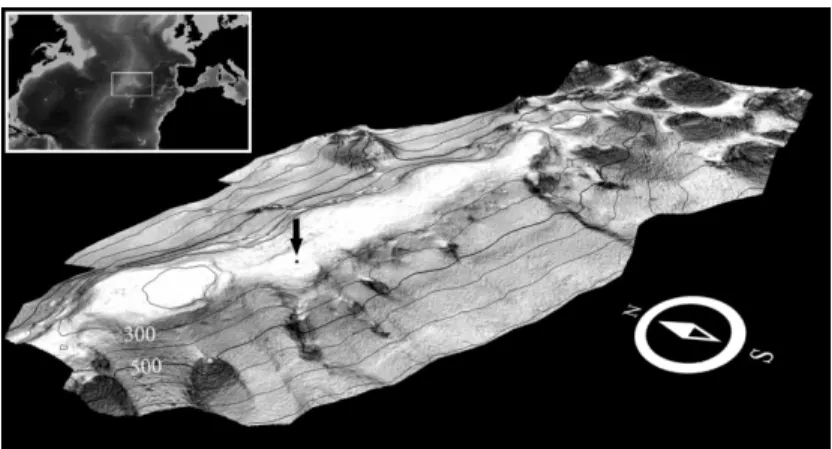
Our observations were concentrated on a stainless steel framework, deployed for 375 days (29 July 2009 to 08 August 2010) on the Condor Sea-mount summit at 230 m depth (38º31.878’N, 029º01.944’W) (Figs. 1 and 2; see Tempera et al. 2012 for details on Condor seamount). The area was in close proximity (~2 m) to a coral garden growing on mixed unconsolidated-consolidated hardground dominated by the plexaurid gor-gonian cf. Dentomuricea, together with sparse
Fig. 1. Location of the opportunistic artificial reef on Condor seamount. Viminella flagellumandhydroidscf. Polyplumaria
forming canopy up to 1 m high (Tempera et al. 2012).
The one metre high structure was pyramidal in shape, and attached to a square cement base with a leveled top holding an Acoustic Doppler Cur-rent Profiler (ADCP). The structure varied in width between 170 cm at the base and 113 cm at the top, while at mid-height it was 176 cm wide due to four extruding floaters (Fig. 2a). In view of the divergence between this structure and the most common definition of artificial reef - a merged structure deliberately placed on the sub-stratum (seabed) to mimic some characteristics of a natural reef (Jensen 1998) - this was therefore considered an “opportunistic Artificial Reef”. The structure and associated fish fauna were inspected for 38:08 minutes by the remotely-operated vehi-cle (ROV) “Luso”, recording full HD digital video. Removal of the top component occurred 17:01 minutes after the beginning of inspection, by mechanically releasing the metal framework and ADCP from the cement base.
Fish presence and relation to the opportunistic AR were analysed from video images using the video annotation software COVER ©Ifremer. A transition zone including 3 m outwards from the sand-reef interface was considered. All visible species were identified to the lowest possible taxon, counted and measured when possible. Each fish was considered a separate event, except for juvenile Anthias anthias due to size and schooling behaviour. Behaviour was annotated
conserva-tively (Stoner et al. 2008), including ‘response to ROV’ (escape/hide/no reaction) and ‘response timming’ (before detection/far from ROV/close to
ROV/no reaction). All fish that reacted ‘before
detection’ or ‘not clear’ were excluded from sub-sequent analysis. Other behaviour recorded in-cluded ‘locomotion’ (no locomotion/slow forward
movements/station holding), ‘position in the
wa-ter’ (sitting on bottom/less than one body
length/< 0.5m/0.5-1m off bottom) and ‘position to
AR’ (below/next to/sitting on/within), ‘distance to AR’ (in contact/<1 body length/<1 AR length (1.20m)). Fish size estimations and distances from the AR were calculated using known meas-ures from the AR with “ImageJ” (Abramoff et al. 2004). Twelve measurements were made per in-dividual to minimise errors and average sizes are presented.
After retrieval of the structure onboard, the invertebrate fouling fauna was measured and the largest sizes of main taxa were recorded. Samples of representative taxa were preserved in 96% ethanol and kept in the reference collection “COLETA” at the Department of Oceanography and Fisheries, from the University of the Azores. RESULTS AND DISCUSSION
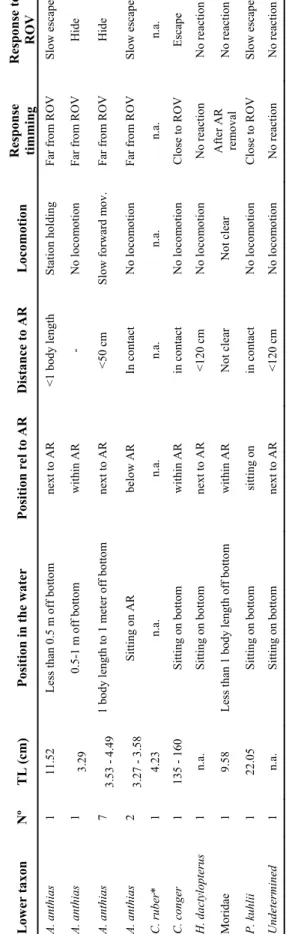
The opportunistic AR was utilised by seven ben-thic fish species (N=18), observed in contact or swimming in the vicinity of the AR. Fish size and behaviour are presented in Table 1.
Tabl e 1. Fish n um ber, siz e and behavior : posit io n in the water an d rel ation to the artif ici al reef ; *Callanthias ruber position is not indicated once it wa s not iden tifi able at dis tance . Lo w er taxon Nº TL (cm) Position in the water Po sition rel to AR Distance to AR Locomotion Re sponse timming Re sponse to ROV A . anthias 1 11. 52 L ess than 0. 5 m of f botto m next to AR <1 body length Station holding Fa r fr om R O V Slow escape A . anthias 1 3. 29 0.5-1 m off botto m within AR - No loco m otion Far fro m R O V Hide A . anthias 7 3. 53 4. 49 1 body length to 1 m eter off bottom next to AR <50 cm Slow for w ar d m ov . Far fr om R O V Hide A . anthias 2 3. 27 3. 58 Sitting on AR below AR In contact No loco m otion Far fro m R O V Slow escape C. ruber* 1 4. 23 n. a. n. a. n. a. n. a. n. a. n. a. C. conger 1 135 - 160 Sitting on bottom within AR in c ontact No loco m otion Close to ROV Escape H. dactylopterus 1 n.a. Sitting on bottom next to AR <120 c m No loco m otion No reaction No reaction M or idae 1 9. 58 L
ess than 1 body
length of f bott om within AR Not clear Not clear Af ter AR re m oval No reaction P. kuhlii 1 22.05 Sitting on bottom sitting on in contact No loco m otion Close to ROV Slow escape Undetermined 1 n.a. Sitting on bottom next to AR <120 cm No loco m otion No reaction No reaction Table 2 . List of sessile invert ebr ate f auna from the artif ic ial r eef; M axim um s ize in cm from vis ual ins pec tion , h fo r height,
w for width (in
C. long ispinus concerns the s hel l); m eas ures are from in situ dat a, and d o not corr espond to th e reposi to ry sam ples indic ated ( repositor y COLETA, from the Dep artm ent of Oceanogr ap hy and F is heri es , U nivers it y of th e Azores ) PHYLUM CLAS S ORDER FAMILY Low er taxa Nº Si ze max (cm) Average (cm) Repository Code BRYOZOA Stenolae m ata Cycl osto m atida Tubuliporidae cf. Id midronea >10 3. 85 w 1. 77 DOP-7440 BRYOZOA Stenolae m ata Cyclosto m atida T ubulipor idae T ubulipor idae ? - - - CNIDAR IA Hy drozoa Leptothecata Aglaopheniidae A glaopheni a sp. >10 2. 90 h - DOP-7441 CNIDAR IA Hydrozoa Leptothecata Laf oeidae A cryptolaria sp. >10 6. 25 h - DOP-7442 CNIDAR IA Hydrozoa Leptothecata Ca m panulariidae Obelia sp. >10 1. 85 h - - MOLLUSCA Gastropoda Trochoidea Calliosto m atidae Calliostoma sp. 1 0. 91 h/ 0. 84 w - DOP-7443 M O LL USCA Gastr opoda T rochoidea T rochidae Clelandella azoric a 1 0. 77 h / 0. 58 w - DOP-7444 ECHIN ODER M A T A Echinoidea Diade m atoida Diade m atidae Centrosteph anus l ongispi nus 1 0. 91 w - - ANNELID A Poly chaeta Sabellida Serpulid ae Filograninae undet . >10 - - -
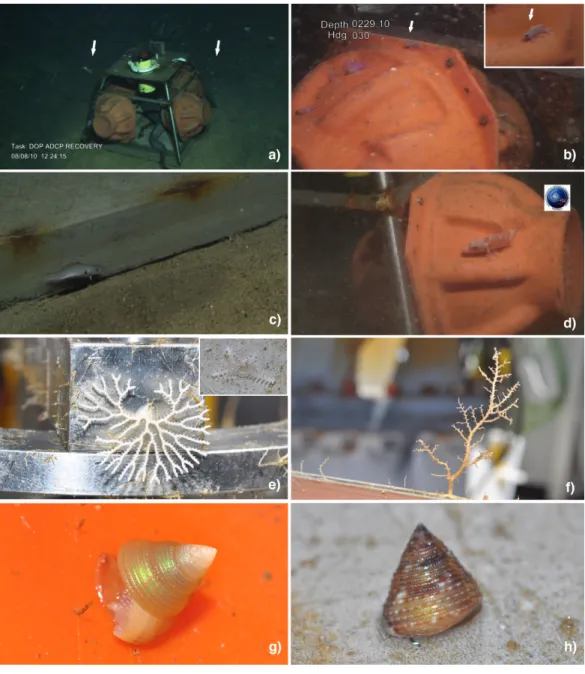
Fig. 2. Fauna associated with the artificial structure: a) general view of opportunistic AR with indication of adult A. anthias (left arrow) and school of juveniles (right arrow); b) juvenile A. anthias and C. ruber (indicated with arrows); c) undetermined Moridae circling the cement base; d) young P. kuhlii sitting on floaters; e) cf. Idmidronea (with top right insert of undet. Tubuliporidae), f) Acryptolaria sp., g) Clelandella azorica, h) Calliostoma sp. All fish maintained their behaviour in relation to
the artificial habitat throughout the 17 minutes of
observations. Exceptions were adult A. anthias
and C. conger that left the area during this period, as well as most juvenile A. anthias that swam towards the artificial structure (Fig. 2b). Besides
the first two, the specimens observed near the AR were all juveniles (Fig. 2a). The juvenile A.
anthias and one Callanthias ruber were within
similar size ranges (A. anthias averaged 3.8, STD=0.53; Table 1). These were differentiated based on the purple body and a stocky yellow head of A. anthias, in contrast to a pallid and elongated C. ruber, with a straight dorsal fin pro-file (Fig. 2b). The undetermined Moridae was also a young stage, and Pontinus kuhlii was esti-mated to be between 7-8 years old (Isidro 1996; Krug et al. 1998; Fig. 2c,d), which is also likely an immature individual (Estácio et al. 2001). The role of reefs in mediating processes of predation and competition by providing refuge for settling recruits is a concept known both from tropical natural and artificial reefs (Hixon & Beets 1989; Hixon 1991). The number of juvenile
A. anthias was smaller than the hundreds of He-manthias vivanus observed over Oculina reefs in
Florida waters, using the coral branches for pro-tection and feeding (Reed 2002). In this study the juvenile A. anthias reacted to the ROV “Luso” by hiding and placing themselves on the floater de-pressions, remaining in contact with the synthetic surface and reducing their exposure to the strong
currents generated by the ROV thrusters(Fig. 2b).
The solitary macro-carnivorous Conger conger and P. kuhlii were using the structure, while H.
dactylopterus and one undetermined species
oc-cupied the surrounding area, sitting on unconsoli-dated sediments. Species occurring near the arti-ficial structure with reactions before detection or
not clear, were the highly mobile Pagellus boga-raveo and Trachurus picturatus, together with
one benthic Helicolenus dactylopterus, and three adult A. anthias (not in Table 1).
The invertebrate biofouling fauna attached to the AR comprised organisms from five different phyla, including rapidly growing sessile bryozoa and hydrozoa, one juvenile echinoderm and juve-nile gastropods. No exact quantification was ac-complished and species with a large number of individuals are indicated (Table 2, Fig. 2e-h). This data aims solely to provide clues on the growth rates of these species. Settlement of ses-sile invertebrate occurred from August onwards,
hence maximum sizes should consider at least12
months of growth. Even though AR may develop fouling assemblages different from epibioses on
natural substrata (Carr & Hixon 1997),the
rele-vance of theseobservations derives from the lack
of taxonomic and ecological information on most of the species recruiting to CWC habitats. Sam-ples are available for future studies.
The opportunistic AR proved useful in provid-ing preliminary insights on the behaviour and habitat association of some bottom fish from CWC areas. Higher diversities of juvenile fish are often associated with increased habitat complex-ity (Gorham & Alevizon 1989; Hixon 1991). In comparison, the structure provided a more com-plex habitat than the CWC area in the vicinity, if only the living component is considered. Neither the fan shaped cf. Dentomuricea, nor the whip coral V. flagellum, can provide the number of cavities for sheltering C. conger, or juvenile A.
anthias as the opportunistic AR in this study.
Fu-ture research should include (non-opportunistic) reef design, orientated to study the importance of CWC 3D structures versus coral and rocky reefs (Carr & Hixon 1997; Auster 2005; Tissot et al. 2006), including temporal observation from vis-ual inspection and/or automatic releases. ACKNOWLEDGMENTS
IMAR-DOP/UAz is Research and Development Unit no. 531 and LARSyS-Associated Laboratory no. 9 funded by the Portuguese Foundation for Science and Technology (FCT) through plurian-nual and programmatic funding schemes (OE, FEDER, POCI2001, FSE) and by the Azores Di-rectorate for Science and Technology (DRCT). Surveys and data analysis have been supported by projects CORALFISH (FP7 ENV/2007/1/21314 4), CONDOR (EEA Grants PT0040/2008), COR-AZON (FCT/PTDC/MAR/72169/2006). Further acknowledgements are due to: the Portuguese Task Group for the Extension of Continental Shelf (EMEPC) for sharing multibeam data and providing the ROV team and equipment during the CORALFISH 2010 cruise; Marina Carreiro Silva and Andreia Braga Henriques for epifaunal collection; Sérgio Ávila and Carlos Moura for photo-identification of gastropods and hydroids, respectively. Pedro Ribeiro for epibenthos photo-graphs. Three anonymous referees have provided valuable comments on earlier versions of this
manuscript. JNGP was funded by FCT PTDC/MAR/72169/2006.
REFERENCES
Abramoff, M.D., P.J. Magalhães & S.J. Ram 2004. Image Processing with ImageJ. Biophotonics International 11(7): 36-42.
Auster, P. J. 2005. Are deep water corals important habitat for fishes? Pp. 747-760 in: Freiwald, A. & J.M. Roberts (Eds). Cold-water corals and ecosystems, Springer, New York. 1244 pp.
Baine, M. 2001. Artificial reefs: a review of their design, application, management and performance. Ocean & Coastal Management 44(3-4): 241-259. Bortone, S.A., F.P. Brandini & S. Otake (Eds). 2011.
Artificial Reefs in Fisheries Management. Taylor & Francis Group, FL, USA. 368 pp.
Carr, M.H. & M.A. Hixon 1997. Artificial reefs: the importance of comparisons with natural reefs. Fisheries 22: 28-33.
Clark, S. & A. Edwards 1994. Use of artificial reef structures to rehabilitate reef flats degraded by coral mining in the Maldives. Bulletin of Marine Science 55: 724-744.
Estacios, S., A. Mendonça, H. Krug, G.M. Menezes & M.R. Pinho 2001. Aspects of the reproduction of six exploited demersal fish species in the Azores archipelago. Arquipelago. Life and Marine Sciences. Supplement 2(B): 83-94.
Gratwicke, B. & M.R. Speight 2005. The relationship between fish species richness, abundance and habitat complexity in a range of shallow tropical marine habitats. Journal of Fish Biology 66: 650-667.
Gorham, J.C. & W.S. Alevizon 1989. Habitat complexity and the abundance of juvenile fishes residing on small-scale artificial reefs. Bulletin of Marine Sciences 44: 662–665.
Harding, J.M. & R. Mann 2001. Oyster reefs as fish habitat: opportunistic use of restored reefs by transient fishes. Journal of Shellfish Research 20: 951–959.
Hixon, M.A. 1991. Predation as a process structuring coral reef fish communities. Pp: 475–508, in: Sale, P.F. (Ed.) The Ecology of Fishes on Coral Reefs. Academic Press, Inc., San Diego.
Hixon, M.A. & J.P. Beets 1989. Shelter characteristics and Caribbean fish assemblages: Experiments with artificial reefs. Bulletin of Marine Sciences 44:666– 680.
Husebø, Å., L. Nøttestad, J.H. Fosså, D.M. Furevik & S.B. Jørgensen 2002. Distribution and abundance
of fish in deep-sea coral habitats. Hydrobiologia 471: 91-99.
Isidro, E.J. 1996. Biology and population dynamics of selected demersal fish species of the Azores Archipelago. PhD Thesis, Department of Environmental and Evolutionary Biology, University of Liverpool, England, 249 pp.
Jensen, A. 1998. European Artificial Reef Research Network (EARRN): Final Report and Recommendations. University of Southampton. Koening, C.C., A.N. Shepard, J.K. Reed, F.C.
Coleman, S.D. Brooke, J. Brusher & K. Scanlon 2004. Florida Oculina coral banks: habitat, fish populations, restoration, and enforcement. In: Proceedings of the Benthic Symposium, Tampa, Florida, 2002.
Krug, H., D. Rosa, G. Menezes & Pinho M. 1998. Age and growth of some demersal species of the Azores. International Council for the Exploration of the Seas, CM 1998/O:84. 11 pp.
Morato, T., R. Watson, T.J. Pitcher and D. Pauly. 2006. Fishing down the deep. Fish and Fisheries7:24-34. Polovina, J.J. 1991. Fisheries applications and
biological impacts of artificial habitats._Pp. 154-176
in: Seaman, W.Jr. & L.M. Sprague (Eds). Artificial habitats for marine and freshwater fisheries. Academic Press, New York.
Reed, J.K. 2002. Comparison of deep-water coral reefs and lithoherms off southeastern U.S.A. Hydrobiologia 471: 57-69.
Roberts, J.M., A.J. Wheeler & A. Freiwald 2006. Reefs of the deep: the biology and geology of cold-water coral ecosystems. Science 312(5773): 543-547. Ross, S.W. & A.M. Quattrini 2007. The fish fauna
associated with deep coral banks off the southeastern United States. Deep Sea Research Part I: Oceanographic Research Papers 54(6): 975-1007.
Stoner, A.W., C.H. Ryer, S.J. Parker, P.J. Auster & W.W. Wakefield 2008. Evaluating the role of fish behavior in surveys conducted with underwater vehicles. Canadian Journal of Fisheries and Aquatic Sciences 65: 1230-1243.
Tempera, F., E. Giacomello, N.C. Mitchell, A.S. Campos, A. Braga-Henriques, I. Bashmachnikov, A. Martins, A. Mendonça, T. Morato, A. Colaco, F.M. Porteiro, D. Catarino, J. Gonçalves, M.R. Pinho, E.J. Isidro, R.S. Santos & G. Menezes. 2012. Mapping Condor Seamount Seafloor Environment and Associated Biological Assemblages (Azores, NE Atlantic). Pp: 807-818, in: Harris, P.T. & E.K. Bakker. Seafloor Geomorphology as Benthic Habitat. Geohab Atlas of Seafloor Geomorphic Features and Benthic Habitats. 900 pp.
Tissot, B.N., M.M. Yoklavich, M.S. Love, K. York & M. Amend. 2006. Benthic invertebrates that form habitat structures on deep banks off southern California, with special reference to deep sea coral. Fisheries Bulletin U.S. 104: 167-181.
Received 1 Sep 2011. Accepted 13 Feb 2012. Published online 5 March 2012.