AUDITORY-PERCEPTUAL JUDGMENT OF VELAR
STOPS ASSOCIATED TO CLEFT PALATE BY JUDGES
WITH AND WITHOUT EXPERIENCE
Julgamento perceptivo-auditivo das oclusivas velares associadas
à fissura labiopalatina por juízes com e sem experiência
Viviane Cristina de Castro Marino(1), Tayrine Sousa Marques Borges(1),
Mayalle Rocha Bonfim Jurado(1), Mariana Rodrigues Canales(1),
Aveliny Mantovan Lima-Gregio(2), Jeniffer de Cássia Rillo Dutka(3)
(1) Departamento de Fonoaudiologia da Universidade
Esta-dual Paulista – UNESP, Campus de Marília, Marília, SP, Brasil.
(2) Universidade de Brasília – UnB, Brasília, DF, Brasil. (3) Faculdade de Odontologia de Bauru da Universidade de
São Paulo, USP; Bauru, SP, Brasil. Grant: PIBIC-CNPq and UNESP-PROEX
Conlict of interest: non-existent
that are established in the early stages of phono
-logical acquisition to functionally compensate for
altered velopharyngeal mechanism. Such produc-tions alter the articulation placements and, in most
cases, are produced in the regions of the vocal tract posterior to the velopharynx1.When present,
the CA can make the child’s or the adult’s speech unintelligible and bring in prejudices to their social
lives, studies and even to their professional lives2,3.
Speech therapy is essential for the establishment of standard production and diferent intervention
approaches have been reported in the literature in
order to facilitate typical speech production in this
population4,5. It requires from the speech-language
pathologist extensive knowledge about the CA in
INTRODUCTION
Among the speech disorders that can be found in the population with cleft lip and palate (CLP), we
can highlight the compensatory articulations (CA),
which are deviations in the production of sounds
ABSTRACT
Purpose: to verify: a) identify the level of agreement amount judges during auditory-perceptual ratings
of velar plosive sounds before and after speech therapy, b) verify if the phonetic context of the speech samples afect judges’ agreement, and c) to compare the ratings among judges with and without experience in rating CA. Methods: speech samples of children with cleft lip and palate, 30 before
and 30 after speech therapy, and 30 samples from a child without cleft lip and palate and with normal speech were rated by a group of 9 judges. Three SLPs established the gold-standard ratings used as reference for comparisons. Six other judges rated the samples for this study: three considered experienced (SLPs) and three non-experienced (students). The speech samples rated involved velar consonants /k/ and /g/ and vowels /a/, /i/ and /u/. Judges were instructed to rate presence or absence of velar consonants or presence of CA. Results: Kappa statistics revealed moderate agreement
among experienced judges and low agreement among the judges without experience for samples recorded before speech therapy. Phonetic context had an efect on the ratings before and after speech therapy. Ratings were signiicantly better among experienced judges before speech therapy (p-valor
<0,001). Conclusion: judges’ experience and phonetic context of speech samples had an efect on
ratings of CA.
Regarding the speech samples used for the identiication of CA, in general, the literature has
reported variability in sample selection among
diferent studies, including spontaneous speech, texts, sentences, words, isolated consonants and
automatic speech (used in an isolated or combined
form)6. One study, in particular, used controlled
words constituted by consonant+vowel+consonant (CVC) inserted in a vehicle sentence to examine the degree of agreement of responses obtained with and without professional experience on identifying
the CA10. The use of speech samples phonetically
controlled and standardized is recommended in the
literature in order to enable comparison of results,
especially in multicentric studies14.
Besides the aspects mentioned above, the
experience of the evaluator in perceptually identify
the CA is considered by the literature as an aspect
that can inluence the judgments of speech. One study in particular found greater agreement in the identiication of CA by professionals with experience in assessing the CLP population, when compared to that obtained by non-experienced professionals,
using the phonetic transcription to record the produc-tions10. In another study, the authors found low
agreement among experienced judges in identifying the parameter of nasality and moderate to good agreement in the identiication of other investigated
parameters (including articulatory production).
Overall, the authors attributed the results of agreement obtained in their study to the need of training with reference samples, even for the experi -enced judges, in order to improve agreement results in assessments12. More recently, a study compared
judgments of aspects from speech (including CA) of untrained judges (staf and irst year students) to judgments of trained speech-language pathologists. The judged speech samples were produced by children with cleft palate or lip/palate and contained two sets of sentences. There was a low incidence of articulatory diiculties presented in the samples and, therefore, it was not possible to ascertain the degree of inter judge agreement regarding this parameter of speech. However, it was found that judges, with and without experience, identiied the only two children with changes in articulatory production)19.
By analyzing the various aspects presented
in the literature that may inluence the perceptual speech analysis, a study of literature review has brought questions about the extent to which the experience of the judge, when considered as a single factor, ensures satisfactory degree of agreement between judges7. Another study16, when
using a procedure speciically designed for training the speech assessment of CLP population, obtained good agreement between judges in the identiication order to identify these productions and also establish
appropriate therapeutic planning 2.
The auditory perceptual evaluation is the initial
procedure used by the speech-language pathologist
for the identiication and characterization of speech disorders associated CLP6. In clinical practice, it
is through the auditory judgment that the speech-language pathologist characterizes the speech
disorders prior to treatment and make sure if the presence of typical speech after intervention.
Considering the perceptual evaluation as essential
for the characterization of speech disorders associated with FLP procedure, researchers have worried about possible aspects that can inluence the interpretation of the results of this assessment6-8.
Among these aspects we can point out intra and inter judges agreement estimated through speciic proce -dures7,9-13, the evaluator’s experience in performing
auditory-perceptual judgment on these productions
6,10,12 and the selection of the speech samples used
in the perceptual evaluation of the speech6,10,14,15.
Particularly in regards to the agreement of judges, literature emphasizes the importance of verifying this aspect in order to allow comparisons of results
in treatment in multicenter7,16 longitudinal studies13
or, also, involving diferent surgical techniques17. In
an article of critical literature review on perceptual assessment of speech in patients with CLP,
researchers6 found that approximately half of the
analyzed articles included measures of reliability (as agreement percent or kappa coeicient), and veriied lack of information on reliability of judges in 49% of
the analyzed material. In general, the literature has
reported low inter judge agreement on perceptual assessment of speech9,10,12. One study in particular
found poor agreement between professionals (with and without experience), when the phonetic transcription was used as a procedure to register the identiied CA in the productions of the speech of individuals with CLP, which led the authors to conclude the need to extend training in the phonetic transcription to identify the CA10. Other procedures
to assess articulatory productions were reported in diferent studies, including the identiication of the presence/absence of typical speech, the calculation of the percentage of correct consonants, frequency and type of changes or description of alterations6.
Although such procedures are referenced on
them, in recent years researchers have advocated
the phonetic transcription by professionals with experience in this task. Recent studies report agreements of 80-90% inter - transcriptions11,18.
However, structured trainings prior to conducting the judgments of speech are recommended in order to facilitate judges in the proposed tasks16, especially
the same speech samples and were called, in the present study, “experienced judges”. Three students
starting the Phonoaudiology course judged the
speech samples included in the study and were named “inexperienced judges”.
The study was conducted in two stages, being
submitted and approved by the Ethics Committee
in Research by the institution of origin, under the numbers 0347/2011 and 0609/2012 and was
considered riskless .
Speech samples stored in the database
Speech samples analyzed in the study are part of a database maintained by the Laboratory of Acoustic Analysis – “Laboratório de Análise Acústica” - LAAC from the institution. At this bank, speech production of the patients undergoing speech therapy is system
-atically recorded before and after the interventions. Particularly, the recordings used in this study were obtained from a ive-year-old child girl with operated cleft palate (CP). Prior to speech therapy, this child
had compromised intelligibility in the speech due to
the use of CA (glottal stop) as identiied in clinical evaluation (live) which consisted of repetition of words and spontaneous conversation. The child participated in a program of speech therapy directed to the establishment of the production of oral articu
-lation points as opposed to the use of compensatory articulation, focusing on stop consonants. The
speech therapy program involving stop consonants
was done weekly, with two 40-minute sessions each week for a period of four months. It was also used in the study, the recordings stored in the database of the LAAC obtained from a ive-year-old girl without cleft palate and with typical speech (control).
For children with CP, the repetitions were obtained in the two studied conditions, before and after speech therapy. For this study, therefore, a total of 90 samples were recorded, being 60 samples from the child with CP, considering the plosives /k/ and /g/, and the vowels /a/, /i/, /u/, the two conditions
studied (pre and post speech therapy), and also 30
samples of the child with typical speech (control), considering the plosives /k/ and /g/, and the vowels /a/, /i/, /u/. So, for the child with CP: 5 (repetitions) X 3 (vowels) X 2 (occlusive) X 2 (condition) = 60
samples, and the control child: 5 (repetitions) X
3 (vowels) X 2 (occlusive) = 30 samples. In total, therefore, 90 recordings stored in the database of the LAAC were of interest to the study.
It is noteworthy that a single evaluator conducted the recordings of the child’s speech with and without CP (pre and after speech therapy). Speech samples were recorded in the same acoustically treated room (LAAC), using high-idelity digital equipment (digital recorder MARANTZ, unidirectional microphone of non-oral consonants (productions in the pharynx
and glottis). From the results obtained, the authors
argue in favor of judgments held after structured training sessions involving the use of pre-recorded speech samples, in contrast to the trials performed counting only on prior experience of the
speech-language pathologist. In overall, the literature suggests that judgments to be made by multiple
judges with experience in assessing aspects of speech presented by the CLP population7.
Based on these, it appears that the
auditory-perceptual evaluation of speech is subject to many variables that can inluence the results, requiring special care for its implementation and interpretation. There is also a major concern from the researcher to recognize and discuss factors that may interfere with the identiication of the CA as well as prepare speech-language pathologists for the task of identi
-fying these changes. This task, which is performed by perceptual evaluation, is essential for clinicians and researchers, as it depends on the deinition of conduct on the need for treatment and monitors the therapeutic results. Information about agreement in
auditory-perceptual judgments obtained in the pre and post speech therapy, taking into account the
experience or not from the judge and the phonetic composition of speech samples can contribute to a better understanding of CA speech of children with CLP. The objectives of this study were: a) to verify the degree of agreement of judges (with and without experience) in the auditory perceptual judgment of the production of velar stops before and after speech therapy in relation to judgments of reference (“gold standard”); b) to check the possible inluence of the phonetic composition of speech samples in this agreement, and c) to verify whether the judgments made by judges with experience difer from those obtained by judges without experience, under the
conditions investigated (pre/post- speech therapy and control).
METHODS
This prospective study included the auditory-perceptual judgment of speech samples from a child with CLP, before and after speech therapy. It also involved the trial of auditory perception speech samples from a child without CLP who presents
typical speech, i.e. normal speech development
After the instructions, the judges had the oppor -tunity to listen simultaneously, in the same room, the speech samples using individual headphones.
Judges were allowed to listen to the samples as often
as they thought necessary, and also could adjust the
volume of recorded samples. After hearing (once or more) each speech sample, the judges wrote down their option (presence/absence of velar plosives or presence of CA) on the sheets of paper made for this purpose and then veriied their answers. In case of disagreeing on their judgments,
speech-language pathologists listened again to obtain
consensual ones (one unique judgment for each of the 90 samples heard). The consensus judgment was called, in this study, “gold standard” and these judgments were reported to verify agreement with the judgments of other participants (judges with or without experience).
Auditory-perceptual judgment: experienced judges
Three other speech-language pathologists within the same center of high complexity in the treatment of craniofacial anomalies, with more than 5 years of experience in evaluating the speech of the CLP population, judged the 90 speech samples, but individually, to meet the irst objective of present study (i.e., verify the agreement between their judgments and the “gold standard”). These
speech-language pathologists reported having
normal hearing, no contact with the subjects who
had recorded their statements and had not received
information about the study objective.
The three speech-language pathologists identiied the presence, absence of velar plosives /k/ and /g/, or even the presence of CA in the speech samples presented, which were the same used for establishing the “gold standard”. In addition, the instructions for the judgment of the three experienced speech-language pathologists followed those described for establishing the “gold standard”, with one diference: every experienced speech-language pathologist heard with individual
headphones the recorded material (90 samples)
in a room reserved for this purpose. Thus, 90 trials were made separately and written down in a sheet similar to that used to establish the “gold standard”
registration.
Auditory-perceptual judgment: judges without experience
Three students enrolled in the second year of the undergraduate course of Phonoaudiology were included in the study and considered “inexperienced” in speech evaluation of CLP population because they had not started the speciic disciplines at the Shure). The microphone was positioned 20 cm from
the mouth of the children. The digitized recordings were stored in a computer.
Sample preparation for analysis by judges
For the study, existing recordings were edited and stored for auditory-perceptual judgments
through PRAAT software. This material comprised
a total of 90 samples randomly edited. The edited material was archived on CD-ROM and sent to the judges who established judgments considered “gold standard”. Then, the same material was sent to each of the judges (with or without experience). Along with the edited material from the two children in the study, it was included on the same CD recorded reference audio samples to the judges. These reference samples were representative of each type of production (typical speech, with the omission of segment or presence of CA) and belonged to other subjects who were not included in this study.
Establishment of the “gold standard”
Three speech-language pathologists have established the reference (“gold standard”) of the 90 speech samples. These professionals belong to a prestigious complexity in the treatment of cranio
-facial anomalies and have worked at this place for over 5 years and have extensive experience in assessing the speech of the CLP population.
Speech-language pathologists reported having
normal hearing, no contact with the subjects who
had recorded their statements and had not received
information about the objective of the study.
It was explained to the speech-language pathol
-ogists that their judgment would serve to identify the presence, absence of occlusive velar /k/ and /g/, or even the presence of CA. Prior to the judgments, instructions and reference samples (recorded audio) representative of each type of production were ofered. When presenting the samples of references, it was nominated which was the kind of production
that should be judged by directing judges that
they should use this information as a parameter to perform their judgments. The judges were instructed to judge only the presence, the absence of velar plosives or the presence of CA in the initial position of the word, inserted into the sentence, regardless of hearing other compensation and/or hypernasality in the presented sentence. For example, upon
hearing the sentence “Fala capa bem bonita” (Say case pretty well), the judge should decide between
interpretations). This conservative approach was also used, along with the percentage of agreement
in previous studies that aimed to obtain inter -
judge reliability in judgments of speech disorders presented by the CLP population12,20. As reported in
the literature12 critics comment that in the Kappa the
expected agreement is a source of concern because
the evaluators are not statistically independent and
the agreement expected by chance is based on the assumption of independent evaluators.
In the present study, the Kappa values were
interpreted according to literature21 in which: 0.00
does not indicate agreement; 0.00 to 0.20 indicates
poor agreement; from 0.21 to 0.40 indicates fair agreement; from 0.41 to 0.60 indicates moderate
agreement; 0.61 to 0.80 indicates substantial
agreement, and 0.81 to 1.00 indicates perfect agreement (or almost perfect). Conidence intervals were constructed with 95% statistical conidence and adopted a signiicance level of 5% (p <0.05). The Kappa coeicient analysis was presented unifying the judgments from the three judges with experience and, similarly, unifying the trials of the three judges without experience, resulting in a single value of Kappa for experienced and inexperienced
judges.
The test of equality of two proportions (nonpara
-metric) was used to compare the proportion of responses from two speciic variables (judges with and without experience) and/or their levels were statistically signiicant.
RESULTS
The results refer to the agreement in auditory-perceptual judgments of experienced judges and “gold standard” (“experienced/gold”) and judges without experience and “gold standard” (“no experience/gold”), at three distinct conditions: pre,
post speech therapy and control.
Tables 1 and 2 show the percentage of “experi
-enced/gold” inter-judge agreement obtained in the
pre-speech therapy condition. More speciically,
Table 1 shows the percentage of agreement for the
45 judgments relating to the consonant /k/ and 45
judgments concerning the consonant /g/. Table 2 on the other hand shows the percentage of agreement for the 30 judgment concerning each of the studied vowels (/a/, /u/, /i/).
Phonoaudiology course, nor had been exposed to clinical activities. These students reported having normal hearing, no contact with the subjects who
had recorded their statements and had not received
information about the study objective.
The three students judged individually the 90 speech samples in order to meet the irst objective of the present study (i.e., verify the agreement between their judgments and the “gold standard”). These three students identiied the presence, absence of velar plosives /k/ and /g/, or even the presence of CA in the speech samples presented, which were the same used for establishing the “gold standard”. In addition, the instructions for the judgment of three students with no experience followed those described for establishing the “gold standard”, with one diference: each student heard the recorded material (90 samples) , with individual
headphones, connected to computers separated
in rooms reserved for this purpose. Every student inished their judgments at the same time and 90 judgments were made separately written down in a sheet similar to that used for the other participants
in this study.
Data Analysis
The obtained responses were presented as percentages of agreement for each studied condition
(pre-speech therapy, post speech therapy, control),
taking into account the judgments obtained for each of the velar consonants (/k/ = 45 judgments and /g/ = 45 judgments) and judgments obtained for each of the vowels (/a/ = 30 judgments, /i/ = 30 judgments and /u/ = 30 judgments). More speciically, the judgments were analyzed by consonants (/k/ or /g/) or vowels (/a/, /i/ and /u/), in order to allow further statistical analysis (Kappa agreement) of data.
The Kappa agreement index was also used to measure the degree of agreement between auditory-perceptual judgments of interest (“gold standard” x judges with experience and “gold standard” x inexperienced judges) among the
studied conditions (pre speech therapy, post speech therapy, control) and the samples used (velar stop
presenting the Kappa agreement index (usually with a consonant and with a vowel).
Table 7 summarizes the percentage of inter-judge “no experience/gold” agreement obtained for judgments (usually with a consonant and with a vowel) in the post-speech therapy condition,
besides presenting the Kappa agreement index (usually with a consonant and with a vowel). It is noteworthy that in two, from 90 productions, there was disagreement, and these occurred for “gula”
speech sample.
The percentage of inter-judge “no experience/ gold” agreement obtained for all judgments (generally with a consonant and with a vowel) in
the control condition was 100% with perfect Kappa agreement.
Table 8 shows the (absolute and relative) distri
-bution of correct answers by the judges (with and without experience), taking into account the three
conditions under investigation (control, pre and post
speech therapy), and indicate the p values found for the groups of judges and the three investigated
conditions.
Table 3 summarizes the percentage of inter-judge “experienced/gold” agreement obtained for judgments (usually with a consonant and with a vowel) in the pre- speech therapy condition, besides presenting the Kappa agreement index (usually with a consonant and with a vowel).
The percentage of inter-judge “experienced/gold” agreement obtained for all judgments (generally with a consonant and with a vowel) in the post-speech therapy condition and in the control condition was
100% with perfect Kappa agreement.
Tables 4 and 5 show the percentage of inter-judge “no experience/gold” agreement obtained in
the pre-speech therapy condition. More speciically,
Table 4 shows the percentage of agreement for the
45 judgments regarding the consonant /k/ to 45
judgments regarding the consonant /g/. Table 5 on the other hand shows the percentage of agreement for the 30 judgments for each of the studied vowels
(/a/, /u/, /i/).
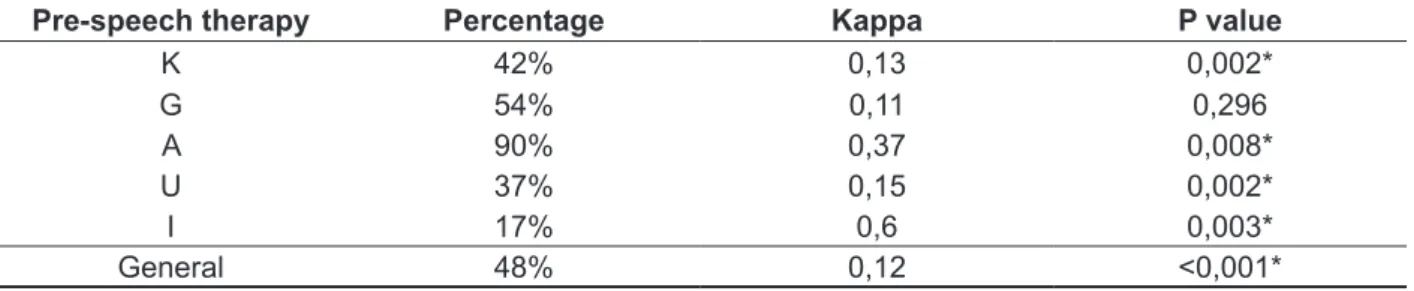
Table 6 summarizes the percentage of inter-judge “no experience/gold” agreement obtained for judgments (usually with a consonant and with a vowel) in the pre- speech therapy condition, besides
Table 1 – Percentage of inter judges agreement (with experience/gold) among the judgments made (omission-O, compensatory articulation-CA or typical speech (T) for velar (/k/ and /g/), in the pre-speech therapy. Occurrences of O, CA and T in regards to each word involving /k/ or /g/ are presented in parentheses
Velar Occlusive Agreement Total
O CA T N (%)
k (capa/cuca/quibe) 11 (11/0/0) 25 (0/14/11) 0 (0/0/0) 36 (80%) 45
g (gato/gula/guizo) 14 (11/3/0) 23 (0/8/15) 0 (0/0/0) 37 (82%) 45
Total 73 (81%) 90
Table 2 – Percentage of inter judges agreement (with experience/gold) among the judgments made (omission-O, compensatory articulation-CA or typical speech (T) with vowel (/a/, /u/ /i/), in the pre-speech therapy condition. Results O, CA and T on every word involving /k/ or /g/ are presented in parentheses
Vowels Agreement Total
O CA T - % N - % Total
a (capa/gato) 22 (11/11) 0 0 (0/0/0/) 22 (74%) 30
u (cuca/gula) 3 (0/3) 22 (14/8) 0 (0/0/0) 25 (84%) 30
i (quibe/guizo) 0 26 (11/15) 0 (0/0/0) 26 (87%) 30
Table 3 – Percentage of agreement and Kappa agreement index to inter-judges (with experience/gold) to the judgments made by consonant (/k/ and /g/) and vowel (/a/, /u/, /i/) in the pre-speech therapy condition
Pre- speech therapy Percentage Kappa p value
K 80% 0,56 <0,001*
G 82% 0,64 <0,001*
A 74% 0,15 0,112
U 84% 0,44 0,014*
I 87% 0,30 0,02*
General 81% 0,60 <0,001*
* Kappa Coeicient p<0.05
Table 4 – Percentage of inter-judges (no experience/gold) in judgments performed (omission-O, compensatory articulation-CA or typical (T) for velar (/k/ and /g/), on pre-speech therapy condition. Occurrences O, CA and T related to each word involving /k/ or /g/ are presented in parentheses
Velar Occlusive Agreement Total
O AC T N - %
k (capa/cuca/quibe) (14/0/0) (0/5/0) 0 (0/0/0) 19 (42%) 45
g (gato/gula/guizo) (13/6/0) (0/0/5) 0 (0/0/0) 24 (54%) 45
Total 43 (48%) 90
Table 5 – Percentage of inter-judges (no experience/gold) in performed judgments (omission-O, compensatory articulation-CA or typical (T) with vowel (/a/, /u/ /i/), in the pre-speech therapy condition. Occurrences O, CA and T related to each word involving /k/ or /g/ are presented in parentheses
Vowels Agreement Total
O CA T N - %
a (capa/gato) (14/13) (0/0) 0 (0/0/0) 27 (90%) 30
u (cuca/gula) (0/6) (5/0) 0 (0/0/00 11 (37%) 30
i (quibe/guizo) (0/0) (0/5) 0 (0/0/0) 5 (17%) 30
Total 43 (48%) 90
Table 6 – Percentage of agreement and Kappa agreement index to inter-judges (no experience/gold) for the judgments made by consonant (/k/ and /g/) and vowel (/a/, /u/, /i/) in the pre-speech therapy condition
Pre-speech therapy Percentage Kappa P value
K 42% 0,13 0,002*
G 54% 0,11 0,296
A 90% 0,37 0,008*
U 37% 0,15 0,002*
I 17% 0,6 0,003*
General 48% 0,12 <0,001*
Table 7 – Percentage of agreement and Kappa agreement index to inter-judges (no experience/gold) to the judgments made by consonant (/k/ and /g/) and vowel (/a/, /u/, /i/) in the post-speech therapy condition
Post-Speech Therapy Percentage Kappa P value
K 100% 1,00 <0,001*
G 95,5% 0,65 <0,001*
A 100% 1,00 <0,001*
U 94% 0,64 <0,001*
I 100% 1,00 <0,001*
General 98% 0,66 <0,001*
* Kappa Coeicient p<0.05
Table 8 - Distribution of correct answers by judges (with and without experience) for the investigated conditions (control, pre and post speech therapy)
Correct Answers N % P value
Control No experience 90 100% 1,000
Experience 90 100%
Pre No experience 43 48% 0,001*
Experience 73 81%
Post No experience 88 98% 0,155
Experience 90 100%
Equality Test of two Proportions (p<0,05)
DISCUSSION
The perceptual assessment is essential for the assessment of speech characteristics of subjects with CLP6 and the importance of this type
of assessment was previously emphasized7,22.
Professionals (and future professionals) involved in perceptual speech assessment of the CLP population need to be prepared to identify, among
other changes, atypical productions (CA) in order to
determine the appropriate treatment plan. Thus, it is of interest to investigate the variables that can afect the judgments of these professionals, as the degree of agreement of judges in relation to judgments of reference (“gold standard”), as well as the inluence of the phonetic composition of speech samples in
this assessment.
In this study, in regards to the agreement
between the judgments of experienced judges and “gold standard” for pre-speech therapy condition,
there was a percentage of agreement in 81% of the total judgments performed with moderate Kappa agreement, statistically signiicant. Further analysis of the data revealed that when the judges disagreed
in their judgments such disagreement occurred only
for the type of change (CA or omission) identiied in judged productions. The diferences in the two types
of analyzes (percentage of agreement, 81 % and Kappa agreement index, 0.60), can be explained by the fact that Kappa corrects the obtained agreement by chance (separating the made observations from the expected ones by chance). Previous studies have reported diferences between these two types of analyzes, with lower Kappa values compared to the percentage of agreement12,20, probably due to
Kappa be a conservative approach that assumes that any agreement that could be obtained by chance
was indeed random12. According to literature, the
option to use both the percentage of agreement as the Kappa index is justiied when seeking a more complete description of the data12.
When considering the results obtained through
the two analyzes performed jointly, it was found
that although the participants (“gold standard “ and
experienced judges) have experience in evaluating the speech of the CLP population, the requested
task (judging typical speech, omission or presence
of CA) may have inluenced the judgments. The literature describes the use of graduated scales
as the most common method used to evaluate the
speech of individuals with CLP6.
However, a tendency in the literature to present results of speeches from the use of phonetic
low intraoral pressure) may, in perceptual terms,
have generated questions to the listeners, resulting
in judgments of both omission of segments (N=3) as CA (N=8), which increased the inal percentage of agreement of the consonant [g].
When considering the vowels, the percentage of agreement was 74% for vowel /a/, 84% for /u/ and 87% for /i/, with little Kappa agreement (0.15 not signiicant) for /a/, regular (0.30 signiicant) for / i / and moderate (0.44, signiicant) for /u/, being the diferences between the two forms of analysis
(percentage agreement and Kappa When
consid-ering the vowels, the percentage of agreement was 74% for vowel /a/, 84% for /u/ and 87% for /i/, with little Kappa agreement (0.15 not signiicant) for /a/, regular (0.30 signiicant) for / i / and moderate (0.44, signiicant) for / u /, being the diferences between the two forms of analysis (percentage agreement and Kappa agreement index) probably due to the Kappa ixing the agreement obtained by chance (separating the observations made from those expected due to chance). Further analysis of the data revealed that, regardless of the consonant, the correlation (smaller and not signiicant) for the vowel /a/ always occurred in relation to the judgment of default, suggesting that this vowel in perceptual terms, favors the identiication of the absence of occlusive ensure, as shown in Table 2.
As for vowel /u/, the observed correlation was greater in regards to the presence of CA (Table 2). It is noteworthy that out of the 30 judgments involving the vowel /u/ 15 succeeded the consonant /k/. In these, there was agreement regarding the presence of CA in 14 judgments, suggesting that, in perceptual terms, the vowel /u/ may have favored the identiication of the presence of CA, in addiction to the fact that the word “cuca” has a high pressure consonant /k/, which may have inluenced the identiication of CA. Yet, in regards to /g/, in 15 judgments, 8 showed agreement for the presence of CA and 3 for omission of the segment, suggesting that the vowel /u/ with /g/ generated questions for the listener as to the classiication of altered speech. It is noteworthy that the word “gula” consists of the consonantal segment /l/, which requires low intraoral pressure, which may have being a disadvantage for the identiication of CA. Regarding the vowel /i/, it was observed that she favored the agreement for the presence of CA both before /k/ as to /g/. It is noteworthy that out of the 30 judgments involving the vowel /i/, 15 involved the consonant /k/ (with
11 concordant judgments, indicating the presence
of CA) and 15 involved the consonant /g/ (15, i.e., 100 % of the concordant judgments, indicating the presence of CA) (Table 2). These data indicate that the use of phonetic transcription is desirable7 it is
rarely used in clinical practice involving speeches
from the CLP population and often in scientiic
research6. Overall, at the clinic, the atypical
consonant productions are described using models proposed in the literature23. A study, in particular,
to verify the agreement between professionals with and without experience in the identiication of CA, obtained poor agreement even for trained judges, when using the phonetic transcription to record found productions, leading the authors to conclude on the need for speciic training in phonetic transcription for evaluators who work with individuals who have CA10. In the present study,
moderate agreement obtained between experienced professionals and “gold standard” (judgments of multiple judges with consensus) can be explained, at least in part, by the fact that the judges had to identify not only the presence or absence of CA, but also the omission of the velar segment. If the task was only to identify the presence or absence of CA, the agreement could have been higher (or even perfect). Higher agreement was found in a study in which the task was to judge the presence or absence of hypernasality when compared to the agreement obtained for the proposed categoriza
-tions for the judgment of resonance changes20. This
information suggests that the requested task can inluence the results obtained in the classiication of speech disorders associated with CLP, including CA. The auditory-perceptual speech assessment therefore is subject to many variables that can inluence the results, requiring special care for its implementation and interpretation. The inluence of methodological issues involved in the
auditory-perceptual assessment has been emphasized by several authors6,7. The need to standardize the task
to be performed by speech-language pathologists in clinical and research contexts has also been
reported14, since the selection of samples may afect
the obtained results6, disadvantaging comparisons
of results in multicenter studies.
In this study, we also aimed to analyze the
data separately taking into account either just the
consonants or the vowels. When considering just the consonants, there was a agreement percentage of 80% for the consonant /k/ and 82% for /g/, with Kappa agreement (0.56) for moderate /k/ and substantial (0.64) to /g/, both statistically signiicant. Jointly, these results suggest that the consonant /g/ showed a tendency to a higher agreement (for omission of segment) among judgments (Table 1). The “gula” speech sample seemed to contribute to the diferentiation of agreement between the velar consonants. The fact that this speech sample is
judgments of judges with and without experience in identifying CA in relation to the “gold standard “. Results indicated greater agreement in the identii
-cation of CA by professionals with experience in the assessment of subjects with CLP when compared to that obtained by professionals without experience, when the phonetic transcription was used. Another study found poor agreement, even among experi
-enced judges in identifying atypical productions, attributing this inding to the lack of suicient training of the evaluators12. Overall, the data from these
studies highlight the need for speciic training for the identiication of compensatory productions, which should be started since graduate school. It is known that the period during the undergraduate course of
Phonoaudiology represents an important
oppor-tunity for professional training to prepare future professionals for specialized clinical assessment. The use of materials that favor such experience is recommended for these future professionals.
When analyzing the data separately and taking
into account only the consonants, there was agreement percentage of 42% for the consonant /k/ and 54% for /g/, with little Kappa agreement, but statistically signiicant for /k/. A more detailed analysis of the data suggested that while there was agreement among judges without experience and “gold standard”, this occurred more times as for the omission of the segment, for both consonants (Table 4). When considering the vowels, the percentage of agreement was 90% for /a/ , 37% for /u/ and 17% for /i/, with regular Kappa agreement (0.37, signiicant) for /a/ and small for /u/ (0.15, signiicant) and /i/ (0.6, signiicant) .
These data suggest that while the vowel /a/ favored the agreement for omission of the segment, the vowels /i/ and /u/ favored the agreement (albeit low) for the presence of CA. Jointly the results suggest that even with low agreement between judges (no experience and “gold standard”), it seems to have been inluenced by the phonetic context of the speech samples. Thus, for clinical and research
purposes, it is suggested to take into account the
inluence of phonetic context on the results obtained. Furthermore, it is suggested the use of speech
assessment based on global standards protocols as recommended internationally in 200814. Whether
used in classes or supervised training graduation, these samples may contribute to the development
of the skills to identify CA for future professionals, empowering them including the judgment of other
speech samples, such as those in vehicle sentences or spontaneous speech. In general, recent studies using phonetic transcriptions indicated agreement
of 80 and 90% among judgments11,18, contradicting
previous studies that found lower agreement7,9,10,12.
the vowel /i/ favors the identiication of the presence of CA, especially before /g/.
Jointly, the results for judgments from experienced judges in regards to “gold standard”, in pre-speech
therapy condition, suggest that there is variability
which could be due to the phonetic composition of the samples, besides the requested task. This was
not observed in the post-speech therapy and control conditions, as in both conditions, there was 100 %
agreement (Kappa = perfect agreement) among the
judgments, suggesting that on typical speech (post-speech therapy or control), neither requested task
nor the phonetic-context samples raise questions for listeners. The literature indicates the diiculty of evaluators to identify phonemic categories that do not exist in the native language of the speaker9,
as occurs, for example, in the presence of glottal occlusive CA (also known as a “glottal stop”) for the Brazilian Portuguese. Taking into account the inluence of the phonetic composition of judgments from the multiple judges, in the last years scholars14
have recommended the use of speech samples consisted by isolated words or particularly phoneti
-cally elaborated sentences, but with recurrence of the target sound. The recurrence of the same sound in the speech samples may facilitate the comparison of results in multicenter studies14 and,
therefore, should be considered in clinical practice and research. The development of standardized protocols for Brazilian Portuguese that meet inter -national recommendations14 can contribute a lot in
studies that seek to verify the agreement among judges, especially if the judgments are carried out
by multiple judges.
In this study, it was also of interest to verify the
agreement among the judgments of judges without
experienced and “gold standard” (“no experience/ gold”). For pre-speech therapy condition, there was
a low percentage of agreement (48%) in judgments conducted with small but statistically signiicant Kappa correlation. Further analysis of the data revealed that while there was agreement, this occurred for samples in which the “gold standard” also judged as a omission and, when there were disagreements, these were among the types of changes identiied as the judges without experience tended to assess productions as “omission” while the “gold standard” judged the same productions as “CA”. Only two out of the total (N=90) of samples were
considered as typical speech by graduate students,
when compared to the “gold standard”, suggesting
that undergraduate students in Phonoaudiology
perceive the presence of altered speech, although they are still unable to distinguish between omission of the velar stops (/k/, /g/) and presence of CA. A
typical speech, but also to diferentiate between CA and omission of segments. The use of phonetic
transcription, even though it is recommended,
could also have hampered the task of judges with no experience in judging the presented speech samples. In this study, the judgments made were made using words inserted in vehicle sentences
approaching the speech samples used in the previous study10. The agreement obtained could
be higher if the speech samples were constituted by sentences with recurrence of sounds which were presented to the judges, with or without experience. A study, now underway, is intended to determine the efect of using diferent speech samples in regards to the judgments of evaluators experience regarding the “gold standard” (multiple judges)
CONCLUSION
The data obtained in this study suggested that the requested task, the phonetic composition of speech samples and the experience of the judges inluenced perceptual judgments, particularly for
pre-speech therapy condition. Overall, the study data indicate the need to select the speech samples that can better respond to questions in relation
to atypical productions associated with CLP. For example, when investigating acoustic facts, the use of words inserted in vehicle sentences is
recommended to control possible variables that
could impact on measures of interest. Yet, when
investigating speech through auditory-perceptual
assessment, the use of standardized protocols involving speech samples with recurrence of sounds can encourage speech analysis by diferent judges. These data suggest that the agreement among
evaluators can be high with proper 16.
For post-speech therapy condition, there was
agreement percentage of 98% (88/90), with Kappa agreement index of 65.2% for /g/ and 64.4% for /u/, both statistically signiicant. Further analysis of the data showed that the vowel /u/ has raised questions for the judges with no experience for this condition, and judges without experience judged two samples of speech “gula” as altered speech (one as omission and another as CA), which suggests that for judges without experience, the production of speech after
speech therapy may not yet be enough to be
rescued aurally as typical in all productions. This was not observed in the control condition, as there
was 100% agreement (Kappa=perfect agreement)
among the judgements, suggesting that
under-graduates at initial series are able to identify the speech samples consisting of velar consonants in subjects with typical speech (no change history), regardless of the phonetic context in which they ind
themselves .
Finally, the present study aimed to determine
whether there are diferences in judgments made by judges with and without experience in the
three conditions (pre-speech therapy, post-speech
therapy and control). The results showed that there is a statistical diference between groups, with a higher percentage of correct answers for experienced judges (81%), which is statistically diferent from the 48% observed for undergraduates (p - value <0.001). This analysis conirms that, in this study, both judges with experience (speech-language pathologists) and inexperienced judges (undergraduate students) had diiculties in identi
REFERENCES
1. Hanayama EM. Distúrbios da comunicação nos pacientes com sequela de issura labiopalatina. Rev Bras Cir Craniomaxilofac. 2009;12(3):118-24. 2. Marino VCC, Dutka, JCR, Pegoraro-Krook MI, Lima-Gregio, AM. Articulação compensatória associada à issura de palato ou disfunção velofaríngea: revisão de literatura. Rev CEFAC.
2012;14(3):528-43.
3. Palandi BBN, Guedes ZCF. Aspectos da fala de indivíduos com issura palatina e labial, corrigida em diferentes idades. Rev CEFAC. 2011;13(1):8-16. 4. Pamplona MC, Ysunza A, Chavelas K, Arámburu E, Patiño C, Martí F et al. A study of strategies for treating compensatory articulation in patients with cleft palate. J Maxillofac Oral Surg.
2012;11(2):144-51.
5. Bessell A, Sell D, Whiting P, Roulstone S,
Albery L, Persson M et al. Speech and language therapy interventions for children with cleft palate: a systematic review. Cleft Palate Craniofac J.
2013;50(1):e1-e17.
6. Lohmander A, Olsson, M. Methodology for perceptual assessment of speech in patients with cleft palate: A critical review of the literature. Cleft Palate Craniofac J. 2004;41(1):64-70.
7. Sell D. Issues in perceptual speech analysis in
cleft palate and related disorders: a review. Int J Lang Com Dis. 2005;40(2):103-21.
8. Lohmander A, Willadsen E, Persson C, Henningsson G, Bowden M, Hutters B. Methodology for speech assessment in the Scandcleft project -
an international randomized clinical trial on palatal
surgery: experiences from a pilot study. Cleft Palate Craniofacial J. 2009;46(4):347-62.
9. Santelman L, Sussman J, Chapman K. Perception of middorsum palatal stops from the speech of three children with repaired cleft palate. The Cleft Palate Craniofac J. 1999;36:233-42.
10. Gooch J, Hardin-Jones M, Chapman K, Trost-Cardamone J, Sussman J. Reliability of listener judgments of compensatory articulations. Cleft Palate Craniofac J. 2001;38:59-67.
11. Chapman KL, Hrdin-Jones MA, Goldstein JA, Halter KA, Havlik RJ, Schulte J. Timing of Palatal Surgery and Speech Outcome. The Cleft Palate Craniofac J. 2008;45(3):297-308.
12. Brunnegard K, Lohmander A. A cross-sectional study in 10-year-old children with cleft palate: results and issues of rater reliability. The Cleft Palate Craniofac J. 2007;44:33-44.
13. Lohmander A, Friede H, Lilja J. Long-Term, longitudinal follow-up of individuals with unilateral cleft lip and palate after the Gothernburg primary
early veloplasty and delayed hard palate closure
protocol: speech outcome. Cleft Palate Craniofac J.
2012;49(6):657-71.
14. Hennigsson G, Kuehn DP, Sell D, Sweeney T, Trost-Cardamone JE, Whitehill TL. Universal parameters for reporting speech outcomes in
RESUMO
Objetivo: veriicar: a) o grau de concordância de juízes no julgamento perceptivo-auditivo da pro
-dução de oclusivas velares, antes e depois da fonoterapia; b) a possível inluência da composição fonética das amostras de fala nesta concordância e c) se os julgamentos obtidos por juízes com expe
-riência diferem daqueles obtidos por juízes sem expe-riência, nas condições investigadas. Métodos:
60 amostras de fala de uma criança com issura labiopalatina (30 previamente e 30 posteriormente a fonoterapia) e 30 amostras de fala de uma criança com fala típica (normal) foram julgadas por um grupo de 9 juízes. Três fonoaudiólogos estabeleceram os julgamentos consensuais “padrão ouro” para o estudo. Seis outros juízes julgaram as amostras: três considerados com experiência (fono
-audiólogos) e três sem experiência (alunos de graduação). As amostras de fala incluíram palavras constituídas pelas oclusivas velares /k/ e /g/ combinada com as vogais /a/, /i/ e /u/. Os juízes foram instruídos a julgar a presença, a ausência das oclusivas velares ou a presença de AC nestas amos -tras. Resultados: veriicou-se diferenças no grau de concordância de juízes com experiência (Kappa
moderada) e sem experiência (Kappa baixo) para os julgamentos realizados na condição pré-fono
-terapia. O contexto fonético das amostras de fala inluenciaram os julgamentos nas condições pré e pós-fonoterapia. Houve maior percentual de acerto para os juízes experientes condição pré-fonote -rapia (p-valor <0,001). Conclusão: a experiência dos juízes e composição fonética das amostras de
fala inluenciam os julgamentos perceptivo-auditivos das AC.
and language pathologists’ ratings. Int J Lang
Commun Disord. 2009;44(5):656-74.
20. Prathanee B, Lorwatanapongsa P, Makarabhirom K, Suphawatjariyakul R, Manochiopining S, Thinnaithorn R. Reliability of perceptual assessment for resonance disorders in patients with cleft palate. J Med Assoc Thai. 2012;95 Suppl 11:S73-9.
21. Landis JR, Koch GG. The measurement of observer agreement for categorical data. Biometrics.
1977;33(1):159-74.
22. Baylis AL, Munson B, Moller KT. Perceptions of audible nasal emission in speakers with cleft palate: a comparative study of listener judgments. Cleft Palate Craniofac J. 2011;48(4):399-411.
23. Bzoch KR. A battery of clinical perceptual tests, techniques, and observations for the reliable clinical assessment, evaluation, and management of 11 categoriasl aspects of cleft palate speech disorders.
In: Bzoch KR (ed). Communicative disorders related
to cleft lip and palate. 5th ed. Austin: Pro-Ed; 2004.
p. 375-462.
individuals with cleft palate. Cleft Palate Craniofac J. 2008;45(1):1-17.
15. Klinto K, Salameh EK, Svensson H, Lohmander A. The impact of speech material on speech judgment in children with and without cleft palate. Int J Lang Commun Disord. 2011;46(3):348-60. 16. Sell D, John A, Harding-Bell A, Sweeney T, Hegarty F., Freeman J. Cleft audit protocol for
speech (CAPS-A): a comprehensive training
package for speech analysis. Int J Lang Comm Dis.
2009;44:529-48.
17. Nyberg J, Westberg LR, Neovius E, Larson O., Henningsson G. Speech results after one-stage palatoplasty with or without muscle reconstruction for isolated cleft palate. Cleft Palate Craniofacial J.
2010;47(1):92-103.
18. Lohmander A, Persson,C. A longitudinal study of speech production in Swedish children with unilateral cleft lip and palate and two-stage palatal repair. Cleft Palate Craniofacial J. 2008;45(1):32-41. 19. Brunnegård K, Lohmander A, van Doorn J. Untrained listeners’ ratings of speech disorders in a group with cleft palate: a comparison with speech
http://dx.doi.org/10.1590/1982-021620151761814 Received on: January 22, 2014
Accepted on: April 25, 2014
Mailing address:
Viviane Cristina de Castro Marino Rua Santa Helena, 1967 casa 07 Marília – SP - Brasil
CEP: 17514-410